T HE T
EEN Y

THE TEEN YEARS

EARS

explained

A GUIDE TO

The Teen Years Explained:

The teen years are a time of opportunity, not turmoil.
The Teen Years Explained: A Guide to Healthy Adolescent Development describes
the normal physical, cognitive, emotional and social, sexual, identity formation,
and spiritual changes that happen during adolescence and how adults can promote
healthy development. Understanding these changes—developmentally, what is
happening and why—can help both adults and teens enjoy the second decade of
life. The Guide is an essential resource for all people who work with young people.
© 2009 Center for Adolescent Health at
Johns Hopkins Bloomberg School of Public Health
All rights reserved. No part of this book may be used or reproduced in any manner whatsoever without written
permission except in the case of brief quotations embodied in critical articles and reviews.
Printed in the United States of America. Printed and distributed by the
Center for Adolescent Health at the Johns Hopkins Bloomberg School of Public Health.
For additional information about the Guide and to order additional copies, please contact:
Center for Adolescent Health
Johns Hopkins Bloomberg School of Public Health
615 N. Wolfe St., E-4543
Baltimore, MD 21205
www.jhsph.edu/adolescenthealth
410-614-3953
ISBN 978-0-615-30246-1

Designed by Denise Dalton of Zota Creative Group

A GUIDE TO HEALTHY ADOLESCENT DEVELOPMENT Clea McNeely & Jayne Blanchard

By Clea McNeely, MA, DrPH and Jayne Blanchard

ADOLESCENT

EXPLAINED :

A Guide to Healthy Adolescent Development

HEALTHY

DEVELOPMENT

Clea McNeely, MA, DrPH and Jayne Blanchard
THE TEEN YEARS
explained

A GUIDE TO
HEALTHY
ADOLESCENT
DEVELOPMENT

Clea McNeely, MA, DrPH and Jayne Blanchard
The teen years
explained

A Guide to
Healthy Adolescent
Development
By

Clea McNeely, MA, DrPH
Jayne Blanchard
With a foreword by

Nicole Yohalem
Karen Pittman
iv

the teen years explained
contents
About the Center for Adolescent Health.......................................... vi
Acknowledgments ........................................................................ vii
Foreword by Nicole Yohalem and Karen Pittman............................. ix
Introduction..................................................................................... 1
Chapters

1 Physical Development............................................................... 7
Brain Page.......................................................................... 16
Obesity: Nutrition & Exercise............................................... 17

2 Cognitive Development............................................................ 21
Sleep................................................................................... 28
Effects of Tobacco, Alcohol & Drugs on the Developing
Adolescent Brain................................................................. 29

3 Emotional & Social Development............................................. 31
Teen Stress......................................................................... 38
Bullying.............................................................................. 40

4 Forming an Identity................................................................. 45
Mental Health..................................................................... 54

5
6
7
8

Sexuality................................................................................. 59
.
Spirituality & Religion............................................................. 71
Profiles of Development........................................................... 79
Conclusion.............................................................................. 87

Resources & Further Reading........................................................ 89
References ................................................................................... 93
Index .......................................................................................... 103
ab o u t t h e c e n t e r

f o r

adolescent
health

T

he Center for Adolescent Health

is a prevention research center at the Johns
Hopkins Bloomberg School of Public Health
and funded by the Centers for Disease Control
and Prevention. We are committed to assisting
urban youth to become healthy and productive
adults. Together with community partners, the
Center conducts research to identify the needs
and strengths of young people, and evaluates and
assists programs to promote the health and wellbeing of young people. Our mission is to work
in partnership with youth, people who work
with youth, community residents, public policy–
makers, and program administrators to help urban
adolescents develop healthy adult lifestyles.

vi

the teen years explained
Acknowledgments
The authors of The Teen Years Explained: A Guide to Healthy Adolescent Development would like to express our sincere
gratitude to the following people for all of their guidance and support during the creation of this book:
Freya Sonenstein, PhD                     Nicole Yohalem                    Karen Pittman
The Guide was made possible by funding from the Centers for Disease Control and Prevention (CDC) to the Center for
Adolescent Health at the Johns Hopkins Bloomberg School of Public Health, a member of the Prevention Research Centers
Program (CDC cooperative agreement 1-U48-DP-000040). We would also like to thank the Charles Crane Family Foundation and the Shapiro Family Foundation for their support for the Guide.

Members of the Scientific Advisory Board
The Scientific Advisory Board provided insight and information in their professional review of the chapters.
We thank them for their invaluable contribution.
	 Catherine Bradshaw, PhD
	 Assistant Professor, Department
of Mental Health, Associate
Director, Johns Hopkins Center for
the Prevention of Youth Violence,
Johns Hopkins Bloomberg School
of Public Health
	 Robert Crosnoe, PhD
	 Associate Professor, Department of
Sociology & Population Research
Center, University of Texas at Austin
	 Jacinda Dariotis, PhD
	 Assistant Scientist, Center for
Adolescent Health, Department of
Population, Family & Reproductive
Health, Johns Hopkins Bloomberg
School of Public Health
	 Nikeea C. Linder, PhD, MPH
Assistant Professor, Division of General Pediatrics & Adolescent Medicine, Department of Pediatrics &
Department of Population, Family &
Reproductive Health, Johns Hopkins
School of Medicine & Bloomberg
School of Public Health

	 Arik V. Marcell, MD, MPH
	 Assistant Professor, Division of General Pediatrics & Adolescent Medicine, Department of Pediatrics &
Department of Population, Family &
Reproductive Health, Johns Hopkins
School of Medicine & Bloomberg
School of Public Health
	 Sara Johnson, MPH, PhD
	 Assistant Professor, Department of
Population, Family & Reproductive
Health, Johns Hopkins Bloomberg
School of Public Health

	 Freya L. Sonenstein, PhD
	 Director, Center for Adolescent
Health, Professor, Department of
Population, Family & Reproductive
Health, Johns Hopkins Bloomberg
School of Public Health
	 Janis Whitlock, MPH, PhD
	 Director, Cornell Research Program
on Self-Injurious Behavior, Research
Scientist, Family Life Development
Center, Lecturer, Human Development Department, Cornell University

	 Lisa Pearce, PhD
	 Associate Professor, Department of
Sociology, Fellow, Carolina Population Center, University of North
Carolina at Chapel Hill
	 Stephen T. Russell, PhD
	 Professor & Director, Frances McClelland Institute for Children,
Youth & Families, Norton School
of Family & Consumer Sciences,
University of Arizona
	

acknowledgments

vii
Members of the Adolescent Colloquium
The Adolescent Colloquium was formed as a partnership with the Center for Adolescent Health in 2005 to provide
important contributions to the shaping of this project. We thank them for their dedication and participation.
	 Rebkha Atnafou, MPH
	 Executive Director, The AfterSchool Institute
	 Robert Blum, MD, MPH, PhD
Director, Urban Health Institute,
William H. Gates, Sr. Professor &
Chair, Department of Population,
Family & Reproductive Health,
Johns Hopkins Bloomberg School of
Public Health
	 Jean-Michel Brevelle
	 Sexual Minorities Program Manager,
Maryland AIDS Administration
	 Peter R. Cohen, MD
	 Medical Director, Alcohol & Drug
Abuse Administration, Maryland
Department of Health &
Mental Hygiene
	 Barbara Conrad, BSN, MPH
	 Chief, Division of Sexually Transmitted Diseases/HIV Partner Notification, Maryland Department of
Health & Mental Hygiene
	 Cheryl De Pinto, MD, MPH
Medical Director, Child, Adolescent, & School Health, Center for
Maternal & Child Health, Maryland
Department of Health &
Mental Hygiene

	 Christine Evans
	 Community Health Educator, Center for Maternal & Child Health,
Maryland Department of Health &
Mental Hygiene

	 Ilene Sparber, LCSW-C
	 Interagency Coalition on Teen Pregnancy & Parenting, Montgomery
County Department of Health &
Human Services

	 Marina Finnegan, MHC
	 Director of Prevention Strategies,
Governor’s Office for Children,
Maryland

	 Mischa Toland
	 Interagency Coalition on Teen Pregnancy & Parenting, Montgomery
County Department of Health &
Human Services

	 Patricia I. Jones, BS
	 Abstinence Education Coordinator, Center for Maternal & Child
Health, Maryland Department of
Health & Mental Hygiene
	 Mary Anne Kane-Breschi
	 Office for Genetics & Children with
Special Health Care Needs Resource
Development, Maryland Department of Health & Mental Hygiene
	 Rebekah Lin
	 Communications & Technical
Assistance Specialist, The AfterSchool Institute

	 Carmi Washington-Flood
	 Chief, Office of Community
Relations & Initiatives, Maryland
Department of Health &
Mental Hygiene
	 Pearl Whitehurst
	 Program Coordinator, Office of
Community Relations & Initiatives,
Maryland Department of Health &
Mental Hygiene

	 Pam Putman, BSN, MPH
	 Healthy Teens & Young Adults Family Planning & Reproductive Health,
Maryland Department of Health &
Mental Hygiene

Additional Thanks
Denise Dalton, David Jernigan, PhD, Meg Tucker, Seante Hatcher, Beth Marshall, Rosemary Hutzler, Ann Stiller
We would like to thank the youth who contributed their voices, which can be found throughout the Guide.
Special thanks to Layne Humphrey and Christine Verdun Schoennberger for their dedication and hard work on the
early version of the Guide.
Disclaimer: While many people have provided guidance in the development of this book, The Teen Years Explained: 	
A Guide to Healthy Adolescent Development represents the thoughts of its authors, who are responsible for its content.
It does not reflect the views of the Adolescent Colloquium, the Scientific Advisory Board, the State of Maryland government agencies, Johns Hopkins University, nor any of its funders.

viii

the teen years explained
foreword
by Nicole Yohalem and Karen Pittman, Forum for Youth Investment
Not since the 2002 publication of Community Programs to Promote Youth Development have we recommended adding any
lengthy publications to the “must-read” list for youth workers, teachers, parents, or anyone interested in ensuring young
people’s positive development. But make room on the bookshelf, because the time has come with the release of The Teen
Years Explained: A Guide to Healthy Adolescent Development.
By compiling in plain English the science behind adolescence, the authors have produced a comprehensive yet accessible resource that 1) explains, without oversimplifying, the complex processes of development; 2) challenges and empowers adults
to invest more attention, more time, and more resources in adolescents as they transition to adulthood; and 3) gives youthdevelopment professionals the knowledge they need to ensure that healthy adolescent development is an explicit goal of
their work.
Everything from basic social development theory to cutting-edge neuroscience is packed into this guide, making it a useful
reminder of some key principles underlying the youth development movement and a resource for adults who find themselves
helping teens navigate a world that likely feels different from the one they grew up in.
At the Forum for Youth Investment, we are committed to supporting leaders who are working on youth issues. One thing
we try to do is meet people where they are, but quickly help them see a bolder path. Simple catchphrases often help us do
that, and three in particular are reinforced by this guide.
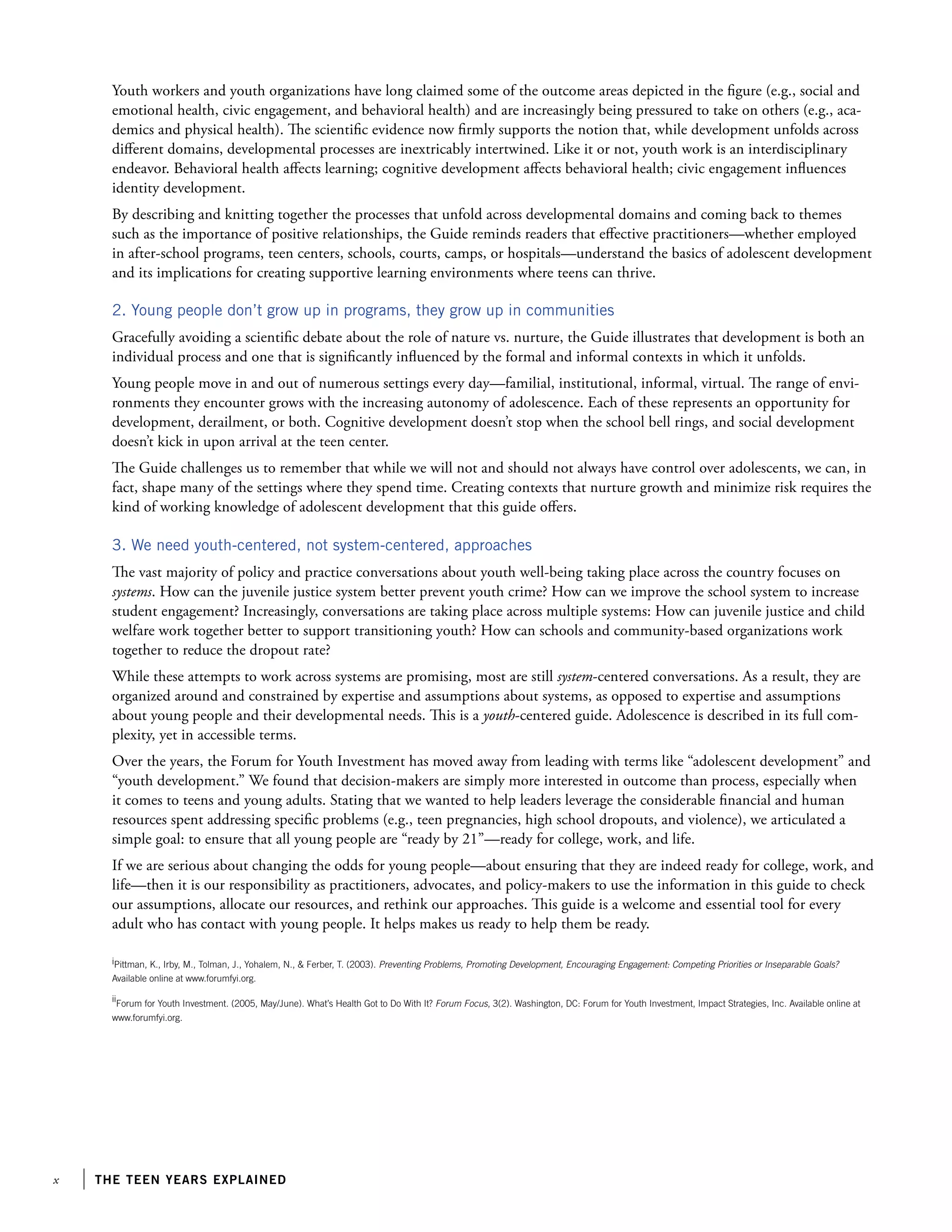
1. Problem-free isn’t fully
prepared

al

Sexual activity
& substance
abuse

Core supports
& opportunities

He

a

ional H lth
ea

Delinquency
& violence

vior

Isolation,
depression
& suicide

me

&E

Dropouts &
illiteracy

Beha

mot

nt

nt

Unemployment

ia l

uc

Ed

n

inme

lth

io
at

tta
al A

age

S

oc

Without going into detail on effective practice, the Guide reinforces the
idea that successful efforts to prevent
specific problems and promote positive
development depend on supportive
relationships, accurate information,
and skill-building opportunities.ii

Core supports & opportunities
of youth problem prevention

Civic Eng

In the 1990s, this phrase helped
capture both the need for, and
approaches to, risk reduction.
Ensuring teenagers enter adulthood
addiction-free, without dropping out
of school, and with no arrest record is
a short-sighted goal that reflects low
expectations. Embracing adolescence
as a time of opportunity is difficult,
given the real risks associated with
this period and the unacceptable
numbers of young people who are, in
fact, dangerously disconnected. Yet
reframing development as a positive,
normative process is critical if parents,
professionals, and institutions are to
support, socialize, challenge,
and instruct.i

Voc

ation

al Readiness & Suc

cess

SOURCE: Forum for Youth Investment

foreword

ix
Youth workers and youth organizations have long claimed some of the outcome areas depicted in the figure (e.g., social and
emotional health, civic engagement, and behavioral health) and are increasingly being pressured to take on others (e.g., academics and physical health). The scientific evidence now firmly supports the notion that, while development unfolds across
different domains, developmental processes are inextricably intertwined. Like it or not, youth work is an interdisciplinary
endeavor. Behavioral health affects learning; cognitive development affects behavioral health; civic engagement influences
identity development.
By describing and knitting together the processes that unfold across developmental domains and coming back to themes
such as the importance of positive relationships, the Guide reminds readers that effective practitioners—whether employed
in after-school programs, teen centers, schools, courts, camps, or hospitals—understand the basics of adolescent development
and its implications for creating supportive learning environments where teens can thrive.
2. Young people don’t grow up in programs, they grow up in communities
Gracefully avoiding a scientific debate about the role of nature vs. nurture, the Guide illustrates that development is both an
individual process and one that is significantly influenced by the formal and informal contexts in which it unfolds.
Young people move in and out of numerous settings every day—familial, institutional, informal, virtual. The range of environments they encounter grows with the increasing autonomy of adolescence. Each of these represents an opportunity for
development, derailment, or both. Cognitive development doesn’t stop when the school bell rings, and social development
doesn’t kick in upon arrival at the teen center.
The Guide challenges us to remember that while we will not and should not always have control over adolescents, we can, in
fact, shape many of the settings where they spend time. Creating contexts that nurture growth and minimize risk requires the
kind of working knowledge of adolescent development that this guide offers.
3. We need youth-centered, not system-centered, approaches
The vast majority of policy and practice conversations about youth well-being taking place across the country focuses on
systems. How can the juvenile justice system better prevent youth crime? How can we improve the school system to increase
student engagement? Increasingly, conversations are taking place across multiple systems: How can juvenile justice and child
welfare work together better to support transitioning youth? How can schools and community-based organizations work
together to reduce the dropout rate?
While these attempts to work across systems are promising, most are still system-centered conversations. As a result, they are
organized around and constrained by expertise and assumptions about systems, as opposed to expertise and assumptions
about young people and their developmental needs. This is a youth-centered guide. Adolescence is described in its full complexity, yet in accessible terms.
Over the years, the Forum for Youth Investment has moved away from leading with terms like “adolescent development” and
“youth development.” We found that decision-makers are simply more interested in outcome than process, especially when
it comes to teens and young adults. Stating that we wanted to help leaders leverage the considerable financial and human
resources spent addressing specific problems (e.g., teen pregnancies, high school dropouts, and violence), we articulated a
simple goal: to ensure that all young people are “ready by 21”—ready for college, work, and life.
If we are serious about changing the odds for young people—about ensuring that they are indeed ready for college, work, and
life—then it is our responsibility as practitioners, advocates, and policy-makers to use the information in this guide to check
our assumptions, allocate our resources, and rethink our approaches. This guide is a welcome and essential tool for every
adult who has contact with young people. It helps makes us ready to help them be ready.
iPittman, K., Irby, M., Tolman, J., Yohalem, N., & Ferber, T. (2003). Preventing Problems, Promoting Development, Encouraging Engagement: Competing Priorities or Inseparable Goals?
Available online at www.forumfyi.org.
iiForum for Youth Investment. (2005, May/June). What’s Health Got to Do With It? Forum Focus, 3(2). Washington, DC: Forum for Youth Investment, Impact Strategies, Inc. Available online at
www.forumfyi.org.


the teen years explained
foreword

xi
xii

the teen years explained
introduction

Why it’s important to understand how adolescents develop

T

he purpose of this guide is to
serve as an essential resource
for people who work with
young people and for youth-serving
organizations.
At no other time except infancy
do human beings pack so much development into such a short period.
During adolescence, children gain 50
percent of their adult body weight, become capable of reproducing, and experience an astounding transformation
in their brains. All these changes occur
in the context of—and indeed, allow
for—rapidly expanding social spheres.
Teens start assuming adult responsibili-

ties such as finding a job, figuring out
romantic relationships, and learning
how to be a good friend.
Understanding these changes—
developmentally, what is happening
and why—can help both adults and
teens enjoy the second decade of life.
Knowledge of adolescent development empowers people who work with
young people to advance teens’ development. And it allows us all to sustain
appreciation and compassion for the
joys and aggravations of adolescence:
the ebullience, the insecurities, the
risk-taking, and the stunning growth
in competence.
Introduction
Healthy adolescent
development
Most books on adolescence highlight
the problems teens face and how
adults can help resolve them. Missing
from the plethora of resources
focused on surviving adolescence
is a description of what happens to
the vast majority of young people:
normal, healthy development. This
guide is an attempt to fill that void.
It describes the changes that happen
during adolescence and how adults can
promote healthy development.
This guide is based on several key
ideas, all of which are supported by
research evidence: 1) adolescence is a
time of opportunity, not turmoil;
2) normal, healthy development is
uneven; 3) young people develop positive attributes through learning and
experience; and 4) the larger community plays a fundamental and essential
role in helping young people move
successfully into adulthood.

fronts do not always happen in
sync. Physically and sexually, young
people, especially girls, may mature
by their mid-teens. Yet the process of
transforming the relatively inefficient
brain of the child into a leaner, more
proficient adult brain may not be
completed until age 25.
Adding even more complexity, this
out-of-sync pattern of development
may seem to be constantly changing.
In early adolescence a young person
may be behind physically and ahead
emotionally. That pattern can reverse
later on as growth spurts occur in different areas of development.
This unevenness of development
calls for active support by caring

adults. Although they may look like
adults—and, at times, want to be
treated as adults—teens are still in a
formative stage. This guide provides
multiple strategies for supporting
young people’s development.
Young people develop positive
attributes through learning and
experience
Throughout this guide, the term
positive youth development is used.
Positive youth development is the
understanding, based on research,
that healthy development is best
promoted by creating opportunities
to develop a set of core assets, dubbed
the 5 C’s: competence, confidence,

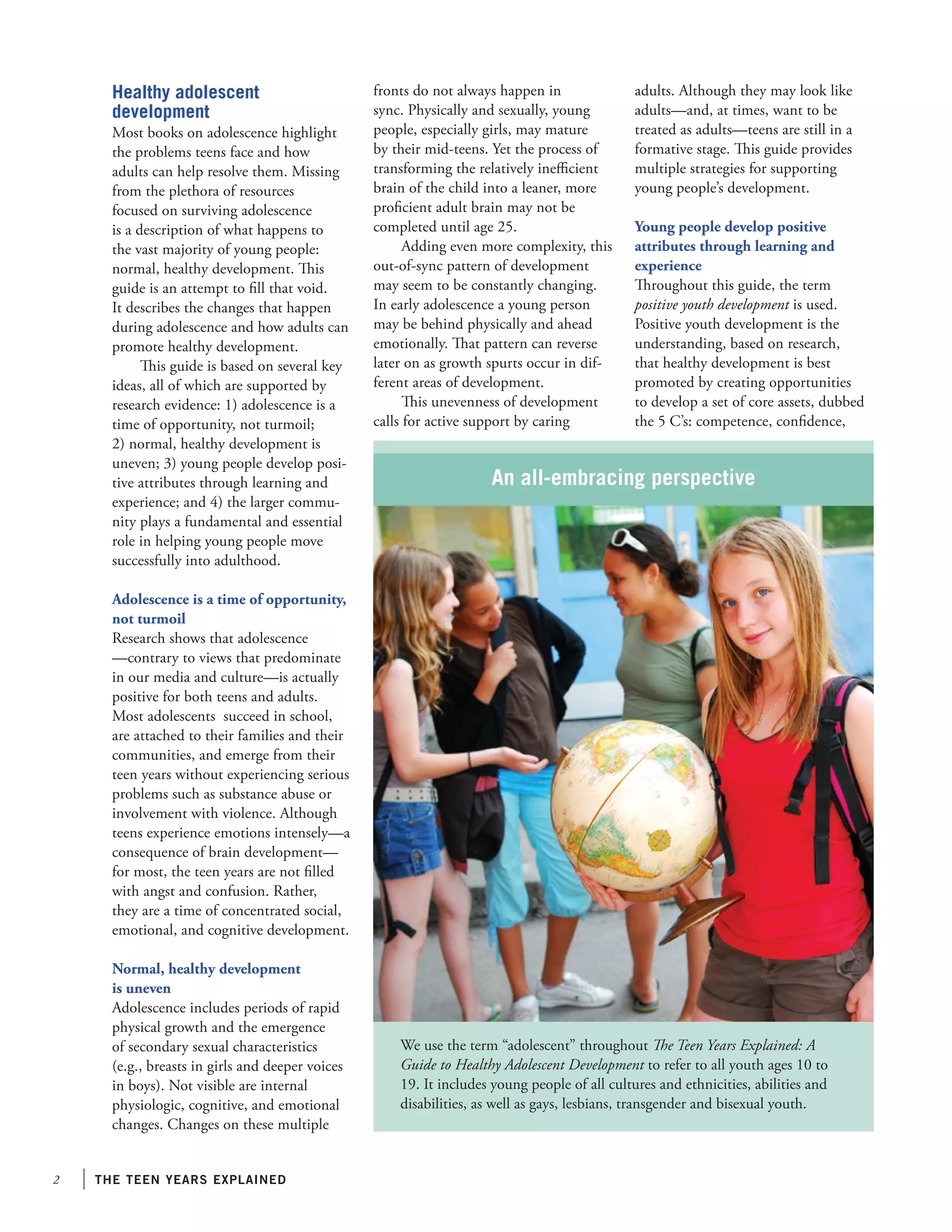
An all-embracing perspective

Adolescence is a time of opportunity,
not turmoil
Research shows that adolescence
—contrary to views that predominate
in our media and culture—is actually
positive for both teens and adults.
Most adolescents succeed in school,
are attached to their families and their
communities, and emerge from their
teen years without experiencing serious
problems such as substance abuse or
involvement with violence. Although
teens experience emotions intensely—a
consequence of brain development—
for most, the teen years are not filled
with angst and confusion. Rather,
they are a time of concentrated social,
emotional, and cognitive development.
Normal, healthy development
is uneven
Adolescence includes periods of rapid
physical growth and the emergence
of secondary sexual characteristics
(e.g., breasts in girls and deeper voices
in boys). Not visible are internal
physiologic, cognitive, and emotional
changes. Changes on these multiple


the teen years explained

We use the term “adolescent” throughout The Teen Years Explained: A
Guide to Healthy Adolescent Development to refer to all youth ages 10 to
19. It includes young people of all cultures and ethnicities, abilities and
disabilities, as well as gays, lesbians, transgender and bisexual youth.
The 5 C’s of positive youth development
Asset

Definition

How to Foster It

Competence

Perception that one has abilities and skills

Provide training and practice in specific skills,
either academic or hands-on

Confidence

Internal sense of self efficacy and positive
self-worth

Provide opportunities for young people to
experience success when trying something new

Connection

Positive bonds with people and institutions

Build relationships between youth and peers,
teachers and parents

Character

A sense of right and wrong (morality), integrity,
and respect for standards of correct behavior

Provide opportunities to practice increasing
self-control and development of spirituality

Caring

A sense of sympathy and empathy for others

Care for young people

connection, character and caring (see
above). Adolescents develop these
core assets when they experience
them in their own lives. A young
person learns that he or she is good at
something (competence) when given
the opportunity to try and practice
new things. Likewise, a young person
learns to be caring by being cared for,
and develops character by practicing
self-control.
The positive youth development
framework expands the traditional
focus on reducing risks. Programs informed by the traditional framework—
which remains important—tend to
focus on avoiding bad things: drugs,
unprotected sex, driving while drunk,
or failing school. Although many riskreduction strategies have been shown
to be successful, research in the field
of positive youth development has
demonstrated that “problem-free is not
fully prepared.” Healthy adolescent
development requires creating opportunities for adolescents to experience,
learn, and practice the 5 C’s. Examples

of effective strategies to promote
healthy development are provided
throughout this guide.
Community has a role:
putting adolescence in context
Before the mid-1980s, adolescent
research focused largely on
development and behavior alone,
looking at physical growth and how
teens act. Little attention was paid to
the settings in which children live.
More recently, research has started
to examine the contexts where
adolescents develop. Context refers
to the surroundings in which a child is
growing up. The places where young
people spend time—at home, with
friends, in school, at work, in front
of television, movies, or other media,
or in the neighborhood—influence
their development.
Research is starting to show a
complex interaction between a young
person and his or her context. People’s
surroundings and experiences can
influence their emotional, cognitive,

and even physical development. At the
same time, adolescents are not simply
passive recipients of experience, all
responding to developmental “inputs”
in the same way. They interpret and respond to each new experience through
the lenses of their innate personalities
and prior experiences.
What does this mean for people
who work with young people? It is
essential to understand the strengths
and needs of adolescents when
designing programs or health-promotion strategies.
It is also important to consider the
context or setting in which an adolescent lives, and to address the risks and
assets of that environment.

How to use this guide
We designed this guide to be useful
to the reader who has five minutes
or five hours. Each chapter describes
a different aspect of development—
physical, cognitive, emotional and
social, identity, sexual, and spiritual.
The chapters do not need to be read in
Introduction
Glossary of terms

The Teen Years Explained: A Guide to Healthy Adolescent Development uses a few key terms through-

out the chapters. Below are the definitions.

Adolescence Usually defined as the second decade of
life, adolescence is the period of transition from childhood to adulthood. Researchers now note that bodily
and brain changes associated with adolescence may
begin as early as age 8 and extend until age 24.
Health risk behaviors These are behaviors that
make one more likely to experience a negative health
result. For example, unprotected sexual intercourse is a
health risk behavior that makes one more susceptible to
sexually transmitted infections and unplanned pregnancy. Health risk behaviors are commonly referred to
as risky health behaviors.
Positive youth development Positive youth
development is a framework for developing strategies
and programs to promote healthy development. It
emphasizes fostering positive developmental outcomes
by providing young people the experiences and opportunities to develop core developmental assets. The list
of core developmental assets typically includes what are
known as the 5 C’s: competence, connection, character,
confidence, and caring.
Protective factors These are characteristics or
behaviors that increase the likelihood of experiencing a
positive result (e.g., the presence of a caring adult is a
protective factor for school success). Protective factors

sequence, as adolescent development
does not happen in sequence.
The last chapter puts the various
dimensions of development together
in a single package and returns to the
theme of development happening at
different rates.


the teen years explained

directly promote healthy development and also reduce
the negative impact of risk factors. Protective factors
exist wherever one finds young people—in school, at
home, and in the community—and include things such
as a long-term relationship with a caring adult, opportunities to build skills and become good at something,
and belonging to a group of friends who value academic
achievement. Protective factors can also be internal to a
person, such as having a sunny temperament.
Puberty The World Health Organization defines
puberty as “the period in life when a child experiences
physical, hormonal, sexual, and social changes and
becomes capable of reproduction.” It is associated with
rapid growth and the appearance of secondary sexual
characteristics. Puberty typically starts for girls between
ages 8 and 13, and for boys between ages 9 and 14, and
may continue until age 19 or older.
Risk factors These are characteristics or behaviors
that increase the likelihood of experiencing a negative
result. For example, smoking is a risk factor for developing heart disease, and harsh parenting a risk factor for
depression. Like protective factors, risk factors can be
innate (e.g., having a genetic vulnerability to a disease),
environmental (e.g., being exposed to lead or living in
a dangerous neighborhood), or learned behaviors (e.g.,
not wearing seatbelts).

Within each chapter are tips for
how to promote healthy adolescent
development. These, too, can be read
by themselves. Finally, throughout the
guide we have two- and three-page descriptions of issues that young people
and people who work with young

people have told us are of concern to
them. These include, among others,
obesity and nutrition, stress, bullying,
and the effects of drugs and alcohol on
the teen brain.
Introduction
the teen years explained
Physical Development

Chapter 1

Puberty—timing differs from teen to teen

“I have a good
body image. If
you don’t have a
good body image,
then you will
push and push
yourself until you
think you are
perfect.” Girl, 12

P

hysical changes are perhaps
the most noticeable signs that
a child is becoming an adolescent. The physical transformations of
puberty affect every aspect of the lives
of teens. Changing bodies may lead to
changes in circles of peers, adults’ view
of teens, and teens’ view of themselves.
Great variability can be found in
the time of onset of puberty, defined
broadly as the biological and physical
changes that occur during adolescence
and result in the capacity to reproduce.
For girls, puberty can start as early
as eight years old. Girls experience a
rapid growth spurt, typically starting
around age 10. This growth spurt lasts

for a few years, and then girls continue
to grow more slowly until they are 17
or 18. During puberty, breast buds
develop, pubic hair appears, height
increases, menstruation begins, and
hips widen.
Boys usually begin their growth
spurt one to two years after most girls.
They continue to develop for three to
four years after the girls, which means
boys may not finish growing physically
until they are 21. For boys, pubic hair
appears, the penis gets longer, height
increases, the voice deepens, and
muscle mass develops.
Puberty is triggered by the actions
of hormones on various parts of the

chapter 1 PHYSICAl development
body. New hormones might be at work
for several months before development
becomes outwardly evident. For adolescent boys, in fact, the visible changes
come late in the development process.
From the teen’s perspective,
puberty puts a bright spotlight on
body image. Body image is the picture
of personal physical appearance that
people hold in their minds. It is the
concept of one’s own changing body—
how it feels, how it moves through
space, how it looks in the mirror, and
how one thinks it looks to others.
Body image can be shaped by emotions, perceptions, physical sensations,
experience, and moods. It can also be
powerfully influenced by cultural messages and societal standards.

Why do I look so different from
my friends?
Some teenagers start maturing early,
while others are late bloomers. As a
result, young people may look out-ofsync developmentally with their peers.
Adolescents may experience a lot of
uncertainty when they do not look
similar to other young people their age.
For example, one girl may be six
months younger than her BFF (Best
Friend Forever), yet start menstruating
and wearing a bra first. Some boys may
look in the mirror and moan that they
are freaks because their nose and ears
have suddenly grown too big for their

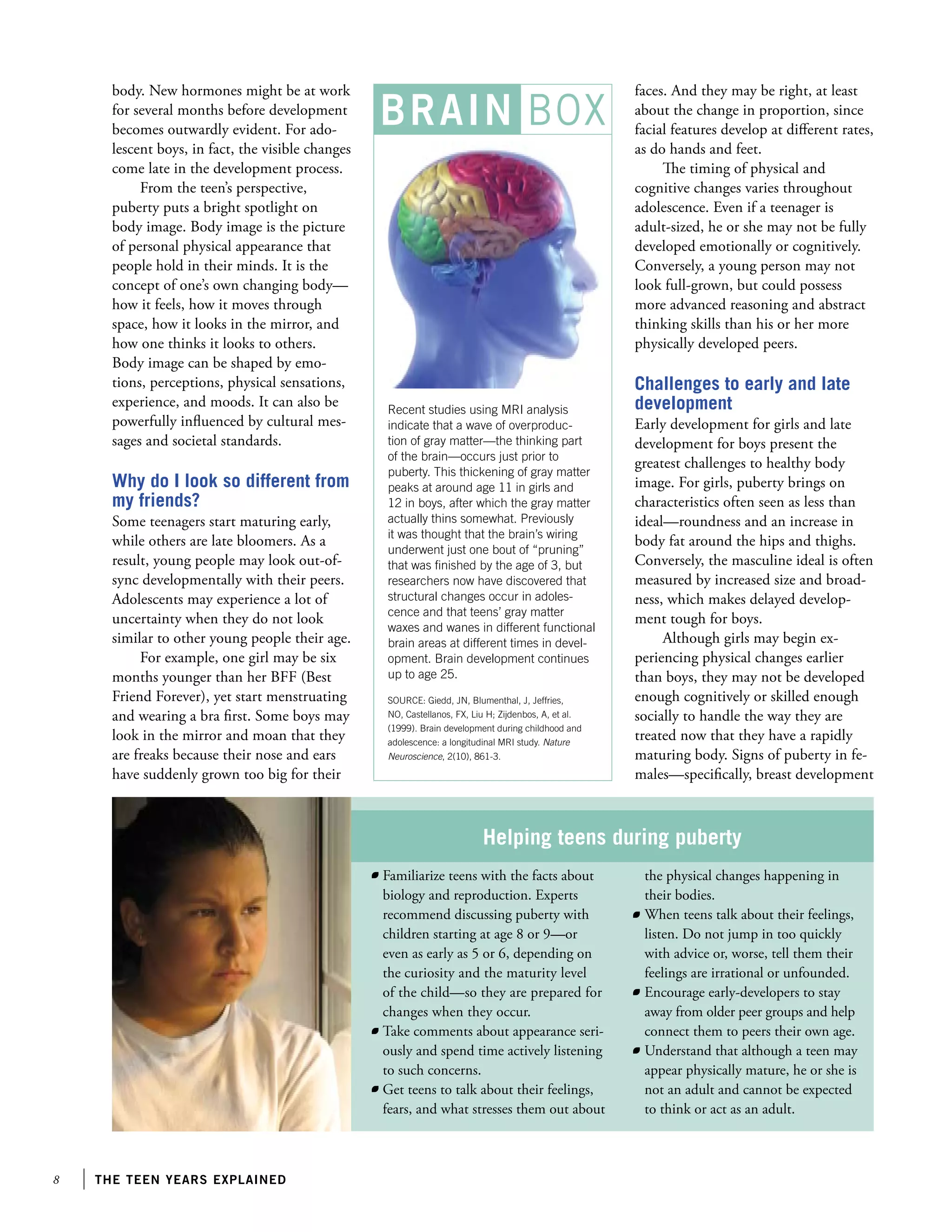
BRAIN BOX

Recent studies using MRI analysis
indicate that a wave of overproduction of gray matter—the thinking part
of the brain—occurs just prior to
puberty. This thickening of gray matter
peaks at around age 11 in girls and
12 in boys, after which the gray matter
actually thins somewhat. Previously
it was thought that the brain’s wiring
underwent just one bout of “pruning”
that was finished by the age of 3, but
researchers now have discovered that
structural changes occur in adolescence and that teens’ gray matter
waxes and wanes in different functional
brain areas at different times in development. Brain development continues
up to age 25.
SOURCE: Giedd, JN, Blumenthal, J, Jeffries,
NO, Castellanos, FX, Liu H; Zijdenbos, A, et al.
(1999). Brain development during childhood and
adolescence: a longitudinal MRI study. Nature
Neuroscience, 2(10), 861-3.

faces. And they may be right, at least
about the change in proportion, since
facial features develop at different rates,
as do hands and feet.
The timing of physical and
cognitive changes varies throughout
adolescence. Even if a teenager is
adult-sized, he or she may not be fully
developed emotionally or cognitively.
Conversely, a young person may not
look full-grown, but could possess
more advanced reasoning and abstract
thinking skills than his or her more
physically developed peers.

Challenges to early and late
development
Early development for girls and late
development for boys present the
greatest challenges to healthy body
image. For girls, puberty brings on
characteristics often seen as less than
ideal—roundness and an increase in
body fat around the hips and thighs.
Conversely, the masculine ideal is often
measured by increased size and broadness, which makes delayed development tough for boys.
Although girls may begin experiencing physical changes earlier
than boys, they may not be developed
enough cognitively or skilled enough
socially to handle the way they are
treated now that they have a rapidly
maturing body. Signs of puberty in females—specifically, breast development

Helping teens during puberty
	 Familiarize teens with the facts about
biology and reproduction. Experts
recommend discussing puberty with
children starting at age 8 or 9—or
even as early as 5 or 6, depending on
the curiosity and the maturity level
of the child—so they are prepared for
changes when they occur.
	 Take comments about appearance seriously and spend time actively listening
to such concerns.
	 Get teens to talk about their feelings,
fears, and what stresses them out about


the teen years explained

the physical changes happening in
their bodies.
	 When teens talk about their feelings,
listen. Do not jump in too quickly
with advice or, worse, tell them their
feelings are irrational or unfounded.
	 Encourage early-developers to stay
away from older peer groups and help
connect them to peers their own age.
	 Understand that although a teen may
appear physically mature, he or she is
not an adult and cannot be expected
to think or act as an adult.
“I like that I am
healthy, but
I dislike that
I am short.”
		

Normal Physical Growth

Boy, 18

and menstruation—are associated with
the end of childhood and a change in
social status. Girls with fuller breasts
and body shapes may be particularly
vulnerable to unwanted attention from
boys and older males. They may feel
pressure to develop sexual identities
and pursue sexual relationships, even
though they do not feel prepared.
Helping an early-developing girl
navigate these stresses often depends
on the unique aspects of her culture or
surroundings. Cultural differences may
also exist with respect to ideals of body
type, shape, and size.
Girls who are obese or overweight
are much more likely to develop early
and experience early menstruation,
defined as beginning before age 11.
This is especially true if they have been
overweight throughout childhood. The
combination of extra pounds, early
development, and early menstruation
can be distressing, since these girls have
to deal with both a mature body and
entrenched stigmas about excess weight
encountered at home, at school, in the
media, and out in the community.
In boys, puberty can bring on
traits the culture perceives as admirable—height, broadness, strength,
speed, muscularity. Early development
in boys has some social benefits, since
added height and muscular appearance
may result in increased popularity
and confidence.
However, stress and anxiety from
physical changes during puberty also
are typical for early-developing boys.
They may be pushed to have sex before
they are not ready, or receive unwanted
sexual advances they cannot handle
emotionally. Teens often have a strong
need to feel accepted, so they may

Girls
	 Appearance of breast buds
(between 8 and 12 years of age),
followed by breast development
(13-18)
	 Development of pubic hair
(11-14)
	 Growth spurt begins (average
age, 10), which adds inches to
height and hip circumference
	 Menses begins (average age,
12, normal age range between
9 and 16)
	 Enlargement of ovaries, uterus,
labia, and clitoris; thickening of
the endo-metrium and vaginal
mucosa
	 Appearance of underarm hair
(13-16)
	 Dental changes, which include
jaw growth and development of
molars
	 Development of body odor
and acne

Boys
	 Testicular enlargement, beginning
as early as 9-½ years of age
	 Appearance of pubic hair (10-15)
	 Onset of spermarche, or sperm
found in the ejaculate
	 Lengthening of genitals (11-14)
	 Rapid enlargement of the larynx,
pharynx, and lungs, which can
lead to alterations in vocal quality
(i.e., voice cracking)
	 Changes in physical growth
(average age, 14), first seen in the
hands and feet, followed by the
arms and legs, and then the trunk
and chest
	 Weight gain and increases in lean
body mass and muscle mass
(11-16)
	 Doubling of heart size and vital
lung capacity, increase in blood
pressure and blood volume
	 Growth of facial and body hair,
which may not be completed
until the mid-20s
	 Dental changes, which include
jaw growth and development of
molars
	 Development of body odor
and acne

chapter 1 PHYSICAl development

9
Potential unhealthy responses to physical changes

It is normal for young people to feel self-conscious and fret about
their appearance. Once in a while, more serious difficulties arise
as teens deal with physical changes. These include:
	 Fear, confusion, or withdrawal, especially during early adolescence,
ages 10-14
	 Obsessive concern about appearance
	 Excessive dieting or exercise
	 Early-maturing teens being exposed to social situations they may not
be ready to handle (e.g., being invited to parties with older teens)
	 Experiencing depression and eating disorders
	 Being bullied, teased, or excluded
be ill-prepared to defend themselves
against unwelcome sexual attention.
Early-developing adolescents
are also more vulnerable to making
risky decisions because their physical
and brain changes are happening on
widely divergent tracks. Their physical
development may garner invitations
and opportunities with older teens and
young adults (parties, drinking, etc.)
just as changes in the brain trigger the
desire for thrill-seeking and risk-taking. However, their brains are not fully
developed, so the urge to experiment is
not balanced by the capacity to make
sound judgments.
10

the teen years explained

Pubertal development at later ages
is completely normal, but boys and
girls with delayed physical maturity
may see themselves—or friends and
family may see them—as still stuck in
childhood.
Later developers, especially boys,
can be excluded from sports. They
might be bullied and picked on, which
puts them at risk for low self-esteem
and depression.

When puberty is not
on track
While there is no set schedule for
physical changes, on average girls

begin puberty with the development of
breast buds around the age of 10, with
growth spurts and menstruation usually following two years later. For boys,
testicular enlargement, growth spurts,
and other signs of puberty normally
start at 12 or 13—although some
pubertal changes can begin at the age
of 9. The rate of maturity may be rapid
for some adolescents, while others may
take four or five years to complete their
development. When a child begins to
develop much earlier than usual, it is
called precocious puberty. Precocious
puberty in boys is defined as testicular
or penile enlargement, and genital or
body and facial hair growth occurring
before the age of 9. In girls, it is breast

“The best thing
about my looks is
my eyes and lips.
The things I like
the least are my
butt, hips,
and thighs.”
		
Girl, 15
development, onset of menstruation,
and pubic or underarm hair growth at
the age of 7 or 8.
It is generally thought that improved nutrition has resulted in the
earlier start of puberty throughout
the 20th century, although genetic,
metabolic, and environmental factors
also contribute.
Physical growth much later than
average—for example, in girls who
have not developed breast buds by age
13 and in boys whose testicles have
not enlarged by age 13-½—is termed
delayed puberty. The causes of delayed
puberty may be growth patterns within
the family, medical conditions, eating
disorders, problems with the pituitary
or thyroid glands, or chromosome
irregularities. Girls who are extremely
Eating disorders
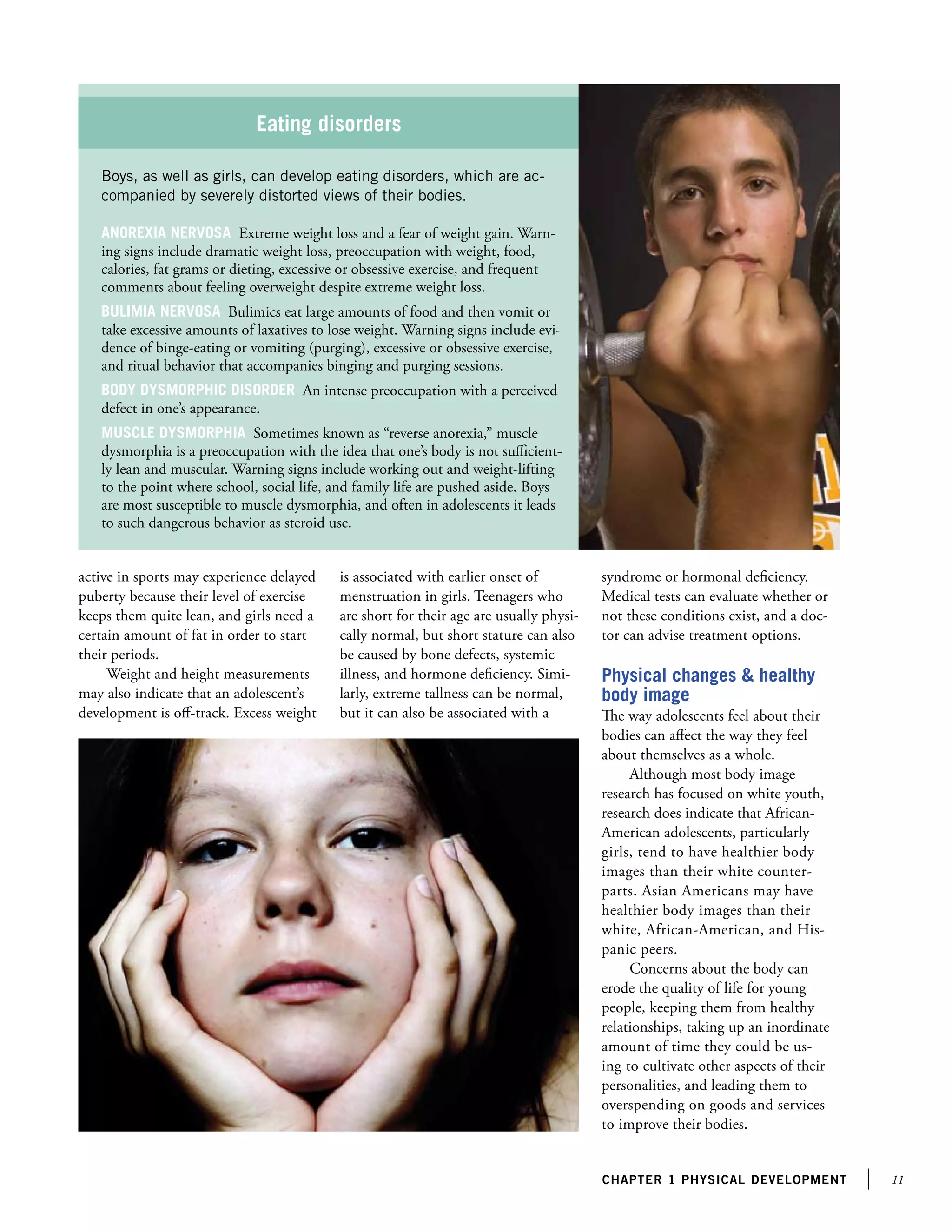
Boys, as well as girls, can develop eating disorders, which are accompanied by severely distorted views of their bodies.
Anorexia nervosa Extreme weight loss and a fear of weight gain. Warning signs include dramatic weight loss, preoccupation with weight, food,
calories, fat grams or dieting, excessive or obsessive exercise, and frequent
comments about feeling overweight despite extreme weight loss.
Bulimia nervosa Bulimics eat large amounts of food and then vomit or
take excessive amounts of laxatives to lose weight. Warning signs include evidence of binge-eating or vomiting (purging), excessive or obsessive exercise,
and ritual behavior that accompanies binging and purging sessions.
Body Dysmorphic Disorder An intense preoccupation with a perceived
defect in one’s appearance.
Muscle Dysmorphia Sometimes known as “reverse anorexia,” muscle
dysmorphia is a preoccupation with the idea that one’s body is not sufficiently lean and muscular. Warning signs include working out and weight-lifting
to the point where school, social life, and family life are pushed aside. Boys
are most susceptible to muscle dysmorphia, and often in adolescents it leads
to such dangerous behavior as steroid use.
active in sports may experience delayed
puberty because their level of exercise
keeps them quite lean, and girls need a
certain amount of fat in order to start
their periods.
Weight and height measurements
may also indicate that an adolescent’s
development is off-track. Excess weight

is associated with earlier onset of
menstruation in girls. Teenagers who
are short for their age are usually physically normal, but short stature can also
be caused by bone defects, systemic
illness, and hormone deficiency. Similarly, extreme tallness can be normal,
but it can also be associated with a

syndrome or hormonal deficiency.
Medical tests can evaluate whether or
not these conditions exist, and a doctor can advise treatment options.

Physical changes  healthy
body image
The way adolescents feel about their
bodies can affect the way they feel
about themselves as a whole.
Although most body image
research has focused on white youth,
research does indicate that AfricanAmerican adolescents, particularly
girls, tend to have healthier body
images than their white counterparts. Asian Americans may have
healthier body images than their
white, African-American, and Hispanic peers.
Concerns about the body can
erode the quality of life for young
people, keeping them from healthy
relationships, taking up an inordinate
amount of time they could be using to cultivate other aspects of their
personalities, and leading them to
overspending on goods and services
to improve their bodies.
chapter 1 PHYSICAl development

11
How steroids affect healthy bodies and minds

Anabolic steroids and legal and illicit supplements
(recombinant human growth hormone, injections of
insulin to increase muscle mass, thyroxine, clenbuterol,
cocaine) are used by athletes to boost strength and
sports performance. Steroids are easily found on the
Internet or in the locker room at some private gyms.
Dietary supplements with similar chemical properties
can be bought at health food stores. Young people who
want steroids can find them.
Recent studies show that 3 percent to 9 percent of
teenagers illegally use steroids, with the highest rates of
use reported in the middle-school years.
Anabolic steroids are a group of laboratory-made drugs
designed to mimic the effects of the male hormone testosterone. These drugs cause muscle and bone growth,
as well as the development of male sexual characteristics. For girls, steroids can cause the development
of male-pattern baldness, infertility, facial hair, and
irreversible hoarseness of the voice.
Anabolic steroids can also increase estrogen production as the body tries to compensate for the high levels
of male-dominant hormones. In boys, the increase in

12

the teen years explained

estrogen can cause hot flashes, testicular shrinkage,
weight gain, bloating, and the growth of fatty breast
tissue.
If teenagers abuse steroids before the normal puberty
growth spurt is complete, they may never reach their
full adult height. Humans are programmed to stop
developing after puberty, and steroid use can boost
hormone levels to the point where the body is tricked
into thinking growth is done.
Some of the short-term side effects of anabolic steroids
for both boys and girls include acne, hostility, anxiety,
and aggression. The psychological effects of steroid
use can be severe, and include paranoia, delusions or
hallucinations, depression, and suicidal thoughts. Steroid use also can lead to heart disease, and liver
and prostate cancer.
Signs of steroid use include quick weight and muscle
gains, combativeness and rage (known as “’roid rage”),
jaundice, purple or red spots on the body, swelling of
feet and lower legs, trembling, persistent unpleasant
breath odor, severe acne and oily skin.
Dealing with powerful media images of youth
	 Explain that media images do not reflect the average person—there is wide
diversity in physical appearance and rate of development.
	 Point out how body sizes, shapes, and faces are altered in magazines and
photographs using software programs like Photoshop. Waists and thighs are
whittled, cheekbones sharpened and lips plumped for women. Muscles are
pumped up and defined, and complexions smoothed for men.
	 Encourage critical thinking about the media and the nature of our consumer culture. Now is the perfect time to help teens develop their critical
thinking skills—help them question what is “normal.”
	 Turn to resources that reflect realistic, diverse appearances of actual people.
	 Encourage activities that focus on attributes other than physical appearance, such as academics, sports, music, the arts, writing, or crafts.
	 Reinforce these messages regularly.

To cultivate a healthy body image,
adolescents can tap into their developing critical thinking skills. A healthy
dose of skepticism can help them sift
through the bombardment of messages
related to body image, appearance,
attractiveness, and eating that they
encounter in the media, at home, and
from their friends.

Adults can provide accurate information regarding physical development, healthy eating, and the effects
of media, society, culture, peers, and
family on body image. Beginning at a
young age, adolescents need to understand that bodies come in all shapes
and sizes and that these disparities are
nothing out of the ordinary.

13 is not a magic number
There is no single age at which teens
enter puberty. Thirteen is not the
miraculous age when a child suddenly
transforms into a young adult. Puberty
can begin as early as age 8 or as late as
15. Regardless of when a child enters
puberty, the changes he or she undergoes affect his or her social interactions
and psychological outlook.
Adults should be aware of these
changes and of the way cultural differences play into such issues as sexual
maturity, body image, and pressures
to behave like a fully grown man
or woman.

“I look at photos in
magazines and on
TV and no way do
I measure up.”
		

Girl, 14

chapter 1 PHYSICAl development

13
Key Features in Adolescent Growth and Development
Ages
10-14

Physical

emotional

Body fat increases (girls)

Sense of identity develops

Breasts begin to enlarge (girls)

May feel awkward or strange about
themselves and their bodies

Menstrual periods begin (girls)
Hips widen (girls)

Focus on self increases

Testicles and penis grow larger (boys)

Ability to use speech to express feelings
improves

Voice deepens (boys)

Close friendships gain importance

Breasts can get tender (girls and boys)

Realization grows that parents are not
perfect, have faults

Height and weight increases (girls and boys)
Skin and hair become oilier, pimples may appear (girls and boys)
Appetite may increase (girls and boys)
Body hair grows (girls and boys)
Hormonal levels change (girls and boys)
Brain develops (girls and boys)

15-19

Overt affection toward parents declines
Occassional rudeness with parents
occurs
Complaints that parents interfere with
independence increase
Friends and peers influence clothing
styles and interests
Childish behavior may return, particularly at times of stress

Girls usually reach full physical development

Independent functioning increases

Boys reach close to full physical development

Firmer and more cohesive sense of
personal identity develops

Voice continues to lower (boys)
Facial hair appears (boys)
Weight and height gain continue (boys)
Eating habits can become sporadic—skipping
meals, late-night eating (girls and boys)

Examination of inner experiences
becomes more important and may
include writing a blog or diary
Ability for delayed gratification and
compromise increases
Ability to think ideas through
increases
Engagement with parents declines
Peer relationships remain important
Emotional steadiness increases
Social networks expand and new
friendships are formed
Concern for others increases

14

the teen years explained
cognitive

sexual

moral/values

Interests tend to focus on the
present, thoughts of the future
are limited

Girls develop ahead of boys

Testing of rules and limits increases

Shyness, blushing, and modesty increases

Intellectual interests expand
and gain in importance

Showing off may increase

More consistent evidence of conscience becomes apparent

Ability to do work (physical,
mental, emotional) expands

Capacity for abstract thought
develops

Interest in privacy increases
Interest in sex increases

Capacity for abstract thinking
increases

Exploration of issues and questions about
sexuality and sexual orientation begins

Risk-taking behaviors may
emerge (experimenting with
tobacco, alcohol, physical risks)

Ideals develop, including selection
of role models

Concerns about physical and sexual attractiveness to others may develop

Questioning of moral rights and
privileges increases

Worries about being “normal” become
common
Short-term romantic relationships may occur

Interests focus on near-future and
future
More importance is placed on
goals, ambitions, role in life
Capacity for setting goals and following through increases
Work habits become more defined
Planning capability expands

Feelings of love and passion intensify

Interest in moral reasoning increases

More serious relationships develop
Sharing of tenderness and fears with romantic
partner increases
Sense of sexual identity becomes more solid
Capacity for affection and sensual love increases

Interest in social, cultural, and
family traditions expands
Emphasis on personal dignity and
self-esteem increases
Capacity increases for useful
insight

Ability for foresight grows
Risk-taking behaviors may emerge
(experimenting with tobacco,
drugs, alcohol, reckless driving)
CHART SOURCES: Adapted from www.aacap.
org/publications/factsfam/develop.htm. American
Academy of Child and Adolescent Psychiatry,
Normal Adolescent Development, handout,
2/2005; http://www.nlm.nih.gov/medlineplus/
ency/article/02003.htm.

chapter 1 PHYSICAl development

15
BRAINPAGE
I

n The Teen Years Explained: A Guide to Healthy Adolescent Development, you will
find many references to the rich cognitive changes and development that occur
throughout the teen years. This page will help explain the different parts of the
brain and how they function.
The human brain is an extremely complex organ composed of interdependent
parts, each with its own specific functions and properties. The brain has three
fundamental segments: the forebrain, the midbrain, and the hindbrain.

The Brain

The Forebrain
The forebrain is the most advanced
and the largest section of the brain,
located in its uppermost part. The
forebrain is involved in all brain functions except for the autonomic activities of the brain stem. It is the part of
the brain responsible for emotions,
memory, and “higher-order” activities
such as thinking and reasoning. The
forebrain is made up of the cerebrum
and the limbic system.
The cerebrum, or cerebral cortex,
is divided into two hemispheres (left
and right). Each hemisphere consists of
four sections, called lobes:
parietal

frontal

occipital

temporal

The Forebrain

	 Occipital Lobe—Located at the
back of the head just above the cerebellum, the occipital lobe processes
sensory information from the eyes.
	 Temporal Lobe—Located at the
sides of the head above the ears, the
temporal lobes perform several functions, including speech, perception and
some types of memory.
	 Parietal Lobe—Located at the top
of the head, the parietal lobe receives
data from the skin, including heat,
cold, pressure, pain, and how the body
is positioned in space.
	 Frontal Lobe—Located under the
forehead, the frontal lobe controls

16

the teen years explained

reasoning, planning, voluntary movement, and some aspects of speech.
The prefrontal cortex is the part of the
frontal lobe right behind the forehead.
It is associated with complex cognitive
skills such as being able to differentiate
among conflicting thoughts, determine good and bad, identify future
consequences of current activities, and
suppress impulses. As the adolescent
brain develops, the prefrontal cortex
becomes increasingly connected with
the seat of emotions, the limbic system, allowing reason and emotion to
be better coordinated. The prefrontal
cortex has also been linked to
personality.
The limbic system, the set of brain
structures that form the inside border
of the cerebrum, accounts for about
one-fifth of the brain’s volume. The
limbic system serves three functions:
First, in cooperation with the brain
stem, it regulates temperature, blood
pressure, heart rate, and blood sugar.
Second, two parts of the limbic system,
the hippocampus and the amygdala,
are essential to forming memories.
Third, the limbic system is the center
of human emotions. The amygdala is
thought to link emotions with sensory
inputs from the environment. Nerve
impulses to the amygdala trigger the
emotions of rage, fear, aggression,
reward, and sexual attraction. These
emotions trigger the action of the
hypothalamus, which regulates blood
pressure and body temperature.
The Midbrain
The midbrain is the topmost section
of the brain stem and the smallest re-

gion of the brain. It is associated with
some, but not all, reflex actions, as well
as with eye movements and hearing.
midbrain

The Midbrain

The midbrain also contains several
structures necessary for voluntary
movement.
The Hindbrain
The hindbrain is the part located at
the upper section of the spinal cord.
The hindbrain includes the brain stem
and the cerebellum. The brain stem,
sometimes called the “reptilian brain,”
is the most basic area of the brain and
controls breathing, heartbeat, and
digestion. Next to the brain stem is
the cerebellum, which is responsible
for many learned physical skills, such
as posture, balance, and coordination.
Actions such as throwing a baseball
or using a keyboard take thought
and effort at first, but become more
natural with practice because the
memory of how to do them is stored
in the cerebellum.

cerebellum

brain stem

The Hindbrain
Obesity: Nutrition and Exercise
Obesity is a societal problem

Weight matters

M

any young people today are
living large. Obesity rates
have doubled since 1980
among children and have tripled for
adolescents. In the past 20 years, the
proportion of adolescents aged 12
to 19 who are obese increased from
5 percent to 18 percent. Obesity is
defined as a body mass index (BMI)
that is equal to or greater than the
95th percentile for age and gender on
growth charts developed by the Centers for Disease Control and Prevention (CDC).
A predisposition to obesity can be
inherited. However, genetic factors do
not explain the dramatic increase in
obesity over the last 30 years. Human
beings, like animals, are hardwired
to eat not simply to sustain life, but
to eat high-calorie foods in anticipation of an unpredictable food supply.
Our surroundings make it possible to
eat fatty foods on a regular basis, but
difficult to burn off all those calories
through activity. High-fat food is
cheap and tasty, and teens’ primary
activities—school and media consumption—are sedentary.
Thus, obesity is a social problem
rather than a personal flaw or a failure
of willpower. Teens, especially, are
impacted by their surroundings, and

The

Perils of pounds

Being overweight or obese is
more than a matter of appearance. Excess pounds contribute
significantly to health problems
and can lead to Type 2 (adult-onset) diabetes, high blood pressure, stroke, heart conditions,
cancer, gallstones and gall bladder
disease, bone and joint problems, sleep apnea, and breathing
difficulties. An adolescent who
is obese (with a body mass index
above the 95th percentile) has a
60 percent chance of developing
one of these conditions.
In addition, studies have found
that overweight youth are at
greater risk for emotional distress
than their non-overweight peers.
Overweight teenagers have fewer
friends, are more likely to be
socially isolated, and suffer higher
rates of depression than young
people of normal weight. Being
overweight also affects self-esteem. According to one study,
obese girls aged 13 to 14 are four
times more likely to suffer from
low self-esteem than non-obese
girls. Low self-esteem in adolescents is associated with higher
rates of loneliness, sadness, and
nervousness.

several studies at the University of
Illinois-Chicago and the University
of Michigan confirm that our modern environment is designed to make
adolescents fat.
There are some environmental factors that contribute to teen obesity.
	 Schools sell more high-fat, highcalorie foods and sugary drinks than
nutritious, lower-calorie choices.
	 Low-income communities offer limited access to healthy food. In some
neighborhoods, convenience stores
are the only places to buy food.
	 Adolescents live sedentary lives.
Teens spend the school day mostly
sitting, and then go on to spend an
average of three more hours parked
in front of a TV or computer screen.
	 School physical education programs
have been slashed. In 1991, 42 percent of high school students participated in daily phys. ed. classes. By
2007, that number was 25 percent
or lower.
	 Airwaves are saturated with foodproduct ads. Teenagers see, on
average, 17 ads a day for candy and
snack foods, or more than 6,000 ads
a year.
	 Big portions provide far more
calories than young people can
burn up. Fast-food burgers can top

chapter 1 physical development

17
become the norm; and some popular
restaurant chains offer entrees that
weigh in at 1,600 calories. The average adolescent needs only 2,300 to
2,500 calories a day.
Because the causes of excess
weight are so complex, dietary changes
are just one aspect of treating obesity.
Adolescent weight problems can be related to poor eating habits, overeating
or binging, physical inactivity, family
history of obesity, stressful life events
or changes (divorce, moves, deaths,
and abuse), problems with family and
friends, low self-esteem, depression,
and other mental health conditions.

they gain 50 percent of their adult
weight and 50 percent of their bone
mass during this decade of life.
Dietary choices and habits
established during adolescence greatly
influence future health. Yet many studies report that teens consume few fruits
and vegetables and are not receiving
the calcium, iron, vitamins, or minerals necessary for healthy development.
Low-income youth are more susceptible to nutritional deficiencies, and
since their diets tend to be made up of
high-calorie and high-fat foods, they
are also at greater risk for overweight
or obesity.

Teens are consuming
more calories, but getting
less nourishment

Teasing about weight
is toxic

Adequate nutrition during adolescence
is particularly important because of
the rapid growth teenagers experience:

18

the teen years explained

Weight is one of the last sanctioned
targets of prejudice left in society.
Being overweight or obese subjects
a teen to teasing and stigmatization

by peers and adults. It can happen
at home, at school, on the street—
anywhere, even on TV. Ads and
programming usually portray the
overweight as the target of jokes,
perpetual losers, and not as smart or
successful as their thinner counterparts.
Teasing by family members,
including parents, is surprisingly common, perhaps because family members
mistakenly believe they are being
helpful when they draw attention to
someone’s size or harass them about
what they are eating. When they label
their overweight adolescents with such
epithets as “greedy,” “lazy,” or “little
piggies,” parents and siblings become
an integral part of the problem.
A 2003 study of nearly 5,000
teenagers in the Minneapolis area
found that 29 percent of girls and 16
percent of boys were teased by family
members and one-third of the girls and
ways you can make a

difference

	 Realize that “kid-friendly” meals
such as chicken nuggets, fries, and
pizza with meat toppings are not
the healthiest choices.
	 advocate for recreation and
com-munity centers and safe parks
and trails so that youths can readily participate in physical activities
and sports programs.
	 Discourage late-night eating or
the habit of consuming most of
the day’s calories in the evening.
	 Rally for the building of supermarkets and for greater access to
fresh foods in urban neighborhoods.
	 Push for direct access from bus
and subway routes to farmers’
markets.

one-fourth of the boys had been teased
by their peers about their weight.
Weight-based taunting is not
harmless. Adolescents in the study saw
the teasing as having a greater negative
impact on their self-image than did
their actual body size.
Teasing should be taken seriously
and never tolerated at home, in school,
or in the community. Policies have
helped to establish norms making ethnic slurs unacceptable. Perhaps similar
policies can be formed to send a clear
message that bullying people about
body shape is not sanctioned in the
schools or the community.

What can be done?

Young people can conquer weight
problems and get adequate nutrition
with a combination of a healthful diet,
regular physical activity, counseling,
and support from adults and peers.
For severely obese teens, medication

	 Support schoolwide efforts to
promote physical activity and to
limit offerings of junk foods and
sugary beverages in the cafeteria
and vending machines.
	 Join forces with adolescents on
an advocacy project insisting that
food companies live up to their
promises to stop marketing unhealthy foods to youth.
	 Acknowledge disparate views
of the body and food based on
gender, such as approval of larger
size among boys.
	 Examine whether entrenched beliefs within your family, e.g., that
it is important to finish everything
on your plate, might be contributing to overeating.

or bariatric surgery is sometimes
prescribed to supplement weight
management efforts.
While proper diet and exercise
improve physical health, parents and
caregivers can also enhance mental
health by emphasizing the overweight
teen’s strengths and positive qualities. After all, the measure of a young
person’s worth is far more than the
numbers on the scale.
Some heavier adolescents will
lose excess weight through positive
lifestyle changes and through the
normal growth spurts of puberty that
make their bodies taller and leaner.
In other cases, obesity becomes a lifelong struggle.
Eating healthy foods in right-sized
portions and exercising are lifelong
habits, not temporary fixes. During
growth spurts, adolescents do need a
lot of calories, and the classic portrait
of a teenager as a bottomless pit—

someone who can consume volumes of
food and burn it all off—seems to hold
true. These increased calories should
come from healthy foods because teens
need more nutrition as well as more
calories. Learning to pay attention
to cues of fullness from the body, as
opposed to eating mindlessly, will
help teens avoid a habit of overeating
in later years when their metabolism
inevitably slows down.
Adults can help control what
happens in the home, schools, and
neighborhood when it comes to eating
and exercise. One of the best ways
adults can influence young people is by
changing their own eating and exercise
habits. Adults can help young people
establish healthy habits by
	 Not skipping breakfast.
	 Eating fruits, vegetables, lean protein, and whole grains.
	 Cooking dinner at home using fresh,
whole foods.
	 Not buying or drinking beverages
with added sugars.
	 Building exercise and physical
activity into one’s own daily routines
and encouraging one’s children to
join them.
	 Not inappropriately encouraging
youth to lose weight.
Weight gain accompanies puberty:
teens grow in height, boys develop
muscle mass; girls develop breasts and
hips; and both boys and girls can put
on body fat before a growth spurt.
Adults should understand normal
physical development (see the Physical
Development chapter) to avoid putting
undue pressure on an adolescent to be
a certain size or weight.

“I think there’s a
lot of pressure
out there to look
perfect, but
what’s perfect?”
			

Girl, 16

chapter 1 physical development

19
20

the teen years explained
Cognitive Development

Chapter 2

The ever-expanding teenage brain

“I see and think
differently now
that I am a
teenager. I know
that there are
negative and
positive outcomes
to everything that
you do.”	 Girl, 14

N

ewly developed thinking skills
are one of the most thrilling
aspects of adolescence. As
their ability to think in abstract terms
grows, young people love to debate,
challenge established ideas or values,
and question authority. They begin
to question notions of absolute truth
and to acquire the capability to present
logical arguments.
This higher level of brainpower
helps adolescents to consider the
future, judge options, solve problems,
and set goals. Part of gaining new
thinking skills includes making mistakes and learning from them. Adults
can play an important role in guiding

cognitive development by helping
young people master the skills of critical thinking and decision making.

The three main components of
adolescent cognitive skills
In adolescence, cognitive development occurs in three main areas. First,
young people strengthen their advanced reasoning skills, which includes
thinking about multiple options and
possibilities, pondering things hypothetically (the age-old “what if…?”
questions), and following a logical
thought process.
Second, teenagers start to develop
abstract thinking skills, meaning they

chapter 2 Cognitive development

21
think about things that cannot be seen,
heard, or touched. Abstract thought
allows one to think about faith, love,
trust, beliefs and spirituality, as well as
higher mathematics.
Third, they enlarge their capacity to think about thinking, a process
known as “meta-cognition.” Metacognition allows young people to consider how they feel and what they are
thinking, and also involves being able
to think about how one is perceived
by others. Meta-cognition can also
be used to develop strategies such as
mnemonic devices, which are useful in
memorization and learning.

Recent neurological findings
map changes in the teenage
brain
The brains of babies and toddlers produce billions of brain cells (neurons)
and connections between brain cells
(synapses). Then, starting around age
3, the synapses are “pruned.” Researchers have discovered a second period of
overproduction of synapses that starts
just before puberty (age 11 in girls, 12
in boys), also followed by pruning.
The pruning of synapses appears to be an essential part of brain
maturation. Taking away the weaker
synapses allows the remaining ones
to become stronger and more stable,
much like the pruning of a tree allows
the remaining branches to thrive. Be-

22

the teen years explained

BRAIN BOX

The teen years are a time of intense
brain changes. Interestingly, two of
the primary brain functions develop at
different rates. Recent brain research
indicates that the part of the brain that
perceives rewards from risk, the limbic
system, kicks into high gear in early
adolescence. The part of the brain
that controls impulses and engages
in longer-term perspective, the frontal
lobes, matures later. This may explain
why teens in mid-adolescence take
more risks than older teens. As the
frontal lobes become more developed,
two things happen. First, self-control
develops as teens are better able to
assess cause and effect. Second, more
areas of the brain become involved
in processing emotions, and teens
become better at accurately interpreting
others’ emotions.
SOURCE: Steinberg, L. (2008) A social neuroscience
perspective on adolescent risk-taking. Developmental
Review, 28:78-106.

tween ages 13 and 18, adolescents lose
approximately 1 percent of their gray
matter every year.
The spurt of synapse formation
and pruning during adolescence occurs
in several parts of the brain, including
the prefrontal cortex. The prefrontal
cortex is responsible for advanced
reasoning, including the ability to
plan, understand cause and effect,
think through scenarios, and manage
impulses. There may be an important link between brain development
and an adolescent’s ability to stop to
consider consequences, develop logical
plans, or filter thoughts before blurting
them out.
The brain changes continue up
to at least age 21, and some scientists
believe maturation is not complete
until 25. Brain development seems to
vary so much between individuals that
it is impractical to pinpoint a specific
age at which young people reach full
maturity in thinking and reasoning.
Throughout adolescence, the capacity
for advanced reasoning, abstract thinking, and meta-cognition expands
and improves.

Do brain changes spur
risk-taking?
For decades, the story line for adolescents—written both by developmental
psychologists and by parents—was that
adolescents underestimate risk.
Teens, it was thought, feel invincible: “It will never happen to me.”
The “it” might be the possibility of
becoming pregnant (“I can’t possibly
get pregnant”), or of contracting a
sexually transmitted disease after having unprotected intercourse (“He/she
couldn’t possibly have a disease”), or
any of the numerous adverse effects of

unsafe behavior. This perceived sense
of invulnerability was considered to be
a stage of cognitive development that
adolescents had to pass through on the
way to adulthood.
We now have considerable scientific evidence that adolescents do feel
vulnerable to contracting a sexually
transmitted disease or getting sick

“Now that I am
older, I can make
choices for myself
and think before
I act.”	
Girl, 12

Understanding teens’ new thinking skills
Teens enjoy exercising their budding ability for lively debate.
For them, conflicts may just be a way of expressing themselves.
Adults, on the other hand, tend to take arguments personally and
may view them as intense and disruptive or as a direct threat to
their authority.
	 Be patient when teens “test drive”
their newly acquired reasoning
skills, and encourage healthy,
respectful debate by setting “rules
of engagement.”
	 Disrespect should never be tolerated by either an adolescent or
an adult.
	 Never correct or put down adolescents’ logic; simply listen to
and acknowledge what they say.
A good strategy is to ask how they

arrived at the thoughts or conclusions they are expressing.
	 Don’t take it to heart when teens
criticize adult opinions and
behaviors. They may challenge
you, but they still need you.
	 Unless a teen has a history of
problem behavior, do not worry
if he or she demonstrates
melodramatic tendencies.
	 Remember that not every disagreement is a conflict.

chapter 2 Cognitive development

23
from drinking too much. In fact, several studies have found that adolescents
perceive more risk in certain areas
than adults do, such as the chance of
getting into an accident if they drive
with a drunk driver. Teenagers also are
not as optimistic as their parents are
about avoiding injuries and illness.
However, they are less likely than
adults to believe poor health will result
from experimenting with sex, drinking,
drugs, or smoking.
For many adolescents, being aware
of the risks involved in a given action
fails to stop them from participating. Research is starting to discover
that adolescents judge the benefits of
partaking in risky behaviors differently
than adults do, and this difference in
judgment may have a biological basis
in the brain. Functional magnetic resonance imaging studies have shown that
while winning at gambling, the “reward” center lights up more in teens’

“As an adolescent, I think more for myself
now. I am also more aware of the feelings
of people around me and more aware of
my own feelings.”				
Girl, 15
brains than in adults’ brains, meaning
that teens experience greater emotional
satisfaction when risk-taking produces
a desired outcome.
Teens also may discern social
benefits from smoking, drinking, or
sexual activity. In schools and communities where the popular students
are more likely to smoke, drink, and
be sexually experienced, trying out
these risky behaviors could be viewed
by young people as a rational strategy
for gaining approval from their friends
and fellow students. Most teens who
experiment with alcohol and cigarettes
do not develop addictions, but some

do, especially if they start experimentation at an early age.
The upside of perceiving rewards
for taking risks is that teens are willing
to assume new challenges necessary
for adulthood, such as starting a job,
leaving home, and forming diverse
relationships. In fact, adolescence is
the perfect time to strike out in different directions. Only in early childhood
are people as receptive to new information as they are in adolescence.
Given the developmental directive
to experiment, it is not surprising that
scare tactics, school-based abstinence
curricula, and “Just say no” cam-

Cognition ignition
Freshly acquired reasoning and logic skills are like a new gadget
adolescents are just itching to try out. Here are some ways you can
help young people make effective use of their developing capacities:
	 Ask open-ended questions that invite thought and debate. This will help
adolescents consider their range of options and the natural consequences of
each choice.
	
	
Example of an open-ended question that invites discussion:
		 “How do you think it will benefit you and/or harm you to quit your after-school
		 job to join the basketball team?”

		 (invites thought and debate)
	
	
Example of a close-ended question that ellicits a yes or no response:
		 “Will you regret quitting your after-school job to join the basketball team?”
	 Never subject an adolescent to public criticism or mockery of their
thoughts or ideas.
	 Encourage a deeper understanding of issues and topics an adolescent
brings up by pointing them to accurate, factual information.
	 Make sure teens grasp the role of emotions in the decision-making
process—feelings like anger, fear, sadness, or elation can cloud judgment.
Decisions, especially important ones, should be made while calm and
revisited after “sleeping on it.”
	 Realize teens bring a variety of strengths—logic, common sense, creative
approaches—to the decision-making process.

24

the teen years explained
Decision-making
strategies
Adolescents need opportunities
to practice and discuss realistic
decision-making. Here are
some ways adults can facilitate
the process:
	 Get youth actively practicing decision-making through role-playing
and group problem-solving exercises.
	 Take a look at how you make decisions and then lead by example.
	 Demonstrate to teens how to choose
between competing pressures and
demands.
	 Many adolescents live in the now.
Show them the benefits of future
thinking by anticipating difficult
situations and planning in advance
how to handle them.
	 Encourage adolescents to spend time
with friends who share their values.

paigns have proven to be ineffective
with young people. More successful
strategies engage youth in using their
emerging critical-thinking skills. For
example, taking young people through
the risks of a certain action or activity
and having them assess the situation’s
consequences at every juncture allows
them to develop future-thinking
techniques and makes them feel more
in control. This tactic challenges their
intellect, while simply forbidding them

to do something only challenges their
sense of autonomy.

Cognitive mindsets
This section details some of the cognitive mindsets—ways of thinking and
believing—experienced by adolescents
as a result of brain development.
I don’t think that’s fair
Advances in reasoning skills lead
teens to become interested in fairness

or justice. They are quick to point
out inconsistencies between adults’
words and their actions. However, the
developing adolescent brain makes it
difficult for them to see shades of gray
or nuances in arguments and opinions.
They tend to view things in extremes
of black and white, allowing little
room for error. Their reasoning skills
can be honed by encouraging teens to
talk about their views, whether it is
their political or spiritual beliefs, or

Sharing your experiences
Adults often support each other by sharing stories about their own experience in a similar situation. This strategy works less well with teens, who may
respond to adults’ attempts to help this way with exclamations of “You don’t
understand!” or “My life is ruined!”
Try not to take it personally when young people discount your experiences.
Just listen to their concerns and empathize. Seek to understand their feelings first before offering up anecdotes about what you were like as a teen,
and when you do, speak about your vulnerabilities and the mistakes that you
made at that age. Don’t let it all hang out, though. Experts advise that adults
talk about their past experiences cautiously and conservatively.

chapter 2 Cognitive development

25
“I am capable of making my own decisions
and I challenge myself a lot more since I
am not a child anymore.”		
Boy, 15
their responses to something they saw
on the Internet or in a magazine.
Researcher Laurence Steinberg,
PhD, has suggested that adults and
adolescents have different views of conflict. It is the parents who get stressed
out by dust-ups over daily mundane
issues. A possible reason for this is that

26

the teen years explained

adults see the decisions in question
as stemming from moral distinctions
of right and wrong, traditions, social
customs, and core beliefs, whereas
teens tend to view decisions simply as
matters of personal choice.
Take a clean bedroom. Adults
view the issue from a moral stand-

point (cleanliness is next to godliness;
cleaning your room is the right thing
to do). An adolescent is more committed to the issue of fairness—my room
is my domain; it is not fair for parents
to dictate whether my room is neat
or messy, and what does it matter in
the grand scheme of things? Adolescents are less interested in the moral
standpoint, so the conflict may not be
as meaningful for them. Therefore, the
parent may walk away upset—and
stay upset—more often than the
young person.
I am taking up the cause
On the one hand, teens are concerned
with their appearance and their every
move. One consistent experience of
adolescence is the constant feeling of
being “on stage”and that everyone and
everything is centered on their appearance and actions. This preoccupation
stems from the fact that brain changes
actually spur adolescents to spend an
inordinate amount of time thinking
about and looking at themselves.
This does not mean young people
are inherently selfish. On the contrary,
cognitive development also prompts
them to become outward-directed and
interested in something larger than
themselves. Embrace this paradox and
accept it.
The newfound ability to consider
abstract concepts may make teens want
to become involved in things that have
deeper meaning. They want to tackle
the big issues and are often drawn into
causes. This not only widens a young
person’s perspective but also is greatly
empowering. After reading about cruelty to animals, an adolescent may
become vegetarian and active in animal
rights campaigns. Support their interests and help them find ways large and
small they can contribute to the causes
in which they believe. This is an excellent way for adolescents to move from
self-consciousness to a greater consciousness of the world.

“Being a teenager
means thinking
about going to
college, acting
more mature,
and being more
interested in girls.”	
			

Boy, 15

chapter 2 Cognitive development

27
Sleep and Cognitive Development
Teen brains need more Zzzzzzzs

B

rain development even affects
the way teens sleep. Adolescents’ normal sleep patterns
are different from those of children
and adults. Teens are often drowsy
upon waking, tired during the day, and
wakeful at night.
Until the age of 10, most children awaken refreshed and energetic.
In adolescence, the brain’s biological clock, or circadian rhythm, shifts
forward. Melatonin secretions, which
trigger sleepiness, start later at night
and turn off later in the morning. This
natural shift peps up adolescents at the
traditional weekday bedtime of 9 or 10
p.m. and can explain why it is so hard
to rouse them at sunrise. In contrast,
circadian rhythms in middle-aged
people tend to swing backward, and
many parents struggle to stay awake
when their adolescent children are at
their most alert.
Teenagers actually need as much
sleep or more than they got as children—nine to 10 hours are optimum.
Most adolescents are chronically
sleep-deprived, averaging a scant six to
seven hours a night. Part of the blame
can be placed on early starting times
for school, which, coupled with many
teens’ 11 p.m. and midnight bedtimes,
result in a considerable sleep deficit.

28

the teen years explained

Too little sleep can result in uncontrolled napping (either in class or,
more dangerously, behind the wheel),
irritability, inability to do tasks that are
not exciting or of a competitive nature,
and dependence on caffeine drinks to
stay alert.
Sleep debt also has a powerful
effect on a teen’s ability to learn and retain new material, especially in abstract
subject areas such as physics, philosophy, math, and calculus.

Battling biology can be daunting, but adults can help teenagers get
enough sleep by keeping TVs and electronic gadgets out of their bedrooms,
switching to caffeine-free drinks in
the evening, and getting them to wind
down activity by a reasonable hour.
Catch-up sleep on weekends is
a second-best option because it can
confuse the brain as to when nighttime occurs and is not as restorative
as regular slumber.
Effects of Tobacco, Alcohol and Drugs
on the Developing Adolescent Brain

R

isk-taking may be based in biology, but that does not diminish
the possible unhealthy consequences of alcohol and other drugs and
tobacco on the developing teen brain.
Recent brain research with magnetic resonance imaging suggests that
alcohol impacts adolescents differently
than it does adults. Young people are
more vulnerable to the negative effects
of alcohol on the hippocampus—the
part of the brain that regulates working memory and learning. Consequently, heavy use of alcohol and
other drugs during the teen years
can result in lower scores on tests of
memory and attention in one’s early
to mid-20s.
People who begin drinking before
age 15 are four times more likely to
become alcohol-dependent than those
who wait until they are 21. Teens also
tend to be less sensitive than adults to
alcohol’s sedative qualities. Sedation
in response to alcohol is one of the
ways the body protects itself, since it
is impossible to keep drinking once
asleep or passed out. Teenagers are
able to stay awake longer with higher
blood alcohol levels than older drinkers
can. This biological difference allows
teens to drink more, thereby exposing

themselves to greater cognitive impairment and perhaps brain damage from
alcohol poisoning.
There are also striking differences
in the way nicotine affects adolescent
and adult smokers. Nicotine results in
cell damage and loss throughout the
brain at any age, but in teenagers the
damage is worse in the hippocampus,
the mind’s memory bank. Compared
to adults, teen smokers experience
more episodes of depression and
cardiac irregularities, and are more apt
to become quickly and persistently
nicotine-dependent.

Drugs such as cocaine and amphetamines target dopamine receptor
neurons in the brain, and damage to
these neurons may affect adolescent
brain development for life in the areas
of impulse control and ability to experience reward.
Other effects of substance abuse in
adolescents include delays in developing executive functions (judgment,
planning and completing tasks, meeting goals) and overblown and immature emotional responses to situations.

chapter 2 cognitive development

29
30

the teen years explained
Emotional  Social
Development

Chapter 3

A quest for emotional and social competence

“Adults influence
me more than my
friends because
they have more
wisdom and
experience in
the world.”
		
Girl, 16

A

lthough the stereotype of adolescence emphasizes emotional
outbursts and mood swings,
in truth, the teen years are a quest for
emotional and social competence.
Emotional competence is the
ability to perceive, assess, and manage
one’s own emotions. Social competence is the capacity to be sensitive and
effective in relating to other people.
Cognitive development in the adolescent brain gives teens increasing capacity to manage their emotions and relate
well to others.
Unlike the physical changes of
puberty, emotional and social development is not an inevitable biological

process during adolescence. Society
expects that young people will learn to
prevent their emotions from interfering with performance and relate well to
other people, but this does not occur
from brain development alone—it
must be cultivated.

Four areas of emotional and
social development
Emotional and social development
work in concert: through relating to
others, you gain insights into yourself. The skills necessary for managing
emotions and successful relationships
have been called “emotional intelligence” and include self-awareness,

chapter 3 emotional  social development

31
social awareness, self-management, and
the ability to get along with others and
make friends.

BRAIN BOX

Self-awareness: What do
I feel?
Self-awareness centers on young people
learning to recognize and name their
emotions. Feelings cannot be labeled
accurately unless conscious attention is
paid to them, and that involves going
deeper than saying one feels “good,”
“bad,” or the all-purpose “OK.”
Going deeper means an adolescent
might discover he or she feels “anxious”
about an upcoming test, or “sad” when
rejected by a potential love interest.
Identifying the source of a feeling can
lead to figuring out constructive ways
to resolve a problem.
Without this awareness, undefined
feelings can become uncomfortable
enough that adolescents may grow
withdrawn or depressed or pursue such
numbing behaviors as drinking alcohol, using drugs, or overeating.

Social awareness: What do
other people feel?
While it is vital that youth recognize
their own emotions, they must also develop empathy and take into account

32

the teen years explained

Increases in estrogen and testosterone
at puberty literally change the brain
structure so that it processes social situations differently. Pubertal hormones
prompt a proliferation of receptors for
oxytocin, a hormone that functions as a
neurotransmitter, in the limbic area of
the brain, where emotional processing
occurs. The effect of increased oxytocin
is to increase feelings of self-consciousness, to the point where an adolescent
may truly feel that his or her behavior is
the focus of everyone else’s attention.
These feelings of having the world as
an audience peak around age 15 and
then decline.
SOURCE: Steinberg, L. (2008) A social neuroscience
perspective on adolescent risk-taking. Developmental
Review, 28, 78–106.

the feelings of others. Understanding
the thoughts and feelings of others and
appreciating the value of human differences are the cornerstones of social
awareness.
Cognitive development during
adolescence may make social awareness difficult for some young people.
Adolescents actually read emotions
through a different part of the brain
than do adults. Dr. Deborah Yurgelun-Todd, director of Neuropsychology and Cognitive Neuroimaging at
McLean Hospital in Belmont, Massachusetts, took magnetic resonance
imaging (MRI) scans of the brains
of both teenagers and adults as they
were shown images of faces that clearly
expressed fear. All the adults correctly
identified fear. About half of the teens
got it wrong, mistaking the expression
as that of shock, sadness, or confusion.
Yurgelun-Todd discovered that on
the MRI scans of the adults, both the
limbic area of the brain (the part of the
brain linked to emotions) and the prefrontal cortex (connected to judgment
and reasoning) were lit up. When teens
saw the same images, the limbic area
was bright, but there was almost no
activity in the prefrontal cortex. Until
the prefrontal cortex fully develops in
early adulthood, teens may misinterpret body language and facial expressions. Adults can help by telling teens
how they are feeling. For example, a
parent can say, “I’m not mad at you,
just tired and crabby.”

Possible causes of heightened emotions in adolescents

Self-management: How can
I control my emotions?
Self-management is monitoring and
regulating one’s emotions and establishing and working toward positive
goals. Adolescents can experience intense emotions with puberty. Researchers have found that the increase of
testosterone in both boys and girls at
puberty literally swells the amygdala,
an area of the brain associated with
social acceptance, responses to reward,
and emotions, especially fear.
Nonetheless, adolescents can and
do learn to manage their emotions.
Self-management in a young person
involves using developing reasoning
and abstract thinking skills to step
back, examine emotions, and consider
how those emotions bear on longerterm goals. By actively managing emotions rather than reacting to a flood
of feelings, young people can learn to
avoid the pitfalls and problems that
strong emotions often evoke. Recognizing that they have the power to
choose how to react in a situation can
greatly improve the way adolescents
experience that situation.

Peer relationships: How can
I make and keep friends?
Social and emotional development
depends on establishing and maintaining healthy, rewarding relationships based on cooperation, effective
communication, and the ability to
resolve conflict and resist inappropriate peer pressure.
These social skills are fostered by
involvement in a peer group, and teens
generally prefer to spend increasing
amounts of time with fellow adolescents and less time with family. Peers
provide a new opportunity for young
people to form necessary social skills
and an identity outside the family.

	 Hormones, which set off physical changes at puberty, also affect moods
and general emotional responses in teens.
	 Concerns about physical changes—height, weight, facial hair, developing
breasts in girls—are a source of sensitivity and heightened emotions.
	 Irregular meal patterns, skipping breakfast, and fasting to lose weight can
affect mood.
	 Inadequate sleep can lead to moodiness, gloominess, irritability, and a
tendency to overreact.
	 Experiencing the normal ups and downs of social relationships, especially
romantic relationships, can make a teen feel anything from elation to
abject despair.
The influence of peers is normal
and expected. Peers have significant
sway on day-to-day values, attitudes,
and behaviors in relation to school, as
well as tastes in clothing and music.
Peers also play a central role in the
development of sexual identities and
the formation of intimate friendships
and romantic relationships.
Friends need not be a threat to
parents’ ultimate authority. Parents re-

main central throughout adolescence.
Young people depend on their families
and adult caregivers for affection, identification, values, and decision-making
skills. Teens report, and research confirms, that parents have more influence
than peers on whether or not adolescents smoke, use alcohol and other
drugs, or initiate sexual intercourse.
Teens also frequently seek out
adult role models and advisors such

“My mom is my biggest influence
because she always knows the answers
to my questions and would never tell
me anything that would hurt me in
the long run.”			
Boy, 15
chapter 3 emotional  social development

33
Popularity plusses and minuses
Most parents wish their teenagers to be popular. Certainly, most teens want
to be popular, too. However, a recent study in the journal Child Development
suggests that being on the A-list is not always what it’s cracked up to be.

The advantages of popularity are that popular adolescents possess a broader array of social skills than their less well-liked peers, better self-concepts, a greater
ability to form meaningful relationships with both friends and parents, and
greater ability to resolve conflicts within these relationships.
But there is a downside. Popular teens are at higher risk for exposure to—and
participation in—whatever risky behaviors are condoned by their peers. Popularity can be associated with higher levels of alcohol and substance abuse and
minor deviant behavior, such as vandalism and shoplifting.
Popular kids tend to get along better with their friends and family members
and seem to have more emotional maturity than others. This maturity can be
compromised by their need for group approval, as popular teens may be even
more willing than other teens to adopt behaviors they think will earn them
greater acceptance. Sometimes the behaviors are “pro-social”—as when a group
pressures popular members to be less aggressive and hostile. Sometimes, when
risky behaviors are valued by popular kids, the behaviors are more deviant.
SOURCE: Allen, J.P., Porter, M.R.,  McFarland, F,C. (2005). The two faces of adolescents’ success with peers:
adolescent popularity, social adaptation, and deviant behavior. Child Development. 76(3), 747–760.

as teachers, relatives, club leaders, or
neighbors. Studies show that connections to teachers, for example, can be
just as protective as connections to parents in delaying the initiation of sexual
activity and use of drugs, alcohol,
and tobacco.
Some teenagers, of course, trade
the influence of parents and other
adults for the influence of their peers,

but this usually happens when family
closeness and parental monitoring are
missing. Youth need to learn independent-thinking, decision-making,
and problem-solving skills from their
parents or guardians and other caring
adults, so they can apply these skills
within their peer network.
The nature of social relationships changes as adolescents get older.
Younger teens typically have at least
one primary group of friends, and the
members are usually similar in many
respects, including gender. During the
early teen years, both boys and girls are
concerned with conforming and being
accepted by their peer group.

“A good parent
listens to you and
does not look
down on you.”
		
Girl, 14
34

the teen years explained

Emerging brain science indicates
that during early adolescence social
acceptance by peers may be processed
by the brain similarly to other pleasurable rewards, such as receiving money
or eating ice cream. This makes social
acceptance highly desirable and helps
explain why adolescents change their
behavior to match their peers’. Teens
often adopt the styles, values, and
interests of the group to maintain an
identity that distinguishes their group
from other students.
Peer groups in middle adolescence
(14-16 years) tend to contain both
boys and girls, and group members are
more tolerant of differences in appearance, beliefs, and feelings. By late adolescence (17-19 years), young people
have diversified their peer network
beyond a single clique or crowd and
develop intimate relationships within
these peer groups, such as one-on-one
friendships and romances.
Dating is a way to develop social
skills, learn about other people, and explore romantic and sexual feelings. The
hormonal changes that accompany pu-
“My friends have
inspired me to
help anyone that
I see in need.”
		
Girl, 12
berty move adolescents toward dating
relationships. Mainstream culture plays
a role as well. Media and popular culture are awash in images and messages
that promote adolescent sexuality and
romance. Dating can lead to sexual
activity, but also to opportunities for
expanded emotional growth. Dating
and friendships open up an adolescent
to experiencing extremes of happiness, excitement, disappointment, and
despair. Recent research has shown that
both boys and girls value intimacy in
romantic relationships, dispelling the
prevailing stereotype that boys prefer
casual sexual relationships.

Decisions about risk-taking often
are made in group situations—settings that activate intense feelings
and trigger impulses. In a recent
experimental study, teenagers, college students, and adults were asked
to play a video driving game. When
participants were alone, levels of risky
driving were the same for the teens,
college students, and adults. However,
when they played the game in front of
friends, risky driving doubled among
the adolescents and increased by 50
percent among the college students,
but remained unchanged among the

adults. Risky behavior increased for
both boys and girls.
In a follow-up study, Laurence
Steinberg, PhD, of Temple University
used functional MRI to map brain
activity during the video driving game.
The brain scans showed that teen
brains respond differently when peers
are present compared to when they are
not present. When teens played the
driving game alone, brain regions
linked to cognitive control and reasoning were activated. When peers were
present, additional brain circuitry that
processes rewards was also activated,

The building blocks of empathy

Emotional and social
development in context
Adolescents face an astonishing array
of options in modern society—everything from choosing multiple sources
of entertainment to deciding among
alternative educational or vocational
pathways. Teenagers are confronted
with more decisions, and more complicated decisions, than their parents and
grandparents faced, often in complex
environments that trigger conflicting
feelings and desires.
Responsible decision-making
involves generating, implementing,
and evaluating ethical choices in a
given situation. The choices ideally will
benefit both the decision-maker and
the well-being of others.
The still-developing frontal
lobes in the brain render adolescents
vulnerable to making poor decisions; they can have trouble forming
judgments when things are cloudy or
uncertain. The Cognitive Development
chapter gives strategies for helping
young people with their decisionmaking skills.

Empathy is the ability to identify with another person’s concerns and feelings.
Empathy is the foundation of tolerance, compassion, and the ability to differentiate right from wrong. Empathy motivates teens and adults alike to care
for those who are hurt or troubled.
Ways you can help build empathy in an adolescent:
	 Demonstrate tolerance and generosity in your thoughts, words, and actions.
	 Actively participate in religious or social organizations that ask you to focus
on issues larger than yourself.
	 Fine-tune your own empathetic behaviors and act on your concerns to
comfort others, so that teenagers can copy your actions.
	 Build a young person’s emotional vocabulary by using such “feelings” statements as “Your friend seems really (anxious, mad, discouraged).” You can
also point out nonverbal feeling cues to a teenager.
	 Teach empathy and awareness of others, such as helping youth understand
on an emotional level the negative consequences of prejudice.
	 Talk with a young person about how his or her own suffering can lead to
compassion for other teens who experience suffering.

chapter 3 emotional  social development

35
suggesting that, for teens, potentially
rewarding—and potentially risky—
behaviors become even more gratifying in the presence of peers. By late
adolescence and early adulthood, the
cognitive control network matures,
so that even among friends in a highpressure situation, the urge to take
risks diminishes.
Because heightened vulnerability
to peer influence and risk-taking ap-

36

the teen years explained

pears to be a natural and normal part
of neurobiological development, telling
adolescents not to give in to peer influence may not be effective, especially
during early adolescence. Instead,
teens may be best protected from
harm through limiting exposure to
risky situations. Harm-reducing tactics
include raising the price of cigarettes,
rigorously policing the sale of alcohol
to minors, placing restrictions on

teen driving, and making reproductive health services more accessible
to adolescents.

“A good friend is
100% real with
you all the time.”
		
Boy, 16
Ways to help teens make healthy social connections
Discuss the meaning of true friendship
People have plenty of acquaintances, but true friends can be rare gifts. Talk
with young people about what distinguishes true friends from situational
friends. True friends like you for yourself. They try to help and encourage
you, and they stand by you when the other kids make fun of you or give
you a hard time. A true friend does not judge you by the clothes you wear
or how much expensive stuff you have, pressure you to go along with the
crowd, make you do dangerous or illegal things, or leave you high and dry
when things get rough.

Help teens get involved in
things they care about

Find role models for friendship
Examples of good friendships abound
in movies, books, and songs, and also
in your community. Friendship could
be the theme of a book club or a movie
series in a youth program. Expose
adolescents to real-life role models and
then discuss what good friendships have
in common. What attributes or values
do these people share?

Young people can make friends at
school, but they can also form relationships through mutual interests.
Find out what adolescents are
interested in—computers, music,
dance, poetry slams, sports, science
fiction/fantasy—and help start a
club, or get teens involved in existing organizations.

Promote service to others
Getting youth involved with a service project in your community is a
way to strengthen friendships, both with people their own age and across
the generations, and to make social connections through the pursuit of
common goals. Community service also promotes the values of caring and
kindness, and it helps adolescents develop a sense of empathy. Let teens
decide what kind of service project they would like to do.

Teach about the relationship
between honesty and tact
Friends don’t tear each other
down—even in the name of honesty. You can help sharpen a young
person’s decision-making skills by
talking about ways of handling
certain situations without being
hurtful. Possible scenarios include
what to say when someone asks,
“Do you like my new haircut?” or
what to say when a friend or relative
mentions, “I’ve never seen you wear
the sweater I gave you.”

Talk about boundaries
Being a friend does not mean
being a doormat or being
joined at the hip 24/7. Friendships need boundaries, just as
other relationships do. Stress the
importance of boundaries, establishing limits, and respecting
privacy and “alone time,” which
make friendships healthier and
stronger in the long run.

chapter 3 emotional  social development

37
Teen Stress
Teens feel the pressure
“I think stress is a problem for teenagers like
me…because when you get a certain age, you start
worrying about certain things, like, when your puberty
comes, your body starts to develop more, and then
you get to worry about school, your families, and what
most people think about you.”			
Girl, 14

Y

ou may have caught yourself
thinking, “Teen stress? Wait
until they’re older—then they’ll
know stress.”
Yet teen stress is an important
health issue. The early teen years are
marked by rapid changes—physical, cognitive, and emotional. Young
people also face changing relationships
with peers, new demands at school,
family tensions, and safety issues in
their communities. The ways in which
teens cope with these stressors can
have significant short- and long-term
consequences on their physical and
emotional health. Difficulties in handling stress can lead to mental health
problems, such as depression and
anxiety disorders.
What is stress? It is the body’s
reaction to a challenge, which could
be anything from outright physical
danger to asking someone for a date or
trying out for a sports team. Good and
bad things create stress. Getting into
a fight with a friend is stressful, but so
is a passionate kiss and contemplating
what might follow.
The human body responds to
stressors by activating the nervous system and specific hormones. The hypothalamus signals the adrenal glands to
produce more of the hormones adrenaline and cortisol and release them into
the bloodstream. The hormones speed

38

the teen years explained

things that can
cause youth

stress

	 School pressure and career decisions
	 After-school or summer jobs
	 Dating and friendships
	 Pressure to wear certain types of
clothing, jewelry, or hairstyles
	 Pressure to experiment with drugs,
alcohol, or sex
	 Pressure to be a particular size or
body shape. With girls, the focus
is often weight. With boys, it is
usually a certain muscular or
athletic physique.
	 Dealing with the physical and
cognitive changes of puberty
	 Family and peer conflicts
	 Being bullied or exposed to
violence or sexual harassment
	 Crammed schedules, juggling
school, sports, after-school
activities, social life,
and family obligations
up heart rate, breathing rate, blood
pressure, and metabolism. Blood
vessels open wider to let more blood
flow to large muscle groups, pupils
dilate to improve vision, and the liver

releases stored glucose to increase the
body’s energy. This physical response
to stress kicks in much more quickly in
teens than in adults because the part of
the brain that can calmly assess danger
and call off the stress response, the prefrontal cortex, is not fully developed in
adolescence.
The stress response prepares a person to react quickly and perform well
under pressure. It can help teens be on
their toes and ready to rise to
a challenge.
The stress response can cause
problems, however, when it overreacts
or goes on for too long. Long-term
stressful situations, like coping with
a parent’s divorce or being bullied at
school, can produce a lasting, low-level
stress that can wear out the body’s
reserves, weaken the immune system,
and make an adolescent feel depleted
or beleaguered.
The things that cause adolescents
stress are often different from what
stresses adults. Adolescents will have
different experiences from one another,
as well. A good example of this can be
seen by observing teens at a dance.
Some are hunched in the corner,
eyes downcast and hugging the wall.
They can’t wait for the night to be over.
Others are out there dancing their feet
off, talking and laughing and hoping
the music never stops. In between, you
may find a few kids pretending to be
bored, hanging out with their friends,
and maybe venturing onto the floor
for a dance or two. So, is the dance
uniformly stressful?
Several strategies can help teens
with their stress. It is best, whenever
possible, to help teens address stressful
situations immediately. Listen to them,
be open, and realize that you can be
supportive even if you cannot relate to
what they are feeling. Tune in to your
own levels of stress, since your overwhelmed feelings can be contagious.
For chronic stress, parents or caring
adults can help teens understand the
cause of the stress and then identify
and practice positive ways to manage
the situation.

signs an adolescent is

overloaded
	 Increased complaints of headache, stomachache, muscle pain, tiredness
	 Shutting down and withdrawing from people and activities
	 Increased anger or irritability; i.e., lashing out at people and situations
	 Crying more often and appearing teary-eyed
	 Feelings of hopelessness
	 Chronic anxiety and nervousness
	 Changes in sleeping and eating habits, i.e., insomnia or being “too
busy” to eat
	 Difficulty concentrating

management

stress
skills
for young people— adults
	 Talk about problems with others
	 Take deep breaths, accompanied by thinking or saying aloud, “I can
	 handle this”
	 Perform progressive muscle relaxation, which involves repeatedly 	
	 tensing and relaxing large muscles of the body
	 Set small goals and break tasks into smaller, manageable chunks
	 Exercise and eat regular meals
	 Get proper sleep
	 Break the habit of relying on caffeine or energy drinks to get through 	
	 the day
	 Focus on what you can control (your reactions, your actions) and let 	
	 go of what you cannot (other people’s opinions and expectations)
	 Visualize and practice feared situations
	 Work through worst-case scenarios until they seem amusing or absurd
	 Lower unrealistic expectations
	 Schedule breaks and enjoyable activities
	 Accept yourself as you are; identify your unique strengths and build 	
	 on them
	 Give up on the idea of perfection, both in yourself and in others
SOURCE: Dyl, J. Helping teens cope with stress. Lifespan. Retrieved from www.lifespan.org/services/
childhealth/parenting/teen-stress.htm

chapter 3 emotional and social development

39
Bullying
Teen bullying: A part of growing up?

M

ost adults can remember
being teased or bullied when
they were younger. It may be
regarded as a regular—albeit nasty—
part of growing up, but research has
shown that bullying has far-reaching
negative effects on adolescents. This
all-too-common experience can lead
to serious problems for young people
at a critical time in their development,
including poor mental health and
dropping out of school.
Estimates from a 2002 CDC
survey reveal that approximately 30
percent of teens in the United States,
or over 5.7 million teens, have been
involved in bullying as a victim,
spectator, or perpetrator. In a 2001
national survey of students in grades
six to 10, 13 percent reported bullying
others, 11 percent reported being the
target of school bullies, and another
6 percent said they bullied others and
were bullied themselves. Teen bullying
appears to be much more common
among younger teens than older teens.
As teens grow older, they are less likely
to bully others and to be the targets of
bullies.
Bullying involves a person or
a group repeatedly trying to harm
someone they see as weaker or more
vulnerable. Appearance and social
status are the main reasons for bullying, but young people can be singled

40

the teen years explained

warning
signs

	 Damaged or missing clothing
and belongings
	 Unexplained cuts, bruises, or
torn clothes
	 Lack of friends
	 Frequent claims of having lost
pocket money, possessions,
packed lunches, or snacks
	 Fear of school or of leaving
the house
	 Avoidance of places, friends,
family members, or activities
teens once enjoyed
	 Unusual routes to and from
school or the bus stop
	 Poor appetite, headaches,
stomachaches
	 Mood swings
	 Trouble sleeping
	 Lack of interest in schoolwork
	 Talk about suicide
	 Uncharacteristic aggression
toward younger siblings or
family members
SOURCE: The Youth Connection, January/February
2005, Institute for Youth Development, www.
youthdevelopment.org

out because of their sexual orientation,
their race or religion, or because they
may be shy and introverted.
Bullying can involve direct attacks—hitting, threatening or intimidating, maliciously teasing and
taunting, name-calling, making sexual
remarks, sexual assault, and stealing
or damaging belongings. Bullying can
also involve the subtler, indirect attacks of rumor-mongering or encouraging others to snub someone. New
technology, such as text messaging,
instant messaging, social networking
websites, and the easy filming and
online posting of videos, has introduced a new form of intimidation—
cyberbullying—which is widespread
on the Internet.

Debunking the myth of
the bully

The typical portrait of a young bully is
someone who is insecure and seething
with self-loathing. The latest research
indicates the opposite is often true,
that teen bullies—both boys and
girls—tend to be confident, with high
self-esteem and elevated social status
among their peers.
Despite bullies’ social status, their
classmates would rather not spend a
lot of time with them. Nonetheless,
bullies’ stature means that other teens
tolerate bullying behavior. This can
taking the

bark out of Bullies

Bullying should not be shrugged off as a normal rite of passage in adolescence.
It is abusive behavior that is likely to create emotional and social problems during the
teen years and later in life for both the victim and the aggressor. Here is how adults
can help:
	 Speak up after a teen tells you about being bullied at school or elsewhere. Take his or her concerns seriously. Go to
the school and talk to the teachers, coaches, and principal. Speak to the parents or adults in charge if a teen is being
harassed by a peer or social clique.
	 Observe your own behavior. Adolescents look to adults for cues as to how to act, so practice being caring and
empathetic, and controlling your aggressions. Avoid engaging in physical violence, harsh criticism, vendettas, and
vicious emotional outbursts.
	 Advocate for policies and programs concerning bullying in the schools and the community. Anti-bullying policies
have been adopted by state boards of education in North Carolina, Oregon, California, New York, Florida, and
Louisiana.
One successful program used throughout the country has been developed by Dan Olweus, a Norwegian psychologist
and bullying expert. The program focuses on creating a “caring community” as opposed to eliminating bad behavior.
For more information on the Olweus Bullying Prevention Program, go to http://www.clemson.edu/olweus/.
pose challenges for those addressing
bullying problems.
Bullies also tend to be physically
aggressive, impulsive, and quick to
anger, which fits in with the profile
of a classic intimidator. Most often,
adolescent bullies are mirroring behavior they have seen in their home or
observed in adults.

School bullying

School bullying occurs more frequently
among boys than among girls. Teenage boys are more likely both to bully
others and to be the targets of bullies.
While both boys and girls say others bully them by making fun of the
way they look or talk, boys are more
likely to report being hit, shoved, or
punched. Girls are more often the targets of rumors and sexual comments,
but fighting does occur.
While teenage boys target both
boys and girls, teenage girls most often
bully other girls, using sly and more
indirect forms of aggression than boys,
such as spreading gossip or urging others to reject or exclude another girl.

Harassment hurts

Bullying can make teens feel stressed,
anxious, and afraid. Adolescent victims
of bullying may not be able to concentrate in school, a problem that can lead
to avoiding classes, sports, and social
situations. If the bullying continues
for long periods of time, feelings of
self-worth suffer. Bullied teens can
become isolated and withdrawn. In
rare cases, adolescents may take drastic
measures, such as carrying weapons
for protection.
One of the most common psychiatric disorders found in adolescents
who are bullied is depression, an illness
which, if left untreated, can interfere
with their ability to function. According to a 2007 study linking bullying
and suicidal behavior, adolescents who
were frequently bullied in school were
five times as likely to have serious suicidal thoughts and four times as likely
to attempt suicide as students who had
not been victims.
Even after the bullying has
stopped, its effects can linger. Researchers have found that years later,

adults who were bullied as teens have
higher levels of depression and poorer
self-esteem than other adults.
Bullies also fare less well in adulthood. Being a teen bully can be a
warning sign of future troubles. Teens,
particularly boys, who bully are more
likely to engage in other delinquent
behaviors in early adulthood, such as
vandalism, shoplifting, truancy, and
drug use. They are four times more
likely than non-bullies to be convicted of crimes by age 24, with 60
percent of bullies having at least one
criminal conviction.

chapter 3 emotional/social development

41
cyber Bullies
Text messaging, social networking sites, blogs, email, instant messaging—all these
are ways teens stay connected to each other and express who they are to the world.
However, this new technology can
make young people vulnerable to
the age-old problem of bullying.
Unmonitored social networking sites
and chat rooms can be a forum for
messages that are sexually provocative, demeaning, violence-based,
or racist.

to occur at about the same rate as
traditional bullying. A 2007 study of
middle schools in the Southeast found

Cyberbullies send harassing or
obscene messages, post private information on a public site, intentionally exclude someone from a chat
room, or pretend to be someone
else to try to embarrass a person (for
example, by pretending to be a boy
or girl who is romantically interested
in the person).
Cyberbullying can spiral into a
“flame war”—an escalation of online
attacks sent back and forth, either
privately through text and instant
messaging or on a public site. On
public sites flaming is meant to
humiliate the person attacked and
drive him or her away from the web
site or forum.
Often, the information used for cyberbullying at first appears innocent
or inconsequential. A teen could
post or text what he or she thinks is
run-of-the-mill news about a friend,
teacher, or family member, but others could use it for harassment or
bullying purposes.
Although there is still very little
research on cyberbullying, it appears

that boys and girls are equally likely to
engage in cyberbullying, but girls are
more likely to be victims. Twenty-five
percent of girls and 17 percent of boys
reported having been victims of cyberbullying in the past couple of months.
Over one-third of victims of electronic bullying in this study also reported
bullying behaviors. Instant messaging is the most common method for
cyberbullying.
Cyberbullying differs from traditional
bullying in that it can be harder to
escape. It can occur at any time of the
day or night, and it can be much more
public, since rude and obscene messages

can be spread quickly. It also can be
anonymous. In the same 2007 study
of middle school students, almost
half of the victims of cyberbullying
did not know who had bullied them.
Cyberbullying is much more common than online sexual solicitation,
another serious concern. Most online
sex crimes involve adult men soliciting teens between the ages of 12 and
17 into meeting them to have sex.
The common media portrayal of teen
victims as naïve is largely false. The
vast majority of teens who are victims
of online sexual predators know they
are communicating with adults,
communicate online about sex, and
expect to have a romantic or sexual
experience if and when they meet.
About three-quarters of teens who
meet the offender meet them more
than once. To help teens avoid becoming victims of online sex crimes,
it is important to have accurate and
candid discussions about how it is
wrong for adults to take advantage of
normal sexual feelings among teens.
Teens are more vulnerable to sexual
solicitations online if they send (not
just post) private information to
someone unknown, visit chat rooms,
access pornography, or make sexual
remarks online themselves.
There is no evidence that use of social
networking sites such as Facebook
or MySpace increases a teen’s risk of
aggressive sexual solicitation.

SOURCES: Gengler, C. (2009). Teens and the internet. Teen Talk: A Survival Guide for Parents of Teenagers. Regents of the University of Minnesota. Available at http://www.
extension.umn.edu/distribution/familydevelopment/00145.pdf.
Gengler, C. (2009). Teens and social networking websites. Teen Talk: A Survival Guide for Parents of Teenagers. Available at http://www.extension.umn.edu/distribution/
familydevelopment/00144.pdf.

42

the teen years explained
way s a d u lt s c a n

protect teens
from cyberbullies and predators

	 Stress to teens what is not safe to put on the web or
give out to people they don’t know: their full name,
address, cell phone number, specific places they
hang out, financial information, ethnic background,
school, or anything else that would help someone
locate them. Although it is important to protect
young people’s privacy, it may be necessary to review
a teen’s social networking site to make sure they do
not reveal too much personal information.

	 Shut down a personal website or blog when the
adolescent is subjected to bullying or flaming. If
necessary, it is possible get a new email address and
instant-messaging (IM) identity.

	 Emphasize that in cyberspace, there’s no such thing
as an “erase” button—messages, photos, rants, and
musings can and do hang around forever. Information that may seem harmless now to a teen can be
used against them at any time—maybe in the future
when applying to college or looking for a job. Photos posted on the sites should not reveal too much
personal information about teens.

	 Encourage teens not to respond to cyberbullying.
The decision whether to erase messages is difficult.
It is not good for teens to revisit them, but they
	 may need to be saved as evidence if the bullying
becomes persistent.

	 Make clear to young people what kinds of messages are harmful and inappropriate. Enforce clearly
spelled-out consequences if young people engage in
those behaviors.

	 Keep computers out of teens’ bedrooms so that
computer activity can be monitored better.

SOURCES: Kowalski, R.M.  Limber, S.P. (2007). Electronic bullying among middle school students. Journal of Adolescent Health, 41, S22–S30.
Wolak, J., Finkelhor, D., Mitchell, K.J.,  Ybarra, M.L. (2008). Online “predators” and their victims: myths, realities, and implications for prevention and treatment.
American Psychologist, 63(2): 111–128.

chapter 3 emotional/social development

43
44

the teen years explained
Forming an Identity

Chapter 4

Building a sense of self

“Part of your
identity is
knowing who you
are, what you
want, and when
to do the right
thing.”	 Girl, 15

A

dolescence is the first time in
life when a person intensely
contemplates the question,
“Who am I?” The answer to that question—which will continue to evolve
over a person’s lifetime—forms the
basis of personal identity, or one’s sense
of self. Changes in the adolescent brain
give teenagers the tools to start building a personal identity.
Identity is one’s sense of self. Two
key aspects of identity are self-concept
and self-esteem.
Self-concept—or what a person
believes about him or herself—is determined by a person’s perceptions about
his or her talents, qualities, goals, and

life experiences. Self-concept can also
include religious or political beliefs.
For example, a teen’s self-concept may
be based on her belief that she is smart,
artistic, politically conservative, and
interested in becoming a doctor. A
teen’s self-concept is also likely to be
influenced by identification with an
ethnic group and the experiences he or
she has as a result of that connection.
Self-esteem, on the other hand,
refers to how people feel about their
self-concept—that is, do they have
high regard for who they are? Selfesteem is affected by approval from
parents and other adults, the level of
support received from friends and

chapter 4 forming an identity

45
family, and personal success. Ups and
downs in self-esteem are normal during
adolescence, particularly in the early
teenage years (around middle school).
Self-esteem becomes more stable as
teens grow older.
During the second decade of life
young people are figuring out their
self-concept and self-esteem, in part,
through five developmental tasks:
•	 becoming independent
•	 achieving mastery or a sense
	 of competence
•	 establishing social status
•	 experiencing intimacy
•	 determining sexual identity
By trying on different ways of
being, adolescents see what fits in
each of these areas. They experiment
with what it feels like to hold different
ideas, dress different ways, hang out
with different kinds of friends, and try
new things.
Adolescents will approach this
exploration in their own way, and at
their own pace. This is a healthy aspect
of growing up and should be no cause
for alarm.
Because their frontal lobes, which
control reasoning, planning, emotions, and problem-solving, are not
fully developed, experimentation is

BRAIN BOX

Becoming independent: I can
do things on my own and think
for myself!

Recent studies have indicated that as
adolescents’ abstract reasoning skills
increase, so do their levels of social
anxiety. Abstract reasoning means
being able to see yourself from the
perspective of an observer, and also to
think about other people’s thoughts and
feelings. The emergence of abstract
reasoning may make adolescents more
vulnerable to social anxiety because
they simultaneously become more selfaware and worry more about what other
people are thinking about them.
SOURCE: Rosso, IM, Young, A.D., Femia, L.A., 
Yurgelun-Todd, D.A. (2004). Cognitive and emotional
components of frontal lobe functioning in adulthood
and adolescence. Annals of the New York Academy
of Sciences, 1021, 355-362.

How self-esteem impacts teens

While fostering high self-esteem is certainly important in a child’s healthy
development, feeling good about oneself does not necessarily protect
against risky behavior, as was once thought. For example, high self-esteem
does not prevent adolescent childbearing, gang involvement, or violence.

46

the teen years explained

not always balanced by the capacity to
make sound judgments or to see into
the not-so-distant future. Consequently, adolescents may take part in risky
and daring behaviors while trying on
new identities and ways of thinking.
Cognitive changes in the brain often
promote the adrenaline rush of thrillseeking and testing of boundaries.

From birth, children start developing autonomy, or the ability to think
and act independently. During the
teen years, achieving autonomy means
becoming a self-governing person.
As they develop autonomy, or independence, adolescents exercise their
increasing ability to make and follow
through on their own decisions and to
formulate their own principles of right
and wrong. Healthy identity is derived
in part from young people’s learning to
trust their capacity to make appropriate choices for themselves.
There are two kinds of autonomy—physical and psychological.
Physical autonomy is the capacity to
do things on one’s own, beyond the
family. As teens gain physical autonomy, they take more responsibility
for themselves. Tasks like making sure
they have everything ready for school
the next day are done independently
from parents.
Psychological autonomy is the
capacity to independently exercise
judgment and to work out one’s own
principles of right and wrong. As teens
gain psychological autonomy they
begin to assert their own opinions and
point out when the adults in their lives
make mistakes.
Developing autonomy often
means trying out different ways of behaving, thinking, and believing. While
it may not be easy for adults to deal
with the “Who am I this time?” aspects
of adolescence, achieving autonomy
is necessary if a teen is to become
self-sufficient in later years. As teens
develop autonomy, they have more
“Independence
to me means
that you are free
to do what you
want, but you
also know the
boundaries and
how far you
can go.”	
			
Girl, 15

contact with the outside world and,
at the same time, may require more
privacy and time alone.
It is important to remember that
young people are taking steps toward
independence, but they are not skilled
at autonomy. The parts of the brain
which control reasoning, planning,
and problem-solving are not fully
developed in adolescents. Thus
teens are unable to accurately assess
risk in a situation. They both need
and want limit-setting to function
and grow.
To be of the most benefit to adolescents, an adult needs to be a consistent figure who provides and maintains
safe boundaries in which the young
person can practice their independence

How to support healthy identity formation

skills. Safe boundaries include clearly
set and enforced expectations for responsible behavior. Expectations tend
to be successfully enforced when they
are explicit, practical, age-appropriate,
and agreed upon by both the adults
and adolescents involved. Both sides
should be flexible, and adults especially
may want to stress what to do in a
given situation, rather than focusing on what not to do or employing
scare tactics.
Setting limits does not mean telling an adolescent how to think or feel.
Telling an adolescent—or a person of
any age, for that matter—how that
person should feel about something,
or shaming a person by saying their
thinking on a subject is wrong or
“bad,” prevents his or her healthy
development. Adolescents who report
that their parents do not grant them
the autonomy to think their own
thoughts and to feel their own emotions are more likely to be depressed
and to act out by getting drunk, skipping school, or fighting.

Achieving a sense of mastery:
Am I competent? What do
I enjoy doing, and what am
I good at?

	 Accept the adolescent for who she or he is.
	 Respect the differences between the two of you.
	 Negotiate with teenagers, especially when establishing limits, and explain
your reasoning.
	 Practice consistency in enforcing rules.
	 Encourage a young person’s self-expression.
	 Take the teen’s point of view into account when reasoning with him or her.
SOURCE: Steinberg, L. and Levine, A. (1997). You and your adolescent, New York: Harper Perennial,
(pp. 191–193).

It is essential to realize teens are
trying to gain a sense of competence, which centers on being good
at something or achieving goals.
Competence is the capacity to master
something that others value. Adolescents strive to prove they are competent in school, sports, and work
settings, as well as in the social realm,
with relationships with peers and family members.
A wide-ranging body of research
indicates that adolescents who score
high on measures of perceived competence are less susceptible to negative
feelings and depression. Adolescents
who have a sense of competence
generally cope better when they are
under stress.
Adolescents need to assess what
their competency and personal goals
are—what they currently do well, and

chapter 4 forming an identity

47
Peer pressure and gangs
A major concern with respect to the influence of peer pressure
is gang involvement.
Young people are involved in gangs in many different ways. Some teenagers
may be hangers-on and not immersed in gang goings-on, while others may
have friends in the gang and occasionally get involved. The next levels are
regulars who hang out with members most of the time and hard-core members with an all-encompassing involvement in gang activities and recruiting
new people.
Gangs differ from groups and cliques in that they can provide a feeling of
identity and belonging far beyond just fitting in. Gangs offer a sense of family,
respect, and personal security. This familial bond is often stronger than those
between teenagers and their natural families since gang members are willing
to die and kill for each other and to protect their turf. The utter loyalty to one
another is often an airtight bond hard to break and even harder to resist for
adolescents who lack this support and constancy in their home lives.
Teenagers join gangs because they want the feelings of safety, companionship,
economic opportunity, and excitement. There is often intense pressure to
join a gang, and often that pressure can come from older brothers and sisters.
However, the feeling of safety in a gang is frequently an illusion, and any
economic opportunity is very short-term. The risky or illegal behavior exploits
teenagers and will not allow them long-term success or happiness.
Being in a gang is associated with delinquency and disconnection from school
and family, as well as an increased risk of death, injury, drug and alcohol
abuse, sexually transmitted infections, and teenage parenthood.

“What I like most
about my best
friend is that she is
comfortable in her
own skin.” Girl, 12

48

the teen years explained

do well, and in which areas they are
willing to strive for success. Those with
teenage children or who work with
adolescents can encourage them to test
their interests. Parents can help them
to find at least one skill that they are
good at and can master, or encourage
involvement in multiple groups or activities within school, religious settings,
and the community.
Adolescents may frequently
change their minds about what they
want to do, which can be frustrating,
but adults can still react positively by
suggesting they stick with something
long enough to establish some skills
before moving on to the next pursuit
or activity.
This is a time when adults can
move beyond the standard role of
authority figures. Instead of solving
adolescents’ problems or telling them
what to do, adults can guide teens
through the often emotional decision-

making process of figuring out where
and when to shine.

Establishing status: Where do
I fit in?
One of the many fascinating contradictions in adolescence is that teens desire
independence, and at the same time
have a deep need to fit in and belong.
On one hand, young people may cry,
“Leave me alone,” but on the other
hand they gravitate toward particular
groups with which they feel an affinity—the geeks, the jocks, the brains,
the hip-hoppers, the Goths, or the
A-list. This seemingly contradictory
behavior is a predictable part of the
identity-formation process.
The impulse to join a group is
thought to stem in part from changes
in the teen brain. Social acceptance
by peers triggers stronger positive
emotions (a bigger “reward response”)
during the teen years than it does in
Peer group plusses

Peer groups help adolescents:

	 Learn how to interact with others
	 Value trust, loyalty, and selfdisclosure
	 Shape their identity, interests,
abilities, and personalites
	 Establish autonomy without the
control of adults and parents
	 Gain emotional support
	 Observe how others cope with
similar problems and judge the
effectiveness of these approaches
	 Build friendships
SOURCE: Atwater, L.E. (1988). The relative importance
of situational and individual variables in predicting
leader behavior: The surprising impact of subordinate
trust. Group  Organization Studies 13, 290–310.

adulthood. Being part of a group offers teens opportunities to learn and
practice the new roles they will take on
as adult members of society.
In addition, most teens find it
supportive to be part of a group going
through the same transitions. Teens
often feel unsure about what grown-up
life will be like and wonder whether
they will succeed or fail when it is
their time to contribute. This ambiguity is easier to bear when shared
with young people going through the
same experiences.

The motivation for belonging
influences how readily adolescents will
give in to peer pressure and how much
influence the group will have in their
lives. In general, the more important it
is to a teen to belong, the more susceptible he or she is to peer influence.
Interestingly, we now know that
popular teens may be more susceptible to peer influence than previously
thought because they work very hard
to maintain their position at the top
of the social pyramid. Part of this hard
work may involve engaging in behav-

iors they think are expected of them,
including smoking, drinking, or sexual
activity.
A sense of self also is connected to
identification with a particular group,
like female, black, Jewish, Hispanic,
gay or lesbian, etc. A few studies have
found that a solid sense of belonging
to one’s ethnic group and its traditions—referred to as ethnic identity—
is associated with many benefits, such
as high self-esteem and high academic
performance. Studies also find that
a positive racial identity protects
chapter 4 forming an identity

49
Dealing with teen peer pressure
	 Stand up and be heard
If adolescents are treated as responsible by the important adults in their
lives, they will more often than not behave responsibly with their peers.
Listen to their ideas, allow them to make decisions, and develop a
healthy appreciation for their perspective.
	 Peer pressure is lifelong
Teenagers are not the only ones influenced by peer pressure; we all face
it in the workplace, with our friends and family, and even in our communities. Use your experiences to help teens see that making decisions
usually means juggling competing pressures and demands.
	 The power of planning ahead
Adolescents often decide what to do in the heat of the moment because
their future-thinking skills are not yet fully developed. Discuss possible
situations and risky scenarios in advance and encourage teenagers to
consider strategies for dealing with them.
SOURCE: Steinberg, L. and Levine, A. (1997). You and your adolescent, New York: Harper Perennial, pp. 191–193.

African-American teenagers against the
psychological or emotional harm of
racial discrimination.
For racial and ethnic minority
adolescents, positive experiences with
their culture have to compete with
negative media messages and experiences of discrimination. Even small
talk can undermine positive ethnic
and racial identity. For example, when

asked where they are from, the answer
“Maryland” or “California” is accepted
from white and African-American
teens. But Latino, Asian-American,
and even Native-American teens may
be asked a follow-up question—“No,
where are you really from?”—causing
them to feel like outsiders.
Parents and caring adults of the
same racial or ethnic group can help

Show teens what
makes a good friend
Good friends:
	 Listen to each other
	 Do not put each other down
	 Do not intentionally hurt each
other’s feelings
	 Can disagree without damaging
each other
	 Are dependable and trustworthy
	 Express mutual respect
	 Give each other room to change
and grow

50

the teen years explained

promote positive racial and ethnic
identity. Messages that emphasize
ethnic pride, history, and traditions
help promote positive identity. So, too,
does exposing adolescents to books,
music, movies, and stories related to
their race, cultural heritage, and experience. Adoptive parents of children
of another race or ethnicity may need
to get outside support in helping their
children develop a positive racial or
ethnic identity.
Discussing discrimination openly
with minority adolescents may be the
best method for dealing with prejudice.
When parents and caring adults speak
forthrightly about discrimination, young
people use more effective ways to cope
with incidents of racial or ethnic bias,
such as seeking outside support and
direct problem-solving. Minority adolescents are more likely to use ineffective strategies—for example, engaging
in verbal exchanges with the perpetrator—when parents do not talk openly
with them about discrimination.
Parents report struggling to find
a balance in preparing their children
for discrimination: they want their
children to learn how to protect them-
Glossary of sexual identity terms
Sexual orientation A person’s emotional and sexual
attraction to other people based on the gender of the
other person. A person may identify their sexual orientation as heterosexual, lesbian, gay, bisexual, or queer.
Gender identity A person’s internal, deeply felt sense
of being male, female, other, or in between. Everyone
has a gender identity.
Gender expression or gender presentation
An individual’s characteristics and behaviors that are
perceived as masculine or feminine, such as appearance, dress, mannerisms, speech patterns, and social
interactions.
Heterosexual or straight A person whose sexual
and emotional feelings are mostly for people of the opposite sex.
Homosexual or gay A person whose sexual and emotional feelings are mostly for people of the same sex.
Lesbian A homosexual woman.
Bisexual A person whose sexual and emotional feelings are for males and females.

Transgender An umbrella term used to describe
people whose gender identity, characteristics, or expression does not conform to the identity, characteristics, or expression traditionally associated with their
biological sex.
LGBTQ An umbrella term that stands for “lesbian, gay,
bisexual, transgender, and questioning.” The category
“questioning” is included to incorporate those who
are not yet certain of their sexual orientation and/or
gender identity.
Queer Historically, a negative term used against people
perceived to be LGBTQ, but more recently reclaimed
by some people as a positive term describing all those
who do not conform to traditional norms of gender
and sexuality.
Gender non-conforming A term used to describe a
person who is or is perceived to have gender characteristics or behaviors that do not conform to traditional or
societal expectations. Gender non-conforming people
may or may not identify as LGBTQ.
SOURCE: California Safe Schools Coalition. Glossary of terms. Retrieved from http://
www.casafeschools.org/resourceguide/glossary.html.

“I think trust plays
a big part in
friendship. If you
can’t trust your
friends, how do
you know that they
aren’t telling your
secrets behind
your back?”
				
Girl, 12

chapter 4 forming an identity

51
selves, without developing a general
mistrust of people of other races. Immigrant parents who did not experience the United States as adolescents
can find it particularly thorny to help
their children deal with discrimination.

Examining intimacy:
Am I lovable and loving?
Like anyone else, adolescents
need to know they are loved by parents
and other adults. They also need to
be reassured that they are capable of
giving and receiving affection in intimate friendships.
Many people, including teens,
equate intimacy with sex. Intimacy and
sex are not the same. Intimacy refers
to close relationships in which people
are open, honest, caring, and trusting.
Intimacy usually is learned first with
parents and within same-sex friendships, and that knowledge is later applied to romantic relationships. Young
people who were raised in families
where closeness is absent or where interpersonal relationships are distorted
may have considerable difficulty learning and becoming comfortable with
self-disclosure and self-expression, two
building blocks of intimacy.
52

the teen years explained

Friendships are the primary
settings in which youth practice the
intimacy skills involved in initiating,
maintaining, and ending relationships. Within friendships, adolescents
learn what it means to be trustworthy,
honest, caring, and thoughtful with
same-age peers, as well as how to avoid
the ways of behaving that cause their
friends to feel excluded or embarrassed.
As teens “try on” new identities, friends
provide valuable feedback.
During adolescence, parents
often feel a loss of intimacy with their
children. Throughout the teen years,
intimacy with friends and romantic
partners increases and eventually
exceeds intimacy with parents. Adult
caregivers should not interpret this
natural transition to mean they are no
longer central in their teenagers’ lives.
On the contrary, emotional support
and guidance from adults remains
crucial throughout adolescence.

Examining sexual identity:
Who am I sexually?
The teen years mark the first time
young people experience sexual feelings
and are cognitively mature enough
to think about their sexuality. Conse-

quently, adolescence is prime time for
developing a sexual identity, the formation of which actually begins earlier
in childhood.
All humans are sexual beings
and develop a sexual identity. Sexual
identity is one’s identification with a
gender and with a sexual orientation.
Gender identity (masculine/feminine)
may differ from a person’s biological
sex (male/female). Sexual orientation
(heterosexual/bisexual/lesbian/gay)
is based on an awareness of being
attracted to the same or opposite sex.
Sexual identity is not simply which of
these categories a young person might
find to be the best fit, but also how he
or she identifies as a member of a social
group. There is considerable diversity
in combinations of gender identity and
sexual orientation among humans.
As with all other areas of development, the process of forming a sexual
identity can be uneven, out of sync,
and therefore possibly confusing. How
teens are educated about and exposed
to sexuality influences how they feel
about their sexual identity.
Adults can help by providing
honest and accurate answers to young
people about sex and sexual identity.
Adults must also take care not to
label emerging sexual thoughts and
behaviors as “perverted” or immoral.
Adolescents may consider a wide range
of sexual orientations or behaviors
before establishing the sexual identity
that will define them, and which they
are comfortable expressing.
Experimentation and role-playing
are common ways that adolescents
will assume different sexual identities
to see which fits. Romantic friendships, dating, and experimentation
(including same-sex experimentation)
are some ways adolescents determine
their sexual identities and learn to
express and receive sexual advances
in ways that are in keeping with their
values. Mid-to-late adolescence is a
time when teens begin to become at

ease with their changing bodies and
sexual feelings.

The many facets of identity
formation
During adolescence, young people
grapple with how others see them and
how they fit into the world. Identity
formation is an iterative process, meaning that adolescents repeatedly try
out different answers to the question,
“Who am I?” At some points in the
process they are firm in their resolve,
and at other points they feel uncertain.
In forming an identity, adolescents may question their passions,
values, and spiritual beliefs and also
examine their relationships with family
members, friends, romantic interests,
and adults. They may think about

their intrinsic gifts and talents and
form a personal definition of success
in school, at work, and in society at
large. In addition to figuring out their
place in the world, young people look
inward at this time and often develop
self-definitions based on body type,
personality, gender, and culture.
Adolescent identity formation differs across contexts, because teenagers
often see themselves one way when
they are with parents and teachers and
another way when they are with their
peers. They can also see themselves
and act differently within various peer
groups. No matter what the context,
adults can ease the process of self-definition by providing a safe and secure
base from which young people can
explore their identity.
chapter 4 forming an identity

53
Mental Health
The process of managing emotions

E

motions can bring discomfort
for everyone, but this is especially true for adolescents, who are
still learning to identify and manage
their emotional responses. Emotional
extremes are common during the teen
years and may be reflected in mood
swings, emotional outbursts, sadness,
or behaviors intended to distract from
uncomfortable feelings (such as sleeping or listening to loud music).
Teens, like all people, have some
periods that are more challenging than
others. For some, though, feelings of
anxiety, sadness, anger, or stress may
linger and become severe enough to interfere with their ability to function. It
is estimated that at some point before
age 20, one in 10 young people experiences a serious emotional disturbance
that disrupts their ability to function at
home, in school, or in the community.
The good news is that most emotional
disturbances are treatable.

Signs of emotional disturbance
What is considered normal and
healthy behavior depends to some
degree on culture. Serious disorders in
one culture may not appear in another
culture. The same is true across generations. One contemporary example
is intentional self-injury (known as
“cutting”), which is incomprehensible
to many adults who are familiar with

54

the teen years explained

other types of emotional disturbances,
such as depression or substance abuse.
A signpost of trouble to watch
for is whether a teen’s capacity to
function in school, at home, and in relationships is being negatively affected
by emotions or behaviors. Family and
friends are usually the first people
to notice.

Emotional disturbance follows
no single pattern. Some adolescents
suffer a single, prolonged episode in
their teen years and enjoy good mental
health in adulthood. Others experience
emotional disturbances episodically,
with bouts of suffering recurring in
their later teen years and adulthood.
Only a small percentage of adoles-

signs of

depression

	 Frequent sadness, tearfulness, crying

	 Decreased interest in activities or
inability to enjoy formerly favorite
activities
	 Hopelessness
	 Persistent boredom, low energy
	 Social isolation, poor
communication
	 Extreme sensitivity to rejection or
failure
	 Increased irritability, anger, or
hostility
	 Difficulty with relationships

	 Frequent complaints of physical
illness such as headaches or
stomachaches
	 Frequent absences from school or
poor performance in school

	 Poor concentration
	 Feeling overwhelmed easily or often
	 A major change in eating and/or
sleeping patterns
	 Talk of or efforts to run away
from home
	 Thoughts or expressions of suicide
or self-destructive behavior

SOURCE: American Academy of Child and Adolescent Psychiatry. (2008). The depressed child. Facts
for Families. Retrieved from www.aacap.org/cs/root/facts_for_families/the_depressed_child.
suicide

If a young person says he or she wants to kill him or herself, always take the statement seriously and immediately
get help. If you think someone is suicidal, do not leave
that person alone.

disorders, a family history of suicide, family violence, and
exposure to suicidal behavior of others, including media
personalities. Opportunity also plays a role. Having a
firearm in the home increases the risk.

The suicide rate increases during the teen years and peaks
in early adulthood (ages 20-24). There is a second peak in
the suicide rate after age 65, and old age is when people
are at highest risk. It is nearly impossible to predict who
might attempt suicide, but some risk factors have been
identified. These include depression or other mental

The American Academy of Child and Adolescent Psychiatry recommends asking a young person whether she is
depressed or thinking about suicide. They advise, “Rather
than putting thoughts in the child’s head, such a question
will provide assurance that somebody cares and will give
the young person the chance to talk about problems.”

SOURCES: American Academy of Child  Adolescent Psychiatry. (2008). Teen suicide. Facts for Families. Retrieved June 4, 2009, from www.aacap.org/cs/root/facts_for_families/
teen_suicide.
National Institute of Mental Health. (2009). Suicide in the U.S.: Statistics and prevention. Retrieved June 4, 2009, from www.nimh.nih.gov/health/publications/suicide-in-the-usstatistics-and-prevention/index.shtml.

cents who experience an episode of
emotional disturbance will go on to
have a lifelong disorder that seriously
impairs their functioning as an adult.
The most common mental health
disorders in adolescence are depression,
characterized by prolonged periods of
feeling hopeless and sad; anxiety disorders, which include extreme feelings of
anxiety and fear; and alcohol and other
drug abuse, including use of prescription drugs like Vicodin or Ritalin for
non-medical reasons.
The underlying causes of emotional disturbances are varied and cannot
always be identified. Many factors go
into the mix, including genetic predisposition, environmental conditions
such as exposure to lead or living in a

chaotic household, and trauma such as
abuse or witnessing a homicide.
Prolonged stress makes teens more
vulnerable to emotional disturbances.
A normal coping reaction to a difficult
experience can impair someone’s wellbeing if it goes on for too long. For example, if a teen is teased at school, it
is normal—even if not desirable—for
him or her to feel humiliated and anxious and to avoid the pain by skipping
school, playing video games, or even
experimenting with substances. These
coping strategies can become harmful
if chronic symptoms of anxiety or depression develop, or if behaviors such
as overeating, self-injury (“cutting”),
alcohol or other drug use—originally
started to distract from uncomfort-

able emotions—become compulsive
or habitual.

Getting help

Most mental health disorders are treatable. Treatment often includes—and
often works best—when multiple
approaches are used. These can include
cognitive-behavioral therapy, family
therapy, medication, and supportive
education for parents and other caring
adults in how to provide stability
and hope as the family navigates
its way through the episode of emotional disturbance.
Parents of teens with Attention Deficit Hyperactivity Disorder
(ADHD), however, have often experienced years of the frustration and

chapter 4 forming an identity

55
exasperation that comes from trying to
establish limits and discipline for children who seem consistently unable or
unwilling to listen. Because all adolescents naturally strive toward assuming
more responsibility and independence,
the frustration of parenting a teen with
ADHD may well intensify during this
period of development.
A cycle of negative interaction,
stress, and failure can also occur in the
classroom between teachers and teens
with ADHD. Teenagers who are disruptive, fidgety and impulsive can be
singled out by the teacher, and labeled
as disciplinary problems. Academic

settings with multiple periods, large
classes, teachers who have differing
styles, and complex schedules present
additional problems for the teenager
with ADHD.
Professional help, especially help
that is affordable, can be hard to find,
as there is a shortage of trained mental
health providers with expertise in
adolescence. The sidebar in this section
provides some resources where caring
adults and teens can look for help.

The power of prevention

address environmental situations that
may trigger emotional disturbances.
The supports that bolster good mental
health are the very same ones that promote healthy development in general.
Especially valuable are opportunities
for young people to practice identifying and naming emotions, to figure
out coping skills that help them dissipate the energy of negative emotions,
and to have the repeated, encouraging
experience of being heard, understood,
respected, and accepted.

It is important to get involved early
to teach positive coping skills and

resources
American Academy of Child and Adolescent Psychiatry: Facts for Families

Extensive series of briefs on a wide variety of behaviors and issues affecting families. http://www.aacap.org/cs/root/
facts_for_families/facts_for_families
The Center for Mental Health in Schools: School Mental Health Project

Clearinghouse for resources on mental health in schools, including systemic, programmatic, and psychosocial/mental
health concerns. http://smhp.psych.ucla.edu/
Surgeon General’s Report on Mental Health

Includes a chapter on children and mental health. http://www.surgeongeneral.gov/library/mentalhealth/home.html
Technical Assistance Partnership for Child and Family Mental Health: Youth Involvement in Systems of Care. A Guide to
Empowerment

Blueprints for local systems of care that are seeking to increase youth involvement. http://www.tapartnership.org/
docs/Youth_Involvement.pdf

SOURCE: Whitlock, J., and Schantz, K. (2009). Mental illness and mental health in adolescence. Research Facts and Findings. ACT for Youth Center of Excellence. Retrieved
June 3, 2009 from http://www.actforyouth.net/documents/MentalHealth_Dec08.pdf

56

the teen years explained
chapter 4 forming an identity

57
58

the teen years explained
Sexuality

Chapter 5

Understanding sexual development

“If someone wants
to accept the
consequences
of sex, then it is
their choice.”
		
Girl, 15

D

eveloping sexually is an expected and natural part of growing
into adulthood. Most people
have considered or experienced some
form of sexual activity by the time they
get out of their teens.
Research on adolescent sexuality
concentrates on two areas—understanding healthy sexual development
and investigating the risks associated
with too-early or unsafe sexual activity.
Healthy sexual development
involves more than sexual behavior. It
is the combination of physical sexual
maturation known as puberty, age-appropriate sexual behaviors, and the
formation of a positive sexual identity

and a sense of sexual well-being. During adolescence, teens strive to become
comfortable with their changing bodies
and to make healthy and safe decisions
about what sexual activities, if any,
they wish to engage in.
Expressions of sexual behavior
differ among youth, and whether they
engage in sexual activity depends on
personal readiness, family standards,
exposure to sexual abuse, peer pressure,
religious values, internalized moral
guidelines, and opportunity.
Motivations may include biological and hormonal urges, curiosity, and
a desire for social acceptance. There
is an added pressure today, especially

chapter 5 sexuality

59
with girls, to appear sexy in all contexts
throughout their lives—school, leisure
time, the workplace, with friends, in
the community, and even while participating in sports or exercise.
Decisions to engage in, or limit,
sexual activity in ways that are consistent with personal principles and protective of health reflect an adolescent’s
maturity and self-acceptance.

BRAIN BOX

Healthy sexuality for everyone
Research shows that providing accurate,
objective information to adolescents
supports healthy sexual development.
All young people need to learn
to be comfortable with their sexuality.
This task may be especially challenging
for teens who are gay, lesbian, bisexual,
or transgender. These young people
often feel worlds apart from their
heterosexual peers, family, or members
of their community, and they need
support from adults more than ever.
Parents and other caregivers may have
difficulty providing straightforward
information and advice to youth
whose sexual orientations or practices
diverge from those of the majority of
the surrounding society.
Adults may find it helpful to keep
in mind that sexual and other stages
of development may be different for
sexual-minority teens.
Regardless of how young people
come to be gay, lesbian or bisexual, it is
essential that these youth be loved and
cared for during this time of exploring
their sexual identity. Perhaps because
of the stigma they face, sexual-minority youth are at higher risk than their
heterosexual peers for substance abuse,
early onset of intercourse, unintended

Common folklore has often assumed that the “raging hormones” of
adolescence are responsible for risky
behaviors, including unsafe sex. The
research, however, shows only small,
direct effects of pubertal hormones (androgens and estrogens) on adolescent
behavior. Rather, adolescent risk-taking
appears to be due to a complex mix of
genes, hormones, brain changes, and
the environment. Hormones interact
with changes occurring in the adolescent brain and in the adolescent’s
social world to affect adolescent behavior. In fact, psychological and social experiences have been shown to impact
brain development and hormone levels,
as well as the other way around.
SOURCE: Spear, L.P. (2008). The Psychobiology
of Adolescence. In K.K. Kline (Ed.), Authoritative
Communities: The Scientific Case for Nurturing the
Whole Child (263–279). The Search Institute Series
on Developmentally Attentive Community and Society
(Vol. 5). New York: Springer.

pregnancy, HIV and other STIs, verbal
and physical violence, and suicide.
Parents and caregivers of adolescents with disabilities, too, may not
know how to respond to their child’s
sexual maturation and the changes

that come with puberty. Young people
who live with physical, mental, or
emotional disabilities will experience
sexual development and must struggle
with the same changes and choices of
puberty that impact all human beings.
This fact might be uncomfortable to
some people, who may find it easier
to view people with disabilities as
“eternal children.” In fact, youth with
disabilities may need more guidance
from adults, not less, because they may
frequently feel isolated and quite different from their same-age peers.
Adolescents with disabilities may
have some unique needs related to sex
education. For example, children with
developmental disabilities may learn
at a slower rate than do their non-disabled peers; yet their physical maturation usually occurs at the same rate. As
a result of the combination of normal
physical maturation and slowed emotional and cognitive development, they
may need sexual health information
that helps build skills for appropriate
language and behavior in public.

“I believe it is better
to have sex while
you are young.”
		
Boy, 15
Sexual development through
the teen years
The experience of adolescence is a
dynamic mixture of physical and
cognitive change coupled with social

More media, earlier first sexual activity
In a 2004 longitudinal study funded by the National Institutes of Health,
early adolescents who had heavier sexual media diets of movies, music, television, and magazines were twice as likely as those with lighter sexual media
diets to have initiated sexual intercourse by the time they were 16.
SOURCE: The Media as Powerful Teen Sex Educators, Jane D. Brown, University of North Carolina, March 2007

60

the teen years explained
Will having sex
make me

popular?
How do
I deal with

pressure
to have sex?

What

teens
might

ask

How do I
know I am
ready for

sex?

How
will I know
I’m in

love?
chapter 5 sexuality

61
Sexual identity versus gender identity
A person’s sexual identity is derived from emotional and sexual attraction to other people based on the other’s gender. People may define
their sexual identity as heterosexual, homosexual, gay, lesbian, or bisexual.
Gender identity describes a person’s internal, deeply felt sense of being
male, female, other, or in between. Everyone has a gender identity.
Sexual identity develops across a person’s life span—different people might
realize at different points in their lives that they are heterosexual, gay,
lesbian, or bisexual. Adolescence is a period in which young people may
still be uncertain of their sexual identity. Sexual behavior is not necessarily synonymous with sexual identity. Many adolescents—as well as many
adults—may identify themselves as homosexual or bisexual without having had any sexual experience. Other people may have had sexual experiences with a person of the same sex but do not consider themselves to be
gay, lesbian, or bisexual. This is particularly relevant during adolescence, a
developmental stage marked by experimentation.

expectations, all of which impact
sexual development. Hormone levels
stimulate physical interest in sexual
matters, and peer relationships shift
toward more adult-style interactions.
This section outlines the stages of
sexual development.
Pre-adolescence (ages 6-10)
Sexual development begins well before
adolescence. Hormonal changes—an
elevation of androgens, estradiol,
thyrotropin, and cortisol in the adrenal
glands—start to emerge between the
ages of 6 and 8.
The visible signs of puberty begin
to show up between the ages of 9 and
12 for most children. Girls may grow
breast buds and pubic and underarm
hair as early as 8 or 9. In boys the
growth of the penis and testicles usually
begins between ages 10 and 11 but can
start to occur at the age of 9.
Before age 10, children usually are
not sexually active or preoccupied with
sexual thoughts, but they are curious
and may start to collect information
and myths about sex from friends,
schoolmates, and family members. Part
of their interaction with peers may
involve jokes and sex talk.

62

the teen years explained

At this age, children become more
self-conscious about their emerging
sexual feelings and their bodies, and
they are often reluctant to undress in
front of others, even a parent of the
same gender. Boys and girls tend to
play with friends of the same gender
and may explore sexuality with them,
perhaps through touching. This does
not necessarily relate to a child’s sexual
identity and is more about inquisitiveness than sexual preference.
Early adolescence (ages 11-13)
The passage into adolescence typically
begins with the onset of menarche
(menstruation) in girls and semenarche
(ejaculation) in boys, both of which
occur, on average, around age 12 or 13.
For girls, menstruation starts approximately two years after breast buds—the
first visible sign of puberty—develop,
although it can happen anytime between ages 9 and 16.
Hormonal changes generated by
the adrenals and testes in boys and the
adrenals and ovaries in girls affect brain
development. The impact of hormones
on brain chemistry results in a larger
amygdala in boys (the part of the brain
governing emotions and instincts)

and a larger hippocampal area in girls
(the section of the brain dealing with
memory and spatial navigation). The
adrenals can also pump some testosterone into girls and estrogen into boys,
with 80 percent of boys experiencing
temporary breast development during
early adolescence.
As physical maturation continues,
early adolescents may become alternately fascinated with and chagrined
by their changing bodies, and often
compare themselves to the development they notice in their peers. Sexual
fantasy and masturbation episodes
increase between the ages of 10 and 13.
As far as social interactions go, many
tend to be nonsexual—text messaging,
phone calls, email—but by the age of
12 or 13, some young people may pair
off and begin dating and experimenting with kissing, touching, and other
physical contact, such as oral sex.
The vast majority of young adolescents are not prepared emotionally
or physically for oral sex and sexual
intercourse. If adolescents this young
do have sex, they are highly vulnerable
for sexual and emotional abuse, STIs,
HIV, and early pregnancy.
Median age at first
marriage, 2005

High school students who have had sexual intercourse
2001	

2007

57%	

54%	

48%	

50%

Females

Females: 25

1995	

Males

Males: 27

1991	

51%	

52%	

43%	

46%

SOURCE: Centers for Disease Control and Prevention (2008). Youth risk behavior surveillance--United States 2007.
Surveillance Summaries, May 9, 2008. Morbidity  Mortality Weekly Report, http:apps.nccd.cdc.gov/yrbss

% ever had sexual intercourse by grade level, 2007
9th grade	

SOURCE: U.S. Census Bureau (2006). Table:
Estimated median age at first marriage, by sex,
1890 to the present, from Current Population
Survey, March and Annual Social and Economic
Supplements, 2005 and earlier. http://www.census.
gov/population/socdemo/hh-fam/ms2.pdf

Middle adolescence (ages 14-16)
Testosterone in boys surges between
the ages of 14 and 16, increasing
muscle mass and setting off a growth
spurt. Testosterone levels in boys are
usually eight times greater than in
girls, and this hormone is the strongest
predictor of sexual drive, frequency of
sexual thoughts, and behavior.
Middle adolescents exhibit an increased interest in romantic and sexual
relationships. The sexual behavior
during this time tends to be exploring, with strong erotic interest. Sexual
activity at this age varies widely and
includes the choice not to have sex.
At this age, both genders experience a high level of sexual energy,
although boys may have a stronger sex
drive due to higher testosterone levels.
Sex drive, commonly known as libido,
refers to sexual desire or an interest in
engaging in sex with a partner.
On an abstract level, adolescents
ages 14 to 16 understand the consequences of unprotected sex and teen
parenthood, if properly taught, but
cognitively they may lack the skills to
integrate this knowledge into everyday
situations or consistently to act responsibly in the heat of the moment.

10th grade	

11th grade	

12th grade

Males

38.1%	

45.6%	

57.3%	

62.8%

Females

27.4%	

41.9%	

53.6%	

66.2%

SOURCE: Centers for Disease Control and Prevention (2007). Youth risk behavior surveillance—United States, 2007.
Retrieved October 1, 2009 from http://apps.nccd.gov/yrbss

Before the age of 17, many adolescents have willingly experienced sexual
intercourse. Teens who have early
sexual intercourse report strong peer
pressure as a reason behind their decision. Some adolescents are just curious
about sex and want to experience it.
No matter what the motivation,
many teens say they regret having had
sex as early as they did, even if the
activity was consensual. Research

published in the journal Pediatrics
noted that up to one-half of the
sexually experienced teenagers in
the 2007 study said they felt “used,”
guilty, or regretful after having sex.
The findings indicated that girls were
twice as likely as boys to respond that
they “felt bad about themselves” after
having sex, and three times more likely
to say they felt “used.”

Masturbation
Masturbation is sexual self-stimulation, usually achieved by touching,
stroking, or massaging the male or
female genitals until this triggers
an orgasm. Masturbation is very
ordinary—even young children
have been known to engage in this
behavior. As the bodies of children
mature, powerful sexual feelings
begin to develop, and masturbation helps release sexual tension.
For adolescents, masturbation is a
common way to explore their erotic
potential, and this behavior can
continue throughout adult life.

chapter 5 sexuality

63
Sexual fantasies

Sexual fantasies are usually associated with masturbation, but the two can
occur independently. Sexual daydreams and fantasies are common—most
people have them, not just teenagers and not just boys.
Fantasies often differ between the sexes. Sexual aggression and dominance are
recurring themes in young male fantasies and usually contain very specific
and graphic sexual behaviors but little emotional involvement. For adolescent
females, sexual fantasies often involve relating to others, and they are more
likely to involve sexual activities with which the girl is already familiar. A
teenage girl’s fantasies also are typically about someone they know—a boyfriend, TV or music stars, friends, casual acquaintances.
The important thing to tell teenagers about sexual fantasies is that thoughts,
in and of themselves, are not sick, weird, or wrong. They are just that:
thoughts. Making a teenager feel guilty or ashamed or suggesting that their
dreams reveal psychological problems can lead to their feeling at odds with
their sexuality. It can also make them more vulnerable to becoming obsessed
about a particular sexual fantasy.
Late adolescence (ages 17-19)
By the time an adolescent is 17, sexual
maturation is typically complete, although late bloomers are not uncommon. Sexual behavior during this time
may be more expressive, since cognitive development in older adolescents
has progressed to the point where they
have somewhat greater impulse control
and are capable of intimate and sharing
relationships.
Intimate relationships usually
involve more than sexual interest.
64

the teen years explained

Emotionally, falling in love is powerful
and all-consuming, and it involves a
greater portion of the adolescent brain.
Brain scientists at University
College London scanned the brains of
young lovers while they were thinking
about their boyfriends and girlfriends
and discovered that four separate areas
of the brain became very active. This
affirms the notion that falling in love
is an all-encompassing emotion that
engages nearly every part of the mind
and body.

“I hear my friends
talking about
their sex lives,
but I don’t really
care because I
am not having
sex, so getting
information
about sex
doesn’t matter
to me.”
			
Girl, 14
Romantic versus sexual
relationships
Libido is distinct from romantic interest, which may or may not be sexual
in nature. Romantic interest usually
emphasizes emotions—love, intimacy,
compassion, appreciation—rather than
the pursuit of physical pleasure driven
by libido.
We may see romance as a feminine
tendency, but recent studies indicate
that teenage boys are as romantic as
girls—a finding that runs counter to
the stereotype of adolescent males as
“players.” Peggy Giordano, a sociology
professor at Bowling Green University,
conducted interviews with a random
sample of 1,316 boys and girls drawn
from the seventh, ninth, and 11th
grades and found that boys were at
least as emotionally invested in their
romantic relationships as their
partners were.
Both boys and girls in the study
agreed, however, that girls in heterosexual romantic relationships hold the
power in the decision of when to have
sexual intercourse.
What works at what age
Early teen years (ages 11-14)

Young teens tend to be concrete and short-term in their thinking, and often
do not consider long-term consequences when making decisions. This is a
good time to talk about delaying sexual activity but a bad time to hammer
home long-term benefits or consequences.

Middle teen years (15-17)

Risk peaks during these years, and teens of this age question limits and authority. Scare tactics do not work at this age; rather, emphasize the influence
of peers. Talking about how to handle peer pressure and changing social
circles (about being associated with certain cliques or groups, and about
how hanging around with older and younger teens affects sexual behavior
and risk-taking) works best at this age.

Late teen years (17 and older)

Older adolescents are entering new social situations such as work and college, so talking about sexual behavior in the context of wider relationships
can be helpful. For example, one might talk about how sexual behavior
helps form a personal identity or define young people, both in how they
may see themselves and how they are viewed within an intimate relationship, in their community, or in various peer groups.

Ways teens protect their
sexual health
Delaying sexual intercourse is associated with many positive outcomes:
less regret about the timing of one’s
first sexual experience, fewer sexual
partners, and a decreased likelihood
of being involved in coercive sexual
relationships.
Waiting to have sex until one is
in a respectful, loving relationship
protects a young person’s emotional
well-being, too. Today’s teenagers are
postponing their first sexual activity, as
compared to young people from prior
decades. The proportion of teenagers
who reported having sexual intercourse
rose steadily through the 1970s and
’80s, fueling a sharp rise in teen pregnancy. The trend reversed around 1991
as a result of AIDS, changing sexual
mores, and other factors. In 2007
nearly half (48 percent) of high school
students ages 15 to 19 reported to the
CDC they had had sexual intercourse.
This was a minor increase since 2005,
but the good news is that teens are
initiating sex at older ages today than
their counterparts in the 1990s. They

also are reporting having fewer sexual
partners than high school students in
1991 had.
Sex with multiple partners is not
widespread among teenagers. Only 15
percent of adolescents have had sexual
intercourse with four or more people
during their lives. Teenagers with
multiple sex partners are more likely to
contract an STI, compared with teenagers who have only one sex partner.
Among those who are sexually
active, the majority use contraception.
The preferred method of contraception

is condoms, although condom use in
teens showed a slight drop between
2005 and 2007, from 63 percent to 61
percent who reported having used a
condom the last time they had sex.
The younger a teen is at first sex,
the less likely is the use of a condom
or another form of contraception.
Condoms protect teens from sexually
transmitted infections and pregnancies when they are used correctly and
consistently. Other hormonal forms
of contraception for girls like the oral
contraceptive pills, the patch, the

chapter 5 sexuality

65
Talking to teens about sex

For parents and teens both, talking about sex can be uncomfortable. Teens do not want to see their parents in a sexual light, and
parents often do not want to see their children that way, either.
That said, teens still report that their parents are the greatest
influences on their sexual behavior, and research backs them
up. Guidelines for successful teen-parent conversation about sex
include the following:
	 Engage children in open, honest discussions regarding appropriate
dating behavior, emotional and sexual intimacy, sexual identity, and
emotional commitment.
	 Discuss responsibilities regarding commitment and intimacy in romantic relationships.
	 Discuss responsibilities regarding avoiding pregnancy, STIs, and HIV.
	 Teach teens not to exploit other people socially, emotionally, or sexually. This is impossible to teach if it is not also modeled. Similarly, teach
teens how to recognize abusive and exploitive relationships.
	 Set appropriate limits regarding dating, such as the age at which dating
will be allowed, curfews, and the age of person your child may date.
	 Since teens may be embarrassed to talk with their parents about sex
and relationships, try to provide access to other trusted adults (church
members, counselors, relatives, etc.)
	 Be open to questions and values expressed by the teen.
SOURCE: Beeler, N., Patrick, B., Pedon, S. Normal child sexual development and promoting healthy sexual
development. The Institute for Human Services for the Pennsylvania Child Welfare Training Program 203: Sexuality
of Children: Healthy Sexual Behaviors and Behaviors Which Cause Concern. Handout 3-1. Available at: http://www.
pacwcbt.pitt.edu/Curriculum/203%20Sexuality%20of%20Children%20Healthy%20Sexual%20Behaviors%20and/
Handouts/HO%203-1.pdf

“It’s all right for a person to have sex when
they are ready mentally, physically, and
emotionally. It is not all right for someone
younger than me to have sex.”
		
					
Girl, 15
66

the teen years explained

injection (Depo-Provera) or the vaginal
ring provide higher levels of protection
from unintended pregnancies but no
protection from sexually transmitted
infections (an excellent chart comparing contraceptive methods can be
found at www.seasonique.com). When
teens become sexually active, ideally,
the male partner would use a condom
and the female would use a hormonal
method of contraception to get double
protection. Fewer than one quarter of
teens, however, currently do this.
When unprotected sex has already
happened, emergency contraception can be used by girls to prevent
pregnancy, especially if it is obtained
within 72 hours of having sex. Known
as Plan B, this concentrated dose of
the hormone found in birth control
pills is available over the counter in
pharmacies for young women ages 17
or older. It is available for younger girls
by prescription.

Risky consequences
Early and unsafe sexual activity can
result in unintended teenage pregnancy and sexually transmitted infections (STIs).
Research shows that giving birth
before age 18 limits the future for
both the girl and her baby. Girls who
become mothers early are less likely
to complete high school and more
likely to face poverty as an adult than
other teens. Teenage girls who are
pregnant often do not get sufficient
prenatal care, and are more prone to
high blood pressure and preeclampsia,
a dangerous medical condition, than
pregnant women in their 20s and
30s. Teens also are at greater risk for
postpartum depression and having
low–birth-weight babies (under five
pounds). Low–birth- weight babies
can have many medical problems,
such as breathing difficulties, as well
as developmental or growth delays.
In addition, children of teen mothers
can experience other health problems
and higher rates of abuse or neglect;
they are also likely to live in poverty
and to receive inadequate health care
compared to children born to mothers
aged 18 and over.
For more than a decade, rates of
teen pregnancy and birth in the U.S.
were down from an all-time peak of
61.8 births per thousand in 1991.
This decline has leveled off, and the
teen birth rate rose slightly between
2005 and 2007. This translates to
about 20,000 more births to teenagers
in 2006 compared to the year before. Births have risen slightly among
women between the ages of 20 and 24
as well.
Sexually transmitted infections
are also a major concern. Sex without
condoms puts young people at risk for
STIs, including HIV infection. Adolescent cases account for half of all STIs.
The latest Centers for Disease Control
and Prevention (CDC) statistics tell us
that more than 3 million teenage girls
in America have an STI. In a national
study in 2003, teens aged 14 to 19
were tested for four infections: Human
Papillomavirus (HPV), chlamydia,
trichomoniasis, and herpes simplex
virus. While one-quarter of the girls
overall had at least one of these infections, nearly half of the African-American girls were infected.
The most common STI found in
teen girls ages 14 to 19 is HPV, which
can cause genital warts in women and
men and is usually not a serious condi-

“I get my information
about sex from
my friends and
magazines.” Girl, 16
tion. Some HPV viruses can lead to
cervical cancer later in life. Fortunately,
a vaccine targeting HPV recently
became available, and national health
organizations recommend the vaccine for 11- and 12-year-old girls, and
catch-up shots for females ages 13 to

26. Vaccines for boys are being readied
but they are not yet recommended.
Chlamydia, another very common infection, can cause pelvic
inflammatory disease and infertility.
This infection is caused by bacteria and can be easily treated if it is
detected. However, many youth with
the infection do not have any symptoms and are unaware that they have
it. In pregnancy, chlamydia and HIV
can infect the growing baby. If these
infections are transmitted to babies,
they can cause low birth weight, eye

Keeping a cool head on a hot topic
	 Get your zen on
When young people bring up sex, try to be calm and reasonable, no matter what the situation. Anger, surprise, and embarrassment are not proper
responses, even if your teen is trying to provoke you.
	 Tone is everything
Teens may have fears that their sexual thoughts and urges are unnatural
or make them freaks. Reassure teens that sexual thoughts and expressions
are normal, and it is OK to have these feelings without acting on them.
	 Papa, don’t preach
Phrases like “But you’re only 16!” are not helpful. Teens are looking for
someone to listen and to give accurate information about sex, not deliver
sermons or make them feel guilty or ashamed.

chapter 5 sexuality

67
infection, pneumonia, blood infection,
brain damage, lack of coordination in
body movements, blindness, deafness, acute hepatitis, meningitis, liver
disease, cirrhosis, or stillbirth.

What adults can do
Young people care about what their
parents and other important adults in
their lives think. When teens—both
boys and girls—believe their parents
want them to delay having sex, they
are more likely to defer first intercourse. When there is a warm relationship, adolescents are even more apt
to behave the way their parents wish
them to, which often means postponing sexual activity.
Parents and caring adults can
foster closeness with their teens and
increase the odds of their avoiding
risky sexual behavior by establishing an
environment in which young people
can feel comfortable and respected
talking or asking about sexual matters. Clear rules about dating, curfews,
and whether adolescents may be alone
together in the teen’s bedroom are also
important but should be negotiated
so that they are perceived as fair by
the teen.

68

the teen years explained

Parents and those who work with
adolescents need to educate themselves
about the various factors affecting
sexual development. Physical changes
make teens appear ready for sexual
activities they might not be prepared
for emotionally and cognitively. Poor
communication about sex, limited or
inaccurate information, media influences, and negative attitudes also can
impact a young person’s sexual health
and identity.
An essential way an adult can
influence sexual behavior is by being a
source of accurate information. Teens
need straight talk about how to refuse
to have sex if they do not want to
have it. They also need to be shown
the right way to use condoms. Adult
involvement in this regard is more important than ever: 47 percent of teens
say their parents are the most important influence in their decisions about
sex, and younger teens view parents as
even more important. If teenagers cannot get information from their parents
or caring adults, they typically will rely
on friends and the media, especially
the Internet, to answer questions about
sexual health.
Sometimes adults wonder how
much information is too much.
Researchers have found no evidence
that either talking about contraception
or making contraception available to
teens hastens the onset of first sex.

Sex education and social
influences
According to the 2002 National Survey
of Family Growth (NSFG), only 2 percent of adolescents say they are getting
essential information about contraception, sexual safety, and other matters.
Research actually suggests that young
people who are knowledgeable about
sexuality and reproductive health are
less likely to engage in early sexual
activity or unprotected sex.
Schools do not necessarily provide
complete or accurate information to
educate adolescents about sexual health
and sexuality. Abstinence-only sex
education curricula and programs have

been widespread in American schools.
A recent evaluation of several abstinence-only sex education curricula,
which teach young people to postpone
sexual intercourse until marriage and
include no information about contraception, has shown them to be ineffective. The researchers from Mathematica, Inc. who conducted the evaluation
found that the children who took part
in sexual-abstinence education classes
engaged in sexual intercourse for the
first time at the same age as children
who did not receive these classes.
The participating students also did
not gain more awareness of the dangers
of unprotected sex than did their nonparticipating counterparts.
Adults can expand on what is
taught in the classroom by welcoming discussions about sexual behavior
and risks, relationships, emotions, and
sexual urges. This kind of respectful,
in-depth communication can positively affect a young person’s sexual
development.

Sexuality is a vital part of
growing up
During adolescence, teens learn how
to deal with sexual feelings, experience
sexual fantasies, and perhaps enjoy romantic relationships. They may choose
to delay sexual activity, or not have sex
at all, which falls within the spectrum
of normal adolescent behavior.
These choices are all part of sexuality. Healthy sexual development is
not simply a matter of sex but involves
a young person’s ability to manage
intimate and reproductive behavior
responsibly and without guilt, fear,
or shame.
American teenagers grow up in a
culture in which sex informs everything from the type of clothes they
wear and the music they listen to, to
the images and messages they continually absorb through the media.
Helping adolescents separate truth
from hype and recognize all aspects of
sexual development encourages them
to make informed and healthy decisions about sexual matters.
10 y s
wa

Teens express
can

love without SEX
Read to

each other
Contribute or
volunteer for
a cause he
or she
Make a

handmade

gift

Program their
I-Pod or make a CD
with songs that are
to both

special

Send a

loving

text message

cares

Offer

to do a
chore

Bake a
heart-shaped

dessert

about

Write a

poem

or a
love letter

Go through
the car wash

together
Rent a

romantic
movie

chapter 5 sexuality

69
70

the teen years explained
Spirituality
 Religion

Chapter 6

Faith is a factor in exploring identity

“The best thing
about my religion
is that everyone
in the community is
nice and accepts
your flaws.”


         Girl, 12

D

uring adolescence, young
people begin to ponder larger
life questions, such as why
there is good and evil and what it
means to be human. The answers to
these questions lie within the realm
of spirituality.
Spirituality centers on the connection to a reality greater than oneself
and can include the sacred experience
of religious awe and reverence. Spirituality involves deep feelings and beliefs,
including a person’s sense of purpose,
connection to others, and understanding of the meaning of life.
Religion, on the other hand, is a
set of common beliefs and practices

shared by a group of people. It can
encompass cultural or ancestral traditions, writings, history, and mythology,
as well as personal faith and mystical
experience.
Spiritual development is shaped
both within and outside of religious
traditions, beliefs, and practices. Adolescents distinguish between religion
and spirituality. In a nationally representative survey conducted as a part
of the National Study of Youth and
Religion (NSYR) in 2002 and 2003,
55 percent of adolescents ages 13 to 17
said that the description “spiritual but
not religious” was somewhat true or
very true of them.

chapter 6 Spirituality  religion

71
Most adolescents say they believe
in God. The NSYR found that 84
percent of adolescents ages 13 to 17
reported believing in God, and 65
percent reported praying at least once
a week.
In the same study, 85 percent of
teens reported being affiliated with a
religious denomination or tradition,
and 42 percent reported attending
religious service at least once a week.
Thirty-nine percent reported participating in a youth group. Just over half
(52 percent) said their religious faith
was very or extremely important in
shaping their daily life.

BRAIN BOX

Developing a spiritual outlook

Prayer and meditation appear to stimulate those parts of the brain responsible
for mental focus and higher thinking
and reasoning skills. A 2003 study using positron emission tomography (PET)
and functional magnetic resonance
imaging (fMRI) found that when nuns
performed a meditative prayer for
almost an hour, during which time they
focused on a phrase from the Bible or
prayer, there was increased blood flow
to the areas of the brain that together
regulate and focus attention.

Theology professor James W. Fowler
describes adolescence as the stage
during which young people begin to
form their own spiritual identity and
outlook. Typically, children in early
adolescence do not yet have a sufficiently developed sense of reason upon
which to construct independent views
about religion and spirituality. They are
still guided by their parents
or other adults as well as influenced
by peers.
As they grow older, teens develop
an understanding of the unknown and

SOURCE: Newberg, A., Pourdehnad, M., Alavi,
A., and D’Aquili, E.G. (2003). Cerebral blood flow
during meditative prayer: Preliminary findings and
methodological issues. Perceptual and Motor Skills,
97, 625–630.

unknowable. Adolescence can be a
time of intense religious and spiritual
questioning for many young people.
This might be because the development of more complex cognitive
abilities promotes thinking on the
existential level as well as the formation
of a broader world view.
In the U.S., where personal
religious freedom is allowed, adolescents might struggle with whether or
not to hold on to the religion of their

“I practice the same
religion I did when
I was a child,
because that’s
what I was raised
on. When I got
older, I understood
the real reasons
behind the beliefs.”


         Boy, 15

Who attends religious services more often?
Younger teens In 2006, 42 percent of eighth graders said they attended
religious services at least once a week. As teens got older, fewer attended every
week (36 percent of 10th graders and 32 percent of 12th graders). Interestingly, older adolescents as a group do not consider themselves to have become
less religious, which suggests that for older adolescents, religiosity extends well
beyond attendance at religious services.
African-American teens In 12th grade, 44 percent of African-American
students attended religious services at least once a week, compared to 31 percent of white students.
Wealthier teens In 12th grade, students whose parents had graduated from
college (an indicator of higher income) were more likely to attend religious
services than students whose parents’ education ended with high school (38
percent vs. 28 percent).
SOURCE: Child Trends analysis of Monitoring the Future Survey data, 1976 to 2006. www.childtrendsdatabank.
org/pdf/32_PDF.pdf

72

the teen years explained
Is religious participation on the decline?
Between 2002 and 2006, the percentage of adolescents who attended
religious services at least once a week declined, from 35 percent to 32
percent for 12th graders, from 42 percent to 36 percent for 10th graders, and from 47 percent to 42 percent among eighth graders. This decline reverses a trend of increased religious attendance observed between
1991 and 2002.
SOURCE: Child Trends analysis of Monitoring the Future Survey data, 1976 to 2006. www.childtrendsdatabank.org/pdf/32_PDF.pdf

childhood. Some adolescents may
want to explore other faiths or spiritual
disciplines in a quest to find one that is
personally meaningful to them. In the
U.S., adolescence is the most common
time for a switch in religious affiliation.
However, for many cultural
groups, religion is intricately intertwined with ethnic and national
identity. Adolescents in these cultures
typically do not change religions, with
no detriment to their development.
Young people can become more
religious than their parents, and
young people who hold deeper religious beliefs than their parents report
more positive family relations. The
opposite tends to be true when parents

are more religious than their adolescent children.

Faith participation can shield
teens from risky behaviors
There has been surprisingly little scientific research on the impact of religion
and spirituality on young people, but
the research that does exist suggests
that faith-based organizations can provide young people with role models,
moral direction, spiritual experiences,
positive social and organizational ties,
and community and leadership skills.
Attendance at religious services
and ceremonies, public prayer, and
participation in group religious
activities, including youth groups, is

associated with less cigarette, alcohol,
and marijuana use; higher self-esteem;
and more positive family relationships.
Attending religious services may also
affect performance in school. Strong
religious communities emphasize and
reward socially acceptable behavior
and encourage young people to keep
up their studies.

“My faith pushes
me to be the
best I can be.”


  Girl, 12

chapter 6 Spirituality  religion

73
Ways to promote spiritual development

Support young people’s commitment to social
justice. By reaching out to others and trying to right
wrongs, a young person can experience a deepening
of personal faith.
Work with religious-based youth groups to provide
supervised activities geared to teens’ interests and
needs. These could be drop-in centers, musical
programs and dances, or late-night programs.
Allow youth to express their religious faith and spirituality and facilitate their search for better understanding of the tradition in which they were raised or
of other religions or spiritual practices.
Poll the youth in your place of worship on their
issues and concerns and set up discussion groups
between teens and adults.

74

the teen years explained

Build relationships between adults and teens through
intergenerational programs, religious services, retreats,
and social activities at your place of worship. These
opportunities provide positive role models for
adolescents and also help dispel adults’ myths and
fears about young people.
Encourage exposure to, and creative expressions in,
art, music, literature, dance, and theater.
Visit local art museums with youth to view religious
paintings and sculptures. Many churches and places
of worship also offer tours and talks about distinctive artwork and the spiritual meanings of
architectural features.
“I questioned my faith sometimes because
when I would go to church people would
shout and get the Holy Ghost, and I never
got it. I thought it was because I didn’t
believe enough.” 	
	
	
    Girl, 14
Being involved in a religious or
spiritual community affords a young
person access to positive adult role
models and social support systems
of fellow worshipers. Nearly half (48
percent) of adolescent respondents to
the 2002 NSYR survey believed that
their religious congregation was a very
good place to go for help with serious
problems, and 26 percent said it was a
fairly good place to go for help.
The private practice of religion—
defined as personal prayer, individual
study of religious texts, and personal importance of religion in one’s
life—does not protect against habitual
or regular involvement in risky behaviors to the same degree as does social
participation in a religious community.
This may be especially true for smoking, which is highly addictive.
We still have much to learn about
how young people’s personal religious
commitment and the private practice

of their faith affect other aspects of
adolescents’ well-being.

Religion is not always
a sanctuary
While organized religion fosters a
sense of belonging for the majority
of young people, it can also lead to
a painful rejection of those who are
perceived not to belong, such as gay,
lesbian, and other sexual-minority
youth.
Some major religious groups
maintain that same-sex attraction is
against sacred teachings and that practicing anything other than a heterosexual lifestyle is sinful or unnatural.
Some religious groups close
their doors to homosexuals or try to
persuade sexual-minority youth to
change their sexual orientation though

therapy. Some religious groups also
become involved in political advocacy
to ensure that laws and public policies
regarding sexual orientation are consistent with their religious doctrine.
Religious-based intolerance can
limit the ability of sexual-minority
youth to receive the full benefit of
religious connection and can also cause
deep psychological and emotional anguish. Religious adults and faith-based
organizations can help by focusing on
and building a relationship with the
adolescent as a whole person.

Adolescence: A time of
questioning and belonging
Spiritual development and religion can
offer a positive environment for youth,
giving them a sense of belonging and
beneficial relationships with peers and
adults, as well as providing a sense of
meaning and purpose.
Spiritual development is shaped
both within and outside of religious
traditions, beliefs, and practices. This
development leads to searching, which
results in some young people enriching their faith and others diverging
from the religious traditions they grew
up with.

“I spent some time away from my religion
and realized it was important to me.”
			
					
Boy, 18

chapter 6 Spirituality  religion

75
JAMES

FOWLER’S

James W. Fowler, professor emeritus of
theology and human development at
Emory University, has written extensively
about spiritual development across the
lifespan. He describes the cognitive, emotional, and behavioral dimensions of faith
development at different life stages.

1

Intuitive-protective
faith ages 3 to 7
Children at this age have no inner structures for sorting and understanding their
experiences. Their lives are a seamless
world of fantasy, stories, experiences, and
imagery. These images include the real
events of daily life and the imaginary life
of the child. Children’s faith is influenced by the examples, stories, and actions of others, especially of adults with
authority. Fowler claims the strength of
this stage of faith lies in the birth of the
imagination and the ability to hold the
intuitive understandings and feelings in
powerful images and stories. The pitfalls
of this stage of faith lie in the potential
for the child to be overwhelmed by
images of terror and destructiveness.
The transition to the next spiritual stage
involves the child’s growing concern to
clarify what is real and what only seems
that way.

2

Stages
of

Faith

Mythic-literal faith
elementary school age
To move to this second stage, children will necessarily have
progressed to the developmental level of concrete operational
thinking. The world has now become linear, orderly, and predictable; faith at this stage becomes a matter of reliance on the stories,
rules, and implicit values of the family’s faith community.
During this spiritual stage, the child begins to accept the stories
and beliefs that symbolize belonging to his or her community.
The child typically makes strong associations with “people like us”
and tends to look critically at those who are “different.” Stories
are taken as literal in their meaning.

3

Synthetic-conventional faith
adolescence
The term “synthetic” here means that the adolescent attempts
to draw together the disparate elements of his or her life into
an integrated identity. The term “conventional” indicates that
the spiritual values and beliefs the adolescent holds are derived
from other people who play significant roles in his or her life
and, for the most part, are accepted at face value.
Young people at this stage do not have a sure enough grasp of
their own identity and faith, nor sufficiently developed judgment to construct an independent perspective. Also, they are
acutely attuned to the expectations and judgments of others.
As a result, a young person at this stage may hold deep spiritual convictions, yet has not examined them critically.

76

the teen years explained
SOURCE: Fowler, J. (1995) Stages of Faith: The Psychology 	
of Human Development. New York: Harper One, 352 pp.

4

Individuative-reflective faith
late adolescence and young adulthood
During this stage the individual emerges from the encircling influence of significant others. Young people begin to
hold themselves, and others, more accountable for their own
“authenticity, congruence, and consistency.” They are eager to
take responsibility for their beliefs, actions, and decisions and
will no longer tolerate just following the crowd.
Young people at this stage do not sit easily with a leadership
structure that requires them to be dependent upon it. They
want leadership that acknowledges and respects their personal
positions and allows room for them to contribute to the decision-making of the group.

5

Conjunctive faith
adulthood and midlife
The experience of reaching midlife can lead to a new stage of
faith development. This transition coincides with a realization of the power and reality of death; feelings of growing and
looking older; one’s children’s reaching teenage or adult years;
and the awareness that there are aspects of one’s own identity
and circumstances that cannot be changed. Fowler sums up
the life experience needed to begin to transition into this stage
as “having learnt by having our noses rubbed in our finitude.”
Conjunctive faith accepts paradox and the apparent contradictions of perspectives on truth as intrinsic to that truth. People
at this stage will “resist reductionist interpretations and are
generally prepared to live with ambiguity, mystery, wonder, and
apparent irrationalities.”

6

Universalizing
midlife and beyond
Only rarely do people reach this stage
of faith development. Fowler’s examples
include Mother Teresa and Mahatma Gandhi, who are characterized as selfless. They
have given up ego for the greater good of
the community.

chapter 6 Spirituality  religion

77
78

the teen years explained
Profiles of
Development

Chapter 7

Out of sync is completely normal

A

dolescent growth and development do not move along on a
seamless, never-wavering path.
Cognitive development can spurt
ahead of physical changes, and viceversa. Similarly, cognitive and physical
development may be in sync, but social
development might be delayed.
The following profiles show how
teenagers’ unique patterns of physical
growth and cognitive development can
have emotional and social significance.
You will no doubt recognize some
of these young people; you might have
fit one of these descriptions yourself
when you were an adolescent. Having
teenagers read the profiles may help them
see that their nonlinear development is
completely normal and to be expected.

They may even gain some insights on
how to handle certain situations.

How to handle the unique
patterns of teen growth
Physical, cognitive, and social
development typically are not in sync
all the way through adolescence. Early
and late bloomers in the physical sense
are acutely aware of being out of sync
with their peers, and reassurance that
they will catch up—or that other teens
will catch up with them—can be extremely helpful. Also helpful is playing
the “mean mom” or “mean dad” role
and limiting their exposure to situations they are not ready to handle.
When delays are cognitive or
social, it is easier to blame the ado-

lescent and expect him or her to fix
it—whether that means improving in
social graces, being more organized
and on time, or being more thoughtful
about others’ feelings.
It is important for adults to follow
the same strategies they use for physical development that is out of sync:
reassure both themselves and their
teen that it is normal, and put in place
strategies to help social and cognitive
skills develop. These strategies include
allowing an extra 15 minutes in the
morning to get organized, spending extra time practicing “what if ”
scenarios, and putting in place systems
of accountability. Of course, if any
delays seem extreme, professional help
should be sought.
chapter 7 profiles of development

79
SARA
Ever since she can remember,
people have been telling Sara she
could be a movie star. She is extremely pretty, exuding innocence
and simplicity. At the age of 11 she
began her menstrual periods, and
by her 13th birthday she had the
fully developed breasts and rounded
hips of a much older teenager. Sara
was at first delighted by all the attention, since seemingly overnight
she had become the envy of many
girls her age, not to mention popular with older boys, who previously
thought of her as just a kid. She
begged her mother to let her date
high school boys, but then became
petrified and overwhelmed when
they tried to kiss her and touch her
body. If the attention from the guys
at school wasn’t confusing enough,
older men—guys practically as old
as her uncles, eeeuuuu!—are always
making remarks about her looks, as
if all of a sudden she had become
public property. She has become
so embarrassed about her body
that she has stopped hanging out
with her girlfriends, preferring to
hide out in her room. When Sara
goes out in public, she wears baggy
sweatshirts and jeans and hunches
her shoulders in an effort to hide
her shape. She never makes eye
contact—“ What’s the point,” she
thinks, “No one looks at me above
chest-level, anyway.”

Sara and Michael illustrate some of the challenges of early bloomers. They are physically quite mature,
to the point where people are not recognizing them for who they are—still children. Even though they have the
bodies of adults, they are nowhere near emotionally ready to be sexually active. Michael’s physical maturity has
resulted in his hanging out with an older age group, which has led to experimenting with sex, drugs, and alcohol
and other risk-taking behaviors he is not emotionally prepared to handle. Sara has responded to her early physical development by withdrawing socially. Her mother, or a caring adult, could assist Sara by not allowing her to

80

the teen years explained
MICHAEL
More than six feet tall, handsome, and with six-pack abs, 15year-old Michael looks like the next
teen idol. He excels at athletics and
everybody wants him on their team.
He is popular and well-liked, which
makes his parents happy. Playing
sports means hanging out with juniors and seniors, who invite him to
parties where there is drinking and
where sometimes drugs are passed
around. Older girls—jeez, some of
them you could call women!—pay
attention to him too, and seem
much more interested in his body
than in anything he has to say. But
inside, Michael feels anything but
mature and confident. Even though
it is exciting to be included in these
parties, he doesn’t feel ready to
experiment with drugs and alcohol.
Yet, he can’t figure out how to stand
up for himself and say, “No thanks.”
Sex is the same way—Michael is
flattered being hit on by older girls,
which is every guy’s dream, right?
Yet, he also feels weirded out by the
pressure to be sexual, and worried
the girls will laugh at his reluctance.
Michael doesn’t know how to put
his feelings into words, so he usually
goes along with it but feels confused
afterward. Sometimes, Michael
wishes people could see the kid he
is inside, rather than just the man
standing before them.

date older boys, even though this might make Sara unhappy in the moment. Similarly, Michael’s parents could
take some of the pressure off their son by not allowing him to attend lots of parties with older team members and
their friends. They can also discuss ways in which Michael can say no and gracefully sidestep uncomfortable or
dangerous situations. Sara and Michael could also benefit by being encouraged to be friends with more boys and
girls their own age, and to get involved in activities that do not put undue emphasis on physical appearance.

chapter 7 profiles of development

81
TOMAS
Tomas was the undisputed
king of middle school—smart,
outgoing, the kind of guy both
girls and boys felt comfortable
around. Everything changed in
high school. Most of the other
guys his age seem stronger, more
muscular, and more attractive—
they are 16 going on manly. Big
and athletic, they knock him over
during football practice and run
right by him on the basketball
court as if he were invisible. He
still has some buddies from middle school, but even they cannot
help with the feelings of physical
inadequacy he experiences on
and off the field. While Tomas
continues to get good grades, he
sometimes feels reluctant to raise
his hand or participate much
in class because he doesn’t want
to draw attention to his small
stature. After practice and in class,
the other boys talk easily to the
girls, but Tomas doesn’t feel like
he has a chance. The girls seem
intimidating, too—tall and as
confident as supermodels. When
he looks in the mirror, a little boy
stares back at him.

Physically, Tomas and Leslie are late bloomers. Even though it is difficult not to be as tall and muscular as
the other boys, Tomas is clearly on track in other areas and is emotionally ready for more mature relationships. He
may be socially reticent at times, but he has the ability to be liked by his peers. Adults can support him by affirming
that his physical development is normal and that he will catch up soon enough. Also, cheering on his efforts to shine
academically will help to sustain his optimism.

82

the teen years explained
LESLIE
At 15, Leslie is small and
wiry, with a boyish frame and a
childlike face. Looking at Leslie,
people might mistake her for a
12-year-old, but then she opens
her mouth and all bets are off.
Leslie is bright and studious,
a complex thinker who tosses
around ideas and concepts as
if they are hacky sacks. Leslie
doesn’t think about her body
size much, preferring the life of
the mind. She has expanded her
world view beyond the bathroom
mirror and is involved in a variety
of causes near and dear to her
heart, like the environment and
animal rescue. In middle school,
Leslie was intimidated by being
short and petite and hid her
light under a bushel. But in high
school her perspective shifts and
centers on learning and getting
into a good college so she can
pursue her dream of becoming
a veterinarian.

Leslie is a good example of someone who is extremely mature in the academic and emotional realms. Her
future-thinking and planning skills are perhaps better developed than many of her peers’. Cognitively, she is way
ahead, but physically Leslie is behind. Unlike Tomas, Leslie is not letting her physical stature affect her feelings of
self-esteem and has expanded her circle to reflect her burgeoning interests and goals. Parents and other adults can
keep Leslie engaged by supporting her love of learning and her work with various causes, and also by making sure
her social development moves apace so she does not become someone who is “all work and no play.”

chapter 7 profiles of development

83
maria
Outgoing and verbally
expressive, 17-year-old Maria is
at home with all kinds of people.
Her social skills are unbeatable,
and she has a knack for seeming
to hang on every word someone
says. People gravitate toward Maria because of her natural warmth
and gift of gab. Her parents are
proud of her popularity and her
social ease, which they believe
will open many doors for her in
college and future life—so they
don’t push her so much to get
better grades. And, truth be told,
she can usually talk her way out
of most situations, especially with
teachers and authority figures. For
all her verbal dexterity, though,
Maria can also be scattered
organizationally and can rarely
see anything to completion. She
has problems thinking through
all the steps in making a plan and
gets distracted easily. She makes
decisions impulsively, without
thinking about their implications.

Maria is socially high-functioning, someone who is way ahead in social and interactive skills. She is also
endowed with a strong sense of who she is and how she can make her personal strengths work for her. However, her
glibness can mask the fact that her complex thinking skills and logic may not be developing at the same pace. Teachers and other adults need to be aware of young people like Maria—those who can talk rings around most people,
but whose cognitive functions might be immature. Maria’s decision-making and planning skills can be helped along
by giving her projects with written or visual content that promote accountability.

84

the teen years explained
TYLER
Tall and with a lifeguard’s
build, 16-year-old Tyler excels
at sports and in the classroom.
He likes to exercise his brain and
especially enjoys memorizing
and dealing with facts. Absolutes
make the most sense to him,
as Tyler prefers the neatness of
black-and-white thinking. What
makes Tyler a little uncomfortable is hypothetical situations and
“what ifs”—if you can’t see it or
prove it, in Tyler’s mind, then it
doesn’t exist. This kind of thinking serves him well in sports and
doing what the coach says, but
he has more trouble when asked
to anticipate what the other team
members are going to do. Sometimes, with his friends, it is the
same way—he thinks things out
to a rational conclusion but has
difficulty when things stray from
what should logically be happening. He also has trouble putting
himself in other people’s shoes
and empathizing with
their situations.

Tyler is physically and academically developed, but cognitively he has not moved beyond the level of a concrete thinker, which usually begins around 7 and ends at age 12. Concrete thinkers think logically and are well-organized, but cannot juggle abstract concepts or multilevel thinking. His cognitive development has slowed his social
development as well, since he does not think beyond his self-orientation (his values, passions, and needs) to take other people’s thoughts and feelings into consideration. Involvement in service learning—which often includes activities
that help teens reflect on their service—could help Tyler develop empathy. Adults can also help build Tyler’s capacity
to recognize and empathize with the perspectives of others by using such “feelings” statements as, “Your friend seems
really (worried, upset, discouraged).”

chapter 7 profiles of development

85
86

the teen years explained
Conclusion

Chapter 8

Healthy development happens

W

e invite people of all ages to
appreciate the marvel of what
it is to be an adolescent. At
no other time in life do human beings
develop so rapidly, in so many different
ways. The teen years are when children
grow to full adult size, become capable
of reproducing, develop thinking skills
that allow them to philosophize about
life and plan complex events, and
develop the emotional capacity to empathize with and make great sacrifices
for others.
The Guide has presented several
key ideas supported by research. First
and most fundamentally, the rapid
changes of adolescence are normal.
Most adolescents and their families
successfully navigate and enjoy these
years. The swiftness of the changes,
though, can be confusing and make
both teens and adults uncertain of
what to do. Knowing what adolescents typically experience emotionally and physically can help resolve
worries about whether a teen is on
track and whether his or her behavior
is reasonable.
The second key idea is that regular, healthy development is uneven.

Physical, emotional, and cognitive
development are not always in sync.
The Guide has described how it is
completely normal for one area of
development to be ahead of others.
Because development happens unevenly, growth in one domain can place
teens in situations they are not ready
to handle until they catch up in other
areas. Teens need reassurance that they
will, indeed, catch up to their peers—
or that their peers will catch up to them.
Teens also need support and limit-setting from adults to keep them safe.
Third, young people develop positive attributes through learning and experience. Although physical and sexual
development happens automatically
given adequate nutrition, social and
cognitive development does not. These
must be nurtured. There is tremendous
variation across cultures regarding what
is expected socially of young people,
but all cultures need to provide the opportunities for young people to experience, learn, and practice competence,
connection, character, confidence,
and caring.
The final key idea in the Guide
is that development happens wher-

ever young people spend time—in
their homes, at school, in after-school
programs, at work, with friends, and
while spending time on the Internet or
watching TV. Development does not
stop at the doorway of the institutions
specifically designed to promote it,
namely schools and places of worship.
Parents know this well and often
worry about fighting a tide of cultural
influences over which they have
no control.
Yet, as the Guide has described,
parents and caring adults often underestimate their capacity to promote
young people’s development. Because
of their developmental stage, young
people stop letting adults know that
they are important in the young
people’s worlds, or, for that matter,
that the adults even matter. But teens
consistently report, and research confirms, that adults remain essential as
caregivers, role models, educators, and
mentors. It is our hope that through
better understanding of adolescent
development, adults will feel confident and inspired to continue their
indispensable work of fostering the
next generation.
conclusion

87
88

the teen years explained
resources 
further reading
If you would like to delve deeper into the topics presented in The Teen Years Explained: A Guide to Healthy Adolescence, the following publications provide additional information and resources.

Adolescent Development
You and Your Adolescent
Laurence Steinberg, PhD, and Ann Levine
Harper Collins, 1997, 432 pp.
Your Adolescent: Emotional, Behavioral, and Cognitive Development Through the Teen Years
David B. Pruitt, MD
American Academy of Child and Adolescent Psychiatry and Harper Collins, 1999, 376 pp.
Why Do They Act That Way? A Survival Guide to the Adolescent Brain for You and Your Teen
David Walsh, PhD
Simon  Schuster, 2004, 276 pp.
The Female Brain
Louann Brizendine, MD
Broadway Books, 2006, 280 pp.
Raising Cain: Protecting the Emotional Life of Boys
Dan Kindlon, PhD, and Michael Thompson, PhD
Ballantine Books, 2000, 320 pp.
How to Talk So Teens Will Listen  Listen So Teens Will Talk
Adele Faber and Elaine Mazlish
Harper Collins, 2005, 224 pp.

Physical Development
Planned Parenthood
www.plannedparenthood.org
Sexuality Information and Education Council of the United States
www.siecus.org
Washington State Department of Health Physical Growth and Development Adolescent Health Fact Sheet
http://www.doh.wa.gov/cfh/adfactsheets/whatsup_physicalgrowth.htm
University of Minnesota Extension. “Family: Understanding Youth”
http://www.extension.umn.edu/topics.html?topic=3subtopic=140
American Psychological Association. Developing Adolescents: A Reference for Professionals (PDF format)
http://www.apa.org/pi/cyf/develop.pdf
Kidshealth.org: Parents’ Section
http://kidshealth.org/parent/

resources  further reading

89
Brain Development
National Institute of Mental Health. Teenage Brain: A work in progress (Fact Sheet): A brief overview of research into
brain development during adolescence.
http://www.nimh.nih.gov/health/publications/teenage-brain-a-work-in-progress-fact-sheet/index.shtml
American Academy of Child and Adolescent Psychiatry. Facts for Families: The Teen Brain: Behavior, Problem Solving,
and Decision Making
http://www.aacap.org/cs/root/facts_for_families/the_teen_brain_behavior_problem_solving_and_decision_making
Harvard Magazine. A Work in Progress: The Teen Brain
http://harvardmagazine.com/2008/09/the-teen-brain.htmll

Body Image
Child Study Center. Teens and Body Image: What’s Typical and What’s Not
http://www.aboutourkids.org/files/articles/mar_apr_2.pdf
NYU Child Study Center. Encouraging Positive Self-Image and Healthy Self-Esteem
http://www.aboutourkids.org/articles/encouraging_positive_selfimage_healthy_selfesteem
Department of Health and Human Services. Body Image and Eating Disorders
http://www.girlshealth.gov/emotions/bodyimage/index.cfm
The Nemours Foundation. Body Image and Self Esteem
http://kidshealth.org/teen/your_mind/body_image/body_image.html

Obesity: Nutrition and Exercise
The Nemours Foundation. When Being Overweight is a Problem
http://kidshealth.org/teen/food_fitness/dieting/obesity.html
Associated Press. Girls Who Feel Unpopular May Gain Weight
http://www.intelihealth.com/IH/ihtIH/EMIHC000/333/8895/651533.html
UCLA Health System. New Factor in Teen Obesity: Parents
http://www.uclahealth.org/body.cfm?id=403action=detailref=1145
Centers for Disease Control. Healthy Youth: Physical Activity
http://www.cdc.gov/HealthyYouth/physicalactivity/index.htm
Centers for Disease Control. Healthy Youth: Nutrition
http://www.cdc.gov/HealthyYouth/nutrition/index.htm

Cognitive Development
American Academy of Child and Adolescent Psychiatry. Normal Adolescent Development: Part 1
http://www.aacap.org/cs/root/facts_for_families/normal_adolescent_development_part_i
American Academy of Child and Adolescent Psychiatry. Normal Adolescent Development: Part 2
http://www.aacap.org/cs/root/facts_for_families/normal_adolescent_development_part_ii
American Psychological Association. Developing Adolescents
http://www.apa.org/pi/cyf/develop.pdf

Drugs and Alcohol
Centers for Disease Control. Alcohol and Drug Use
http://www.cdc.gov/HealthyYouth/alcoholdrug/index.htm
The Nemours Foundation. Drugs and Alcohol
http://teenshealth.org/teen/drug_alcohol/
American Academy of Child and Adolescent Psychiatry. Teens: Alcohol and Other Drugs
http://www.aacap.org/cs/root/facts_for_families/teens_alcohol_and_other_drugs

90

the teen years explained
Department of Health and Human Services. Drugs, Alcohol, and Smoking
http://www.4girls.gov/substance/alcohol/index.cfm

Teen Stress
American Academy of Child and Adolescent Psychiatry. Helping Teenagers with Stress
http://www.aacap.org/cs/root/facts_for_families/helping_teenagers_with_stress
The Nemours Foundation. Stress
http://kidshealth.org/teen/your_mind/emotions/stress.html
American Academy of Pediatrics. Children, Teens and Resiliency
http://www.aap.org/stress/stressparent.htm

Emotional and Social Development
Child Development Institute. Stages of Social and Emotional Development in Children and Teenagers
http://www.childdevelopmentinfo.com/development/erickson.shtml
Child Trends. Background for Community-Level Work on Emotional Well-being in Adolescence: Reviewing the
Literature on Contributing Factors
http://www.childtrends.org/what_works/youth_development/doc/KEmotionalES.pdf
American Psychological Association. Developing Adolescents
http://www.apa.org/pi/cyf/develop.pdf

Popularity
WebMD. The Price of Teen Popularity
http://www.webmd.com/news/20050517/price-of-teen-popularity?src=rss_foxnews
Department of Health and Human Services. Teen Popularity Tied to Alcohol, Tobacco and Illegal Drug Use
http://www.family.samhsa.gov/teach/popularity.aspx
Journal of Pediatric Psychology. Adolescent Oral Sex, Peer Popularity, and Perceptions
of Best Friends’ Sexual Behavior
http://jpepsy.oxfordjournals.org/cgi/content/full/28/4/243
Psych Central. Teens’ Perception of Popularity is Important
http://psychcentral.com/news/2008/05/19/teens-perception-of-popularity-is-important/2312.html
Society for Research in Child Development. The Dark Side of Adolescent Popularity
http://www.eurekalert.org/pub_releases/2005-05/sfri-tds051005.php

Bullying
Education.com. Bullying at School and Online
http://www.education.com/topic/school-bullying-teasing/
Centers for Disease Control. New Technology and Youth Violence
http://www.cdc.gov/ViolencePrevention/youthviolence/electronicaggression/index.html
The Nemours Foundation. Dealing with Bullying
http://kidshealth.org/teen/your_mind/problems/bullies.html?tracking=T_RelatedArticle

Forming an Identity
Counseling and Human Development: Adolescent Identity. Peers, Parents, Culture and the Counselor
http://findarticles.com/p/articles/mi_qa3934/is_199904/ai_n8829700
The Nemours Foundation. Your Mind
http://kidshealth.org/teen/your_mind/
Psych Central. Your Teen’s Search for Identity
http://psychcentral.com/lib/2007/your-teens-search-for-identity/

resources  further reading

91
Peer Pressure
The Nemours Foundation. Peer Pressure

http://kidshealth.org/teen/your_mind/relationships/peer_pressure.html

WebMD. Raising a Peer Pressure-Proof Child
http://www.webmd.com/parenting/features/teen-peer-pressure-raising-peer-pressure-proof-child
EPNET.com. The Potential Dual Role of Popularity in Teenagers
http://healthlibrary.epnet.com/print.aspx?token=b93d114e-5009-4f6a-9917-6c594254fcc7+chunkiid=98661
Child Development. The Link Between Popularity, Social Status, and Aggression in Children
http://www.srcd.org/journals/cdev/1-1/Cillessen.pdf

Gangs
Department of Health and Human Services. Youth Violence: A Report of the Surgeon General
http://mentalhealth.samhsa.gov/youthviolence/surgeongeneral/SG_Site/chapter4/sec3.asp
Institute for Intergovernmental Research. National Youth Gang Center
http://www.iir.com/nygc/
National Gang Crime Research Center.
http://www.ngcrc.com/
Centers for Disease Control. Youth Violence
http://www.cdc.gov/ViolencePrevention/youthviolence/index.html

Sexuality
Centers for Disease Control. Sexual Risk Behaviors
http://www.cdc.gov/HealthyYouth/sexualbehaviors/index.htm
The National Campaign to Prevent Teen Pregnancy.
http://www.teenpregnancy.org/resources/reading/males.asp
Planned Parenthood. Teen Talk: Take Care of Yourself
www.teenwire.com
The Nemours Foundation. Sexual Health
http://teenshealth.org/teen/sexual_health/
American Social Health Organization. Sex Ed 101
www.iwannaknow.org
PFLAG.com. Resources
www.pflag.org
Campaign for Our Children. Teen Guide and Parent Resource Center
www.cfoc.org
Healthy Teen Network. Research and Resources
http://www.healthyteennetwork.org/
SIECUS.org. Why It Is Important to Talk About Sexual Orientation
www.siecus.org/pubs/families/FAT_Newsletter_V3N1.pdf

Religion and Spirituality
YouthandReligion.org. National Study of Youth and Religion Releases Third Report
www.youthandreligion.org/news/docs/22-litwebupdate.pdf
National Study of Youth and Religion. Sociologists Find Stronger Relationships Between Mothers and Fathers in
Religiously Active Families
www.youthandreligion.org/news/2003-1022.html
National Study of Youth and Religion. Religion and the Life Attitudes and Self-Images of American Adolescents
www.youthandreligion.org/publications/docs/Attitudes.pdf

92

the teen years explained
references
Introduction
American Psychological Association. (2002). Developing adolescents: A reference for professionals. Washington, DC: American Psychological Association.
Behrer, C.J., Hughes, D.M.,  Posivak, N.P. (1993). The second decade: A critical period of development. Washington: DC, National
Network of Runaway Youth, 1-88.
Benard, B. (1991). Fostering resiliency in kids: Protective factors in the family, school, and community. San Francisco, CA: Far West Laboratory.
Blum, R. W. (2003). Positive youth development: A strategy for improving adolescent health. In F. Jacobs, D. Wertlieb,  R. M.
Lerner (Eds.), Handbook of applied developmental science, enhancing the life chances of youth and families: Contributions of programs,
policies, and service systems (Vol. 2) (pp. 237-252). Thousand Oaks, CA: Sage Publications.
Blum, R. W., McNeely, C.,  Nonnemaker, J. Vulnerability, risk, and protection. (2002). Journal of Adolescent Health, 31, 28-39.
Catalano, R. G., Hawkins, J. D., Berglund, L. M., Pollard, J. A.,  Arthur, M. W. (2002). Prevention science and positive youth
development: Competitive or cooperative frameworks? J Adolesc Health, 230-239.
Centers for Disease Control and Prevention. (2008). Youth risk behavior surveillance-United States, 2007. Morbidity  Mortality Weekly,
Washington, DC: U.S. Department of Health and Human Services (HHS).
Meyers, S. A.,  Miller, C. (2004). Direct, mediated, moderated, and cumulative relations between neighborhood characteristics
and adolescent outcomes. Adolescence, 39,121-144.
Scales, P. C. (2002). Reducing risks and building developmental assets: Essential actions for promoting adolescent health. Journal of
School Health, 69,113-199.
Small, S. A. (2005). Bridging research and practice in the family and human sciences. Family Relations, 54, 320-334. Retrieved May
15, 2008, from http://www.blackwell-synergy.com/doi/abs/10.1111/j.0197-6664.2005.000024.x

Physical Development
Adolescent Health Working Group. (2005). Body basics. Retrieved July 19, 2008, from http://www.ahwg.net/resources/toolkit.htm
Adolescent Health Working Group. (2005). The basics. Retrieved July 19, 2008, from http://www.ahwg.net/resources/toolkit.htm
American Academy of Child and Adolescent Psychiatry. (2005). Normal adolescent development. Retrieved June 12, 2008, from
http://www.aacap.org/publications/factsfam/develop.htm
Centers for Disease Control and Prevention. (2008). Youth risk behavior surveillance-United States, 2007. Morbidity  Mortality Weekly,
Washington, DC: U.S. Department of Health and Human Services (HHS).
Cohen, M. I. (1996). Great transitions, preparing adolescents for a new century. A commentary on the health component of the
concluding report of the Carnegie Council on Adolescent Development. Journal of Adolescent Health, 19, 2-5.
Cunningham, M., Swanson, D. P., Spencer, M. B., Dupree, D. (2003). The association of physical maturation with family hassles
among African American adolescent males. Cultural Diversity  Ethnic Minority Psycholology, 9, 276-288.
Demerath, E., Li, J., Sun, S., Chumlea, W. C., et al. (2004). Fifty-year trends in serial body mass index during adolescence in girls:
the Fels Longitudinal Study. American Journal of Clinical Nutrition, 80, 441-446.
Eccles, J. S., Barber, B. et al. (1999). Self-evaluations of competence, task values, and self-esteem. In N. G. Johnson, M. C. Roberts
and J. Worell (Eds.), Beyond Appearance: A New Look at Adolescent Girls (pp. 53-82). Washington, DC: American Psychological
Association.

references

93
Harrison, K.,  Hefner, V. (2008). Chapter 18: Body image and eating disorders. In S. L. Calvert  B. J. Wildson (Eds.), The
handbook of children, media, and development (pp. 645-688). New York, NY: Wiley-Blackwell.
Kimm, Y. S., Barton, B., Obarzanek, E., McMahon, R., et al. (2001). Racial divergence in adiposity during adolescence: The
NHLBI growth and health study. Pediatrics. Retrieved November 24, 2008, from: http://www.pediatrics.org/cgi/content/
full/107/3/e34
Kipke, M. D. (1999). Adolescent development and the biology of puberty. Washington, DC: National Academy Press, 11-40.
Medline Plus. (2003). Adolescent physical development. Retrieved May 3, 2008, from http://www.nlm.nih.gov/medlineplus/ency/article/02003.htm
Morris, S. B. (1995). Vanity motivated overspending. Educational and Psychological Measurement, 55(1), 95.
Nemours Foundation. (2007). Body image and self-esteem. Retrieved May 23, 2007, from http://www.kidshealth.org/teen/your_
mind/body_image.html
O’Dea, J. A.,  Abraham, S. (1999). Onset of disordered eating attitudes and behaviors in early adolescence: interplay of pubertal
status, gender, weight, and age. Adolescence, 34(136), 671-679.
Pruitt, D. (1999). Your adolescent. New York, NY: HarperResource, 3-49, 260-269.
Siegel, J. M., Yancey, A. K., Aneshensel, C. S.,  Schuler, R. (1999). Body image, perceived pubertal timing, and adolescent mental
health. Journal of Adolescent Health, 25(2),155-165.
Simmons, R. G.,  Blyth, D. A. (1987). Moving into adolescence: The impact of pubertal change and school context. New York, NY: A. de
Gruyter.
Spencer, M. B., Harpalani, V., Cassidy, E., Jacobs, C. Y., Donde, S., Goss, T., et al. (2006). Understanding vulnerability and resilience from a normative developmental perspective: Implications for racially and ethnically diverse youth. In D. Cicchetti  D.
Cohen, (Eds.), Developmental psychopathology: Vol. 1. Theory and Method (2nd ed., pp. 627-672). Hoboken, NJ: Wiley.
Stang, J.,  Story, M. (2005). Body image and adolescents. Guidelines for adolescent nutrition services, 155-166. Retrieved May 5,
2008, from http://www.epi.umn.edu/let/pubs/adol_book.shtm
Steinberg, L.,  Morris, A. S. (2001). Adolescent development. Annual Review of Psychology, 52, 83-110.
Steinberg, L. D. (1993). Adolescence (3rd ed.). New York, NY: McGraw-Hill.
Steinberg, L.,  Levine, A. (1997) You and your adolescent. New York, NY: Harper Collins, 71-101.
Walsh, J. (2004). Why do they act that way? New York, NY: Free Press, 14-25.

Obesity and Nutrition
Abdur-Rahman, S. (August 13, 2003). Risk seen in teasing kids about weight. Chicago Tribune. Retrieved January 15, 2009, from
http://www.drwoolard.com/peinnews/teasing.htm
American Psychiatric Association. (2003). Obesity can be harmful to your child’s mental health. Retrieved December 15, 2008, from
http://www.eurekalert.org/pub_releases/2003-10/apa-ocb100103.php
Centers for Disease Control and Prevention. (2008). Youth risk behavior surveillance-United States, 2007. Morbidity  Mortality Weekly,
Washington, DC: U.S. Department of Health and Human Services (HHS).
Daniels, S., Arnett, D. K., Eckel, R. H., Gidding, S. S., et al. (2005). Overweight in children and adolescents: Pathophysiology,
consequences, prevention, and treatment. Circulation, 111, 1119-2012. Retrieved April 16, 2007, from http://circ.ahajournals.
org/cgi/content/full/111/15/1999
Eisenberg, M. (2005). Teasing about weight may have dire consequences. Retrieved January 15, 2009, from http://www.healthtalk.umn.
edu/healthtalk/topics/teasingweight/home.html
Kaiser Family Foundation. (2007). New study finds that food is the top product seen advertised by children. Retrieved May 15, 2007, from
http://kff.org/entmedia/entmedia032807nr.cfm?RenderForPrint=1
Kluger, J. (June 12, 2008). How America’s children packed on the pounds. Time Magazine. Retrieved November 24, 2008, from
http://www.time.com/time/printout/0,8816,1813700,00.htm
Moran, M. (2003). Teasing is toxic when obese kids are the targets. Retrieved January 15, 2009, from http://pn.psychiatryonline.org/cgi/
content/full/38/22/22
Neumark-Sztainer, D., Story, M., Resnick, M. D.,  Blum, R. W. (1998). Lessons learned about adolescent nutrition from the
Minnesota adolescent health survey. Journal of the American Dietetic Association, 98, 1449-1456.

94

the teen years explained
Oliwenstein, L. (June 12, 2008). Weighty issues for parents. Time Magazine. Retrieved November 24, 2008, from http://www.time.
com/time/printout/0,8816,1813953,00.htm
Park, A. (June 12, 2008). Overweight children: Living large. Time Magazine. Retrieved November 24, 2008, from http://www.time.
com/time/printout/0,8816,1813962,00.htm
Reaves, J. A. (March 14, 2001). Weighty issue: Ever-fatter kids. Time Magazine. Retrieved November 24, 2008, from http://www.
time.com/time/printout/0,8816,102443,00.htm
Thompson Medstat. (2003). Childhood Obesity: Costs, treatment patterns, disparities in care, and prevalent medical conditions. Retrieved
December 15, 2008, from http://www.medstat.com/pdfs/childhood_obesity.pdf
U.S. Department of Health and Human Services. (2007). Childhood Obesity. Retrieved April 20, 2007, from http://family.samhsa.
gov/get/child_obesity.aspx?
Wahl, R. (1999). Nutrition in the adolescent. Pediatr Ann. 28, 107-111.
Walsh, B. (May 27, 2008). Child obesity rate levels off. Time Magazine. Retrieved November 24, 2008, from http://www.time.
com/time/printout/0,8816,1809829,00.htm

Cognitive Development
Adolescent Health Working Group (2008). Behavioral health. Retrieved July 19, 2009, from http://www.ahwg.net/resources/toolkit.
htm
Baron, J.,  Brown, R.V. (1991). Toward improved instruction in decision making to adolescents: A conceptual framework and
pilot program. In J. Baron  R.V. Brown (Eds.), Teaching Decision Making to Adolescents (pp. 95-122). Hillsdale, NJ: Lawrence
Erlbaum Associates.
Beckman, M. (2004). Crime, culpability, and the adolescent brain. Science, 305, 596-599.
Beyth-Marom, R., Austin, L., Fischhoff, B., Palmgren, C.,  Jacobs-Quadrel, M. (1993). Perceived consequences of risky behaviors: Adults and adolescents. Developmental Psychology, 29(3), 549-563.
Beyth-Marom, R., Fischhoff, B., Jacobs-Quadrel, M.,  Furby, L. (1991). Teaching decision making to adolescents: A critical
review. In J. Baron  R.V. Brown (Eds.), Teaching Decision Making to Adolescents (pp. 19-60). Hillsdale, NJ: Lawrence Erlbaum
Associates.
Brady, S. S.,  Halpern-Felsher, B. L. (2007). Adolescents’ reported consequences of having oral versus vaginal sex. Pediatrics, 119,
229-236.
Campbell, V. N.,  Laskey, K. B. (1991). Institutional strategy for teaching decision making in schools. In J. Baron  R. V. Brown
(Eds.), Teaching Decision Making to Adolescents (pp. 297-308). Hillsdale, NJ: Lawrence Erlbaum Associates.
Carris, M. J., Sheeber, L.,  Howe, S. (1998). Family rigidity, adolescent problem-solving deficits, and suicidal ideation: A mediational model [Electronic version]. Journal of Adolescence, 21, 459-472.
Cohn, L. D., Macfarlane, S., Yanez, C.,  Imai, W. (1995). Risk-perception: Differences between adolescents and adults. Health
Psychology, 14(3), 217-222.
Elias, M. J., Branden-Muller, L. R.,  Sayette, M. A. (1991). Teaching the foundations of social decision making and problem solving in the elementary school. In J. Baron  R. V. Brown (Eds.), Teaching Decision Making to Adolescents (pp. 161-185). Hillsdale,
NJ: Lawrence Erlbaum Associates.
Epstein, J. A., Griffin, K. W.,  Botvin, G. J. (2000). Role of general and specific competence skills in protecting inner-city adolescents from alcohol use [Electronic version]. Journal of Studies on Alcohol, 61, 379-386.
Ernst, M., Pine, D.,  Hardin, M. (2006). Triadic model of the neurobiology of motivated behavior in adolescence. Psychological
Medicine, 36(3), 299-312.
Eshel, N., Nelson, E. E., Blair, R. J., Pine, D.,  Ernst, M. (2007). Neural substrates of choice selection in adults and adolescents:
Development of the ventrolateral prefrontal and anterior cingulate cortices. Neuropsychologica, 45, 1270-1279.
Fischhoff, B. (1992). Risk taking: A developmental perspective. In J.F. Yates (Ed.), Risk-Taking Behavior (pp. 133-162). Chichester,
England: John Wiley  Sons.
Fischhoff, B., Crowell, N. A.,  Kipke, M. (1999). Adolescent decision making: Implications for prevention programs. Summary of a
workshop. Washington, DC: National Academy Press.
Ganzel, A. K. (1999). Adolescent decision making: The influence of mood, age, and gender on the consideration of information
[Electronic version]. Journal of Adolescent Research, 14, 289-318.

references

95
Giedd, J. N., Blumenthal, J., Jeffries, N. O., et al. (1999). Brain development during childhood and adolescence: A longitudinal
MRI study. Nature Neuroscience, 2(10), 861-863.
Giedd, J. N. (1997). Normal development. Child and Adolescent Psychiatric Clinics of North America, 6, 265-282.
Goldberg, J. H., Halpern-Felsher, B. L.,  Millstein, S. G. (2002). Beyond invulnerability: The importance of benefits in adolescents’ decision to drink alcohol. Health Psychology, 21, 477-484.
Graumlich, G.,  Baron, J. (1991). Teaching decision making in the city: Two experiences. In J. Baron  R. V. Brown (Eds.),
Teaching Decision Making to Adolescents (pp. 147-160). Hillsdale, NJ: Lawrence Erlbaum Associates.
Halpern-Felsher, B., Cornell, J., Kropp, R.,  Tschann, J. M. (2005). Oral versus vaginal sex among adolescents: Perceptions, attitudes, and behavior. Pediatrics, 115(4), 845-851.
Halpern-Felsher, B.,  Cauffman, E. (2001). Costs and benefits of a decision: Decision making competence in adolescents and
adults. Journal of Applied Developmental Psychology, 22, 257-273.
Halpern-Felsher, B.L., Millstein. S. G., Ellen, J., Adler, N., Tschann, J.,  Biehl, M. (2001). The role of behavioral experience in
judging risks. Health Psychology, 20, 120-126.
Igra, V.,  Irwin, C. E. (1996).Theories of adolescent risk behavior. In Ralph J. DiClemente, William Bunker Hansen, Lynn E.
Ponton (Eds.), Handbook of Adolescent Health Risk Behavior (pp. 35-47). New York, NY: Springer.
Keating, D. P. (1990). Adolescent thinking. In S. Feldman  G. Elliott (Eds.), At the threshold: The developing adolescent (pp. 54-89).
Cambridge, MA: Harvard University Press.
Keating, D. (2004). Cognitive and brain development. Handbook of adolescent psychology (2nd ed.) (pp. 54-89). New York, NY: John
Wiley  Sons, Inc..
Krain, A. L., Hefton, S., Pine, D., Ernst, M., et al. (2006). An fMRI examination of developmental differences in the neural correlates of uncertainty and decision-making. Journal of Child Psychology  Psychiatry, 47(10), 1023-1030.
Kuther, T. L.,  Higgins-D’Alessandro, A. (2000). Bridging the gap between moral reasoning and adolescent engagement in risky
behavior. Journal of Adolescence, 23, 409-422.
Laskey, K. B.,  Campbell, V. N. (1991). Evaluation of an intermediate level decision analysis course. In J. Baron  R. V. Brown
(Eds.), Teaching Decision Making to Adolescents (pp. 123-146). Hillsdale, NJ: Lawrence Erlbaum Associates.
Lenroot, R. K.,  Giedd, J. N. (2006). Brain development in children and adolescents: Insights from anatomical magnetic resonance imaging. Neuroscience  Behavioral Reviews, 30, 718-729.
Marcotte, D., Alain, M.,  Gosselin, M. J. (1999). Gender differences in adolescent depression: Gender-typed characteristics or
problem-solving skills deficits? [Electronic version]. Sex Roles: A Journal of Research, 41(1), 31-48.
Medline Plus. (2003). Adolescent development. Retrieved February 19, 2008, from http://www.nlm.nih.gov/medlineplus/ency/article/002003.htm
Michels, T. M., Kropp, R. Y., Eyre, S. L.,  Halpern-Felsher, B. L. (2005). Initiating sexual experiences: How do young adolescents
make decisions regarding early sexual activity? Journal of Research on Adolescence, 15, 583-607.
Millstein, S. G.,  Halpern-Felsher, B. L. (2002). Judgments about risk and perceived invulnerability in adolescents and young
adults. Journal of Research on Adolescence, 12 (4), 399.
Public Broadcasting Service.(2002). Inside the teenage brain: Interview with Mary Carskadon. Retrieved January 18, 2007, from http://
www.pbs.org/wgbh/pages/frontline/shows/teenbrain/interviews/carskadon.html
Public Broadcasting Service.(2002).Inside the teenage brain: Introduction. Retrieved January 18, 2007, from http://www.pbs.org/wgbh/
pages/frontline/shows/teenbrain/etc/synopsis.html
Quadrel, M. J., Fischhoff, B.,  Davis, Q. (1993). Adolescent (in)vulnerability. American Psychologist, 48(2), 102-16.
Roth, J.,  Brooks Gunn, J. (2000). What do adolescents need for healthy development?: Implications for youth policy. Social Policy Report.
Society for Research in Child Development.
Society for Neuroscience. (2007). Brain briefings: The adolescent brain. Washington, DC: Society for Neuroscience. Retrieved February
12, 2008, from: http://www.sfn.org/index.cfm?pagename=brainBriefings_Adolescent_brain
Spear, L. P. (2000). Neurobehavioral changes in adolescence. Current Directions in Psychological Science, 9(4),111-114.
Spear, L. P. (2000). The adolescent brain and age-related behavioral manifestations. Neuroscience and Behavioral Reviews, 24, 417-463.
Steinberg, L.,  Morris, A. S. (2001). Adolescent development. Annual Review of Psychology, 52, 83-110.
Steinberg, L. (2007). Risk taking in adolescence: New perspectives from brain and behavioral science. Current Directions in Psychological Science, 16(2), 55-59.

96

the teen years explained
Steinberg, L. (2001). We know some things: Parent-adolescent relationships in retrospect and prospect. Journal of Research on Adolescence, 11(1), 1-19.
Steinberg, L.  Levine, A. (1997). You and your adolescent. New York, NY: Harper Collins, 60-100, 139-155.
St. Lawrence, J. S., Jefferson, K. W., Alleyne, E., O’Bannon III, R. E.,  Shirley, A. (1995). Cognitive-behavioral intervention to
reduce African American adolescents’ risk for HIV infection. Journal of Consulting and Clinical Psychology, 63(2), 221-237.
Thompson, P. M., Giedd, J. N., Woods, R. P., et al. (2000). Growth patterns in the developing brain detected by using continuum
mechanical tensor maps. Nature, 404(6774), 190-193.
von Winterfeldt, D.,  Edwards, W. (1986). Decision analysis and behavioral research. New York, NY: Cambridge University Press.
Walsh, J. (2004). Why do they act that way? New York, NY: Free Press, 28-100.
Weinberger, D. R., Elvevag, B.,  Giedd, J. N. (2005). The adolescent brain: A work in progress. National Campaign to Prevent Teen
Pregnancy, 1-24.

Teens and Sleep
Baucum, D.,  Craig, G. (1999). Human Development. New York, NY: Prentice Hal, 2-20.
Public Broadcasting Service. (2002). Inside the teenage brain: Adolescents and sleep. Retrieved January 18, 2007, from http://www.pbs.
org/wgbh/pages/frontline/shows/teenbrain/from/sleep.html
Public Broadcasting Service. (2002). Inside the teenage brain: Interview with Mary Carskadon. Retrieved January 18, 2007, from http://
www.pbs.org/wgbh/pages/frontline/shows/teenbrain/interviews/carskadon.html
Public Broadcasting Service. (2002). Inside the teenage brain: Introduction. Retrieved January 18, 2007, from http://www.pbs.org/
wgbh/pages/frontline/shows/teenbrain/etc/synopsis.html
Walrus Magazine. (2006). Science: The teenage brain. Retrieved July 19, 2007, from http://www.walrusmagazine.com/print/2006.11science-the-teenage-brain/

Effects of Drugs, Alcohol, and Tobacco on the Teen Brain
Bandy, T.,  Moore, K.A. (2008). What works for preventing and stopping substance abuse in adolescents: Lessons from experimental evaluations of programs and interventions. Washington, DC: Child Trends.
Epstein, J. A., Griffin, K. W.,  Botvin, G. J. (2000). Role of general and specific competence skills in protecting inner-city adolescents from alcohol use [Electronic version]. Journal of Studies on Alcohol, 61, 379-386.
Goldberg, J. H., Halpern-Felsher, B. L., Millstein, S. G. (2002). Beyond invulnerability: The importance of benefits in adolescents’
decision to drink alcohol. Health Psychology, 21, 477-484.
Grant, B. F.,  Dawson. D. (1997). Age of onset of alcohol use and its association with DSM-IV alcohol abuse and dependence:
Results from the National Longitudinal Alcohol Epidemiologic Survey. Journal of Substance Abuse, 9,103-110.
Hingson, R. W. (2006). Early drinking linked to risk for alcohol dependence. Retrieved April 19, 2007 from http://pubs.ama-assn.
org/media/2006a/0703.dtl
Slotkin, T. (2002). Nicotine and the adolescent brain: Insights from an animal model. Neurotoxicology and Teratology, 24, 369-384.
Spear, L. P. (2002). The adolescent brain and the college drinker. Retrieved August 6, 2008 from http://www.jsad.com/jsad/article/The_
Adolescent_Brain_and_the_College_Drinker_Biological_Basis_of_Propensit/1466.html

Emotional/Social Development
Allen, J. P., Porter, M. R.,  McFarland, F. C. (2005). The two faces of adolescents’ success with peers: adolescent popularity, social
adaptation, and deviant behavior. Child Development, 76(3), 747-760.
Beyth-Marom, R., Austin, L., Fischhoff, B., Palmgren, C.,  Jacobs-Quadrel, M. (1993). Perceived consequences of risky behaviors: Adults and adolescents. Developmental Psychology, 29(3), 549-563.
Beyth-Marom, R., Fischhoff, B., Jacobs-Quadrel, M.,  Furby, L. (1991). Teaching decision making to adolescents: A critical
review. In J. Baron  R.V. Brown (Eds.), Teaching decision making to adolescents (pp. 19-60). Hillsdale, NJ: Lawrence Erlbaum
Associates.
Cillessen, A. H. N.,  Rose, A. J. (2005). Understanding popularity in the peer system. Current Directions in Psychological Science,
14(2), 102-105.
Cohn, L. D., Macfarlane, S., Yanez, C.,  Imai, W. (1995). Risk-perception: Differences between adolescents and adults. Health
Psychology, 14(3), 217-222.

references

97
Eccles, J. S., Lord, S., Roeser, R. W., Barber, B.,  Josefowicz-Hernandez, D. (1997). The association of school transitions in early
adolescence with developmental trajectories through high school. In J. Schulenberg, J. L. Maggs,  K. Hurrelmann (Eds.),
Health risks and developmental transitions during adolescence (pp. 283-320). New York, NY: Cambridge University Press.
Eccles, J. S., Midgley, C., Wigfield, A., et al. (1993). Development during adolescence. The impact of stage-environment fit on
young adolescents’ experiences in schools and in families. American Psychologist, 48, 90-101.
Furman, W., Bradford Brown, B.,  Feiring, C. (1999). Missing the love boat: Why researchers have shied away from adolescent
romance. In The development of romantic relationships in adolescence (pp. 1-16). New York, NY: Cambridge University Press.
Ganzel, A. K. (1999). Adolescent decision making: The influence of mood, age, and gender on the consideration of information
[Electronic version]. Journal of Adolescent Research, 14, 289-318.
Giordano, P. C., Longmore, M. A.,  Manning, W. D. (2006). Gender and the meanings of adolescent romantic relationships: A
focus on boys. American Sociological Review, 71, 260-287.
Grossman, L. (August 27, 2006). The secret love lives of teenage boys. Time Magazine. Retrieved May 18, 2008, from: http://www.
time.com/time/magazine/article/0,9171,1376235-1,00.html
Halpern-Felsher, B. L., Millstein, S. G., Ellen, J., Adler, N., Tschann, J.,  Biehl, M. (2001). The role of behavioral experience in
judging risks. Health Psychology, 20, 120-126.
Igra, V.,  Irwin, C. E. (1996). Theories of adolescent risk behavior.. In Ralph J. DiClemente, William Bunker Hansen, Lynn E.
Ponton (Eds.), Handbook of adolescent health risk behavior (pp. 35-47). New York, NY: Springer.
Jacobs, J. E.,  Klaczynski, P. A. (2002). The development of judgment and decision making during childhood and adolescence.
Current Directions in Psychological Science, 11, 145-149.
Kuther, T. L.,  Higgins-D’Alessandro, A. (2000). Bridging the gap between moral reasoning and adolescent engagement in risky
behavior. Journal of Adolescence, 23, 409-422.
Larson, R. W., Clove, G. L.,  Wood, G. A. (1999). The emotions of romantic relationships: Do they wreak havoc on adolescents?.
In W. Furman, B. B. Brown,  C. Feiring (Eds.), The development of romantic relationships in adolescence (pp. 19-43). New York,
NY: Cambridge University Press.
Maccoby, E. E. (1998). The two sexes: Growing up apart. Cambridge, MA: Belknap Press.
Petersen, A. C., Richmond. J. B.,  Leffert, N. (1993). Social changes among youth: The United States experience. Journal of Adolescent Health, 14, 632-7, 697-702.
Pruitt, D. (1999). Your adolescent. New York, NY: HarperResource, 9-20, 29-31, 36-38, 82.
Resnick, M., Bearman, P. S., Blum, R. W., Bauman, K. E., et al. (1997). Protecting adolescents from harm: Findings from the National Longitudinal Study of Adolescent Health. Journal of the American Medical Association, 278(10), 823-832.
Richards, M. H., Crowe, P. A., Larson, R.,  Swarr, A. (1998). Developmental patterns and gender differences in the experience of
peer companionship during adolescence. Child Development, 69(1), 154-163.
Steinberg, L. (2008). A social neuroscience perspective on adolescent risk-taking. Developmental Review, 28, 78-106.
Steinberg, L. (2007). Risk taking in adolescence: New perspectives from brain and behavioral science. Current Directions in Psychological Science, 16(2), 55-59.
Steinberg, L.,  Levine, A. (1997). You and your adolescent. New York, NY: Harper Collins, 165-205.
Steinberg, L.,  Monahan, K. C. (2007). Age differences in resistance to peer influence. Developmental Psychology, 43(6), 1531-1543.
Steinberg, L.,  Morris, A. S. (2001). Adolescent development. Annual Review of Psychology, 52, 83-110.
Walsh, J. (2004). Why do they act that way? New York, NY: Free Press, 210-228.
Weinberger, D. R., Elvevag, B.,  Giedd, J. N. (2005). The adolescent brain: A work in progress. National Campaign to Prevent Teen
Pregnancy, 1-24.

Teens and Stress
American Academy of Child  Adolescent Psychiatry. (2008). The depressed child. Retrieved August 25, 2008, from http://www.
aacap.org/cs/root/facts_for_families/the_depressed_child
American Academy of Child  Adult Psychiatry. (2008). Helping teenagers with stress. Retrieved August 25, 2008 from http://www.
aacap.org/page.ww?name=Helping+Teenagers+with+StressSection=Facts+for+Families
American Academy of Pediatrics. (2008). Create a personal stress management guide. Retrieved August 25, 2008 from http://www.
aacap.org/stress/teen1-a.cfm

98

the teen years explained
American Academy of Pediatrics. (2008). Building resilience—a teen’s plan. Retrieved August 25, 2008 from http://www.aacap.org/
stress/teen1-a.cfm
Garmezy, N. (1991). Resiliency and vulnerability to adverse developmental outcomes associated with poverty. American Journal of
Behavioral Sciences, 34, 416-430.
Haggerty J., Lonnie, R., Garmezy, N.,  Rutter, M. (1996). Stress, risk and resilience in children and adolescents: Processes, mechanisms
and interventions. New York, NY: Cambridge University Press.
Haggerty, R. J. (1994). Stress, risk, and resilience in children and adolescents: Processes, mechanisms, and interventions. New York, NY: Cambridge University Press.
Kendler, K. S.,  Karkowski-Shuman, L. (1997). Stressful life events and genetic liability to major depression: Genetic control of
exposure to the environment? Psychological Medicine, 27, 539-547.
Nemours Foundation. (2007). Stress. Retrieved August 25, 2008, from http://kidhealth.org
Think Quest. (2007). Stress: Physical causes and effects. Retrieved August 25, 2008, from http://library.thinkquest.org/13561/english/
physical.html

Bullying
American Medical Association. (2004). Featured report: Bullying behaviors among children and adolescents. Retrieved February 20, 2009,
from http://www.ama-assn.org/ama/pub/category/print/14312.html
American Psychological Association. (2007). School bullying is nothing new, but psychologists identify new ways to prevent it. Accessed
February 20, 2009, at http://www.psychologymatters.org/bullying.html
Centers for Disease Control and Prevention. (2004). School bullying and teen bullying statistics. Retrieved February 20, 2009, at http://
www.familyfirstaid.org/bullying.html
Frisen, A., Jonsson, A.,  Persson, C. (2007). Adolescents’ perceptions of bullying: who is the victim? Who is the bully? What can
be done to stop bullying? Adolescence, 42(168), 749-61.
Juvonen, J., Graham, S.,  Schuster, M. (2003). Bullying among young adolescents: The strong, the weak, and the troubled. Pediatrics, 112, 1231-37. Retrieved February 20, 2009, from http://pediatrics.aappublications.org/cgi/content/full/112/6/1231
Klomek, A. B., Kleinman, M., et al. (2007). Bullying, depression, and suicidality in adolescents. Journal of the American Academy of
Child and Adolescent Psychiatry, 46, 40-49.
Kowalski, R. M.,  S. P. Limber (2007) Electronic Bullying Among Middle School Students. Journal of Adolescent Health, 41, S22S30.
Walsh, J. (2004). Why do they act that way? New York, NY: Free Press, 100-108.

Forming an Identity
Allen, J. P., Porter, M. R.,  McFarland, F. C. (2005). The two faces of adolescents’ success with peers: adolescent popularity, social
adaptation, and deviant behavior. Child Development, 76(3), 747-760.
Block, J.,  Robins, R. W. (1993). A longitudinal study of consistency and change in self-esteem from early adolescence to early
adulthood. Child Development, 64, 909-923.
Bloomberg, L., Meyers, J.,  Braverman, M. T. (1994). The importance of social interaction: A new perspective on social epidemiology, social risk factors, and health. Health Education  Behavior, 21, 447-463, discussion 465-469.
Cillessen, A. H.,  Rose, A. J. (2005). Understanding popularity in the peer system. Current Directions in Psychological Science, 14(2),
102-105.
Connell, J. P.,  Wellborn, J. G. (1991). Competence, autonomy, and relatedness: A motivational analysis of self-system processes. Hillsdale,
NJ: Lawrence Erlbaum Associates.
D’Augelli, A. (2006). Developmental and contextual factors and mental health among lesbian, gay, and bisexual youths. In A.E.
Omoto  H.M. Kurtzman (Eds.), Sexual orientation and mental health: Examining identity and development in lesbian, gay, and
bisexual people (pp. 37-53). Washington, DC: American Psychological Association.
Deci, E. L.,  Ryan, R. M. (1985). Intrinsic motivation and self-determination in human behavior. New York, NY: Plenum Press.
Dweck, C. S.,  Leggett, E. L. (1988). A social-cognitive approach to motivation and personality. Psychological Review, 95(2), 256273.
Hughes, D., Smith, E. P., Steven, H. C., Rodriquez, J., Johnson, D. J.,  Spicer, P. (2006). Parents’ ethnic-racial socialization practices: A review of research and directions for future study. Developmental Psychology, 42, 747-770.

references

99
National Campaign to Prevent Teen Pregnancy. (2007). Kiss and tell: What teens say about love, trust and other relationship stuff. Retrieved April 2, 2009, from http://www.thenationalcampaign.org/resources/pdf/pubs/kiss_tell.pdf
Pitzer, R. L. (2000). Authoritative parenting involves balance. Retrieved September 9, 2008, from http://www.cyfc.umn.edu/family/resources/authpar.html
Seligman, M. E., Kamen, L. P.,  Nolen-Hoeksema, S. (1988). Explanatory style across the life span. In E. M. Hetherington, R.
M. Lerner,  M. Perlmutter (Eds.), Child development in life-span perspective (pp. 91-114). Hillsdale, NJ: Erlbaum.
Skinner, E. A.,  Wellborn, J. G. (1997). Children’s coping in the academic domain. In S. A. Wolchik  I. N. Sandler (Eds.),
Handbook of children’s coping with common stressors: Linking theory and intervention (pp. 387-422). New York, NY: Plenum.
Skinner, E. A., Zimmer-Gembeck, M. J., Connell, J. P., Eccles, J. S.,  Wellborn, J. G. (1998). Individual differences in the development of perceived control. Monographs of the Society for Research in Child Development, 63(2/3), i-231.
Steinberg, L.,  Morris, A. S. (2001). Adolescent development. Annual Review of Psychology, 52, 83-110.
Steinberg, L. (2007). Risk taking in adolescence: New perspectives from brain and behavioral science. Current Directions in Psychological Science, 16(2), 55-59.
Steinberg, L.,  Levine, A. (1997). You and your adolescent. New York, NY: Harper Collins, 155-205, 299-314.
Walsh, J. (2004). Why do they act that way? New York, NY: Free Press, 229-247.
Weinberger, D. R., Elvevag, B.,  Giedd, J. N. (2005). The adolescent brain: A work in progress. National Campaign to Prevent Teen
Pregnancy, 1-24.
Weiner, B. (1985). An attributional theory of achievement motivation and emotion. Psychological Review, 92, 548-573.
Weiner, B. (1986). An attributional theory of motivation and emotion. New York, NY: Springer-Verlag.

Mental Health
ACT for Youth Center of Excellence. (2008). Research Facts and Findings. ACT for Youth Center of Excellence. Retrieved June 3,
2009, from http://www.actforyouth.net/documents/MentalHealth_Dec08.pdf
American Academy of Child and Adolescent Psychiatry. (2008) Facts for Families: Teen Suicide. American Academy of Child and
Adolescent Psychiatry. Retrieved June 4, 2009, from http://www.aacap.org/cs/root/facts_for_families/teen_suicide
National Institute of Mental Health. (2009). Suicide in the U.S.: Statistics and Prevention. National Institute of Mental Health.
Retrieved June 4, 2009, from http://www.nimh.nih.gov/health/publications/suicide-in-the-us-statistics-and-prevention/index.
shtml
U.S. Department of Health and Human Services. (1999). Mental health: A report of the Surgeon General. Rockville, MD: U.S. Department of Health and Human Services.
Whitlock, J.,  Schantz, K. (2008). Mental Illness and Mental Health in Adolescence. Research Facts and Findings. Retrieved June 4,
2009, from http://www.actforyouth.net/documents/MentalHealth_Dec08.pdf

Sexuality
Adolescent Health Working Group. (2007). Sexual health. Retrieved July 19, 2008, from http://www.ahwg.net/resources/toolkit.htm
American Psychological Association Online. (2007). Just the facts about sexual orientation and youth: A primer for principals, educators
and school personnel. Washington, DC: American Psychological Association. Retrieved April 25, 2007, from http://www.apa.
org/pi/lgbc/publications/justthefacts.html
Brady, S. S.,  Halpern-Felsher, B. L. (2007). Adolescents’ reported consequences of having oral versus vaginal sex. Pediatrics, 119,
229-236.
Brooks-Gunn, J.,  Paikoff, R. (1999). Sexuality and developmental transitions during adolescents. In J. Schulenberg, J. Maggs,
 K. Hurrelmann (Eds.) Health risks and developmental transitions during adolescence (pp. 190-217). New York, NY: Cambridge
University Press.
Centers for Disease Control and Prevention. (2008). National Survey of Family Growth Reports (2007). Washington, DC: U.S. Department of Health and Human Services. Retrieved December 5, 2008, from http://www.cdc.gov/nchs/about/major/nsfgcycle6reports.htm
Centers for Disease Control and Prevention. (2007). Sexual risk behaviors. Washington, DC: U.S. Department of Health and Human Services (HHS). Retrieved May 15, 2007, from http://www.cdc.gov/HealthyYouth/sexualbehaviors/index.htm
Centers for Disease Control and Prevention. (2007). Teen birth rate rises for first time in 14 years. Washington, DC: U.S. Depart-

100

the teen years explained
ment of Health and Human Services (HHS). Retrieved December 7, 2007, from http://www.cdc.gov/nchs/pressroom/
07newsreleases/teenbirth.htm
Centers for Disease Control and Prevention. (2008). Teen sexual activity increases, contraceptive use decreases: Results from the 2007 Youth
Risk Behavioral System. Washington, DC: U.S. Department of Health and Human Services (HHS). Retrieved June 5, 2009,
from http://www.cdc.gov/healthyyouth/yrbs/
Centers for Disease Control and Prevention. (2006). Youth risk behavior surveillance-United States, 2005. Morbidity  Mortality
Weekly, Washington, DC: U.S. Department of Health and Human Services (HHS).
Centers for Disease Control and Prevention. (2008). Youth risk behavior surveillance-United States, 2007. Morbidity  Mortality
Weekly, Washington, DC: U.S. Department of Health and Human Services (HHS).
Cosgrove, K.P., Mazure, C.M.,  Staley, J.K. (2007). Evolving knowledge of sex differences in brain structure, function, and
chemistry. Biological Psychiatry, 62, 847-855.
Dillorio, C., Dudley W.N., Soet, J.E., et al. (2004). Sexual possibility situations and sexual behaviors among young adolescents: the
moderating role of protective factors. Journal of Adolescent Health, 35(6), 528.
Franzetta, K., Terry-Humen, E.,  Manlove, J. (2006). Trends and recent estimates: Contraceptive use among U.S. teens. Child
Trends, 1-7.
Gordon, C.P. (1996). Adolescent decision making: A broadly based theory and its application to the prevention of early pregnancy
[Electronic version]. Adolescence, 31, 561-584.
Grossman, L. (August 27, 2006). The secret love lives of teenage boys. Time Magazine. Retrieved June 30, 2008, from http://www.
time.com/time/printout/0,8816,1376235,00.htm
Jemmott III, J. B., Jemmott, L. S.,  Fong, G. T. (1998). Abstinence and safer sex HIV risk-reduction interventions for African American adolescents: A randomized controlled trial [Electronic version]. The Journal of the American Medical Association,
279(19), 1529-1536.
Kelley, S. S., Borawski, E. A., Flocke, S. A.,  Keen. K. J. (2003). The role of sequential and concurrent sexual relationships in the
risk of sexually transmitted diseases among adolescents. Journal of Adolescent Health, 32(4), 296-305.
Medline Plus. (2007). Teenage pregnancy. Retrieved March 30, 2008, from http://www.nlm.nih.gov/medlineplus/teenagepregnancy.
htm
Michels, T. M., Kropp, R. Y., Eyre, S. L.,  Halpern-Felsher, B.L. (2005). Initiating sexual experiences: How do young adolescents
make decisions regarding early sexual activity? Journal of Research on Adolescence, 15, 583-607.
Mosher, W. D., Chandra, A.,  Jones, J. (2005). Sexual behavior and selected health measures: Men and women 15–44 years of age, United
States. Advance data from vital and health statistics; no 362. Hyattsville, MD: National Center for Health Statistics.
National Campaign to Prevent Teen Pregnancy. (2005). Freeze frame: A snapshot of American teens. Retrieved April 2, 2009, from
http://www.ahwg.net/resources/toolkit.htm
National Campaign to Prevent Teen Pregnancy. (2006). It’s a guy thing: Boys, young men, and teen pregnancy prevention. Retrieved April
2, 2009, from http://www.thenationalcampaign.org/resources/pdf/pubs/Guy_Thing.pdf
National Campaign to Prevent Teen Pregnancy. (2004). Science says: Parental influence and teen pregnancy. Washington: DC: National
Campaign to Prevent Teen Pregnancy. Retrieved April 2, 2009, from http://www.thenationalcampaign.org/resources/pdf/pubs/
WOV2007_fulltext.pdf
National Campaign to Prevent Teen Pregnancy (2007). With one voice 2007: America’s adults and teens sound off about teen pregnancy.
Retrieved April 2, 2009, from http://www.thenationalcampaign.org/resources/pdf/pubs/WOV2007_fulltext.pdf
Nemours Foundation. (2009). When your teen is having a baby. Retrieved December 5, 2008, from http://www.kidshealth.org/parent/positive/talk/teen_pregnancy.html
Norton, A. (February 5, 2007). Sex of any kind can harm teens emotionally. Reuters Health. Retrieved February 8, 2007, from http://
www.chc.ucsf.edu/archives/archive_Sexofanykind.htm
Ponton, L. E.,  Judice, S. (2004). Typical adolescent sexual development. Child Adolesc Psychiatric Clin N Am, 13, 497-511.
Prinstein, M. J., Meade, C.,  Cohen, G. L. (2003). Adolescent oral sex, peer popularity, and perceptions of best friends’ sexual
behavior. Journal of Pediatric Psychology, 28(4), 243-249.
Pruitt, D. (1999). Your adolescent. New York, NY: HarperResource, 20-22, 31-34, 90-93.
SIECUS Family Project. (2004). Families are talking: What is normal sexual development? Retrieved April 2, 2009, from http://
www.siecus.org/_data/global/images/FAT_Newsletter_V3N4.pdf

references

101
SIECUS Family Project. (2004). Families are talking: Why it’s important to talk about sexual orientation. Retrieved April 2, 2009, from
http://www.siecus.org/_data/global/images/FAT_Newsletter_V3N2.pdf
Stein, Rob. (June 5, 2008). Decline in teen sex levels off, survey shows. Washington Post. Retrieved June 6, 2008, from http://cdcnpin.org/scripts/display/NewsDisplay.asp?NewsNbr=51007
Steinberg, L.,  Levine, A. (1997). You and your adolescent. New York, NY: Harper Collins, 102-120.
Terry-Humen, E., Manlove, J.,  Cottingham, S. (2006). Trends and recent estimates: Sexual activity among U.S. teens. Child
Trends, 1-8.
Walsh, J. (2004). Why do they act that way? New York, NY: Free Press, 108-136.
WebMD Medical News. (2008). Rate of teenage births leaps 3%; births to single moms hit historic highs. Retrieved December 4, 2008
from http://www.webmd.com/news/20080711/teen-pregnancy-rates-edige-higher
WebMD Medical News. (2008). Teen pregnancy: Medical risks and realities. Retrieved December 4, 2008, from http://www.webmd.
com/baby/teen-pregnancy-medical-risks-and-realities?page=2

Religion and Spirituality
Bachman, J. G., Johnston, L. D.,  O’Malley, P. M. (2007). Monitoring the future: National survey results on drug use. Retrieved October 15, 2008, from http://www.ncjrs.gov/App/Publications/abstract.aspx?ID=191071
Denton, M. L., Pearce, L. D.,  Smith, C. (2008). Religion and spirituality on the path through adolescence. Research report number 8.
National Study of Youth and Religion, University of North Carolina at Chapel Hill.
Erickson, J. (1992). Adolescent religious development and commitment. Journal for the Scientific Study of Religion, 31(2), 131-152.
Nonnemaker, J., McNeely, C.,  Blum, R. W. (2006). Public and private domains of religiosity and adolescent smoking transitions.
Social Science and Medicine, 62, 3084-3095.
Ream, G. L.,  Witt, P. A. (2003). Organizations serving all ages. In S.F. Hamilton  M. A. Hamilton (Eds.), Handbook of Youth
Development (pp. 49-74). Thousand Oaks, CA: Sage Publications.
Regnerus, M. (2002). Religion and positive adolescent outcomes: A review of research and theory. Review of Religious Research, 44(4),
394-413.
Regnerus, M.,  Elden, G. H. (2003). Religion and vulnerability among low-risk adolescents. Social Science Research, 32(4), 633658.
Regnerus, M., Smith, C.,  Fritsch, M. (2003). Religion in the lives of American adolescents: A review of the literature. Research
report number 3. National Study of Youth and Religion, University of North Carolina at Chapel Hill.
Regnerus, M., Smith, C.,  Smith, B. (2004). Social context in the development of adolescent religiosity. Applied Developmental
Science, 8(1), 27-38.
Regnerus, M.,  Uecker, J. (2006). Finding faith, losing faith: The prevalence and context of religious transformations during
adolescence. Review of Religious Research, 47(3), 217-237.
Regnerus, M.,  Smith, C. (2005). Selection effects in studies of religious influence. Review of Religious Research, 47(1), 23-50.
Rostosky, S., Regnerus, M.,  Comer Wright, M. (2003). Coital debut: The role of religiosity and sex attitudes in the Add Health
Survey. The Journal of Sex Research, 40(4), 358-367.
Smith, C. (2003). Theorizing religious effects among American adolescents. Journal for the Scientific Study of Religion, 46(1), 17-30.
Smith, C., Denton, M, Faris, R.,  Regnerus, M. (2002). Mapping American adolescent religious participation. Association for the
Sociology of Religion, 41(4), 597-612.
Smith, C.,  Faris, R. (2002). Religion and the life attitudes and self-images of American adolescents. Research report number 2.
National Study of Youth and Religion, University of North Carolina at Chapel Hill
Smith, C.,  Kim, P. (2003). Family religious involvement and the quality of parental relationships for families with early adolescents. Research report number 5. National Study of Youth and Religion, University of North Carolina at Chapel Hill.
Wilson, M. (2006). Religion and spirituality at the end of life: A lifespan approach. In E. Dowling and W.G. Scarlett (Eds.), Encyclopedia of spiritual and religious development in childhood and adolescence (pp. 141-142). Thousand Oaks, CA: Sage Publications.

102

the teen years explained
index
A

Abstract thinking skills, 21–22, 27, 46, 72, 84–85
Academic success, 29, 73
Acceptance, 9–10, 34, 48
Adolescence
cognitive development stages, 15, 21–22
defined, 4
emotional and social development stages, 14, 31–35
healthy development during, 2–3
physical development stages, 9, 14
sexual development stages, 15, 62–64
spiritual development stages, 15, 76–77
stages of identity development, 45–46
Adult support, in
building empathy, 35
bullying issues, 41, 42–43
cognitive development, 23, 24–26
encouraging healthy relationships, 37
identity development, 47–48
mental health issues, 54–56
obesity, 19
peer pressure, 50
positive youth development, 1–4, 87
puberty, 8, 13
risk-taking behaviors, 3, 36
sexual identity development, 52–53, 60, 65–68
social awareness, 33
spiritual development, 74, 75
stressful times, 39
See also Parents
Alcohol use, 29, 33–34, 55
Amygdala, 16, 33, 62
Anabolic steroids, 12
Anorexia nervosa, 11
Arguments, 23
Athletes, 11, 12
Attention Deficit Hyperactivity Disorder (ADHD),
55–56
Autonomy, 46–47

B

Birth control, 65–66
Body dysmorphic disorder, 11
Body image, 8, 11, 13
Body mass index (BMI), 17

Boundaries, 37, 47, 68
Brain development
autonomy and, 47
emotions and, 33
identity development and, 46
neurological changes in, 22
overview of, 16
peer relationships and, 34
during puberty, 8
romantic interests and, 64
sleep and, 28
social awareness and, 32
spirituality and, 72
tobacco, alcohol and drugs and, 29
See also Cognitive development
Breast development, 8–9, 62
Bulimia nervosa, 11
Bullying, 10, 18–19, 38, 40–43

C

Cerebral cortex, 16
Cerebrum, 16
Chlamydia, 67–68
Cliques, 48, 65
Cognitive development
body image and, 13
emotions and, 31
mindsets in, 25–27
profiles of development in, 80–85
risk-taking and, 22–25
sleep and, 28
social awareness and, 32
typical stages of, 15, 21–22
unique patterns of, 2, 8, 79, 87
See also Brain development
Community, 3, 75
Community service, 37
Competence, sense of, 3, 47–48
Condoms, 65–66
Confidence. See Self-esteem
Conflict, 23, 26, 33
Contraception, 65–66
Cultural influences
body image and, 8, 11
on healthy development, 87
identity formation and, 49–50
puberty and, 9

INDEX

103
on sexuality, 35
See also Ethnic identities
“Cutting,” 54, 55
Cyberbullies, 42–43

D

Dating, 34–35, 62
Decision-making strategies, 25, 35
Delayed puberty, 10
Depression, 41, 54, 55
Disabled teens, 60
Divorce, 38
Drug abuse, 12, 29, 33–34, 55

E

Eating disorders, 11
Emotional competence, 31
Emotional development
brain development and, 16, 22
obesity and, 17–18
profiles of development in, 80–85
self-awareness, 32
self-control, 34
sexual development and, 62–63
through peer relationships, 33–34
typical stages of, 14, 31–35
unique patterns of, 2, 8, 87
Emotional disturbance, 54–56
Emotions, 32, 33, 54–56
Empathy, 3, 32–33, 35, 85
See also Social awareness
Environment, 3, 17, 56, 87
Estrogen, 32, 62
Ethnic identities, 49–50, 71, 73
See also Cultural influences
Exercise, 11, 19

F

Faith. See Spiritual development
“Flame war,” 42
Forebrain, 16
Friendships. See Peer relationships
Frontal lobe, 16

G

Gangs, 48
Gender, 34, 41, 42
Gender identity, 51, 52, 62
Growth spurts. See Physical development

H

Health risk behaviors. See Risk-taking
Herpes simplex virus, 67
Hindbrain, 16

104

the teen years explained

Hippocampus, 16, 29, 62
Honesty, 37
Hormones
causing stress, 38
emotions and, 33
puberty and, 7–8
sexual development and, 60, 62–63
social development and, 32
steroids and, 12
Human Papillomavirus (HPV), 67

I

Identity development
cultural influences on, 49–50
sexual, 9, 51, 52–53
typical stages of, 45–46
Independence. See Autonomy
Intentional self-injury, 54
Interests, 27, 37, 48, 74
Intimacy, 35, 52, 64

L

Libido, 63, 64
Limbic system, 16, 32
Love. See Romantic interests
Low-income, 18

M

Mastery. See Competence, sense of
Masturbation, 62, 63
Maturation rates, 8, 9, 22, 62–64
See also Physical development
Media images, 13, 35, 60
Medical issues, 10–11, 17
Menstruation, 8–9, 62
Mental health, 54–56
Meta-cognition, 22
Midbrain, 16
Morality, 3, 15
Muscle dysmorphia, 11

N

Nicotine. See Tobacco use
Nutrition, 10, 17–18, 33

O

Obesity, 9, 17–19
Occipital lobe, 16
Online issues, 42–43

P

Parents, 33–34, 52, 87
See also Adult support, in
Parietal lobe, 16
Peer groups, 33–34, 35, 48–50
Peer pressure, 48, 49, 50, 80–81
Peer relationships
healthy, 37, 50
intimacy and, 52
positive youth development and, 3
social and emotional development and, 33–34
See also Social development
Physical autonomy, 46–47
Physical development
body image and, 8, 11, 13
emotions and, 33
profiles of development in, 80–85
puberty and, 7–8
sexual development and, 62–63
typical stages of, 9, 14
unhealthy responses to, 10
unique patterns of, 2, 8–11, 14, 79, 87
See also Maturation rates; Puberty
Plan B, 66
Popularity, 34, 49
Positive youth development, 2–4
Precocious puberty, 10
Pre-frontal cortex, 22, 32–33, 46
Profiles of development, 80–85
Protective factors, 4, 34, 75
Psychological autonomy, 46–47
Puberty
cultural influences on, 9
defined, 4
onset of, 7–8
talking about, 8, 13
typical stages of, 13–15
See also Physical development

R

Racial discrimination, 50, 52
Reasoning skills, 21, 25–26
Religion, 71–75
Reverse anorexia, 11
Risk factors, 4
Risk-taking
bullying and, 41
cognitive development and, 22–25
early developing teens and, 10
during identity development, 46
in peer groups, 35–36
popularity and, 34
profiles of development in, 80–81
reduction of, 3, 36
religion and, 73
sexual development and, 60
sexuality and, 66–68
tobacco, alcohol and drugs, 29
Romantic interests, 64, 69

S

Self-concept, 45
Self-consciousness, 27, 32–33, 62
Self-control, 22, 33
Self-esteem, 3, 19, 41, 45–46
Sex education, 68
Sexual activity, 33–34, 63–64, 65
Sexual development
forming identity during, 9, 51, 52–53
healthy, 59–61, 68
typical stages of, 15, 62–64
See also Sexuality
Sexual fantasies, 62, 64
Sexual orientation, 51, 60, 75
Sexual predators, 42
Sexuality
cultural influences on, 35
preferences in, 51, 60, 75
protecting health of, 65–66
risk-taking with, 66–68
trends in, 65
See also Sexual development
Sexually transmitted infections (STI), 66, 67
Sleep, 28, 33
Smoking. See Tobacco use
Social awareness, 32–33, 46
See also Empathy
Social competence, 31
Social development
emotions and, 33
empathy, 32
peer groups, 49
profiles of development in, 80–85
religion and, 75
risk-taking and, 24
social awareness and, 32–33
through peer relationships, 33–34
typical stages of, 14, 31–35
unique patterns of, 79, 87
See also Peer relationships
Social networking sites, 42–43
Spiritual development, 15, 71–73, 75, 76–77
Spirituality, 71
Sports, 11, 12
Status, 9, 48–50
Steroids, 12
Stress, 38–39, 41, 55
Suicidal behavior, 41, 55
Synapses, 22

T

Teasing, 18–19, 55
See also Bullying
Teen parenthood, 63, 65, 66–67
Temporal lobe, 16
Testosterone, 32, 33, 62, 63
Tobacco use, 29, 33–34
Trichomoniasis, 67

Self-awareness, 32

INDEX

105
references

105
The Teen Years Explained:

A Guide to Healthy Adolescent Development
By Clea McNeely, MA, DrPH and Jayne Blanchard

The teen years are a time of opportunity, not turmoil.
The Teen Years Explained: A Guide to Healthy Adolescent Development describes
the normal physical, cognitive, emotional and social, sexual, identity formation,
and spiritual changes that happen during adolescence and how adults can promote
healthy development. Understanding these changes—developmentally, what is
happening and why—can help both adults and teens enjoy the second decade of
life. The Guide is an essential resource for all people who work with young people.
© 2009 Center for Adolescent Health at
Johns Hopkins Bloomberg School of Public Health
All rights reserved. No part of this book may be used or reproduced in any manner whatsoever without written
permission except in the case of brief quotations embodied in critical articles and reviews.
Printed in the United States of America. Printed and distributed by the
Center for Adolescent Health at the Johns Hopkins Bloomberg School of Public Health.
For additional information about the Guide and to order additional copies, please contact:
Center for Adolescent Health
Johns Hopkins Bloomberg School of Public Health
615 N. Wolfe St., E-4543
Baltimore, MD 21205
www.jhsph.edu/adolescenthealth
410-614-3953
ISBN 978-0-615-30246-1

Designed by Denise Dalton of Zota Creative Group
T HE T
EEN Y

THE TEEN YEARS

EARS

explained

A GUIDE TO

The Teen Years Explained:

The teen years are a time of opportunity, not turmoil.
The Teen Years Explained: A Guide to Healthy Adolescent Development describes
the normal physical, cognitive, emotional and social, sexual, identity formation,
and spiritual changes that happen during adolescence and how adults can promote
healthy development. Understanding these changes—developmentally, what is
happening and why—can help both adults and teens enjoy the second decade of
life. The Guide is an essential resource for all people who work with young people.
© 2009 Center for Adolescent Health at
Johns Hopkins Bloomberg School of Public Health
All rights reserved. No part of this book may be used or reproduced in any manner whatsoever without written
permission except in the case of brief quotations embodied in critical articles and reviews.
Printed in the United States of America. Printed and distributed by the
Center for Adolescent Health at the Johns Hopkins Bloomberg School of Public Health.
For additional information about the Guide and to order additional copies, please contact:
Center for Adolescent Health
Johns Hopkins Bloomberg School of Public Health
615 N. Wolfe St., E-4543
Baltimore, MD 21205
www.jhsph.edu/adolescenthealth
410-614-3953
ISBN 978-0-615-30246-1

Designed by Denise Dalton of Zota Creative Group

A GUIDE TO HEALTHY ADOLESCENT DEVELOPMENT Clea McNeely  Jayne Blanchard

By Clea McNeely, MA, DrPH and Jayne Blanchard

ADOLESCENT

EXPLAINED :

A Guide to Healthy Adolescent Development

HEALTHY

DEVELOPMENT

Clea McNeely, MA, DrPH and Jayne Blanchard

- The Teenage years --

  • 1.
    T HE T EENY THE TEEN YEARS EARS explained A GUIDE TO The Teen Years Explained: The teen years are a time of opportunity, not turmoil. The Teen Years Explained: A Guide to Healthy Adolescent Development describes the normal physical, cognitive, emotional and social, sexual, identity formation, and spiritual changes that happen during adolescence and how adults can promote healthy development. Understanding these changes—developmentally, what is happening and why—can help both adults and teens enjoy the second decade of life. The Guide is an essential resource for all people who work with young people. © 2009 Center for Adolescent Health at Johns Hopkins Bloomberg School of Public Health All rights reserved. No part of this book may be used or reproduced in any manner whatsoever without written permission except in the case of brief quotations embodied in critical articles and reviews. Printed in the United States of America. Printed and distributed by the Center for Adolescent Health at the Johns Hopkins Bloomberg School of Public Health. For additional information about the Guide and to order additional copies, please contact: Center for Adolescent Health Johns Hopkins Bloomberg School of Public Health 615 N. Wolfe St., E-4543 Baltimore, MD 21205 www.jhsph.edu/adolescenthealth 410-614-3953 ISBN 978-0-615-30246-1 Designed by Denise Dalton of Zota Creative Group A GUIDE TO HEALTHY ADOLESCENT DEVELOPMENT Clea McNeely & Jayne Blanchard By Clea McNeely, MA, DrPH and Jayne Blanchard ADOLESCENT EXPLAINED : A Guide to Healthy Adolescent Development HEALTHY DEVELOPMENT Clea McNeely, MA, DrPH and Jayne Blanchard
  • 2.
    THE TEEN YEARS explained AGUIDE TO HEALTHY ADOLESCENT DEVELOPMENT Clea McNeely, MA, DrPH and Jayne Blanchard
  • 6.
    The teen years explained AGuide to Healthy Adolescent Development By Clea McNeely, MA, DrPH Jayne Blanchard With a foreword by Nicole Yohalem Karen Pittman
  • 7.
  • 8.
    contents About the Centerfor Adolescent Health.......................................... vi Acknowledgments ........................................................................ vii Foreword by Nicole Yohalem and Karen Pittman............................. ix Introduction..................................................................................... 1 Chapters 1 Physical Development............................................................... 7 Brain Page.......................................................................... 16 Obesity: Nutrition & Exercise............................................... 17 2 Cognitive Development............................................................ 21 Sleep................................................................................... 28 Effects of Tobacco, Alcohol & Drugs on the Developing Adolescent Brain................................................................. 29 3 Emotional & Social Development............................................. 31 Teen Stress......................................................................... 38 Bullying.............................................................................. 40 4 Forming an Identity................................................................. 45 Mental Health..................................................................... 54 5 6 7 8 Sexuality................................................................................. 59 . Spirituality & Religion............................................................. 71 Profiles of Development........................................................... 79 Conclusion.............................................................................. 87 Resources & Further Reading........................................................ 89 References ................................................................................... 93 Index .......................................................................................... 103
  • 9.
    ab o ut t h e c e n t e r f o r adolescent health T he Center for Adolescent Health is a prevention research center at the Johns Hopkins Bloomberg School of Public Health and funded by the Centers for Disease Control and Prevention. We are committed to assisting urban youth to become healthy and productive adults. Together with community partners, the Center conducts research to identify the needs and strengths of young people, and evaluates and assists programs to promote the health and wellbeing of young people. Our mission is to work in partnership with youth, people who work with youth, community residents, public policy– makers, and program administrators to help urban adolescents develop healthy adult lifestyles. vi the teen years explained
  • 10.
    Acknowledgments The authors ofThe Teen Years Explained: A Guide to Healthy Adolescent Development would like to express our sincere gratitude to the following people for all of their guidance and support during the creation of this book: Freya Sonenstein, PhD Nicole Yohalem Karen Pittman The Guide was made possible by funding from the Centers for Disease Control and Prevention (CDC) to the Center for Adolescent Health at the Johns Hopkins Bloomberg School of Public Health, a member of the Prevention Research Centers Program (CDC cooperative agreement 1-U48-DP-000040). We would also like to thank the Charles Crane Family Foundation and the Shapiro Family Foundation for their support for the Guide. Members of the Scientific Advisory Board The Scientific Advisory Board provided insight and information in their professional review of the chapters. We thank them for their invaluable contribution. Catherine Bradshaw, PhD Assistant Professor, Department of Mental Health, Associate Director, Johns Hopkins Center for the Prevention of Youth Violence, Johns Hopkins Bloomberg School of Public Health Robert Crosnoe, PhD Associate Professor, Department of Sociology & Population Research Center, University of Texas at Austin Jacinda Dariotis, PhD Assistant Scientist, Center for Adolescent Health, Department of Population, Family & Reproductive Health, Johns Hopkins Bloomberg School of Public Health Nikeea C. Linder, PhD, MPH Assistant Professor, Division of General Pediatrics & Adolescent Medicine, Department of Pediatrics & Department of Population, Family & Reproductive Health, Johns Hopkins School of Medicine & Bloomberg School of Public Health Arik V. Marcell, MD, MPH Assistant Professor, Division of General Pediatrics & Adolescent Medicine, Department of Pediatrics & Department of Population, Family & Reproductive Health, Johns Hopkins School of Medicine & Bloomberg School of Public Health Sara Johnson, MPH, PhD Assistant Professor, Department of Population, Family & Reproductive Health, Johns Hopkins Bloomberg School of Public Health Freya L. Sonenstein, PhD Director, Center for Adolescent Health, Professor, Department of Population, Family & Reproductive Health, Johns Hopkins Bloomberg School of Public Health Janis Whitlock, MPH, PhD Director, Cornell Research Program on Self-Injurious Behavior, Research Scientist, Family Life Development Center, Lecturer, Human Development Department, Cornell University Lisa Pearce, PhD Associate Professor, Department of Sociology, Fellow, Carolina Population Center, University of North Carolina at Chapel Hill Stephen T. Russell, PhD Professor & Director, Frances McClelland Institute for Children, Youth & Families, Norton School of Family & Consumer Sciences, University of Arizona acknowledgments vii
  • 11.
    Members of theAdolescent Colloquium The Adolescent Colloquium was formed as a partnership with the Center for Adolescent Health in 2005 to provide important contributions to the shaping of this project. We thank them for their dedication and participation. Rebkha Atnafou, MPH Executive Director, The AfterSchool Institute Robert Blum, MD, MPH, PhD Director, Urban Health Institute, William H. Gates, Sr. Professor & Chair, Department of Population, Family & Reproductive Health, Johns Hopkins Bloomberg School of Public Health Jean-Michel Brevelle Sexual Minorities Program Manager, Maryland AIDS Administration Peter R. Cohen, MD Medical Director, Alcohol & Drug Abuse Administration, Maryland Department of Health & Mental Hygiene Barbara Conrad, BSN, MPH Chief, Division of Sexually Transmitted Diseases/HIV Partner Notification, Maryland Department of Health & Mental Hygiene Cheryl De Pinto, MD, MPH Medical Director, Child, Adolescent, & School Health, Center for Maternal & Child Health, Maryland Department of Health & Mental Hygiene Christine Evans Community Health Educator, Center for Maternal & Child Health, Maryland Department of Health & Mental Hygiene Ilene Sparber, LCSW-C Interagency Coalition on Teen Pregnancy & Parenting, Montgomery County Department of Health & Human Services Marina Finnegan, MHC Director of Prevention Strategies, Governor’s Office for Children, Maryland Mischa Toland Interagency Coalition on Teen Pregnancy & Parenting, Montgomery County Department of Health & Human Services Patricia I. Jones, BS Abstinence Education Coordinator, Center for Maternal & Child Health, Maryland Department of Health & Mental Hygiene Mary Anne Kane-Breschi Office for Genetics & Children with Special Health Care Needs Resource Development, Maryland Department of Health & Mental Hygiene Rebekah Lin Communications & Technical Assistance Specialist, The AfterSchool Institute Carmi Washington-Flood Chief, Office of Community Relations & Initiatives, Maryland Department of Health & Mental Hygiene Pearl Whitehurst Program Coordinator, Office of Community Relations & Initiatives, Maryland Department of Health & Mental Hygiene Pam Putman, BSN, MPH Healthy Teens & Young Adults Family Planning & Reproductive Health, Maryland Department of Health & Mental Hygiene Additional Thanks Denise Dalton, David Jernigan, PhD, Meg Tucker, Seante Hatcher, Beth Marshall, Rosemary Hutzler, Ann Stiller We would like to thank the youth who contributed their voices, which can be found throughout the Guide. Special thanks to Layne Humphrey and Christine Verdun Schoennberger for their dedication and hard work on the early version of the Guide. Disclaimer: While many people have provided guidance in the development of this book, The Teen Years Explained: A Guide to Healthy Adolescent Development represents the thoughts of its authors, who are responsible for its content. It does not reflect the views of the Adolescent Colloquium, the Scientific Advisory Board, the State of Maryland government agencies, Johns Hopkins University, nor any of its funders. viii the teen years explained
  • 12.
    foreword by Nicole Yohalemand Karen Pittman, Forum for Youth Investment Not since the 2002 publication of Community Programs to Promote Youth Development have we recommended adding any lengthy publications to the “must-read” list for youth workers, teachers, parents, or anyone interested in ensuring young people’s positive development. But make room on the bookshelf, because the time has come with the release of The Teen Years Explained: A Guide to Healthy Adolescent Development. By compiling in plain English the science behind adolescence, the authors have produced a comprehensive yet accessible resource that 1) explains, without oversimplifying, the complex processes of development; 2) challenges and empowers adults to invest more attention, more time, and more resources in adolescents as they transition to adulthood; and 3) gives youthdevelopment professionals the knowledge they need to ensure that healthy adolescent development is an explicit goal of their work. Everything from basic social development theory to cutting-edge neuroscience is packed into this guide, making it a useful reminder of some key principles underlying the youth development movement and a resource for adults who find themselves helping teens navigate a world that likely feels different from the one they grew up in. At the Forum for Youth Investment, we are committed to supporting leaders who are working on youth issues. One thing we try to do is meet people where they are, but quickly help them see a bolder path. Simple catchphrases often help us do that, and three in particular are reinforced by this guide. 1. Problem-free isn’t fully prepared al Sexual activity & substance abuse Core supports & opportunities He a ional H lth ea Delinquency & violence vior Isolation, depression & suicide me &E Dropouts & illiteracy Beha mot nt nt Unemployment ia l uc Ed n inme lth io at tta al A age S oc Without going into detail on effective practice, the Guide reinforces the idea that successful efforts to prevent specific problems and promote positive development depend on supportive relationships, accurate information, and skill-building opportunities.ii Core supports & opportunities of youth problem prevention Civic Eng In the 1990s, this phrase helped capture both the need for, and approaches to, risk reduction. Ensuring teenagers enter adulthood addiction-free, without dropping out of school, and with no arrest record is a short-sighted goal that reflects low expectations. Embracing adolescence as a time of opportunity is difficult, given the real risks associated with this period and the unacceptable numbers of young people who are, in fact, dangerously disconnected. Yet reframing development as a positive, normative process is critical if parents, professionals, and institutions are to support, socialize, challenge, and instruct.i Voc ation al Readiness & Suc cess SOURCE: Forum for Youth Investment foreword ix
  • 13.
    Youth workers andyouth organizations have long claimed some of the outcome areas depicted in the figure (e.g., social and emotional health, civic engagement, and behavioral health) and are increasingly being pressured to take on others (e.g., academics and physical health). The scientific evidence now firmly supports the notion that, while development unfolds across different domains, developmental processes are inextricably intertwined. Like it or not, youth work is an interdisciplinary endeavor. Behavioral health affects learning; cognitive development affects behavioral health; civic engagement influences identity development. By describing and knitting together the processes that unfold across developmental domains and coming back to themes such as the importance of positive relationships, the Guide reminds readers that effective practitioners—whether employed in after-school programs, teen centers, schools, courts, camps, or hospitals—understand the basics of adolescent development and its implications for creating supportive learning environments where teens can thrive. 2. Young people don’t grow up in programs, they grow up in communities Gracefully avoiding a scientific debate about the role of nature vs. nurture, the Guide illustrates that development is both an individual process and one that is significantly influenced by the formal and informal contexts in which it unfolds. Young people move in and out of numerous settings every day—familial, institutional, informal, virtual. The range of environments they encounter grows with the increasing autonomy of adolescence. Each of these represents an opportunity for development, derailment, or both. Cognitive development doesn’t stop when the school bell rings, and social development doesn’t kick in upon arrival at the teen center. The Guide challenges us to remember that while we will not and should not always have control over adolescents, we can, in fact, shape many of the settings where they spend time. Creating contexts that nurture growth and minimize risk requires the kind of working knowledge of adolescent development that this guide offers. 3. We need youth-centered, not system-centered, approaches The vast majority of policy and practice conversations about youth well-being taking place across the country focuses on systems. How can the juvenile justice system better prevent youth crime? How can we improve the school system to increase student engagement? Increasingly, conversations are taking place across multiple systems: How can juvenile justice and child welfare work together better to support transitioning youth? How can schools and community-based organizations work together to reduce the dropout rate? While these attempts to work across systems are promising, most are still system-centered conversations. As a result, they are organized around and constrained by expertise and assumptions about systems, as opposed to expertise and assumptions about young people and their developmental needs. This is a youth-centered guide. Adolescence is described in its full complexity, yet in accessible terms. Over the years, the Forum for Youth Investment has moved away from leading with terms like “adolescent development” and “youth development.” We found that decision-makers are simply more interested in outcome than process, especially when it comes to teens and young adults. Stating that we wanted to help leaders leverage the considerable financial and human resources spent addressing specific problems (e.g., teen pregnancies, high school dropouts, and violence), we articulated a simple goal: to ensure that all young people are “ready by 21”—ready for college, work, and life. If we are serious about changing the odds for young people—about ensuring that they are indeed ready for college, work, and life—then it is our responsibility as practitioners, advocates, and policy-makers to use the information in this guide to check our assumptions, allocate our resources, and rethink our approaches. This guide is a welcome and essential tool for every adult who has contact with young people. It helps makes us ready to help them be ready. iPittman, K., Irby, M., Tolman, J., Yohalem, N., & Ferber, T. (2003). Preventing Problems, Promoting Development, Encouraging Engagement: Competing Priorities or Inseparable Goals? Available online at www.forumfyi.org. iiForum for Youth Investment. (2005, May/June). What’s Health Got to Do With It? Forum Focus, 3(2). Washington, DC: Forum for Youth Investment, Impact Strategies, Inc. Available online at www.forumfyi.org. the teen years explained
  • 14.
  • 15.
  • 16.
    introduction Why it’s importantto understand how adolescents develop T he purpose of this guide is to serve as an essential resource for people who work with young people and for youth-serving organizations. At no other time except infancy do human beings pack so much development into such a short period. During adolescence, children gain 50 percent of their adult body weight, become capable of reproducing, and experience an astounding transformation in their brains. All these changes occur in the context of—and indeed, allow for—rapidly expanding social spheres. Teens start assuming adult responsibili- ties such as finding a job, figuring out romantic relationships, and learning how to be a good friend. Understanding these changes— developmentally, what is happening and why—can help both adults and teens enjoy the second decade of life. Knowledge of adolescent development empowers people who work with young people to advance teens’ development. And it allows us all to sustain appreciation and compassion for the joys and aggravations of adolescence: the ebullience, the insecurities, the risk-taking, and the stunning growth in competence. Introduction
  • 17.
    Healthy adolescent development Most bookson adolescence highlight the problems teens face and how adults can help resolve them. Missing from the plethora of resources focused on surviving adolescence is a description of what happens to the vast majority of young people: normal, healthy development. This guide is an attempt to fill that void. It describes the changes that happen during adolescence and how adults can promote healthy development. This guide is based on several key ideas, all of which are supported by research evidence: 1) adolescence is a time of opportunity, not turmoil; 2) normal, healthy development is uneven; 3) young people develop positive attributes through learning and experience; and 4) the larger community plays a fundamental and essential role in helping young people move successfully into adulthood. fronts do not always happen in sync. Physically and sexually, young people, especially girls, may mature by their mid-teens. Yet the process of transforming the relatively inefficient brain of the child into a leaner, more proficient adult brain may not be completed until age 25. Adding even more complexity, this out-of-sync pattern of development may seem to be constantly changing. In early adolescence a young person may be behind physically and ahead emotionally. That pattern can reverse later on as growth spurts occur in different areas of development. This unevenness of development calls for active support by caring adults. Although they may look like adults—and, at times, want to be treated as adults—teens are still in a formative stage. This guide provides multiple strategies for supporting young people’s development. Young people develop positive attributes through learning and experience Throughout this guide, the term positive youth development is used. Positive youth development is the understanding, based on research, that healthy development is best promoted by creating opportunities to develop a set of core assets, dubbed the 5 C’s: competence, confidence, An all-embracing perspective Adolescence is a time of opportunity, not turmoil Research shows that adolescence —contrary to views that predominate in our media and culture—is actually positive for both teens and adults. Most adolescents succeed in school, are attached to their families and their communities, and emerge from their teen years without experiencing serious problems such as substance abuse or involvement with violence. Although teens experience emotions intensely—a consequence of brain development— for most, the teen years are not filled with angst and confusion. Rather, they are a time of concentrated social, emotional, and cognitive development. Normal, healthy development is uneven Adolescence includes periods of rapid physical growth and the emergence of secondary sexual characteristics (e.g., breasts in girls and deeper voices in boys). Not visible are internal physiologic, cognitive, and emotional changes. Changes on these multiple the teen years explained We use the term “adolescent” throughout The Teen Years Explained: A Guide to Healthy Adolescent Development to refer to all youth ages 10 to 19. It includes young people of all cultures and ethnicities, abilities and disabilities, as well as gays, lesbians, transgender and bisexual youth.
  • 18.
    The 5 C’sof positive youth development Asset Definition How to Foster It Competence Perception that one has abilities and skills Provide training and practice in specific skills, either academic or hands-on Confidence Internal sense of self efficacy and positive self-worth Provide opportunities for young people to experience success when trying something new Connection Positive bonds with people and institutions Build relationships between youth and peers, teachers and parents Character A sense of right and wrong (morality), integrity, and respect for standards of correct behavior Provide opportunities to practice increasing self-control and development of spirituality Caring A sense of sympathy and empathy for others Care for young people connection, character and caring (see above). Adolescents develop these core assets when they experience them in their own lives. A young person learns that he or she is good at something (competence) when given the opportunity to try and practice new things. Likewise, a young person learns to be caring by being cared for, and develops character by practicing self-control. The positive youth development framework expands the traditional focus on reducing risks. Programs informed by the traditional framework— which remains important—tend to focus on avoiding bad things: drugs, unprotected sex, driving while drunk, or failing school. Although many riskreduction strategies have been shown to be successful, research in the field of positive youth development has demonstrated that “problem-free is not fully prepared.” Healthy adolescent development requires creating opportunities for adolescents to experience, learn, and practice the 5 C’s. Examples of effective strategies to promote healthy development are provided throughout this guide. Community has a role: putting adolescence in context Before the mid-1980s, adolescent research focused largely on development and behavior alone, looking at physical growth and how teens act. Little attention was paid to the settings in which children live. More recently, research has started to examine the contexts where adolescents develop. Context refers to the surroundings in which a child is growing up. The places where young people spend time—at home, with friends, in school, at work, in front of television, movies, or other media, or in the neighborhood—influence their development. Research is starting to show a complex interaction between a young person and his or her context. People’s surroundings and experiences can influence their emotional, cognitive, and even physical development. At the same time, adolescents are not simply passive recipients of experience, all responding to developmental “inputs” in the same way. They interpret and respond to each new experience through the lenses of their innate personalities and prior experiences. What does this mean for people who work with young people? It is essential to understand the strengths and needs of adolescents when designing programs or health-promotion strategies. It is also important to consider the context or setting in which an adolescent lives, and to address the risks and assets of that environment. How to use this guide We designed this guide to be useful to the reader who has five minutes or five hours. Each chapter describes a different aspect of development— physical, cognitive, emotional and social, identity, sexual, and spiritual. The chapters do not need to be read in Introduction
  • 19.
    Glossary of terms TheTeen Years Explained: A Guide to Healthy Adolescent Development uses a few key terms through- out the chapters. Below are the definitions. Adolescence Usually defined as the second decade of life, adolescence is the period of transition from childhood to adulthood. Researchers now note that bodily and brain changes associated with adolescence may begin as early as age 8 and extend until age 24. Health risk behaviors These are behaviors that make one more likely to experience a negative health result. For example, unprotected sexual intercourse is a health risk behavior that makes one more susceptible to sexually transmitted infections and unplanned pregnancy. Health risk behaviors are commonly referred to as risky health behaviors. Positive youth development Positive youth development is a framework for developing strategies and programs to promote healthy development. It emphasizes fostering positive developmental outcomes by providing young people the experiences and opportunities to develop core developmental assets. The list of core developmental assets typically includes what are known as the 5 C’s: competence, connection, character, confidence, and caring. Protective factors These are characteristics or behaviors that increase the likelihood of experiencing a positive result (e.g., the presence of a caring adult is a protective factor for school success). Protective factors sequence, as adolescent development does not happen in sequence. The last chapter puts the various dimensions of development together in a single package and returns to the theme of development happening at different rates. the teen years explained directly promote healthy development and also reduce the negative impact of risk factors. Protective factors exist wherever one finds young people—in school, at home, and in the community—and include things such as a long-term relationship with a caring adult, opportunities to build skills and become good at something, and belonging to a group of friends who value academic achievement. Protective factors can also be internal to a person, such as having a sunny temperament. Puberty The World Health Organization defines puberty as “the period in life when a child experiences physical, hormonal, sexual, and social changes and becomes capable of reproduction.” It is associated with rapid growth and the appearance of secondary sexual characteristics. Puberty typically starts for girls between ages 8 and 13, and for boys between ages 9 and 14, and may continue until age 19 or older. Risk factors These are characteristics or behaviors that increase the likelihood of experiencing a negative result. For example, smoking is a risk factor for developing heart disease, and harsh parenting a risk factor for depression. Like protective factors, risk factors can be innate (e.g., having a genetic vulnerability to a disease), environmental (e.g., being exposed to lead or living in a dangerous neighborhood), or learned behaviors (e.g., not wearing seatbelts). Within each chapter are tips for how to promote healthy adolescent development. These, too, can be read by themselves. Finally, throughout the guide we have two- and three-page descriptions of issues that young people and people who work with young people have told us are of concern to them. These include, among others, obesity and nutrition, stress, bullying, and the effects of drugs and alcohol on the teen brain.
  • 20.
  • 21.
    the teen yearsexplained
  • 22.
    Physical Development Chapter 1 Puberty—timingdiffers from teen to teen “I have a good body image. If you don’t have a good body image, then you will push and push yourself until you think you are perfect.” Girl, 12 P hysical changes are perhaps the most noticeable signs that a child is becoming an adolescent. The physical transformations of puberty affect every aspect of the lives of teens. Changing bodies may lead to changes in circles of peers, adults’ view of teens, and teens’ view of themselves. Great variability can be found in the time of onset of puberty, defined broadly as the biological and physical changes that occur during adolescence and result in the capacity to reproduce. For girls, puberty can start as early as eight years old. Girls experience a rapid growth spurt, typically starting around age 10. This growth spurt lasts for a few years, and then girls continue to grow more slowly until they are 17 or 18. During puberty, breast buds develop, pubic hair appears, height increases, menstruation begins, and hips widen. Boys usually begin their growth spurt one to two years after most girls. They continue to develop for three to four years after the girls, which means boys may not finish growing physically until they are 21. For boys, pubic hair appears, the penis gets longer, height increases, the voice deepens, and muscle mass develops. Puberty is triggered by the actions of hormones on various parts of the chapter 1 PHYSICAl development
  • 23.
    body. New hormonesmight be at work for several months before development becomes outwardly evident. For adolescent boys, in fact, the visible changes come late in the development process. From the teen’s perspective, puberty puts a bright spotlight on body image. Body image is the picture of personal physical appearance that people hold in their minds. It is the concept of one’s own changing body— how it feels, how it moves through space, how it looks in the mirror, and how one thinks it looks to others. Body image can be shaped by emotions, perceptions, physical sensations, experience, and moods. It can also be powerfully influenced by cultural messages and societal standards. Why do I look so different from my friends? Some teenagers start maturing early, while others are late bloomers. As a result, young people may look out-ofsync developmentally with their peers. Adolescents may experience a lot of uncertainty when they do not look similar to other young people their age. For example, one girl may be six months younger than her BFF (Best Friend Forever), yet start menstruating and wearing a bra first. Some boys may look in the mirror and moan that they are freaks because their nose and ears have suddenly grown too big for their BRAIN BOX Recent studies using MRI analysis indicate that a wave of overproduction of gray matter—the thinking part of the brain—occurs just prior to puberty. This thickening of gray matter peaks at around age 11 in girls and 12 in boys, after which the gray matter actually thins somewhat. Previously it was thought that the brain’s wiring underwent just one bout of “pruning” that was finished by the age of 3, but researchers now have discovered that structural changes occur in adolescence and that teens’ gray matter waxes and wanes in different functional brain areas at different times in development. Brain development continues up to age 25. SOURCE: Giedd, JN, Blumenthal, J, Jeffries, NO, Castellanos, FX, Liu H; Zijdenbos, A, et al. (1999). Brain development during childhood and adolescence: a longitudinal MRI study. Nature Neuroscience, 2(10), 861-3. faces. And they may be right, at least about the change in proportion, since facial features develop at different rates, as do hands and feet. The timing of physical and cognitive changes varies throughout adolescence. Even if a teenager is adult-sized, he or she may not be fully developed emotionally or cognitively. Conversely, a young person may not look full-grown, but could possess more advanced reasoning and abstract thinking skills than his or her more physically developed peers. Challenges to early and late development Early development for girls and late development for boys present the greatest challenges to healthy body image. For girls, puberty brings on characteristics often seen as less than ideal—roundness and an increase in body fat around the hips and thighs. Conversely, the masculine ideal is often measured by increased size and broadness, which makes delayed development tough for boys. Although girls may begin experiencing physical changes earlier than boys, they may not be developed enough cognitively or skilled enough socially to handle the way they are treated now that they have a rapidly maturing body. Signs of puberty in females—specifically, breast development Helping teens during puberty Familiarize teens with the facts about biology and reproduction. Experts recommend discussing puberty with children starting at age 8 or 9—or even as early as 5 or 6, depending on the curiosity and the maturity level of the child—so they are prepared for changes when they occur. Take comments about appearance seriously and spend time actively listening to such concerns. Get teens to talk about their feelings, fears, and what stresses them out about the teen years explained the physical changes happening in their bodies. When teens talk about their feelings, listen. Do not jump in too quickly with advice or, worse, tell them their feelings are irrational or unfounded. Encourage early-developers to stay away from older peer groups and help connect them to peers their own age. Understand that although a teen may appear physically mature, he or she is not an adult and cannot be expected to think or act as an adult.
  • 24.
    “I like thatI am healthy, but I dislike that I am short.” Normal Physical Growth Boy, 18 and menstruation—are associated with the end of childhood and a change in social status. Girls with fuller breasts and body shapes may be particularly vulnerable to unwanted attention from boys and older males. They may feel pressure to develop sexual identities and pursue sexual relationships, even though they do not feel prepared. Helping an early-developing girl navigate these stresses often depends on the unique aspects of her culture or surroundings. Cultural differences may also exist with respect to ideals of body type, shape, and size. Girls who are obese or overweight are much more likely to develop early and experience early menstruation, defined as beginning before age 11. This is especially true if they have been overweight throughout childhood. The combination of extra pounds, early development, and early menstruation can be distressing, since these girls have to deal with both a mature body and entrenched stigmas about excess weight encountered at home, at school, in the media, and out in the community. In boys, puberty can bring on traits the culture perceives as admirable—height, broadness, strength, speed, muscularity. Early development in boys has some social benefits, since added height and muscular appearance may result in increased popularity and confidence. However, stress and anxiety from physical changes during puberty also are typical for early-developing boys. They may be pushed to have sex before they are not ready, or receive unwanted sexual advances they cannot handle emotionally. Teens often have a strong need to feel accepted, so they may Girls Appearance of breast buds (between 8 and 12 years of age), followed by breast development (13-18) Development of pubic hair (11-14) Growth spurt begins (average age, 10), which adds inches to height and hip circumference Menses begins (average age, 12, normal age range between 9 and 16) Enlargement of ovaries, uterus, labia, and clitoris; thickening of the endo-metrium and vaginal mucosa Appearance of underarm hair (13-16) Dental changes, which include jaw growth and development of molars Development of body odor and acne Boys Testicular enlargement, beginning as early as 9-½ years of age Appearance of pubic hair (10-15) Onset of spermarche, or sperm found in the ejaculate Lengthening of genitals (11-14) Rapid enlargement of the larynx, pharynx, and lungs, which can lead to alterations in vocal quality (i.e., voice cracking) Changes in physical growth (average age, 14), first seen in the hands and feet, followed by the arms and legs, and then the trunk and chest Weight gain and increases in lean body mass and muscle mass (11-16) Doubling of heart size and vital lung capacity, increase in blood pressure and blood volume Growth of facial and body hair, which may not be completed until the mid-20s Dental changes, which include jaw growth and development of molars Development of body odor and acne chapter 1 PHYSICAl development 9
  • 25.
    Potential unhealthy responsesto physical changes It is normal for young people to feel self-conscious and fret about their appearance. Once in a while, more serious difficulties arise as teens deal with physical changes. These include: Fear, confusion, or withdrawal, especially during early adolescence, ages 10-14 Obsessive concern about appearance Excessive dieting or exercise Early-maturing teens being exposed to social situations they may not be ready to handle (e.g., being invited to parties with older teens) Experiencing depression and eating disorders Being bullied, teased, or excluded be ill-prepared to defend themselves against unwelcome sexual attention. Early-developing adolescents are also more vulnerable to making risky decisions because their physical and brain changes are happening on widely divergent tracks. Their physical development may garner invitations and opportunities with older teens and young adults (parties, drinking, etc.) just as changes in the brain trigger the desire for thrill-seeking and risk-taking. However, their brains are not fully developed, so the urge to experiment is not balanced by the capacity to make sound judgments. 10 the teen years explained Pubertal development at later ages is completely normal, but boys and girls with delayed physical maturity may see themselves—or friends and family may see them—as still stuck in childhood. Later developers, especially boys, can be excluded from sports. They might be bullied and picked on, which puts them at risk for low self-esteem and depression. When puberty is not on track While there is no set schedule for physical changes, on average girls begin puberty with the development of breast buds around the age of 10, with growth spurts and menstruation usually following two years later. For boys, testicular enlargement, growth spurts, and other signs of puberty normally start at 12 or 13—although some pubertal changes can begin at the age of 9. The rate of maturity may be rapid for some adolescents, while others may take four or five years to complete their development. When a child begins to develop much earlier than usual, it is called precocious puberty. Precocious puberty in boys is defined as testicular or penile enlargement, and genital or body and facial hair growth occurring before the age of 9. In girls, it is breast “The best thing about my looks is my eyes and lips. The things I like the least are my butt, hips, and thighs.” Girl, 15 development, onset of menstruation, and pubic or underarm hair growth at the age of 7 or 8. It is generally thought that improved nutrition has resulted in the earlier start of puberty throughout the 20th century, although genetic, metabolic, and environmental factors also contribute. Physical growth much later than average—for example, in girls who have not developed breast buds by age 13 and in boys whose testicles have not enlarged by age 13-½—is termed delayed puberty. The causes of delayed puberty may be growth patterns within the family, medical conditions, eating disorders, problems with the pituitary or thyroid glands, or chromosome irregularities. Girls who are extremely
  • 26.
    Eating disorders Boys, aswell as girls, can develop eating disorders, which are accompanied by severely distorted views of their bodies. Anorexia nervosa Extreme weight loss and a fear of weight gain. Warning signs include dramatic weight loss, preoccupation with weight, food, calories, fat grams or dieting, excessive or obsessive exercise, and frequent comments about feeling overweight despite extreme weight loss. Bulimia nervosa Bulimics eat large amounts of food and then vomit or take excessive amounts of laxatives to lose weight. Warning signs include evidence of binge-eating or vomiting (purging), excessive or obsessive exercise, and ritual behavior that accompanies binging and purging sessions. Body Dysmorphic Disorder An intense preoccupation with a perceived defect in one’s appearance. Muscle Dysmorphia Sometimes known as “reverse anorexia,” muscle dysmorphia is a preoccupation with the idea that one’s body is not sufficiently lean and muscular. Warning signs include working out and weight-lifting to the point where school, social life, and family life are pushed aside. Boys are most susceptible to muscle dysmorphia, and often in adolescents it leads to such dangerous behavior as steroid use. active in sports may experience delayed puberty because their level of exercise keeps them quite lean, and girls need a certain amount of fat in order to start their periods. Weight and height measurements may also indicate that an adolescent’s development is off-track. Excess weight is associated with earlier onset of menstruation in girls. Teenagers who are short for their age are usually physically normal, but short stature can also be caused by bone defects, systemic illness, and hormone deficiency. Similarly, extreme tallness can be normal, but it can also be associated with a syndrome or hormonal deficiency. Medical tests can evaluate whether or not these conditions exist, and a doctor can advise treatment options. Physical changes healthy body image The way adolescents feel about their bodies can affect the way they feel about themselves as a whole. Although most body image research has focused on white youth, research does indicate that AfricanAmerican adolescents, particularly girls, tend to have healthier body images than their white counterparts. Asian Americans may have healthier body images than their white, African-American, and Hispanic peers. Concerns about the body can erode the quality of life for young people, keeping them from healthy relationships, taking up an inordinate amount of time they could be using to cultivate other aspects of their personalities, and leading them to overspending on goods and services to improve their bodies. chapter 1 PHYSICAl development 11
  • 27.
    How steroids affecthealthy bodies and minds Anabolic steroids and legal and illicit supplements (recombinant human growth hormone, injections of insulin to increase muscle mass, thyroxine, clenbuterol, cocaine) are used by athletes to boost strength and sports performance. Steroids are easily found on the Internet or in the locker room at some private gyms. Dietary supplements with similar chemical properties can be bought at health food stores. Young people who want steroids can find them. Recent studies show that 3 percent to 9 percent of teenagers illegally use steroids, with the highest rates of use reported in the middle-school years. Anabolic steroids are a group of laboratory-made drugs designed to mimic the effects of the male hormone testosterone. These drugs cause muscle and bone growth, as well as the development of male sexual characteristics. For girls, steroids can cause the development of male-pattern baldness, infertility, facial hair, and irreversible hoarseness of the voice. Anabolic steroids can also increase estrogen production as the body tries to compensate for the high levels of male-dominant hormones. In boys, the increase in 12 the teen years explained estrogen can cause hot flashes, testicular shrinkage, weight gain, bloating, and the growth of fatty breast tissue. If teenagers abuse steroids before the normal puberty growth spurt is complete, they may never reach their full adult height. Humans are programmed to stop developing after puberty, and steroid use can boost hormone levels to the point where the body is tricked into thinking growth is done. Some of the short-term side effects of anabolic steroids for both boys and girls include acne, hostility, anxiety, and aggression. The psychological effects of steroid use can be severe, and include paranoia, delusions or hallucinations, depression, and suicidal thoughts. Steroid use also can lead to heart disease, and liver and prostate cancer. Signs of steroid use include quick weight and muscle gains, combativeness and rage (known as “’roid rage”), jaundice, purple or red spots on the body, swelling of feet and lower legs, trembling, persistent unpleasant breath odor, severe acne and oily skin.
  • 28.
    Dealing with powerfulmedia images of youth Explain that media images do not reflect the average person—there is wide diversity in physical appearance and rate of development. Point out how body sizes, shapes, and faces are altered in magazines and photographs using software programs like Photoshop. Waists and thighs are whittled, cheekbones sharpened and lips plumped for women. Muscles are pumped up and defined, and complexions smoothed for men. Encourage critical thinking about the media and the nature of our consumer culture. Now is the perfect time to help teens develop their critical thinking skills—help them question what is “normal.” Turn to resources that reflect realistic, diverse appearances of actual people. Encourage activities that focus on attributes other than physical appearance, such as academics, sports, music, the arts, writing, or crafts. Reinforce these messages regularly. To cultivate a healthy body image, adolescents can tap into their developing critical thinking skills. A healthy dose of skepticism can help them sift through the bombardment of messages related to body image, appearance, attractiveness, and eating that they encounter in the media, at home, and from their friends. Adults can provide accurate information regarding physical development, healthy eating, and the effects of media, society, culture, peers, and family on body image. Beginning at a young age, adolescents need to understand that bodies come in all shapes and sizes and that these disparities are nothing out of the ordinary. 13 is not a magic number There is no single age at which teens enter puberty. Thirteen is not the miraculous age when a child suddenly transforms into a young adult. Puberty can begin as early as age 8 or as late as 15. Regardless of when a child enters puberty, the changes he or she undergoes affect his or her social interactions and psychological outlook. Adults should be aware of these changes and of the way cultural differences play into such issues as sexual maturity, body image, and pressures to behave like a fully grown man or woman. “I look at photos in magazines and on TV and no way do I measure up.” Girl, 14 chapter 1 PHYSICAl development 13
  • 29.
    Key Features inAdolescent Growth and Development Ages 10-14 Physical emotional Body fat increases (girls) Sense of identity develops Breasts begin to enlarge (girls) May feel awkward or strange about themselves and their bodies Menstrual periods begin (girls) Hips widen (girls) Focus on self increases Testicles and penis grow larger (boys) Ability to use speech to express feelings improves Voice deepens (boys) Close friendships gain importance Breasts can get tender (girls and boys) Realization grows that parents are not perfect, have faults Height and weight increases (girls and boys) Skin and hair become oilier, pimples may appear (girls and boys) Appetite may increase (girls and boys) Body hair grows (girls and boys) Hormonal levels change (girls and boys) Brain develops (girls and boys) 15-19 Overt affection toward parents declines Occassional rudeness with parents occurs Complaints that parents interfere with independence increase Friends and peers influence clothing styles and interests Childish behavior may return, particularly at times of stress Girls usually reach full physical development Independent functioning increases Boys reach close to full physical development Firmer and more cohesive sense of personal identity develops Voice continues to lower (boys) Facial hair appears (boys) Weight and height gain continue (boys) Eating habits can become sporadic—skipping meals, late-night eating (girls and boys) Examination of inner experiences becomes more important and may include writing a blog or diary Ability for delayed gratification and compromise increases Ability to think ideas through increases Engagement with parents declines Peer relationships remain important Emotional steadiness increases Social networks expand and new friendships are formed Concern for others increases 14 the teen years explained
  • 30.
    cognitive sexual moral/values Interests tend tofocus on the present, thoughts of the future are limited Girls develop ahead of boys Testing of rules and limits increases Shyness, blushing, and modesty increases Intellectual interests expand and gain in importance Showing off may increase More consistent evidence of conscience becomes apparent Ability to do work (physical, mental, emotional) expands Capacity for abstract thought develops Interest in privacy increases Interest in sex increases Capacity for abstract thinking increases Exploration of issues and questions about sexuality and sexual orientation begins Risk-taking behaviors may emerge (experimenting with tobacco, alcohol, physical risks) Ideals develop, including selection of role models Concerns about physical and sexual attractiveness to others may develop Questioning of moral rights and privileges increases Worries about being “normal” become common Short-term romantic relationships may occur Interests focus on near-future and future More importance is placed on goals, ambitions, role in life Capacity for setting goals and following through increases Work habits become more defined Planning capability expands Feelings of love and passion intensify Interest in moral reasoning increases More serious relationships develop Sharing of tenderness and fears with romantic partner increases Sense of sexual identity becomes more solid Capacity for affection and sensual love increases Interest in social, cultural, and family traditions expands Emphasis on personal dignity and self-esteem increases Capacity increases for useful insight Ability for foresight grows Risk-taking behaviors may emerge (experimenting with tobacco, drugs, alcohol, reckless driving) CHART SOURCES: Adapted from www.aacap. org/publications/factsfam/develop.htm. American Academy of Child and Adolescent Psychiatry, Normal Adolescent Development, handout, 2/2005; http://www.nlm.nih.gov/medlineplus/ ency/article/02003.htm. chapter 1 PHYSICAl development 15
  • 31.
    BRAINPAGE I n The TeenYears Explained: A Guide to Healthy Adolescent Development, you will find many references to the rich cognitive changes and development that occur throughout the teen years. This page will help explain the different parts of the brain and how they function. The human brain is an extremely complex organ composed of interdependent parts, each with its own specific functions and properties. The brain has three fundamental segments: the forebrain, the midbrain, and the hindbrain. The Brain The Forebrain The forebrain is the most advanced and the largest section of the brain, located in its uppermost part. The forebrain is involved in all brain functions except for the autonomic activities of the brain stem. It is the part of the brain responsible for emotions, memory, and “higher-order” activities such as thinking and reasoning. The forebrain is made up of the cerebrum and the limbic system. The cerebrum, or cerebral cortex, is divided into two hemispheres (left and right). Each hemisphere consists of four sections, called lobes: parietal frontal occipital temporal The Forebrain Occipital Lobe—Located at the back of the head just above the cerebellum, the occipital lobe processes sensory information from the eyes. Temporal Lobe—Located at the sides of the head above the ears, the temporal lobes perform several functions, including speech, perception and some types of memory. Parietal Lobe—Located at the top of the head, the parietal lobe receives data from the skin, including heat, cold, pressure, pain, and how the body is positioned in space. Frontal Lobe—Located under the forehead, the frontal lobe controls 16 the teen years explained reasoning, planning, voluntary movement, and some aspects of speech. The prefrontal cortex is the part of the frontal lobe right behind the forehead. It is associated with complex cognitive skills such as being able to differentiate among conflicting thoughts, determine good and bad, identify future consequences of current activities, and suppress impulses. As the adolescent brain develops, the prefrontal cortex becomes increasingly connected with the seat of emotions, the limbic system, allowing reason and emotion to be better coordinated. The prefrontal cortex has also been linked to personality. The limbic system, the set of brain structures that form the inside border of the cerebrum, accounts for about one-fifth of the brain’s volume. The limbic system serves three functions: First, in cooperation with the brain stem, it regulates temperature, blood pressure, heart rate, and blood sugar. Second, two parts of the limbic system, the hippocampus and the amygdala, are essential to forming memories. Third, the limbic system is the center of human emotions. The amygdala is thought to link emotions with sensory inputs from the environment. Nerve impulses to the amygdala trigger the emotions of rage, fear, aggression, reward, and sexual attraction. These emotions trigger the action of the hypothalamus, which regulates blood pressure and body temperature. The Midbrain The midbrain is the topmost section of the brain stem and the smallest re- gion of the brain. It is associated with some, but not all, reflex actions, as well as with eye movements and hearing. midbrain The Midbrain The midbrain also contains several structures necessary for voluntary movement. The Hindbrain The hindbrain is the part located at the upper section of the spinal cord. The hindbrain includes the brain stem and the cerebellum. The brain stem, sometimes called the “reptilian brain,” is the most basic area of the brain and controls breathing, heartbeat, and digestion. Next to the brain stem is the cerebellum, which is responsible for many learned physical skills, such as posture, balance, and coordination. Actions such as throwing a baseball or using a keyboard take thought and effort at first, but become more natural with practice because the memory of how to do them is stored in the cerebellum. cerebellum brain stem The Hindbrain
  • 32.
    Obesity: Nutrition andExercise Obesity is a societal problem Weight matters M any young people today are living large. Obesity rates have doubled since 1980 among children and have tripled for adolescents. In the past 20 years, the proportion of adolescents aged 12 to 19 who are obese increased from 5 percent to 18 percent. Obesity is defined as a body mass index (BMI) that is equal to or greater than the 95th percentile for age and gender on growth charts developed by the Centers for Disease Control and Prevention (CDC). A predisposition to obesity can be inherited. However, genetic factors do not explain the dramatic increase in obesity over the last 30 years. Human beings, like animals, are hardwired to eat not simply to sustain life, but to eat high-calorie foods in anticipation of an unpredictable food supply. Our surroundings make it possible to eat fatty foods on a regular basis, but difficult to burn off all those calories through activity. High-fat food is cheap and tasty, and teens’ primary activities—school and media consumption—are sedentary. Thus, obesity is a social problem rather than a personal flaw or a failure of willpower. Teens, especially, are impacted by their surroundings, and The Perils of pounds Being overweight or obese is more than a matter of appearance. Excess pounds contribute significantly to health problems and can lead to Type 2 (adult-onset) diabetes, high blood pressure, stroke, heart conditions, cancer, gallstones and gall bladder disease, bone and joint problems, sleep apnea, and breathing difficulties. An adolescent who is obese (with a body mass index above the 95th percentile) has a 60 percent chance of developing one of these conditions. In addition, studies have found that overweight youth are at greater risk for emotional distress than their non-overweight peers. Overweight teenagers have fewer friends, are more likely to be socially isolated, and suffer higher rates of depression than young people of normal weight. Being overweight also affects self-esteem. According to one study, obese girls aged 13 to 14 are four times more likely to suffer from low self-esteem than non-obese girls. Low self-esteem in adolescents is associated with higher rates of loneliness, sadness, and nervousness. several studies at the University of Illinois-Chicago and the University of Michigan confirm that our modern environment is designed to make adolescents fat. There are some environmental factors that contribute to teen obesity. Schools sell more high-fat, highcalorie foods and sugary drinks than nutritious, lower-calorie choices. Low-income communities offer limited access to healthy food. In some neighborhoods, convenience stores are the only places to buy food. Adolescents live sedentary lives. Teens spend the school day mostly sitting, and then go on to spend an average of three more hours parked in front of a TV or computer screen. School physical education programs have been slashed. In 1991, 42 percent of high school students participated in daily phys. ed. classes. By 2007, that number was 25 percent or lower. Airwaves are saturated with foodproduct ads. Teenagers see, on average, 17 ads a day for candy and snack foods, or more than 6,000 ads a year. Big portions provide far more calories than young people can burn up. Fast-food burgers can top chapter 1 physical development 17
  • 33.
    become the norm;and some popular restaurant chains offer entrees that weigh in at 1,600 calories. The average adolescent needs only 2,300 to 2,500 calories a day. Because the causes of excess weight are so complex, dietary changes are just one aspect of treating obesity. Adolescent weight problems can be related to poor eating habits, overeating or binging, physical inactivity, family history of obesity, stressful life events or changes (divorce, moves, deaths, and abuse), problems with family and friends, low self-esteem, depression, and other mental health conditions. they gain 50 percent of their adult weight and 50 percent of their bone mass during this decade of life. Dietary choices and habits established during adolescence greatly influence future health. Yet many studies report that teens consume few fruits and vegetables and are not receiving the calcium, iron, vitamins, or minerals necessary for healthy development. Low-income youth are more susceptible to nutritional deficiencies, and since their diets tend to be made up of high-calorie and high-fat foods, they are also at greater risk for overweight or obesity. Teens are consuming more calories, but getting less nourishment Teasing about weight is toxic Adequate nutrition during adolescence is particularly important because of the rapid growth teenagers experience: 18 the teen years explained Weight is one of the last sanctioned targets of prejudice left in society. Being overweight or obese subjects a teen to teasing and stigmatization by peers and adults. It can happen at home, at school, on the street— anywhere, even on TV. Ads and programming usually portray the overweight as the target of jokes, perpetual losers, and not as smart or successful as their thinner counterparts. Teasing by family members, including parents, is surprisingly common, perhaps because family members mistakenly believe they are being helpful when they draw attention to someone’s size or harass them about what they are eating. When they label their overweight adolescents with such epithets as “greedy,” “lazy,” or “little piggies,” parents and siblings become an integral part of the problem. A 2003 study of nearly 5,000 teenagers in the Minneapolis area found that 29 percent of girls and 16 percent of boys were teased by family members and one-third of the girls and
  • 34.
    ways you canmake a difference Realize that “kid-friendly” meals such as chicken nuggets, fries, and pizza with meat toppings are not the healthiest choices. advocate for recreation and com-munity centers and safe parks and trails so that youths can readily participate in physical activities and sports programs. Discourage late-night eating or the habit of consuming most of the day’s calories in the evening. Rally for the building of supermarkets and for greater access to fresh foods in urban neighborhoods. Push for direct access from bus and subway routes to farmers’ markets. one-fourth of the boys had been teased by their peers about their weight. Weight-based taunting is not harmless. Adolescents in the study saw the teasing as having a greater negative impact on their self-image than did their actual body size. Teasing should be taken seriously and never tolerated at home, in school, or in the community. Policies have helped to establish norms making ethnic slurs unacceptable. Perhaps similar policies can be formed to send a clear message that bullying people about body shape is not sanctioned in the schools or the community. What can be done? Young people can conquer weight problems and get adequate nutrition with a combination of a healthful diet, regular physical activity, counseling, and support from adults and peers. For severely obese teens, medication Support schoolwide efforts to promote physical activity and to limit offerings of junk foods and sugary beverages in the cafeteria and vending machines. Join forces with adolescents on an advocacy project insisting that food companies live up to their promises to stop marketing unhealthy foods to youth. Acknowledge disparate views of the body and food based on gender, such as approval of larger size among boys. Examine whether entrenched beliefs within your family, e.g., that it is important to finish everything on your plate, might be contributing to overeating. or bariatric surgery is sometimes prescribed to supplement weight management efforts. While proper diet and exercise improve physical health, parents and caregivers can also enhance mental health by emphasizing the overweight teen’s strengths and positive qualities. After all, the measure of a young person’s worth is far more than the numbers on the scale. Some heavier adolescents will lose excess weight through positive lifestyle changes and through the normal growth spurts of puberty that make their bodies taller and leaner. In other cases, obesity becomes a lifelong struggle. Eating healthy foods in right-sized portions and exercising are lifelong habits, not temporary fixes. During growth spurts, adolescents do need a lot of calories, and the classic portrait of a teenager as a bottomless pit— someone who can consume volumes of food and burn it all off—seems to hold true. These increased calories should come from healthy foods because teens need more nutrition as well as more calories. Learning to pay attention to cues of fullness from the body, as opposed to eating mindlessly, will help teens avoid a habit of overeating in later years when their metabolism inevitably slows down. Adults can help control what happens in the home, schools, and neighborhood when it comes to eating and exercise. One of the best ways adults can influence young people is by changing their own eating and exercise habits. Adults can help young people establish healthy habits by Not skipping breakfast. Eating fruits, vegetables, lean protein, and whole grains. Cooking dinner at home using fresh, whole foods. Not buying or drinking beverages with added sugars. Building exercise and physical activity into one’s own daily routines and encouraging one’s children to join them. Not inappropriately encouraging youth to lose weight. Weight gain accompanies puberty: teens grow in height, boys develop muscle mass; girls develop breasts and hips; and both boys and girls can put on body fat before a growth spurt. Adults should understand normal physical development (see the Physical Development chapter) to avoid putting undue pressure on an adolescent to be a certain size or weight. “I think there’s a lot of pressure out there to look perfect, but what’s perfect?” Girl, 16 chapter 1 physical development 19
  • 35.
  • 36.
    Cognitive Development Chapter 2 Theever-expanding teenage brain “I see and think differently now that I am a teenager. I know that there are negative and positive outcomes to everything that you do.” Girl, 14 N ewly developed thinking skills are one of the most thrilling aspects of adolescence. As their ability to think in abstract terms grows, young people love to debate, challenge established ideas or values, and question authority. They begin to question notions of absolute truth and to acquire the capability to present logical arguments. This higher level of brainpower helps adolescents to consider the future, judge options, solve problems, and set goals. Part of gaining new thinking skills includes making mistakes and learning from them. Adults can play an important role in guiding cognitive development by helping young people master the skills of critical thinking and decision making. The three main components of adolescent cognitive skills In adolescence, cognitive development occurs in three main areas. First, young people strengthen their advanced reasoning skills, which includes thinking about multiple options and possibilities, pondering things hypothetically (the age-old “what if…?” questions), and following a logical thought process. Second, teenagers start to develop abstract thinking skills, meaning they chapter 2 Cognitive development 21
  • 37.
    think about thingsthat cannot be seen, heard, or touched. Abstract thought allows one to think about faith, love, trust, beliefs and spirituality, as well as higher mathematics. Third, they enlarge their capacity to think about thinking, a process known as “meta-cognition.” Metacognition allows young people to consider how they feel and what they are thinking, and also involves being able to think about how one is perceived by others. Meta-cognition can also be used to develop strategies such as mnemonic devices, which are useful in memorization and learning. Recent neurological findings map changes in the teenage brain The brains of babies and toddlers produce billions of brain cells (neurons) and connections between brain cells (synapses). Then, starting around age 3, the synapses are “pruned.” Researchers have discovered a second period of overproduction of synapses that starts just before puberty (age 11 in girls, 12 in boys), also followed by pruning. The pruning of synapses appears to be an essential part of brain maturation. Taking away the weaker synapses allows the remaining ones to become stronger and more stable, much like the pruning of a tree allows the remaining branches to thrive. Be- 22 the teen years explained BRAIN BOX The teen years are a time of intense brain changes. Interestingly, two of the primary brain functions develop at different rates. Recent brain research indicates that the part of the brain that perceives rewards from risk, the limbic system, kicks into high gear in early adolescence. The part of the brain that controls impulses and engages in longer-term perspective, the frontal lobes, matures later. This may explain why teens in mid-adolescence take more risks than older teens. As the frontal lobes become more developed, two things happen. First, self-control develops as teens are better able to assess cause and effect. Second, more areas of the brain become involved in processing emotions, and teens become better at accurately interpreting others’ emotions. SOURCE: Steinberg, L. (2008) A social neuroscience perspective on adolescent risk-taking. Developmental Review, 28:78-106. tween ages 13 and 18, adolescents lose approximately 1 percent of their gray matter every year. The spurt of synapse formation and pruning during adolescence occurs in several parts of the brain, including the prefrontal cortex. The prefrontal cortex is responsible for advanced reasoning, including the ability to plan, understand cause and effect, think through scenarios, and manage impulses. There may be an important link between brain development and an adolescent’s ability to stop to consider consequences, develop logical plans, or filter thoughts before blurting them out. The brain changes continue up to at least age 21, and some scientists believe maturation is not complete until 25. Brain development seems to vary so much between individuals that it is impractical to pinpoint a specific age at which young people reach full maturity in thinking and reasoning. Throughout adolescence, the capacity for advanced reasoning, abstract thinking, and meta-cognition expands and improves. Do brain changes spur risk-taking? For decades, the story line for adolescents—written both by developmental psychologists and by parents—was that adolescents underestimate risk.
  • 38.
    Teens, it wasthought, feel invincible: “It will never happen to me.” The “it” might be the possibility of becoming pregnant (“I can’t possibly get pregnant”), or of contracting a sexually transmitted disease after having unprotected intercourse (“He/she couldn’t possibly have a disease”), or any of the numerous adverse effects of unsafe behavior. This perceived sense of invulnerability was considered to be a stage of cognitive development that adolescents had to pass through on the way to adulthood. We now have considerable scientific evidence that adolescents do feel vulnerable to contracting a sexually transmitted disease or getting sick “Now that I am older, I can make choices for myself and think before I act.” Girl, 12 Understanding teens’ new thinking skills Teens enjoy exercising their budding ability for lively debate. For them, conflicts may just be a way of expressing themselves. Adults, on the other hand, tend to take arguments personally and may view them as intense and disruptive or as a direct threat to their authority. Be patient when teens “test drive” their newly acquired reasoning skills, and encourage healthy, respectful debate by setting “rules of engagement.” Disrespect should never be tolerated by either an adolescent or an adult. Never correct or put down adolescents’ logic; simply listen to and acknowledge what they say. A good strategy is to ask how they arrived at the thoughts or conclusions they are expressing. Don’t take it to heart when teens criticize adult opinions and behaviors. They may challenge you, but they still need you. Unless a teen has a history of problem behavior, do not worry if he or she demonstrates melodramatic tendencies. Remember that not every disagreement is a conflict. chapter 2 Cognitive development 23
  • 39.
    from drinking toomuch. In fact, several studies have found that adolescents perceive more risk in certain areas than adults do, such as the chance of getting into an accident if they drive with a drunk driver. Teenagers also are not as optimistic as their parents are about avoiding injuries and illness. However, they are less likely than adults to believe poor health will result from experimenting with sex, drinking, drugs, or smoking. For many adolescents, being aware of the risks involved in a given action fails to stop them from participating. Research is starting to discover that adolescents judge the benefits of partaking in risky behaviors differently than adults do, and this difference in judgment may have a biological basis in the brain. Functional magnetic resonance imaging studies have shown that while winning at gambling, the “reward” center lights up more in teens’ “As an adolescent, I think more for myself now. I am also more aware of the feelings of people around me and more aware of my own feelings.” Girl, 15 brains than in adults’ brains, meaning that teens experience greater emotional satisfaction when risk-taking produces a desired outcome. Teens also may discern social benefits from smoking, drinking, or sexual activity. In schools and communities where the popular students are more likely to smoke, drink, and be sexually experienced, trying out these risky behaviors could be viewed by young people as a rational strategy for gaining approval from their friends and fellow students. Most teens who experiment with alcohol and cigarettes do not develop addictions, but some do, especially if they start experimentation at an early age. The upside of perceiving rewards for taking risks is that teens are willing to assume new challenges necessary for adulthood, such as starting a job, leaving home, and forming diverse relationships. In fact, adolescence is the perfect time to strike out in different directions. Only in early childhood are people as receptive to new information as they are in adolescence. Given the developmental directive to experiment, it is not surprising that scare tactics, school-based abstinence curricula, and “Just say no” cam- Cognition ignition Freshly acquired reasoning and logic skills are like a new gadget adolescents are just itching to try out. Here are some ways you can help young people make effective use of their developing capacities: Ask open-ended questions that invite thought and debate. This will help adolescents consider their range of options and the natural consequences of each choice. Example of an open-ended question that invites discussion: “How do you think it will benefit you and/or harm you to quit your after-school job to join the basketball team?” (invites thought and debate) Example of a close-ended question that ellicits a yes or no response: “Will you regret quitting your after-school job to join the basketball team?” Never subject an adolescent to public criticism or mockery of their thoughts or ideas. Encourage a deeper understanding of issues and topics an adolescent brings up by pointing them to accurate, factual information. Make sure teens grasp the role of emotions in the decision-making process—feelings like anger, fear, sadness, or elation can cloud judgment. Decisions, especially important ones, should be made while calm and revisited after “sleeping on it.” Realize teens bring a variety of strengths—logic, common sense, creative approaches—to the decision-making process. 24 the teen years explained
  • 40.
    Decision-making strategies Adolescents need opportunities topractice and discuss realistic decision-making. Here are some ways adults can facilitate the process: Get youth actively practicing decision-making through role-playing and group problem-solving exercises. Take a look at how you make decisions and then lead by example. Demonstrate to teens how to choose between competing pressures and demands. Many adolescents live in the now. Show them the benefits of future thinking by anticipating difficult situations and planning in advance how to handle them. Encourage adolescents to spend time with friends who share their values. paigns have proven to be ineffective with young people. More successful strategies engage youth in using their emerging critical-thinking skills. For example, taking young people through the risks of a certain action or activity and having them assess the situation’s consequences at every juncture allows them to develop future-thinking techniques and makes them feel more in control. This tactic challenges their intellect, while simply forbidding them to do something only challenges their sense of autonomy. Cognitive mindsets This section details some of the cognitive mindsets—ways of thinking and believing—experienced by adolescents as a result of brain development. I don’t think that’s fair Advances in reasoning skills lead teens to become interested in fairness or justice. They are quick to point out inconsistencies between adults’ words and their actions. However, the developing adolescent brain makes it difficult for them to see shades of gray or nuances in arguments and opinions. They tend to view things in extremes of black and white, allowing little room for error. Their reasoning skills can be honed by encouraging teens to talk about their views, whether it is their political or spiritual beliefs, or Sharing your experiences Adults often support each other by sharing stories about their own experience in a similar situation. This strategy works less well with teens, who may respond to adults’ attempts to help this way with exclamations of “You don’t understand!” or “My life is ruined!” Try not to take it personally when young people discount your experiences. Just listen to their concerns and empathize. Seek to understand their feelings first before offering up anecdotes about what you were like as a teen, and when you do, speak about your vulnerabilities and the mistakes that you made at that age. Don’t let it all hang out, though. Experts advise that adults talk about their past experiences cautiously and conservatively. chapter 2 Cognitive development 25
  • 41.
    “I am capableof making my own decisions and I challenge myself a lot more since I am not a child anymore.” Boy, 15 their responses to something they saw on the Internet or in a magazine. Researcher Laurence Steinberg, PhD, has suggested that adults and adolescents have different views of conflict. It is the parents who get stressed out by dust-ups over daily mundane issues. A possible reason for this is that 26 the teen years explained adults see the decisions in question as stemming from moral distinctions of right and wrong, traditions, social customs, and core beliefs, whereas teens tend to view decisions simply as matters of personal choice. Take a clean bedroom. Adults view the issue from a moral stand- point (cleanliness is next to godliness; cleaning your room is the right thing to do). An adolescent is more committed to the issue of fairness—my room is my domain; it is not fair for parents to dictate whether my room is neat or messy, and what does it matter in the grand scheme of things? Adolescents are less interested in the moral standpoint, so the conflict may not be as meaningful for them. Therefore, the parent may walk away upset—and stay upset—more often than the young person.
  • 42.
    I am takingup the cause On the one hand, teens are concerned with their appearance and their every move. One consistent experience of adolescence is the constant feeling of being “on stage”and that everyone and everything is centered on their appearance and actions. This preoccupation stems from the fact that brain changes actually spur adolescents to spend an inordinate amount of time thinking about and looking at themselves. This does not mean young people are inherently selfish. On the contrary, cognitive development also prompts them to become outward-directed and interested in something larger than themselves. Embrace this paradox and accept it. The newfound ability to consider abstract concepts may make teens want to become involved in things that have deeper meaning. They want to tackle the big issues and are often drawn into causes. This not only widens a young person’s perspective but also is greatly empowering. After reading about cruelty to animals, an adolescent may become vegetarian and active in animal rights campaigns. Support their interests and help them find ways large and small they can contribute to the causes in which they believe. This is an excellent way for adolescents to move from self-consciousness to a greater consciousness of the world. “Being a teenager means thinking about going to college, acting more mature, and being more interested in girls.” Boy, 15 chapter 2 Cognitive development 27
  • 43.
    Sleep and CognitiveDevelopment Teen brains need more Zzzzzzzs B rain development even affects the way teens sleep. Adolescents’ normal sleep patterns are different from those of children and adults. Teens are often drowsy upon waking, tired during the day, and wakeful at night. Until the age of 10, most children awaken refreshed and energetic. In adolescence, the brain’s biological clock, or circadian rhythm, shifts forward. Melatonin secretions, which trigger sleepiness, start later at night and turn off later in the morning. This natural shift peps up adolescents at the traditional weekday bedtime of 9 or 10 p.m. and can explain why it is so hard to rouse them at sunrise. In contrast, circadian rhythms in middle-aged people tend to swing backward, and many parents struggle to stay awake when their adolescent children are at their most alert. Teenagers actually need as much sleep or more than they got as children—nine to 10 hours are optimum. Most adolescents are chronically sleep-deprived, averaging a scant six to seven hours a night. Part of the blame can be placed on early starting times for school, which, coupled with many teens’ 11 p.m. and midnight bedtimes, result in a considerable sleep deficit. 28 the teen years explained Too little sleep can result in uncontrolled napping (either in class or, more dangerously, behind the wheel), irritability, inability to do tasks that are not exciting or of a competitive nature, and dependence on caffeine drinks to stay alert. Sleep debt also has a powerful effect on a teen’s ability to learn and retain new material, especially in abstract subject areas such as physics, philosophy, math, and calculus. Battling biology can be daunting, but adults can help teenagers get enough sleep by keeping TVs and electronic gadgets out of their bedrooms, switching to caffeine-free drinks in the evening, and getting them to wind down activity by a reasonable hour. Catch-up sleep on weekends is a second-best option because it can confuse the brain as to when nighttime occurs and is not as restorative as regular slumber.
  • 44.
    Effects of Tobacco,Alcohol and Drugs on the Developing Adolescent Brain R isk-taking may be based in biology, but that does not diminish the possible unhealthy consequences of alcohol and other drugs and tobacco on the developing teen brain. Recent brain research with magnetic resonance imaging suggests that alcohol impacts adolescents differently than it does adults. Young people are more vulnerable to the negative effects of alcohol on the hippocampus—the part of the brain that regulates working memory and learning. Consequently, heavy use of alcohol and other drugs during the teen years can result in lower scores on tests of memory and attention in one’s early to mid-20s. People who begin drinking before age 15 are four times more likely to become alcohol-dependent than those who wait until they are 21. Teens also tend to be less sensitive than adults to alcohol’s sedative qualities. Sedation in response to alcohol is one of the ways the body protects itself, since it is impossible to keep drinking once asleep or passed out. Teenagers are able to stay awake longer with higher blood alcohol levels than older drinkers can. This biological difference allows teens to drink more, thereby exposing themselves to greater cognitive impairment and perhaps brain damage from alcohol poisoning. There are also striking differences in the way nicotine affects adolescent and adult smokers. Nicotine results in cell damage and loss throughout the brain at any age, but in teenagers the damage is worse in the hippocampus, the mind’s memory bank. Compared to adults, teen smokers experience more episodes of depression and cardiac irregularities, and are more apt to become quickly and persistently nicotine-dependent. Drugs such as cocaine and amphetamines target dopamine receptor neurons in the brain, and damage to these neurons may affect adolescent brain development for life in the areas of impulse control and ability to experience reward. Other effects of substance abuse in adolescents include delays in developing executive functions (judgment, planning and completing tasks, meeting goals) and overblown and immature emotional responses to situations. chapter 2 cognitive development 29
  • 45.
  • 46.
    Emotional Social Development Chapter3 A quest for emotional and social competence “Adults influence me more than my friends because they have more wisdom and experience in the world.” Girl, 16 A lthough the stereotype of adolescence emphasizes emotional outbursts and mood swings, in truth, the teen years are a quest for emotional and social competence. Emotional competence is the ability to perceive, assess, and manage one’s own emotions. Social competence is the capacity to be sensitive and effective in relating to other people. Cognitive development in the adolescent brain gives teens increasing capacity to manage their emotions and relate well to others. Unlike the physical changes of puberty, emotional and social development is not an inevitable biological process during adolescence. Society expects that young people will learn to prevent their emotions from interfering with performance and relate well to other people, but this does not occur from brain development alone—it must be cultivated. Four areas of emotional and social development Emotional and social development work in concert: through relating to others, you gain insights into yourself. The skills necessary for managing emotions and successful relationships have been called “emotional intelligence” and include self-awareness, chapter 3 emotional social development 31
  • 47.
    social awareness, self-management,and the ability to get along with others and make friends. BRAIN BOX Self-awareness: What do I feel? Self-awareness centers on young people learning to recognize and name their emotions. Feelings cannot be labeled accurately unless conscious attention is paid to them, and that involves going deeper than saying one feels “good,” “bad,” or the all-purpose “OK.” Going deeper means an adolescent might discover he or she feels “anxious” about an upcoming test, or “sad” when rejected by a potential love interest. Identifying the source of a feeling can lead to figuring out constructive ways to resolve a problem. Without this awareness, undefined feelings can become uncomfortable enough that adolescents may grow withdrawn or depressed or pursue such numbing behaviors as drinking alcohol, using drugs, or overeating. Social awareness: What do other people feel? While it is vital that youth recognize their own emotions, they must also develop empathy and take into account 32 the teen years explained Increases in estrogen and testosterone at puberty literally change the brain structure so that it processes social situations differently. Pubertal hormones prompt a proliferation of receptors for oxytocin, a hormone that functions as a neurotransmitter, in the limbic area of the brain, where emotional processing occurs. The effect of increased oxytocin is to increase feelings of self-consciousness, to the point where an adolescent may truly feel that his or her behavior is the focus of everyone else’s attention. These feelings of having the world as an audience peak around age 15 and then decline. SOURCE: Steinberg, L. (2008) A social neuroscience perspective on adolescent risk-taking. Developmental Review, 28, 78–106. the feelings of others. Understanding the thoughts and feelings of others and appreciating the value of human differences are the cornerstones of social awareness. Cognitive development during adolescence may make social awareness difficult for some young people. Adolescents actually read emotions through a different part of the brain than do adults. Dr. Deborah Yurgelun-Todd, director of Neuropsychology and Cognitive Neuroimaging at McLean Hospital in Belmont, Massachusetts, took magnetic resonance imaging (MRI) scans of the brains of both teenagers and adults as they were shown images of faces that clearly expressed fear. All the adults correctly identified fear. About half of the teens got it wrong, mistaking the expression as that of shock, sadness, or confusion. Yurgelun-Todd discovered that on the MRI scans of the adults, both the limbic area of the brain (the part of the brain linked to emotions) and the prefrontal cortex (connected to judgment and reasoning) were lit up. When teens saw the same images, the limbic area was bright, but there was almost no activity in the prefrontal cortex. Until the prefrontal cortex fully develops in
  • 48.
    early adulthood, teensmay misinterpret body language and facial expressions. Adults can help by telling teens how they are feeling. For example, a parent can say, “I’m not mad at you, just tired and crabby.” Possible causes of heightened emotions in adolescents Self-management: How can I control my emotions? Self-management is monitoring and regulating one’s emotions and establishing and working toward positive goals. Adolescents can experience intense emotions with puberty. Researchers have found that the increase of testosterone in both boys and girls at puberty literally swells the amygdala, an area of the brain associated with social acceptance, responses to reward, and emotions, especially fear. Nonetheless, adolescents can and do learn to manage their emotions. Self-management in a young person involves using developing reasoning and abstract thinking skills to step back, examine emotions, and consider how those emotions bear on longerterm goals. By actively managing emotions rather than reacting to a flood of feelings, young people can learn to avoid the pitfalls and problems that strong emotions often evoke. Recognizing that they have the power to choose how to react in a situation can greatly improve the way adolescents experience that situation. Peer relationships: How can I make and keep friends? Social and emotional development depends on establishing and maintaining healthy, rewarding relationships based on cooperation, effective communication, and the ability to resolve conflict and resist inappropriate peer pressure. These social skills are fostered by involvement in a peer group, and teens generally prefer to spend increasing amounts of time with fellow adolescents and less time with family. Peers provide a new opportunity for young people to form necessary social skills and an identity outside the family. Hormones, which set off physical changes at puberty, also affect moods and general emotional responses in teens. Concerns about physical changes—height, weight, facial hair, developing breasts in girls—are a source of sensitivity and heightened emotions. Irregular meal patterns, skipping breakfast, and fasting to lose weight can affect mood. Inadequate sleep can lead to moodiness, gloominess, irritability, and a tendency to overreact. Experiencing the normal ups and downs of social relationships, especially romantic relationships, can make a teen feel anything from elation to abject despair. The influence of peers is normal and expected. Peers have significant sway on day-to-day values, attitudes, and behaviors in relation to school, as well as tastes in clothing and music. Peers also play a central role in the development of sexual identities and the formation of intimate friendships and romantic relationships. Friends need not be a threat to parents’ ultimate authority. Parents re- main central throughout adolescence. Young people depend on their families and adult caregivers for affection, identification, values, and decision-making skills. Teens report, and research confirms, that parents have more influence than peers on whether or not adolescents smoke, use alcohol and other drugs, or initiate sexual intercourse. Teens also frequently seek out adult role models and advisors such “My mom is my biggest influence because she always knows the answers to my questions and would never tell me anything that would hurt me in the long run.” Boy, 15 chapter 3 emotional social development 33
  • 49.
    Popularity plusses andminuses Most parents wish their teenagers to be popular. Certainly, most teens want to be popular, too. However, a recent study in the journal Child Development suggests that being on the A-list is not always what it’s cracked up to be. The advantages of popularity are that popular adolescents possess a broader array of social skills than their less well-liked peers, better self-concepts, a greater ability to form meaningful relationships with both friends and parents, and greater ability to resolve conflicts within these relationships. But there is a downside. Popular teens are at higher risk for exposure to—and participation in—whatever risky behaviors are condoned by their peers. Popularity can be associated with higher levels of alcohol and substance abuse and minor deviant behavior, such as vandalism and shoplifting. Popular kids tend to get along better with their friends and family members and seem to have more emotional maturity than others. This maturity can be compromised by their need for group approval, as popular teens may be even more willing than other teens to adopt behaviors they think will earn them greater acceptance. Sometimes the behaviors are “pro-social”—as when a group pressures popular members to be less aggressive and hostile. Sometimes, when risky behaviors are valued by popular kids, the behaviors are more deviant. SOURCE: Allen, J.P., Porter, M.R., McFarland, F,C. (2005). The two faces of adolescents’ success with peers: adolescent popularity, social adaptation, and deviant behavior. Child Development. 76(3), 747–760. as teachers, relatives, club leaders, or neighbors. Studies show that connections to teachers, for example, can be just as protective as connections to parents in delaying the initiation of sexual activity and use of drugs, alcohol, and tobacco. Some teenagers, of course, trade the influence of parents and other adults for the influence of their peers, but this usually happens when family closeness and parental monitoring are missing. Youth need to learn independent-thinking, decision-making, and problem-solving skills from their parents or guardians and other caring adults, so they can apply these skills within their peer network. The nature of social relationships changes as adolescents get older. Younger teens typically have at least one primary group of friends, and the members are usually similar in many respects, including gender. During the early teen years, both boys and girls are concerned with conforming and being accepted by their peer group. “A good parent listens to you and does not look down on you.” Girl, 14 34 the teen years explained Emerging brain science indicates that during early adolescence social acceptance by peers may be processed by the brain similarly to other pleasurable rewards, such as receiving money or eating ice cream. This makes social acceptance highly desirable and helps explain why adolescents change their behavior to match their peers’. Teens often adopt the styles, values, and interests of the group to maintain an identity that distinguishes their group from other students. Peer groups in middle adolescence (14-16 years) tend to contain both boys and girls, and group members are more tolerant of differences in appearance, beliefs, and feelings. By late adolescence (17-19 years), young people have diversified their peer network beyond a single clique or crowd and develop intimate relationships within these peer groups, such as one-on-one friendships and romances. Dating is a way to develop social skills, learn about other people, and explore romantic and sexual feelings. The hormonal changes that accompany pu-
  • 50.
    “My friends have inspiredme to help anyone that I see in need.” Girl, 12 berty move adolescents toward dating relationships. Mainstream culture plays a role as well. Media and popular culture are awash in images and messages that promote adolescent sexuality and romance. Dating can lead to sexual activity, but also to opportunities for expanded emotional growth. Dating and friendships open up an adolescent to experiencing extremes of happiness, excitement, disappointment, and despair. Recent research has shown that both boys and girls value intimacy in romantic relationships, dispelling the prevailing stereotype that boys prefer casual sexual relationships. Decisions about risk-taking often are made in group situations—settings that activate intense feelings and trigger impulses. In a recent experimental study, teenagers, college students, and adults were asked to play a video driving game. When participants were alone, levels of risky driving were the same for the teens, college students, and adults. However, when they played the game in front of friends, risky driving doubled among the adolescents and increased by 50 percent among the college students, but remained unchanged among the adults. Risky behavior increased for both boys and girls. In a follow-up study, Laurence Steinberg, PhD, of Temple University used functional MRI to map brain activity during the video driving game. The brain scans showed that teen brains respond differently when peers are present compared to when they are not present. When teens played the driving game alone, brain regions linked to cognitive control and reasoning were activated. When peers were present, additional brain circuitry that processes rewards was also activated, The building blocks of empathy Emotional and social development in context Adolescents face an astonishing array of options in modern society—everything from choosing multiple sources of entertainment to deciding among alternative educational or vocational pathways. Teenagers are confronted with more decisions, and more complicated decisions, than their parents and grandparents faced, often in complex environments that trigger conflicting feelings and desires. Responsible decision-making involves generating, implementing, and evaluating ethical choices in a given situation. The choices ideally will benefit both the decision-maker and the well-being of others. The still-developing frontal lobes in the brain render adolescents vulnerable to making poor decisions; they can have trouble forming judgments when things are cloudy or uncertain. The Cognitive Development chapter gives strategies for helping young people with their decisionmaking skills. Empathy is the ability to identify with another person’s concerns and feelings. Empathy is the foundation of tolerance, compassion, and the ability to differentiate right from wrong. Empathy motivates teens and adults alike to care for those who are hurt or troubled. Ways you can help build empathy in an adolescent: Demonstrate tolerance and generosity in your thoughts, words, and actions. Actively participate in religious or social organizations that ask you to focus on issues larger than yourself. Fine-tune your own empathetic behaviors and act on your concerns to comfort others, so that teenagers can copy your actions. Build a young person’s emotional vocabulary by using such “feelings” statements as “Your friend seems really (anxious, mad, discouraged).” You can also point out nonverbal feeling cues to a teenager. Teach empathy and awareness of others, such as helping youth understand on an emotional level the negative consequences of prejudice. Talk with a young person about how his or her own suffering can lead to compassion for other teens who experience suffering. chapter 3 emotional social development 35
  • 51.
    suggesting that, forteens, potentially rewarding—and potentially risky— behaviors become even more gratifying in the presence of peers. By late adolescence and early adulthood, the cognitive control network matures, so that even among friends in a highpressure situation, the urge to take risks diminishes. Because heightened vulnerability to peer influence and risk-taking ap- 36 the teen years explained pears to be a natural and normal part of neurobiological development, telling adolescents not to give in to peer influence may not be effective, especially during early adolescence. Instead, teens may be best protected from harm through limiting exposure to risky situations. Harm-reducing tactics include raising the price of cigarettes, rigorously policing the sale of alcohol to minors, placing restrictions on teen driving, and making reproductive health services more accessible to adolescents. “A good friend is 100% real with you all the time.” Boy, 16
  • 52.
    Ways to helpteens make healthy social connections Discuss the meaning of true friendship People have plenty of acquaintances, but true friends can be rare gifts. Talk with young people about what distinguishes true friends from situational friends. True friends like you for yourself. They try to help and encourage you, and they stand by you when the other kids make fun of you or give you a hard time. A true friend does not judge you by the clothes you wear or how much expensive stuff you have, pressure you to go along with the crowd, make you do dangerous or illegal things, or leave you high and dry when things get rough. Help teens get involved in things they care about Find role models for friendship Examples of good friendships abound in movies, books, and songs, and also in your community. Friendship could be the theme of a book club or a movie series in a youth program. Expose adolescents to real-life role models and then discuss what good friendships have in common. What attributes or values do these people share? Young people can make friends at school, but they can also form relationships through mutual interests. Find out what adolescents are interested in—computers, music, dance, poetry slams, sports, science fiction/fantasy—and help start a club, or get teens involved in existing organizations. Promote service to others Getting youth involved with a service project in your community is a way to strengthen friendships, both with people their own age and across the generations, and to make social connections through the pursuit of common goals. Community service also promotes the values of caring and kindness, and it helps adolescents develop a sense of empathy. Let teens decide what kind of service project they would like to do. Teach about the relationship between honesty and tact Friends don’t tear each other down—even in the name of honesty. You can help sharpen a young person’s decision-making skills by talking about ways of handling certain situations without being hurtful. Possible scenarios include what to say when someone asks, “Do you like my new haircut?” or what to say when a friend or relative mentions, “I’ve never seen you wear the sweater I gave you.” Talk about boundaries Being a friend does not mean being a doormat or being joined at the hip 24/7. Friendships need boundaries, just as other relationships do. Stress the importance of boundaries, establishing limits, and respecting privacy and “alone time,” which make friendships healthier and stronger in the long run. chapter 3 emotional social development 37
  • 53.
    Teen Stress Teens feelthe pressure “I think stress is a problem for teenagers like me…because when you get a certain age, you start worrying about certain things, like, when your puberty comes, your body starts to develop more, and then you get to worry about school, your families, and what most people think about you.” Girl, 14 Y ou may have caught yourself thinking, “Teen stress? Wait until they’re older—then they’ll know stress.” Yet teen stress is an important health issue. The early teen years are marked by rapid changes—physical, cognitive, and emotional. Young people also face changing relationships with peers, new demands at school, family tensions, and safety issues in their communities. The ways in which teens cope with these stressors can have significant short- and long-term consequences on their physical and emotional health. Difficulties in handling stress can lead to mental health problems, such as depression and anxiety disorders. What is stress? It is the body’s reaction to a challenge, which could be anything from outright physical danger to asking someone for a date or trying out for a sports team. Good and bad things create stress. Getting into a fight with a friend is stressful, but so is a passionate kiss and contemplating what might follow. The human body responds to stressors by activating the nervous system and specific hormones. The hypothalamus signals the adrenal glands to produce more of the hormones adrenaline and cortisol and release them into the bloodstream. The hormones speed 38 the teen years explained things that can cause youth stress School pressure and career decisions After-school or summer jobs Dating and friendships Pressure to wear certain types of clothing, jewelry, or hairstyles Pressure to experiment with drugs, alcohol, or sex Pressure to be a particular size or body shape. With girls, the focus is often weight. With boys, it is usually a certain muscular or athletic physique. Dealing with the physical and cognitive changes of puberty Family and peer conflicts Being bullied or exposed to violence or sexual harassment Crammed schedules, juggling school, sports, after-school activities, social life, and family obligations up heart rate, breathing rate, blood pressure, and metabolism. Blood vessels open wider to let more blood flow to large muscle groups, pupils dilate to improve vision, and the liver releases stored glucose to increase the body’s energy. This physical response to stress kicks in much more quickly in teens than in adults because the part of the brain that can calmly assess danger and call off the stress response, the prefrontal cortex, is not fully developed in adolescence. The stress response prepares a person to react quickly and perform well under pressure. It can help teens be on their toes and ready to rise to a challenge. The stress response can cause problems, however, when it overreacts or goes on for too long. Long-term stressful situations, like coping with a parent’s divorce or being bullied at school, can produce a lasting, low-level stress that can wear out the body’s reserves, weaken the immune system, and make an adolescent feel depleted or beleaguered. The things that cause adolescents stress are often different from what stresses adults. Adolescents will have different experiences from one another, as well. A good example of this can be seen by observing teens at a dance. Some are hunched in the corner, eyes downcast and hugging the wall. They can’t wait for the night to be over. Others are out there dancing their feet off, talking and laughing and hoping the music never stops. In between, you
  • 54.
    may find afew kids pretending to be bored, hanging out with their friends, and maybe venturing onto the floor for a dance or two. So, is the dance uniformly stressful? Several strategies can help teens with their stress. It is best, whenever possible, to help teens address stressful situations immediately. Listen to them, be open, and realize that you can be supportive even if you cannot relate to what they are feeling. Tune in to your own levels of stress, since your overwhelmed feelings can be contagious. For chronic stress, parents or caring adults can help teens understand the cause of the stress and then identify and practice positive ways to manage the situation. signs an adolescent is overloaded Increased complaints of headache, stomachache, muscle pain, tiredness Shutting down and withdrawing from people and activities Increased anger or irritability; i.e., lashing out at people and situations Crying more often and appearing teary-eyed Feelings of hopelessness Chronic anxiety and nervousness Changes in sleeping and eating habits, i.e., insomnia or being “too busy” to eat Difficulty concentrating management stress skills for young people— adults Talk about problems with others Take deep breaths, accompanied by thinking or saying aloud, “I can handle this” Perform progressive muscle relaxation, which involves repeatedly tensing and relaxing large muscles of the body Set small goals and break tasks into smaller, manageable chunks Exercise and eat regular meals Get proper sleep Break the habit of relying on caffeine or energy drinks to get through the day Focus on what you can control (your reactions, your actions) and let go of what you cannot (other people’s opinions and expectations) Visualize and practice feared situations Work through worst-case scenarios until they seem amusing or absurd Lower unrealistic expectations Schedule breaks and enjoyable activities Accept yourself as you are; identify your unique strengths and build on them Give up on the idea of perfection, both in yourself and in others SOURCE: Dyl, J. Helping teens cope with stress. Lifespan. Retrieved from www.lifespan.org/services/ childhealth/parenting/teen-stress.htm chapter 3 emotional and social development 39
  • 55.
    Bullying Teen bullying: Apart of growing up? M ost adults can remember being teased or bullied when they were younger. It may be regarded as a regular—albeit nasty— part of growing up, but research has shown that bullying has far-reaching negative effects on adolescents. This all-too-common experience can lead to serious problems for young people at a critical time in their development, including poor mental health and dropping out of school. Estimates from a 2002 CDC survey reveal that approximately 30 percent of teens in the United States, or over 5.7 million teens, have been involved in bullying as a victim, spectator, or perpetrator. In a 2001 national survey of students in grades six to 10, 13 percent reported bullying others, 11 percent reported being the target of school bullies, and another 6 percent said they bullied others and were bullied themselves. Teen bullying appears to be much more common among younger teens than older teens. As teens grow older, they are less likely to bully others and to be the targets of bullies. Bullying involves a person or a group repeatedly trying to harm someone they see as weaker or more vulnerable. Appearance and social status are the main reasons for bullying, but young people can be singled 40 the teen years explained warning signs Damaged or missing clothing and belongings Unexplained cuts, bruises, or torn clothes Lack of friends Frequent claims of having lost pocket money, possessions, packed lunches, or snacks Fear of school or of leaving the house Avoidance of places, friends, family members, or activities teens once enjoyed Unusual routes to and from school or the bus stop Poor appetite, headaches, stomachaches Mood swings Trouble sleeping Lack of interest in schoolwork Talk about suicide Uncharacteristic aggression toward younger siblings or family members SOURCE: The Youth Connection, January/February 2005, Institute for Youth Development, www. youthdevelopment.org out because of their sexual orientation, their race or religion, or because they may be shy and introverted. Bullying can involve direct attacks—hitting, threatening or intimidating, maliciously teasing and taunting, name-calling, making sexual remarks, sexual assault, and stealing or damaging belongings. Bullying can also involve the subtler, indirect attacks of rumor-mongering or encouraging others to snub someone. New technology, such as text messaging, instant messaging, social networking websites, and the easy filming and online posting of videos, has introduced a new form of intimidation— cyberbullying—which is widespread on the Internet. Debunking the myth of the bully The typical portrait of a young bully is someone who is insecure and seething with self-loathing. The latest research indicates the opposite is often true, that teen bullies—both boys and girls—tend to be confident, with high self-esteem and elevated social status among their peers. Despite bullies’ social status, their classmates would rather not spend a lot of time with them. Nonetheless, bullies’ stature means that other teens tolerate bullying behavior. This can
  • 56.
    taking the bark outof Bullies Bullying should not be shrugged off as a normal rite of passage in adolescence. It is abusive behavior that is likely to create emotional and social problems during the teen years and later in life for both the victim and the aggressor. Here is how adults can help: Speak up after a teen tells you about being bullied at school or elsewhere. Take his or her concerns seriously. Go to the school and talk to the teachers, coaches, and principal. Speak to the parents or adults in charge if a teen is being harassed by a peer or social clique. Observe your own behavior. Adolescents look to adults for cues as to how to act, so practice being caring and empathetic, and controlling your aggressions. Avoid engaging in physical violence, harsh criticism, vendettas, and vicious emotional outbursts. Advocate for policies and programs concerning bullying in the schools and the community. Anti-bullying policies have been adopted by state boards of education in North Carolina, Oregon, California, New York, Florida, and Louisiana. One successful program used throughout the country has been developed by Dan Olweus, a Norwegian psychologist and bullying expert. The program focuses on creating a “caring community” as opposed to eliminating bad behavior. For more information on the Olweus Bullying Prevention Program, go to http://www.clemson.edu/olweus/. pose challenges for those addressing bullying problems. Bullies also tend to be physically aggressive, impulsive, and quick to anger, which fits in with the profile of a classic intimidator. Most often, adolescent bullies are mirroring behavior they have seen in their home or observed in adults. School bullying School bullying occurs more frequently among boys than among girls. Teenage boys are more likely both to bully others and to be the targets of bullies. While both boys and girls say others bully them by making fun of the way they look or talk, boys are more likely to report being hit, shoved, or punched. Girls are more often the targets of rumors and sexual comments, but fighting does occur. While teenage boys target both boys and girls, teenage girls most often bully other girls, using sly and more indirect forms of aggression than boys, such as spreading gossip or urging others to reject or exclude another girl. Harassment hurts Bullying can make teens feel stressed, anxious, and afraid. Adolescent victims of bullying may not be able to concentrate in school, a problem that can lead to avoiding classes, sports, and social situations. If the bullying continues for long periods of time, feelings of self-worth suffer. Bullied teens can become isolated and withdrawn. In rare cases, adolescents may take drastic measures, such as carrying weapons for protection. One of the most common psychiatric disorders found in adolescents who are bullied is depression, an illness which, if left untreated, can interfere with their ability to function. According to a 2007 study linking bullying and suicidal behavior, adolescents who were frequently bullied in school were five times as likely to have serious suicidal thoughts and four times as likely to attempt suicide as students who had not been victims. Even after the bullying has stopped, its effects can linger. Researchers have found that years later, adults who were bullied as teens have higher levels of depression and poorer self-esteem than other adults. Bullies also fare less well in adulthood. Being a teen bully can be a warning sign of future troubles. Teens, particularly boys, who bully are more likely to engage in other delinquent behaviors in early adulthood, such as vandalism, shoplifting, truancy, and drug use. They are four times more likely than non-bullies to be convicted of crimes by age 24, with 60 percent of bullies having at least one criminal conviction. chapter 3 emotional/social development 41
  • 57.
    cyber Bullies Text messaging,social networking sites, blogs, email, instant messaging—all these are ways teens stay connected to each other and express who they are to the world. However, this new technology can make young people vulnerable to the age-old problem of bullying. Unmonitored social networking sites and chat rooms can be a forum for messages that are sexually provocative, demeaning, violence-based, or racist. to occur at about the same rate as traditional bullying. A 2007 study of middle schools in the Southeast found Cyberbullies send harassing or obscene messages, post private information on a public site, intentionally exclude someone from a chat room, or pretend to be someone else to try to embarrass a person (for example, by pretending to be a boy or girl who is romantically interested in the person). Cyberbullying can spiral into a “flame war”—an escalation of online attacks sent back and forth, either privately through text and instant messaging or on a public site. On public sites flaming is meant to humiliate the person attacked and drive him or her away from the web site or forum. Often, the information used for cyberbullying at first appears innocent or inconsequential. A teen could post or text what he or she thinks is run-of-the-mill news about a friend, teacher, or family member, but others could use it for harassment or bullying purposes. Although there is still very little research on cyberbullying, it appears that boys and girls are equally likely to engage in cyberbullying, but girls are more likely to be victims. Twenty-five percent of girls and 17 percent of boys reported having been victims of cyberbullying in the past couple of months. Over one-third of victims of electronic bullying in this study also reported bullying behaviors. Instant messaging is the most common method for cyberbullying. Cyberbullying differs from traditional bullying in that it can be harder to escape. It can occur at any time of the day or night, and it can be much more public, since rude and obscene messages can be spread quickly. It also can be anonymous. In the same 2007 study of middle school students, almost half of the victims of cyberbullying did not know who had bullied them. Cyberbullying is much more common than online sexual solicitation, another serious concern. Most online sex crimes involve adult men soliciting teens between the ages of 12 and 17 into meeting them to have sex. The common media portrayal of teen victims as naïve is largely false. The vast majority of teens who are victims of online sexual predators know they are communicating with adults, communicate online about sex, and expect to have a romantic or sexual experience if and when they meet. About three-quarters of teens who meet the offender meet them more than once. To help teens avoid becoming victims of online sex crimes, it is important to have accurate and candid discussions about how it is wrong for adults to take advantage of normal sexual feelings among teens. Teens are more vulnerable to sexual solicitations online if they send (not just post) private information to someone unknown, visit chat rooms, access pornography, or make sexual remarks online themselves. There is no evidence that use of social networking sites such as Facebook or MySpace increases a teen’s risk of aggressive sexual solicitation. SOURCES: Gengler, C. (2009). Teens and the internet. Teen Talk: A Survival Guide for Parents of Teenagers. Regents of the University of Minnesota. Available at http://www. extension.umn.edu/distribution/familydevelopment/00145.pdf. Gengler, C. (2009). Teens and social networking websites. Teen Talk: A Survival Guide for Parents of Teenagers. Available at http://www.extension.umn.edu/distribution/ familydevelopment/00144.pdf. 42 the teen years explained
  • 58.
    way s ad u lt s c a n protect teens from cyberbullies and predators Stress to teens what is not safe to put on the web or give out to people they don’t know: their full name, address, cell phone number, specific places they hang out, financial information, ethnic background, school, or anything else that would help someone locate them. Although it is important to protect young people’s privacy, it may be necessary to review a teen’s social networking site to make sure they do not reveal too much personal information. Shut down a personal website or blog when the adolescent is subjected to bullying or flaming. If necessary, it is possible get a new email address and instant-messaging (IM) identity. Emphasize that in cyberspace, there’s no such thing as an “erase” button—messages, photos, rants, and musings can and do hang around forever. Information that may seem harmless now to a teen can be used against them at any time—maybe in the future when applying to college or looking for a job. Photos posted on the sites should not reveal too much personal information about teens. Encourage teens not to respond to cyberbullying. The decision whether to erase messages is difficult. It is not good for teens to revisit them, but they may need to be saved as evidence if the bullying becomes persistent. Make clear to young people what kinds of messages are harmful and inappropriate. Enforce clearly spelled-out consequences if young people engage in those behaviors. Keep computers out of teens’ bedrooms so that computer activity can be monitored better. SOURCES: Kowalski, R.M. Limber, S.P. (2007). Electronic bullying among middle school students. Journal of Adolescent Health, 41, S22–S30. Wolak, J., Finkelhor, D., Mitchell, K.J., Ybarra, M.L. (2008). Online “predators” and their victims: myths, realities, and implications for prevention and treatment. American Psychologist, 63(2): 111–128. chapter 3 emotional/social development 43
  • 59.
  • 60.
    Forming an Identity Chapter4 Building a sense of self “Part of your identity is knowing who you are, what you want, and when to do the right thing.” Girl, 15 A dolescence is the first time in life when a person intensely contemplates the question, “Who am I?” The answer to that question—which will continue to evolve over a person’s lifetime—forms the basis of personal identity, or one’s sense of self. Changes in the adolescent brain give teenagers the tools to start building a personal identity. Identity is one’s sense of self. Two key aspects of identity are self-concept and self-esteem. Self-concept—or what a person believes about him or herself—is determined by a person’s perceptions about his or her talents, qualities, goals, and life experiences. Self-concept can also include religious or political beliefs. For example, a teen’s self-concept may be based on her belief that she is smart, artistic, politically conservative, and interested in becoming a doctor. A teen’s self-concept is also likely to be influenced by identification with an ethnic group and the experiences he or she has as a result of that connection. Self-esteem, on the other hand, refers to how people feel about their self-concept—that is, do they have high regard for who they are? Selfesteem is affected by approval from parents and other adults, the level of support received from friends and chapter 4 forming an identity 45
  • 61.
    family, and personalsuccess. Ups and downs in self-esteem are normal during adolescence, particularly in the early teenage years (around middle school). Self-esteem becomes more stable as teens grow older. During the second decade of life young people are figuring out their self-concept and self-esteem, in part, through five developmental tasks: • becoming independent • achieving mastery or a sense of competence • establishing social status • experiencing intimacy • determining sexual identity By trying on different ways of being, adolescents see what fits in each of these areas. They experiment with what it feels like to hold different ideas, dress different ways, hang out with different kinds of friends, and try new things. Adolescents will approach this exploration in their own way, and at their own pace. This is a healthy aspect of growing up and should be no cause for alarm. Because their frontal lobes, which control reasoning, planning, emotions, and problem-solving, are not fully developed, experimentation is BRAIN BOX Becoming independent: I can do things on my own and think for myself! Recent studies have indicated that as adolescents’ abstract reasoning skills increase, so do their levels of social anxiety. Abstract reasoning means being able to see yourself from the perspective of an observer, and also to think about other people’s thoughts and feelings. The emergence of abstract reasoning may make adolescents more vulnerable to social anxiety because they simultaneously become more selfaware and worry more about what other people are thinking about them. SOURCE: Rosso, IM, Young, A.D., Femia, L.A., Yurgelun-Todd, D.A. (2004). Cognitive and emotional components of frontal lobe functioning in adulthood and adolescence. Annals of the New York Academy of Sciences, 1021, 355-362. How self-esteem impacts teens While fostering high self-esteem is certainly important in a child’s healthy development, feeling good about oneself does not necessarily protect against risky behavior, as was once thought. For example, high self-esteem does not prevent adolescent childbearing, gang involvement, or violence. 46 the teen years explained not always balanced by the capacity to make sound judgments or to see into the not-so-distant future. Consequently, adolescents may take part in risky and daring behaviors while trying on new identities and ways of thinking. Cognitive changes in the brain often promote the adrenaline rush of thrillseeking and testing of boundaries. From birth, children start developing autonomy, or the ability to think and act independently. During the teen years, achieving autonomy means becoming a self-governing person. As they develop autonomy, or independence, adolescents exercise their increasing ability to make and follow through on their own decisions and to formulate their own principles of right and wrong. Healthy identity is derived in part from young people’s learning to trust their capacity to make appropriate choices for themselves. There are two kinds of autonomy—physical and psychological. Physical autonomy is the capacity to do things on one’s own, beyond the family. As teens gain physical autonomy, they take more responsibility for themselves. Tasks like making sure they have everything ready for school the next day are done independently from parents. Psychological autonomy is the capacity to independently exercise judgment and to work out one’s own principles of right and wrong. As teens gain psychological autonomy they begin to assert their own opinions and point out when the adults in their lives make mistakes. Developing autonomy often means trying out different ways of behaving, thinking, and believing. While it may not be easy for adults to deal with the “Who am I this time?” aspects of adolescence, achieving autonomy is necessary if a teen is to become self-sufficient in later years. As teens develop autonomy, they have more
  • 62.
    “Independence to me means thatyou are free to do what you want, but you also know the boundaries and how far you can go.” Girl, 15 contact with the outside world and, at the same time, may require more privacy and time alone. It is important to remember that young people are taking steps toward independence, but they are not skilled at autonomy. The parts of the brain which control reasoning, planning, and problem-solving are not fully developed in adolescents. Thus teens are unable to accurately assess risk in a situation. They both need and want limit-setting to function and grow. To be of the most benefit to adolescents, an adult needs to be a consistent figure who provides and maintains safe boundaries in which the young person can practice their independence How to support healthy identity formation skills. Safe boundaries include clearly set and enforced expectations for responsible behavior. Expectations tend to be successfully enforced when they are explicit, practical, age-appropriate, and agreed upon by both the adults and adolescents involved. Both sides should be flexible, and adults especially may want to stress what to do in a given situation, rather than focusing on what not to do or employing scare tactics. Setting limits does not mean telling an adolescent how to think or feel. Telling an adolescent—or a person of any age, for that matter—how that person should feel about something, or shaming a person by saying their thinking on a subject is wrong or “bad,” prevents his or her healthy development. Adolescents who report that their parents do not grant them the autonomy to think their own thoughts and to feel their own emotions are more likely to be depressed and to act out by getting drunk, skipping school, or fighting. Achieving a sense of mastery: Am I competent? What do I enjoy doing, and what am I good at? Accept the adolescent for who she or he is. Respect the differences between the two of you. Negotiate with teenagers, especially when establishing limits, and explain your reasoning. Practice consistency in enforcing rules. Encourage a young person’s self-expression. Take the teen’s point of view into account when reasoning with him or her. SOURCE: Steinberg, L. and Levine, A. (1997). You and your adolescent, New York: Harper Perennial, (pp. 191–193). It is essential to realize teens are trying to gain a sense of competence, which centers on being good at something or achieving goals. Competence is the capacity to master something that others value. Adolescents strive to prove they are competent in school, sports, and work settings, as well as in the social realm, with relationships with peers and family members. A wide-ranging body of research indicates that adolescents who score high on measures of perceived competence are less susceptible to negative feelings and depression. Adolescents who have a sense of competence generally cope better when they are under stress. Adolescents need to assess what their competency and personal goals are—what they currently do well, and chapter 4 forming an identity 47
  • 63.
    Peer pressure andgangs A major concern with respect to the influence of peer pressure is gang involvement. Young people are involved in gangs in many different ways. Some teenagers may be hangers-on and not immersed in gang goings-on, while others may have friends in the gang and occasionally get involved. The next levels are regulars who hang out with members most of the time and hard-core members with an all-encompassing involvement in gang activities and recruiting new people. Gangs differ from groups and cliques in that they can provide a feeling of identity and belonging far beyond just fitting in. Gangs offer a sense of family, respect, and personal security. This familial bond is often stronger than those between teenagers and their natural families since gang members are willing to die and kill for each other and to protect their turf. The utter loyalty to one another is often an airtight bond hard to break and even harder to resist for adolescents who lack this support and constancy in their home lives. Teenagers join gangs because they want the feelings of safety, companionship, economic opportunity, and excitement. There is often intense pressure to join a gang, and often that pressure can come from older brothers and sisters. However, the feeling of safety in a gang is frequently an illusion, and any economic opportunity is very short-term. The risky or illegal behavior exploits teenagers and will not allow them long-term success or happiness. Being in a gang is associated with delinquency and disconnection from school and family, as well as an increased risk of death, injury, drug and alcohol abuse, sexually transmitted infections, and teenage parenthood. “What I like most about my best friend is that she is comfortable in her own skin.” Girl, 12 48 the teen years explained do well, and in which areas they are willing to strive for success. Those with teenage children or who work with adolescents can encourage them to test their interests. Parents can help them to find at least one skill that they are good at and can master, or encourage involvement in multiple groups or activities within school, religious settings, and the community. Adolescents may frequently change their minds about what they want to do, which can be frustrating, but adults can still react positively by suggesting they stick with something long enough to establish some skills before moving on to the next pursuit or activity. This is a time when adults can move beyond the standard role of authority figures. Instead of solving adolescents’ problems or telling them what to do, adults can guide teens through the often emotional decision- making process of figuring out where and when to shine. Establishing status: Where do I fit in? One of the many fascinating contradictions in adolescence is that teens desire independence, and at the same time have a deep need to fit in and belong. On one hand, young people may cry, “Leave me alone,” but on the other hand they gravitate toward particular groups with which they feel an affinity—the geeks, the jocks, the brains, the hip-hoppers, the Goths, or the A-list. This seemingly contradictory behavior is a predictable part of the identity-formation process. The impulse to join a group is thought to stem in part from changes in the teen brain. Social acceptance by peers triggers stronger positive emotions (a bigger “reward response”) during the teen years than it does in
  • 64.
    Peer group plusses Peergroups help adolescents: Learn how to interact with others Value trust, loyalty, and selfdisclosure Shape their identity, interests, abilities, and personalites Establish autonomy without the control of adults and parents Gain emotional support Observe how others cope with similar problems and judge the effectiveness of these approaches Build friendships SOURCE: Atwater, L.E. (1988). The relative importance of situational and individual variables in predicting leader behavior: The surprising impact of subordinate trust. Group Organization Studies 13, 290–310. adulthood. Being part of a group offers teens opportunities to learn and practice the new roles they will take on as adult members of society. In addition, most teens find it supportive to be part of a group going through the same transitions. Teens often feel unsure about what grown-up life will be like and wonder whether they will succeed or fail when it is their time to contribute. This ambiguity is easier to bear when shared with young people going through the same experiences. The motivation for belonging influences how readily adolescents will give in to peer pressure and how much influence the group will have in their lives. In general, the more important it is to a teen to belong, the more susceptible he or she is to peer influence. Interestingly, we now know that popular teens may be more susceptible to peer influence than previously thought because they work very hard to maintain their position at the top of the social pyramid. Part of this hard work may involve engaging in behav- iors they think are expected of them, including smoking, drinking, or sexual activity. A sense of self also is connected to identification with a particular group, like female, black, Jewish, Hispanic, gay or lesbian, etc. A few studies have found that a solid sense of belonging to one’s ethnic group and its traditions—referred to as ethnic identity— is associated with many benefits, such as high self-esteem and high academic performance. Studies also find that a positive racial identity protects chapter 4 forming an identity 49
  • 65.
    Dealing with teenpeer pressure Stand up and be heard If adolescents are treated as responsible by the important adults in their lives, they will more often than not behave responsibly with their peers. Listen to their ideas, allow them to make decisions, and develop a healthy appreciation for their perspective. Peer pressure is lifelong Teenagers are not the only ones influenced by peer pressure; we all face it in the workplace, with our friends and family, and even in our communities. Use your experiences to help teens see that making decisions usually means juggling competing pressures and demands. The power of planning ahead Adolescents often decide what to do in the heat of the moment because their future-thinking skills are not yet fully developed. Discuss possible situations and risky scenarios in advance and encourage teenagers to consider strategies for dealing with them. SOURCE: Steinberg, L. and Levine, A. (1997). You and your adolescent, New York: Harper Perennial, pp. 191–193. African-American teenagers against the psychological or emotional harm of racial discrimination. For racial and ethnic minority adolescents, positive experiences with their culture have to compete with negative media messages and experiences of discrimination. Even small talk can undermine positive ethnic and racial identity. For example, when asked where they are from, the answer “Maryland” or “California” is accepted from white and African-American teens. But Latino, Asian-American, and even Native-American teens may be asked a follow-up question—“No, where are you really from?”—causing them to feel like outsiders. Parents and caring adults of the same racial or ethnic group can help Show teens what makes a good friend Good friends: Listen to each other Do not put each other down Do not intentionally hurt each other’s feelings Can disagree without damaging each other Are dependable and trustworthy Express mutual respect Give each other room to change and grow 50 the teen years explained promote positive racial and ethnic identity. Messages that emphasize ethnic pride, history, and traditions help promote positive identity. So, too, does exposing adolescents to books, music, movies, and stories related to their race, cultural heritage, and experience. Adoptive parents of children of another race or ethnicity may need to get outside support in helping their children develop a positive racial or ethnic identity. Discussing discrimination openly with minority adolescents may be the best method for dealing with prejudice. When parents and caring adults speak forthrightly about discrimination, young people use more effective ways to cope with incidents of racial or ethnic bias, such as seeking outside support and direct problem-solving. Minority adolescents are more likely to use ineffective strategies—for example, engaging in verbal exchanges with the perpetrator—when parents do not talk openly with them about discrimination. Parents report struggling to find a balance in preparing their children for discrimination: they want their children to learn how to protect them-
  • 66.
    Glossary of sexualidentity terms Sexual orientation A person’s emotional and sexual attraction to other people based on the gender of the other person. A person may identify their sexual orientation as heterosexual, lesbian, gay, bisexual, or queer. Gender identity A person’s internal, deeply felt sense of being male, female, other, or in between. Everyone has a gender identity. Gender expression or gender presentation An individual’s characteristics and behaviors that are perceived as masculine or feminine, such as appearance, dress, mannerisms, speech patterns, and social interactions. Heterosexual or straight A person whose sexual and emotional feelings are mostly for people of the opposite sex. Homosexual or gay A person whose sexual and emotional feelings are mostly for people of the same sex. Lesbian A homosexual woman. Bisexual A person whose sexual and emotional feelings are for males and females. Transgender An umbrella term used to describe people whose gender identity, characteristics, or expression does not conform to the identity, characteristics, or expression traditionally associated with their biological sex. LGBTQ An umbrella term that stands for “lesbian, gay, bisexual, transgender, and questioning.” The category “questioning” is included to incorporate those who are not yet certain of their sexual orientation and/or gender identity. Queer Historically, a negative term used against people perceived to be LGBTQ, but more recently reclaimed by some people as a positive term describing all those who do not conform to traditional norms of gender and sexuality. Gender non-conforming A term used to describe a person who is or is perceived to have gender characteristics or behaviors that do not conform to traditional or societal expectations. Gender non-conforming people may or may not identify as LGBTQ. SOURCE: California Safe Schools Coalition. Glossary of terms. Retrieved from http:// www.casafeschools.org/resourceguide/glossary.html. “I think trust plays a big part in friendship. If you can’t trust your friends, how do you know that they aren’t telling your secrets behind your back?” Girl, 12 chapter 4 forming an identity 51
  • 67.
    selves, without developinga general mistrust of people of other races. Immigrant parents who did not experience the United States as adolescents can find it particularly thorny to help their children deal with discrimination. Examining intimacy: Am I lovable and loving? Like anyone else, adolescents need to know they are loved by parents and other adults. They also need to be reassured that they are capable of giving and receiving affection in intimate friendships. Many people, including teens, equate intimacy with sex. Intimacy and sex are not the same. Intimacy refers to close relationships in which people are open, honest, caring, and trusting. Intimacy usually is learned first with parents and within same-sex friendships, and that knowledge is later applied to romantic relationships. Young people who were raised in families where closeness is absent or where interpersonal relationships are distorted may have considerable difficulty learning and becoming comfortable with self-disclosure and self-expression, two building blocks of intimacy. 52 the teen years explained Friendships are the primary settings in which youth practice the intimacy skills involved in initiating, maintaining, and ending relationships. Within friendships, adolescents learn what it means to be trustworthy, honest, caring, and thoughtful with same-age peers, as well as how to avoid the ways of behaving that cause their friends to feel excluded or embarrassed. As teens “try on” new identities, friends provide valuable feedback. During adolescence, parents often feel a loss of intimacy with their children. Throughout the teen years, intimacy with friends and romantic partners increases and eventually exceeds intimacy with parents. Adult caregivers should not interpret this natural transition to mean they are no longer central in their teenagers’ lives. On the contrary, emotional support and guidance from adults remains crucial throughout adolescence. Examining sexual identity: Who am I sexually? The teen years mark the first time young people experience sexual feelings and are cognitively mature enough to think about their sexuality. Conse- quently, adolescence is prime time for developing a sexual identity, the formation of which actually begins earlier in childhood. All humans are sexual beings and develop a sexual identity. Sexual identity is one’s identification with a gender and with a sexual orientation. Gender identity (masculine/feminine) may differ from a person’s biological sex (male/female). Sexual orientation (heterosexual/bisexual/lesbian/gay) is based on an awareness of being attracted to the same or opposite sex. Sexual identity is not simply which of these categories a young person might find to be the best fit, but also how he or she identifies as a member of a social group. There is considerable diversity in combinations of gender identity and sexual orientation among humans. As with all other areas of development, the process of forming a sexual identity can be uneven, out of sync, and therefore possibly confusing. How teens are educated about and exposed to sexuality influences how they feel about their sexual identity. Adults can help by providing honest and accurate answers to young people about sex and sexual identity.
  • 68.
    Adults must alsotake care not to label emerging sexual thoughts and behaviors as “perverted” or immoral. Adolescents may consider a wide range of sexual orientations or behaviors before establishing the sexual identity that will define them, and which they are comfortable expressing. Experimentation and role-playing are common ways that adolescents will assume different sexual identities to see which fits. Romantic friendships, dating, and experimentation (including same-sex experimentation) are some ways adolescents determine their sexual identities and learn to express and receive sexual advances in ways that are in keeping with their values. Mid-to-late adolescence is a time when teens begin to become at ease with their changing bodies and sexual feelings. The many facets of identity formation During adolescence, young people grapple with how others see them and how they fit into the world. Identity formation is an iterative process, meaning that adolescents repeatedly try out different answers to the question, “Who am I?” At some points in the process they are firm in their resolve, and at other points they feel uncertain. In forming an identity, adolescents may question their passions, values, and spiritual beliefs and also examine their relationships with family members, friends, romantic interests, and adults. They may think about their intrinsic gifts and talents and form a personal definition of success in school, at work, and in society at large. In addition to figuring out their place in the world, young people look inward at this time and often develop self-definitions based on body type, personality, gender, and culture. Adolescent identity formation differs across contexts, because teenagers often see themselves one way when they are with parents and teachers and another way when they are with their peers. They can also see themselves and act differently within various peer groups. No matter what the context, adults can ease the process of self-definition by providing a safe and secure base from which young people can explore their identity. chapter 4 forming an identity 53
  • 69.
    Mental Health The processof managing emotions E motions can bring discomfort for everyone, but this is especially true for adolescents, who are still learning to identify and manage their emotional responses. Emotional extremes are common during the teen years and may be reflected in mood swings, emotional outbursts, sadness, or behaviors intended to distract from uncomfortable feelings (such as sleeping or listening to loud music). Teens, like all people, have some periods that are more challenging than others. For some, though, feelings of anxiety, sadness, anger, or stress may linger and become severe enough to interfere with their ability to function. It is estimated that at some point before age 20, one in 10 young people experiences a serious emotional disturbance that disrupts their ability to function at home, in school, or in the community. The good news is that most emotional disturbances are treatable. Signs of emotional disturbance What is considered normal and healthy behavior depends to some degree on culture. Serious disorders in one culture may not appear in another culture. The same is true across generations. One contemporary example is intentional self-injury (known as “cutting”), which is incomprehensible to many adults who are familiar with 54 the teen years explained other types of emotional disturbances, such as depression or substance abuse. A signpost of trouble to watch for is whether a teen’s capacity to function in school, at home, and in relationships is being negatively affected by emotions or behaviors. Family and friends are usually the first people to notice. Emotional disturbance follows no single pattern. Some adolescents suffer a single, prolonged episode in their teen years and enjoy good mental health in adulthood. Others experience emotional disturbances episodically, with bouts of suffering recurring in their later teen years and adulthood. Only a small percentage of adoles- signs of depression Frequent sadness, tearfulness, crying Decreased interest in activities or inability to enjoy formerly favorite activities Hopelessness Persistent boredom, low energy Social isolation, poor communication Extreme sensitivity to rejection or failure Increased irritability, anger, or hostility Difficulty with relationships Frequent complaints of physical illness such as headaches or stomachaches Frequent absences from school or poor performance in school Poor concentration Feeling overwhelmed easily or often A major change in eating and/or sleeping patterns Talk of or efforts to run away from home Thoughts or expressions of suicide or self-destructive behavior SOURCE: American Academy of Child and Adolescent Psychiatry. (2008). The depressed child. Facts for Families. Retrieved from www.aacap.org/cs/root/facts_for_families/the_depressed_child.
  • 70.
    suicide If a youngperson says he or she wants to kill him or herself, always take the statement seriously and immediately get help. If you think someone is suicidal, do not leave that person alone. disorders, a family history of suicide, family violence, and exposure to suicidal behavior of others, including media personalities. Opportunity also plays a role. Having a firearm in the home increases the risk. The suicide rate increases during the teen years and peaks in early adulthood (ages 20-24). There is a second peak in the suicide rate after age 65, and old age is when people are at highest risk. It is nearly impossible to predict who might attempt suicide, but some risk factors have been identified. These include depression or other mental The American Academy of Child and Adolescent Psychiatry recommends asking a young person whether she is depressed or thinking about suicide. They advise, “Rather than putting thoughts in the child’s head, such a question will provide assurance that somebody cares and will give the young person the chance to talk about problems.” SOURCES: American Academy of Child Adolescent Psychiatry. (2008). Teen suicide. Facts for Families. Retrieved June 4, 2009, from www.aacap.org/cs/root/facts_for_families/ teen_suicide. National Institute of Mental Health. (2009). Suicide in the U.S.: Statistics and prevention. Retrieved June 4, 2009, from www.nimh.nih.gov/health/publications/suicide-in-the-usstatistics-and-prevention/index.shtml. cents who experience an episode of emotional disturbance will go on to have a lifelong disorder that seriously impairs their functioning as an adult. The most common mental health disorders in adolescence are depression, characterized by prolonged periods of feeling hopeless and sad; anxiety disorders, which include extreme feelings of anxiety and fear; and alcohol and other drug abuse, including use of prescription drugs like Vicodin or Ritalin for non-medical reasons. The underlying causes of emotional disturbances are varied and cannot always be identified. Many factors go into the mix, including genetic predisposition, environmental conditions such as exposure to lead or living in a chaotic household, and trauma such as abuse or witnessing a homicide. Prolonged stress makes teens more vulnerable to emotional disturbances. A normal coping reaction to a difficult experience can impair someone’s wellbeing if it goes on for too long. For example, if a teen is teased at school, it is normal—even if not desirable—for him or her to feel humiliated and anxious and to avoid the pain by skipping school, playing video games, or even experimenting with substances. These coping strategies can become harmful if chronic symptoms of anxiety or depression develop, or if behaviors such as overeating, self-injury (“cutting”), alcohol or other drug use—originally started to distract from uncomfort- able emotions—become compulsive or habitual. Getting help Most mental health disorders are treatable. Treatment often includes—and often works best—when multiple approaches are used. These can include cognitive-behavioral therapy, family therapy, medication, and supportive education for parents and other caring adults in how to provide stability and hope as the family navigates its way through the episode of emotional disturbance. Parents of teens with Attention Deficit Hyperactivity Disorder (ADHD), however, have often experienced years of the frustration and chapter 4 forming an identity 55
  • 71.
    exasperation that comesfrom trying to establish limits and discipline for children who seem consistently unable or unwilling to listen. Because all adolescents naturally strive toward assuming more responsibility and independence, the frustration of parenting a teen with ADHD may well intensify during this period of development. A cycle of negative interaction, stress, and failure can also occur in the classroom between teachers and teens with ADHD. Teenagers who are disruptive, fidgety and impulsive can be singled out by the teacher, and labeled as disciplinary problems. Academic settings with multiple periods, large classes, teachers who have differing styles, and complex schedules present additional problems for the teenager with ADHD. Professional help, especially help that is affordable, can be hard to find, as there is a shortage of trained mental health providers with expertise in adolescence. The sidebar in this section provides some resources where caring adults and teens can look for help. The power of prevention address environmental situations that may trigger emotional disturbances. The supports that bolster good mental health are the very same ones that promote healthy development in general. Especially valuable are opportunities for young people to practice identifying and naming emotions, to figure out coping skills that help them dissipate the energy of negative emotions, and to have the repeated, encouraging experience of being heard, understood, respected, and accepted. It is important to get involved early to teach positive coping skills and resources American Academy of Child and Adolescent Psychiatry: Facts for Families Extensive series of briefs on a wide variety of behaviors and issues affecting families. http://www.aacap.org/cs/root/ facts_for_families/facts_for_families The Center for Mental Health in Schools: School Mental Health Project Clearinghouse for resources on mental health in schools, including systemic, programmatic, and psychosocial/mental health concerns. http://smhp.psych.ucla.edu/ Surgeon General’s Report on Mental Health Includes a chapter on children and mental health. http://www.surgeongeneral.gov/library/mentalhealth/home.html Technical Assistance Partnership for Child and Family Mental Health: Youth Involvement in Systems of Care. A Guide to Empowerment Blueprints for local systems of care that are seeking to increase youth involvement. http://www.tapartnership.org/ docs/Youth_Involvement.pdf SOURCE: Whitlock, J., and Schantz, K. (2009). Mental illness and mental health in adolescence. Research Facts and Findings. ACT for Youth Center of Excellence. Retrieved June 3, 2009 from http://www.actforyouth.net/documents/MentalHealth_Dec08.pdf 56 the teen years explained
  • 72.
    chapter 4 formingan identity 57
  • 73.
  • 74.
    Sexuality Chapter 5 Understanding sexualdevelopment “If someone wants to accept the consequences of sex, then it is their choice.” Girl, 15 D eveloping sexually is an expected and natural part of growing into adulthood. Most people have considered or experienced some form of sexual activity by the time they get out of their teens. Research on adolescent sexuality concentrates on two areas—understanding healthy sexual development and investigating the risks associated with too-early or unsafe sexual activity. Healthy sexual development involves more than sexual behavior. It is the combination of physical sexual maturation known as puberty, age-appropriate sexual behaviors, and the formation of a positive sexual identity and a sense of sexual well-being. During adolescence, teens strive to become comfortable with their changing bodies and to make healthy and safe decisions about what sexual activities, if any, they wish to engage in. Expressions of sexual behavior differ among youth, and whether they engage in sexual activity depends on personal readiness, family standards, exposure to sexual abuse, peer pressure, religious values, internalized moral guidelines, and opportunity. Motivations may include biological and hormonal urges, curiosity, and a desire for social acceptance. There is an added pressure today, especially chapter 5 sexuality 59
  • 75.
    with girls, toappear sexy in all contexts throughout their lives—school, leisure time, the workplace, with friends, in the community, and even while participating in sports or exercise. Decisions to engage in, or limit, sexual activity in ways that are consistent with personal principles and protective of health reflect an adolescent’s maturity and self-acceptance. BRAIN BOX Healthy sexuality for everyone Research shows that providing accurate, objective information to adolescents supports healthy sexual development. All young people need to learn to be comfortable with their sexuality. This task may be especially challenging for teens who are gay, lesbian, bisexual, or transgender. These young people often feel worlds apart from their heterosexual peers, family, or members of their community, and they need support from adults more than ever. Parents and other caregivers may have difficulty providing straightforward information and advice to youth whose sexual orientations or practices diverge from those of the majority of the surrounding society. Adults may find it helpful to keep in mind that sexual and other stages of development may be different for sexual-minority teens. Regardless of how young people come to be gay, lesbian or bisexual, it is essential that these youth be loved and cared for during this time of exploring their sexual identity. Perhaps because of the stigma they face, sexual-minority youth are at higher risk than their heterosexual peers for substance abuse, early onset of intercourse, unintended Common folklore has often assumed that the “raging hormones” of adolescence are responsible for risky behaviors, including unsafe sex. The research, however, shows only small, direct effects of pubertal hormones (androgens and estrogens) on adolescent behavior. Rather, adolescent risk-taking appears to be due to a complex mix of genes, hormones, brain changes, and the environment. Hormones interact with changes occurring in the adolescent brain and in the adolescent’s social world to affect adolescent behavior. In fact, psychological and social experiences have been shown to impact brain development and hormone levels, as well as the other way around. SOURCE: Spear, L.P. (2008). The Psychobiology of Adolescence. In K.K. Kline (Ed.), Authoritative Communities: The Scientific Case for Nurturing the Whole Child (263–279). The Search Institute Series on Developmentally Attentive Community and Society (Vol. 5). New York: Springer. pregnancy, HIV and other STIs, verbal and physical violence, and suicide. Parents and caregivers of adolescents with disabilities, too, may not know how to respond to their child’s sexual maturation and the changes that come with puberty. Young people who live with physical, mental, or emotional disabilities will experience sexual development and must struggle with the same changes and choices of puberty that impact all human beings. This fact might be uncomfortable to some people, who may find it easier to view people with disabilities as “eternal children.” In fact, youth with disabilities may need more guidance from adults, not less, because they may frequently feel isolated and quite different from their same-age peers. Adolescents with disabilities may have some unique needs related to sex education. For example, children with developmental disabilities may learn at a slower rate than do their non-disabled peers; yet their physical maturation usually occurs at the same rate. As a result of the combination of normal physical maturation and slowed emotional and cognitive development, they may need sexual health information that helps build skills for appropriate language and behavior in public. “I believe it is better to have sex while you are young.” Boy, 15 Sexual development through the teen years The experience of adolescence is a dynamic mixture of physical and cognitive change coupled with social More media, earlier first sexual activity In a 2004 longitudinal study funded by the National Institutes of Health, early adolescents who had heavier sexual media diets of movies, music, television, and magazines were twice as likely as those with lighter sexual media diets to have initiated sexual intercourse by the time they were 16. SOURCE: The Media as Powerful Teen Sex Educators, Jane D. Brown, University of North Carolina, March 2007 60 the teen years explained
  • 76.
    Will having sex makeme popular? How do I deal with pressure to have sex? What teens might ask How do I know I am ready for sex? How will I know I’m in love? chapter 5 sexuality 61
  • 77.
    Sexual identity versusgender identity A person’s sexual identity is derived from emotional and sexual attraction to other people based on the other’s gender. People may define their sexual identity as heterosexual, homosexual, gay, lesbian, or bisexual. Gender identity describes a person’s internal, deeply felt sense of being male, female, other, or in between. Everyone has a gender identity. Sexual identity develops across a person’s life span—different people might realize at different points in their lives that they are heterosexual, gay, lesbian, or bisexual. Adolescence is a period in which young people may still be uncertain of their sexual identity. Sexual behavior is not necessarily synonymous with sexual identity. Many adolescents—as well as many adults—may identify themselves as homosexual or bisexual without having had any sexual experience. Other people may have had sexual experiences with a person of the same sex but do not consider themselves to be gay, lesbian, or bisexual. This is particularly relevant during adolescence, a developmental stage marked by experimentation. expectations, all of which impact sexual development. Hormone levels stimulate physical interest in sexual matters, and peer relationships shift toward more adult-style interactions. This section outlines the stages of sexual development. Pre-adolescence (ages 6-10) Sexual development begins well before adolescence. Hormonal changes—an elevation of androgens, estradiol, thyrotropin, and cortisol in the adrenal glands—start to emerge between the ages of 6 and 8. The visible signs of puberty begin to show up between the ages of 9 and 12 for most children. Girls may grow breast buds and pubic and underarm hair as early as 8 or 9. In boys the growth of the penis and testicles usually begins between ages 10 and 11 but can start to occur at the age of 9. Before age 10, children usually are not sexually active or preoccupied with sexual thoughts, but they are curious and may start to collect information and myths about sex from friends, schoolmates, and family members. Part of their interaction with peers may involve jokes and sex talk. 62 the teen years explained At this age, children become more self-conscious about their emerging sexual feelings and their bodies, and they are often reluctant to undress in front of others, even a parent of the same gender. Boys and girls tend to play with friends of the same gender and may explore sexuality with them, perhaps through touching. This does not necessarily relate to a child’s sexual identity and is more about inquisitiveness than sexual preference. Early adolescence (ages 11-13) The passage into adolescence typically begins with the onset of menarche (menstruation) in girls and semenarche (ejaculation) in boys, both of which occur, on average, around age 12 or 13. For girls, menstruation starts approximately two years after breast buds—the first visible sign of puberty—develop, although it can happen anytime between ages 9 and 16. Hormonal changes generated by the adrenals and testes in boys and the adrenals and ovaries in girls affect brain development. The impact of hormones on brain chemistry results in a larger amygdala in boys (the part of the brain governing emotions and instincts) and a larger hippocampal area in girls (the section of the brain dealing with memory and spatial navigation). The adrenals can also pump some testosterone into girls and estrogen into boys, with 80 percent of boys experiencing temporary breast development during early adolescence. As physical maturation continues, early adolescents may become alternately fascinated with and chagrined by their changing bodies, and often compare themselves to the development they notice in their peers. Sexual fantasy and masturbation episodes increase between the ages of 10 and 13. As far as social interactions go, many tend to be nonsexual—text messaging, phone calls, email—but by the age of 12 or 13, some young people may pair off and begin dating and experimenting with kissing, touching, and other physical contact, such as oral sex. The vast majority of young adolescents are not prepared emotionally or physically for oral sex and sexual intercourse. If adolescents this young do have sex, they are highly vulnerable for sexual and emotional abuse, STIs, HIV, and early pregnancy.
  • 78.
    Median age atfirst marriage, 2005 High school students who have had sexual intercourse 2001 2007 57% 54% 48% 50% Females Females: 25 1995 Males Males: 27 1991 51% 52% 43% 46% SOURCE: Centers for Disease Control and Prevention (2008). Youth risk behavior surveillance--United States 2007. Surveillance Summaries, May 9, 2008. Morbidity Mortality Weekly Report, http:apps.nccd.cdc.gov/yrbss % ever had sexual intercourse by grade level, 2007 9th grade SOURCE: U.S. Census Bureau (2006). Table: Estimated median age at first marriage, by sex, 1890 to the present, from Current Population Survey, March and Annual Social and Economic Supplements, 2005 and earlier. http://www.census. gov/population/socdemo/hh-fam/ms2.pdf Middle adolescence (ages 14-16) Testosterone in boys surges between the ages of 14 and 16, increasing muscle mass and setting off a growth spurt. Testosterone levels in boys are usually eight times greater than in girls, and this hormone is the strongest predictor of sexual drive, frequency of sexual thoughts, and behavior. Middle adolescents exhibit an increased interest in romantic and sexual relationships. The sexual behavior during this time tends to be exploring, with strong erotic interest. Sexual activity at this age varies widely and includes the choice not to have sex. At this age, both genders experience a high level of sexual energy, although boys may have a stronger sex drive due to higher testosterone levels. Sex drive, commonly known as libido, refers to sexual desire or an interest in engaging in sex with a partner. On an abstract level, adolescents ages 14 to 16 understand the consequences of unprotected sex and teen parenthood, if properly taught, but cognitively they may lack the skills to integrate this knowledge into everyday situations or consistently to act responsibly in the heat of the moment. 10th grade 11th grade 12th grade Males 38.1% 45.6% 57.3% 62.8% Females 27.4% 41.9% 53.6% 66.2% SOURCE: Centers for Disease Control and Prevention (2007). Youth risk behavior surveillance—United States, 2007. Retrieved October 1, 2009 from http://apps.nccd.gov/yrbss Before the age of 17, many adolescents have willingly experienced sexual intercourse. Teens who have early sexual intercourse report strong peer pressure as a reason behind their decision. Some adolescents are just curious about sex and want to experience it. No matter what the motivation, many teens say they regret having had sex as early as they did, even if the activity was consensual. Research published in the journal Pediatrics noted that up to one-half of the sexually experienced teenagers in the 2007 study said they felt “used,” guilty, or regretful after having sex. The findings indicated that girls were twice as likely as boys to respond that they “felt bad about themselves” after having sex, and three times more likely to say they felt “used.” Masturbation Masturbation is sexual self-stimulation, usually achieved by touching, stroking, or massaging the male or female genitals until this triggers an orgasm. Masturbation is very ordinary—even young children have been known to engage in this behavior. As the bodies of children mature, powerful sexual feelings begin to develop, and masturbation helps release sexual tension. For adolescents, masturbation is a common way to explore their erotic potential, and this behavior can continue throughout adult life. chapter 5 sexuality 63
  • 79.
    Sexual fantasies Sexual fantasiesare usually associated with masturbation, but the two can occur independently. Sexual daydreams and fantasies are common—most people have them, not just teenagers and not just boys. Fantasies often differ between the sexes. Sexual aggression and dominance are recurring themes in young male fantasies and usually contain very specific and graphic sexual behaviors but little emotional involvement. For adolescent females, sexual fantasies often involve relating to others, and they are more likely to involve sexual activities with which the girl is already familiar. A teenage girl’s fantasies also are typically about someone they know—a boyfriend, TV or music stars, friends, casual acquaintances. The important thing to tell teenagers about sexual fantasies is that thoughts, in and of themselves, are not sick, weird, or wrong. They are just that: thoughts. Making a teenager feel guilty or ashamed or suggesting that their dreams reveal psychological problems can lead to their feeling at odds with their sexuality. It can also make them more vulnerable to becoming obsessed about a particular sexual fantasy. Late adolescence (ages 17-19) By the time an adolescent is 17, sexual maturation is typically complete, although late bloomers are not uncommon. Sexual behavior during this time may be more expressive, since cognitive development in older adolescents has progressed to the point where they have somewhat greater impulse control and are capable of intimate and sharing relationships. Intimate relationships usually involve more than sexual interest. 64 the teen years explained Emotionally, falling in love is powerful and all-consuming, and it involves a greater portion of the adolescent brain. Brain scientists at University College London scanned the brains of young lovers while they were thinking about their boyfriends and girlfriends and discovered that four separate areas of the brain became very active. This affirms the notion that falling in love is an all-encompassing emotion that engages nearly every part of the mind and body. “I hear my friends talking about their sex lives, but I don’t really care because I am not having sex, so getting information about sex doesn’t matter to me.” Girl, 14 Romantic versus sexual relationships Libido is distinct from romantic interest, which may or may not be sexual in nature. Romantic interest usually emphasizes emotions—love, intimacy, compassion, appreciation—rather than the pursuit of physical pleasure driven by libido. We may see romance as a feminine tendency, but recent studies indicate that teenage boys are as romantic as girls—a finding that runs counter to the stereotype of adolescent males as “players.” Peggy Giordano, a sociology professor at Bowling Green University, conducted interviews with a random sample of 1,316 boys and girls drawn from the seventh, ninth, and 11th grades and found that boys were at least as emotionally invested in their romantic relationships as their partners were. Both boys and girls in the study agreed, however, that girls in heterosexual romantic relationships hold the power in the decision of when to have sexual intercourse.
  • 80.
    What works atwhat age Early teen years (ages 11-14) Young teens tend to be concrete and short-term in their thinking, and often do not consider long-term consequences when making decisions. This is a good time to talk about delaying sexual activity but a bad time to hammer home long-term benefits or consequences. Middle teen years (15-17) Risk peaks during these years, and teens of this age question limits and authority. Scare tactics do not work at this age; rather, emphasize the influence of peers. Talking about how to handle peer pressure and changing social circles (about being associated with certain cliques or groups, and about how hanging around with older and younger teens affects sexual behavior and risk-taking) works best at this age. Late teen years (17 and older) Older adolescents are entering new social situations such as work and college, so talking about sexual behavior in the context of wider relationships can be helpful. For example, one might talk about how sexual behavior helps form a personal identity or define young people, both in how they may see themselves and how they are viewed within an intimate relationship, in their community, or in various peer groups. Ways teens protect their sexual health Delaying sexual intercourse is associated with many positive outcomes: less regret about the timing of one’s first sexual experience, fewer sexual partners, and a decreased likelihood of being involved in coercive sexual relationships. Waiting to have sex until one is in a respectful, loving relationship protects a young person’s emotional well-being, too. Today’s teenagers are postponing their first sexual activity, as compared to young people from prior decades. The proportion of teenagers who reported having sexual intercourse rose steadily through the 1970s and ’80s, fueling a sharp rise in teen pregnancy. The trend reversed around 1991 as a result of AIDS, changing sexual mores, and other factors. In 2007 nearly half (48 percent) of high school students ages 15 to 19 reported to the CDC they had had sexual intercourse. This was a minor increase since 2005, but the good news is that teens are initiating sex at older ages today than their counterparts in the 1990s. They also are reporting having fewer sexual partners than high school students in 1991 had. Sex with multiple partners is not widespread among teenagers. Only 15 percent of adolescents have had sexual intercourse with four or more people during their lives. Teenagers with multiple sex partners are more likely to contract an STI, compared with teenagers who have only one sex partner. Among those who are sexually active, the majority use contraception. The preferred method of contraception is condoms, although condom use in teens showed a slight drop between 2005 and 2007, from 63 percent to 61 percent who reported having used a condom the last time they had sex. The younger a teen is at first sex, the less likely is the use of a condom or another form of contraception. Condoms protect teens from sexually transmitted infections and pregnancies when they are used correctly and consistently. Other hormonal forms of contraception for girls like the oral contraceptive pills, the patch, the chapter 5 sexuality 65
  • 81.
    Talking to teensabout sex For parents and teens both, talking about sex can be uncomfortable. Teens do not want to see their parents in a sexual light, and parents often do not want to see their children that way, either. That said, teens still report that their parents are the greatest influences on their sexual behavior, and research backs them up. Guidelines for successful teen-parent conversation about sex include the following: Engage children in open, honest discussions regarding appropriate dating behavior, emotional and sexual intimacy, sexual identity, and emotional commitment. Discuss responsibilities regarding commitment and intimacy in romantic relationships. Discuss responsibilities regarding avoiding pregnancy, STIs, and HIV. Teach teens not to exploit other people socially, emotionally, or sexually. This is impossible to teach if it is not also modeled. Similarly, teach teens how to recognize abusive and exploitive relationships. Set appropriate limits regarding dating, such as the age at which dating will be allowed, curfews, and the age of person your child may date. Since teens may be embarrassed to talk with their parents about sex and relationships, try to provide access to other trusted adults (church members, counselors, relatives, etc.) Be open to questions and values expressed by the teen. SOURCE: Beeler, N., Patrick, B., Pedon, S. Normal child sexual development and promoting healthy sexual development. The Institute for Human Services for the Pennsylvania Child Welfare Training Program 203: Sexuality of Children: Healthy Sexual Behaviors and Behaviors Which Cause Concern. Handout 3-1. Available at: http://www. pacwcbt.pitt.edu/Curriculum/203%20Sexuality%20of%20Children%20Healthy%20Sexual%20Behaviors%20and/ Handouts/HO%203-1.pdf “It’s all right for a person to have sex when they are ready mentally, physically, and emotionally. It is not all right for someone younger than me to have sex.” Girl, 15 66 the teen years explained injection (Depo-Provera) or the vaginal ring provide higher levels of protection from unintended pregnancies but no protection from sexually transmitted infections (an excellent chart comparing contraceptive methods can be found at www.seasonique.com). When teens become sexually active, ideally, the male partner would use a condom and the female would use a hormonal method of contraception to get double protection. Fewer than one quarter of teens, however, currently do this. When unprotected sex has already happened, emergency contraception can be used by girls to prevent pregnancy, especially if it is obtained within 72 hours of having sex. Known as Plan B, this concentrated dose of the hormone found in birth control pills is available over the counter in pharmacies for young women ages 17 or older. It is available for younger girls by prescription. Risky consequences Early and unsafe sexual activity can result in unintended teenage pregnancy and sexually transmitted infections (STIs). Research shows that giving birth before age 18 limits the future for both the girl and her baby. Girls who become mothers early are less likely to complete high school and more likely to face poverty as an adult than other teens. Teenage girls who are pregnant often do not get sufficient prenatal care, and are more prone to high blood pressure and preeclampsia, a dangerous medical condition, than pregnant women in their 20s and 30s. Teens also are at greater risk for postpartum depression and having low–birth-weight babies (under five pounds). Low–birth- weight babies can have many medical problems, such as breathing difficulties, as well as developmental or growth delays. In addition, children of teen mothers can experience other health problems and higher rates of abuse or neglect; they are also likely to live in poverty and to receive inadequate health care
  • 82.
    compared to childrenborn to mothers aged 18 and over. For more than a decade, rates of teen pregnancy and birth in the U.S. were down from an all-time peak of 61.8 births per thousand in 1991. This decline has leveled off, and the teen birth rate rose slightly between 2005 and 2007. This translates to about 20,000 more births to teenagers in 2006 compared to the year before. Births have risen slightly among women between the ages of 20 and 24 as well. Sexually transmitted infections are also a major concern. Sex without condoms puts young people at risk for STIs, including HIV infection. Adolescent cases account for half of all STIs. The latest Centers for Disease Control and Prevention (CDC) statistics tell us that more than 3 million teenage girls in America have an STI. In a national study in 2003, teens aged 14 to 19 were tested for four infections: Human Papillomavirus (HPV), chlamydia, trichomoniasis, and herpes simplex virus. While one-quarter of the girls overall had at least one of these infections, nearly half of the African-American girls were infected. The most common STI found in teen girls ages 14 to 19 is HPV, which can cause genital warts in women and men and is usually not a serious condi- “I get my information about sex from my friends and magazines.” Girl, 16 tion. Some HPV viruses can lead to cervical cancer later in life. Fortunately, a vaccine targeting HPV recently became available, and national health organizations recommend the vaccine for 11- and 12-year-old girls, and catch-up shots for females ages 13 to 26. Vaccines for boys are being readied but they are not yet recommended. Chlamydia, another very common infection, can cause pelvic inflammatory disease and infertility. This infection is caused by bacteria and can be easily treated if it is detected. However, many youth with the infection do not have any symptoms and are unaware that they have it. In pregnancy, chlamydia and HIV can infect the growing baby. If these infections are transmitted to babies, they can cause low birth weight, eye Keeping a cool head on a hot topic Get your zen on When young people bring up sex, try to be calm and reasonable, no matter what the situation. Anger, surprise, and embarrassment are not proper responses, even if your teen is trying to provoke you. Tone is everything Teens may have fears that their sexual thoughts and urges are unnatural or make them freaks. Reassure teens that sexual thoughts and expressions are normal, and it is OK to have these feelings without acting on them. Papa, don’t preach Phrases like “But you’re only 16!” are not helpful. Teens are looking for someone to listen and to give accurate information about sex, not deliver sermons or make them feel guilty or ashamed. chapter 5 sexuality 67
  • 83.
    infection, pneumonia, bloodinfection, brain damage, lack of coordination in body movements, blindness, deafness, acute hepatitis, meningitis, liver disease, cirrhosis, or stillbirth. What adults can do Young people care about what their parents and other important adults in their lives think. When teens—both boys and girls—believe their parents want them to delay having sex, they are more likely to defer first intercourse. When there is a warm relationship, adolescents are even more apt to behave the way their parents wish them to, which often means postponing sexual activity. Parents and caring adults can foster closeness with their teens and increase the odds of their avoiding risky sexual behavior by establishing an environment in which young people can feel comfortable and respected talking or asking about sexual matters. Clear rules about dating, curfews, and whether adolescents may be alone together in the teen’s bedroom are also important but should be negotiated so that they are perceived as fair by the teen. 68 the teen years explained Parents and those who work with adolescents need to educate themselves about the various factors affecting sexual development. Physical changes make teens appear ready for sexual activities they might not be prepared for emotionally and cognitively. Poor communication about sex, limited or inaccurate information, media influences, and negative attitudes also can impact a young person’s sexual health and identity. An essential way an adult can influence sexual behavior is by being a source of accurate information. Teens need straight talk about how to refuse to have sex if they do not want to have it. They also need to be shown the right way to use condoms. Adult involvement in this regard is more important than ever: 47 percent of teens say their parents are the most important influence in their decisions about sex, and younger teens view parents as even more important. If teenagers cannot get information from their parents or caring adults, they typically will rely on friends and the media, especially the Internet, to answer questions about sexual health. Sometimes adults wonder how much information is too much. Researchers have found no evidence that either talking about contraception or making contraception available to teens hastens the onset of first sex. Sex education and social influences According to the 2002 National Survey of Family Growth (NSFG), only 2 percent of adolescents say they are getting essential information about contraception, sexual safety, and other matters. Research actually suggests that young people who are knowledgeable about sexuality and reproductive health are less likely to engage in early sexual activity or unprotected sex. Schools do not necessarily provide complete or accurate information to educate adolescents about sexual health and sexuality. Abstinence-only sex education curricula and programs have been widespread in American schools. A recent evaluation of several abstinence-only sex education curricula, which teach young people to postpone sexual intercourse until marriage and include no information about contraception, has shown them to be ineffective. The researchers from Mathematica, Inc. who conducted the evaluation found that the children who took part in sexual-abstinence education classes engaged in sexual intercourse for the first time at the same age as children who did not receive these classes. The participating students also did not gain more awareness of the dangers of unprotected sex than did their nonparticipating counterparts. Adults can expand on what is taught in the classroom by welcoming discussions about sexual behavior and risks, relationships, emotions, and sexual urges. This kind of respectful, in-depth communication can positively affect a young person’s sexual development. Sexuality is a vital part of growing up During adolescence, teens learn how to deal with sexual feelings, experience sexual fantasies, and perhaps enjoy romantic relationships. They may choose to delay sexual activity, or not have sex at all, which falls within the spectrum of normal adolescent behavior. These choices are all part of sexuality. Healthy sexual development is not simply a matter of sex but involves a young person’s ability to manage intimate and reproductive behavior responsibly and without guilt, fear, or shame. American teenagers grow up in a culture in which sex informs everything from the type of clothes they wear and the music they listen to, to the images and messages they continually absorb through the media. Helping adolescents separate truth from hype and recognize all aspects of sexual development encourages them to make informed and healthy decisions about sexual matters.
  • 84.
    10 y s wa Teensexpress can love without SEX Read to each other Contribute or volunteer for a cause he or she Make a handmade gift Program their I-Pod or make a CD with songs that are to both special Send a loving text message cares Offer to do a chore Bake a heart-shaped dessert about Write a poem or a love letter Go through the car wash together Rent a romantic movie chapter 5 sexuality 69
  • 85.
  • 86.
    Spirituality Religion Chapter 6 Faithis a factor in exploring identity “The best thing about my religion is that everyone in the community is nice and accepts your flaws.” Girl, 12 D uring adolescence, young people begin to ponder larger life questions, such as why there is good and evil and what it means to be human. The answers to these questions lie within the realm of spirituality. Spirituality centers on the connection to a reality greater than oneself and can include the sacred experience of religious awe and reverence. Spirituality involves deep feelings and beliefs, including a person’s sense of purpose, connection to others, and understanding of the meaning of life. Religion, on the other hand, is a set of common beliefs and practices shared by a group of people. It can encompass cultural or ancestral traditions, writings, history, and mythology, as well as personal faith and mystical experience. Spiritual development is shaped both within and outside of religious traditions, beliefs, and practices. Adolescents distinguish between religion and spirituality. In a nationally representative survey conducted as a part of the National Study of Youth and Religion (NSYR) in 2002 and 2003, 55 percent of adolescents ages 13 to 17 said that the description “spiritual but not religious” was somewhat true or very true of them. chapter 6 Spirituality religion 71
  • 87.
    Most adolescents saythey believe in God. The NSYR found that 84 percent of adolescents ages 13 to 17 reported believing in God, and 65 percent reported praying at least once a week. In the same study, 85 percent of teens reported being affiliated with a religious denomination or tradition, and 42 percent reported attending religious service at least once a week. Thirty-nine percent reported participating in a youth group. Just over half (52 percent) said their religious faith was very or extremely important in shaping their daily life. BRAIN BOX Developing a spiritual outlook Prayer and meditation appear to stimulate those parts of the brain responsible for mental focus and higher thinking and reasoning skills. A 2003 study using positron emission tomography (PET) and functional magnetic resonance imaging (fMRI) found that when nuns performed a meditative prayer for almost an hour, during which time they focused on a phrase from the Bible or prayer, there was increased blood flow to the areas of the brain that together regulate and focus attention. Theology professor James W. Fowler describes adolescence as the stage during which young people begin to form their own spiritual identity and outlook. Typically, children in early adolescence do not yet have a sufficiently developed sense of reason upon which to construct independent views about religion and spirituality. They are still guided by their parents or other adults as well as influenced by peers. As they grow older, teens develop an understanding of the unknown and SOURCE: Newberg, A., Pourdehnad, M., Alavi, A., and D’Aquili, E.G. (2003). Cerebral blood flow during meditative prayer: Preliminary findings and methodological issues. Perceptual and Motor Skills, 97, 625–630. unknowable. Adolescence can be a time of intense religious and spiritual questioning for many young people. This might be because the development of more complex cognitive abilities promotes thinking on the existential level as well as the formation of a broader world view. In the U.S., where personal religious freedom is allowed, adolescents might struggle with whether or not to hold on to the religion of their “I practice the same religion I did when I was a child, because that’s what I was raised on. When I got older, I understood the real reasons behind the beliefs.” Boy, 15 Who attends religious services more often? Younger teens In 2006, 42 percent of eighth graders said they attended religious services at least once a week. As teens got older, fewer attended every week (36 percent of 10th graders and 32 percent of 12th graders). Interestingly, older adolescents as a group do not consider themselves to have become less religious, which suggests that for older adolescents, religiosity extends well beyond attendance at religious services. African-American teens In 12th grade, 44 percent of African-American students attended religious services at least once a week, compared to 31 percent of white students. Wealthier teens In 12th grade, students whose parents had graduated from college (an indicator of higher income) were more likely to attend religious services than students whose parents’ education ended with high school (38 percent vs. 28 percent). SOURCE: Child Trends analysis of Monitoring the Future Survey data, 1976 to 2006. www.childtrendsdatabank. org/pdf/32_PDF.pdf 72 the teen years explained
  • 88.
    Is religious participationon the decline? Between 2002 and 2006, the percentage of adolescents who attended religious services at least once a week declined, from 35 percent to 32 percent for 12th graders, from 42 percent to 36 percent for 10th graders, and from 47 percent to 42 percent among eighth graders. This decline reverses a trend of increased religious attendance observed between 1991 and 2002. SOURCE: Child Trends analysis of Monitoring the Future Survey data, 1976 to 2006. www.childtrendsdatabank.org/pdf/32_PDF.pdf childhood. Some adolescents may want to explore other faiths or spiritual disciplines in a quest to find one that is personally meaningful to them. In the U.S., adolescence is the most common time for a switch in religious affiliation. However, for many cultural groups, religion is intricately intertwined with ethnic and national identity. Adolescents in these cultures typically do not change religions, with no detriment to their development. Young people can become more religious than their parents, and young people who hold deeper religious beliefs than their parents report more positive family relations. The opposite tends to be true when parents are more religious than their adolescent children. Faith participation can shield teens from risky behaviors There has been surprisingly little scientific research on the impact of religion and spirituality on young people, but the research that does exist suggests that faith-based organizations can provide young people with role models, moral direction, spiritual experiences, positive social and organizational ties, and community and leadership skills. Attendance at religious services and ceremonies, public prayer, and participation in group religious activities, including youth groups, is associated with less cigarette, alcohol, and marijuana use; higher self-esteem; and more positive family relationships. Attending religious services may also affect performance in school. Strong religious communities emphasize and reward socially acceptable behavior and encourage young people to keep up their studies. “My faith pushes me to be the best I can be.” Girl, 12 chapter 6 Spirituality religion 73
  • 89.
    Ways to promotespiritual development Support young people’s commitment to social justice. By reaching out to others and trying to right wrongs, a young person can experience a deepening of personal faith. Work with religious-based youth groups to provide supervised activities geared to teens’ interests and needs. These could be drop-in centers, musical programs and dances, or late-night programs. Allow youth to express their religious faith and spirituality and facilitate their search for better understanding of the tradition in which they were raised or of other religions or spiritual practices. Poll the youth in your place of worship on their issues and concerns and set up discussion groups between teens and adults. 74 the teen years explained Build relationships between adults and teens through intergenerational programs, religious services, retreats, and social activities at your place of worship. These opportunities provide positive role models for adolescents and also help dispel adults’ myths and fears about young people. Encourage exposure to, and creative expressions in, art, music, literature, dance, and theater. Visit local art museums with youth to view religious paintings and sculptures. Many churches and places of worship also offer tours and talks about distinctive artwork and the spiritual meanings of architectural features.
  • 90.
    “I questioned myfaith sometimes because when I would go to church people would shout and get the Holy Ghost, and I never got it. I thought it was because I didn’t believe enough.” Girl, 14 Being involved in a religious or spiritual community affords a young person access to positive adult role models and social support systems of fellow worshipers. Nearly half (48 percent) of adolescent respondents to the 2002 NSYR survey believed that their religious congregation was a very good place to go for help with serious problems, and 26 percent said it was a fairly good place to go for help. The private practice of religion— defined as personal prayer, individual study of religious texts, and personal importance of religion in one’s life—does not protect against habitual or regular involvement in risky behaviors to the same degree as does social participation in a religious community. This may be especially true for smoking, which is highly addictive. We still have much to learn about how young people’s personal religious commitment and the private practice of their faith affect other aspects of adolescents’ well-being. Religion is not always a sanctuary While organized religion fosters a sense of belonging for the majority of young people, it can also lead to a painful rejection of those who are perceived not to belong, such as gay, lesbian, and other sexual-minority youth. Some major religious groups maintain that same-sex attraction is against sacred teachings and that practicing anything other than a heterosexual lifestyle is sinful or unnatural. Some religious groups close their doors to homosexuals or try to persuade sexual-minority youth to change their sexual orientation though therapy. Some religious groups also become involved in political advocacy to ensure that laws and public policies regarding sexual orientation are consistent with their religious doctrine. Religious-based intolerance can limit the ability of sexual-minority youth to receive the full benefit of religious connection and can also cause deep psychological and emotional anguish. Religious adults and faith-based organizations can help by focusing on and building a relationship with the adolescent as a whole person. Adolescence: A time of questioning and belonging Spiritual development and religion can offer a positive environment for youth, giving them a sense of belonging and beneficial relationships with peers and adults, as well as providing a sense of meaning and purpose. Spiritual development is shaped both within and outside of religious traditions, beliefs, and practices. This development leads to searching, which results in some young people enriching their faith and others diverging from the religious traditions they grew up with. “I spent some time away from my religion and realized it was important to me.” Boy, 18 chapter 6 Spirituality religion 75
  • 91.
    JAMES FOWLER’S James W. Fowler,professor emeritus of theology and human development at Emory University, has written extensively about spiritual development across the lifespan. He describes the cognitive, emotional, and behavioral dimensions of faith development at different life stages. 1 Intuitive-protective faith ages 3 to 7 Children at this age have no inner structures for sorting and understanding their experiences. Their lives are a seamless world of fantasy, stories, experiences, and imagery. These images include the real events of daily life and the imaginary life of the child. Children’s faith is influenced by the examples, stories, and actions of others, especially of adults with authority. Fowler claims the strength of this stage of faith lies in the birth of the imagination and the ability to hold the intuitive understandings and feelings in powerful images and stories. The pitfalls of this stage of faith lie in the potential for the child to be overwhelmed by images of terror and destructiveness. The transition to the next spiritual stage involves the child’s growing concern to clarify what is real and what only seems that way. 2 Stages of Faith Mythic-literal faith elementary school age To move to this second stage, children will necessarily have progressed to the developmental level of concrete operational thinking. The world has now become linear, orderly, and predictable; faith at this stage becomes a matter of reliance on the stories, rules, and implicit values of the family’s faith community. During this spiritual stage, the child begins to accept the stories and beliefs that symbolize belonging to his or her community. The child typically makes strong associations with “people like us” and tends to look critically at those who are “different.” Stories are taken as literal in their meaning. 3 Synthetic-conventional faith adolescence The term “synthetic” here means that the adolescent attempts to draw together the disparate elements of his or her life into an integrated identity. The term “conventional” indicates that the spiritual values and beliefs the adolescent holds are derived from other people who play significant roles in his or her life and, for the most part, are accepted at face value. Young people at this stage do not have a sure enough grasp of their own identity and faith, nor sufficiently developed judgment to construct an independent perspective. Also, they are acutely attuned to the expectations and judgments of others. As a result, a young person at this stage may hold deep spiritual convictions, yet has not examined them critically. 76 the teen years explained
  • 92.
    SOURCE: Fowler, J.(1995) Stages of Faith: The Psychology of Human Development. New York: Harper One, 352 pp. 4 Individuative-reflective faith late adolescence and young adulthood During this stage the individual emerges from the encircling influence of significant others. Young people begin to hold themselves, and others, more accountable for their own “authenticity, congruence, and consistency.” They are eager to take responsibility for their beliefs, actions, and decisions and will no longer tolerate just following the crowd. Young people at this stage do not sit easily with a leadership structure that requires them to be dependent upon it. They want leadership that acknowledges and respects their personal positions and allows room for them to contribute to the decision-making of the group. 5 Conjunctive faith adulthood and midlife The experience of reaching midlife can lead to a new stage of faith development. This transition coincides with a realization of the power and reality of death; feelings of growing and looking older; one’s children’s reaching teenage or adult years; and the awareness that there are aspects of one’s own identity and circumstances that cannot be changed. Fowler sums up the life experience needed to begin to transition into this stage as “having learnt by having our noses rubbed in our finitude.” Conjunctive faith accepts paradox and the apparent contradictions of perspectives on truth as intrinsic to that truth. People at this stage will “resist reductionist interpretations and are generally prepared to live with ambiguity, mystery, wonder, and apparent irrationalities.” 6 Universalizing midlife and beyond Only rarely do people reach this stage of faith development. Fowler’s examples include Mother Teresa and Mahatma Gandhi, who are characterized as selfless. They have given up ego for the greater good of the community. chapter 6 Spirituality religion 77
  • 93.
  • 94.
    Profiles of Development Chapter 7 Outof sync is completely normal A dolescent growth and development do not move along on a seamless, never-wavering path. Cognitive development can spurt ahead of physical changes, and viceversa. Similarly, cognitive and physical development may be in sync, but social development might be delayed. The following profiles show how teenagers’ unique patterns of physical growth and cognitive development can have emotional and social significance. You will no doubt recognize some of these young people; you might have fit one of these descriptions yourself when you were an adolescent. Having teenagers read the profiles may help them see that their nonlinear development is completely normal and to be expected. They may even gain some insights on how to handle certain situations. How to handle the unique patterns of teen growth Physical, cognitive, and social development typically are not in sync all the way through adolescence. Early and late bloomers in the physical sense are acutely aware of being out of sync with their peers, and reassurance that they will catch up—or that other teens will catch up with them—can be extremely helpful. Also helpful is playing the “mean mom” or “mean dad” role and limiting their exposure to situations they are not ready to handle. When delays are cognitive or social, it is easier to blame the ado- lescent and expect him or her to fix it—whether that means improving in social graces, being more organized and on time, or being more thoughtful about others’ feelings. It is important for adults to follow the same strategies they use for physical development that is out of sync: reassure both themselves and their teen that it is normal, and put in place strategies to help social and cognitive skills develop. These strategies include allowing an extra 15 minutes in the morning to get organized, spending extra time practicing “what if ” scenarios, and putting in place systems of accountability. Of course, if any delays seem extreme, professional help should be sought. chapter 7 profiles of development 79
  • 95.
    SARA Ever since shecan remember, people have been telling Sara she could be a movie star. She is extremely pretty, exuding innocence and simplicity. At the age of 11 she began her menstrual periods, and by her 13th birthday she had the fully developed breasts and rounded hips of a much older teenager. Sara was at first delighted by all the attention, since seemingly overnight she had become the envy of many girls her age, not to mention popular with older boys, who previously thought of her as just a kid. She begged her mother to let her date high school boys, but then became petrified and overwhelmed when they tried to kiss her and touch her body. If the attention from the guys at school wasn’t confusing enough, older men—guys practically as old as her uncles, eeeuuuu!—are always making remarks about her looks, as if all of a sudden she had become public property. She has become so embarrassed about her body that she has stopped hanging out with her girlfriends, preferring to hide out in her room. When Sara goes out in public, she wears baggy sweatshirts and jeans and hunches her shoulders in an effort to hide her shape. She never makes eye contact—“ What’s the point,” she thinks, “No one looks at me above chest-level, anyway.” Sara and Michael illustrate some of the challenges of early bloomers. They are physically quite mature, to the point where people are not recognizing them for who they are—still children. Even though they have the bodies of adults, they are nowhere near emotionally ready to be sexually active. Michael’s physical maturity has resulted in his hanging out with an older age group, which has led to experimenting with sex, drugs, and alcohol and other risk-taking behaviors he is not emotionally prepared to handle. Sara has responded to her early physical development by withdrawing socially. Her mother, or a caring adult, could assist Sara by not allowing her to 80 the teen years explained
  • 96.
    MICHAEL More than sixfeet tall, handsome, and with six-pack abs, 15year-old Michael looks like the next teen idol. He excels at athletics and everybody wants him on their team. He is popular and well-liked, which makes his parents happy. Playing sports means hanging out with juniors and seniors, who invite him to parties where there is drinking and where sometimes drugs are passed around. Older girls—jeez, some of them you could call women!—pay attention to him too, and seem much more interested in his body than in anything he has to say. But inside, Michael feels anything but mature and confident. Even though it is exciting to be included in these parties, he doesn’t feel ready to experiment with drugs and alcohol. Yet, he can’t figure out how to stand up for himself and say, “No thanks.” Sex is the same way—Michael is flattered being hit on by older girls, which is every guy’s dream, right? Yet, he also feels weirded out by the pressure to be sexual, and worried the girls will laugh at his reluctance. Michael doesn’t know how to put his feelings into words, so he usually goes along with it but feels confused afterward. Sometimes, Michael wishes people could see the kid he is inside, rather than just the man standing before them. date older boys, even though this might make Sara unhappy in the moment. Similarly, Michael’s parents could take some of the pressure off their son by not allowing him to attend lots of parties with older team members and their friends. They can also discuss ways in which Michael can say no and gracefully sidestep uncomfortable or dangerous situations. Sara and Michael could also benefit by being encouraged to be friends with more boys and girls their own age, and to get involved in activities that do not put undue emphasis on physical appearance. chapter 7 profiles of development 81
  • 97.
    TOMAS Tomas was theundisputed king of middle school—smart, outgoing, the kind of guy both girls and boys felt comfortable around. Everything changed in high school. Most of the other guys his age seem stronger, more muscular, and more attractive— they are 16 going on manly. Big and athletic, they knock him over during football practice and run right by him on the basketball court as if he were invisible. He still has some buddies from middle school, but even they cannot help with the feelings of physical inadequacy he experiences on and off the field. While Tomas continues to get good grades, he sometimes feels reluctant to raise his hand or participate much in class because he doesn’t want to draw attention to his small stature. After practice and in class, the other boys talk easily to the girls, but Tomas doesn’t feel like he has a chance. The girls seem intimidating, too—tall and as confident as supermodels. When he looks in the mirror, a little boy stares back at him. Physically, Tomas and Leslie are late bloomers. Even though it is difficult not to be as tall and muscular as the other boys, Tomas is clearly on track in other areas and is emotionally ready for more mature relationships. He may be socially reticent at times, but he has the ability to be liked by his peers. Adults can support him by affirming that his physical development is normal and that he will catch up soon enough. Also, cheering on his efforts to shine academically will help to sustain his optimism. 82 the teen years explained
  • 98.
    LESLIE At 15, Leslieis small and wiry, with a boyish frame and a childlike face. Looking at Leslie, people might mistake her for a 12-year-old, but then she opens her mouth and all bets are off. Leslie is bright and studious, a complex thinker who tosses around ideas and concepts as if they are hacky sacks. Leslie doesn’t think about her body size much, preferring the life of the mind. She has expanded her world view beyond the bathroom mirror and is involved in a variety of causes near and dear to her heart, like the environment and animal rescue. In middle school, Leslie was intimidated by being short and petite and hid her light under a bushel. But in high school her perspective shifts and centers on learning and getting into a good college so she can pursue her dream of becoming a veterinarian. Leslie is a good example of someone who is extremely mature in the academic and emotional realms. Her future-thinking and planning skills are perhaps better developed than many of her peers’. Cognitively, she is way ahead, but physically Leslie is behind. Unlike Tomas, Leslie is not letting her physical stature affect her feelings of self-esteem and has expanded her circle to reflect her burgeoning interests and goals. Parents and other adults can keep Leslie engaged by supporting her love of learning and her work with various causes, and also by making sure her social development moves apace so she does not become someone who is “all work and no play.” chapter 7 profiles of development 83
  • 99.
    maria Outgoing and verbally expressive,17-year-old Maria is at home with all kinds of people. Her social skills are unbeatable, and she has a knack for seeming to hang on every word someone says. People gravitate toward Maria because of her natural warmth and gift of gab. Her parents are proud of her popularity and her social ease, which they believe will open many doors for her in college and future life—so they don’t push her so much to get better grades. And, truth be told, she can usually talk her way out of most situations, especially with teachers and authority figures. For all her verbal dexterity, though, Maria can also be scattered organizationally and can rarely see anything to completion. She has problems thinking through all the steps in making a plan and gets distracted easily. She makes decisions impulsively, without thinking about their implications. Maria is socially high-functioning, someone who is way ahead in social and interactive skills. She is also endowed with a strong sense of who she is and how she can make her personal strengths work for her. However, her glibness can mask the fact that her complex thinking skills and logic may not be developing at the same pace. Teachers and other adults need to be aware of young people like Maria—those who can talk rings around most people, but whose cognitive functions might be immature. Maria’s decision-making and planning skills can be helped along by giving her projects with written or visual content that promote accountability. 84 the teen years explained
  • 100.
    TYLER Tall and witha lifeguard’s build, 16-year-old Tyler excels at sports and in the classroom. He likes to exercise his brain and especially enjoys memorizing and dealing with facts. Absolutes make the most sense to him, as Tyler prefers the neatness of black-and-white thinking. What makes Tyler a little uncomfortable is hypothetical situations and “what ifs”—if you can’t see it or prove it, in Tyler’s mind, then it doesn’t exist. This kind of thinking serves him well in sports and doing what the coach says, but he has more trouble when asked to anticipate what the other team members are going to do. Sometimes, with his friends, it is the same way—he thinks things out to a rational conclusion but has difficulty when things stray from what should logically be happening. He also has trouble putting himself in other people’s shoes and empathizing with their situations. Tyler is physically and academically developed, but cognitively he has not moved beyond the level of a concrete thinker, which usually begins around 7 and ends at age 12. Concrete thinkers think logically and are well-organized, but cannot juggle abstract concepts or multilevel thinking. His cognitive development has slowed his social development as well, since he does not think beyond his self-orientation (his values, passions, and needs) to take other people’s thoughts and feelings into consideration. Involvement in service learning—which often includes activities that help teens reflect on their service—could help Tyler develop empathy. Adults can also help build Tyler’s capacity to recognize and empathize with the perspectives of others by using such “feelings” statements as, “Your friend seems really (worried, upset, discouraged).” chapter 7 profiles of development 85
  • 101.
  • 102.
    Conclusion Chapter 8 Healthy developmenthappens W e invite people of all ages to appreciate the marvel of what it is to be an adolescent. At no other time in life do human beings develop so rapidly, in so many different ways. The teen years are when children grow to full adult size, become capable of reproducing, develop thinking skills that allow them to philosophize about life and plan complex events, and develop the emotional capacity to empathize with and make great sacrifices for others. The Guide has presented several key ideas supported by research. First and most fundamentally, the rapid changes of adolescence are normal. Most adolescents and their families successfully navigate and enjoy these years. The swiftness of the changes, though, can be confusing and make both teens and adults uncertain of what to do. Knowing what adolescents typically experience emotionally and physically can help resolve worries about whether a teen is on track and whether his or her behavior is reasonable. The second key idea is that regular, healthy development is uneven. Physical, emotional, and cognitive development are not always in sync. The Guide has described how it is completely normal for one area of development to be ahead of others. Because development happens unevenly, growth in one domain can place teens in situations they are not ready to handle until they catch up in other areas. Teens need reassurance that they will, indeed, catch up to their peers— or that their peers will catch up to them. Teens also need support and limit-setting from adults to keep them safe. Third, young people develop positive attributes through learning and experience. Although physical and sexual development happens automatically given adequate nutrition, social and cognitive development does not. These must be nurtured. There is tremendous variation across cultures regarding what is expected socially of young people, but all cultures need to provide the opportunities for young people to experience, learn, and practice competence, connection, character, confidence, and caring. The final key idea in the Guide is that development happens wher- ever young people spend time—in their homes, at school, in after-school programs, at work, with friends, and while spending time on the Internet or watching TV. Development does not stop at the doorway of the institutions specifically designed to promote it, namely schools and places of worship. Parents know this well and often worry about fighting a tide of cultural influences over which they have no control. Yet, as the Guide has described, parents and caring adults often underestimate their capacity to promote young people’s development. Because of their developmental stage, young people stop letting adults know that they are important in the young people’s worlds, or, for that matter, that the adults even matter. But teens consistently report, and research confirms, that adults remain essential as caregivers, role models, educators, and mentors. It is our hope that through better understanding of adolescent development, adults will feel confident and inspired to continue their indispensable work of fostering the next generation. conclusion 87
  • 103.
  • 104.
    resources further reading Ifyou would like to delve deeper into the topics presented in The Teen Years Explained: A Guide to Healthy Adolescence, the following publications provide additional information and resources. Adolescent Development You and Your Adolescent Laurence Steinberg, PhD, and Ann Levine Harper Collins, 1997, 432 pp. Your Adolescent: Emotional, Behavioral, and Cognitive Development Through the Teen Years David B. Pruitt, MD American Academy of Child and Adolescent Psychiatry and Harper Collins, 1999, 376 pp. Why Do They Act That Way? A Survival Guide to the Adolescent Brain for You and Your Teen David Walsh, PhD Simon Schuster, 2004, 276 pp. The Female Brain Louann Brizendine, MD Broadway Books, 2006, 280 pp. Raising Cain: Protecting the Emotional Life of Boys Dan Kindlon, PhD, and Michael Thompson, PhD Ballantine Books, 2000, 320 pp. How to Talk So Teens Will Listen Listen So Teens Will Talk Adele Faber and Elaine Mazlish Harper Collins, 2005, 224 pp. Physical Development Planned Parenthood www.plannedparenthood.org Sexuality Information and Education Council of the United States www.siecus.org Washington State Department of Health Physical Growth and Development Adolescent Health Fact Sheet http://www.doh.wa.gov/cfh/adfactsheets/whatsup_physicalgrowth.htm University of Minnesota Extension. “Family: Understanding Youth” http://www.extension.umn.edu/topics.html?topic=3subtopic=140 American Psychological Association. Developing Adolescents: A Reference for Professionals (PDF format) http://www.apa.org/pi/cyf/develop.pdf Kidshealth.org: Parents’ Section http://kidshealth.org/parent/ resources further reading 89
  • 105.
    Brain Development National Instituteof Mental Health. Teenage Brain: A work in progress (Fact Sheet): A brief overview of research into brain development during adolescence. http://www.nimh.nih.gov/health/publications/teenage-brain-a-work-in-progress-fact-sheet/index.shtml American Academy of Child and Adolescent Psychiatry. Facts for Families: The Teen Brain: Behavior, Problem Solving, and Decision Making http://www.aacap.org/cs/root/facts_for_families/the_teen_brain_behavior_problem_solving_and_decision_making Harvard Magazine. A Work in Progress: The Teen Brain http://harvardmagazine.com/2008/09/the-teen-brain.htmll Body Image Child Study Center. Teens and Body Image: What’s Typical and What’s Not http://www.aboutourkids.org/files/articles/mar_apr_2.pdf NYU Child Study Center. Encouraging Positive Self-Image and Healthy Self-Esteem http://www.aboutourkids.org/articles/encouraging_positive_selfimage_healthy_selfesteem Department of Health and Human Services. Body Image and Eating Disorders http://www.girlshealth.gov/emotions/bodyimage/index.cfm The Nemours Foundation. Body Image and Self Esteem http://kidshealth.org/teen/your_mind/body_image/body_image.html Obesity: Nutrition and Exercise The Nemours Foundation. When Being Overweight is a Problem http://kidshealth.org/teen/food_fitness/dieting/obesity.html Associated Press. Girls Who Feel Unpopular May Gain Weight http://www.intelihealth.com/IH/ihtIH/EMIHC000/333/8895/651533.html UCLA Health System. New Factor in Teen Obesity: Parents http://www.uclahealth.org/body.cfm?id=403action=detailref=1145 Centers for Disease Control. Healthy Youth: Physical Activity http://www.cdc.gov/HealthyYouth/physicalactivity/index.htm Centers for Disease Control. Healthy Youth: Nutrition http://www.cdc.gov/HealthyYouth/nutrition/index.htm Cognitive Development American Academy of Child and Adolescent Psychiatry. Normal Adolescent Development: Part 1 http://www.aacap.org/cs/root/facts_for_families/normal_adolescent_development_part_i American Academy of Child and Adolescent Psychiatry. Normal Adolescent Development: Part 2 http://www.aacap.org/cs/root/facts_for_families/normal_adolescent_development_part_ii American Psychological Association. Developing Adolescents http://www.apa.org/pi/cyf/develop.pdf Drugs and Alcohol Centers for Disease Control. Alcohol and Drug Use http://www.cdc.gov/HealthyYouth/alcoholdrug/index.htm The Nemours Foundation. Drugs and Alcohol http://teenshealth.org/teen/drug_alcohol/ American Academy of Child and Adolescent Psychiatry. Teens: Alcohol and Other Drugs http://www.aacap.org/cs/root/facts_for_families/teens_alcohol_and_other_drugs 90 the teen years explained
  • 106.
    Department of Healthand Human Services. Drugs, Alcohol, and Smoking http://www.4girls.gov/substance/alcohol/index.cfm Teen Stress American Academy of Child and Adolescent Psychiatry. Helping Teenagers with Stress http://www.aacap.org/cs/root/facts_for_families/helping_teenagers_with_stress The Nemours Foundation. Stress http://kidshealth.org/teen/your_mind/emotions/stress.html American Academy of Pediatrics. Children, Teens and Resiliency http://www.aap.org/stress/stressparent.htm Emotional and Social Development Child Development Institute. Stages of Social and Emotional Development in Children and Teenagers http://www.childdevelopmentinfo.com/development/erickson.shtml Child Trends. Background for Community-Level Work on Emotional Well-being in Adolescence: Reviewing the Literature on Contributing Factors http://www.childtrends.org/what_works/youth_development/doc/KEmotionalES.pdf American Psychological Association. Developing Adolescents http://www.apa.org/pi/cyf/develop.pdf Popularity WebMD. The Price of Teen Popularity http://www.webmd.com/news/20050517/price-of-teen-popularity?src=rss_foxnews Department of Health and Human Services. Teen Popularity Tied to Alcohol, Tobacco and Illegal Drug Use http://www.family.samhsa.gov/teach/popularity.aspx Journal of Pediatric Psychology. Adolescent Oral Sex, Peer Popularity, and Perceptions of Best Friends’ Sexual Behavior http://jpepsy.oxfordjournals.org/cgi/content/full/28/4/243 Psych Central. Teens’ Perception of Popularity is Important http://psychcentral.com/news/2008/05/19/teens-perception-of-popularity-is-important/2312.html Society for Research in Child Development. The Dark Side of Adolescent Popularity http://www.eurekalert.org/pub_releases/2005-05/sfri-tds051005.php Bullying Education.com. Bullying at School and Online http://www.education.com/topic/school-bullying-teasing/ Centers for Disease Control. New Technology and Youth Violence http://www.cdc.gov/ViolencePrevention/youthviolence/electronicaggression/index.html The Nemours Foundation. Dealing with Bullying http://kidshealth.org/teen/your_mind/problems/bullies.html?tracking=T_RelatedArticle Forming an Identity Counseling and Human Development: Adolescent Identity. Peers, Parents, Culture and the Counselor http://findarticles.com/p/articles/mi_qa3934/is_199904/ai_n8829700 The Nemours Foundation. Your Mind http://kidshealth.org/teen/your_mind/ Psych Central. Your Teen’s Search for Identity http://psychcentral.com/lib/2007/your-teens-search-for-identity/ resources further reading 91
  • 107.
    Peer Pressure The NemoursFoundation. Peer Pressure http://kidshealth.org/teen/your_mind/relationships/peer_pressure.html WebMD. Raising a Peer Pressure-Proof Child http://www.webmd.com/parenting/features/teen-peer-pressure-raising-peer-pressure-proof-child EPNET.com. The Potential Dual Role of Popularity in Teenagers http://healthlibrary.epnet.com/print.aspx?token=b93d114e-5009-4f6a-9917-6c594254fcc7+chunkiid=98661 Child Development. The Link Between Popularity, Social Status, and Aggression in Children http://www.srcd.org/journals/cdev/1-1/Cillessen.pdf Gangs Department of Health and Human Services. Youth Violence: A Report of the Surgeon General http://mentalhealth.samhsa.gov/youthviolence/surgeongeneral/SG_Site/chapter4/sec3.asp Institute for Intergovernmental Research. National Youth Gang Center http://www.iir.com/nygc/ National Gang Crime Research Center. http://www.ngcrc.com/ Centers for Disease Control. Youth Violence http://www.cdc.gov/ViolencePrevention/youthviolence/index.html Sexuality Centers for Disease Control. Sexual Risk Behaviors http://www.cdc.gov/HealthyYouth/sexualbehaviors/index.htm The National Campaign to Prevent Teen Pregnancy. http://www.teenpregnancy.org/resources/reading/males.asp Planned Parenthood. Teen Talk: Take Care of Yourself www.teenwire.com The Nemours Foundation. Sexual Health http://teenshealth.org/teen/sexual_health/ American Social Health Organization. Sex Ed 101 www.iwannaknow.org PFLAG.com. Resources www.pflag.org Campaign for Our Children. Teen Guide and Parent Resource Center www.cfoc.org Healthy Teen Network. Research and Resources http://www.healthyteennetwork.org/ SIECUS.org. Why It Is Important to Talk About Sexual Orientation www.siecus.org/pubs/families/FAT_Newsletter_V3N1.pdf Religion and Spirituality YouthandReligion.org. National Study of Youth and Religion Releases Third Report www.youthandreligion.org/news/docs/22-litwebupdate.pdf National Study of Youth and Religion. Sociologists Find Stronger Relationships Between Mothers and Fathers in Religiously Active Families www.youthandreligion.org/news/2003-1022.html National Study of Youth and Religion. Religion and the Life Attitudes and Self-Images of American Adolescents www.youthandreligion.org/publications/docs/Attitudes.pdf 92 the teen years explained
  • 108.
    references Introduction American Psychological Association.(2002). Developing adolescents: A reference for professionals. Washington, DC: American Psychological Association. Behrer, C.J., Hughes, D.M., Posivak, N.P. (1993). The second decade: A critical period of development. Washington: DC, National Network of Runaway Youth, 1-88. Benard, B. (1991). Fostering resiliency in kids: Protective factors in the family, school, and community. San Francisco, CA: Far West Laboratory. Blum, R. W. (2003). Positive youth development: A strategy for improving adolescent health. In F. Jacobs, D. Wertlieb, R. M. Lerner (Eds.), Handbook of applied developmental science, enhancing the life chances of youth and families: Contributions of programs, policies, and service systems (Vol. 2) (pp. 237-252). Thousand Oaks, CA: Sage Publications. Blum, R. W., McNeely, C., Nonnemaker, J. Vulnerability, risk, and protection. (2002). Journal of Adolescent Health, 31, 28-39. Catalano, R. G., Hawkins, J. D., Berglund, L. M., Pollard, J. A., Arthur, M. W. (2002). Prevention science and positive youth development: Competitive or cooperative frameworks? J Adolesc Health, 230-239. Centers for Disease Control and Prevention. (2008). Youth risk behavior surveillance-United States, 2007. Morbidity Mortality Weekly, Washington, DC: U.S. Department of Health and Human Services (HHS). Meyers, S. A., Miller, C. (2004). Direct, mediated, moderated, and cumulative relations between neighborhood characteristics and adolescent outcomes. Adolescence, 39,121-144. Scales, P. C. (2002). Reducing risks and building developmental assets: Essential actions for promoting adolescent health. Journal of School Health, 69,113-199. Small, S. A. (2005). Bridging research and practice in the family and human sciences. Family Relations, 54, 320-334. Retrieved May 15, 2008, from http://www.blackwell-synergy.com/doi/abs/10.1111/j.0197-6664.2005.000024.x Physical Development Adolescent Health Working Group. (2005). Body basics. Retrieved July 19, 2008, from http://www.ahwg.net/resources/toolkit.htm Adolescent Health Working Group. (2005). The basics. Retrieved July 19, 2008, from http://www.ahwg.net/resources/toolkit.htm American Academy of Child and Adolescent Psychiatry. (2005). Normal adolescent development. Retrieved June 12, 2008, from http://www.aacap.org/publications/factsfam/develop.htm Centers for Disease Control and Prevention. (2008). Youth risk behavior surveillance-United States, 2007. Morbidity Mortality Weekly, Washington, DC: U.S. Department of Health and Human Services (HHS). Cohen, M. I. (1996). Great transitions, preparing adolescents for a new century. A commentary on the health component of the concluding report of the Carnegie Council on Adolescent Development. Journal of Adolescent Health, 19, 2-5. Cunningham, M., Swanson, D. P., Spencer, M. B., Dupree, D. (2003). The association of physical maturation with family hassles among African American adolescent males. Cultural Diversity Ethnic Minority Psycholology, 9, 276-288. Demerath, E., Li, J., Sun, S., Chumlea, W. C., et al. (2004). Fifty-year trends in serial body mass index during adolescence in girls: the Fels Longitudinal Study. American Journal of Clinical Nutrition, 80, 441-446. Eccles, J. S., Barber, B. et al. (1999). Self-evaluations of competence, task values, and self-esteem. In N. G. Johnson, M. C. Roberts and J. Worell (Eds.), Beyond Appearance: A New Look at Adolescent Girls (pp. 53-82). Washington, DC: American Psychological Association. references 93
  • 109.
    Harrison, K., Hefner, V. (2008). Chapter 18: Body image and eating disorders. In S. L. Calvert B. J. Wildson (Eds.), The handbook of children, media, and development (pp. 645-688). New York, NY: Wiley-Blackwell. Kimm, Y. S., Barton, B., Obarzanek, E., McMahon, R., et al. (2001). Racial divergence in adiposity during adolescence: The NHLBI growth and health study. Pediatrics. Retrieved November 24, 2008, from: http://www.pediatrics.org/cgi/content/ full/107/3/e34 Kipke, M. D. (1999). Adolescent development and the biology of puberty. Washington, DC: National Academy Press, 11-40. Medline Plus. (2003). Adolescent physical development. Retrieved May 3, 2008, from http://www.nlm.nih.gov/medlineplus/ency/article/02003.htm Morris, S. B. (1995). Vanity motivated overspending. Educational and Psychological Measurement, 55(1), 95. Nemours Foundation. (2007). Body image and self-esteem. Retrieved May 23, 2007, from http://www.kidshealth.org/teen/your_ mind/body_image.html O’Dea, J. A., Abraham, S. (1999). Onset of disordered eating attitudes and behaviors in early adolescence: interplay of pubertal status, gender, weight, and age. Adolescence, 34(136), 671-679. Pruitt, D. (1999). Your adolescent. New York, NY: HarperResource, 3-49, 260-269. Siegel, J. M., Yancey, A. K., Aneshensel, C. S., Schuler, R. (1999). Body image, perceived pubertal timing, and adolescent mental health. Journal of Adolescent Health, 25(2),155-165. Simmons, R. G., Blyth, D. A. (1987). Moving into adolescence: The impact of pubertal change and school context. New York, NY: A. de Gruyter. Spencer, M. B., Harpalani, V., Cassidy, E., Jacobs, C. Y., Donde, S., Goss, T., et al. (2006). Understanding vulnerability and resilience from a normative developmental perspective: Implications for racially and ethnically diverse youth. In D. Cicchetti D. Cohen, (Eds.), Developmental psychopathology: Vol. 1. Theory and Method (2nd ed., pp. 627-672). Hoboken, NJ: Wiley. Stang, J., Story, M. (2005). Body image and adolescents. Guidelines for adolescent nutrition services, 155-166. Retrieved May 5, 2008, from http://www.epi.umn.edu/let/pubs/adol_book.shtm Steinberg, L., Morris, A. S. (2001). Adolescent development. Annual Review of Psychology, 52, 83-110. Steinberg, L. D. (1993). Adolescence (3rd ed.). New York, NY: McGraw-Hill. Steinberg, L., Levine, A. (1997) You and your adolescent. New York, NY: Harper Collins, 71-101. Walsh, J. (2004). Why do they act that way? New York, NY: Free Press, 14-25. Obesity and Nutrition Abdur-Rahman, S. (August 13, 2003). Risk seen in teasing kids about weight. Chicago Tribune. Retrieved January 15, 2009, from http://www.drwoolard.com/peinnews/teasing.htm American Psychiatric Association. (2003). Obesity can be harmful to your child’s mental health. Retrieved December 15, 2008, from http://www.eurekalert.org/pub_releases/2003-10/apa-ocb100103.php Centers for Disease Control and Prevention. (2008). Youth risk behavior surveillance-United States, 2007. Morbidity Mortality Weekly, Washington, DC: U.S. Department of Health and Human Services (HHS). Daniels, S., Arnett, D. K., Eckel, R. H., Gidding, S. S., et al. (2005). Overweight in children and adolescents: Pathophysiology, consequences, prevention, and treatment. Circulation, 111, 1119-2012. Retrieved April 16, 2007, from http://circ.ahajournals. org/cgi/content/full/111/15/1999 Eisenberg, M. (2005). Teasing about weight may have dire consequences. Retrieved January 15, 2009, from http://www.healthtalk.umn. edu/healthtalk/topics/teasingweight/home.html Kaiser Family Foundation. (2007). New study finds that food is the top product seen advertised by children. Retrieved May 15, 2007, from http://kff.org/entmedia/entmedia032807nr.cfm?RenderForPrint=1 Kluger, J. (June 12, 2008). How America’s children packed on the pounds. Time Magazine. Retrieved November 24, 2008, from http://www.time.com/time/printout/0,8816,1813700,00.htm Moran, M. (2003). Teasing is toxic when obese kids are the targets. Retrieved January 15, 2009, from http://pn.psychiatryonline.org/cgi/ content/full/38/22/22 Neumark-Sztainer, D., Story, M., Resnick, M. D., Blum, R. W. (1998). Lessons learned about adolescent nutrition from the Minnesota adolescent health survey. Journal of the American Dietetic Association, 98, 1449-1456. 94 the teen years explained
  • 110.
    Oliwenstein, L. (June12, 2008). Weighty issues for parents. Time Magazine. Retrieved November 24, 2008, from http://www.time. com/time/printout/0,8816,1813953,00.htm Park, A. (June 12, 2008). Overweight children: Living large. Time Magazine. Retrieved November 24, 2008, from http://www.time. com/time/printout/0,8816,1813962,00.htm Reaves, J. A. (March 14, 2001). Weighty issue: Ever-fatter kids. Time Magazine. Retrieved November 24, 2008, from http://www. time.com/time/printout/0,8816,102443,00.htm Thompson Medstat. (2003). Childhood Obesity: Costs, treatment patterns, disparities in care, and prevalent medical conditions. Retrieved December 15, 2008, from http://www.medstat.com/pdfs/childhood_obesity.pdf U.S. Department of Health and Human Services. (2007). Childhood Obesity. Retrieved April 20, 2007, from http://family.samhsa. gov/get/child_obesity.aspx? Wahl, R. (1999). Nutrition in the adolescent. Pediatr Ann. 28, 107-111. Walsh, B. (May 27, 2008). Child obesity rate levels off. Time Magazine. Retrieved November 24, 2008, from http://www.time. com/time/printout/0,8816,1809829,00.htm Cognitive Development Adolescent Health Working Group (2008). Behavioral health. Retrieved July 19, 2009, from http://www.ahwg.net/resources/toolkit. htm Baron, J., Brown, R.V. (1991). Toward improved instruction in decision making to adolescents: A conceptual framework and pilot program. In J. Baron R.V. Brown (Eds.), Teaching Decision Making to Adolescents (pp. 95-122). Hillsdale, NJ: Lawrence Erlbaum Associates. Beckman, M. (2004). Crime, culpability, and the adolescent brain. Science, 305, 596-599. Beyth-Marom, R., Austin, L., Fischhoff, B., Palmgren, C., Jacobs-Quadrel, M. (1993). Perceived consequences of risky behaviors: Adults and adolescents. Developmental Psychology, 29(3), 549-563. Beyth-Marom, R., Fischhoff, B., Jacobs-Quadrel, M., Furby, L. (1991). Teaching decision making to adolescents: A critical review. In J. Baron R.V. Brown (Eds.), Teaching Decision Making to Adolescents (pp. 19-60). Hillsdale, NJ: Lawrence Erlbaum Associates. Brady, S. S., Halpern-Felsher, B. L. (2007). Adolescents’ reported consequences of having oral versus vaginal sex. Pediatrics, 119, 229-236. Campbell, V. N., Laskey, K. B. (1991). Institutional strategy for teaching decision making in schools. In J. Baron R. V. Brown (Eds.), Teaching Decision Making to Adolescents (pp. 297-308). Hillsdale, NJ: Lawrence Erlbaum Associates. Carris, M. J., Sheeber, L., Howe, S. (1998). Family rigidity, adolescent problem-solving deficits, and suicidal ideation: A mediational model [Electronic version]. Journal of Adolescence, 21, 459-472. Cohn, L. D., Macfarlane, S., Yanez, C., Imai, W. (1995). Risk-perception: Differences between adolescents and adults. Health Psychology, 14(3), 217-222. Elias, M. J., Branden-Muller, L. R., Sayette, M. A. (1991). Teaching the foundations of social decision making and problem solving in the elementary school. In J. Baron R. V. Brown (Eds.), Teaching Decision Making to Adolescents (pp. 161-185). Hillsdale, NJ: Lawrence Erlbaum Associates. Epstein, J. A., Griffin, K. W., Botvin, G. J. (2000). Role of general and specific competence skills in protecting inner-city adolescents from alcohol use [Electronic version]. Journal of Studies on Alcohol, 61, 379-386. Ernst, M., Pine, D., Hardin, M. (2006). Triadic model of the neurobiology of motivated behavior in adolescence. Psychological Medicine, 36(3), 299-312. Eshel, N., Nelson, E. E., Blair, R. J., Pine, D., Ernst, M. (2007). Neural substrates of choice selection in adults and adolescents: Development of the ventrolateral prefrontal and anterior cingulate cortices. Neuropsychologica, 45, 1270-1279. Fischhoff, B. (1992). Risk taking: A developmental perspective. In J.F. Yates (Ed.), Risk-Taking Behavior (pp. 133-162). Chichester, England: John Wiley Sons. Fischhoff, B., Crowell, N. A., Kipke, M. (1999). Adolescent decision making: Implications for prevention programs. Summary of a workshop. Washington, DC: National Academy Press. Ganzel, A. K. (1999). Adolescent decision making: The influence of mood, age, and gender on the consideration of information [Electronic version]. Journal of Adolescent Research, 14, 289-318. references 95
  • 111.
    Giedd, J. N.,Blumenthal, J., Jeffries, N. O., et al. (1999). Brain development during childhood and adolescence: A longitudinal MRI study. Nature Neuroscience, 2(10), 861-863. Giedd, J. N. (1997). Normal development. Child and Adolescent Psychiatric Clinics of North America, 6, 265-282. Goldberg, J. H., Halpern-Felsher, B. L., Millstein, S. G. (2002). Beyond invulnerability: The importance of benefits in adolescents’ decision to drink alcohol. Health Psychology, 21, 477-484. Graumlich, G., Baron, J. (1991). Teaching decision making in the city: Two experiences. In J. Baron R. V. Brown (Eds.), Teaching Decision Making to Adolescents (pp. 147-160). Hillsdale, NJ: Lawrence Erlbaum Associates. Halpern-Felsher, B., Cornell, J., Kropp, R., Tschann, J. M. (2005). Oral versus vaginal sex among adolescents: Perceptions, attitudes, and behavior. Pediatrics, 115(4), 845-851. Halpern-Felsher, B., Cauffman, E. (2001). Costs and benefits of a decision: Decision making competence in adolescents and adults. Journal of Applied Developmental Psychology, 22, 257-273. Halpern-Felsher, B.L., Millstein. S. G., Ellen, J., Adler, N., Tschann, J., Biehl, M. (2001). The role of behavioral experience in judging risks. Health Psychology, 20, 120-126. Igra, V., Irwin, C. E. (1996).Theories of adolescent risk behavior. In Ralph J. DiClemente, William Bunker Hansen, Lynn E. Ponton (Eds.), Handbook of Adolescent Health Risk Behavior (pp. 35-47). New York, NY: Springer. Keating, D. P. (1990). Adolescent thinking. In S. Feldman G. Elliott (Eds.), At the threshold: The developing adolescent (pp. 54-89). Cambridge, MA: Harvard University Press. Keating, D. (2004). Cognitive and brain development. Handbook of adolescent psychology (2nd ed.) (pp. 54-89). New York, NY: John Wiley Sons, Inc.. Krain, A. L., Hefton, S., Pine, D., Ernst, M., et al. (2006). An fMRI examination of developmental differences in the neural correlates of uncertainty and decision-making. Journal of Child Psychology Psychiatry, 47(10), 1023-1030. Kuther, T. L., Higgins-D’Alessandro, A. (2000). Bridging the gap between moral reasoning and adolescent engagement in risky behavior. Journal of Adolescence, 23, 409-422. Laskey, K. B., Campbell, V. N. (1991). Evaluation of an intermediate level decision analysis course. In J. Baron R. V. Brown (Eds.), Teaching Decision Making to Adolescents (pp. 123-146). Hillsdale, NJ: Lawrence Erlbaum Associates. Lenroot, R. K., Giedd, J. N. (2006). Brain development in children and adolescents: Insights from anatomical magnetic resonance imaging. Neuroscience Behavioral Reviews, 30, 718-729. Marcotte, D., Alain, M., Gosselin, M. J. (1999). Gender differences in adolescent depression: Gender-typed characteristics or problem-solving skills deficits? [Electronic version]. Sex Roles: A Journal of Research, 41(1), 31-48. Medline Plus. (2003). Adolescent development. Retrieved February 19, 2008, from http://www.nlm.nih.gov/medlineplus/ency/article/002003.htm Michels, T. M., Kropp, R. Y., Eyre, S. L., Halpern-Felsher, B. L. (2005). Initiating sexual experiences: How do young adolescents make decisions regarding early sexual activity? Journal of Research on Adolescence, 15, 583-607. Millstein, S. G., Halpern-Felsher, B. L. (2002). Judgments about risk and perceived invulnerability in adolescents and young adults. Journal of Research on Adolescence, 12 (4), 399. Public Broadcasting Service.(2002). Inside the teenage brain: Interview with Mary Carskadon. Retrieved January 18, 2007, from http:// www.pbs.org/wgbh/pages/frontline/shows/teenbrain/interviews/carskadon.html Public Broadcasting Service.(2002).Inside the teenage brain: Introduction. Retrieved January 18, 2007, from http://www.pbs.org/wgbh/ pages/frontline/shows/teenbrain/etc/synopsis.html Quadrel, M. J., Fischhoff, B., Davis, Q. (1993). Adolescent (in)vulnerability. American Psychologist, 48(2), 102-16. Roth, J., Brooks Gunn, J. (2000). What do adolescents need for healthy development?: Implications for youth policy. Social Policy Report. Society for Research in Child Development. Society for Neuroscience. (2007). Brain briefings: The adolescent brain. Washington, DC: Society for Neuroscience. Retrieved February 12, 2008, from: http://www.sfn.org/index.cfm?pagename=brainBriefings_Adolescent_brain Spear, L. P. (2000). Neurobehavioral changes in adolescence. Current Directions in Psychological Science, 9(4),111-114. Spear, L. P. (2000). The adolescent brain and age-related behavioral manifestations. Neuroscience and Behavioral Reviews, 24, 417-463. Steinberg, L., Morris, A. S. (2001). Adolescent development. Annual Review of Psychology, 52, 83-110. Steinberg, L. (2007). Risk taking in adolescence: New perspectives from brain and behavioral science. Current Directions in Psychological Science, 16(2), 55-59. 96 the teen years explained
  • 112.
    Steinberg, L. (2001).We know some things: Parent-adolescent relationships in retrospect and prospect. Journal of Research on Adolescence, 11(1), 1-19. Steinberg, L. Levine, A. (1997). You and your adolescent. New York, NY: Harper Collins, 60-100, 139-155. St. Lawrence, J. S., Jefferson, K. W., Alleyne, E., O’Bannon III, R. E., Shirley, A. (1995). Cognitive-behavioral intervention to reduce African American adolescents’ risk for HIV infection. Journal of Consulting and Clinical Psychology, 63(2), 221-237. Thompson, P. M., Giedd, J. N., Woods, R. P., et al. (2000). Growth patterns in the developing brain detected by using continuum mechanical tensor maps. Nature, 404(6774), 190-193. von Winterfeldt, D., Edwards, W. (1986). Decision analysis and behavioral research. New York, NY: Cambridge University Press. Walsh, J. (2004). Why do they act that way? New York, NY: Free Press, 28-100. Weinberger, D. R., Elvevag, B., Giedd, J. N. (2005). The adolescent brain: A work in progress. National Campaign to Prevent Teen Pregnancy, 1-24. Teens and Sleep Baucum, D., Craig, G. (1999). Human Development. New York, NY: Prentice Hal, 2-20. Public Broadcasting Service. (2002). Inside the teenage brain: Adolescents and sleep. Retrieved January 18, 2007, from http://www.pbs. org/wgbh/pages/frontline/shows/teenbrain/from/sleep.html Public Broadcasting Service. (2002). Inside the teenage brain: Interview with Mary Carskadon. Retrieved January 18, 2007, from http:// www.pbs.org/wgbh/pages/frontline/shows/teenbrain/interviews/carskadon.html Public Broadcasting Service. (2002). Inside the teenage brain: Introduction. Retrieved January 18, 2007, from http://www.pbs.org/ wgbh/pages/frontline/shows/teenbrain/etc/synopsis.html Walrus Magazine. (2006). Science: The teenage brain. Retrieved July 19, 2007, from http://www.walrusmagazine.com/print/2006.11science-the-teenage-brain/ Effects of Drugs, Alcohol, and Tobacco on the Teen Brain Bandy, T., Moore, K.A. (2008). What works for preventing and stopping substance abuse in adolescents: Lessons from experimental evaluations of programs and interventions. Washington, DC: Child Trends. Epstein, J. A., Griffin, K. W., Botvin, G. J. (2000). Role of general and specific competence skills in protecting inner-city adolescents from alcohol use [Electronic version]. Journal of Studies on Alcohol, 61, 379-386. Goldberg, J. H., Halpern-Felsher, B. L., Millstein, S. G. (2002). Beyond invulnerability: The importance of benefits in adolescents’ decision to drink alcohol. Health Psychology, 21, 477-484. Grant, B. F., Dawson. D. (1997). Age of onset of alcohol use and its association with DSM-IV alcohol abuse and dependence: Results from the National Longitudinal Alcohol Epidemiologic Survey. Journal of Substance Abuse, 9,103-110. Hingson, R. W. (2006). Early drinking linked to risk for alcohol dependence. Retrieved April 19, 2007 from http://pubs.ama-assn. org/media/2006a/0703.dtl Slotkin, T. (2002). Nicotine and the adolescent brain: Insights from an animal model. Neurotoxicology and Teratology, 24, 369-384. Spear, L. P. (2002). The adolescent brain and the college drinker. Retrieved August 6, 2008 from http://www.jsad.com/jsad/article/The_ Adolescent_Brain_and_the_College_Drinker_Biological_Basis_of_Propensit/1466.html Emotional/Social Development Allen, J. P., Porter, M. R., McFarland, F. C. (2005). The two faces of adolescents’ success with peers: adolescent popularity, social adaptation, and deviant behavior. Child Development, 76(3), 747-760. Beyth-Marom, R., Austin, L., Fischhoff, B., Palmgren, C., Jacobs-Quadrel, M. (1993). Perceived consequences of risky behaviors: Adults and adolescents. Developmental Psychology, 29(3), 549-563. Beyth-Marom, R., Fischhoff, B., Jacobs-Quadrel, M., Furby, L. (1991). Teaching decision making to adolescents: A critical review. In J. Baron R.V. Brown (Eds.), Teaching decision making to adolescents (pp. 19-60). Hillsdale, NJ: Lawrence Erlbaum Associates. Cillessen, A. H. N., Rose, A. J. (2005). Understanding popularity in the peer system. Current Directions in Psychological Science, 14(2), 102-105. Cohn, L. D., Macfarlane, S., Yanez, C., Imai, W. (1995). Risk-perception: Differences between adolescents and adults. Health Psychology, 14(3), 217-222. references 97
  • 113.
    Eccles, J. S.,Lord, S., Roeser, R. W., Barber, B., Josefowicz-Hernandez, D. (1997). The association of school transitions in early adolescence with developmental trajectories through high school. In J. Schulenberg, J. L. Maggs, K. Hurrelmann (Eds.), Health risks and developmental transitions during adolescence (pp. 283-320). New York, NY: Cambridge University Press. Eccles, J. S., Midgley, C., Wigfield, A., et al. (1993). Development during adolescence. The impact of stage-environment fit on young adolescents’ experiences in schools and in families. American Psychologist, 48, 90-101. Furman, W., Bradford Brown, B., Feiring, C. (1999). Missing the love boat: Why researchers have shied away from adolescent romance. In The development of romantic relationships in adolescence (pp. 1-16). New York, NY: Cambridge University Press. Ganzel, A. K. (1999). Adolescent decision making: The influence of mood, age, and gender on the consideration of information [Electronic version]. Journal of Adolescent Research, 14, 289-318. Giordano, P. C., Longmore, M. A., Manning, W. D. (2006). Gender and the meanings of adolescent romantic relationships: A focus on boys. American Sociological Review, 71, 260-287. Grossman, L. (August 27, 2006). The secret love lives of teenage boys. Time Magazine. Retrieved May 18, 2008, from: http://www. time.com/time/magazine/article/0,9171,1376235-1,00.html Halpern-Felsher, B. L., Millstein, S. G., Ellen, J., Adler, N., Tschann, J., Biehl, M. (2001). The role of behavioral experience in judging risks. Health Psychology, 20, 120-126. Igra, V., Irwin, C. E. (1996). Theories of adolescent risk behavior.. In Ralph J. DiClemente, William Bunker Hansen, Lynn E. Ponton (Eds.), Handbook of adolescent health risk behavior (pp. 35-47). New York, NY: Springer. Jacobs, J. E., Klaczynski, P. A. (2002). The development of judgment and decision making during childhood and adolescence. Current Directions in Psychological Science, 11, 145-149. Kuther, T. L., Higgins-D’Alessandro, A. (2000). Bridging the gap between moral reasoning and adolescent engagement in risky behavior. Journal of Adolescence, 23, 409-422. Larson, R. W., Clove, G. L., Wood, G. A. (1999). The emotions of romantic relationships: Do they wreak havoc on adolescents?. In W. Furman, B. B. Brown, C. Feiring (Eds.), The development of romantic relationships in adolescence (pp. 19-43). New York, NY: Cambridge University Press. Maccoby, E. E. (1998). The two sexes: Growing up apart. Cambridge, MA: Belknap Press. Petersen, A. C., Richmond. J. B., Leffert, N. (1993). Social changes among youth: The United States experience. Journal of Adolescent Health, 14, 632-7, 697-702. Pruitt, D. (1999). Your adolescent. New York, NY: HarperResource, 9-20, 29-31, 36-38, 82. Resnick, M., Bearman, P. S., Blum, R. W., Bauman, K. E., et al. (1997). Protecting adolescents from harm: Findings from the National Longitudinal Study of Adolescent Health. Journal of the American Medical Association, 278(10), 823-832. Richards, M. H., Crowe, P. A., Larson, R., Swarr, A. (1998). Developmental patterns and gender differences in the experience of peer companionship during adolescence. Child Development, 69(1), 154-163. Steinberg, L. (2008). A social neuroscience perspective on adolescent risk-taking. Developmental Review, 28, 78-106. Steinberg, L. (2007). Risk taking in adolescence: New perspectives from brain and behavioral science. Current Directions in Psychological Science, 16(2), 55-59. Steinberg, L., Levine, A. (1997). You and your adolescent. New York, NY: Harper Collins, 165-205. Steinberg, L., Monahan, K. C. (2007). Age differences in resistance to peer influence. Developmental Psychology, 43(6), 1531-1543. Steinberg, L., Morris, A. S. (2001). Adolescent development. Annual Review of Psychology, 52, 83-110. Walsh, J. (2004). Why do they act that way? New York, NY: Free Press, 210-228. Weinberger, D. R., Elvevag, B., Giedd, J. N. (2005). The adolescent brain: A work in progress. National Campaign to Prevent Teen Pregnancy, 1-24. Teens and Stress American Academy of Child Adolescent Psychiatry. (2008). The depressed child. Retrieved August 25, 2008, from http://www. aacap.org/cs/root/facts_for_families/the_depressed_child American Academy of Child Adult Psychiatry. (2008). Helping teenagers with stress. Retrieved August 25, 2008 from http://www. aacap.org/page.ww?name=Helping+Teenagers+with+StressSection=Facts+for+Families American Academy of Pediatrics. (2008). Create a personal stress management guide. Retrieved August 25, 2008 from http://www. aacap.org/stress/teen1-a.cfm 98 the teen years explained
  • 114.
    American Academy ofPediatrics. (2008). Building resilience—a teen’s plan. Retrieved August 25, 2008 from http://www.aacap.org/ stress/teen1-a.cfm Garmezy, N. (1991). Resiliency and vulnerability to adverse developmental outcomes associated with poverty. American Journal of Behavioral Sciences, 34, 416-430. Haggerty J., Lonnie, R., Garmezy, N., Rutter, M. (1996). Stress, risk and resilience in children and adolescents: Processes, mechanisms and interventions. New York, NY: Cambridge University Press. Haggerty, R. J. (1994). Stress, risk, and resilience in children and adolescents: Processes, mechanisms, and interventions. New York, NY: Cambridge University Press. Kendler, K. S., Karkowski-Shuman, L. (1997). Stressful life events and genetic liability to major depression: Genetic control of exposure to the environment? Psychological Medicine, 27, 539-547. Nemours Foundation. (2007). Stress. Retrieved August 25, 2008, from http://kidhealth.org Think Quest. (2007). Stress: Physical causes and effects. Retrieved August 25, 2008, from http://library.thinkquest.org/13561/english/ physical.html Bullying American Medical Association. (2004). Featured report: Bullying behaviors among children and adolescents. Retrieved February 20, 2009, from http://www.ama-assn.org/ama/pub/category/print/14312.html American Psychological Association. (2007). School bullying is nothing new, but psychologists identify new ways to prevent it. Accessed February 20, 2009, at http://www.psychologymatters.org/bullying.html Centers for Disease Control and Prevention. (2004). School bullying and teen bullying statistics. Retrieved February 20, 2009, at http:// www.familyfirstaid.org/bullying.html Frisen, A., Jonsson, A., Persson, C. (2007). Adolescents’ perceptions of bullying: who is the victim? Who is the bully? What can be done to stop bullying? Adolescence, 42(168), 749-61. Juvonen, J., Graham, S., Schuster, M. (2003). Bullying among young adolescents: The strong, the weak, and the troubled. Pediatrics, 112, 1231-37. Retrieved February 20, 2009, from http://pediatrics.aappublications.org/cgi/content/full/112/6/1231 Klomek, A. B., Kleinman, M., et al. (2007). Bullying, depression, and suicidality in adolescents. Journal of the American Academy of Child and Adolescent Psychiatry, 46, 40-49. Kowalski, R. M., S. P. Limber (2007) Electronic Bullying Among Middle School Students. Journal of Adolescent Health, 41, S22S30. Walsh, J. (2004). Why do they act that way? New York, NY: Free Press, 100-108. Forming an Identity Allen, J. P., Porter, M. R., McFarland, F. C. (2005). The two faces of adolescents’ success with peers: adolescent popularity, social adaptation, and deviant behavior. Child Development, 76(3), 747-760. Block, J., Robins, R. W. (1993). A longitudinal study of consistency and change in self-esteem from early adolescence to early adulthood. Child Development, 64, 909-923. Bloomberg, L., Meyers, J., Braverman, M. T. (1994). The importance of social interaction: A new perspective on social epidemiology, social risk factors, and health. Health Education Behavior, 21, 447-463, discussion 465-469. Cillessen, A. H., Rose, A. J. (2005). Understanding popularity in the peer system. Current Directions in Psychological Science, 14(2), 102-105. Connell, J. P., Wellborn, J. G. (1991). Competence, autonomy, and relatedness: A motivational analysis of self-system processes. Hillsdale, NJ: Lawrence Erlbaum Associates. D’Augelli, A. (2006). Developmental and contextual factors and mental health among lesbian, gay, and bisexual youths. In A.E. Omoto H.M. Kurtzman (Eds.), Sexual orientation and mental health: Examining identity and development in lesbian, gay, and bisexual people (pp. 37-53). Washington, DC: American Psychological Association. Deci, E. L., Ryan, R. M. (1985). Intrinsic motivation and self-determination in human behavior. New York, NY: Plenum Press. Dweck, C. S., Leggett, E. L. (1988). A social-cognitive approach to motivation and personality. Psychological Review, 95(2), 256273. Hughes, D., Smith, E. P., Steven, H. C., Rodriquez, J., Johnson, D. J., Spicer, P. (2006). Parents’ ethnic-racial socialization practices: A review of research and directions for future study. Developmental Psychology, 42, 747-770. references 99
  • 115.
    National Campaign toPrevent Teen Pregnancy. (2007). Kiss and tell: What teens say about love, trust and other relationship stuff. Retrieved April 2, 2009, from http://www.thenationalcampaign.org/resources/pdf/pubs/kiss_tell.pdf Pitzer, R. L. (2000). Authoritative parenting involves balance. Retrieved September 9, 2008, from http://www.cyfc.umn.edu/family/resources/authpar.html Seligman, M. E., Kamen, L. P., Nolen-Hoeksema, S. (1988). Explanatory style across the life span. In E. M. Hetherington, R. M. Lerner, M. Perlmutter (Eds.), Child development in life-span perspective (pp. 91-114). Hillsdale, NJ: Erlbaum. Skinner, E. A., Wellborn, J. G. (1997). Children’s coping in the academic domain. In S. A. Wolchik I. N. Sandler (Eds.), Handbook of children’s coping with common stressors: Linking theory and intervention (pp. 387-422). New York, NY: Plenum. Skinner, E. A., Zimmer-Gembeck, M. J., Connell, J. P., Eccles, J. S., Wellborn, J. G. (1998). Individual differences in the development of perceived control. Monographs of the Society for Research in Child Development, 63(2/3), i-231. Steinberg, L., Morris, A. S. (2001). Adolescent development. Annual Review of Psychology, 52, 83-110. Steinberg, L. (2007). Risk taking in adolescence: New perspectives from brain and behavioral science. Current Directions in Psychological Science, 16(2), 55-59. Steinberg, L., Levine, A. (1997). You and your adolescent. New York, NY: Harper Collins, 155-205, 299-314. Walsh, J. (2004). Why do they act that way? New York, NY: Free Press, 229-247. Weinberger, D. R., Elvevag, B., Giedd, J. N. (2005). The adolescent brain: A work in progress. National Campaign to Prevent Teen Pregnancy, 1-24. Weiner, B. (1985). An attributional theory of achievement motivation and emotion. Psychological Review, 92, 548-573. Weiner, B. (1986). An attributional theory of motivation and emotion. New York, NY: Springer-Verlag. Mental Health ACT for Youth Center of Excellence. (2008). Research Facts and Findings. ACT for Youth Center of Excellence. Retrieved June 3, 2009, from http://www.actforyouth.net/documents/MentalHealth_Dec08.pdf American Academy of Child and Adolescent Psychiatry. (2008) Facts for Families: Teen Suicide. American Academy of Child and Adolescent Psychiatry. Retrieved June 4, 2009, from http://www.aacap.org/cs/root/facts_for_families/teen_suicide National Institute of Mental Health. (2009). Suicide in the U.S.: Statistics and Prevention. National Institute of Mental Health. Retrieved June 4, 2009, from http://www.nimh.nih.gov/health/publications/suicide-in-the-us-statistics-and-prevention/index. shtml U.S. Department of Health and Human Services. (1999). Mental health: A report of the Surgeon General. Rockville, MD: U.S. Department of Health and Human Services. Whitlock, J., Schantz, K. (2008). Mental Illness and Mental Health in Adolescence. Research Facts and Findings. Retrieved June 4, 2009, from http://www.actforyouth.net/documents/MentalHealth_Dec08.pdf Sexuality Adolescent Health Working Group. (2007). Sexual health. Retrieved July 19, 2008, from http://www.ahwg.net/resources/toolkit.htm American Psychological Association Online. (2007). Just the facts about sexual orientation and youth: A primer for principals, educators and school personnel. Washington, DC: American Psychological Association. Retrieved April 25, 2007, from http://www.apa. org/pi/lgbc/publications/justthefacts.html Brady, S. S., Halpern-Felsher, B. L. (2007). Adolescents’ reported consequences of having oral versus vaginal sex. Pediatrics, 119, 229-236. Brooks-Gunn, J., Paikoff, R. (1999). Sexuality and developmental transitions during adolescents. In J. Schulenberg, J. Maggs, K. Hurrelmann (Eds.) Health risks and developmental transitions during adolescence (pp. 190-217). New York, NY: Cambridge University Press. Centers for Disease Control and Prevention. (2008). National Survey of Family Growth Reports (2007). Washington, DC: U.S. Department of Health and Human Services. Retrieved December 5, 2008, from http://www.cdc.gov/nchs/about/major/nsfgcycle6reports.htm Centers for Disease Control and Prevention. (2007). Sexual risk behaviors. Washington, DC: U.S. Department of Health and Human Services (HHS). Retrieved May 15, 2007, from http://www.cdc.gov/HealthyYouth/sexualbehaviors/index.htm Centers for Disease Control and Prevention. (2007). Teen birth rate rises for first time in 14 years. Washington, DC: U.S. Depart- 100 the teen years explained
  • 116.
    ment of Healthand Human Services (HHS). Retrieved December 7, 2007, from http://www.cdc.gov/nchs/pressroom/ 07newsreleases/teenbirth.htm Centers for Disease Control and Prevention. (2008). Teen sexual activity increases, contraceptive use decreases: Results from the 2007 Youth Risk Behavioral System. Washington, DC: U.S. Department of Health and Human Services (HHS). Retrieved June 5, 2009, from http://www.cdc.gov/healthyyouth/yrbs/ Centers for Disease Control and Prevention. (2006). Youth risk behavior surveillance-United States, 2005. Morbidity Mortality Weekly, Washington, DC: U.S. Department of Health and Human Services (HHS). Centers for Disease Control and Prevention. (2008). Youth risk behavior surveillance-United States, 2007. Morbidity Mortality Weekly, Washington, DC: U.S. Department of Health and Human Services (HHS). Cosgrove, K.P., Mazure, C.M., Staley, J.K. (2007). Evolving knowledge of sex differences in brain structure, function, and chemistry. Biological Psychiatry, 62, 847-855. Dillorio, C., Dudley W.N., Soet, J.E., et al. (2004). Sexual possibility situations and sexual behaviors among young adolescents: the moderating role of protective factors. Journal of Adolescent Health, 35(6), 528. Franzetta, K., Terry-Humen, E., Manlove, J. (2006). Trends and recent estimates: Contraceptive use among U.S. teens. Child Trends, 1-7. Gordon, C.P. (1996). Adolescent decision making: A broadly based theory and its application to the prevention of early pregnancy [Electronic version]. Adolescence, 31, 561-584. Grossman, L. (August 27, 2006). The secret love lives of teenage boys. Time Magazine. Retrieved June 30, 2008, from http://www. time.com/time/printout/0,8816,1376235,00.htm Jemmott III, J. B., Jemmott, L. S., Fong, G. T. (1998). Abstinence and safer sex HIV risk-reduction interventions for African American adolescents: A randomized controlled trial [Electronic version]. The Journal of the American Medical Association, 279(19), 1529-1536. Kelley, S. S., Borawski, E. A., Flocke, S. A., Keen. K. J. (2003). The role of sequential and concurrent sexual relationships in the risk of sexually transmitted diseases among adolescents. Journal of Adolescent Health, 32(4), 296-305. Medline Plus. (2007). Teenage pregnancy. Retrieved March 30, 2008, from http://www.nlm.nih.gov/medlineplus/teenagepregnancy. htm Michels, T. M., Kropp, R. Y., Eyre, S. L., Halpern-Felsher, B.L. (2005). Initiating sexual experiences: How do young adolescents make decisions regarding early sexual activity? Journal of Research on Adolescence, 15, 583-607. Mosher, W. D., Chandra, A., Jones, J. (2005). Sexual behavior and selected health measures: Men and women 15–44 years of age, United States. Advance data from vital and health statistics; no 362. Hyattsville, MD: National Center for Health Statistics. National Campaign to Prevent Teen Pregnancy. (2005). Freeze frame: A snapshot of American teens. Retrieved April 2, 2009, from http://www.ahwg.net/resources/toolkit.htm National Campaign to Prevent Teen Pregnancy. (2006). It’s a guy thing: Boys, young men, and teen pregnancy prevention. Retrieved April 2, 2009, from http://www.thenationalcampaign.org/resources/pdf/pubs/Guy_Thing.pdf National Campaign to Prevent Teen Pregnancy. (2004). Science says: Parental influence and teen pregnancy. Washington: DC: National Campaign to Prevent Teen Pregnancy. Retrieved April 2, 2009, from http://www.thenationalcampaign.org/resources/pdf/pubs/ WOV2007_fulltext.pdf National Campaign to Prevent Teen Pregnancy (2007). With one voice 2007: America’s adults and teens sound off about teen pregnancy. Retrieved April 2, 2009, from http://www.thenationalcampaign.org/resources/pdf/pubs/WOV2007_fulltext.pdf Nemours Foundation. (2009). When your teen is having a baby. Retrieved December 5, 2008, from http://www.kidshealth.org/parent/positive/talk/teen_pregnancy.html Norton, A. (February 5, 2007). Sex of any kind can harm teens emotionally. Reuters Health. Retrieved February 8, 2007, from http:// www.chc.ucsf.edu/archives/archive_Sexofanykind.htm Ponton, L. E., Judice, S. (2004). Typical adolescent sexual development. Child Adolesc Psychiatric Clin N Am, 13, 497-511. Prinstein, M. J., Meade, C., Cohen, G. L. (2003). Adolescent oral sex, peer popularity, and perceptions of best friends’ sexual behavior. Journal of Pediatric Psychology, 28(4), 243-249. Pruitt, D. (1999). Your adolescent. New York, NY: HarperResource, 20-22, 31-34, 90-93. SIECUS Family Project. (2004). Families are talking: What is normal sexual development? Retrieved April 2, 2009, from http:// www.siecus.org/_data/global/images/FAT_Newsletter_V3N4.pdf references 101
  • 117.
    SIECUS Family Project.(2004). Families are talking: Why it’s important to talk about sexual orientation. Retrieved April 2, 2009, from http://www.siecus.org/_data/global/images/FAT_Newsletter_V3N2.pdf Stein, Rob. (June 5, 2008). Decline in teen sex levels off, survey shows. Washington Post. Retrieved June 6, 2008, from http://cdcnpin.org/scripts/display/NewsDisplay.asp?NewsNbr=51007 Steinberg, L., Levine, A. (1997). You and your adolescent. New York, NY: Harper Collins, 102-120. Terry-Humen, E., Manlove, J., Cottingham, S. (2006). Trends and recent estimates: Sexual activity among U.S. teens. Child Trends, 1-8. Walsh, J. (2004). Why do they act that way? New York, NY: Free Press, 108-136. WebMD Medical News. (2008). Rate of teenage births leaps 3%; births to single moms hit historic highs. Retrieved December 4, 2008 from http://www.webmd.com/news/20080711/teen-pregnancy-rates-edige-higher WebMD Medical News. (2008). Teen pregnancy: Medical risks and realities. Retrieved December 4, 2008, from http://www.webmd. com/baby/teen-pregnancy-medical-risks-and-realities?page=2 Religion and Spirituality Bachman, J. G., Johnston, L. D., O’Malley, P. M. (2007). Monitoring the future: National survey results on drug use. Retrieved October 15, 2008, from http://www.ncjrs.gov/App/Publications/abstract.aspx?ID=191071 Denton, M. L., Pearce, L. D., Smith, C. (2008). Religion and spirituality on the path through adolescence. Research report number 8. National Study of Youth and Religion, University of North Carolina at Chapel Hill. Erickson, J. (1992). Adolescent religious development and commitment. Journal for the Scientific Study of Religion, 31(2), 131-152. Nonnemaker, J., McNeely, C., Blum, R. W. (2006). Public and private domains of religiosity and adolescent smoking transitions. Social Science and Medicine, 62, 3084-3095. Ream, G. L., Witt, P. A. (2003). Organizations serving all ages. In S.F. Hamilton M. A. Hamilton (Eds.), Handbook of Youth Development (pp. 49-74). Thousand Oaks, CA: Sage Publications. Regnerus, M. (2002). Religion and positive adolescent outcomes: A review of research and theory. Review of Religious Research, 44(4), 394-413. Regnerus, M., Elden, G. H. (2003). Religion and vulnerability among low-risk adolescents. Social Science Research, 32(4), 633658. Regnerus, M., Smith, C., Fritsch, M. (2003). Religion in the lives of American adolescents: A review of the literature. Research report number 3. National Study of Youth and Religion, University of North Carolina at Chapel Hill. Regnerus, M., Smith, C., Smith, B. (2004). Social context in the development of adolescent religiosity. Applied Developmental Science, 8(1), 27-38. Regnerus, M., Uecker, J. (2006). Finding faith, losing faith: The prevalence and context of religious transformations during adolescence. Review of Religious Research, 47(3), 217-237. Regnerus, M., Smith, C. (2005). Selection effects in studies of religious influence. Review of Religious Research, 47(1), 23-50. Rostosky, S., Regnerus, M., Comer Wright, M. (2003). Coital debut: The role of religiosity and sex attitudes in the Add Health Survey. The Journal of Sex Research, 40(4), 358-367. Smith, C. (2003). Theorizing religious effects among American adolescents. Journal for the Scientific Study of Religion, 46(1), 17-30. Smith, C., Denton, M, Faris, R., Regnerus, M. (2002). Mapping American adolescent religious participation. Association for the Sociology of Religion, 41(4), 597-612. Smith, C., Faris, R. (2002). Religion and the life attitudes and self-images of American adolescents. Research report number 2. National Study of Youth and Religion, University of North Carolina at Chapel Hill Smith, C., Kim, P. (2003). Family religious involvement and the quality of parental relationships for families with early adolescents. Research report number 5. National Study of Youth and Religion, University of North Carolina at Chapel Hill. Wilson, M. (2006). Religion and spirituality at the end of life: A lifespan approach. In E. Dowling and W.G. Scarlett (Eds.), Encyclopedia of spiritual and religious development in childhood and adolescence (pp. 141-142). Thousand Oaks, CA: Sage Publications. 102 the teen years explained
  • 118.
    index A Abstract thinking skills,21–22, 27, 46, 72, 84–85 Academic success, 29, 73 Acceptance, 9–10, 34, 48 Adolescence cognitive development stages, 15, 21–22 defined, 4 emotional and social development stages, 14, 31–35 healthy development during, 2–3 physical development stages, 9, 14 sexual development stages, 15, 62–64 spiritual development stages, 15, 76–77 stages of identity development, 45–46 Adult support, in building empathy, 35 bullying issues, 41, 42–43 cognitive development, 23, 24–26 encouraging healthy relationships, 37 identity development, 47–48 mental health issues, 54–56 obesity, 19 peer pressure, 50 positive youth development, 1–4, 87 puberty, 8, 13 risk-taking behaviors, 3, 36 sexual identity development, 52–53, 60, 65–68 social awareness, 33 spiritual development, 74, 75 stressful times, 39 See also Parents Alcohol use, 29, 33–34, 55 Amygdala, 16, 33, 62 Anabolic steroids, 12 Anorexia nervosa, 11 Arguments, 23 Athletes, 11, 12 Attention Deficit Hyperactivity Disorder (ADHD), 55–56 Autonomy, 46–47 B Birth control, 65–66 Body dysmorphic disorder, 11 Body image, 8, 11, 13 Body mass index (BMI), 17 Boundaries, 37, 47, 68 Brain development autonomy and, 47 emotions and, 33 identity development and, 46 neurological changes in, 22 overview of, 16 peer relationships and, 34 during puberty, 8 romantic interests and, 64 sleep and, 28 social awareness and, 32 spirituality and, 72 tobacco, alcohol and drugs and, 29 See also Cognitive development Breast development, 8–9, 62 Bulimia nervosa, 11 Bullying, 10, 18–19, 38, 40–43 C Cerebral cortex, 16 Cerebrum, 16 Chlamydia, 67–68 Cliques, 48, 65 Cognitive development body image and, 13 emotions and, 31 mindsets in, 25–27 profiles of development in, 80–85 risk-taking and, 22–25 sleep and, 28 social awareness and, 32 typical stages of, 15, 21–22 unique patterns of, 2, 8, 79, 87 See also Brain development Community, 3, 75 Community service, 37 Competence, sense of, 3, 47–48 Condoms, 65–66 Confidence. See Self-esteem Conflict, 23, 26, 33 Contraception, 65–66 Cultural influences body image and, 8, 11 on healthy development, 87 identity formation and, 49–50 puberty and, 9 INDEX 103
  • 119.
    on sexuality, 35 Seealso Ethnic identities “Cutting,” 54, 55 Cyberbullies, 42–43 D Dating, 34–35, 62 Decision-making strategies, 25, 35 Delayed puberty, 10 Depression, 41, 54, 55 Disabled teens, 60 Divorce, 38 Drug abuse, 12, 29, 33–34, 55 E Eating disorders, 11 Emotional competence, 31 Emotional development brain development and, 16, 22 obesity and, 17–18 profiles of development in, 80–85 self-awareness, 32 self-control, 34 sexual development and, 62–63 through peer relationships, 33–34 typical stages of, 14, 31–35 unique patterns of, 2, 8, 87 Emotional disturbance, 54–56 Emotions, 32, 33, 54–56 Empathy, 3, 32–33, 35, 85 See also Social awareness Environment, 3, 17, 56, 87 Estrogen, 32, 62 Ethnic identities, 49–50, 71, 73 See also Cultural influences Exercise, 11, 19 F Faith. See Spiritual development “Flame war,” 42 Forebrain, 16 Friendships. See Peer relationships Frontal lobe, 16 G Gangs, 48 Gender, 34, 41, 42 Gender identity, 51, 52, 62 Growth spurts. See Physical development H Health risk behaviors. See Risk-taking Herpes simplex virus, 67 Hindbrain, 16 104 the teen years explained Hippocampus, 16, 29, 62 Honesty, 37 Hormones causing stress, 38 emotions and, 33 puberty and, 7–8 sexual development and, 60, 62–63 social development and, 32 steroids and, 12 Human Papillomavirus (HPV), 67 I Identity development cultural influences on, 49–50 sexual, 9, 51, 52–53 typical stages of, 45–46 Independence. See Autonomy Intentional self-injury, 54 Interests, 27, 37, 48, 74 Intimacy, 35, 52, 64 L Libido, 63, 64 Limbic system, 16, 32 Love. See Romantic interests Low-income, 18 M Mastery. See Competence, sense of Masturbation, 62, 63 Maturation rates, 8, 9, 22, 62–64 See also Physical development Media images, 13, 35, 60 Medical issues, 10–11, 17 Menstruation, 8–9, 62 Mental health, 54–56 Meta-cognition, 22 Midbrain, 16 Morality, 3, 15 Muscle dysmorphia, 11 N Nicotine. See Tobacco use Nutrition, 10, 17–18, 33 O Obesity, 9, 17–19 Occipital lobe, 16 Online issues, 42–43 P Parents, 33–34, 52, 87 See also Adult support, in
  • 120.
    Parietal lobe, 16 Peergroups, 33–34, 35, 48–50 Peer pressure, 48, 49, 50, 80–81 Peer relationships healthy, 37, 50 intimacy and, 52 positive youth development and, 3 social and emotional development and, 33–34 See also Social development Physical autonomy, 46–47 Physical development body image and, 8, 11, 13 emotions and, 33 profiles of development in, 80–85 puberty and, 7–8 sexual development and, 62–63 typical stages of, 9, 14 unhealthy responses to, 10 unique patterns of, 2, 8–11, 14, 79, 87 See also Maturation rates; Puberty Plan B, 66 Popularity, 34, 49 Positive youth development, 2–4 Precocious puberty, 10 Pre-frontal cortex, 22, 32–33, 46 Profiles of development, 80–85 Protective factors, 4, 34, 75 Psychological autonomy, 46–47 Puberty cultural influences on, 9 defined, 4 onset of, 7–8 talking about, 8, 13 typical stages of, 13–15 See also Physical development R Racial discrimination, 50, 52 Reasoning skills, 21, 25–26 Religion, 71–75 Reverse anorexia, 11 Risk factors, 4 Risk-taking bullying and, 41 cognitive development and, 22–25 early developing teens and, 10 during identity development, 46 in peer groups, 35–36 popularity and, 34 profiles of development in, 80–81 reduction of, 3, 36 religion and, 73 sexual development and, 60 sexuality and, 66–68 tobacco, alcohol and drugs, 29 Romantic interests, 64, 69 S Self-concept, 45 Self-consciousness, 27, 32–33, 62 Self-control, 22, 33 Self-esteem, 3, 19, 41, 45–46 Sex education, 68 Sexual activity, 33–34, 63–64, 65 Sexual development forming identity during, 9, 51, 52–53 healthy, 59–61, 68 typical stages of, 15, 62–64 See also Sexuality Sexual fantasies, 62, 64 Sexual orientation, 51, 60, 75 Sexual predators, 42 Sexuality cultural influences on, 35 preferences in, 51, 60, 75 protecting health of, 65–66 risk-taking with, 66–68 trends in, 65 See also Sexual development Sexually transmitted infections (STI), 66, 67 Sleep, 28, 33 Smoking. See Tobacco use Social awareness, 32–33, 46 See also Empathy Social competence, 31 Social development emotions and, 33 empathy, 32 peer groups, 49 profiles of development in, 80–85 religion and, 75 risk-taking and, 24 social awareness and, 32–33 through peer relationships, 33–34 typical stages of, 14, 31–35 unique patterns of, 79, 87 See also Peer relationships Social networking sites, 42–43 Spiritual development, 15, 71–73, 75, 76–77 Spirituality, 71 Sports, 11, 12 Status, 9, 48–50 Steroids, 12 Stress, 38–39, 41, 55 Suicidal behavior, 41, 55 Synapses, 22 T Teasing, 18–19, 55 See also Bullying Teen parenthood, 63, 65, 66–67 Temporal lobe, 16 Testosterone, 32, 33, 62, 63 Tobacco use, 29, 33–34 Trichomoniasis, 67 Self-awareness, 32 INDEX 105
  • 122.
  • 123.
    The Teen YearsExplained: A Guide to Healthy Adolescent Development By Clea McNeely, MA, DrPH and Jayne Blanchard The teen years are a time of opportunity, not turmoil. The Teen Years Explained: A Guide to Healthy Adolescent Development describes the normal physical, cognitive, emotional and social, sexual, identity formation, and spiritual changes that happen during adolescence and how adults can promote healthy development. Understanding these changes—developmentally, what is happening and why—can help both adults and teens enjoy the second decade of life. The Guide is an essential resource for all people who work with young people. © 2009 Center for Adolescent Health at Johns Hopkins Bloomberg School of Public Health All rights reserved. No part of this book may be used or reproduced in any manner whatsoever without written permission except in the case of brief quotations embodied in critical articles and reviews. Printed in the United States of America. Printed and distributed by the Center for Adolescent Health at the Johns Hopkins Bloomberg School of Public Health. For additional information about the Guide and to order additional copies, please contact: Center for Adolescent Health Johns Hopkins Bloomberg School of Public Health 615 N. Wolfe St., E-4543 Baltimore, MD 21205 www.jhsph.edu/adolescenthealth 410-614-3953 ISBN 978-0-615-30246-1 Designed by Denise Dalton of Zota Creative Group
  • 124.
    T HE T EENY THE TEEN YEARS EARS explained A GUIDE TO The Teen Years Explained: The teen years are a time of opportunity, not turmoil. The Teen Years Explained: A Guide to Healthy Adolescent Development describes the normal physical, cognitive, emotional and social, sexual, identity formation, and spiritual changes that happen during adolescence and how adults can promote healthy development. Understanding these changes—developmentally, what is happening and why—can help both adults and teens enjoy the second decade of life. The Guide is an essential resource for all people who work with young people. © 2009 Center for Adolescent Health at Johns Hopkins Bloomberg School of Public Health All rights reserved. No part of this book may be used or reproduced in any manner whatsoever without written permission except in the case of brief quotations embodied in critical articles and reviews. Printed in the United States of America. Printed and distributed by the Center for Adolescent Health at the Johns Hopkins Bloomberg School of Public Health. For additional information about the Guide and to order additional copies, please contact: Center for Adolescent Health Johns Hopkins Bloomberg School of Public Health 615 N. Wolfe St., E-4543 Baltimore, MD 21205 www.jhsph.edu/adolescenthealth 410-614-3953 ISBN 978-0-615-30246-1 Designed by Denise Dalton of Zota Creative Group A GUIDE TO HEALTHY ADOLESCENT DEVELOPMENT Clea McNeely Jayne Blanchard By Clea McNeely, MA, DrPH and Jayne Blanchard ADOLESCENT EXPLAINED : A Guide to Healthy Adolescent Development HEALTHY DEVELOPMENT Clea McNeely, MA, DrPH and Jayne Blanchard