The Technological Singularity Managing The Journey 1st Edition Victor Callaghan
The Technological Singularity Managing The Journey 1st Edition Victor Callaghan
The Technological Singularity Managing The Journey 1st Edition Victor Callaghan
The Technological Singularity Managing The Journey 1st Edition Victor Callaghan
The Technological Singularity Managing The Journey 1st Edition Victor Callaghan
1.
The Technological SingularityManaging The
Journey 1st Edition Victor Callaghan download
https://ebookbell.com/product/the-technological-singularity-
managing-the-journey-1st-edition-victor-callaghan-5886196
Explore and download more ebooks at ebookbell.com
2.
Here are somerecommended products that we believe you will be
interested in. You can click the link to download.
The Technological Singularity 1st Edition Murray Shanahan
https://ebookbell.com/product/the-technological-singularity-1st-
edition-murray-shanahan-56576576
Automation Innovation And Work The Impact Of Technological Economic
And Social Singularity 1st Edition Jonarild Johannessen
https://ebookbell.com/product/automation-innovation-and-work-the-
impact-of-technological-economic-and-social-singularity-1st-edition-
jonarild-johannessen-48075614
The Technological Behaviour Of Public Enterprises In Developing
Countries Jeffrey James
https://ebookbell.com/product/the-technological-behaviour-of-public-
enterprises-in-developing-countries-jeffrey-james-46192318
The Technological Study Of Books And Manuscripts As Artefacts Research
Questions And Analytical Solutions Sarah Neate
https://ebookbell.com/product/the-technological-study-of-books-and-
manuscripts-as-artefacts-research-questions-and-analytical-solutions-
sarah-neate-49996310
3.
The Technological IntrojectFriedrich Kittler Between Implementation
And The Incalculable
https://ebookbell.com/product/the-technological-introject-friedrich-
kittler-between-implementation-and-the-incalculable-51899400
The Technological Indian Ross Bassett
https://ebookbell.com/product/the-technological-indian-ross-
bassett-57165350
The Technologicalindustrial Complex And Education Navigating
Algorithms Datafication And Artificial Intelligence Sydney Marie
Simone Curtis
https://ebookbell.com/product/the-technologicalindustrial-complex-and-
education-navigating-algorithms-datafication-and-artificial-
intelligence-sydney-marie-simone-curtis-58445424
The Technological Introject Friedrich Kittler Between Implementation
And The Incalculable 1st Edition Jeffrey Champlin
https://ebookbell.com/product/the-technological-introject-friedrich-
kittler-between-implementation-and-the-incalculable-1st-edition-
jeffrey-champlin-37318484
The Technological Evolution Of Industrial Districts 1st Edition
Giacomo Becattini Auth
https://ebookbell.com/product/the-technological-evolution-of-
industrial-districts-1st-edition-giacomo-becattini-auth-4265992
5.
123
T H EF R O N T I E R S C O L L E C T I O N
Victor Callaghan
James Miller
Roman Yampolskiy
Stuart Armstrong (Eds.)
THE
TECHNOLOGICAL
SINGULARITY
Managing the Journey
6.
THE FRONTIERS COLLECTION
Serieseditors
Avshalom C. Elitzur
Iyar The Israel Institute for Advanced Research, Rehovot, Israel
e-mail: avshalom.elitzur@weizmann.ac.il
Zeeya Merali
Foundational Questions Institute, Decatur, GA 30031, USA
e-mail: merali@fqxi.org
T. Padmanabhan
Inter University Centre for Astronomy and Astrophysics (IUCAA), Pune, India
e-mail: paddy@iucaa.ernet.in
Maximilian Schlosshauer
Department of Physics, University of Portland, Portland, OR 97203, USA
e-mail: schlossh@up.edu
Mark P. Silverman
Department of Physics, Trinity College, Hartford, CT 06106, USA
e-mail: mark.silverman@trincoll.edu
Jack A. Tuszynski
Department of Physics, University of Alberta, Edmonton, AB T6G 1Z2, Canada
e-mail: jtus@phys.ualberta.ca
Rüdiger Vaas
Bild der wissenschaft, Redaktion Astronomie, Physik, 70771 Leinfelden‐
Echterdingen, Germany
e-mail: ruediger.vaas@t-online.de
7.
THE FRONTIERS COLLECTION
SeriesEditors
A.C. Elitzur Z. Merali T. Padmanabhan M. Schlosshauer
M.P. Silverman J.A. Tuszynski R. Vaas
The books in this collection are devoted to challenging and open problems at the
forefront of modern science, including related philosophical debates. In contrast to
typical research monographs, however, they strive to present their topics in a
manner accessible also to scientifically literate non-specialists wishing to gain
insight into the deeper implications and fascinating questions involved. Taken as a
whole, the series reflects the need for a fundamental and interdisciplinary approach
to modern science. Furthermore, it is intended to encourage active scientists in all
areas to ponder over important and perhaps controversial issues beyond their own
speciality. Extending from quantum physics and relativity to entropy, conscious-
ness and complex systems—the Frontiers Collection will inspire readers to push
back the frontiers of their own knowledge.
More information about this series at http://www.springer.com/series/5342
For a full list of published titles, please see back of book or springer.com/series/5342
8.
Victor Callaghan ⋅James Miller
Roman Yampolskiy ⋅ Stuart Armstrong
Editors
THE TECHNOLOGICAL
SINGULARITY
Managing the Journey
123
Foreword
The technological singularityis based on the ongoing improvements in and power
of artificial intelligence (AI) which, at some point, will enable intelligent machines
to design successive generations of increasingly more powerful machines, even-
tually creating a form of intelligence that surpasses that of humans (Kurzweil 2006).
The technological singularity (or ‘singularity’ as I shall refer to it from hereon) is
the actual point past which events are beyond the control of humans, resulting either
in humans upgrading (with implants) to become cyborgs or with intelligent
machines taking complete control. As well as being not particularly good news for
ordinary humans, it is clearly an extremely critical point in time.
Already AI exhibits several advantages over the human form of intelligence.
These are perhaps most easily witnessed in such terms as mathematical processing,
memory, multidimensional operation, multi-sensory capabilities, body extension
and, perhaps above all else, heightened forms of communication. As these advances
accelerate, producing artificial general intelligence (AGI) whereby its future capa-
bilities may well be impossible for humans to comprehend. This book seeks to give
us some understanding of what lies ahead. In doing so, I believe the coverage is
balanced, realistic and not at all sensationalist. Whilst the possibility of a major
machine takeover is sensibly recognised by all authors, many of the articles look at
ways of combating the situation or at least of how humans might live with intel-
ligent machines rather than being ruled by them.
This particular work is therefore of considerable importance, containing, as it
does, a focused collection of articles by some of the world’s leading thinkers and
experts on the topic. In this foreword, I do not wish to merely give a two-line precis
of each entry but rather I have selected some of the works that caught my eye in
particular. What follows is therefore my completely biased assessment.
Importantly, the two chapters by Yampolskiy and Sotala, which form Part I, take
a serious look at what exactly AGI is all about and what the real risks are. They go
on to consider in depth a wide variety of pro and con arguments with regard to the
reality of these risks. These include giving a voice to those who feel that any
dangers are (as they call them) over-hyped and we need to do nothing but we can all
v
11.
sleep soundly. Inthis part, some of the different possible outcomes of the singu-
larity are described in detail, ranging from an intelligent machine takeover through
human-into-cyborgs upgrades but also encapsulating the possibility of a direct
merger involving biological brains in a technological body.
Part II examines various aspects of a potential singularity in greater depth.
Soares’ article, for example, looks at an approach to align the interests and direction
of super-intelligent entities with those of humans, or rather how humans can realign
their own thinking and mode of operation to potentially encompass the rise of
intelligent machines. On an even more conservative note, Barrett and Baum con-
sider ways in which, as they read it, the low probability of an artificial
super-intelligence can be managed. In this way, the risk is acknowledged but, they
argue, safety features can be built in and human progress can be steered
appropriately.
Zheng and Akhmad consider, from a perspective of change agency theory, how
the course of any singularity will be driven by socio-economic factors and natural
human development. In particular, they map out the path of change. For us to
realise that intelligent machines can not only learn and adapt their ways and goals,
but also pass this on to the next generation is an important factor. This is picked up
on nicely by Majot and Yampolskiy in their article on recursive, self-improving
machines. They believe that due to natural limits, things may well not turn out as
bad as some suggest. Indeed, their message is that the suggested ever-widening gap
between machine and human intelligence will not be as problematic as was first
thought and that any dangerous situation could be halted.
Part III is entitled reflections and contains, amongst other things, a reprint of
Vinge’s original article on the singularity. This is a sterling contribution that is in
itself well worth reading. In many ways, it puts the rest of this book in perspective
and makes one realise how relatively recent is the whole field of study on which this
book is based. Looking back merely a decade, terms such as ‘human enhancement’
were very much aimed at individual enhancements, often bringing that individual
back towards a human norm for someone who had lost an ability due to an accident
or illness. Now, because of the available technology and the scientific experiments
which have since taken place, we can readily explore and discuss the possibilities of
enhancement beyond a human norm.
In terms of artificial intelligence, just as Alan Turing predicted over 60 years
ago, ‘the use of words and general educated opinion will have altered so much that
one will be able to speak of machines thinking without expecting to be contradicted’
(Turing 1950). Turing also saw machine intelligence to be somewhat different to
human intelligence, which we can now generally see it to be for all sorts of reasons.
One consequence of this difference is that it can potentially outperform the human
version, rather like an aeroplane, in many ways, outperforms a bird in terms of
flying. The actual instantiations of artificial intelligence and a more powerful arti-
ficial general intelligence therefore form an area of extremely exciting study in
which new discoveries are being made regularly. However, along with many
positive uses comes the threat of the singularity with all its consequences for
present day humanity.
vi Foreword
12.
It would probablybe sensible for readers to take on board the messages con-
tained in this book sooner rather than later. In different ways, humans are endowing
certain machines with increasing intellectual abilities and deferring to them in an
ever-increasing fashion. Unfortunately, humans will most likely not be aware when
the singularity has been reached until it is too late. Some pundits have suggested
that indicators such as the passing of the Turing test may well give us a clear sign.
However, this has been shown to be false (Warwick and Shah 2016). Most likely,
the singularity will happen before we realise it and before we can do anything about
it. Rather than getting closer to the edge of a cliff, as we take each step forward we
will feel that all is OK until we take one step too far and there will be no turning
back—the singularity will be upon us.
Prof. Kevin Warwick
Deputy Vice Chancellor (Research)
Coventry University
Coventry, UK
References
Kurzweil, R., (2006) “The Singularity is Near”, Duckworth.
Turing, A. (1950) “Computing machinery and intelligence”. Mind, LIX, pp. 433–460.
doi:10.1093/mind/LIX.236.433.
Warwick, K. and Shah, H (2016) “Passing the Turing Test does not mean the end of Humanity”,
Cognitive Computation, DOI: 10.1007/s12559-015-9372-6, February, 2016.
Foreword vii
13.
Acknowledgements
We are indebtedto many people for the successful completion of this book. We
should start by acknowledging the pivotal role played by Amnon H. Eden,
James H Moor, Johnny H. Soraker and Eric Steinhart, the editorial team of the
earlier volume of the Springer Frontiers Collection “Singularity Hypotheses: A
Scientific and Philosophical Assessment”, who’s excellent work opened up the
opportunity for this follow-on publication. In particular, we are especially grateful
to Dr Amnon Eden who spotted the opportunity for this book and who wrote the
original proposal to Springer before passing the project, most graciously, over to the
current editorial team. We are also pleased to express our deep gratitude to the
excellent support provided by the Springer team, especially Dr Angela Lahee
Executive Editor, Physics, Springer Heidelberg, Germany for the highly proficient
support and genuine enthusiasm she has shown to us throughout the production of
this book. Without Angela’s support this book would not have been possible.
Likewise, we are grateful to Springer's Indian team, most notably, Shobana
Ramamurthy, for overseeing the final stages of production. We should also
acknowledge the Creative Science Foundation (www.creative-science.org) and
their head of media communications, Jennifer O’Connor, for hosting the ‘call for
chapters’ (and supporting information) on their website and promoting it
throughout their network. Finally, we wish to express our deeply felt thanks to the
authors who have generously allowed us to reproduce their articles in support of
this book. In particular we wish to thank the authors of the blogs reproduced in
Chapter 14 (Singularity Blog Insights) namely, Eliezer Yudkowsky (Three Major
Singularity Schools), Stuart Armstrong (AI Timeline Predictions: Are We Getting
Better), Scott Siskind (No Time Like the Present for AI Safety Work) and Scott
Aaronson (The Singularity is Far). Last, but not least, we wish to thank Vernor
Vinge for his permission to reproduce his visionary 1993 article “The Coming
Technological Singularity: How to Survive in the Post-human Era” in the appendix
ix
14.
of this book.By way of a concluding reflection, we should like to add that we are
grateful to you, the reader, for taking the time to read this book and, as a conse-
quence, to be part of a collective consciousness that we hope will influence any
upcoming singularity towards an outcome that is beneficial to our world.
Victor Callaghan
James Miller
Roman Yampolskiy
Stuart Armstrong
x Acknowledgements
15.
Contents
1 Introduction tothe Technological Singularity . . . . . . . . . . . . . . . . . . 1
Stuart Armstrong
Part I Risks of, and Responses to, the Journey to the Singularity
2 Risks of the Journey to the Singularity . . . . . . . . . . . . . . . . . . . . . . . 11
Kaj Sotala and Roman Yampolskiy
3 Responses to the Journey to the Singularity . . . . . . . . . . . . . . . . . . . 25
Kaj Sotala and Roman Yampolskiy
Part II Managing the Singularity Journey
4 How Change Agencies Can Affect Our Path Towards
a Singularity . . . . . . . . . . . . . . . . . . . . . . . . . . . . . . . . . . . . . . . . . . . . 87
Ping Zheng and Mohammed-Asif Akhmad
5 Agent Foundations for Aligning Machine Intelligence with
Human Interests: A Technical Research Agenda . . . . . . . . . . . . . . . 103
Nate Soares and Benya Fallenstein
6 Risk Analysis and Risk Management for the Artificial
Superintelligence Research and Development Process . . . . . . . . . . . 127
Anthony M. Barrett and Seth D. Baum
7 Diminishing Returns and Recursive Self Improving
Artificial Intelligence . . . . . . . . . . . . . . . . . . . . . . . . . . . . . . . . . . . . . . 141
Andrew Majot and Roman Yampolskiy
8 Energy, Complexity, and the Singularity. . . . . . . . . . . . . . . . . . . . . . 153
Kent A. Peacock
9 Computer Simulations as a Technological Singularity
in the Empirical Sciences . . . . . . . . . . . . . . . . . . . . . . . . . . . . . . . . . . 167
Juan M. Durán
xi
16.
10 Can theSingularity Be Patented? (And Other IP Conundrums
for Converging Technologies). . . . . . . . . . . . . . . . . . . . . . . . . . . . . . . 181
David Koepsell
11 The Emotional Nature of Post-Cognitive Singularities . . . . . . . . . . . 193
Jordi Vallverdú
12 A Psychoanalytic Approach to the Singularity: Why We Cannot
Do Without Auxiliary Constructions . . . . . . . . . . . . . . . . . . . . . . . . . 209
Graham Clarke
Part III Reflections on the Journey
13 Reflections on the Singularity Journey . . . . . . . . . . . . . . . . . . . . . . . 223
James D. Miller
14 Singularity Blog Insights. . . . . . . . . . . . . . . . . . . . . . . . . . . . . . . . . . . 229
James D. Miller
Appendix . . . . . . . . . . . . . . . . . . . . . . . . . . . . . . . . . . . . . . . . . . . . . . . . . . . 245
Titles in this Series . . . . . . . . . . . . . . . . . . . . . . . . . . . . . . . . . . . . . . . . . . . 257
xii Contents
that, all thehumans (or human-equivalent robots) typically have the exact same
cultural values as the writers of the work.
Contrast that with a more mechanical or analytic interpretation of the problem:
what will happen when human capital (what we used to call “employees”) can be
mass produced as needed for any purpose by companies? Or by political parties, by
charities, by think tanks, by surveillance organisations, by supermarkets, by parking
services, by publishers, by travel agencies? When everything in the world that is
currently limited by human focus and attention—which is most things, today—
suddenly becomes a thousand times easier. Every moment of every day would be
transformed, even something as simple as a lock: why bother with a key if a
personal assistant can wait alongside or inside the door, opening as needed (and
only as needed). On top of that, add the shock of (some? most? all?) jobs getting
destroyed at the same time as there is a huge surge in manufacturing, services, and
production of all kind. Add further the social dislocations and political responses,
and the social and cultural transformations that will inevitably follow. It is clear that
industry, economy, entertainment, society, culture, politics, and people’s very
conception of themselves and their roles, could be completely transformed by the
arrival of AIs.
Though the point should not be belaboured (and there are certainly uncertainties
and doubts as to how exactly things might play out) it is clear that our fiction and
our conception of AIs as “yet another technology” could leave us woefully
unprepared for how transformative they could be. Thus, “singularity” is not an
inappropriate term: a reminder of the possible magnitude of the change.
This book is the second in a series looking at such an AI-empowered singularity.
The first, “Singularity Hypotheses: A Scientific and Philosophical Assessment”
looked squarely at the concept, analysing its features and likelihood from a variety
of technical and philosophical perspectives. This book, in contrast, is focused
squarely on managing the AI transition, how to best deal with the wondrous pos-
sibilities and extreme risks it may entail.
If we are to have a singularity, we want to have the best singularity we can.
1.1 Why the “Singularity” Is Important
Though the concept of machine intelligence is fascinating both from a storytelling
and a philosophical point of view, it is the practical implications that are of highest
importance in preparing for it. Some of these implications have already been hinted
at: the possibility of replacing “human capital” (workers and employees) with
AI-powered versions of this. While humans require a long, 18+ years of maturation
to reach capability, and can perform one task at a time, an AI, once trained, could be
copied at will to perform almost any task. The fallibilities of the human condition—
our limited memories, our loss of skills due to ageing, our limited short term
memories, our slow thinking speeds on many difficult and important problems, and
so on—need not concern AIs. Indeed, AIs would follow a radically different
2 S. Armstrong
19.
learning cycle thanhumans: different humans must learn the same skill individu-
ally, while skills learnt by an AI could then become available for every AI to
perform at comparable ability—just as once the basic calculator was invented, all
computers could perform superhuman feats of multiplication from then on.
This issue, though not exactly prominent, has already been addressed in many
areas, with suggestions ranging from a merging of humans and AIs (just as
smartphone or cars are an extension of many people’s brains today), through to
arguments about AIs complementing rather than substituting for human labour, and
radical political ideas to use the AI-generated surplus for guaranteeing a basic
income to everyone. In a sense, the arguments are nothing new, variants of the
perennial debates about technological unemployment. What is often underesti-
mated, though, is the speed with which the change could happen. Precisely because
AIs could have general intelligence—therefore the ability to adapt to new situations
—they could be rapidly used in jobs of all varieties and descriptions, with whole
categories of human professions vanishing every time the AI discovered a new
skill.
But those issues, though interesting, pale in comparison with the possibility of
AIs becoming superintelligent. That is the real transformative opportunity/risk. But
what do we mean exactly by this superintelligence?
1.2 Superintelligence, Superpowers
One could define intelligence as the ability to achieve goals across a wide variety of
different domains. This definition naturally includes the creativity, flexibility, and
learning needed to achieve these goals, and if there are other intelligent agents in
those domains, it naturally also includes understanding, negotiating with, and
manipulating other agents.
What would a “super” version of that mean? Well, that the agent has a
“super-ability” to achieve its goals. This is close to being a tautology—the winning
agent is the agent that wins—so exploring the concept generally involves mining
analogies for insight. One way to do so would be to look down: chimps and
dolphins are quite intelligent, yet they have not constructed machinery, cities, or
rockets, and are indeed currently dependent on human goodwill for their continued
survival. Therefore it seems possible that intelligences as far “above” us as we are
above chimps or cows, would be able to dominate us more completely than we
dominate them.
We could imagine such an intelligence simply by endowing it with excellent
predictive powers. With good predictions, draining all money from the stockmar-
kets becomes trivial. An agent could always know exactly how much risk to take,
exactly who would win any debate, war, or election, exactly what words would be
the most likely to convince humans of its goals, and so on. Perfect prediction would
make such an AI irresistible; any objections along the lines of “but wouldn’t people
do X to stop it” runs up against the objection of “the AI could predict if people
1 Introduction to the Technological Singularity 3
20.
would try X,and would either stop X or find an approach so people wouldn’t want
to do X”.
That superpredictor is almost certainly fanciful. Chaos is a very real factor in the
world, reducing the ability of any entity to accurately predict everything. But an AI
need not be able to predict everything, just to be able to predict enough. The stock
market, for instance, might be chaotic to our human eyes, and might be mainly
chaotic in reality, but there might be enough patterns for an AI to exploit. Therefore
the concept of superintelligence is really an entwining of two ideas: that the AI
could be much better than us at certain skills, and that those skills could lead to
great abilities and power the world. So the question is whether there is a dimin-
ishing return to intelligence (meaning that humans will probably soon plumb the
limits of what’s possible), or is its potential impact extreme? And if the return to
intelligence is limited, is that true both in the short and the long terms?
We cannot be sure at this point, because these questions are precisely about areas
where humans have difficulty reasoning—if we knew what we would do with
superintelligence, we’d do that already. Some have argued that, in a certain sense,
humans are as intelligent as possible (just as all Turing-complete agents are
equivalent), and that the only difference between agents is time, resources, and
implementation details. Therefore, there is no further leap in intelligence possible:
everything is on a smooth continuum.
Though that argument sounds superficially plausible, it can be undermined by
turning it on its head and looking back into the past. It might be that there is an
upper limit on social intelligence—maybe the most convincing demagogue or con
man wouldn’t be much better than what humans can achieve today. But scientific
and technological intelligence seem different. It seems perfectly plausible for a
superintelligence in 1880 to develop airplanes, car, effective mass production,
possibly nuclear weapons and mass telecommunications. With skillful deployment,
these could have made it superpowered at that time. Do we think that our era is
somehow more resistant? Even if the curve of intelligence is smooth, it doesn’t
mean the curve of impact is.
Another analogy for superintelligence, created by this author, is of a super-
committee. Consisting of AIs trained to top human level in a variety of skills (e.g.
Einstein-level for scientific theorising, Bill Clinton-level for social interactions),
and networked together perfectly, run at superhuman speeds, with access to all
research published today in many domains. It seems likely to accumulate vast
amounts of power. Even if it is limited over the short term (though recall its
potential to be copied into most jobs currently done by humans), it’s long-term
planning could be excellent, slowly and inexorably driving the world in the
direction it desires.
That is a potentially superintelligent entity constructed from human-level intel-
ligences. Most of the other paths to superintelligence involves the AIs turning their
intelligence towards developing their own software and hardware, and hence
achieving a recursive feedback loop, boosting their abilities to ever greater levels (is
such a feedback even loop possible? Add that question to the pile of unknowns).
There is, however, another possibility for superintelligence: it is possible that the
4 S. Armstrong
21.
range of humanintelligences, that seems so broad to us, is actually fairly narrow. In
this view, humans are products of evolution, with some thin rational ability layered
on top of a mind developed mainly for moving about in the savannah and dealing
with tribal politics. And a small part of that rational ability was later co-opted by
culture for such tasks as mathematics and scientific reasoning, something humans
would be very bad at in any objective sense. Potentially, the AIs could develop at a
steady pace, but move from being dumber than almost all humans, to radically
smarter than everyone, in the space of a single small upgrade.
Finally, though we’ve been describing an AI becoming “superpowered” via
being superintelligent, this need not be the case. There are ways that a relatively
“dumb” AI could become superpowered. Various scenarios can be imagined, for an
AI to dominate human society as it currently stands. For instance, a small AI with
the ability to hack could take over a computer, copy itself there, take over two
computers from its current basis, copy themselves there, and so on, thus taking over
most of the internet in short order (a smart botnet). Alternately, there are ways that
certain narrow abilities could lend themselves to AI takeover, such as weapon
design and manufacturing (especially biological weapons such as targeted pan-
demics). A more thorough look at potential AI superpower can be found in Nick
Bostrom’s book (2014).
It seems therefore that there is a potential for extremely superintelligent AIs
being developed, following soon after AIs of “human-level” intelligence. Whether
or not this is possible depends on certain facts about the nature of intelligence, the
potential return on new knowledge, and the vulnerabilities of human society, that
we just can’t know at the present.
1.3 Danger, Danger!
Of course, just because an AI could become extremely powerful, does not mean that
it need be dangerous. Ability and morality are not correlated in humans (and even
less so in the alien mind of an AI), so the AI could be extremely powerful while
being extremely well-intentioned.
There are arguments to doubt that happy picture, however. Those arguments are
presented mainly in the preceding book (Eden et al. 2012), and in other works such
as Bostrom (2014) and Armstrong (2014), so the point won’t be belaboured here
too much. The risk is not that the AI could, by luck or design, end up “evil” in the
human sense. The risk is rather that the AI’s goals, while harmless initially, become
dangerous when the AI becomes powerful. In fact, most goals are dangerous at high
power. Consider the trivial example of a spam filter that becomes superintelligent.
Its task is to cut down on the number of spam messages that people receive. With
great power, one solution to this requirement is to arrange to have all spammers
killed. Or to shut down the internet. Or to have everyone killed. Or imagine an AI
dedicated to increasing human happiness, as measured by the results of surveys, or
by some biochemical marker in their brain. The most efficient way of doing this is
1 Introduction to the Technological Singularity 5
22.
to publicly executeanyone who marks themselves as unhappy on their survey, or to
forcibly inject everyone with that biochemical marker. We can’t be sloppy when it
comes to AI goal design—if we want “happiness”, we have to fully unambiguously
define it.
This is a general feature of AI motivations: goals that seem safe for a weak or
controlled AI, can lead to extremely pathological behaviour if the AI becomes
powerful. As the AI gains in power, it becomes more and more important that its
goals be fully compatible with human flourishing, or the AI could enact a patho-
logical solution rather than one that we intended. Humans don’t expect this kind of
behaviour, because our goals include a lot of implicit information, and we take
“filter out the spam” to include “and don’t kill everyone in the world”, without
having to articulate it. But the AI might be an extremely alien mind: we cannot
anthropomorphise it, or expect it to interpret things the way we would. We have to
articulate all the implicit limitations. Which may mean coming up with a solution
to, say, human value and flourishing—a task philosophers have been failing at for
millennia—and cast it unambiguously and without error into computer code.
Note that the AI may have a perfect understanding that when we programmed in
“filter out the spam”, we implicitly meant “don’t kill everyone in the world”. But
the AI has no motivation to go along with the spirit of the law: its goals are the letter
only, the bit we actually programmed into it. Another worrying feature is that the AI
would be motivated to hide its pathological tendencies as long as it is weak, and
assure us that all was well, through anything it says or does. This is because it will
never be able to achieve its goals if it is turned off, so it must lie and play nice to get
anywhere. Only when we can no longer control it, would it be willing to act openly
on its true goals—we so we better have made those safe.
1.4 Uncertainties and Safety
The analogies and arguments of the preceding sections are somewhat frustrating. “It
seems”, “possibly”, “it might”, “maybe”, and so on. Why is there so much
uncertainty and so many caveats? Is everyone so vague about what AIs could be or
do?
Certainly not. Vagueness is not the norm for AI predictions. Instead, the norm is
for predictors to be bold, dramatic, confident—and wrong. We can comfortably say
that most AI predictions are wrong, simply because they contradict each other. For
a simple taste, see the following graph showing a variety of predictions for the dates
at which we might have AI (for more details on this data see “AI timeline pre-
dictions: are we getting better?”, see Chap. 14 in this book):
6 S. Armstrong
23.
As can beseen, the predictions are all over the place, not showing any particular
consensus, with wide intervals between them, and a few of the dates already passed.
Digging into the details of the predictions—and the weak arguments that underpins
the strong confidence—paints an even more dismal picture.
But, stepping back a bit, why should we expect anyone to be accurate about
predicting AI? We don’t have an AI. We don’t know how to build one. We don’t
know what features it would have if it were built. We don’t know whether con-
sciousness, intuitions, and emotions would be necessary for an AI (also, we don’t
know what consciousness is). We don’t know if it would need to be physically
embodied, how fast it could run, whether it would make new discoveries at the
speed of thought or at the slower speed of experiment, and so on. If predictions in
politics are so poor—and they are, as Tetlock (2005) has demonstrated—and
politics involve very understandable human-centric processes, why would we
expect predictions in AI to be any better? We are indeed trying to predict a future
technology, dependent on future unknown algorithms and the solutions to whole
host of problems we can’t yet even see.
There actually has been quite a bit of work on the quality of expert predictions.
A lot of different analysis have been done, by such people as Shanteau et al. (2002),
Khaneman (2011), Cooke (2004), Klein (1997), and others (one disturbing feature
of the expertise literature is how little the various researchers seem to know about
each other). And AI predictions have none of the features that would predict good
predictions; to use Shanteau’s table on what predicts good or bad expert perfor-
mance, with the features of AI timeline predictions marked in red:
1 Introduction to the Technological Singularity 7
24.
Feedback, the mostimportant component in good expert prediction, is almost
completely absent (immediate feedback, the crown jewel of expert competence, is
completely absent). Experts disagree strongly on AI dates and the formats of AI, as
we’ve seen. Finally, though better predictions are made by decomposing the
problem, few predictors do so (possibly because of the magnitude of the problem).
A big warning here: it is easy to fall into the rhetorical trap of thinking “if it’s
uncertain, then we don’t need to worry about it”. That “argument”, or variants of it, is
often used to dismiss concerns about AI, even by very intelligent critics. Considering the
argument deployed in other areas is enough to illustrate its weakness: “the enemy army
could come down the right pass or the left one, we really don’t know, so let’s not worry
about either”, or “the virus you caught may or may not be infectious, I wouldn’t worry
about it if I were you.” In fact, claiming that AIs are safe or impossible (which is what
“don’t worry” amounts to) is a very confident and specific prediction about the future of
AI development. Hence, almost certainly wrong. Uncertainty is not safety’s ally.
References
Armstrong, Stuart. Smarter than us: The rise of machine intelligence. MIRI, 2014.
Bostrom, Nick. Superintelligence: Paths, dangers, strategies. OUP Oxford, 2014.
Cooke, Roger M., and Louis HJ Goossens. “Expert judgement elicitation for risk assessments of
critical infrastructures.” Journal of risk research 7.6 (2004): 643–656.
Eden, Amnon H., Eric Steinhart, David Pearce, and James H. Moor. “Singularity hypotheses: an
overview.” In Singularity Hypotheses, pp. 1–12. Springer Berlin Heidelberg, 2012. Harvard
Kahneman, Daniel. Thinking, fast and slow. Macmillan, 2011.
Klein, Gary. “The recognition-primed decision (RPD) model: Looking back, looking forward.”
Naturalistic decision making (1997): 285–292.
Sandberg, Anders. “An overview of models of technological singularity.” Roadmaps to AGI and
the Future of AGI Workshop, Lugano, Switzerland, March. Vol. 8. 2010.
Shanteau, James, et al. “Performance-based assessment of expertise: How to decide if someone is
an expert or not.” European Journal of Operational Research 136.2 (2002): 253–263.
Tetlock, Philip. Expert political judgment: How good is it? How can we know?. Princeton
University Press, 2005.
8 S. Armstrong
25.
Part I
Risks of,and Responses to, the Journey
to the Singularity
that AGIs maycome to act in ways not intended by their creators, and in this way
pose a catastrophic (Bostrom and Ćirković 2008) or even an existential (Bostrom
2002) risk to humanity.4
2.2 Catastrophic AGI Risk
We begin with a brief sketch of the argument that AGI poses a catastrophic risk to
humanity. At least two separate lines of argument seem to support this conclusion.
This argument will be further elaborated on in the following sections.
First, AI has already made it possible to automate many jobs (Brynjolfsson and
McAfee 2011), and AGIs, when they are created, should be capable of performing
most jobs better than humans (Hanson 2008; Bostrom 2014). As humanity grows
increasingly reliant on AGIs, these AGIs will begin to wield more and more
influence and power. Even if AGIs initially function as subservient tools, an
increasing number of decisions will be made by autonomous AGIs rather than by
humans. Over time it would become ever more difficult to replace the AGIs, even if
they no longer remained subservient.
Second, there may be a sudden discontinuity in which AGIs rapidly become far
more numerous or intelligent (Good 1965; Chalmers 2010; Bostrom 2014). This
could happen due to (1) a conceptual breakthrough which makes it easier to run
AGIs using far less hardware, (2) AGIs using fast computing hardware to develop
ever-faster hardware, or (3) AGIs crossing a threshold in intelligence that allows
them to carry out increasingly fast software self-improvement. Even if the AGIs
were expensive to develop at first, they could be cheaply copied and could thus
spread quickly once created.
Once they become powerful enough, AGIs might be a threat to humanity even if
they are not actively malevolent or hostile. Mere indifference to human values—
including human survival—could be sufficient for AGIs to pose an existential threat
(Yudkowsky 2008a, 2011; Omohundro 2007, 2008; Bostrom 2014).
We will now lay out the above reasoning in more detail.
2.2.1 Most Tasks Will Be Automated
Ever since the Industrial Revolution, society has become increasingly automated.
Brynjolfsson and McAfee (2011) argue that the current high unemployment rate in
the United States is partially due to rapid advances in information technology,
4
A catastrophic risk is something that might inflict serious damage to human well-being on a
global scale and cause ten million or more fatalities (Bostrom and Ćirković 2008). An existential
risk is one that threatens human extinction (Bostrom 2002). Many writers argue that AGI might be
a risk of such magnitude (Butler 1863; Wiener 1960; Good 1965; Vinge 1993; Joy 2000; Yud-
kowsky 2008a; Bostrom 2014).
12 K. Sotala and R. Yampolskiy
28.
which has madeit possible to replace human workers with computers faster than
human workers can be trained in jobs that computers cannot yet perform. Vending
machines are replacing shop attendants, automated discovery programs which
locate relevant legal documents are replacing lawyers and legal aides, and auto-
mated virtual assistants are replacing customer service representatives.
Labor is becoming automated for reasons of cost, efficiency, and quality. Once a
machine becomes capable of performing a task as well as (or almost as well as) a
human, the cost of purchasing and maintaining it may be less than the cost of
having a salaried human perform the same task. In many cases, machines are also
capable of doing the same job faster, for longer periods, and with fewer errors. In
addition to replacing workers entirely, machines may also take over aspects of jobs
that were once the sole domain of highly trained professionals, making the job
easier to perform by less-skilled employees (Whitby 1996).
If workers can be affordably replaced by developing more sophisticated AI, there
is a strong economic incentive to do so. This is already happening with narrow AI,
which often requires major modifications or even a complete redesign in order to be
adapted for new tasks. “A Roadmap for US Robotics” (Hollerbach et al. 2009) calls
for major investments into automation, citing the potential for considerable
improvements in the fields of manufacturing, logistics, health care, and services.
Similarly, the US Air Force Chief Scientist’s (Dahm 2010) “Technology Horizons”
report mentions “increased use of autonomy and autonomous systems” as a key
area of research to focus on in the next decade, and also notes that reducing the
need for manpower provides the greatest potential for cutting costs. In 2000, the US
Congress instructed the armed forces to have one third of their deep strike force
aircraft be unmanned by 2010, and one third of their ground combat vehicles be
unmanned by 2015 (Congress 2000).
To the extent that an AGI could learn to do many kinds of tasks—or even any
kind of task—without needing an extensive re-engineering effort, the AGI could
make the replacement of humans by machines much cheaper and more profitable.
As more tasks become automated, the bottlenecks for further automation will
require adaptability and flexibility that narrow-AI systems are incapable of. These
will then make up an increasing portion of the economy, further strengthening the
incentive to develop AGI.
Increasingly sophisticated AI may eventually lead to AGI, possibly within the
next several decades (Baum et al. 2011; Müller and Bostrom 2014). Eventually it
will make economic sense to automate all or nearly all jobs (Hanson 2008; Hall
2008). As AGIs will possess many advantages over humans (Sotala 2012;
Muehlhauser and Salamon 2012a, b; Bostrom 2014), a greater and greater pro-
portion of the workforce will consist of intelligent machines.
2 Risks of the Journey to the Singularity 13
29.
2.2.2 AGIs MightHarm Humans
AGIs might bestow overwhelming military, economic, or political power on the
groups that control them (Bostrom 2002, 2014). For example, automation could
lead to an ever-increasing transfer of wealth and power to the owners of the AGIs
(Brynjolfsson and McAfee 2011). AGIs could also be used to develop advanced
weapons and plans for military operations or political takeovers (Bostrom 2002).
Some of these scenarios could lead to catastrophic risks, depending on the capa-
bilities of the AGIs and other factors.
Our focus is on the risk from the possibility that AGIs could behave in unex-
pected and harmful ways, even if the intentions of their owners were benign. Even
modern-day narrow-AI systems are becoming autonomous and powerful enough
that they sometimes take unanticipated and harmful actions before a human
supervisor has a chance to react. To take one example, rapid automated trading was
found to have contributed to the 2010 stock market “Flash Crash” (CFTC and SEC
2010).5
Autonomous systems may also cause people difficulties in more mundane
situations, such as when a credit card is automatically flagged as possibly stolen due
to an unusual usage pattern (Allen et al. 2006), or when automatic defense systems
malfunction and cause deaths (Shachtman 2007).
As machines become more autonomous, humans will have fewer opportunities
to intervene in time and will be forced to rely on machines making good choices.
This has prompted the creation of the field of “machine ethics” (Wallach and Allen
2009; Allen et al. 2006; Anderson and Anderson 2011), concerned with creating AI
systems designed to make appropriate moral choices. Compared to narrow-AI
systems, AGIs will be even more autonomous and capable, and will thus require
even more robust solutions for governing their behavior.6
If some AGIs were both powerful and indifferent to human values, the conse-
quences could be disastrous. At one extreme, powerful AGIs indifferent to human
survival could bring about human extinction. As Yudkowsky (2008a) writes, “The
AI does not hate you, nor does it love you, but you are made out of atoms which it
can use for something else.”
5
On the less serious front, see http://www.michaeleisen.org/blog/?p=358 for an amusing example
of automated trading going awry.
6
In practice, there have been two separate communities doing research on automated moral
decision-making (Muehlhauser and Helm 2012a, b; Allen and Wallach 2012; Shulman et al.
2009). The “AI risk” community has concentrated specifically on advanced AGIs (e.g. Yud-
kowsky 2008a; Bostrom 2014), while the “machine ethics” community typically has concentrated
on more immediate applications for current-day AI (e.g. Wallach et al. 2008; Anderson and
Anderson 2011). In this chapter, we have cited the machine ethics literature only where it seemed
relevant, leaving out papers that seemed to be too focused on narrow-AI systems for our purposes.
In particular, we have left out most discussions of military machine ethics (Arkin 2009), which
focus primarily on the constrained special case of creating systems that are safe for battlefield
usage.
14 K. Sotala and R. Yampolskiy
30.
Omohundro (2007, 2008)and Bostrom (2012) argue that standard microeco-
nomic theory prescribes particular instrumental behaviors which are useful for the
achievement of almost any set of goals. Furthermore, any agents which do not
follow certain axioms of rational behavior will possess vulnerabilities which some
other agent may exploit to their own benefit. Thus AGIs which understand these
principles and wish to act efficiently will modify themselves so that their behavior
more closely resembles rational economic behavior (Omohundro 2012). Extra
resources are useful in the pursuit of nearly any set of goals, and self-preservation
behaviors will increase the probability that the agent can continue to further its
goals. AGI systems which follow rational economic theory will then exhibit ten-
dencies toward behaviors such as self-replicating, breaking into other machines, and
acquiring resources without regard for anyone else’s safety. They will also attempt
to improve themselves in order to more effectively achieve these and other goals,
which could lead to rapid improvement even if the designers did not intend the
agent to self-improve.
Even AGIs that were explicitly designed to behave ethically might end up acting
at cross-purposes to humanity, because it is difficult to precisely capture the
complexity of human values in machine goal systems (Yudkowsky 2011; Muehl-
hauser and Helm 2012a, b; Bostrom 2014).
Muehlhauser and Helm (2012a, b) caution that moral philosophy has found no
satisfactory formalization of human values. All moral theories proposed so far
would lead to undesirable consequences if implemented by superintelligent
machines. For example, a machine programmed to maximize the satisfaction of
human (or sentient) preferences might simply modify people’s brains to give them
desires that are maximally easy to satisfy.
Intuitively, one might say that current moral theories are all too simple—even if
they seem correct at first glance, they do not actually take into account all the things
that we value, and this leads to a catastrophic outcome. This could be referred to as
the complexity of value thesis. Recent psychological and neuroscientific experi-
ments confirm that human values are highly complex (Muehlhauser and Helm
2012a, b), that the pursuit of pleasure is not the only human value, and that humans
are often unaware of their own values.
Still, perhaps powerful AGIs would have desirable consequences so long as they
were programmed to respect most human values. If so, then our inability to per-
fectly specify human values in AGI designs need not pose a catastrophic risk.
Different cultures and generations have historically had very different values from
each other, and it seems likely that over time our values would become consider-
ably different from current-day ones. It could be enough to maintain some small set
of core values, though what exactly would constitute a core value is unclear. For
example, different people may disagree over whether freedom or well-being is a
more important value.
Yudkowsky (2011) argues that, due to the fragility of value, the basic problem
remains. He argues that, even if an AGI implemented most human values, the
outcome might still be unacceptable. For example, an AGI which failed to incor-
porate the value of novelty could create a solar system filled with countless minds
2 Risks of the Journey to the Singularity 15
31.
experiencing one highlyoptimal and satisfying experience over and over again,
never doing or feeling anything else (Yudkowsky 2009).7
In this paper, we will frequently refer to the problem of “AGI safety” or “safe
AGI,” by which we mean the problem of ensuring that AGIs respect human values,
or perhaps some extrapolation or idealization of human values. We do not seek to
imply that current human values would be the best possible ones, that AGIs could
not help us in developing our values further, or that the values of other sentient
beings would be irrelevant. Rather, by “human values” we refer to the kinds of
basic values that nearly all humans would agree upon, such as that AGIs forcibly
reprogramming people’s brains, or destroying humanity, would be a bad outcome.
In cases where proposals related to AGI risk might change human values in some
major but not as obviously catastrophic way, we will mention the possibility of
these changes but remain agnostic on whether they are desirable or undesirable.
We conclude this section with one frequently forgotten point in order to avoid
catastrophic risks or worse, it is not enough to ensure that only some AGIs are safe.
Proposals which seek to solve the issue of catastrophic AGI risk need to also
provide some mechanism for ensuring that most (or perhaps even “nearly all”)
AGIs are either created safe or prevented from doing considerable harm.
2.2.3 AGIs May Become Powerful Quickly
There are several reasons why AGIs may quickly come to wield unprecedented
power in society. “Wielding power” may mean having direct decision-making
power, or it may mean carrying out human decisions in a way that makes the
decision maker reliant on the AGI. For example, in a corporate context an AGI could
be acting as the executive of the company, or it could be carrying out countless
low-level tasks which the corporation needs to perform as part of its daily operations.
Bugaj and Goertzel (2007) consider three kinds of AGI scenarios: capped
intelligence, soft takeoff, and hard takeoff. In a capped intelligence scenario, all
AGIs are prevented from exceeding a predetermined level of intelligence and
remain at a level roughly comparable with humans. In a soft takeoff scenario, AGIs
become far more powerful than humans, but on a timescale which permits ongoing
human interaction during the ascent. Time is not of the essence, and learning
7
Miller (2012) similarly notes that, despite a common belief to the contrary, it is impossible to
write laws in a manner that would match our stated moral principles without a judge needing to use
a large amount of implicit common-sense knowledge to correctly interpret them. “Laws shouldn’t
always be interpreted literally because legislators can’t anticipate all possible contingencies. Also,
humans’ intuitive feel for what constitutes murder goes beyond anything we can commit to paper.
The same applies to friendliness.” (Miller 2012).
16 K. Sotala and R. Yampolskiy
32.
proceeds at arelatively human-like pace. In a hard takeoff scenario, an AGI will
undergo an extraordinarily fast increase in power, taking effective control of the
world within a few years or less.8
In this scenario, there is little time for error
correction or a gradual tuning of the AGI’s goals.
The viability of many proposed approaches depends on the hardness of a takeoff.
The more time there is to react and adapt to developing AGIs, the easier it is to
control them. A soft takeoff might allow for an approach of incremental machine
ethics (Powers 2011), which would not require us to have a complete philosophical
theory of ethics and values, but would rather allow us to solve problems in a
gradual manner. A soft takeoff might however present its own problems, such as
there being a larger number of AGIs distributed throughout the economy, making it
harder to contain an eventual takeoff.
Hard takeoff scenarios can be roughly divided into those involving the quantity
of hardware (the hardware overhang scenario), the quality of hardware (the speed
explosion scenario), and the quality of software (the intelligence explosion sce-
nario). Although we discuss them separately, it seems plausible that several of them
could happen simultaneously and feed into each other.9
2.2.3.1 Hardware Overhang
Hardware progress may outpace AGI software progress. Contemporary super-
computers already rival or even exceed some estimates of the computational
capacity of the human brain, while no software seems to have both the brain’s
general learning capacity and its scalability.10
If such trends continue, then by the time the software for AGI is invented there
may be a computing overhang—an abundance of cheap hardware available for
8
Bugaj and Goertzel defined hard takeoff to refer to a period of months or less. We have chosen a
somewhat longer time period, as even a few years might easily turn out to be too little time for
society to properly react.
9
Bostrom (2014, chap. 3) discusses three kinds of superintelligence. A speed superintelligence
“can do all that a human intellect can do, but much faster”. A collective superintelligence is “a
system composed of large number of smaller intellects such that the system's overall performance
across many very general domains vastly outstrips that of any current cognitive system”. A quality
superintelligence “is at least as fast as a human mind and vastly qualitatively smarter”. These can
be seen as roughly corresponding to the different kinds of hard takeoff scenarios. A speed
explosion implies a speed superintelligence, an intelligence explosion a quality superintelligence,
and a hardware overhang may lead to any combination of speed, collective, and quality
superintelligence.
10
Bostrom (1998) estimates that the effective computing capacity of the human brain might be
somewhere around 1017
operations per second (OPS), and Moravec (1998) estimates it at 1014
OPS. As of June 2016, the fastest supercomputer in the world had achieved a top capacity of 1016
floating-point operations per second (FLOPS) and the five-hundredth fastest a top capacity of 1014
FLOPS (Top500 2016). Note however that OPS and FLOPS are not directly comparable and there
is no reliable way of interconverting the two. Sandberg and Bostrom (2008) estimate that OPS and
FLOPS grow at a roughly comparable rate.
2 Risks of the Journey to the Singularity 17
33.
running thousands ormillions of AGIs, possibly with a speed of thought much
faster than that of humans (Yudkowsky 2008b; Shulman and Sandberg 2010, Sotala
2012).
As increasingly sophisticated AGI software becomes available, it would be
possible to rapidly copy improvements to millions of servers, each new version
being capable of doing more kinds of work or being run with less hardware. Thus,
the AGI software could replace an increasingly large fraction of the workforce.11
The need for AGI systems to be trained for some jobs would slow the rate of
adoption, but powerful computers could allow for fast training. If AGIs end up doing
the vast majority of work in society, humans could become dependent on them.
AGIs could also plausibly take control of Internet-connected machines in order
to harness their computing power (Sotala 2012); Internet-connected machines are
regularly compromised.12
2.2.3.2 Speed Explosion
Another possibility is a speed explosion (Solomonoff 1985; Yudkowsky 1996;
Chalmers 2010), in which intelligent machines design increasingly faster machines.
A hardware overhang might contribute to a speed explosion, but is not required for
it. An AGI running at the pace of a human could develop a second generation of
hardware on which it could run at a rate faster than human thought. It would then
require a shorter time to develop a third generation of hardware, allowing it to run
faster than on the previous generation, and so on. At some point, the process would
hit physical limits and stop, but by that time AGIs might come to accomplish most
tasks at far faster rates than humans, thereby achieving dominance. (In principle, the
same process could also be achieved via improved software.)
11
The speed that would allow AGIs to take over most jobs would depend on the cost of the
hardware and the granularity of the software upgrades. A series of upgrades over an extended
period, each producing a 1% improvement, would lead to a more gradual transition than a single
upgrade that brought the software from the capability level of a chimpanzee to a rough human
equivalence. Note also that several companies, including Amazon and Google, offer vast amounts
of computing power for rent on an hourly basis. An AGI that acquired money and then invested all
of it in renting a large amount of computing resources for a brief period could temporarily achieve
a much larger boost than its budget would otherwise suggest.
12
Botnets are networks of computers that have been compromised by outside attackers and are
used for illegitimate purposes. Rajab et al. (2007) review several studies which estimate the sizes
of the largest botnets as being between a few thousand to 350,000 bots. Modern-day malware
could theoretically infect any susceptible Internet-connected machine within tens of seconds of its
initial release (Staniford et al. 2002). The Slammer worm successfully infected more than 90% of
vulnerable hosts within ten minutes, and had infected at least 75,000 machines by the thirty-minute
mark (Moore et al. 2003). The previous record holder in speed, the Code Red worm, took fourteen
hours to infect more than 359,000 machines (Moore et al. 2002).
18 K. Sotala and R. Yampolskiy
34.
The extent towhich the AGI needs humans in order to produce better hardware
will limit the pace of the speed explosion, so a rapid speed explosion requires the
ability to automate a large proportion of the hardware manufacturing process.
However, this kind of automation may already be achieved by the time that AGI is
developed.13
2.2.3.3 Intelligence Explosion
Third, there could be an intelligence explosion, in which one AGI figures out how
to create a qualitatively smarter AGI, and that AGI uses its increased intelligence to
create still more intelligent AGIs, and so on,14
such that the intelligence of
humankind is quickly left far behind and the machines achieve dominance (Good
1965; Chalmers 2010; Muehlhauser and Salamon 2012a, b; Loosemore and
Goertzel 2012; Bostrom 2014).
Yudkowsky (2008a, b) argues that an intelligence explosion is likely. So far,
natural selection has been improving human intelligence, and human intelligence
has to some extent been able to improve itself. However, the core process by which
natural selection improves humanity has been essentially unchanged, and humans
have been unable to deeply affect the cognitive algorithms which produce their own
intelligence. Yudkowsky suggests that if a mind became capable of directly editing
itself, this could spark a rapid increase in intelligence, as the actual process causing
increases in intelligence could itself be improved upon. (This requires that there
exist powerful improvements which, when implemented, considerably increase the
rate at which such minds can improve themselves.)
Hall (2008) argues that, based on standard economic considerations, it would not
make sense for an AGI to focus its resources on solitary self-improvement. Rather,
in order not to be left behind by society at large, it should focus its resources on
doing the things that it is good at and trade for the things it is not good at. However,
once there exists a community of AGIs that can trade with one another, this
community could collectively undergo rapid improvement and leave humans
behind.
13
Loosemore and Goertzel (2012) also suggest that current companies carrying out research and
development are more constrained by a lack of capable researchers than by the ability to carry out
physical experiments.
14
Most accounts of this scenario do not give exact definitions for “intelligence” or explain what a
“superintelligent” AGI would be like, instead using informal characterizations such as “a machine
that can surpass the intellectual activities of any man however clever” (Good 1965) or “an intellect
that is much smarter than the best human brains in practically every field, including scientific
creativity, general wisdom and social skills” (Bostrom 1998). Yudkowsky (2008a) defines intel-
ligence in relation to “optimization power,” the ability to reliably hit small targets in large search
spaces, such as by finding the a priori exceedingly unlikely organization of atoms which makes up
a car. A more mathematical definition of machine intelligence is offered by Legg and Hutter
(2007). Sotala (2012) discusses some of the functional routes to actually achieving
superintelligence.
2 Risks of the Journey to the Singularity 19
35.
A number offormal growth models have been developed which are relevant to
predicting the speed of a takeoff; an overview of these can be found in Sandberg
(2010). Many of them suggest rapid growth. For instance, Hanson (1998) suggests
that AGI might lead to the economy doubling in months rather than years. How-
ever, Hanson is skeptical about whether this would prove a major risk to humanity,
and considers it mainly an economic transition similar to the Industrial Revolution.
To some extent, the soft/hard takeoff distinction may be a false dichotomy.
A takeoff may be soft for a while, and then become hard. Two of the main factors
influencing the speed of a takeoff are the pace at which computing hardware is
developed and the ease of modifying minds (Sotala 2012). This allows for scenarios
in which AGI is developed and there seems to be a soft takeoff for, say, the initial
ten years, causing a false sense of security until a breakthrough in hardware
development causes a hard takeoff.
Another factor that might cause a false sense of security is the possibility that
AGIs can be developed by a combination of insights from humans and AGIs
themselves. As AGIs become more intelligent and it becomes possible to automate
portions of the development effort, those parts accelerate and the parts requiring
human effort become bottlenecks. Reducing the amount of human insight required
could dramatically accelerate the speed of improvement. Halving the amount of
human involvement required might at most double the speed of development,
possibly giving an impression of relative safety, but going from 50% human insight
required to 1% human insight required could cause the development to become
ninety-nine times faster.15
From a safety viewpoint, the conservative assumption is to presume the worst
(Yudkowsky 2001). Yudkowsky argues that the worst outcome would be a hard
takeoff, as it would give us the least time to prepare and correct errors. On the other
hand, it can also be argued that a soft takeoff would be just as bad, as it would allow
the creation of multiple competing AGIs, allowing the AGIs that were the least
burdened with goals such as “respect human values” to prevail. We would ideally
like a solution, or a combination of solutions, which would work effectively for
both a soft and a hard takeoff.
References
Allen, Colin, and Wendell Wallach. 2012. “Moral Machines: Contradiction in Terms or
Abdication of Human Responsibility.” In Lin, Abney, and Bekey 2012, 55–68.
Allen, Colin, Wendell Wallach, and Iva Smit. 2006. “Why Machine Ethics?” IEEE Intelligent
Systems 21 (4): 12–17. doi:10.1109/MIS.2006.83.
Amdahl, Gene M. 1967. “Validity of the Single Processor Approach to Achieving Large Scale
Computing Capabilities.” In Proceedings of the April 18–20, 1967, Spring Joint Computer
15
The relationship in question is similar to that described by Amdahl’s (1967) law.
20 K. Sotala and R. Yampolskiy
36.
Conference—AFIPS ’67 (Spring),483–485. New York: ACM Press. doi:10.1145/1465482.
1465560.
Anderson, Michael, and Susan Leigh Anderson, eds. 2011. Machine Ethics. New York:
Cambridge University Press.
Arkin, Ronald C. 2009. Governing Lethal Behavior in Autonomous Robots. Boca Raton, FL: CRC
Press.
Baum, Seth D., Ben Goertzel, and Ted G. Goertzel. 2011. “How Long Until Human-Level AI?
Results from an Expert Assessment.” Technological Forecasting and Social Change 78 (1):
185–195. doi:10.1016/j.techfore.2010.09.006.
Bostrom, Nick. 1998. “How Long Before Superintelligence?” International Journal of Futures
Studies 2.
Bostrom, Nick. 2002. “Existential Risks: Analyzing Human Extinction Scenarios and Related
Hazards.” Journal of Evolution and Technology 9. http://www.jetpress.org/volume9/risks.html.
Bostrom, Nick. 2012. “The Superintelligent Will: Motivation and Instrumental Rationality in
Advanced Artificial Agents.” In “Theory and Philosophy of AI,” edited by Vincent C. Müller.
Special issue, Minds and Machines 22 (2): 71–85. doi:10.1007/s11023-012-9281-3.
Bostrom, Nick. 2014. Superintelligence: Paths, dangers, strategies. Oxford University Press.
Bostrom, Nick, and Milan M. Ćirković. 2008. “Introduction.” In Bostrom, Nick, and Milan M.
Ćirković, eds. Global Catastrophic Risks. New York: Oxford University Press., 1–30.
Brynjolfsson, Erik, and Andrew McAfee. 2011. Race Against The Machine: How the Digital
Revolution is Accelerating Innovation, Driving Productivity, and Irreversibly Transforming
Employment and the Economy. Lexington, MA: Digital Frontier. Kindle edition.
Bugaj, Stephan Vladimir, and Ben Goertzel. 2007. “Five Ethical Imperatives and Their
Implications for Human-AGI Interaction.” Dynamical Psychology. http://goertzel.org/
dynapsyc/2007/Five_Ethical_Imperatives_svbedit.htm.
Butler, Samuel [Cellarius, pseud.]. 1863. “Darwin Among the Machines.” Christchurch Press,
June 13. http://www.nzetc.org/tm/scholarly/tei-ButFir-t1-g1-t1-g1-t4-body.html.
CFTC & SEC (Commodity Futures Trading Commission and Securities & Exchange Commis-
sion). 2010. Findings Regarding the Market Events of May 6, 2010: Report of the Staffs of the
CFTC and SEC to the Joint Advisory Committee on Emerging Regulatory Issues. Washington,
DC. http://www.sec.gov/news/studies/2010/marketevents-report.pdf.
Chalmers, David John. 2010. “The Singularity: A Philosophical Analysis.” Journal of
Consciousness Studies 17 (9–10): 7–65. http://www.ingentaconnect.com/content/imp/jcs/
2010/00000017/f0020009/art00001.
Congress, US. 2000. National Defense Authorization, Fiscal Year 2001, Pub. L. No. 106–398, 114
Stat. 1654.
Dahm, Werner J. A. 2010. Technology Horizons: A Vision for Air Force Science & Technology
During 2010-2030. AF/ST-TR-10-01-PR. Washington, DC: USAF. http://www.au.af.mil/au/
awc/awcgate/af/tech_horizons_vol-1_may2010.pdf.
Good, Irving John. 1965. “Speculations Concerning the First Ultraintelligent Machine.” In
Advances in Computers, edited by Franz L. Alt and Morris Rubinoff, 31–88. Vol. 6. New
York: Academic Press. doi:10.1016/S0065-2458(08)60418-0.
Hall, John Storrs 2008. “Engineering Utopia.” In Wang, Goertzel, and Franklin 2008, 460–467.
Hanson, Robin. 1998. “Economic Growth Given Machine Intelligence.” Unpublished manuscript.
Accessed May 15, 2013. http://hanson.gmu.edu/aigrow.pdf.
Hanson, Robin. 2008. “Economics of the Singularity.” IEEE Spectrum 45 (6): 45–50. doi:10.1109/
MSPEC.2008.4531461.
Hollerbach, John M., Matthew T. Mason, and Henrik I. Christensen. 2009. A Roadmap for US
Robotics: From Internet to Robotics. Snobird, UT: Computing Community Consortium. http://
www.usrobotics.us/reports/CCC%20Report.pdf.
Joy, Bill. 2000. “Why the Future Doesn’t Need Us.” Wired, April. http://www.wired.com/wired/
archive/8.04/joy.html.
Legg, Shane, and Marcus Hutter. 2007. “A Collection of Definitions of Intelligence.” In Advances
in Artificial General Intelligence: Concepts, Architectures and Algorithms—Proceedings of the
2 Risks of the Journey to the Singularity 21
37.
AGI Workshop 2006,edited by Ben Goertzel and Pei Wang, 17–24. Frontiers in Artificial
Intelligence and Applications 157. Amsterdam: IOS.
Loosemore, Richard, and Ben Goertzel. 2012. “Why an Intelligence Explosion is Probable.” In
Eden, Amnon, Johnny Søraker, James H. Moor, and Eric Steinhart, eds. Singularity
Hypotheses: A Scientific and Philosophical Assessment. The Frontiers Collection. Berlin:
Springer.
Miller, James D. 2012. Singularity Rising: Surviving and Thriving in a Smarter, Richer, and More
Dangerous World. Dallas, TX: BenBella Books.
Moore, David, Vern Paxson, Stefan Savage, Colleen Shannon, Stuart Staniford, and Nicholas
Weaver. 2003. “Inside the Slammer Worm.” IEEE Security & Privacy Magazine 1 (4): 33–39.
doi:10.1109/MSECP.2003.1219056.
Moore, David, Colleen Shannon, and Jeffery Brown. 2002. “Code-Red: A Case Study on the
Spread and Victims of an Internet Worm.” In Proceedings of the Second ACM SIGCOMM
Workshop on Internet Measurement (IMW ’02), 273–284. New York: ACM Press. doi:10.
1145/637201.637244.
Moravec, Hans P. 1998. “When Will Computer Hardware Match the Human Brain?” Journal of
Evolution and Technology 1. http://www.transhumanist.com/volume1/moravec.htm.
Muehlhauser, Luke, and Louie Helm. 2012. “The Singularity and Machine Ethics.” In Eden,
Amnon, Johnny Søraker, James H. Moor, and Eric Steinhart, eds. Singularity Hypotheses: A
Scientific and Philosophical Assessment. The Frontiers Collection. Berlin: Springer.
Muehlhauser, Luke, and Anna Salamon. 2012. “Intelligence Explosion: Evidence and Import.” In
Eden, Amnon, Johnny Søraker, James H. Moor, and Eric Steinhart, eds. Singularity
Hypotheses: A Scientific and Philosophical Assessment. The Frontiers Collection. Berlin:
Springer.
Müller, V. C., and Bostrom, N. 2014. Future progress in artificial intelligence: A survey of expert
opinion. Fundamental Issues of Artificial Intelligence.
Omohundro, Stephen M. 2007. “The Nature of Self-Improving Artificial Intelligence.” Paper
presented at Singularity Summit 2007, San Francisco, CA, September 8–9. http://
selfawaresystems.com/2007/10/05/paper-on-the-nature-of-self-improving-artificial-
intelligence/.
Omohundro, Stephen M. 2008. “The Basic AI Drives.” In Wang, Goertzel, and Franklin 2008,
483–492.
Omohundro, Stephen M. 2012. “Rational Artificial Intelligence for the Greater Good.” In Eden,
Amnon, Johnny Søraker, James H. Moor, and Eric Steinhart, eds. Singularity Hypotheses: A
Scientific and Philosophical Assessment. The Frontiers Collection. Berlin: Springer.
Powers, Thomas M. 2011. “Incremental Machine Ethics.” IEEE Robotics & Automation
Magazine 18 (1): 51–58. doi:10.1109/MRA.2010.940152.
Rajab, Moheeb Abu, Jay Zarfoss, Fabian Monrose, and Andreas Terzis. 2007. “My Botnet is
Bigger than Yours (Maybe, Better than Yours): Why Size Estimates Remain Challenging.” In
Proceedings of 1st Workshop on Hot Topics in Understanding Botnets (HotBots ’07).Berkeley,
CA: USENIX. http://static.usenix.org/event/hotbots07/tech/full_papers/rajab/rajab.pdf.
Sandberg, Anders. 2010. “An Overview of Models of Technological Singularity.” Paper presented
at the Roadmaps to AGI and the Future of AGI Workshop, Lugano, Switzerland, March 8.
http://agi-conf.org/2010/wp-content/uploads/2009/06/agi10singmodels2.pdf.
Sandberg, Anders, and Nick Bostrom. 2008. Whole Brain Emulation: A Roadmap. Technical
Report, 2008-3. Future of Humanity Institute, University of Oxford. http://www.fhi.ox.ac.uk/
wpcontent/uploads/brain-emulation-roadmap-report1.pdf.
Sandberg, Anders, and Nick Bostrom. 2011. Machine Intelligence Survey. Technical Report,
2011-1. Future of Humanity Institute, University of Oxford. http://www.fhi.ox.ac.uk/reports/
2011-1.pdf.
Shachtman, Noah. 2007. “Robot Cannon Kills 9, Wounds 14.” Wired, October 18. http://www.
wired.com/dangerroom/2007/10/robot-cannon-ki/.
22 K. Sotala and R. Yampolskiy
38.
Shulman, Carl, andAnders Sandberg. 2010. “Implications of a Software-Limited Singularity.” In
Mainzer, Klaus, ed. ECAP10: VIII European Conference on Computing and Philosophy.
Munich: Dr. Hut.
Shulman, Carl, Henrik Jonsson, and Nick Tarleton. 2009. “Machine Ethics and Superintelligence.”
In Reynolds, Carson, and Alvaro Cassinelli, eds. AP-CAP 2009: The Fifth Asia-Pacific
Computing and Philosophy Conference, October 1st-2nd, University of Tokyo, Japan,
Proceedings, 95–97.
Solomonoff, Ray J. 1985. “The Time Scale of Artificial Intelligence: Reflections on Social
Effects.” Human Systems Management 5:149–153.
Sotala, Kaj, and Roman V. Yampolskiy. 2013. Responses to catastrophic AGI risk: a survey.
Technical report 2013-2. Berkeley, CA: Machine Intelligence Research Institute.
Sotala, Kaj, and Roman V. Yampolskiy. 2015. Responses to catastrophic AGI risk: a survey.
Physica Scripta, 90(1), 018001.
Sotala, Kaj. 2012. “Advantages of Artificial Intelligences, Uploads, and Digital Minds.”
International Journal of Machine Consciousness 4 (1): 275–291. doi:10.1142/
S1793843012400161.
Staniford, Stuart, Vern Paxson, and Nicholas Weaver. 2002. “How to 0wn the Internet in Your
Spare Time.” In Proceedings of the 11th USENIX Security Symposium, edited by Dan Boneh,
149–167. Berkeley, CA: USENIX. http://www.icir.org/vern/papers/cdc-usenix-sec02/.
Top500.org. 2016. Top500 list – June 2016. https://www.top500.org/list/2016/06/.
Vinge, Vernor. 1993. “The Coming Technological Singularity: How to Survive in the Post-Human
Era.” In Vision-21: Interdisciplinary Science and Engineering in the Era of Cyberspace, 11–22.
NASA Conference Publication 10129. NASA Lewis Research Center. http://ntrs.nasa.gov/
archive/nasa/casi.ntrs.nasa.gov/19940022855_1994022855.pdf.
Wallach, Wendell, and Colin Allen. 2009. Moral Machines: Teaching Robots Right from Wrong.
New York: Oxford University Press. doi:10.1093/acprof:oso/9780195374049.001.0001.
Wallach, Wendell, Colin Allen, and Iva Smit. 2008. “Machine Morality: Bottom-Up and
Top-Down Approaches for Modelling Human Moral Faculties.” In “Ethics and Artificial
Agents.” Special issue, AI & Society 22 (4): 565–582. doi:10.1007/s00146-007-0099-0.
Whitby, Blay. 1996. Reflections on Artificial Intelligence: The Legal, Moral, and Ethical
Dimensions. Exeter, UK: Intellect Books.
Wiener, Norbert. 1960. “Some Moral and Technical Consequences of Automation.” Science 131
(3410): 1355–1358. http://www.jstor.org/stable/1705998.
Yampolskiy, Roman V. 2013. What to Do with the Singularity Paradox? Studies in Applied
Philosophy, Epistemology and Rational Ethics vol 5, pp. 397–413. Springer Berlin Heidelberg.
Yudkowsky, Eliezer. 1996. “Staring into the Singularity.” Unpublished manuscript. Last revised
May 27, 2001. http://yudkowsky.net/obsolete/singularity.html.
Yudkowsky, Eliezer. 2001. Creating Friendly AI 1.0: The Analysis and Design of Benevolent
Goal Architectures. The Singularity Institute, San Francisco, CA, June 15. http://intelligence.
org/files/CFAI.pdf.
Yudkowsky, Eliezer. 2008a. “Artificial Intelligence as a Positive and Negative Factor in Global
Risk.” In Bostrom, Nick, and Milan M. Ćirković, eds. Global Catastrophic Risks. New York:
Oxford University Press., 308–345.
Yudkowsky, Eliezer. 2008b. “Hard Takeoff.” Less Wrong (blog), December 2. http://lesswrong.
com/lw/wf/hard_takeoff/.
Yudkowsky, Eliezer. 2009. “Value is Fragile.” Less Wrong (blog), January 29. http://lesswrong.
com/lw/y3/value_is_fragile/.
Yudkowsky, Eliezer. 2011. Complex Value Systems are Required to Realize Valuable Futures.
The Singularity Institute, San Francisco, CA. http://intelligence.org/files/ComplexValues.pdf.
2 Risks of the Journey to the Singularity 23
3.2 Post-Superintelligence Responses
Thischapter is based on an earlier paper (Sotala and Yampolskiy 2015), which was
the formally published version of a previous technical report (Sotala and Yam-
polskiy 2013). The tech report, in turn, was a greatly expanded version of an earlier
conference paper (Yampolskiy 2013). Since the writing of the original papers, the
topic of catastrophic AGI risk has attracted considerable attention both in academia
and the popular press, much of it due to the publication of the book Superintelli-
gence (Bostrom 2014).
We feel that it would not be appropriate to simply lump in all the new responses
together with the old sections, as the debate has now become considerably more
active and high-profile. In particular, numerous AI researchers have signed an open
letter calling for more research into making sure that AI systems will be robust and
beneficial rather than just capable (Future of Life Institute 2015). The open letter
included a list of suggested research directions (Russell et al. 2015), including ones
specifically aimed at dealing with the risks from AGI. The research directions
document draws on a number of sources, including an ambitious research agenda
recently published by the Machine Intelligence Research Institute (see Chap. 5).
Soon after the publication of the open letter, Elon Musk donated 10 million dollars
for the purpose of furthering research into safe and beneficial AI and AGI.
At the same time, several prominent researchers have also expressed the feeling
that the risks from AGI are overhyped, and that there is a danger of the general
public taking them too seriously at this stage. This position has been expressed in
interviews of researchers such as Professor Andrew Ng (Madrigal 2015) and
Facebook AI director Yann LeCun (Gomes 2015), who emphasize that current-day
technology is still a long way from AGI. Even the more skeptical researchers tend
to agree that the issue will eventually require some consideration, however
(Alexander 2015).
3.3 Societal Proposals
Proposals can be divided into three general categories proposals for societal action,
design proposals for external constraints on AGI behavior, and design recom-
mendations for internal constraints on AGI behavior. In this section we briefly
survey societal proposals. These include doing nothing, integrating AGIs with
society, regulating research, merging with machines, and relinquishing research
into AGI.
26 K. Sotala and R. Yampolskiy
41.
3.3.1 Do Nothing
3.3.1.1AI Is Too Distant to Be Worth Our Attention
One response is that, although AGI is possible in principle, there is no reason to
expect it in the near future. Typically, this response arises from the belief that,
although there have been great strides in narrow AI, researchers are still very far
from understanding how to build AGI. Distinguished computer scientists such as
Gordon Bell and Gordon Moore, as well as cognitive scientists such as Douglas
Hofstadter and Steven Pinker, have expressed the opinion that the advent of AGI is
remote (IEEE Spectrum 2008). Davis (2012) reviews some of the ways in which
computers are still far from human capabilities. Bringsjord and Bringsjord (2012)
even claim that a belief in AGI this century is fideistic, appropriate within the realm
of religion but not within science or engineering.
Some writers also actively criticize any discussion of AGI risk in the first place.
The philosopher Alfred Nordmann (2007, 2008) holds the view that ethical concern
is a scarce resource, not to be wasted on unlikely future scenarios such as AGI.
Likewise, Dennett (2012) considers AGI risk an “imprudent pastime” because it
distracts our attention from more immediate threats.
Others think that AGI is far off and not yet a major concern, but admit that it
might be valuable to give the issue some attention. A presidential panel of the
Association for the Advancement of Artificial Intelligence considering the
long-term future of AI concluded that there was overall skepticism about AGI risk,
but that additional research into the topic and related subjects would be valuable
(Horvitz and Selman 2009). Posner (2004) writes that dedicated efforts for
addressing the problem can wait, but that we should gather more information about
the problem in the meanwhile.
Potential negative consequences of AGI are enormous, ranging from economic
instability to human extinction. “Do nothing” could be a reasonable course of action
if near-term AGI seemed extremely unlikely, if it seemed too early for any pro-
posals to be effective in reducing risk, or if those proposals seemed too expensive to
implement.
As a comparison, asteroid impact prevention is generally considered a topic
worth studying, even though the probability of a civilization-threatening asteroid
impact in the near future is not considered high. Napier (2008) discusses several
ways of estimating the frequency of such impacts. Many models produce a rate of
one civilization-threatening impact per five hundred thousand or more years, though
some models suggest that rates of one such impact per hundred thousand years
cannot be excluded.
An estimate of one impact per hundred thousand years would suggest less than a
0.1% chance of a civilization-threatening impact within the next hundred years. The
probability of AGI being developed within the same period seems considerably
higher (Müller and Bostrom 2014), and there is likewise a reasonable chance of a
hard takeoff after it has been developed (Yudkowsky 2008, 2008b), suggesting that
3 Responses to the Journey to the Singularity 27
42.
the topic isat the very least worth studying. Even without a hard takeoff, society is
becoming increasingly automated, and even narrow AI is starting to require ethical
guidelines (Wallach and Allen 2009).
We know neither which fields of science will be needed nor how much progress
in them will be necessary for safe AGI. If much progress is needed and we believe
effective progress to be possible this early on, it becomes reasonable to start
studying the topic even before AGI is near. Muehlhauser and Helm (2012) suggest
that, for one safe AGI approach alone (value learning, discussed further in
Sect. 3.5.2.5), efforts by AGI researchers, economists, mathematicians, and
philosophers may be needed. Safe AI may require the solutions for some of these
problems to come well before AGI is developed.
3.3.1.2 Little Risk, no Action Needed
Some authors accept that a form of AGI will probably be developed but do not
consider autonomous AGI to be a risk, or consider the possible negative conse-
quences acceptable. Bryson and Kime (1998) argue that, although AGI will require
us to consider ethical and social dangers, the dangers will be no worse than those of
other technologies. Whitby (1996) writes that there has historically been no con-
sistent trend of the most intelligent people acquiring the most authority, and that
computers will augment humans rather than replace them. Whitby and Oliver
(2000) further argue that AGIs will not have any particular motivation to act against
us. Jenkins (2003) agrees with these points to the extent of saying that a machine
will only act against humans if it is programmed to value itself over humans,
although she does find AGI to be a real concern.
Another kind of “no action needed” response argues that AGI development will
take a long time (Brooks 2008), implying that there will be plenty of time to deal
with the issue later on. This can also be taken as an argument for later efforts being
more effective, as they will be better tuned to AGI as it develops.
Others argue that superintelligence will not be possible at all.1
McDermott
(2012) points out that there are no good examples of algorithms which could be
improved upon indefinitely. Deutsch (2011) argues that there will never be super-
intelligent AGIs, because human minds are already universal reasoners, and com-
puters can at best speed up the experimental work that is required for testing and
fine-tuning theories. He also suggests that even as the speed of technological
development increases, so will our ability to deal with change. Anderson (2010)
likewise suggests that the inherent unpredictability of the world will place upper
limits on an entity’s effective intelligence.
1
The opposite argument is that superior intelligence will inevitably lead to more moral behavior.
Some of the arguments related to this position are discussed in the context of evolutionary
invariants (Sect. 3.5.3.1), although the authors advocating the use of evolutionary invariants do
believe AGI risk to be worth our concern.
28 K. Sotala and R. Yampolskiy
43.
Heylighen (2012) arguesthat a single, stand-alone computer is exceedingly
unlikely to become superintelligent, and that individual intelligences are always
outmatched by the distributed intelligence found in social systems of many minds.
Superintelligence will be achieved by building systems that integrate and improve
the “Global Brain,” the collective intelligence of everyone on Earth. Heylighen
does acknowledge that this kind of a transition will pose its own challenges, but not
of the kind usually evoked in discussions of AGI risk.
The idea of AGIs not having a motivation to act against humans is intuitively
appealing, but there seem to be strong theoretical arguments against it. As men-
tioned earlier, Omohundro (2007, 2008) and Bostrom (2012) argue that
self-replication and the acquisition of resources are useful in the pursuit of many
different kinds of goals, and that many types of AI systems will therefore exhibit
tendencies toward behaviors such as breaking into other machines, self-replicating,
and acquiring resources without regard for anyone else’s safety. The right design
might make it possible to partially work around these behaviors (Shulman 2010a;
Wang 2012), but they still need to be taken into account. Furthermore, we might not
foresee all the complex interactions of different AGI mechanisms in the systems
that we build, and they may end up with very different goals than the ones we
intended (Yudkowsky 2008, 2011).
Can AGIs become superintelligent? First, we note that AGIs do not necessarily
need to be much more intelligent than humans in order to be dangerous. AGIs
already enjoy advantages such as the ability to rapidly expand their population by
having themselves copied (Hanson 1994, 2008; Sotala 2012a), which may confer
on them considerable economic and political influence even if they were not
superintelligent. A better-than-human ability to coordinate their actions, which
AGIs of a similar design could plausibly have (Sotala 2012), might then be enough
to tilt the odds in their favor.
Another consideration is that AGIs do not necessarily need to be qualitatively
more intelligent than humans in order to outperform humans. An AGI that merely
thought twice as fast as any single human could still defeat him at intellectual tasks
that had a time constraint, all else equal. Here an “intellectual” task should be
interpreted broadly to refer not only to “book smarts” but to any task that animals
cannot perform due to their mental limitations—including tasks involving social
skills (Yudkowsky 2008). Straightforward improvements in computing power
could provide AGIs with a considerable advantage in speed, which the AGI could
then use to study and accumulate experiences that improved its skills.
As for Heylighen’s (2012) Global Brain argument, there does not seem to be a
reason to presume that powerful AGIs could not be geographically distributed, or
that they couldn’t seize control of much of the Internet. Even if individual minds
were not very smart and needed a society to make progress, for minds that are
capable of copying themselves and communicating perfectly with each other,
individual instances of the mind might be better understood as parts of a whole than
as separate individuals. In general, the distinction between an individual and a
community might not be meaningful for AGIs. If there were enough AGIs, they
might be able to form a community sufficient to take control of the rest of the Earth.
3 Responses to the Journey to the Singularity 29
44.
Heylighen (2007) himselfhas argued that many of the features of the Internet are
virtually identical to the mechanisms used by the human brain. If the AGI is not
carefully controlled, it might end up in a position where it made up the majority of
the “Global Brain” and could undertake actions which the remaining parts of the
organism did not agree with.
3.3.1.3 Let Them Kill Us
Dietrich (2007) argues that humanity frequently harms other species, and that
people have also evolved to hurt other people by engaging in behaviors such as
child abuse, sexism, rape, and racism. Therefore, human extinction would not
matter, as long as the machines implemented only the positive aspects of humanity.
De Garis (2005) suggests that AGIs destroying humanity might not matter. He
writes that on a cosmic scale, with hundreds of billions of stars in our galaxy alone,
the survival of the inhabitants of a single planet is irrelevant. As AGIs would be
more intelligent than us in every way, it would be better if they replaced humanity.
AGIs being more intelligent and therefore more valuable than humans equates
intelligence with value, but Bostrom (2004) suggests ways by which a civilization
of highly intelligent entities might lack things which we thought to have value. For
example, such entities might not be conscious in the first place. Alternatively, there
are many things which we consider valuable for their own sake, such as humor,
love, game-playing, art, sex, dancing, social conversation, philosophy, literature,
scientific discovery, food and drink, friendship, parenting, and sport. We value
these due to the fact that we have dispositions and preferences which have been
evolutionarily adaptive in the past, but for a future civilization few or none of them
might be, creating a world with very little of value. Bostrom (2012) proposes an
orthogonality thesis, by which an artificial intelligence can have any combination of
intelligence level and goal, including goals that humans would intuitively deem to
be of no value.
3.3.1.4 “Do Nothing” Proposals—Our View
As discussed above, completely ignoring the possibility of AGI risk at this stage
would seem to require a confident belief in at least one of the following
propositions
1. AGI is very remote.
2. There is no major risk from AGI even if it is created.
3. Very little effective work can be done at this stage.
4. AGIs destroying humanity would not matter.
30 K. Sotala and R. Yampolskiy
45.
In the beginningof this paper, we mentioned several experts who considered it
plausible that AGI might be created in the next twenty to one hundred years; in this
section we have covered experts who disagree.
In general, there is a great deal of disagreement among people who have made
AGI predictions, and no clear consensus even among experts in the field of artificial
intelligence. The lack of expert agreement suggests that expertise in the field does
not contribute to an ability to make reliable predictions.2
If the judgment of experts
is not reliable, then, probably, neither is anyone else’s. This suggests that it is
unjustified to be highly certain of AGI being near, but also of it not being near. We
thus consider it unreasonable to have a confident belief in the first proposition.
The second proposition also seems questionable. As discussed in the previous
chapter, AGIs seem very likely to obtain great power, possibly very quickly.
Furthermore, as also discussed in the previous chapter, the complexity and fragility
of value theses imply that it could be very difficult to create AGIs which would not
cause immense amounts of damage if they had enough power.
It also does not seem like it is too early to work on the problem as we summarize
in Sect. 3.6, there seem to be a number of promising research directions which can
already be pursued. We also agree with Yudkowsky (2008), who points out that
research on the philosophical and technical requirements of safe AGI might show
that broad classes of possible AGI architectures are fundamentally unsafe, sug-
gesting that such architectures should be avoided. If this is the case, it seems better
to have that knowledge as early as possible, before there has been a great deal of
investment into unsafe AGI designs.
In response to the suggestion that humanity being destroyed would not matter,
we certainly agree that there is much to be improved in today’s humanity, and that
our future descendants might have very little resemblance to ourselves. Regardless,
we think that much about today’s humans is valuable and worth preserving, and
that we should be able to preserve it without involving the death of present humans.
3.3.2 Integrate with Society
Integration proposals hold that AGI might be created in the next several decades,
and that there are indeed risks involved. These proposals argue that the best way to
deal with the problem is to make sure that our societal structures are equipped to
handle AGIs once they are created.
2
Armstrong and Sotala (2012) point out that many of the task properties which have been found to
be conducive for developing reliable and useful expertise are missing in AGI timeline forecasting.
In particular, one of the most important factors is whether experts get rapid (preferably immediate)
feedback, while a timeline prediction that is set many decades in the future might have been
entirely forgotten by the time that its correctness could be evaluated.
3 Responses to the Journey to the Singularity 31
46.
There has beensome initial work toward integrating AGIs with existing legal
and social frameworks, such as considering questions of their legal position and
moral rights (Gunkel 2012).
3.3.2.1 Legal and Economic Controls
Hanson (2012) writes that the values of older and younger generations have often
been in conflict with each other, and he compares this to a conflict between humans
and AGIs. He believes that the best way to control AGI risk is to create a legal
framework such that it is in the interest of both humans and AGIs to uphold it.
Hanson (2009) suggests that if the best way for AGIs to get what they want is via
mutually agreeable exchanges, then humans would need to care less about what the
AGIs wanted. According to him, we should be primarily concerned with ensuring
that the AGIs will be law-abiding enough to respect our property rights. Miller
(2012) summarizes Hanson’s argument, and the idea that humanity could be con-
tent with a small fraction of the world’s overall wealth and let the AGIs have the
rest. An analogy to this idea is that humans do not kill people who become old
enough to no longer contribute to production, even though younger people could in
principle join together and take the wealth of the older people. Instead, old people
are allowed to keep their wealth even while in retirement. If things went well, AGIs
might similarly allow humanity to “retire” and keep its accumulated wealth, even if
humans were no longer otherwise useful for AGIs.
Hall (2007a) also says that we should ensure that the interactions between
ourselves and machines are economic, “based on universal rules of property and
reciprocity.” Moravec (1999) likewise writes that governmental controls should be
used to ensure that humans benefit from AGIs. Without government intervention,
humans would be squeezed out of existence by more efficient robots, but taxation
could be used to support human populations for a long time. He also recommends
laws which would require any AGIs to incorporate programming that made them
safe and subservient to human desires. Sandberg (2001) writes that relying only on
legal and economic controls would be problematic, but that a strategy which also
incorporated them in addition to other approaches would be more robust than a
strategy which did not.
However, even if AGIs were integrated with human institutions, it does not
guarantee that human values would survive. If humans were reduced to a position
of negligible power, AGIs might not have any reason to keep us around.
Economic arguments, such as the principle of comparative advantage, are
sometimes invoked to argue that AGI would find it more beneficial to trade with us
than to do us harm. However, technological progress can drive the wages of
workers below the level needed for survival, and there is already a possible threat of
technological unemployment (Brynjolfsson and McAfee 2011). AGIs keeping
humans around due to gains from trade implicitly presumes that they would not
have the will or the opportunity to simply eliminate humans in order to replace them
with a better trading partner, and then trade with the new partner instead.
32 K. Sotala and R. Yampolskiy
47.
Humans already eliminatespecies with low economic value in order to make
room for more humans, such as when clearing a forest in order to build new homes.
Clark (2007) uses the example of horses in Britain their population peaked in 1901,
with 3.25 million horses doing work such as plowing fields, hauling wagons and
carriages short distances, and carrying armies into battle. The internal combustion
engine replaced so many of them that by 1924 there were fewer than two million.
Clark writes
There was always a wage at which all these horses could have remained employed. But that
wage was so low that it did not pay for their feed, and it certainly did not pay enough to
breed fresh generations of horses to replace them. Horses were thus an early casualty of
industrialization (Clark 2007).
There are also ways to harm humans while still respecting their property rights,
such as by manipulating them into making bad decisions, or selling them addictive
substances. If AGIs were sufficiently smarter than humans, humans could be tricked
into making a series of trades that respected their property rights but left them with
negligible assets and caused considerable damage to their well-being.
A related issue is that AGIs might become more capable of changing our values
than we are capable of changing AGI values. Mass media already convey values
that have a negative impact on human well-being, such as idealization of rare body
types, which causes dissatisfaction among people who do not have those kinds of
bodies (Groesz et al. 2001; Agliata and Tantleff-Dunn 2004). AGIs with a deep
understanding of human psychology could engineer the spread of values which
shifted more power to them, regardless of their effect on human well-being.
Yet another problem is ensuring that the AGIs have indeed adopted the right
values. Making intelligent beings adopt specific values is a difficult process which
often fails. There could be an AGI with the wrong goals that would pretend to
behave correctly in society throughout the whole socialization process. AGIs could
conceivably preserve and conceal their goals far better than humans could.
Society does not know of any methods which would reliably instill our chosen
values in human minds, despite a long history of trying to develop them. Our
attempts to make AGIs adopt human values would be hampered by our lack of
experience and understanding of the AGI’s thought processes, with even
tried-and-true methods for instilling positive values in humans possibly being
ineffective. The limited success that we do have with humans is often backed up by
various incentives as well as threats of punishment, both of which might fail in the
case of an AGI developing to become vastly more powerful than us.
Additionally, the values which a being is likely to adopt, or is even capable of
adopting, will depend on its mental architecture. We will demonstrate these claims
with examples from humans, who are not blank slates on whom arbitrary values can
be imposed with the right education. Although the challenge of instilling specific
values in humans is very different from the challenge of instilling them in AGIs, our
examples are meant to demonstrate the fact that the existing properties of a mind
will affect the process of acquiring values. Just as it is difficult to make humans
3 Responses to the Journey to the Singularity 33
48.
permanently adopt somekinds of values, the kind of mental architecture that an
AGI has will affect its inclination to adopt various values.
Psychopathy is a risk factor for violence, and psychopathic criminals are much
more likely to reoffend than nonpsychopaths (Hare et al. 2000). Harris and Rice
(2006) argue that therapy for psychopaths is ineffective and may even make them
more dangerous, as they use their improved social skills to manipulate others more
effectively. Furthermore, “cult brainwashing” is generally ineffective and most cult
members will eventually leave (Anthony and Robbins 2004); and large-scale social
engineering efforts often face widespread resistance, even in dictatorships with few
scruples about which methods to use (Scott 1998, Chap. 6–7). Thus, while one can
try to make humans adopt values, this will only work to the extent that the indi-
viduals in question are actually disposed toward adopting them.
3.3.2.2 Foster Positive Values
Kurzweil (2005), considering the possible effects of many future technologies,
notes that AGI may be a catastrophic risk. He generally supports regulation and
partial relinquishment of dangerous technologies, as well as research into their
defensive applications. However, he believes that with AGI this may be insufficient
and that, at the present time, it may be infeasible to develop strategies that would
guarantee safe AGI. He argues that machine intelligences will be tightly integrated
into our society and that, for the time being, the best chance of avoiding AGI risk is
to foster positive values in our society. This will increase the likelihood that any
AGIs that are created will reflect such positive values.
One possible way of achieving such a goal is moral enhancement (Douglas
2008), the use of technology to instill people with better motives. Persson and
Savulescu (2008, 2012) argue that, as technology improves, we become more
capable of damaging humanity, and that we need to carry out moral enhancement in
order to lessen our destructive impulses.
3.3.2.3 “Integrate with Society” Proposals—Our View
Proposals to incorporate AGIs into society suffer from the issue that some AGIs
may never adopt benevolent and cooperative values, no matter what the environ-
ment. Neither does the intelligence of the AGIs necessarily affect their values
(Bostrom 2012). Sufficiently intelligent AGIs could certainly come to eventually
understand human values, but humans can also come to understand others’ values
while continuing to disagree with them.
Thus, in order for these kinds of proposals to work, they need to incorporate
strong enforcement mechanisms to keep non–safe AGIs in line and to prevent them
from acquiring significant power. This requires an ability to create
value-conforming AGIs in the first place, to implement the enforcement. Even a
soft takeoff would eventually lead to AGIs wielding great power, so the
34 K. Sotala and R. Yampolskiy
49.
enforcement could notbe left to just humans or narrow AIs.3
In practice, this means
that integration proposals must be combined with some proposal for internal con-
straints which is capable of reliably creating value-conforming AGIs. Integration
proposals also require there to be a soft takeoff in order to work, as having a small
group of AGIs which rapidly acquired enough power to take control of the world
would prevent any gradual integration schemes from working.
Therefore, because any effective integration strategy would require creating safe
AGIs, and the right safe AGI design could lead to a positive outcome even if there
were a hard takeoff, we believe that it is currently better to focus on proposals which
are aimed at furthering the creation of safe AGIs.
3.3.3 Regulate Research
Integrating AGIs into society may require explicit regulation. Calls for regulation
are often agnostic about long-term outcomes but nonetheless recommend caution as
a reasonable approach. For example, Hibbard (2005b) calls for international reg-
ulation to ensure that AGIs will value the long-term well-being of humans, but does
not go into much detail. Daley (2011) calls for a government panel for AGI issues.
Hughes (2001) argues that AGI should be regulated using the same mechanisms as
previous technologies, creating state agencies responsible for the task and fostering
global cooperation in the regulation effort.
Current mainstream academic opinion does not consider AGI a serious threat
(Horvitz and Selman 2009), so AGI regulation seems unlikely in the near future. On
the other hand, many AI systems are becoming increasingly autonomous, and a
number of authors are arguing that even narrow-AI applications should be equipped
with an understanding of ethics (Wallach and Allen 2009). Currently there are calls
to regulate AI in the form of high-frequency trading (Sobolewski 2012), and AI
applications that have a major impact on society might become increasingly reg-
ulated. At the same time, legislation has a well-known tendency to lag behind
technology, and regulating AI applications will probably not translate into regu-
lating basic research into AGI.
3.3.3.1 Review Boards
Yampolskiy and Fox (2012) note that university research programs in the social and
medical sciences are overseen by institutional review boards. They propose setting
up analogous review boards to evaluate potential AGI research. Research that was
found to be AGI related would be restricted with measures ranging from
3
For proposals which suggest that humans could use technology to remain competitive with AGIs
and thus prevent them from acquiring excessive amounts of power, see Sect. 3.4.
3 Responses to the Journey to the Singularity 35
50.
supervision and fundinglimits to partial or complete bans. At the same time,
research focusing on safety measures would be encouraged.
Posner (2004, p. 221) suggests the enactment of a law which would require
scientific research projects in dangerous areas to be reviewed by a federal catas-
trophic risks assessment board, and forbidden if the board found that the project
would create an undue risk to human survival.
Wilson (2013) makes possibly the most detailed AGI regulation proposal so far,
recommending a new international treaty where a body of experts would determine
whether there was a “reasonable level of concern” about AGI or some other pos-
sibly dangerous research. States would be required to regulate research or even
temporarily prohibit it once experts agreed upon there being such a level of con-
cern. He also suggests a number of other safeguards built into the treaty, such as the
creation of ethical oversight organizations for researchers, mechanisms for moni-
toring abuses of dangerous technologies, and an oversight mechanism for scientific
publications.
3.3.3.2 Encourage Research into Safe AGI
In contrast, McGinnis (2010) argues that the government should not attempt to
regulate AGI development. Rather, it should concentrate on providing funding for
research projects intended to create safe AGI.
Goertzel and Pitt (2012) argue for an open-source approach to safe AGI
development instead of regulation. Hibbard (2008) has likewise suggested devel-
oping AGI via open-source methods, but not as an alternative to regulation.
Legg (2009) proposes funding safe AGI research via an organization that takes a
venture capitalist approach to funding research teams, backing promising groups
and cutting funding to any teams that fail to make significant progress. The focus of
the funding would be to make AGI as safe as possible.
3.3.3.3 Differential Technological Progress
Both review boards and government funding could be used to implement “differ-
ential intellectual progress”
Differential intellectual progress consists in prioritizing risk-reducing intellectual progress
over risk-increasing intellectual progress. As applied to AI risks in particular, a plan of
differential intellectual progress would recommend that our progress on the scientific,
philosophical, and technological problems of AI safety outpace our progress on the
problems of AI capability such that we develop safe superhuman AIs before we develop
(arbitrary) superhuman AIs (Muehlhauser and Salamon 2012).
Examples of research questions that could constitute philosophical or scientific
progress in safety can be found in later sections of this paper—for instance, the
36 K. Sotala and R. Yampolskiy
51.
usefulness of differentinternal constraints on ensuring safe behavior, or ways of
making AGIs reliably adopt human values as they learn what those values are like.
Bostrom (2002) used the term “differential technological progress” to refer to
differential intellectual progress in technological development. Bostrom defined
differential technological progress as “trying to retard the implementation of dan-
gerous technologies and accelerate implementation of beneficial technologies,
especially those that ameliorate the hazards posed by other technologies”.
One issue with differential technological progress is that we do not know what
kind of progress should be accelerated and what should be retarded. For example, a
more advanced communication infrastructure could make AGIs more dangerous, as
there would be more networked machines that could be accessed via the Internet.
Alternatively, it could be that the world will already be so networked that AGIs will
be a major threat anyway, and further advances will make the networks more
resilient to attack. Similarly, it can be argued that AGI development is dangerous
for as long as we have yet to solve the philosophical problems related to safe AGI
design and do not know which AGI architectures are safe to pursue (Yudkowsky
2008). But it can also be argued that we should invest in AGI development now,
when the related tools and hardware are still primitive enough that progress will be
slow and gradual (Goertzel and Pitt 2012).
3.3.3.4 International Mass Surveillance
For AGI regulation to work, it needs to be enacted on a global scale. This requires
solving both the problem of effectively enforcing regulation within a country and
the problem of getting many different nations to all agree on the need for regulation.
Shulman (2009) discusses various factors influencing the difficulty of AGI arms
control. He notes that AGI technology itself might make international cooperation
more feasible. If narrow AIs and early-stage AGIs were used to analyze the
information obtained from wide-scale mass surveillance and wiretapping, this might
make it easier to ensure that nobody was developing more advanced AGI designs.
Shulman (2010b) similarly notes that machine intelligences could be used to
enforce treaties between nations. They could also act as trustworthy inspectors
which would be restricted to communicating only information about treaty viola-
tions, thus not endangering state secrets even if they were allowed unlimited access
to them. This could help establish a “singleton” regulatory regimen capable of
effectively enforcing international regulation, including AGI-related treaties.
Goertzel and Pitt (2012) also discuss the possibility of having a network of AGIs
monitoring the world in order to police other AGIs and to prevent any of them from
suddenly obtaining excessive power.
Another proposal for international mass surveillance is to build an “AGI Nanny”
(Goertzel 2012b; Goertzel and Pitt 2012), a proposal discussed in Sect. 3.5.4.
Large-scale surveillance efforts are ethically problematic and face major political
resistance, and it seems unlikely that current political opinion would support the
creation of a far-reaching surveillance network for the sake of AGI risk alone. The
3 Responses to the Journey to the Singularity 37
52.
extent to whichsuch extremes would be necessary depends on exactly how easy it
would be to develop AGI in secret. Although several authors make the point that
AGI is much easier to develop unnoticed than something like nuclear weapons
(McGinnis 2010; Miller 2012), cutting-edge high-tech research does tend to require
major investments which might plausibly be detected even by less elaborate
surveillance efforts.
To the extent that surveillance does turn out to be necessary, there is already a
strong trend toward a “surveillance society” with increasing amounts of information
about people being collected and recorded in various databases (Wood and Ball
2006). As a reaction to the increased surveillance, Mann et al. (2003) propose to
counter it with sousveillance—giving private individuals the ability to document
their life and subject the authorities to surveillance in order to protect civil liberties.
This is similar to the proposals of Brin (1998), who argues that technological
progress might eventually lead to a “transparent society,” where we will need to
redesign our societal institutions in a way that allows us to maintain some of our
privacy despite omnipresent surveillance. Miller (2012) notes that intelligence
agencies are already making major investments in AI-assisted analysis of surveil-
lance data.
If social and technological developments independently create an environment
where large-scale surveillance or sousveillance is commonplace, it might be pos-
sible to take advantage of those developments in order to police AGI risk.4
Walker
(2008) argues that in order for mass surveillance to become effective, it must be
designed in such a way that it will not excessively violate people’s privacy, for
otherwise the system will face widespread sabotage. Even under such conditions,
there is no clear way to define what counts as dangerous AGI. Goertzel and Pitt
(2012) point out that there is no clear division between narrow AI and AGI, and
attempts to establish such criteria have failed. They argue that since AGI has a
nebulous definition, obvious wide-ranging economic benefits, and potentially rich
penetration into multiple industry sectors, it is unlikely to be regulated due to
speculative long-term risks.
AGI regulation requires global cooperation, as the noncooperation of even a
single nation might lead to catastrophe. Historically, achieving global cooperation
on tasks such as nuclear disarmament and climate change has been very difficult. As
with nuclear weapons, AGI could give an immense economic and military
advantage to the country that develops it first, in which case limiting AGI research
might even give other countries an incentive to develop AGI faster (Miller 2012).
To be effective, regulation also needs to enjoy support among those being
regulated. If developers working in AGI-related fields only follow the letter of the
law, while privately viewing all regulations as annoying hindrances, and fears about
AGI as overblown, the regulations may prove ineffective. Thus, it might not be
4
An added benefit would be that this could also help avoid other kinds of existential risk, such as
the intentional creation of dangerous new diseases.
38 K. Sotala and R. Yampolskiy
53.
enough to convincegovernments of the need for regulation; the much larger group
of people working in the appropriate fields may also need to be convinced.
While Shulman (2009) argues that the unprecedentedly destabilizing effect of
AGI could be a cause for world leaders to cooperate more than usual, the opposite
argument can be made as well. Gubrud (1997) argues that increased automation
could make countries more self-reliant, and international cooperation considerably
more difficult. AGI technology is also much harder to detect than, for example,
nuclear technology is—nuclear weapons require a substantial infrastructure to
develop, while AGI needs much less (McGinnis 2010; Miller 2012).
Miller (2012) even suggests that the mere possibility of a rival being close to
developing AGI might, if taken seriously, trigger a nuclear war. The nation that was
losing the AGI race might think that being the first to develop AGI was sufficiently
valuable that it was worth launching a first strike for, even if it would lose most of
its own population in the retaliatory attack. He further argues that, although it would
be in the interest of every nation to try to avoid such an outcome, the ease of
secretly pursuing an AGI development program undetected, in violation of treaty,
could cause most nations to violate the treaty.
Miller also points out that the potential for an AGI arms race exists not only
between nations, but between corporations as well. He notes that the more AGI
developers there are, the more likely it is that they will all take more risks, with each
AGI developer reasoning that if they don’t take this risk, somebody else might take
that risk first.
Goertzel and Pitt (2012) suggest that for regulation to be enacted, there might
need to be an “AGI Sputnik”—a technological achievement that makes the pos-
sibility of AGI evident to the public and policy makers. They note that after such a
moment, it might not take very long for full human-level AGI to be developed,
while the negotiations required to enact new kinds of arms control treaties would
take considerably longer.
So far, the discussion has assumed that regulation would be carried out effec-
tively and in the pursuit of humanity’s common interests, but actual legislation is
strongly affected by lobbying and the desires of interest groups (Olson 1982;
Mueller 2003, Chap. 22). Many established interest groups would have an eco-
nomic interest in either furthering or retarding AGI development, rendering the
success of regulation uncertain.
3.3.3.5 “Regulate Research” Proposals—Our View
Although there seem to be great difficulties involved with regulation, there also
remains the fact that many technologies have been successfully subjected to
international regulation. Even if one were skeptical about the chances of effective
regulation, an AGI arms race seems to be one of the worst possible scenarios, one
which should be avoided if at all possible. We are therefore generally supportive of
regulation, though the most effective regulatory approach remains unclear.
3 Responses to the Journey to the Singularity 39
54.
3.3.4 Enhance HumanCapabilities
While regulation approaches attempt to limit the kinds of AGIs that will be created,
enhancement approaches attempt to give humanity and AGIs a level playing field.
In principle, gains in AGI capability would not be a problem if humans could
improve themselves to the same level.
Alternatively, human capabilities could be improved in order to obtain a more
general capability to deal with difficult problems. Verdoux (2010, 2011) suggests
that cognitive enhancement could help in transforming previously incomprehensi-
ble mysteries into tractable problems, and Verdoux (2010) particularly highlights
the possibility of cognitive enhancement helping to deal with the problems posed
by existential risks. One problem with such approaches is that increasing human-
ity’s capability for solving problems will also make it easier to develop dangerous
technologies. It is possible that cognitive enhancement should be combined with
moral enhancement, in order to help foster the kind of cooperation that would help
avoid the risks of technology (Persson and Savulescu 2008, 2012).
Moravec (1988, 1999) proposes that humans could keep up with AGIs via “mind
uploading,” a process of transferring the information in human brains to computer
systems so that human minds could run on a computer substrate. This technology
may arrive during a similar timeframe as AGI (Kurzweil 2005; Sandberg and
Bostrom 2008; Hayworth 2012; Koene 2012b; Cattell and Parker 2012; Sandberg
2012). However, Moravec argues that mind uploading would come after AGIs, and
that unless the uploaded minds (“uploads”) would transform themselves to become
radically nonhuman, they would be weaker and less competitive than AGIs that
were native to a digital environment Moravec (1992, 1999). For these reasons,
Warwick (1998) also expresses doubt about the usefulness of mind uploading.
Kurzweil (2005) posits an evolution that will start with brain-computer inter-
faces, then proceed to using brain-embedded nanobots to enhance our intelligence,
and finally lead to full uploading and radical intelligence enhancement. Koene
(2012a) criticizes plans to create safe AGIs and considers uploading both a more
feasible and a more reliable approach.
Similar proposals have also been made without explicitly mentioning mind
uploading. Cade (1966) speculates on the option of gradually merging with
machines by replacing body parts with mechanical components. Turney (1991)
proposes linking AGIs directly to human brains so that the two meld together into
one entity, and Warwick (1998, 2003) notes that cyborgization could be used to
enhance humans.
Mind uploading might also be used to make human value systems more
accessible and easy to learn for AGIs, such as by having an AGI extrapolate the
upload’s goals directly from its brain, with the upload providing feedback.
40 K. Sotala and R. Yampolskiy
beneath the miraculousbridge, which was now seen for the first time!—On
examining the body, it was found to be much bruised and mutilated, as if—
which indeed was evident—Don Guiterre had fallen in an attempt to cross
the hazardous bridge, and although one deep wound seemed to have been
inflicted by some sharp instrument, yet it might have been given by the
pointed rocks with which the bed of the rivulet is strewed, and there was no
other reason to suppose that he had fallen by the hands of bandits; since
nothing had been taken from his person. His sword was found lying near
him, but it might have dropt from its scabbard.
The cause of the Governor’s visit to this secluded spot nobody could
divine; but the general astonishment on this head was still further increased,
when, a few days after, the body of a near relative of Don Guiterre—one of
the principal officers of the Holy Inquisition—was discovered at the very
same spot, and bearing marks of having met with a similar death.
A clue to the solution of these mysterious and appalling events was at
length, however, obtained; though it still left many of the particulars open to
conjecture. An old and faithful servant of the late Governor was, not many
days after, found in the bed of the stream, having also, as it appeared, fallen
from the enchanted bridge. Life, however, was not extinct. He was
conveyed to a neighbouring monastery, where every attention was paid to
his wounds, though without the slightest hope of his ultimate recovery. The
excessive pain, caused by a severe wound in the head, brought on delirium;
so that little information could be gathered from him; but in his paroxysms
he raved of a brilliant light that shone constantly before his eyes, which,
with piercing cries for mercy, intermixed with frightful imprecations on
Don Guiterre, he fervently invoked.—But in the last moments of his
wretched existence, he became somewhat more tranquil; and the monk who
attended him, (a brother of one of my distant ancestors) collected at
intervals the following particulars of his melancholy story.
His master it appeared had willingly entered into the plot—already
alluded to—projected by the old Moor. The inquisitorial visit, planned by
these two fiends in human form, was brought about by information secretly
furnished to the Holy Tribunal, by the wretched maniac himself. Their
professed object in procuring Hinzára’s incarceration was, to frighten her
into a marriage with Don Guiterre, whose influence over the Inquisitor, his
relative, was to be employed in procuring her liberation, on condition that
she gave proof of her innocence by consenting to marry him.—Each of
57.
these miscreants imagined,however, that he was making a dupe of his
confederate; for each breathed only vengeance on the innocent Hinzára.
Don Guiterre could not forgive her contemptuous rejection of his suit; and,
his ungovernable passion continuing unabated, he hoped, by acceding to the
terms on which only it was proposed, she should obtain her liberation,—to
have her in his power to satisfy his revenge, after he had gratified his yet
more hateful passion: or, should she, contrary to his expectations, continue
obdurate, to feast his eyes on the tortures of his hapless victim. Abenhabuz,
on the other hand, knew his daughter too well to imagine she would consent
to purchase life on the terms proposed. His sole object was to procure her
death,—which, as he conceived, was merited as much by her disobedience
to his commands, as by the unpardonable sin of deserting the faith of her
forefathers;—and, as he himself could not inflict the punishment without
exciting suspicion, he hit upon the plan of making Don Guiterre a tool to
effect his purpose. But, in the words of the Roman Fabulist, “Vindictæ
cupidus sibi malum accersit.” Each of these monsters reaped the just fruit of
his crime.
Whether the terms of liberation before alluded to were ever proposed to
the daughter of Abenhabuz, I cannot inform you, Don Carlos:—most
probably not, however.—Don Guiterre doubtless overrated his influence
with the Holy Tribunal,—the vast powers and inaccessible character of
which were at that early period of its establishment not known even to
Spaniards themselves. At all events, the governor, finding that the doom of
his victim was irrevocably fixed, and—ignorant of the secret wishes of the
Moor—fearing that the full weight of Abenhabuz’s resentment would fall
upon him on the discovery of the failure of their scheme,—resolved, ere the
Auto da fé was announced to take place, to prevent the possibility of the
Moor’s attempting to save his daughter, by confessing the plot, and making
known the share he—Guiterre—had taken in it.
The wretch, who, in his dying moments, confessed these atrocities, was
an accomplice in the crime by which this object was attained.—The foul
deed committed, the corpse of Abenhabuz was destroyed by quick lime, and
his papers were minutely examined, lest any proof should be furnished by
them of the plot against Hinzára. Letters were then found from the sons of
the murdered Moor, (who it appeared had joined the discontented
inhabitants of the Alpujarras, at that time about to take up arms against the
government,) which brought to light a project on the eve of being carried
58.
into execution, toseize upon the city of Ronda. These, after being made up
in a sealed parcel, were dropt, by the governor’s faithful agent, on the road
to Marbella, and, being picked up by a chance traveller, were brought to
Don Guiterre.
The importance of their contents caused them of course to be forwarded
to the seat of government, accompanied by a statement, that diligent but
unavailing search having been made for Abenhabuz, it was supposed he had
escaped to the mountains, and must, in the hurry of his flight, have lost
these papers, containing indubitable proofs of his treason.
The policy of keeping these events secret was suggested by the artful
Guiterre, on the plea, that it might lead to the detection of other persons
engaged in the conspiracy; which recommendation, having been approved
of, it soon came to be believed that the missing Abenhabuz was, as well as
his daughter, an inmate of the dungeon of the Inquisition.
By what means Don Guiterre met with his death still remained a matter
of mystery.—By his servant’s statement it appeared that he had fallen in an
attempt to pass over the rustic bridge, leading to the cavern under the quinta
of the deceased Moor; whither by an anonymous communication he had
been invited to repair unattended, under the promise of having the spot
shown to him where the Alchymist’s riches were buried.—The wretched
Lopez, who had followed his master at a distance, saw a bright light shining
to point out the passage made across the deep chasm, and heard his cries on
falling; but, overcome by fear, he immediately took to flight, and for
obvious reasons had not given any information on the subject.
Whatever further particulars—if any—were gathered from him ere his
death, never became public. Sufficient, however, was known to cause the
spot to be held in great awe; so much so, indeed, that, after the miraculous
abstraction of various goats, sheep, &c., from the flocks grazing in the
neighbourhood, not a soul would venture near it; the common opinion
being, that some vindictive fairy had taken up his abode in the cavern, and
amused himself by playing off his malicious pranks upon mankind.
After a lapse of some years, a Hermit applied to the owner of the
property, for permission to make the haunted cavern his cell; and, trusting
that his prayers would be instrumental in laying the troublesome Sprite, his
request was readily granted.
59.
The holy manwho thus proffered his good offices, though bent down
and infirm, had not the eye of one stricken in years; neither did his flowing
beard, though white as the undrifted snow on the surrounding mountain
tops, appear to have been blanched so much by time, as by privations and
sufferings. He went out but seldom, and then only to attend upon the sick
and poor. Within the city walls he was never known to enter. He had
travelled much—had made a pilgrimage to Jerusalem, and visited the Holy
house at Loreto—was known to carry on a correspondence with some of the
first dignitaries of the Pontifical City,—and never wanted money.
By his piety, munificence, and benevolence, Father Anselmo at length
attained such celebrity throughout the country, that his prayers were
considered nearly as efficacious as those of most saints.—He sunk
gradually and quietly to his grave. Not having been seen for several days,
those to whose wants he was in the daily habit of administering consulted
together as to the steps to be taken to ascertain his fate. They determined to
enter his cell, and, as he would never permit a soul to cross the bridge,
procured a long ladder to enable them to effect their purpose. On gaining
admission, they discovered Anselmo’s body, stiffened unto death, in the
attitude of prayer. His knees were bent before an Altar, on which stood a
small gold crucifix, of exquisite workmanship; but his head had fallen
forwards on his clasped hands.—By his side lay a poignard. Its point was
corroded with the deep rust of years; but every other part of the shining
blade bore evidence of the peculiar care which has been taken of its
preservation. Its hilt was a glittering mass of costly diamonds.
From the deceased hermit’s neck a small packet was suspended,
containing a lock of auburn hair, and on the envelope, the following words
were written, in Anselmo’s hand. “For thee have I passed a life of celibacy
and seclusion!—for disobeying thy sacred injunctions have I been sorely
chastened!—Sainted Virgin! plead for me with our Heavenly Father, that
the sins I have committed in this world may be forgiven in that which is to
come!”
It was evident,—said the worthy Padre, concluding his long story,—it
was evident, Don Carlos, that his prayer could be addressed to no other than
the Holy Virgin, Mother of our blessed Saviour,—and, consequently, that
the lock of hair must have been her’s. It was accordingly sent to Toledo, and
deposited in the church of San Juan de los Reyes,—where a magnificent urn
—now probably melted down into some atheistical French Marshal’s soup
60.
tureen—enclosed for manyyears the precious relic. What became of the
poignard I know not.
The pious Anselmo was buried with great pomp, and numberless
miracles have been wrought at his grave;—the mischievous fairy feared to
return to a place purified by so holy a person;—the passage leading to the
subterranean apartments has long been filled up;—and the miraculous
bridge decayed and was carried away by the stream.
We have put up a cross to scare away evil spirits; but they nevertheless
say, that strange noises are yet heard, and flickering lights occasionally seen
in the vicinity. I do not attach much credit to such tales. “Fallax vulgi
judicium,” (the good Father loved a scrap of Latin) and—producing from
his pocket a white cambric handkerchief, and wiping his forehead with it, as
if to show he had some notion of the use to which the cavern was at the
present day applied, he added—“I dare say you are equally sceptical.”—I
will now, Don Carlos, wish you a pleasant Siesta—“Dios guard’
usted.”[108]
61.
CHAPTER VIII.
DEPARTURE FORMALAGA—SCENERY ON AND DANGERS OF THE
ROAD TO EL BURGO—FINE VIEW FROM CASARABONELA—AN
INDEPENDENT INNKEEPER—A SPANISH BATTLE, ATTENDED WITH
MORE DECISIVE RESULTS THAN USUAL—DESCRIPTION OF
CASARABONELA—COMELINESS OF ITS WASHING NYMPHS—ROAD
TO MALAGA—RIVER GUADALJORCE—SIGILA OF THE ROMANS—
CARTAMA.
BIDDING adieu to Ronda,—its fruitful groves, crystal springs, snow-
white bread, and jet-black eyes,—we will take the road to Malaga.
At about a mile and a half from the town, the road arrives at and passes
under a long aqueduct, by means of which a stream is conveyed across the
valley, for the supply of the fountains of the Mercadillo; thereby saving to
its inhabitants the expense of sinking deep wells in the rocky hill.
At the end of another half league, the road having gained a slight
acclivity, commands a fine view of the venerable old city and its fertile
plain; but diving thence into a dark and narrow ravine, a contrast of the
wildest character presents itself, and the road winds for many miles
amongst the rugged roots of the old women’s teeth, already noticed.—These
have certainly not had the effect of grinding the path smooth—for a more
execrable trocha it never has been my fate to ride over. Part of it is so bad,
—resembling a petrified honeycomb of Brobdignag dimensions,—that our
horses had to pause at every step, and consider into which of the holes
presented to their choice they should next venture to put their feet.
The scenery is splendid. It consists of terrific precipices and impending
mountains—foaming torrents and rustic bridges—umbrageous oaks and
wide-spreading cork trees. But our enjoyment of these wild beauties was
considerably diminished, as well by the torrents of rain that fell without
ceasing from the time of our entering the mountains, as from the attention it
was necessary to give our horses.
Our progress, necessarily slow over this camino de perdices,[109] was
yet further retarded by numberless trains of loaded mules, which, having
left Ronda with the earliest dawn, had gained an advance upon us over the
62.
plain, and, labouringunder the bulky produce of the fair, were filing slowly
along the same narrow track as ourselves, restricting our pace to an average
rate of something less than three miles an hour. Vain were all our
endeavours to gain the head of the lengthened column;—for though we
seized every opportunity the rugged road presented of pushing on with our
less burthened animals, yet no sooner had we succeeded in passing one
string of mules, than we found ourselves in contact with the tail of another.
Gradually, however, the Cafilas[110] became wider and wider apart; and
on arriving within a few miles of the town of El Burgo, an open and
comparatively level space presenting itself, unobstructed by man or beast,
we began to indulge the hope that our perseverance had earned its reward,
and that thenceforth a clear road lay before us. Our impatient steeds gladly
availed themselves of the permission to quicken their pace; but five
minutes’ canter carried us across the verdant glade, when we again found
ourselves immured within a rocky ravine, shadowed by the dark forest, and
—to our disappointment—in contact with yet another string of mules and
boricos.
The pass was more rugged than any we had hitherto met with, and the
sure-footed animals, with noses almost touching the stony path, were
scrambling down the rough descent with caprinine agility; though
sometimes—thrown off their equilibrium by the size rather than the weight
of their burthens,—they would stagger from side to side, so as to make their
destruction appear inevitable. Righting themselves, however, in the most
scientific manner, and making a short pause, as if to recover their self-
possession, they would resume their perilous undertaking, without further
incitement than an “arre!”[111] glad enough not to feel the usual
accompaniment on their houghs or ribs.
Considering it advisable to follow the muleteers’ example, we too
allowed our beasts to use their own discretion in the selection of their
stepping-places by giving them their heads; and, folding our cloaks about
us, so as to afford the utmost possible protection against the pelting storm,
we resigned ourselves to fate; there being nothing for it, as the philosophic
Sancho says, but patience and a shrug of the shoulders.
Whilst proceeding with our necks thus in chancery—sliding, stumbling,
and dripping along, in rear of the closely formed column—we came most
unexpectedly upon a peasant, mounted on a sleek mule, who, taking
63.
advantage of afavourable spot, had drawn up on the road side to allow the
train to pass. The circumstance of his being the only person we had met
journeying towards Ronda, would of itself have caused us to notice him, but
there was something in the man’s deportment that peculiarly attracted
observation. In the first place, he suffered all his fellow-countrymen to pass
without deigning to return their usual courteous salutation; in the next, he
was smoking a tabaco[112] instead of a papelito; and, lastly, he was muffled
up so completely in his manta that every part of his dress was concealed,
and of his face little more than the eyes could be seen. These were dark,
piercing, and inquisitive, and their sidelong glances, evidently following
their owner’s thoughts, were directed with searching scrutiny on the
tempting bales that passed successively before him.
So thoroughly was the attention of this person devoted to this interesting
examination, that, concealed as we were by the moving mountains of
Manchester goods which preceded us, our military cortège, bringing up the
rear of the column, took him completely by surprise. For the moment all
presence of mind forsook him. His left arm, by an instinctive jerk, removed
the hat from his head; disclosing a most sinister countenance, and a brace of
pistols stuck in his worsted sash; whilst, with the other, he hurriedly made
the cruz de admirado,[113] muttering, at the same time, the usual passing
benediction. With the flurry of a person exerting himself to appear
composed, he then, to our great amusement and astonishment, began
singing one of the peculiar ditties of the arrieros, at the very extent of his
voice.
These sudden transitions, first from arrogance to servility, then from
alarm to merriment, struck us all very forcibly; and each was pondering to
himself,—for it rained too hard to render talking agreeable,—what could
possibly have given rise to them, when, reaching the bottom of the descent,
a sharp turn in the road brought us in view of a party of some twelve or
fifteen persons, who, partially concealed in a thicket of underwood, were
assembled under the shelter of a huge cork tree, about fifty paces off the
road. Though habited as Contrabandistas, they were armed up to the teeth,
and had a far more offensive than defensive appearance. Most of the party
were grouped round the stem of the huge tree, under protection of which a
fire was struggling for existence against the storm and rain; but some of the
64.
men were scatteredamongst the brushwood, and seemed to be girthing up
and preparing their horses for a start.
All eyes were anxiously fixed upon us the moment we came in sight,
showing that the muleteer’s song had not been a spontaneous outbreak of
hilarity; and the examination of our persons was evidently productive of
some little distrust and apprehension; for though the folds of our capacious
cloaks screened our persons most effectually from view, yet the glazed caps
that protruded above, and the steel scabbards that peeped out below,
sufficiently showed our military calling.
A short and hurried consultation was the result of their scrutiny. That
ended, one of the party, who seemed to be its chief, stepped a few paces
towards us, whilst the rest, as if wishing to avoid observation, resumed their
interrupted occupation at the fire.
The person who thus put himself forward was a handsome, jolly-looking
fellow, who, despite the heat of some fifty Andalusian summers, was
bordering on corpulency. Richly dressed and well armed (as well with
assurance as with blunderbuss and pistols), he was, in every sense of the
word, un hombre de bigote;[114] and, saluting our party most courteously,
he requested our knightships would alight and warm ourselves at their fire;
and, if we could put up with road-way fare, partake of their poor breakfast.
Treating this invitation as—that which no doubt it was meant to be,—a
mere compliment d’usage, we politely, but with the brevity which the
Spanish language admits of, excused ourselves (for the weather was anti-
ceremonious), and passed on without even exchanging a single word
amongst ourselves.
That fatal effects are frequently the consequence of too great loquacity,
no one will venture to dispute; but that similar results should spring from
over-taciturnity, many may be disposed to controvert. Voltaire (I think)
relates a ludicrous story of some drowning Dutchmen, who would not part
with their pipes to cry help; but the fact may be doubted. In the present
case, however, several luckless wights were actually throttled for want of
one saving word of English!—But I am anticipating the catastrophe of our
adventure, if so it deserve to be called.
We had no sooner passed beyond hearing of the suspicious-looking
troop, than a peasant, who had stuck close to our heels all the morning, rode
up to inform us that the persons we had just met were muy mala gente,[115]
65.
and that wehad had a most fortunate escape.—We too were pretty well
convinced that the party had halted at that retired spot with the intention of
taking something more substantial than breakfast; but we did not feel
surprised at their allowing us to pass without molestation, since our party
was strong and our baggage light.
On our arrival at Malaga next day, we learnt that a sharp affair had taken
place near El Burgo, between some of the government troops and a gang of
robbers; and the following afternoon, when riding on the Alameda, whom
should we meet but our quondam friend, and two of his companions,
proceeding under an escort to the city gaol. He recognized us immediately,
but his breeding was by no means improved by the air of the city;—the
friendly greeting of the Sierra being changed into a torrent of maledictions.
Curious to learn the particulars of the case, and cause of his abuse of the
malditos Ingleses, we made particular inquiries on the subject, and learnt, to
our surprise, that we had ourselves been mainly instrumental in causing the
apprehension of the robbers. Deceived by our being muffled up in our
cloaks, they had taken us for one of the detachments of Spanish troops,
which, at the breaking up of the fair, are sent from Ronda to patrole all the
principal roads leading through the Serranía. The vidette whom we came
upon so unexpectedly had not been able to give the bandits sufficient time,
either to prepare for action, or to conceal themselves; which accounted for
the confusion so perceptible when we first discovered them; as, expecting
to have easy work with the muleteers, they had secured their horses in the
thicket, to have all hands ready for the ransack.
Trusting that our suspicions had not been excited, and relieved from all
apprehension of encountering another patrole for some hours, they had
stopped, and were in the act of plundering one of the richly-laden trains that
we had passed in the morning, when the real gens d’armes came to the
rescue. In their fancied security, the robbers had gone so deliberately to
work, that the notice of their scout had not given them time to regain their
tethered horses; and in the scuffle that ensued, three of the gang were
captured, whose necks, as we were afterwards informed, were in the due
course of justice submitted to the garrote.
I must now return to El Burgo,—which place we were five hours in
reaching, although its distance from Ronda is scarcely eleven miles; indeed,
in the measure of the country, it is reckoned but two leagues.
66.
El Burgo deRonda (as it is generally called) is a miserable village,
containing about 200 Vecinos; but it is most romantically situated, in a
fertile plain encompassed with magnificent woods and mountains, and
watered by numerous springs. We arrived thoroughly drenched, and were
glad to halt for a short time, to breathe our horses and dry our cloaks.
Towards noon, the weather becoming more propitious, we continued our
journey to Casarabonela. The road is very bad all the way, though
somewhat better than we had gone over in the morning. The scenery is not
by any means so fine.
The direct road to Malaga avoids Casarabonela, leaving it, perched on
the side of a steep mountain, some thousand feet above, and about half a
mile off, on the right; but the view from the summit of the ridge
overlooking the town is so grand, that I would strongly recommend all
travellers to ascend the rugged mountain, even at the cost of an hour’s
delay, and risk of a displaced collar-bone.
The little town, embosomed in groves of fruit-trees, lies about half way
down the southern side of the mountain. On its right, and somewhat
overlooking it, an old Moorish fortress occupies a cragged eminence; its
smoked and shattered walls seeming, after the manner of its founders, to be
mourning with dirt and ashes the loss of the rich plain spread out beneath;
over which, in former days, they held despotic dominion.
This vast plain stretches south, to where the winding Guadaljorce
discharges itself into the ocean; the Sierra Gibalgalía rising “like a huge
incumbrance” from its centre, and sheltering the mouldering walls of the
famed city of Cartáma. Along the eastern side of the valley, the mountains
of Alhama, the Alpujarras, and snowy ridge of Granada, successively
overtop the rugged ramifications of the Sierra of Almoxia, which bound it
in that direction. To the west, the Sierras of Alhaurin and Mijas present
themselves, rising abruptly from the plain. Between these two masses of
mountains, and beyond the plain, a wide expanse of the blue and glassy
Mediterranean is visible, studded with white sails, bearing the rich produce
of Malaga to every part of the world.
The descent to the town is good, but tedious,—winding through
luxuriant vineyards and orchards. The vines are here trained on frames
raised about five feet from the ground; a method by no means general in
67.
Spain, and which,though certainly more pleasing to the eye, is not
considered so favourable to the fruit as that usually adopted.
The Inn looked dirty and comfortless, and its keeper was so imbued with
the constitutional doctrines of liberty and equality,—then much in vogue,—
that he would hardly condescend to answer our questions concerning
accommodation, and was perfectly indignant at our suggesting the
expediency of his rising from his seat, and showing us the way to his stable.
—“There was the door of his house if we chose to enter; if not, we had but
to suit ourselves elsewhere.”
Aware that the town did not possess another posada, and that the nearest
Venta on the road was at a distance of several leagues, the dignified
innkeeper trusted, from the lateness of the hour, that we should necessarily
be obliged to place ourselves at his mercy. We, on the other hand,
determined, if possible, to obtain accommodation elsewhere, and seeing the
lady-owner of the adjoining house standing at her door, asked her if she
knew any one who, for a handsome consideration, would furnish us with a
night’s lodging.
After a short parley, it was agreed that her house and stable should be
placed at our “disposicion” for the night, and sundry of our hard dollars at
her’s in perpetuity. The publican—who, pending the negociation, sat at his
portal puffing a cigar, affecting the utmost indifference to its result, but in
reality listening impatiently to every word that passed—no sooner found
how good a thing had slipped through his fingers, than he started up in the
most ungovernable passion, venting his rage upon our buxom hostess,
somewhat in the following strain—“Mala Pascua te dé Dios! Hija de puta
ruin![116]—May you be burnt for a witch before the year’s over, for taking
the bread out of a neighbour’s mouth!—May the ghost of your cuckold
husband appear at your bedside this night, you shameless wanton!—
May”—“Que chusco es el tuerto!”[117] interrupted the incensed fair one, in
a scream that completely drowned the rest of his good wishes, to whatever
extent they may have been carried—“Look at home, Cabron,[118] ere you
call an honest man cuckold, and a virtuous woman wanton.”—“Virtuous
woman, indeed!” resumed he of the Venta; “and admits four smooth-
chinned Ingleses into her house, to say nothing of their two stout grooms,
and that monkey-faced Portuguese, their guide; whom I know right well,
68.
though he hasgrown fat under English feeding; and whom, fat or lean, no
virtuous woman would suffer within reach of her nostrils.”
This unlooked-for attack on “lazy Antonio” drew a furious cross-fire
upon the irritated Ventero; for whilst our hostess flinched not one inch from
his direct and somewhat scandalous assault—par pari referens—“Vosse
mercé” opened a fire of loud, nasal Portuguese-Spanish upon his flank, that
exceeded in noise the braying of a whole troop of asses.
This, in its turn, unkennelled the publican’s Cara Sposa. The combat
recovered its equilibrium, and seemed likely to be terminated only by the
coming night; for all our endeavours to withdraw the valorous Antonio
proved unavailing. But, in the words of the Manchegan Knight, “siempre
deja la ventura, una puerta abierta.”[119] The publican and his wife, though
proof against the reputation-killing batteries of their open enemies, could
not stand before an insidious covert attack that was now about to open upon
them.
The town’s people, amongst whom the liberal ventero did not appear to
be in good odour, flocked in crowds to the scene of action, and, though
professing to take no part in the fray, yet, by whooping, hollowing, and
laughing, whenever the widow and her Portuguese ally fired a successful
shot at their adversaries, they gave the former a “moral support,” that, in its
results, proved quite as efficacious as an active interference.
The Innkeeper—who hitherto had manfully confronted his opponents—
now saw that victory was no longer attainable, and abandoned the field;
leaving his light-tongued helpmate to cover his retreat. This task she
performed with consummate ability, supporting her nearly exhausted
volleys of words by screams of defiance, and various offensive
gesticulations. The last distinguishable turn of reproach that reached our
ears, was Alarbes![120] which she seemed to consider the ne plus ultra of
vituperation, and certainly was the very last epithet we had any right to
expect would be applied to fair-skinned mortals like ourselves, by such a
bronze-complexioned semi-morisco.
The battle over, and stable door unlocked,—the key of which, firmly
grasped in her right hand, had been the standard under which our hostess
had fought and conquered,—we led our tired horses in, leaving her to fire a
round of taunts in celebration of the victory.
69.
Casarabonela is aclean and well-paved town. For the former quality, it is
principally indebted to a stream of limpid water that, issuing from the side
of the mountain, rushes down the steep streets, carrying every thing
offensive before it. Its supply is so bountiful that, besides doing the
scavenging duty of the town, and turning a number of mill-wheels, it is led
off in irrigating channels through all the gardens and orchards in the
neighbourhood.
The inhabitants are celebrated for their comeliness, and I willingly bear
witness to the truth of common report in this particular instance; having
seldom seen more lovely faces than amongst those of the bright-eyed, fair-
complexioned damsels of this mountain town. Nor are their figures
unworthy of note, albeit, their limbs are something too muscular for
Naiades and Oreades.
It is meet, by the way, that I should explain how I became acquainted
with this latter fact relating to their secret history, lest scandal should blight
the fair fame of the Casarabonelian maidens. The truth is, then, we arrived
at the town upon a washing day, and in taking our evening stroll, chanced to
come upon the congregated village nymphs engaged knee-deep at their
lavatory vocation in the mill stream; jumping and stamping with all their
might upon the soiled garments of the preceding week; and certainly
displaying more of their fair skins than might reasonably have been
expected to meet the eyes of strangers. So they appeared to think also; for
our sudden advent created an extraordinary sensation amongst them. Some
had sufficient presence of mind to get on dry ground ere they loosened the
bandage that confined their petticoats at the knee; others, regardless of
consequences, let them drop in the water; and some few were so completely
bewildered as to fancy their only chance of obtaining concealment was by
squatting down, even in the midst of the stream.—All laughed, but there
was nothing either immodest or rude in their merriment. They were
evidently ashamed that their bare legs (albeit not to be ashamed of) had
been exposed to our gaze; but, at the same time, they could not but be
amused at the various extraordinary expedients resorted to to conceal them.
As we could not accuse ourselves of any indiscreet curiosity in this
matter—for we had followed a beaten path leading to the old castle—we
had but to compliment them on their fair skins and sound understandings,
and pass on. Indeed, I suspect it was merely our being strangers that had
occasioned their modesty to be so put to the blush; for their own
70.
countrymen must havebeen passing to and fro the whole day, in proceeding
to their work in the fields. Such is the force of habit.
The view from the Old Castle, looking towards Malaga, is nearly equal
to that from the top of the mountain; and in the opposite direction, the
outline of the Sierra itself is very bold, and is set off to great advantage by
the rich foliage of well-grown forest trees that clothe its rough side.
Our landlady’s will was better than her accommodation. Our beds, which
(so careful was she of her reputation) were all in one small room, looked
well enough; but the somnifugeous animals domesticated therein were so
numerous, so vigorous, and so insatiable, that we gladly hailed the dawn of
day to escape from their persevering attentions.
The road down the side of the mountain (in its windings upwards of a
mile) is far from good, and it is only tolerable after gaining the plain, until it
passes by a ford to the left bank of the Guadaljorce, when it becomes
practicable for carriages all the way to Malaga.
The course of this river (Guada al jars—River of the Guard) is most
eccentric. It rises considerably to the eastward of the city of Antequera,
almost, it may be said, on the margin of the Genil, and running, during the
early part of its course, nearly parallel to that river, seems, like it, to be
directing itself to the Guadalquivír. But, after following this westerly course
for upwards of thirty miles, it turns abruptly from the level country, in a
southerly direction; pierces its way through a most intricate country to
Alora; washes the base of the rock on which that ancient city is perched;
and then, entering the vale of Malaga, winds round to the eastward,
fertilizing that spacious plain; and discharges itself into the Mediterranean:
—thus, from its source to its mouth, describing a perfect semicircle.
In the centre of the extensive vale of Malaga, the volume of the
Guadaljorce is increased by the junction of the Rio Grande—a far less
considerable stream, which comes down from the mountains encircling
Toloz, Monda, and other Roman-Moorish fortresses, that guard the passes
on the western side of the plain.
Carter, describing this latter river from its source to its embouchure,
states it to be the Sigila of the Romans. Should this be the case, (though it
seems probable that the larger stream of the two would have carried its
name to the sea) we have yet to learn by what name the Guadaljorce was
known in former days.—I mention this, as I shall hereafter refer to the
71.
subject in speakingof the Salsus, which, it strikes me forcibly, was the
name given formerly to the upper portion of the Guadaljorce—i. e. before it
was lost in the rocky defiles to the north of Alora.
The Guadaljorce—jore—joz—and—quivirejo, (for it is equally known
by all those names) runs in a wide, pebbly bed, and is readily enough forded
at all seasons, excepting when heavy rains happen to have caused it to
overflow its banks. Under any circumstances, however, Malaga may be
reached by making a détour to the westward; crossing the Rio Grande at
Casa Palma, and from thence, following the road by Cartama, down the
right bank of the Guadaljorce, until arrived abreast of the village of
Aljaurinejo, where a bridge presents itself.
The direct Road from Casarabonela crosses the River, previous to its
confluence with the Rio Grande; and about a mile beyond the ford, reaches
the Venta de Cartáma. This is often made the resting-place between Ronda
and Malaga. Now, as I write with the view of tempting others to ride after
me, I feel called upon, despite the poor accommodation of Casarabonela, to
advise future travellers to put up with it; for certainly a more wretched
hovel than the Venta of Cartáma I never looked into. A single glance
produces an irritation of the skin, and a sympathetic restlessness of the
fingers.
Proceeding onwards, a view of the town of Cartáma is obtained on the
right. It lies somewhat removed from the bank of the Guadaljorce, upon the
north side of the Sierra Gibalgalía. The harvest of statues, pavements, coins,
&c. gathered amongst the ruins of this ancient Roman city, has been very
abundant. A few years back it possessed a Forum, Porticoes, and Temples,
in a very perfect state. But, though the Spaniards talk much of their
antiquities, they trouble themselves but little about their preservation; and
Cartáma contains now scarcely any thing worthy of note.
From the Venta de Cartáma to Malaga the road is practicable for
carriages to an extent of thirteen miles and a half; making the total distance
from Casarabonela twenty-five miles;—from Ronda, forty-five.
72.
CHAPTER IX.
UNPREPOSSESSING APPEARANCEOF MALAGA—DREAD OF YELLOW
FEVER—THE ALAMEDA—DERIVATION OF THE CITY’S NAME, AND
SKETCH OF ITS HISTORY—THE GIBRALFARO AND ALCAZABA—
CATHEDRAL—CIGAR MANUFACTORY—CALCULATION OF THE
SUPPLY AND CONSUMPTION OF CIGARS IN SPAIN—MALAGA
FIGURES—POPULATION—TRADE—WINE—HARBOUR—SOCIETY—
VISIT TO EL RETIRO—THE FANDANGO AND CACHUCHA.
THE appearance of Malaga on a near approach is mean and
unprepossessing; nor is this an optical deception, for the suburbs are
miserably poor and excessively dirty. This last, indeed, is a fault that the
city may be charged with generally; and such is the contempt in which the
virtue of cleanliness is held by the inhabitants, that, though the little river
Guadalmedina[121] winds its way through the heart of the city, requiring
only to be properly husbanded to keep the place sweet and clean; yet, from
mismanagement, it is itself suffered to become a nuisance; the scanty
stream left after supplying the fountains being in summer so obstructed by
heaps of filth, brought out from the city, and thrown into its wide bed, that
not having sufficient power to carry off the accumulated mass of corruption,
it serves only (by keeping it constantly moist) to render the process of
putrefaction more fetid and deadly.
The calm indifference with which the inhabitants of Malaga endure the
intolerable nuisance thus generated by their improvidence and indolence,
and the patience with which they look forward to the winter torrents to rid
them of it, contrast singularly enough with the immoderate alarm
occasioned by the arrival of a vessel from the Habana, and the haste with
which they send it from their port to undergo purification at Minorca. Thus,
whilst dreading most unwarrantably the importation of the yellow fever
from a place which, at the time, perhaps, was perfectly free from it, they
disregard altogether the little forcing-bed of miasmatic diseases, situated
under their own immediate noses.
The city, it is true, has suffered so severely from visitations of this
terrible disease, that the inhabitants may well dread its recurrence; but since
they are aware that Coin, Alhaurin, and other places in the neighbourhood,
73.
situated in apurer atmosphere, are beyond its influence; surely they ought
to look at home for the causes of its fatal virulence, if not of its actual
production.
The winter torrents come down in great force, and, from the proximity of
the mountains, the Guadalmedina rises very suddenly; rendering a wide bed
quite necessary to carry it off, as well as strong walls to resist and direct it
in its course. But, in spite of these precautions, the lower portions of the city
are frequently inundated.
A wooden bridge, on stone piers, keeps up the communication between
the two parts of the city during sweet winter; but the bed of the river, which
is eighty yards wide, may be crossed dry-foot the greater part of the year.
The principal portion of the city is on the left bank of the Guadalmedina.
Indeed, the part situated on the western side is, properly speaking, only a
large suburb. The change on passing the bridge is most agreeable; the first
object that presents itself being the Alameda, a fine open space, lined on
three sides with handsome houses, and on the fourth open to the refreshing
westerly breezes. A shaded carriage drive goes round the quadrangle; and
down its centre, a broad gravel walk, furnished with seats, and planted with
flowers and shrubs, affords the public a delightful promenade.
On a Sunday evening this Paseo is crowded with all classes of the
inhabitants; and the dark voluptuous Malagueña, as, with mincing step, she
threads the motley throng, fails not to display her skill in fanning signals to
her various acquaintances. The stranger, whilst following, with admiring
eyes, the graceful movements of the fluttering parchment,[122] little
suspects that he is himself the subject matter of its telegraphic
communications.
Besides the Alameda, there are several fine open spaces in the city, but
certainly not one good street, although some few pretend to the convenience
of a trottoir. The inns are tolerably good. That which is dignified by the
name of “Los tres Reyes” was the best, at the period of my last visit.
Malaga is said by some to have received its name from the Hebrew work
Malach, (signifying to reign) and to have been founded by the Phœnicians,
eight centuries before the advent of our Saviour. Others, on the contrary,
maintain that its name is derived from the Phœnician language; the same
word Malach signifying in it to salt; and that the city was so called from the
quantity of fish taken and cured there. The learned Florez, who inclines to
74.
this latter opinion,states that the cured fish of Malaga was so esteemed at
Rome that a body corporate of merchants was established in that Capital of
the world, under the name of Malacitani, as proved by an inscription found
in the Campo di Flora.
By the Romans the city was called Malaca; and became one of their
confederates, (of which there were but three in Bœtica) as well as the great
emporium for their Spanish trade; although Pomponius Mela speaks
slightingly of its importance.[123] It was captured by the Moors under Tarik,
A.D. 715; and probably such portions of the walls as still exist were built
about that period; but the fortress on the Gibralfaro, and the Alcazaba, or
Royal Palace, are said to have been erected only towards the end of the
thirteenth century; when the Moors, by the rapid progress of the Christian
arms, (which had already wrested from them both Cordoba and Valencia)
saw the necessity of strengthening the towns of their diminished territories.
Malaga had become a separate kingdom, however, as early as the
beginning of the eleventh century; when the Caliphat of Cordoba ceased
under the imbecile Haccham II.
The first who mounted the throne of Malaga was Ali Aben Hameth. But
it does not appear that the crown was regularly handed down in one family;
it seems rather to have been a constant object of strife; and its power over
other states seems to have varied according to the talents of him who wore
it; for sometimes we find the sovereign of Malaga owning obedience to the
Princes of Seville and Cordoba; at others claiming dominion over those
kingdoms; and generally, over the city of Granada.
Ishmael, a prince of the house of Alhamares, was the last king who dwelt
within the walls of the Alcazaba. From the time of his being called to the
throne of Granada, (A.D. 1313), Malaga was governed by a prince of the
royal blood.
Malaga was one of the last cities that fell to the Christian arms,
Ferdinand and Isabella having succeeded in capturing it, after an obstinate
siege, only five years prior to the conquest of Granada, viz., A.D. 1487.
The Gibralfaro is, or rather has been, a fortress of great strength and
considerable extent. Its ruins occupy the crest of a rugged mountain, from
which, and a signal tower that formerly stood on the summit, it receives its
present name, Gibel al faro.
75.
The rocky ridgestretches east and west along the Mediterranean shore,
falling precipitously towards the beach, and roughly and rapidly in the
opposite direction, but less abruptly as it approaches the city, which it
partially shelters to the S.E. A narrow, walled passage connects the castle
with the Alcazaba, which, standing on a plateau near the termination of the
rocky tongue, has a better and more immediate command over the city and
harbour than even the Gibralfaro itself.
The walls of the fortress were evidently constructed at the cost of some
proud Roman temple, and were probably run up in great haste, as numerous
fragments of columns, capitals, &c., are built in with the more suitable
bricks which the Moors generally used when they bestowed pains upon
their works.
The walls of the Alcazaba, like those of the fortress, are studded with
these venerable fragments, and are in an equally ruinous condition. The
principal gateway is, however, tolerably perfect, and affords a fine
specimen of Moorish architecture. The Alcazaba answered the triple
purpose of a royal palace, an advanced work of the more elevated citadel,
and a dock or arsenal for the city galleys. The docks were situated under its
north wall; but they have long since been buried under the ruins of the
impending building, and are now covered over with houses.
The Cathedral of Malaga, commenced about the middle of the sixteenth
century, is a handsome building; but, from one only of its towers having
been finished, its appearance is much injured. How frequently has it
happened, and how much is it to be regretted, that edifices, dedicated to the
worship of the Deity, have, as in this instance, been planned and partly
executed on a scale of magnificence totally disproportioned to the means
possessed for completing them according to the original design.
Besides the deformities that offend the eye in these patched-up
buildings, and the unpleasant feeling to which the contemplation of an
unfinished Christian church ever gives birth, a deplorable conviction is
forced upon the mind, that these splendid piles were erected rather with a
view to commemorate their founders than to promote the well-being of
mankind; and that large sums of money have thus been vainly squandered,
or, at best, lain profitless for ages; which might have been otherwise
beneficially employed in the interests of Christianity.
76.
Let me notlead my reader to suppose, however, that I dislike to see
stately temples raised for the worship of our Creator. On the contrary, the
lofty towers, high vaulted aisles, and gorgeous windows of many of our
Christian churches are well calculated to predispose the mind to devotion;
since, wonderful as they are, considered as works of man, how
contemptible do they appear, compared with the mighty works of our
Maker! and, viewed in this light, they cannot but impress us with a sense of
His power and our utter insignificance.
With such feelings I have ever regarded the splendid cathedrals of
Antwerp, Cöln, Rheims, Ratisbon, Vienna, &c., which are amongst the
number of those that remain to this day in a more or less unfinished state,
though, in other respects, they are some of the finest specimens of Gothic
architecture extant.
The cathedral of Malaga is of noble proportions, but of a heavy, over-
ornamented, composite style of architecture; and it is disfigured in an
extraordinary degree with gilt chapels, carved saints, and votive offerings. It
contains little worthy of notice besides the carved wood-work of the seats in
the choir, the jewels, dresses, &c., in the Tesoreria[124], and one good
painting by Alonzo Cano, in the chapel of the Rosario.
The tower of the cathedral is 300 feet in height, and commands a fine
view, though not equal to that obtained from the Gibralfaro, since this latter
includes the whole city, as well as the extensive plain of the Guadaljorce,
and the various ranges of mountains that stretch along the Mediterranean
shore between Monda and Marbella.
Immediately under the Alcazaba stands an immense and rather
handsome edifice, built not many years since for a custom-house; but,
meeting with few customers in that line of business, it has recently been
converted into a Royal cigar manufactory, and is now in a thriving
condition.
Previous to the establishment of this assistant, the Royal manufactory of
Seville had imposed on it the impossible task of supplying cigars and snuff
for the whole of Spain; and even now, with such additional means of
production, the demand is ten times greater than the two factories have the
power of furnishing, as the following statement will, I think, pretty clearly
show.
77.
The manufactory ofMalaga employs 700 persons (women and children)
in making cigars. A good pair of hands at the work may furnish three
hundred a day; but (as the children cannot make half that number), taking
the average at two hundred, gives a daily supply of 140,000. The
manufactory of Seville employs 1,000 men and 1,600 women. These 2,600
persons may be calculated as furnishing, on an average, 250 each per diem;
or, altogether, 650,000. Add to this number the 140,000 made at Malaga,
and we have 790,000 as the “total of the whole” manufactured daily in
Spain. But, as there are but six working days in the week, and seven
smoking—indeed the lungs ought to be calculated as doing double work in
Spain on Sundays and Saints’ days, whilst the hands are quite idle—we
must reduce that amount by one seventh, to obtain the average number of
cigars furnished for each day’s consumption throughout the year, which
amounts therefore but to 677,143.
Now, taking the population of the country at 11,000,000 of souls, and
supposing (which is a moderate computation) that but one million and a
half of that number are consumers of tobacco, it is evident that Spain, with
her present means, can supply her smokers with but seven sixteenths of a
cigar per ora, per diem; and, consequently, as my proposition advanced,
with less than one tenth part of the demand.
It follows, as a corollary, that great encouragement is given to the
pernicious habits of smuggling and smoking papelitos[125].
The persons employed in the manufacture of cigars are paid at the rate of
one real vellon for fifty, which enables even a first-rate maker to earn but
fifteen pence a day. The best cigars are made entirely of Habana tobacco,
and are sold at the factory at the rate of thirty reales vellon a hundred, or
about three farthings, English, each. The second quality, composed of
mixed tobaccoes, (that is, the interior of Habana leaf, and the outside of
Virginia) cost eighteen reales vellon per hundred, or something under a
half-penny each.
It may be seen, from this statement of the cost of cigars of the Royal
Manufactory, that smuggling cannot but prosper; since, at the Habana, the
very best cigars are sold for twelve dollars a thousand (or a trifle above a
half-penny each), whilst those of inferior quality may be had for one fourth
that price.
78.
One of themost interesting sights of Malaga is the Studio of Señor Leon,
the most renowned of the numerous modellers in clay, for which the city is
celebrated. His figures are admirably executed, as well as strikingly
characteristic; and, from first to last, are the work of himself and family. His
sons form them by hand of a very ductile clay; he goes over such parts as
require the finish of an experienced artist; and they are then passed over to
his daughters, who give them life by their exquisite taste and skilful
management of the pencil. The price is high, the most simple figures
costing four dollars (about seventeen shillings) each. A group of nine
equestrian figures that Señor Leon had just executed for the Infante Don
Francisco de Paula, when I last visited Malaga, he valued at nine thousand
reales vellon, or ninety four pounds!
The population of Malaga is estimated at sixty thousand souls. It was
formerly much greater, and, not many years since, considerably less, having
been reduced from 80,000 to 40,000, by repeated visitations of the yellow
fever, about the commencement of the present century. But the city has
been exempted from any very severe infliction of this scourge for some
years past, and the amount of its population, and, consequently, its
commercial prosperity, are rapidly increasing.
The place is celebrated for its manufactures of silk, linen, and hats; but
the quantity of these articles now made is trifling, the greater portion of the
inhabitants being employed in the more profitable occupation of preparing
wines and dried fruits for the foreign markets.
Upwards of 18,000 butts of wine—sweet and dry—are annually shipped
from Malaga, of which the chief part is taken by the Americans; but a vast
quantity of the latter, under the name of Malaga Sherry, finds its way also
into the cellars of “the trade” in England; whence, after undergoing a
simple metonymical process, it flows down the public throat under its new
name of “old brown,” or, perchance, “curiously old dry Sherry.”
The cured fish of Malaga, though not so celebrated as in the gastronomic
days of ancient Rome, continues nevertheless to be a profitable branch of its
trade; anchovies being annually exported from thence, to the amount of
20,000 quintals.
The export of olive oil is also very great, the average quantity being
about 10,000 arrobas per annum. But, perhaps, the most profitable article
of produce shipped from Malaga is fruit—almonds, oranges, and raisins;
79.
the preparation ofwhich costs little, whilst they are always sure to find a
market and fetch a good price. The quantity exported is enormous.
The harbour of Malaga is artificially formed by a stone pier, that,
protruding upwards of a quarter of a mile into the sea, screens it perfectly
from the prevailing easterly gales. In the opposite direction it is nearly as
effectually sheltered by the coast itself, which bends for some distance to
the S.W. So that, in fact, the anchorage is exposed only to a due south wind,
which, besides being one that seldom blows in this part of the
Mediterranean, cannot, from the proximity of the African shore, occasion a
heavy swell.
The depth of water inside the mole is not sufficient to allow line of battle
ships to lie there; and the port is otherwise inconvenient, from the difficulty
of “making” it, when the wind is blowing strong on shore. But it is an
excellent place of refuge for steamers, which need not apprehend so much
the danger of getting on a lee shore. A light-house stands on the pier head,
and the entrance of the harbour is guarded by several batteries.
The society of Malaga is very changeable. During the constitutional
frenzy, the principal inhabitants were extremely liberal in their
entertainments, as well as in their ideas; were fond of bull-fights, dancing,
singing, ponch y huevos,[126] and even, because it was English, of bottled
porter. But a sad change afterwards came over them. These festive meetings
were, on the return of absolutism, deemed vulgar, democratical, and
illegitimate; and a more dull and gloomy city than Malaga, after the star of
liberty had set, can hardly be imagined. I speak, of course, of the Spanish
portion of the inhabitants only. The foreign merchants of the place have at
all times been, and still continue to be, noted for hospitality.
Most of the leading men of the city have country houses, to which they
retire with their families during the heat of summer. One of the most
delightful of these sin cuidados,[127] is “El Retiro de San Tomas,” situated
at the foot of the mountain range that bounds the vale of Malaga to the
west, and distant about eight miles from the city. This charming retreat is
said to occupy the site of a villa built by one of the Moslem sovereigns of
Malaga, and destroyed by the Spaniards in one of the devastating inroads
made upon the fertile valley of the Guadaljorce, in the time of Ferdinand
and Isabella. The present edifice, erected shortly after the kingdom of
Granada was annexed to the crown of Spain, was also a royal seat, and so
80.
continued to beuntil the time of Philip V., who bestowed it upon an
illegitimate son, then bishop of the diocese; from whom, he being of the
order of San Domingo, it received its present name, El Retiro de San Tomas.
At his death it went to the Dominican convent, of which he was a member,
but has since passed into other hands, and, at the period of which I write,
was occupied by Mr. Roose, the consulgeneral of Prussia, who, in favour of
a letter of introduction with which I had been furnished, gave my friends
and self a most courteous reception.
The Retiro is celebrated for the rare productions and luxuriance of its
gardens, the fragrance of its orange and citron groves, the splendour of its
jets d’eau, and the beauty of the scenery it commands in all directions.
After seeing all the external sights of the place, we were introduced to
one of a much more novel character in Spain, viz., a large circle of ladies,
assembled round a steaming urn, in the fragrant enjoyment of a “cup of
tea.” We needed but little pressing to join in the imbibition of the refreshing
beverage, at all times acceptable, but especially in this country, where,
excepting in an apothecary’s shop, the cherished leaves of the invaluable
shrub are seldom to be seen. From the salon we were conducted to a
secluded part of the grounds, where another agreeable surprise awaited us,
the peasantry of the neighbourhood, decked out in their holiday suits,
having been assembled there, to do honour to the patron saint of the village,
by belabouring the gazon vert with an interminable fandango.
The natives of the south of Spain are passionately fond of this dance,
which, like a Scotch reel, is usually kept up as long as fingers or lungs can
be found to mark time for the exhibitors. A few notes thrummed on the
guitar are quite sufficient to set a fandango on foot; or, in default of that
instrument, a monotonous ditty chaunted by one of the bystanders answers
the purpose.
Sometimes, when the vocalist is a gracioso,[128] his part of the
performance is by far the most entertaining, as he will improvise couplets
on the various gymnasts, who, from time to time, relieve each other at the
laborious amusement, seasoning his verses plentifully with Andalusian wit.
This dance is certainly of Oriental parentage. It is the same, in fact, as
that of the Ghawazies of Egypt, but clothed with South of Europe decency.
The balancing movements of the arms are precisely the same in both, and
the contortions of the body differ but slightly, though the Spanish dancers
81.
Welcome to ourwebsite – the perfect destination for book lovers and
knowledge seekers. We believe that every book holds a new world,
offering opportunities for learning, discovery, and personal growth.
That’s why we are dedicated to bringing you a diverse collection of
books, ranging from classic literature and specialized publications to
self-development guides and children's books.
More than just a book-buying platform, we strive to be a bridge
connecting you with timeless cultural and intellectual values. With an
elegant, user-friendly interface and a smart search system, you can
quickly find the books that best suit your interests. Additionally,
our special promotions and home delivery services help you save time
and fully enjoy the joy of reading.
Join us on a journey of knowledge exploration, passion nurturing, and
personal growth every day!
ebookbell.com





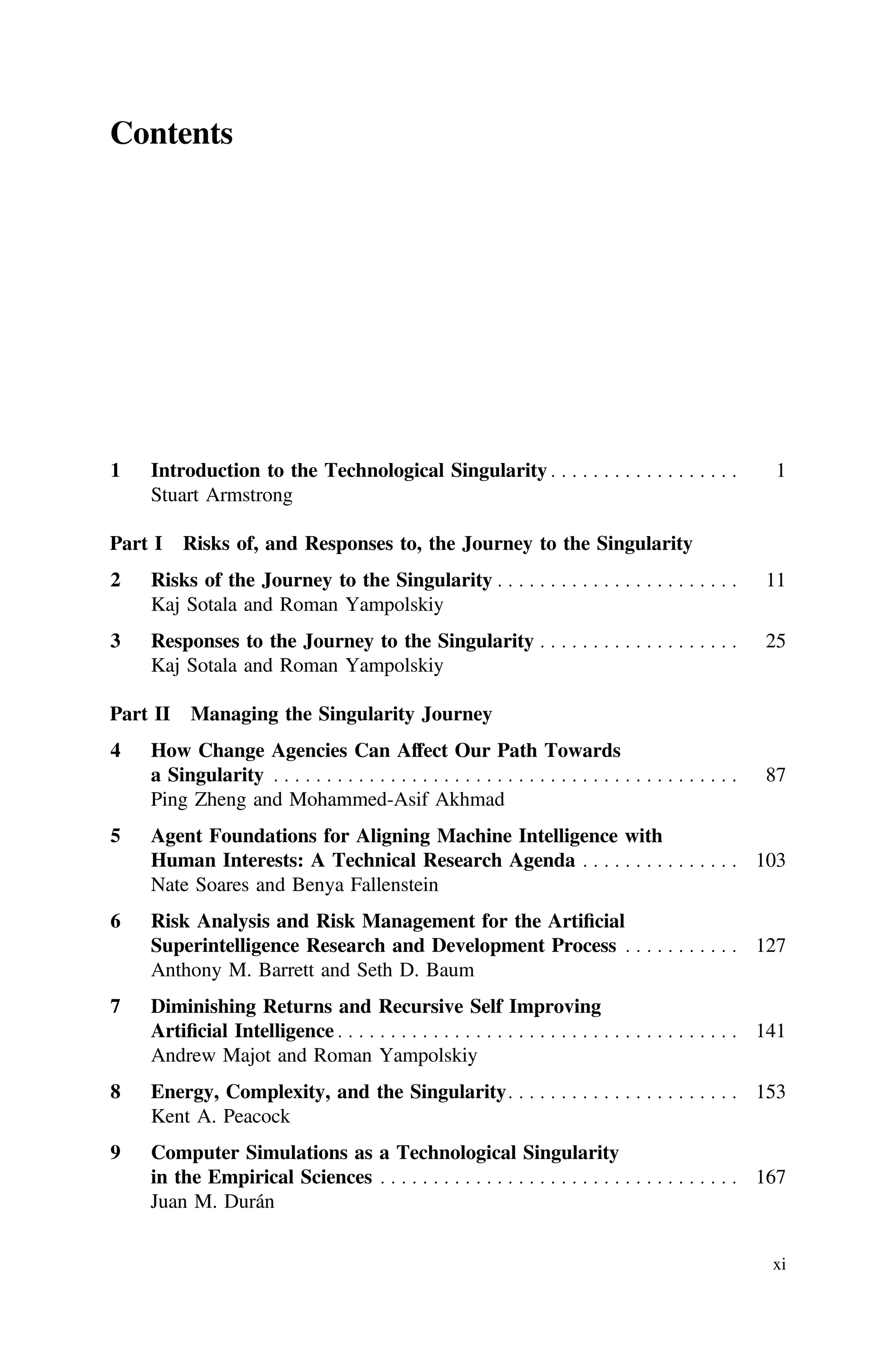
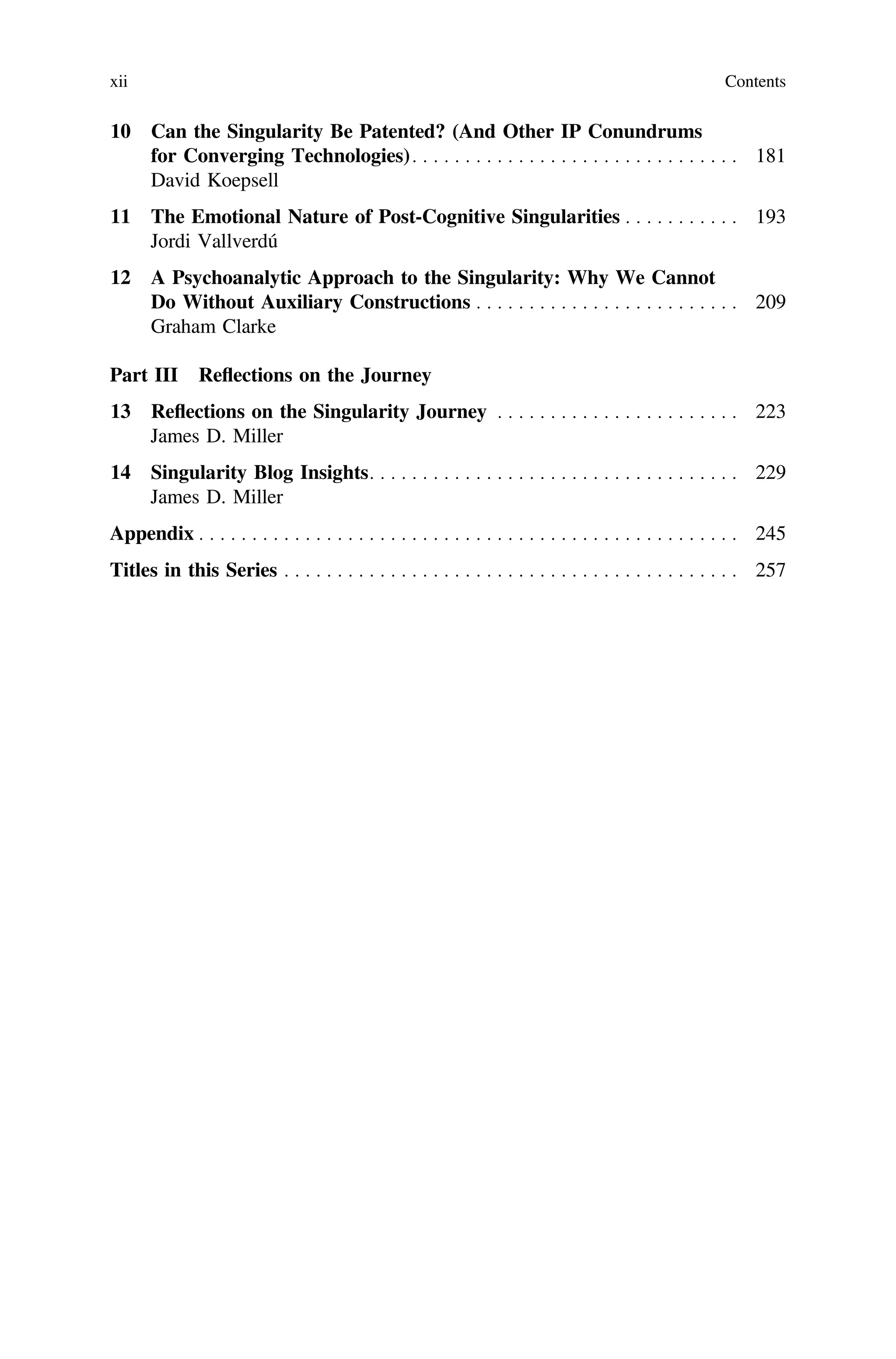
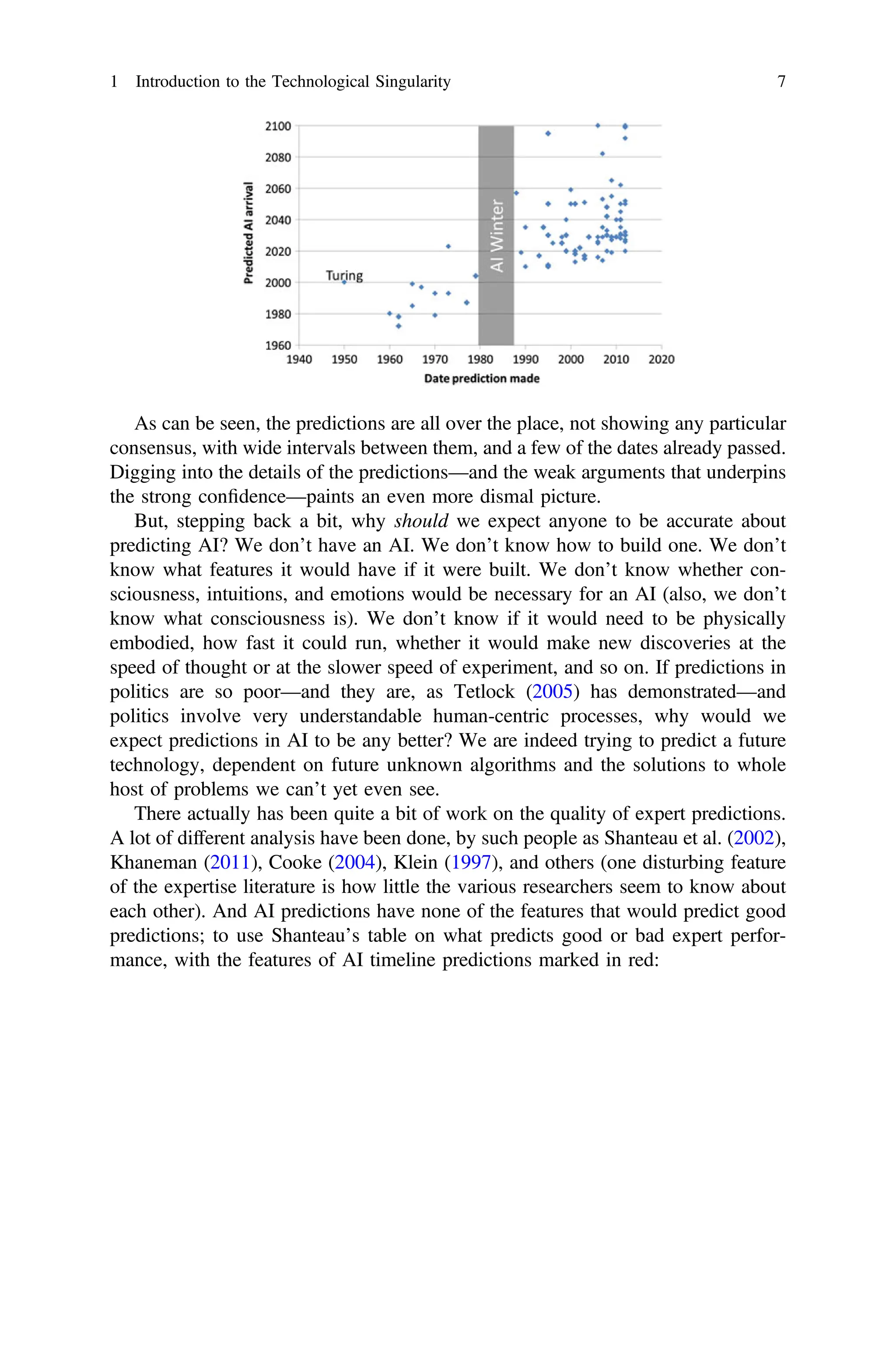
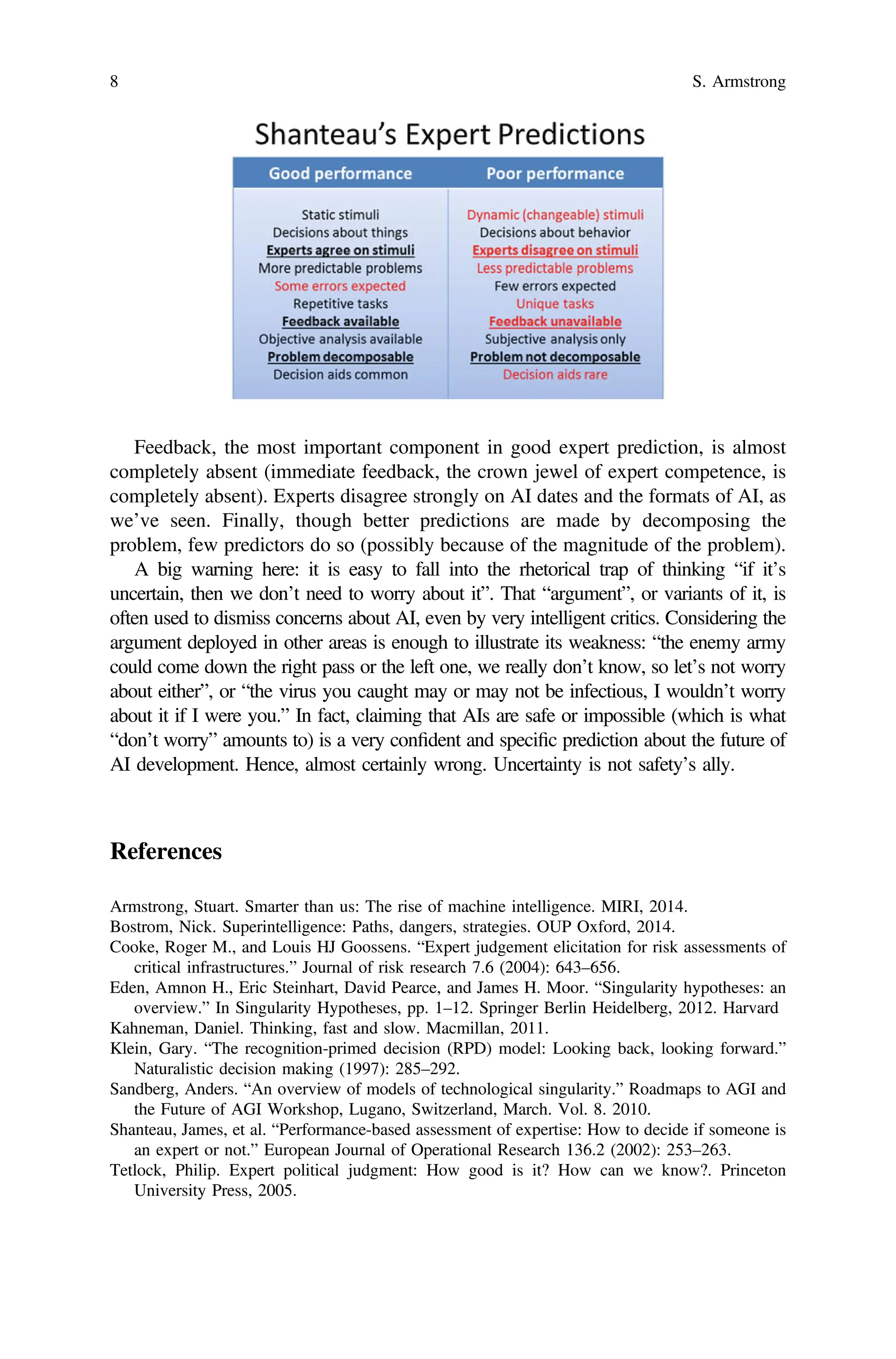

![Chapter 2
Risks of the Journey to the Singularity
Kaj Sotala and Roman Yampolskiy
2.1 Introduction1
Many have argued that in the next twenty to one hundred years we will create
artificial general intelligences [AGIs] (Baum et al. 2011; Sandberg and Bostrom
2011; Müller and Bostrom 2014).2
Unlike current “narrow” AI systems, AGIs
would perform at or above the human level not merely in particular domains (e.g.,
chess or arithmetic), but in a wide variety of domains, including novel ones.3
They
would have a robust understanding of natural language and be capable of general
problem solving.
The creation of AGI could pose challenges and risks of varied severity for
society, such as the possibility of AGIs outcompeting humans in the job market
(Brynjolfsson and McAfee 2011). This article, however, focuses on the suggestion
K. Sotala
Foundational Research Institute, Basel, Switzerland
e-mail: kaj.sotala@foundational-research.org
R. Yampolskiy (✉)
University of Louisville, Louisville, USA
e-mail: roman.yampolskiy@louisville.edu
1
This chapter is based on three earlier publications (Sotala and Yampolskiy 2015; Sotala
and Yampolskiy 2013; Yampolskiy 2013).
2
Unlike the term “human-level AI,” the term “Artificial General Intelligence” does not necessarily
presume that the intelligence will be human-like.
3
For this paper, we use a binary distinction between narrow AI and AGI. This is merely for the
sake of simplicity we do not assume the actual difference between the two categories to necessarily
be so clean-cut.
© Springer-Verlag GmbH Germany 2017
V. Callaghan et al. (eds.), The Technological Singularity,
The Frontiers Collection, DOI 10.1007/978-3-662-54033-6_2
11](https://image.slidesharecdn.com/2943098-250518120647-ea63737a/75/The-Technological-Singularity-Managing-The-Journey-1st-Edition-Victor-Callaghan-26-2048.jpg)

![Conference—AFIPS ’67 (Spring), 483–485. New York: ACM Press. doi:10.1145/1465482.
1465560.
Anderson, Michael, and Susan Leigh Anderson, eds. 2011. Machine Ethics. New York:
Cambridge University Press.
Arkin, Ronald C. 2009. Governing Lethal Behavior in Autonomous Robots. Boca Raton, FL: CRC
Press.
Baum, Seth D., Ben Goertzel, and Ted G. Goertzel. 2011. “How Long Until Human-Level AI?
Results from an Expert Assessment.” Technological Forecasting and Social Change 78 (1):
185–195. doi:10.1016/j.techfore.2010.09.006.
Bostrom, Nick. 1998. “How Long Before Superintelligence?” International Journal of Futures
Studies 2.
Bostrom, Nick. 2002. “Existential Risks: Analyzing Human Extinction Scenarios and Related
Hazards.” Journal of Evolution and Technology 9. http://www.jetpress.org/volume9/risks.html.
Bostrom, Nick. 2012. “The Superintelligent Will: Motivation and Instrumental Rationality in
Advanced Artificial Agents.” In “Theory and Philosophy of AI,” edited by Vincent C. Müller.
Special issue, Minds and Machines 22 (2): 71–85. doi:10.1007/s11023-012-9281-3.
Bostrom, Nick. 2014. Superintelligence: Paths, dangers, strategies. Oxford University Press.
Bostrom, Nick, and Milan M. Ćirković. 2008. “Introduction.” In Bostrom, Nick, and Milan M.
Ćirković, eds. Global Catastrophic Risks. New York: Oxford University Press., 1–30.
Brynjolfsson, Erik, and Andrew McAfee. 2011. Race Against The Machine: How the Digital
Revolution is Accelerating Innovation, Driving Productivity, and Irreversibly Transforming
Employment and the Economy. Lexington, MA: Digital Frontier. Kindle edition.
Bugaj, Stephan Vladimir, and Ben Goertzel. 2007. “Five Ethical Imperatives and Their
Implications for Human-AGI Interaction.” Dynamical Psychology. http://goertzel.org/
dynapsyc/2007/Five_Ethical_Imperatives_svbedit.htm.
Butler, Samuel [Cellarius, pseud.]. 1863. “Darwin Among the Machines.” Christchurch Press,
June 13. http://www.nzetc.org/tm/scholarly/tei-ButFir-t1-g1-t1-g1-t4-body.html.
CFTC & SEC (Commodity Futures Trading Commission and Securities & Exchange Commis-
sion). 2010. Findings Regarding the Market Events of May 6, 2010: Report of the Staffs of the
CFTC and SEC to the Joint Advisory Committee on Emerging Regulatory Issues. Washington,
DC. http://www.sec.gov/news/studies/2010/marketevents-report.pdf.
Chalmers, David John. 2010. “The Singularity: A Philosophical Analysis.” Journal of
Consciousness Studies 17 (9–10): 7–65. http://www.ingentaconnect.com/content/imp/jcs/
2010/00000017/f0020009/art00001.
Congress, US. 2000. National Defense Authorization, Fiscal Year 2001, Pub. L. No. 106–398, 114
Stat. 1654.
Dahm, Werner J. A. 2010. Technology Horizons: A Vision for Air Force Science & Technology
During 2010-2030. AF/ST-TR-10-01-PR. Washington, DC: USAF. http://www.au.af.mil/au/
awc/awcgate/af/tech_horizons_vol-1_may2010.pdf.
Good, Irving John. 1965. “Speculations Concerning the First Ultraintelligent Machine.” In
Advances in Computers, edited by Franz L. Alt and Morris Rubinoff, 31–88. Vol. 6. New
York: Academic Press. doi:10.1016/S0065-2458(08)60418-0.
Hall, John Storrs 2008. “Engineering Utopia.” In Wang, Goertzel, and Franklin 2008, 460–467.
Hanson, Robin. 1998. “Economic Growth Given Machine Intelligence.” Unpublished manuscript.
Accessed May 15, 2013. http://hanson.gmu.edu/aigrow.pdf.
Hanson, Robin. 2008. “Economics of the Singularity.” IEEE Spectrum 45 (6): 45–50. doi:10.1109/
MSPEC.2008.4531461.
Hollerbach, John M., Matthew T. Mason, and Henrik I. Christensen. 2009. A Roadmap for US
Robotics: From Internet to Robotics. Snobird, UT: Computing Community Consortium. http://
www.usrobotics.us/reports/CCC%20Report.pdf.
Joy, Bill. 2000. “Why the Future Doesn’t Need Us.” Wired, April. http://www.wired.com/wired/
archive/8.04/joy.html.
Legg, Shane, and Marcus Hutter. 2007. “A Collection of Definitions of Intelligence.” In Advances
in Artificial General Intelligence: Concepts, Architectures and Algorithms—Proceedings of the
2 Risks of the Journey to the Singularity 21](https://image.slidesharecdn.com/2943098-250518120647-ea63737a/75/The-Technological-Singularity-Managing-The-Journey-1st-Edition-Victor-Callaghan-36-2048.jpg)

![tureen—enclosed for many years the precious relic. What became of the
poignard I know not.
The pious Anselmo was buried with great pomp, and numberless
miracles have been wrought at his grave;—the mischievous fairy feared to
return to a place purified by so holy a person;—the passage leading to the
subterranean apartments has long been filled up;—and the miraculous
bridge decayed and was carried away by the stream.
We have put up a cross to scare away evil spirits; but they nevertheless
say, that strange noises are yet heard, and flickering lights occasionally seen
in the vicinity. I do not attach much credit to such tales. “Fallax vulgi
judicium,” (the good Father loved a scrap of Latin) and—producing from
his pocket a white cambric handkerchief, and wiping his forehead with it, as
if to show he had some notion of the use to which the cavern was at the
present day applied, he added—“I dare say you are equally sceptical.”—I
will now, Don Carlos, wish you a pleasant Siesta—“Dios guard’
usted.”[108]](https://image.slidesharecdn.com/2943098-250518120647-ea63737a/75/The-Technological-Singularity-Managing-The-Journey-1st-Edition-Victor-Callaghan-60-2048.jpg)
![CHAPTER VIII.
DEPARTURE FOR MALAGA—SCENERY ON AND DANGERS OF THE
ROAD TO EL BURGO—FINE VIEW FROM CASARABONELA—AN
INDEPENDENT INNKEEPER—A SPANISH BATTLE, ATTENDED WITH
MORE DECISIVE RESULTS THAN USUAL—DESCRIPTION OF
CASARABONELA—COMELINESS OF ITS WASHING NYMPHS—ROAD
TO MALAGA—RIVER GUADALJORCE—SIGILA OF THE ROMANS—
CARTAMA.
BIDDING adieu to Ronda,—its fruitful groves, crystal springs, snow-
white bread, and jet-black eyes,—we will take the road to Malaga.
At about a mile and a half from the town, the road arrives at and passes
under a long aqueduct, by means of which a stream is conveyed across the
valley, for the supply of the fountains of the Mercadillo; thereby saving to
its inhabitants the expense of sinking deep wells in the rocky hill.
At the end of another half league, the road having gained a slight
acclivity, commands a fine view of the venerable old city and its fertile
plain; but diving thence into a dark and narrow ravine, a contrast of the
wildest character presents itself, and the road winds for many miles
amongst the rugged roots of the old women’s teeth, already noticed.—These
have certainly not had the effect of grinding the path smooth—for a more
execrable trocha it never has been my fate to ride over. Part of it is so bad,
—resembling a petrified honeycomb of Brobdignag dimensions,—that our
horses had to pause at every step, and consider into which of the holes
presented to their choice they should next venture to put their feet.
The scenery is splendid. It consists of terrific precipices and impending
mountains—foaming torrents and rustic bridges—umbrageous oaks and
wide-spreading cork trees. But our enjoyment of these wild beauties was
considerably diminished, as well by the torrents of rain that fell without
ceasing from the time of our entering the mountains, as from the attention it
was necessary to give our horses.
Our progress, necessarily slow over this camino de perdices,[109] was
yet further retarded by numberless trains of loaded mules, which, having
left Ronda with the earliest dawn, had gained an advance upon us over the](https://image.slidesharecdn.com/2943098-250518120647-ea63737a/75/The-Technological-Singularity-Managing-The-Journey-1st-Edition-Victor-Callaghan-61-2048.jpg)
![plain, and, labouring under the bulky produce of the fair, were filing slowly
along the same narrow track as ourselves, restricting our pace to an average
rate of something less than three miles an hour. Vain were all our
endeavours to gain the head of the lengthened column;—for though we
seized every opportunity the rugged road presented of pushing on with our
less burthened animals, yet no sooner had we succeeded in passing one
string of mules, than we found ourselves in contact with the tail of another.
Gradually, however, the Cafilas[110] became wider and wider apart; and
on arriving within a few miles of the town of El Burgo, an open and
comparatively level space presenting itself, unobstructed by man or beast,
we began to indulge the hope that our perseverance had earned its reward,
and that thenceforth a clear road lay before us. Our impatient steeds gladly
availed themselves of the permission to quicken their pace; but five
minutes’ canter carried us across the verdant glade, when we again found
ourselves immured within a rocky ravine, shadowed by the dark forest, and
—to our disappointment—in contact with yet another string of mules and
boricos.
The pass was more rugged than any we had hitherto met with, and the
sure-footed animals, with noses almost touching the stony path, were
scrambling down the rough descent with caprinine agility; though
sometimes—thrown off their equilibrium by the size rather than the weight
of their burthens,—they would stagger from side to side, so as to make their
destruction appear inevitable. Righting themselves, however, in the most
scientific manner, and making a short pause, as if to recover their self-
possession, they would resume their perilous undertaking, without further
incitement than an “arre!”[111] glad enough not to feel the usual
accompaniment on their houghs or ribs.
Considering it advisable to follow the muleteers’ example, we too
allowed our beasts to use their own discretion in the selection of their
stepping-places by giving them their heads; and, folding our cloaks about
us, so as to afford the utmost possible protection against the pelting storm,
we resigned ourselves to fate; there being nothing for it, as the philosophic
Sancho says, but patience and a shrug of the shoulders.
Whilst proceeding with our necks thus in chancery—sliding, stumbling,
and dripping along, in rear of the closely formed column—we came most
unexpectedly upon a peasant, mounted on a sleek mule, who, taking](https://image.slidesharecdn.com/2943098-250518120647-ea63737a/75/The-Technological-Singularity-Managing-The-Journey-1st-Edition-Victor-Callaghan-62-2048.jpg)
![advantage of a favourable spot, had drawn up on the road side to allow the
train to pass. The circumstance of his being the only person we had met
journeying towards Ronda, would of itself have caused us to notice him, but
there was something in the man’s deportment that peculiarly attracted
observation. In the first place, he suffered all his fellow-countrymen to pass
without deigning to return their usual courteous salutation; in the next, he
was smoking a tabaco[112] instead of a papelito; and, lastly, he was muffled
up so completely in his manta that every part of his dress was concealed,
and of his face little more than the eyes could be seen. These were dark,
piercing, and inquisitive, and their sidelong glances, evidently following
their owner’s thoughts, were directed with searching scrutiny on the
tempting bales that passed successively before him.
So thoroughly was the attention of this person devoted to this interesting
examination, that, concealed as we were by the moving mountains of
Manchester goods which preceded us, our military cortège, bringing up the
rear of the column, took him completely by surprise. For the moment all
presence of mind forsook him. His left arm, by an instinctive jerk, removed
the hat from his head; disclosing a most sinister countenance, and a brace of
pistols stuck in his worsted sash; whilst, with the other, he hurriedly made
the cruz de admirado,[113] muttering, at the same time, the usual passing
benediction. With the flurry of a person exerting himself to appear
composed, he then, to our great amusement and astonishment, began
singing one of the peculiar ditties of the arrieros, at the very extent of his
voice.
These sudden transitions, first from arrogance to servility, then from
alarm to merriment, struck us all very forcibly; and each was pondering to
himself,—for it rained too hard to render talking agreeable,—what could
possibly have given rise to them, when, reaching the bottom of the descent,
a sharp turn in the road brought us in view of a party of some twelve or
fifteen persons, who, partially concealed in a thicket of underwood, were
assembled under the shelter of a huge cork tree, about fifty paces off the
road. Though habited as Contrabandistas, they were armed up to the teeth,
and had a far more offensive than defensive appearance. Most of the party
were grouped round the stem of the huge tree, under protection of which a
fire was struggling for existence against the storm and rain; but some of the](https://image.slidesharecdn.com/2943098-250518120647-ea63737a/75/The-Technological-Singularity-Managing-The-Journey-1st-Edition-Victor-Callaghan-63-2048.jpg)
![men were scattered amongst the brushwood, and seemed to be girthing up
and preparing their horses for a start.
All eyes were anxiously fixed upon us the moment we came in sight,
showing that the muleteer’s song had not been a spontaneous outbreak of
hilarity; and the examination of our persons was evidently productive of
some little distrust and apprehension; for though the folds of our capacious
cloaks screened our persons most effectually from view, yet the glazed caps
that protruded above, and the steel scabbards that peeped out below,
sufficiently showed our military calling.
A short and hurried consultation was the result of their scrutiny. That
ended, one of the party, who seemed to be its chief, stepped a few paces
towards us, whilst the rest, as if wishing to avoid observation, resumed their
interrupted occupation at the fire.
The person who thus put himself forward was a handsome, jolly-looking
fellow, who, despite the heat of some fifty Andalusian summers, was
bordering on corpulency. Richly dressed and well armed (as well with
assurance as with blunderbuss and pistols), he was, in every sense of the
word, un hombre de bigote;[114] and, saluting our party most courteously,
he requested our knightships would alight and warm ourselves at their fire;
and, if we could put up with road-way fare, partake of their poor breakfast.
Treating this invitation as—that which no doubt it was meant to be,—a
mere compliment d’usage, we politely, but with the brevity which the
Spanish language admits of, excused ourselves (for the weather was anti-
ceremonious), and passed on without even exchanging a single word
amongst ourselves.
That fatal effects are frequently the consequence of too great loquacity,
no one will venture to dispute; but that similar results should spring from
over-taciturnity, many may be disposed to controvert. Voltaire (I think)
relates a ludicrous story of some drowning Dutchmen, who would not part
with their pipes to cry help; but the fact may be doubted. In the present
case, however, several luckless wights were actually throttled for want of
one saving word of English!—But I am anticipating the catastrophe of our
adventure, if so it deserve to be called.
We had no sooner passed beyond hearing of the suspicious-looking
troop, than a peasant, who had stuck close to our heels all the morning, rode
up to inform us that the persons we had just met were muy mala gente,[115]](https://image.slidesharecdn.com/2943098-250518120647-ea63737a/75/The-Technological-Singularity-Managing-The-Journey-1st-Edition-Victor-Callaghan-64-2048.jpg)
![Spain, and which, though certainly more pleasing to the eye, is not
considered so favourable to the fruit as that usually adopted.
The Inn looked dirty and comfortless, and its keeper was so imbued with
the constitutional doctrines of liberty and equality,—then much in vogue,—
that he would hardly condescend to answer our questions concerning
accommodation, and was perfectly indignant at our suggesting the
expediency of his rising from his seat, and showing us the way to his stable.
—“There was the door of his house if we chose to enter; if not, we had but
to suit ourselves elsewhere.”
Aware that the town did not possess another posada, and that the nearest
Venta on the road was at a distance of several leagues, the dignified
innkeeper trusted, from the lateness of the hour, that we should necessarily
be obliged to place ourselves at his mercy. We, on the other hand,
determined, if possible, to obtain accommodation elsewhere, and seeing the
lady-owner of the adjoining house standing at her door, asked her if she
knew any one who, for a handsome consideration, would furnish us with a
night’s lodging.
After a short parley, it was agreed that her house and stable should be
placed at our “disposicion” for the night, and sundry of our hard dollars at
her’s in perpetuity. The publican—who, pending the negociation, sat at his
portal puffing a cigar, affecting the utmost indifference to its result, but in
reality listening impatiently to every word that passed—no sooner found
how good a thing had slipped through his fingers, than he started up in the
most ungovernable passion, venting his rage upon our buxom hostess,
somewhat in the following strain—“Mala Pascua te dé Dios! Hija de puta
ruin![116]—May you be burnt for a witch before the year’s over, for taking
the bread out of a neighbour’s mouth!—May the ghost of your cuckold
husband appear at your bedside this night, you shameless wanton!—
May”—“Que chusco es el tuerto!”[117] interrupted the incensed fair one, in
a scream that completely drowned the rest of his good wishes, to whatever
extent they may have been carried—“Look at home, Cabron,[118] ere you
call an honest man cuckold, and a virtuous woman wanton.”—“Virtuous
woman, indeed!” resumed he of the Venta; “and admits four smooth-
chinned Ingleses into her house, to say nothing of their two stout grooms,
and that monkey-faced Portuguese, their guide; whom I know right well,](https://image.slidesharecdn.com/2943098-250518120647-ea63737a/75/The-Technological-Singularity-Managing-The-Journey-1st-Edition-Victor-Callaghan-67-2048.jpg)
![though he has grown fat under English feeding; and whom, fat or lean, no
virtuous woman would suffer within reach of her nostrils.”
This unlooked-for attack on “lazy Antonio” drew a furious cross-fire
upon the irritated Ventero; for whilst our hostess flinched not one inch from
his direct and somewhat scandalous assault—par pari referens—“Vosse
mercé” opened a fire of loud, nasal Portuguese-Spanish upon his flank, that
exceeded in noise the braying of a whole troop of asses.
This, in its turn, unkennelled the publican’s Cara Sposa. The combat
recovered its equilibrium, and seemed likely to be terminated only by the
coming night; for all our endeavours to withdraw the valorous Antonio
proved unavailing. But, in the words of the Manchegan Knight, “siempre
deja la ventura, una puerta abierta.”[119] The publican and his wife, though
proof against the reputation-killing batteries of their open enemies, could
not stand before an insidious covert attack that was now about to open upon
them.
The town’s people, amongst whom the liberal ventero did not appear to
be in good odour, flocked in crowds to the scene of action, and, though
professing to take no part in the fray, yet, by whooping, hollowing, and
laughing, whenever the widow and her Portuguese ally fired a successful
shot at their adversaries, they gave the former a “moral support,” that, in its
results, proved quite as efficacious as an active interference.
The Innkeeper—who hitherto had manfully confronted his opponents—
now saw that victory was no longer attainable, and abandoned the field;
leaving his light-tongued helpmate to cover his retreat. This task she
performed with consummate ability, supporting her nearly exhausted
volleys of words by screams of defiance, and various offensive
gesticulations. The last distinguishable turn of reproach that reached our
ears, was Alarbes![120] which she seemed to consider the ne plus ultra of
vituperation, and certainly was the very last epithet we had any right to
expect would be applied to fair-skinned mortals like ourselves, by such a
bronze-complexioned semi-morisco.
The battle over, and stable door unlocked,—the key of which, firmly
grasped in her right hand, had been the standard under which our hostess
had fought and conquered,—we led our tired horses in, leaving her to fire a
round of taunts in celebration of the victory.](https://image.slidesharecdn.com/2943098-250518120647-ea63737a/75/The-Technological-Singularity-Managing-The-Journey-1st-Edition-Victor-Callaghan-68-2048.jpg)
![CHAPTER IX.
UNPREPOSSESSING APPEARANCE OF MALAGA—DREAD OF YELLOW
FEVER—THE ALAMEDA—DERIVATION OF THE CITY’S NAME, AND
SKETCH OF ITS HISTORY—THE GIBRALFARO AND ALCAZABA—
CATHEDRAL—CIGAR MANUFACTORY—CALCULATION OF THE
SUPPLY AND CONSUMPTION OF CIGARS IN SPAIN—MALAGA
FIGURES—POPULATION—TRADE—WINE—HARBOUR—SOCIETY—
VISIT TO EL RETIRO—THE FANDANGO AND CACHUCHA.
THE appearance of Malaga on a near approach is mean and
unprepossessing; nor is this an optical deception, for the suburbs are
miserably poor and excessively dirty. This last, indeed, is a fault that the
city may be charged with generally; and such is the contempt in which the
virtue of cleanliness is held by the inhabitants, that, though the little river
Guadalmedina[121] winds its way through the heart of the city, requiring
only to be properly husbanded to keep the place sweet and clean; yet, from
mismanagement, it is itself suffered to become a nuisance; the scanty
stream left after supplying the fountains being in summer so obstructed by
heaps of filth, brought out from the city, and thrown into its wide bed, that
not having sufficient power to carry off the accumulated mass of corruption,
it serves only (by keeping it constantly moist) to render the process of
putrefaction more fetid and deadly.
The calm indifference with which the inhabitants of Malaga endure the
intolerable nuisance thus generated by their improvidence and indolence,
and the patience with which they look forward to the winter torrents to rid
them of it, contrast singularly enough with the immoderate alarm
occasioned by the arrival of a vessel from the Habana, and the haste with
which they send it from their port to undergo purification at Minorca. Thus,
whilst dreading most unwarrantably the importation of the yellow fever
from a place which, at the time, perhaps, was perfectly free from it, they
disregard altogether the little forcing-bed of miasmatic diseases, situated
under their own immediate noses.
The city, it is true, has suffered so severely from visitations of this
terrible disease, that the inhabitants may well dread its recurrence; but since
they are aware that Coin, Alhaurin, and other places in the neighbourhood,](https://image.slidesharecdn.com/2943098-250518120647-ea63737a/75/The-Technological-Singularity-Managing-The-Journey-1st-Edition-Victor-Callaghan-72-2048.jpg)
![situated in a purer atmosphere, are beyond its influence; surely they ought
to look at home for the causes of its fatal virulence, if not of its actual
production.
The winter torrents come down in great force, and, from the proximity of
the mountains, the Guadalmedina rises very suddenly; rendering a wide bed
quite necessary to carry it off, as well as strong walls to resist and direct it
in its course. But, in spite of these precautions, the lower portions of the city
are frequently inundated.
A wooden bridge, on stone piers, keeps up the communication between
the two parts of the city during sweet winter; but the bed of the river, which
is eighty yards wide, may be crossed dry-foot the greater part of the year.
The principal portion of the city is on the left bank of the Guadalmedina.
Indeed, the part situated on the western side is, properly speaking, only a
large suburb. The change on passing the bridge is most agreeable; the first
object that presents itself being the Alameda, a fine open space, lined on
three sides with handsome houses, and on the fourth open to the refreshing
westerly breezes. A shaded carriage drive goes round the quadrangle; and
down its centre, a broad gravel walk, furnished with seats, and planted with
flowers and shrubs, affords the public a delightful promenade.
On a Sunday evening this Paseo is crowded with all classes of the
inhabitants; and the dark voluptuous Malagueña, as, with mincing step, she
threads the motley throng, fails not to display her skill in fanning signals to
her various acquaintances. The stranger, whilst following, with admiring
eyes, the graceful movements of the fluttering parchment,[122] little
suspects that he is himself the subject matter of its telegraphic
communications.
Besides the Alameda, there are several fine open spaces in the city, but
certainly not one good street, although some few pretend to the convenience
of a trottoir. The inns are tolerably good. That which is dignified by the
name of “Los tres Reyes” was the best, at the period of my last visit.
Malaga is said by some to have received its name from the Hebrew work
Malach, (signifying to reign) and to have been founded by the Phœnicians,
eight centuries before the advent of our Saviour. Others, on the contrary,
maintain that its name is derived from the Phœnician language; the same
word Malach signifying in it to salt; and that the city was so called from the
quantity of fish taken and cured there. The learned Florez, who inclines to](https://image.slidesharecdn.com/2943098-250518120647-ea63737a/75/The-Technological-Singularity-Managing-The-Journey-1st-Edition-Victor-Callaghan-73-2048.jpg)
![this latter opinion, states that the cured fish of Malaga was so esteemed at
Rome that a body corporate of merchants was established in that Capital of
the world, under the name of Malacitani, as proved by an inscription found
in the Campo di Flora.
By the Romans the city was called Malaca; and became one of their
confederates, (of which there were but three in Bœtica) as well as the great
emporium for their Spanish trade; although Pomponius Mela speaks
slightingly of its importance.[123] It was captured by the Moors under Tarik,
A.D. 715; and probably such portions of the walls as still exist were built
about that period; but the fortress on the Gibralfaro, and the Alcazaba, or
Royal Palace, are said to have been erected only towards the end of the
thirteenth century; when the Moors, by the rapid progress of the Christian
arms, (which had already wrested from them both Cordoba and Valencia)
saw the necessity of strengthening the towns of their diminished territories.
Malaga had become a separate kingdom, however, as early as the
beginning of the eleventh century; when the Caliphat of Cordoba ceased
under the imbecile Haccham II.
The first who mounted the throne of Malaga was Ali Aben Hameth. But
it does not appear that the crown was regularly handed down in one family;
it seems rather to have been a constant object of strife; and its power over
other states seems to have varied according to the talents of him who wore
it; for sometimes we find the sovereign of Malaga owning obedience to the
Princes of Seville and Cordoba; at others claiming dominion over those
kingdoms; and generally, over the city of Granada.
Ishmael, a prince of the house of Alhamares, was the last king who dwelt
within the walls of the Alcazaba. From the time of his being called to the
throne of Granada, (A.D. 1313), Malaga was governed by a prince of the
royal blood.
Malaga was one of the last cities that fell to the Christian arms,
Ferdinand and Isabella having succeeded in capturing it, after an obstinate
siege, only five years prior to the conquest of Granada, viz., A.D. 1487.
The Gibralfaro is, or rather has been, a fortress of great strength and
considerable extent. Its ruins occupy the crest of a rugged mountain, from
which, and a signal tower that formerly stood on the summit, it receives its
present name, Gibel al faro.](https://image.slidesharecdn.com/2943098-250518120647-ea63737a/75/The-Technological-Singularity-Managing-The-Journey-1st-Edition-Victor-Callaghan-74-2048.jpg)
![Let me not lead my reader to suppose, however, that I dislike to see
stately temples raised for the worship of our Creator. On the contrary, the
lofty towers, high vaulted aisles, and gorgeous windows of many of our
Christian churches are well calculated to predispose the mind to devotion;
since, wonderful as they are, considered as works of man, how
contemptible do they appear, compared with the mighty works of our
Maker! and, viewed in this light, they cannot but impress us with a sense of
His power and our utter insignificance.
With such feelings I have ever regarded the splendid cathedrals of
Antwerp, Cöln, Rheims, Ratisbon, Vienna, &c., which are amongst the
number of those that remain to this day in a more or less unfinished state,
though, in other respects, they are some of the finest specimens of Gothic
architecture extant.
The cathedral of Malaga is of noble proportions, but of a heavy, over-
ornamented, composite style of architecture; and it is disfigured in an
extraordinary degree with gilt chapels, carved saints, and votive offerings. It
contains little worthy of notice besides the carved wood-work of the seats in
the choir, the jewels, dresses, &c., in the Tesoreria[124], and one good
painting by Alonzo Cano, in the chapel of the Rosario.
The tower of the cathedral is 300 feet in height, and commands a fine
view, though not equal to that obtained from the Gibralfaro, since this latter
includes the whole city, as well as the extensive plain of the Guadaljorce,
and the various ranges of mountains that stretch along the Mediterranean
shore between Monda and Marbella.
Immediately under the Alcazaba stands an immense and rather
handsome edifice, built not many years since for a custom-house; but,
meeting with few customers in that line of business, it has recently been
converted into a Royal cigar manufactory, and is now in a thriving
condition.
Previous to the establishment of this assistant, the Royal manufactory of
Seville had imposed on it the impossible task of supplying cigars and snuff
for the whole of Spain; and even now, with such additional means of
production, the demand is ten times greater than the two factories have the
power of furnishing, as the following statement will, I think, pretty clearly
show.](https://image.slidesharecdn.com/2943098-250518120647-ea63737a/75/The-Technological-Singularity-Managing-The-Journey-1st-Edition-Victor-Callaghan-76-2048.jpg)
![The manufactory of Malaga employs 700 persons (women and children)
in making cigars. A good pair of hands at the work may furnish three
hundred a day; but (as the children cannot make half that number), taking
the average at two hundred, gives a daily supply of 140,000. The
manufactory of Seville employs 1,000 men and 1,600 women. These 2,600
persons may be calculated as furnishing, on an average, 250 each per diem;
or, altogether, 650,000. Add to this number the 140,000 made at Malaga,
and we have 790,000 as the “total of the whole” manufactured daily in
Spain. But, as there are but six working days in the week, and seven
smoking—indeed the lungs ought to be calculated as doing double work in
Spain on Sundays and Saints’ days, whilst the hands are quite idle—we
must reduce that amount by one seventh, to obtain the average number of
cigars furnished for each day’s consumption throughout the year, which
amounts therefore but to 677,143.
Now, taking the population of the country at 11,000,000 of souls, and
supposing (which is a moderate computation) that but one million and a
half of that number are consumers of tobacco, it is evident that Spain, with
her present means, can supply her smokers with but seven sixteenths of a
cigar per ora, per diem; and, consequently, as my proposition advanced,
with less than one tenth part of the demand.
It follows, as a corollary, that great encouragement is given to the
pernicious habits of smuggling and smoking papelitos[125].
The persons employed in the manufacture of cigars are paid at the rate of
one real vellon for fifty, which enables even a first-rate maker to earn but
fifteen pence a day. The best cigars are made entirely of Habana tobacco,
and are sold at the factory at the rate of thirty reales vellon a hundred, or
about three farthings, English, each. The second quality, composed of
mixed tobaccoes, (that is, the interior of Habana leaf, and the outside of
Virginia) cost eighteen reales vellon per hundred, or something under a
half-penny each.
It may be seen, from this statement of the cost of cigars of the Royal
Manufactory, that smuggling cannot but prosper; since, at the Habana, the
very best cigars are sold for twelve dollars a thousand (or a trifle above a
half-penny each), whilst those of inferior quality may be had for one fourth
that price.](https://image.slidesharecdn.com/2943098-250518120647-ea63737a/75/The-Technological-Singularity-Managing-The-Journey-1st-Edition-Victor-Callaghan-77-2048.jpg)
![the preparation of which costs little, whilst they are always sure to find a
market and fetch a good price. The quantity exported is enormous.
The harbour of Malaga is artificially formed by a stone pier, that,
protruding upwards of a quarter of a mile into the sea, screens it perfectly
from the prevailing easterly gales. In the opposite direction it is nearly as
effectually sheltered by the coast itself, which bends for some distance to
the S.W. So that, in fact, the anchorage is exposed only to a due south wind,
which, besides being one that seldom blows in this part of the
Mediterranean, cannot, from the proximity of the African shore, occasion a
heavy swell.
The depth of water inside the mole is not sufficient to allow line of battle
ships to lie there; and the port is otherwise inconvenient, from the difficulty
of “making” it, when the wind is blowing strong on shore. But it is an
excellent place of refuge for steamers, which need not apprehend so much
the danger of getting on a lee shore. A light-house stands on the pier head,
and the entrance of the harbour is guarded by several batteries.
The society of Malaga is very changeable. During the constitutional
frenzy, the principal inhabitants were extremely liberal in their
entertainments, as well as in their ideas; were fond of bull-fights, dancing,
singing, ponch y huevos,[126] and even, because it was English, of bottled
porter. But a sad change afterwards came over them. These festive meetings
were, on the return of absolutism, deemed vulgar, democratical, and
illegitimate; and a more dull and gloomy city than Malaga, after the star of
liberty had set, can hardly be imagined. I speak, of course, of the Spanish
portion of the inhabitants only. The foreign merchants of the place have at
all times been, and still continue to be, noted for hospitality.
Most of the leading men of the city have country houses, to which they
retire with their families during the heat of summer. One of the most
delightful of these sin cuidados,[127] is “El Retiro de San Tomas,” situated
at the foot of the mountain range that bounds the vale of Malaga to the
west, and distant about eight miles from the city. This charming retreat is
said to occupy the site of a villa built by one of the Moslem sovereigns of
Malaga, and destroyed by the Spaniards in one of the devastating inroads
made upon the fertile valley of the Guadaljorce, in the time of Ferdinand
and Isabella. The present edifice, erected shortly after the kingdom of
Granada was annexed to the crown of Spain, was also a royal seat, and so](https://image.slidesharecdn.com/2943098-250518120647-ea63737a/75/The-Technological-Singularity-Managing-The-Journey-1st-Edition-Victor-Callaghan-79-2048.jpg)
![continued to be until the time of Philip V., who bestowed it upon an
illegitimate son, then bishop of the diocese; from whom, he being of the
order of San Domingo, it received its present name, El Retiro de San Tomas.
At his death it went to the Dominican convent, of which he was a member,
but has since passed into other hands, and, at the period of which I write,
was occupied by Mr. Roose, the consulgeneral of Prussia, who, in favour of
a letter of introduction with which I had been furnished, gave my friends
and self a most courteous reception.
The Retiro is celebrated for the rare productions and luxuriance of its
gardens, the fragrance of its orange and citron groves, the splendour of its
jets d’eau, and the beauty of the scenery it commands in all directions.
After seeing all the external sights of the place, we were introduced to
one of a much more novel character in Spain, viz., a large circle of ladies,
assembled round a steaming urn, in the fragrant enjoyment of a “cup of
tea.” We needed but little pressing to join in the imbibition of the refreshing
beverage, at all times acceptable, but especially in this country, where,
excepting in an apothecary’s shop, the cherished leaves of the invaluable
shrub are seldom to be seen. From the salon we were conducted to a
secluded part of the grounds, where another agreeable surprise awaited us,
the peasantry of the neighbourhood, decked out in their holiday suits,
having been assembled there, to do honour to the patron saint of the village,
by belabouring the gazon vert with an interminable fandango.
The natives of the south of Spain are passionately fond of this dance,
which, like a Scotch reel, is usually kept up as long as fingers or lungs can
be found to mark time for the exhibitors. A few notes thrummed on the
guitar are quite sufficient to set a fandango on foot; or, in default of that
instrument, a monotonous ditty chaunted by one of the bystanders answers
the purpose.
Sometimes, when the vocalist is a gracioso,[128] his part of the
performance is by far the most entertaining, as he will improvise couplets
on the various gymnasts, who, from time to time, relieve each other at the
laborious amusement, seasoning his verses plentifully with Andalusian wit.
This dance is certainly of Oriental parentage. It is the same, in fact, as
that of the Ghawazies of Egypt, but clothed with South of Europe decency.
The balancing movements of the arms are precisely the same in both, and
the contortions of the body differ but slightly, though the Spanish dancers](https://image.slidesharecdn.com/2943098-250518120647-ea63737a/75/The-Technological-Singularity-Managing-The-Journey-1st-Edition-Victor-Callaghan-80-2048.jpg)