1
A
Technical Seminar on
“The Study on Construction of Artificial Island”
Submitted in partial fulfillment of the requirements for the award of the degree
Of
BACHELOR OF TECHNOLOGY
In
CIVIL ENGINEERING
By
MD Ahmad Hussain
14G71A0101
Under the guidance of
Mr. B. Venkat M.Tech
Head of the Department
Department of Civil Engineering.
Department Of
CIVIL ENGINEERING
MADHIRA INSTITUTE OF TECHNOLOGY AND SCIENCES
(Accreditedby NBA, Approvedby A.I.C.T.E, NewDelhi,Affiliatedto JNTU,Hyd.)
Madhira Nagar, Kodad, Suryapet District,Telangana-508206
Phone: 08683-240377/99.Fax:240388
WEB:www.mitskodad.ac.in; E-MAIL:mits_g7@yahoo.co.in
2
MADHIRA INSTITUTE OF TECHNOLOGY AND SCIENCES
(Accreditedby NBA, Approvedby A.I.C.T.E, NewDelhi,Affiliatedto JNTU, Hyd.)
Madhira Nagar, Kodad, Nalgonda District,Telangana-508206
Phone: 08683-240377/99.Fax:240388
WEB:www.mitskodad.ac.in; E-MAIL:mits_g7@yahoo.co.in
Department of CIVIL
CERTIFICATE
This is to Certified that the industry oriented project entitled “The Study on
Construction of Artificial Island” is a bonafied work done by MD. Ahmad Hussain
14G71A0101 in partial fulfillment of Bachelor of Technology in “Civil Engineering”
from JNTU, Hyderabad during the academic year 2017-2018.
Mr. B. VENKAT M.Tech Mr. B.VENKAT M.Tech
Internal Guide Head of the Department
Assistant Professor Assistant Professor
3
ACKNOWLEDGEMENT
I express our sincere thanks to our guide Mr. B.VENKAT Asst. Prof. for giving us moral
support, kind attention and valuable guidance to us throughout this project work.
It isour privilege to thank, Mr. B.VENKAT, Asst. Prof. & our Head of the Department for his
encouragement during the progress of this project work.
It isour privilege tothank all Review Committee members for allowing us to do this report
and providing us all the facilities to do our project work.
It derives great pleasure in expressing our sincere gratitude to our Principal Dr. RUDRA
PRATHAP DAS for his timely suggestions, which helped us to complete this work successfully.
I thank to teaching and non-teaching staff members of Civil Department for their kind
cooperation and all sorts of help to bring out this project work successfully.
It is our privilege to thank management members for allowing us to do this project and
providing us all the facilities to do our project work.
In all sincerity,
MD. Ahmad Hussain
14G71A0101
4
CONTENTS
Page No
ABSTRACT 1
1. INTRODUCTION 2
2 DESIGN CONSIDERATIONS FOR ARTIFICIAL ISLAND CONSTRUCTION
4
3. LAND RECLAMATION PROCESS AND ITS ADVANTAGES ON
ARTIFICIAL ISLAND CONSTRUCTION 5
4. DIFFERENT TYPES OF LOADINGS ON ARTIFICIAL ISLANDS 7
5. CONSTRUCTION AND DESIGN PROBLEMS OF AN
ARTIFICIAL ISLAND 8
6. LIMITATIONS OF LAND RECLAMATION TECHNIQUES
FOR ARTIFICIAL ISLAND CONSTRUCTION 9
7. CONCLUSION 10
8. CASE STUDY
Palm islands an evolution of an artificial land on globe: 12
9. CONSTRUCTION OF PALM ISLANDS 15
10. CHALLENGES AND MEASURES ADOPTED 21
11. CONCLUSION 25
5
ABSTRACT
The advancement and development in construction field has changed the scenario of
world today and an artificial island has been perfect example to represent infrastructural
development at present time. An artificial island is landmark surrounded all sides by water
which is constructed artificially by means of human manpower with uses of advance
technologies and machineries. An artificial island is an application of various engineering
concepts that has brought a drastic change on construction technology. This report
incorporates the details about the construction process involved in artificial island like land
reclamation, dredging, soil-bed preparation, underwater concreting with various challenges
and advantages. Land Reclamation technique is the most crucial process used for
construction of artificial island which means preparation of new land from oceans, river beds
or lake beds. This report is all about procedures and impact analysis of land reclamation
process on artificial island construction. This concept has been mostly used on developed
countries like Qatar, Japan, etc and my main motive of studying about it is to grab depth
knowledge about its construction technologies and requirement so that we can use it on India
and many other countries to promote tourism industry as well as for geotechnical exploration.
Some contemporary projects are much more ambitious. Kansai International Airport is the
first airport to be built completely on an artificial island in 1994.Dubai is home to some of the
largest artificial island complexes in the world, including the three Palm Islands projects, The
World and the Dubai Waterfront, the last of which will be the largest in scale.
-
6
1. INTRODUCTION
An artificial island is man-made island constructed over sea, ocean or river beds. The
construction of artificial island is done by land reclamation, expansion of existing islets,
combining small group of islets and filling different materials over sea or an ocean bed. In
ancient periods they were constructed over lakes by driving piles into lake beds but at present
artificial islands are constructed using new technologies and land reclamation process is one
of common technique. Till present dates, some of the artificial islands that exist are Kansai
Airport (4km × 2.5 km) located in Osaka Bay, Japan and The Palms (50 km2 ) located in
Dubai. The construction methodologies for artificial island using land reclamation techniques
commonly involve three major procedures and with site conditions and requirements there
may be some changes. These major three stages of artificial island construction are:
 Remediation of seabed
 Construction of sea defenses (sea wall)
 Fill
Remediation of seabed consists of reforming the seabed in case of settlement problem.
Remediation process varies from island to island due to different soil characteristics and
geological features. For example different type of remediation process was used to stop
settlement on artificial island construction of the Kansai International Airport located in
Japan. Due to presence of Holocene clay layer in seabed, there was occurring differential
settlement problem and it was reduced by help of sand drain method which artificially speed
up the remediation process. The sand drain process helped to minimize settlement problem
within one year else it would have taken a longer period (more than a decade).
7
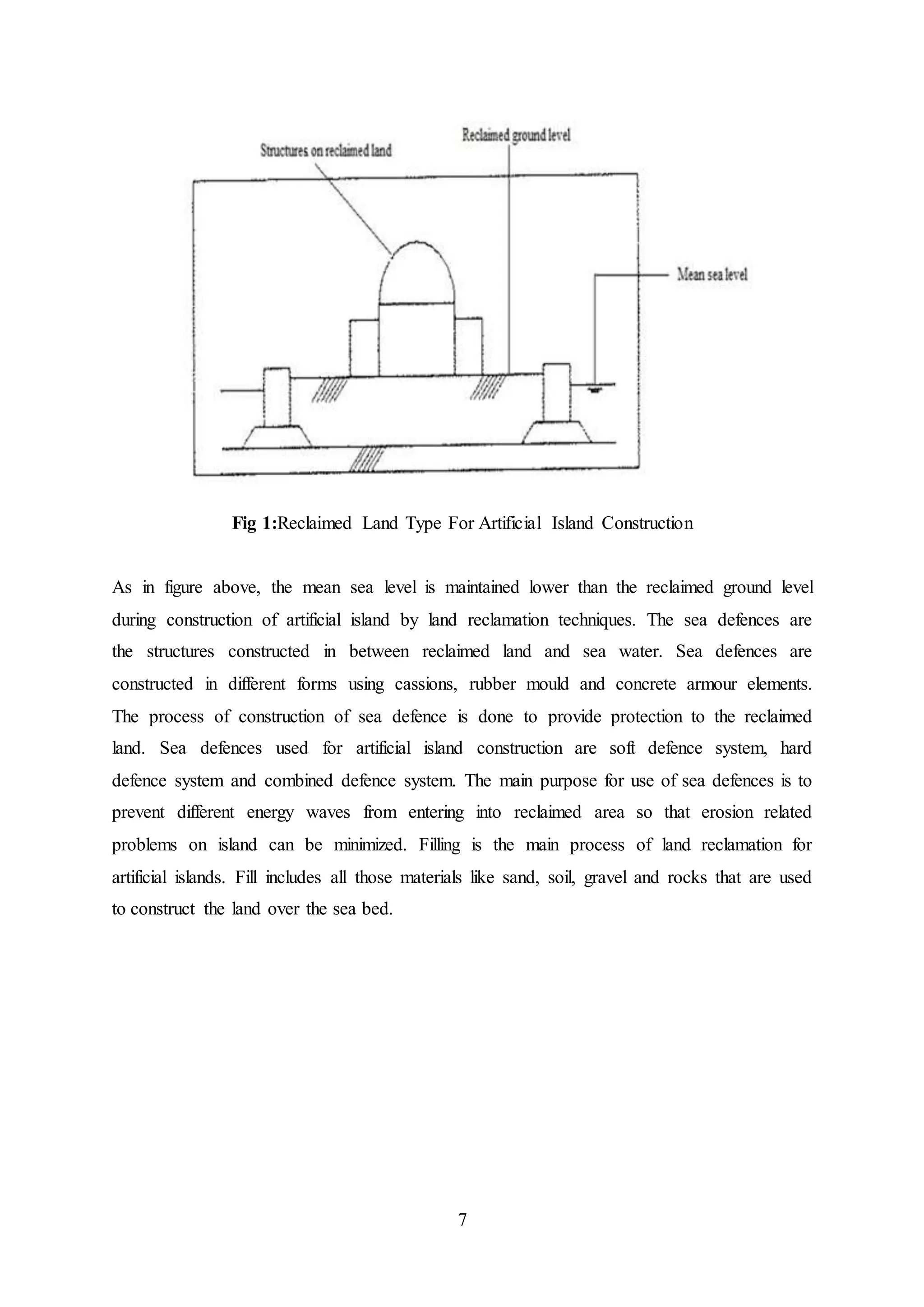
Fig 1:Reclaimed Land Type For Artificial Island Construction
As in figure above, the mean sea level is maintained lower than the reclaimed ground level
during construction of artificial island by land reclamation techniques. The sea defences are
the structures constructed in between reclaimed land and sea water. Sea defences are
constructed in different forms using cassions, rubber mould and concrete armour elements.
The process of construction of sea defence is done to provide protection to the reclaimed
land. Sea defences used for artificial island construction are soft defence system, hard
defence system and combined defence system. The main purpose for use of sea defences is to
prevent different energy waves from entering into reclaimed area so that erosion related
problems on island can be minimized. Filling is the main process of land reclamation for
artificial islands. Fill includes all those materials like sand, soil, gravel and rocks that are used
to construct the land over the sea bed.
8
2. DESIGN CONSIDERATIONS FOR ARTIFICIAL ISLAND
CONSTRUCTION
Before designing and commencement of artificial island constriction on any site of
sea beds or river beds we should collect various data and information. Some of major
information we have to collect for design of artificial islands is listed below:
 Water depth
 Wave height ranges
 Ice conditions
 Tidal range
 Currents
 Foundation conditions
 Earthquake risk
 Source of materials
 Shipping lanes
 Existing pipelines and cables
So these are important information we should have knowledge of before designing
any artificial island and on basis of these data our construction works are carried out. The
construction of any structures in an island is a serious challenge due to presence of water
currents, different tidal ranges, climatic variation sand earthquake; so before construction of
island there should be maximum effort from every part to minimize effects of earthquake,
wave currents, etc. e.g. Preparation of site by remediation of sea bed is essential to reduce the
effects of earthquake on the island.
9
3. LAND RECLAMATION PROCESS AND ITS ADVANTAGES
ON ARTIFICIAL ISLAND CONSTRUCTION
Land reclamation is the technique by which new land is formed or gained from sea
beds or wetlands. The land reclamation process for artificial island construction is common
method and is more preferable over breakwater construction and vibro-compaction methods.
The land reclamation method involves many steps and basic knowledge of these steps is also
included in this topic.
3.1. Soil bed preparation:
The preparation of soil bed on depth of ocean or sea for remediation of soil bed so
that uniform settlement of soil bed will occur under different loading conditions is initial step
for land reclamation. The preparation of soil bed requires a number of steps which includes
formation of isolation layer, provision of ballast (small rock pieces), surcharge for
preloading, drainage system construction and reducing soil voids.
3.2. Sand Placement:
The sand is major construction material required for land reclamation. Coarse grained
sands of good engineering qualities such as crushing strength, impact value, etc must be
located near to the site of island construction. The dumping of sand in site is done by using
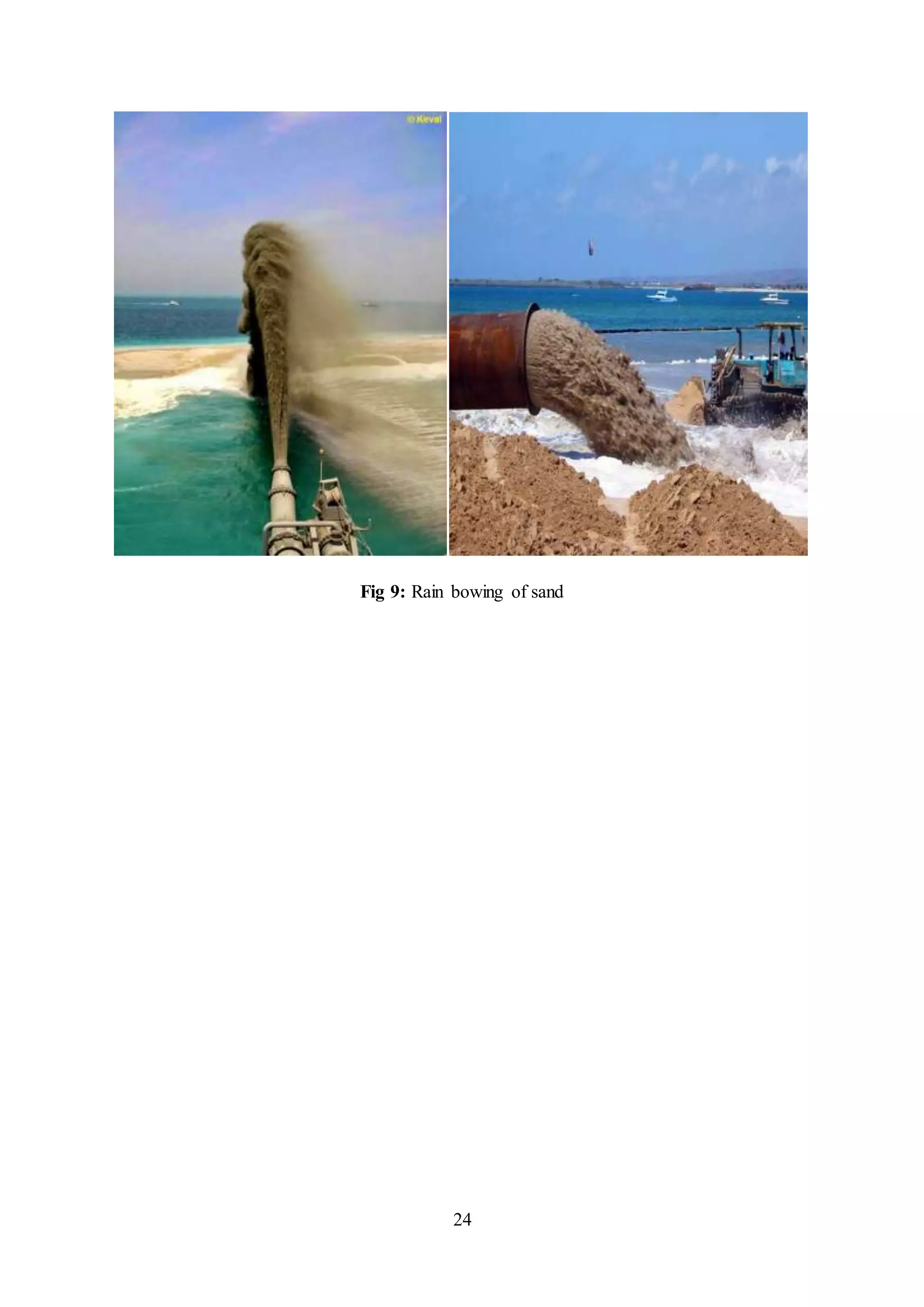
trailers. The dumping procedure varies with the water depth of the sea bed. Rain bowing
process is the common and fast method for placement of sand during land reclamation
process. After the placement of sand, a bitumen emulsion and sand is sprayed over it. Finally
plantation of grass is done to reduce erosion on the reclaimed land.
3.3. Dredging:
The process of excavating soil from marine sites like seas, ocean bottom or coastal
areas is called dredging. The dredging process is operated with help of various dredges and
trailers such as trailing section hopper dredgers. These dredgers work on repeating process of
dredging, loading transport to dumping site and dumping of load. The selection of dredges
depends on type of soil, depth of excavation, operation area and various machineries qualities
like cutter type, type and stroke of spud carriage. So, Dredging can be termed as the maritime
10
transportation of the natural minerals from water environment to any other dumping areas.
There are numerous advantages of using land reclamation process for island construction.
By land reclamation techniques, an artificial island can be constructed of any shape, any size
& anywhere. Land reclamation will definitely increase land area for a certain country. Mining
of natural resources such as oil and gas can be done with artificial island construction. The
generation of tidal and wind energy can be possible on artificial island zones. Reclamation of
a lot of lands from flooding will also be possible using this technique. Development of mass
tourism has been possible by construction of artificial island such as Palm Island located in
Dubai has collected a large amount of revenue from tourism sector.
11
4. DIFFERENT TYPES OF LOADINGS ON ARTIFICIAL
ISLANDS
The design and construction of any types of structures require the different types of
loading acting on structure, their magnitude and direction. The artificial islands are subjected
to three major types of loads: permanent loads, variable loads and natural or environmental
loads.
4.1. Permanentloads:
 Dead loads like weight of all types of structures calculated using nominal values,
 Permanently installed machineries and equipment’s
 Forces due to hydrostatic pressure during calm sea conditions calculated from sea
level,
 Loads due to ballasts used during filling process,
 Permanent earth pressure
4.2. Variable Loads:
 Different types of temporarily installed machineries and equipment’s such as
dredgers, trailers, etc.
 Differences in internal and external pressures of natural resources like water, oil, etc
caused by normal operating of structures
 Loads acting on island due to movement of vessels, landing of air vehicles, use of
cranes and drilling operations.
4.3. Environmental Loads:
 Wind loads and other loads caused by climatic variations on surroundings
 Loads due to wind, climatic variations of surrounding, tidal loads and currents
 Seismic loads due to earthquake and loads due to tsunamis
12
5. CONSTRUCTION AND DESIGN PROBLEMS OF AN
ARTIFICIAL ISLAND
There are always numerous challenges in every construction works. With various case
studies on different islands construction, some construction and design problems of an
artificial island are earthquake, morphological impacts, high costs and uneven settlements.
The earthquake can impact on sea defences and may cause liquefaction problems on soil.
Morphological impacts include erosion and accretion of soil on coastal lines and soil removal
at borrow sites. The cost of equipments during construction like dredgers, trailers and cost of
fill materials and sea defence is high which need more investments. Similarly undesirable
settlements of sea beds may also cause serious problem both during pre-construction and
post-construction. From economical point of view the construction artificial island is
restricted to water depth of 30m. So construction at depth more than the limit may cause
economic problems to investors.
13
6. LIMITATIONS OF LAND RECLAMATION TECHNIQUES
FOR ARTIFICIAL ISLAND CONSTRUCTION
There are various factors that may cause problems to use of land reclamation techniques
for artificial island construction. Some are listed below:
 As the process is very costly this can lead to financial crisis.
 Lack of machineries like trailers and dredgers may slow down the construction
procedure of island.
 Land reclamation process is a time consuming process of an island construction.
 Faulty construction process can cause settlement of the island in deep waters, as in the
case of Kansai Airport, Japan.
 Land reclamation can be damaging to corals and marine life.
 High probability of occurrence of natural calamities such as tidal forces, earthquake
and tsunami loads and due to these forces special provisions should be adopted during
design of an artificial island.
14
7. CONCLUSION
The establishment of industrial estates near to residential areas, working offices and
business zones has caused a lot of problems to human life due to air, land and noise pollution.
So, Construction of artificial island plays crucial role on preventing these environmental
problems by providing areas for establishment of industrial estates. So, my report can be a
platform of knowledge for many people and respective industrial organization about
minimizing environmental problems that has been causing serious problems these days.
The advancement in technologies in every field is very common these days. So
artificial island can also help in construction of extended runways, infrastructures like ports
and airports, etc which can bring a lot of luxury to a lot of people.
We are using our natural resources as source of energy from a very past which have
now resulted a vulnerable stage to a lot of nonrenewable natural resources. Artificial Island
can bring a lot of help on mining of natural resource mostly nonrenewable resources that can
help in our environment conservation.
People are fond of recreational activities these days and construction of artificial
island can be a lot of beneficial for mass tourism activity. E.g. Palm Island.
So, as a student of civil engineering it has been immense pleasure for me to study
about artificial island construction and I got idea that it can bring great revolution on civil
engineering technologies. Only a few countries have constructed artificial island and they
have been highly beneficial from environmental, economic and social point of view.
Developed countries like Qatar, China, Japan, etc are able to construct artificial islands and
observing its increasing benefits every country should consider the use of this technique in
civil engineering technology.
15
Largest artificial islands according to their size (reclaimed lands)
No. Name
Size
(km2)
Location
Year
built
Utilisation
1 Flevopolder 970 Netherlands 1968 Towns, agriculture
2 Yas Island 25
Abu Dhabi,
UAE
2018 Yas Marina Circuit
4
Kansai International
Airport
10.68[6] Japan 1994 Airport
3
Hong Kong
International Airport
9.4 Hong Kong 1998 Airport
5 Palm Jebel Ali 8 Dubai, UAE Unknown on hold
6
ChūbuCentrair
International Airport
6.8 Japan 2005 Airport
7 Palm Jumeirah[7] 6.5[7] Dubai, UAE Unknown Housing
8 Rokko Island 5.8 Japan 1992 Housing
9 Fundão Island[8] 5.23 Brazil 1983
Federal University of
Rio de Janeiro
10 Port Island 5.2 Japan 1981 Housing
16
8. CASE STUDY
Palm islands an evolution of an artificial land on globe:
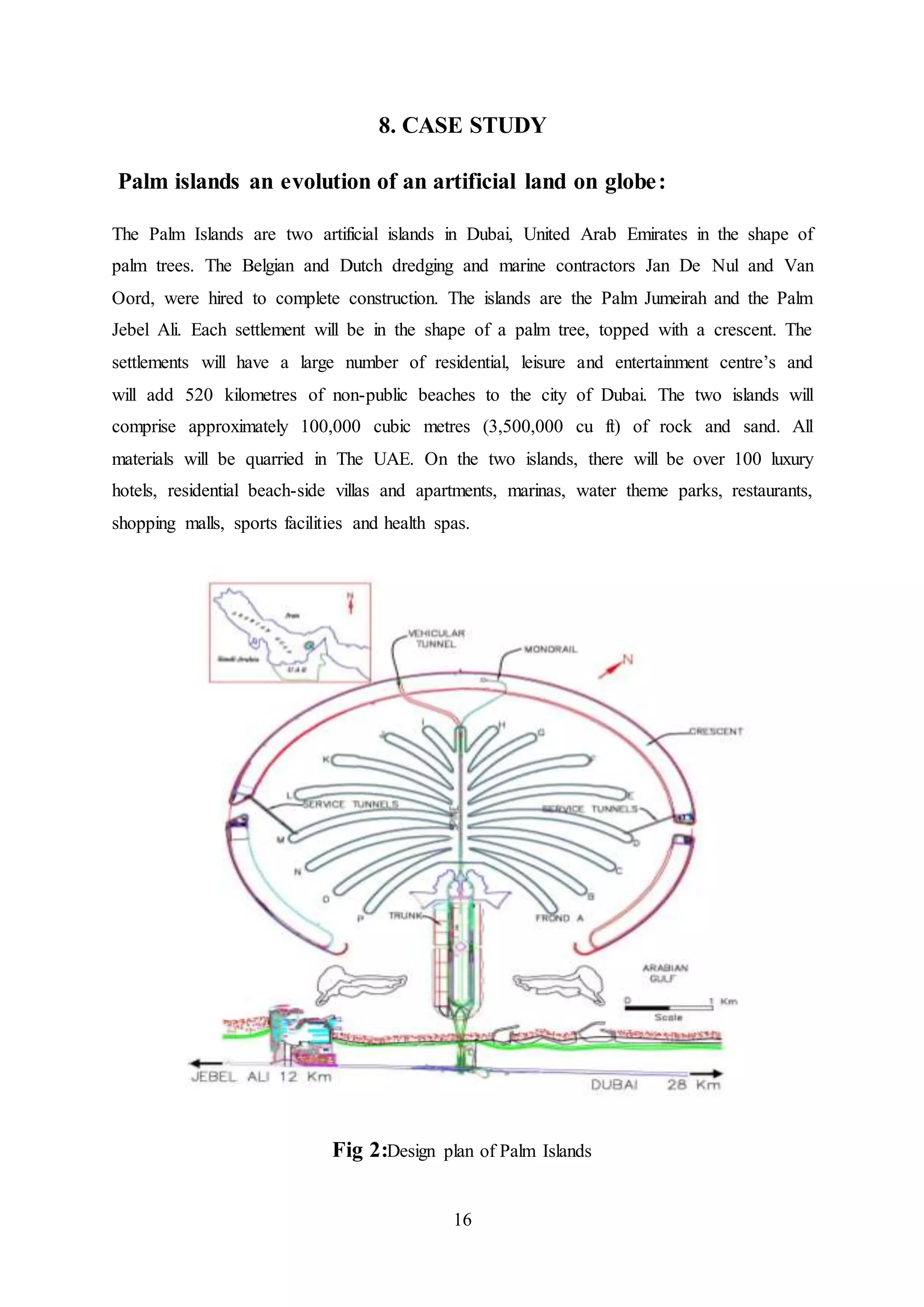
The Palm Islands are two artificial islands in Dubai, United Arab Emirates in the shape of
palm trees. The Belgian and Dutch dredging and marine contractors Jan De Nul and Van
Oord, were hired to complete construction. The islands are the Palm Jumeirah and the Palm
Jebel Ali. Each settlement will be in the shape of a palm tree, topped with a crescent. The
settlements will have a large number of residential, leisure and entertainment centre’s and
will add 520 kilometres of non-public beaches to the city of Dubai. The two islands will
comprise approximately 100,000 cubic metres (3,500,000 cu ft) of rock and sand. All
materials will be quarried in The UAE. On the two islands, there will be over 100 luxury
hotels, residential beach-side villas and apartments, marinas, water theme parks, restaurants,
shopping malls, sports facilities and health spas.
Fig 2:Design plan of Palm Islands
17
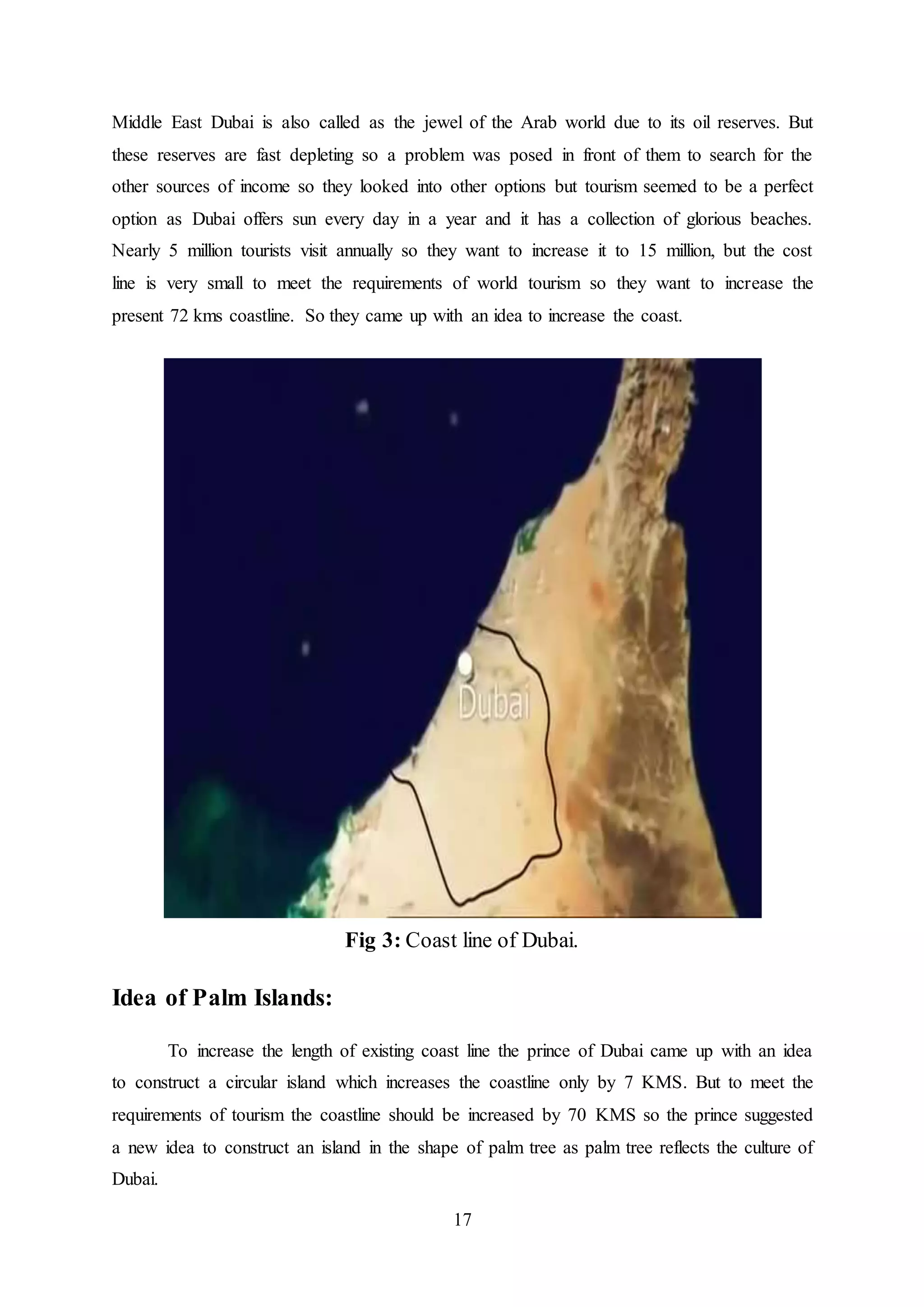
Middle East Dubai is also called as the jewel of the Arab world due to its oil reserves. But
these reserves are fast depleting so a problem was posed in front of them to search for the
other sources of income so they looked into other options but tourism seemed to be a perfect
option as Dubai offers sun every day in a year and it has a collection of glorious beaches.
Nearly 5 million tourists visit annually so they want to increase it to 15 million, but the cost
line is very small to meet the requirements of world tourism so they want to increase the
present 72 kms coastline. So they came up with an idea to increase the coast.
Fig 3: Coast line of Dubai.
Idea of Palm Islands:
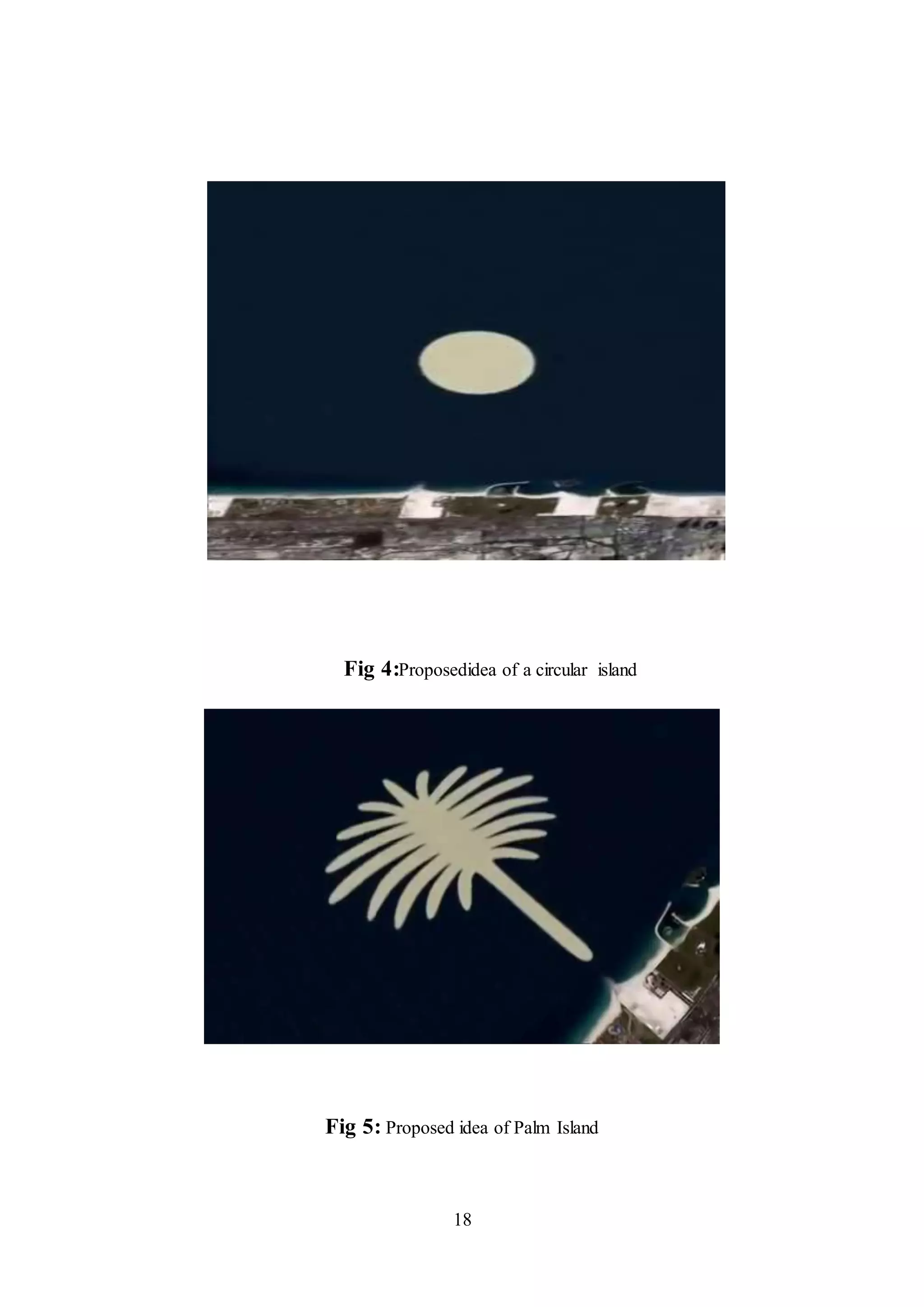
To increase the length of existing coast line the prince of Dubai came up with an idea
to construct a circular island which increases the coastline only by 7 KMS. But to meet the
requirements of tourism the coastline should be increased by 70 KMS so the prince suggested
a new idea to construct an island in the shape of palm tree as palm tree reflects the culture of
Dubai.
18
Fig 4:Proposedidea of a circular island
Fig 5: Proposed idea of Palm Island
19
9. CONSTRUCTION OF PALM ISLANDS
Break water construction:
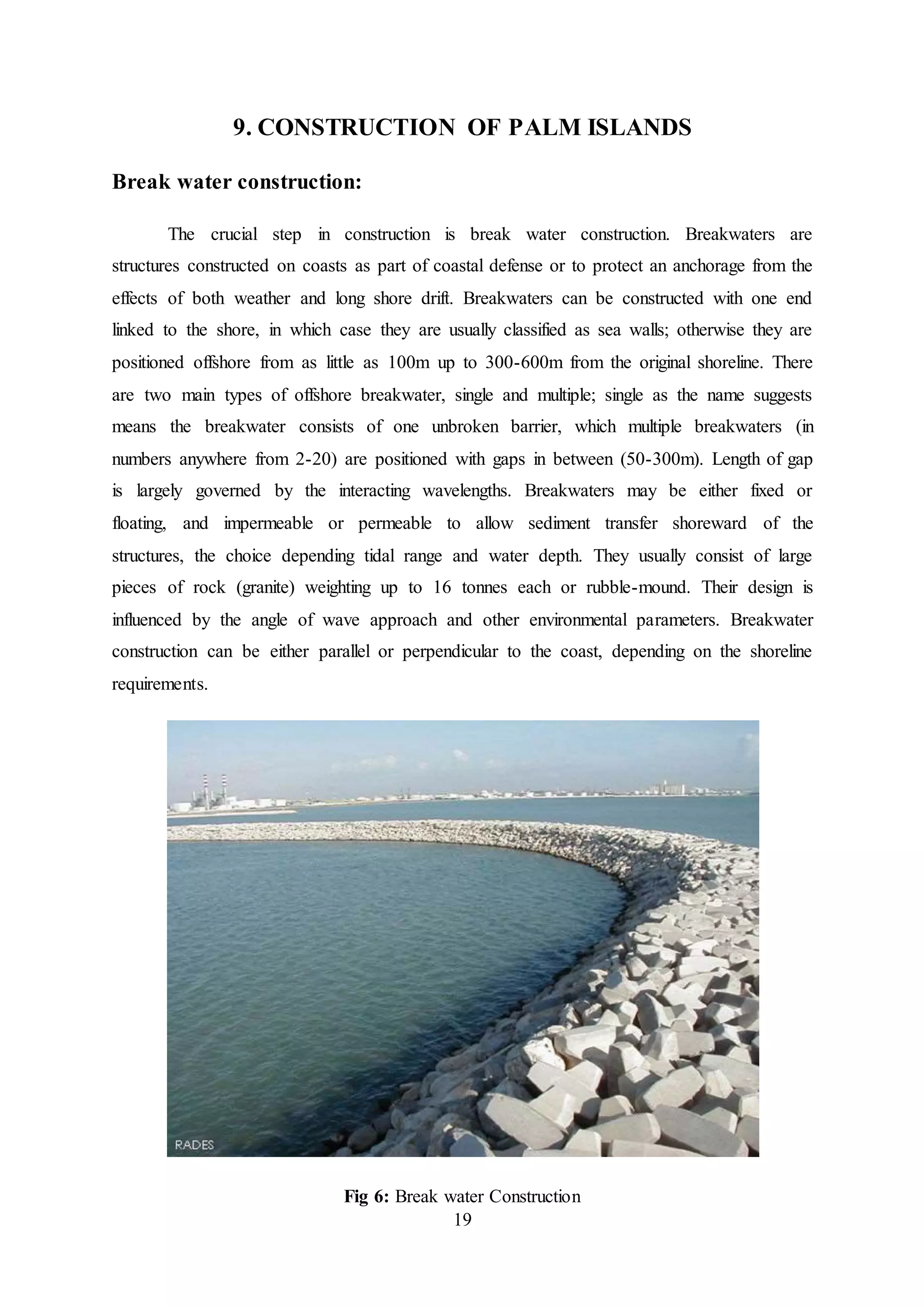
The crucial step in construction is break water construction. Breakwaters are
structures constructed on coasts as part of coastal defense or to protect an anchorage from the
effects of both weather and long shore drift. Breakwaters can be constructed with one end
linked to the shore, in which case they are usually classified as sea walls; otherwise they are
positioned offshore from as little as 100m up to 300-600m from the original shoreline. There
are two main types of offshore breakwater, single and multiple; single as the name suggests
means the breakwater consists of one unbroken barrier, which multiple breakwaters (in
numbers anywhere from 2-20) are positioned with gaps in between (50-300m). Length of gap
is largely governed by the interacting wavelengths. Breakwaters may be either fixed or
floating, and impermeable or permeable to allow sediment transfer shoreward of the
structures, the choice depending tidal range and water depth. They usually consist of large
pieces of rock (granite) weighting up to 16 tonnes each or rubble-mound. Their design is
influenced by the angle of wave approach and other environmental parameters. Breakwater
construction can be either parallel or perpendicular to the coast, depending on the shoreline
requirements.
Fig 6: Break water Construction
20
The break water construction of Palm Island is taken place in following steps
Machines required:
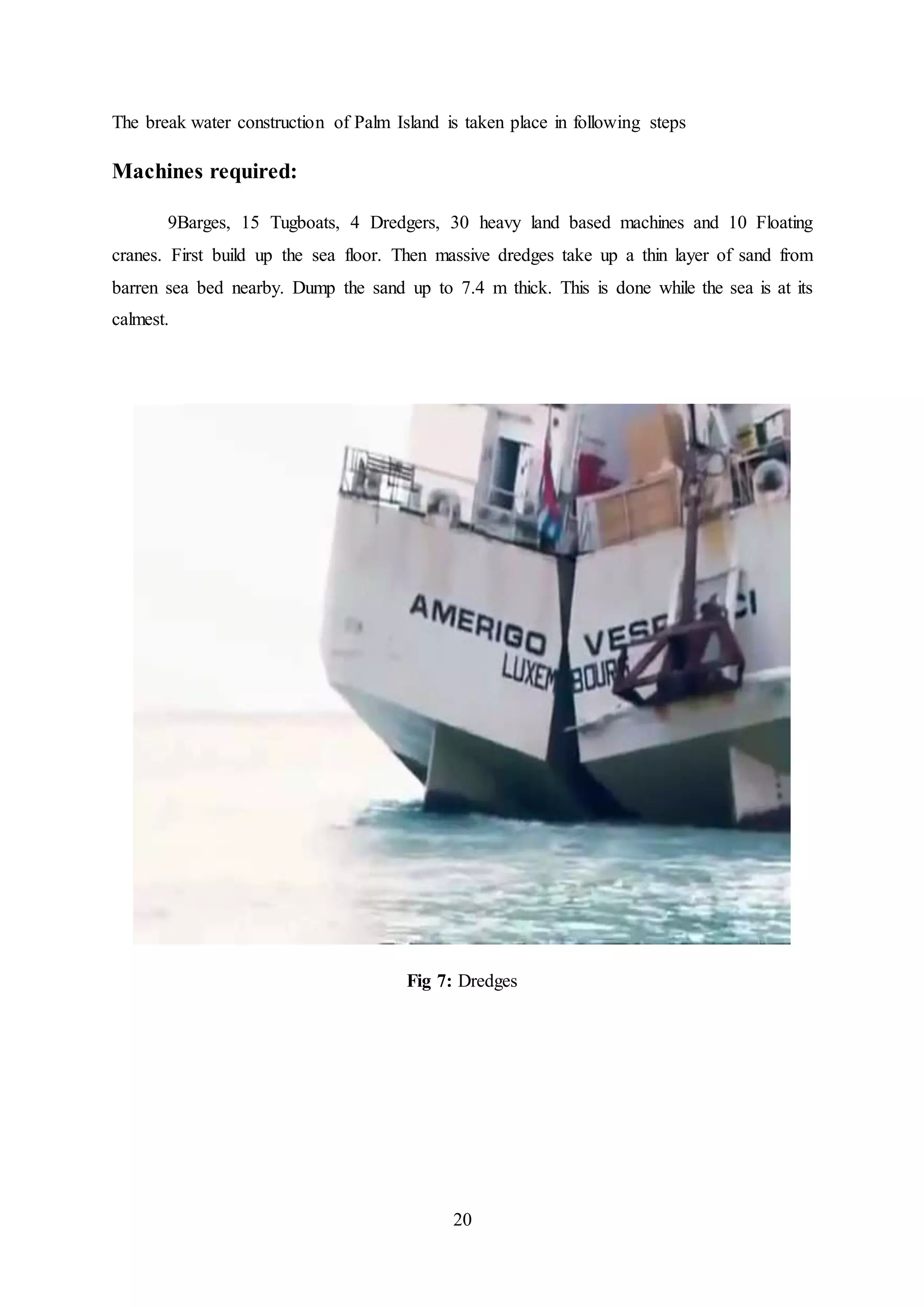
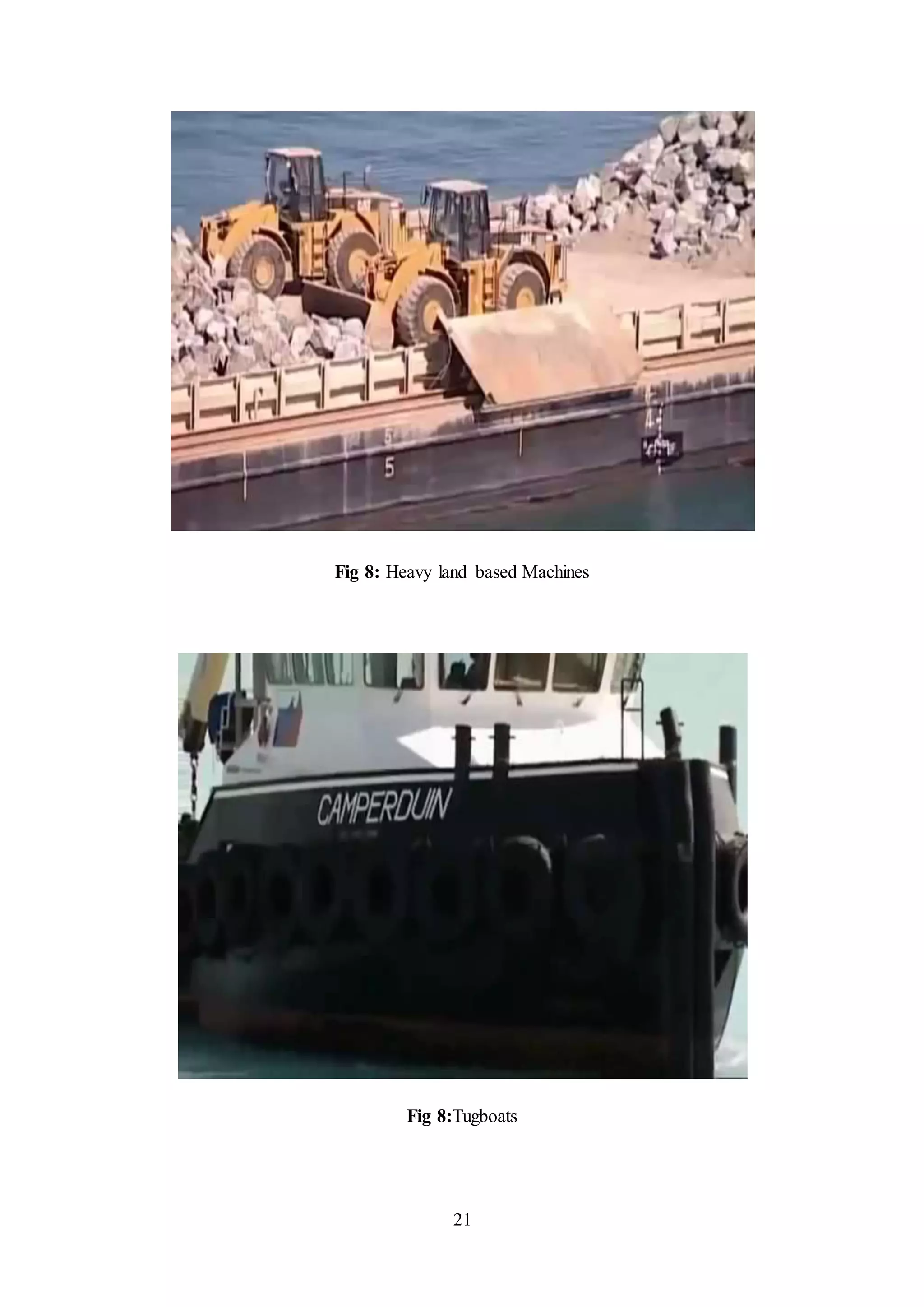
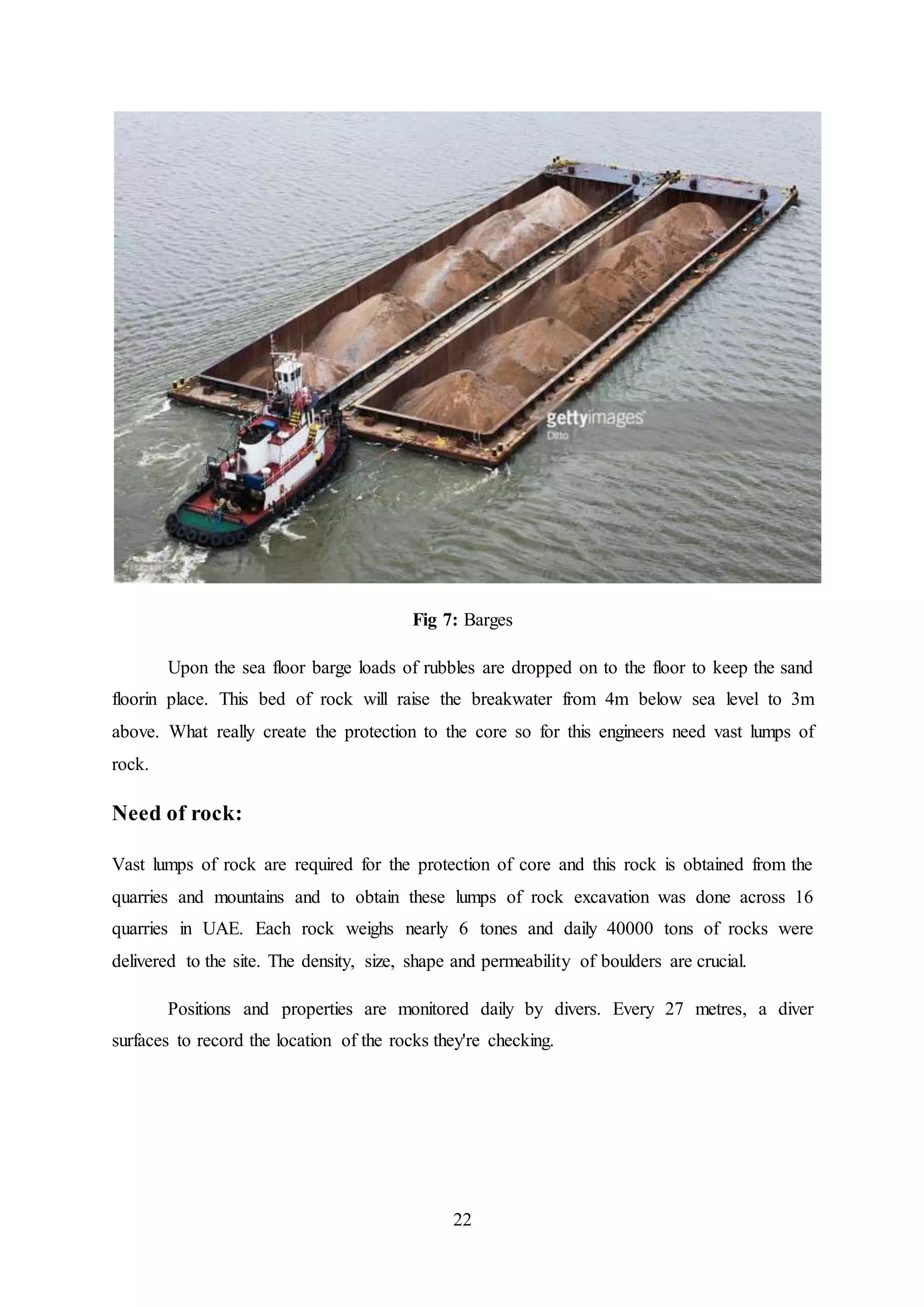
9Barges, 15 Tugboats, 4 Dredgers, 30 heavy land based machines and 10 Floating
cranes. First build up the sea floor. Then massive dredges take up a thin layer of sand from
barren sea bed nearby. Dump the sand up to 7.4 m thick. This is done while the sea is at its
calmest.
Fig 7: Dredges
21
Fig 8: Heavy land based Machines
Fig 8:Tugboats
22
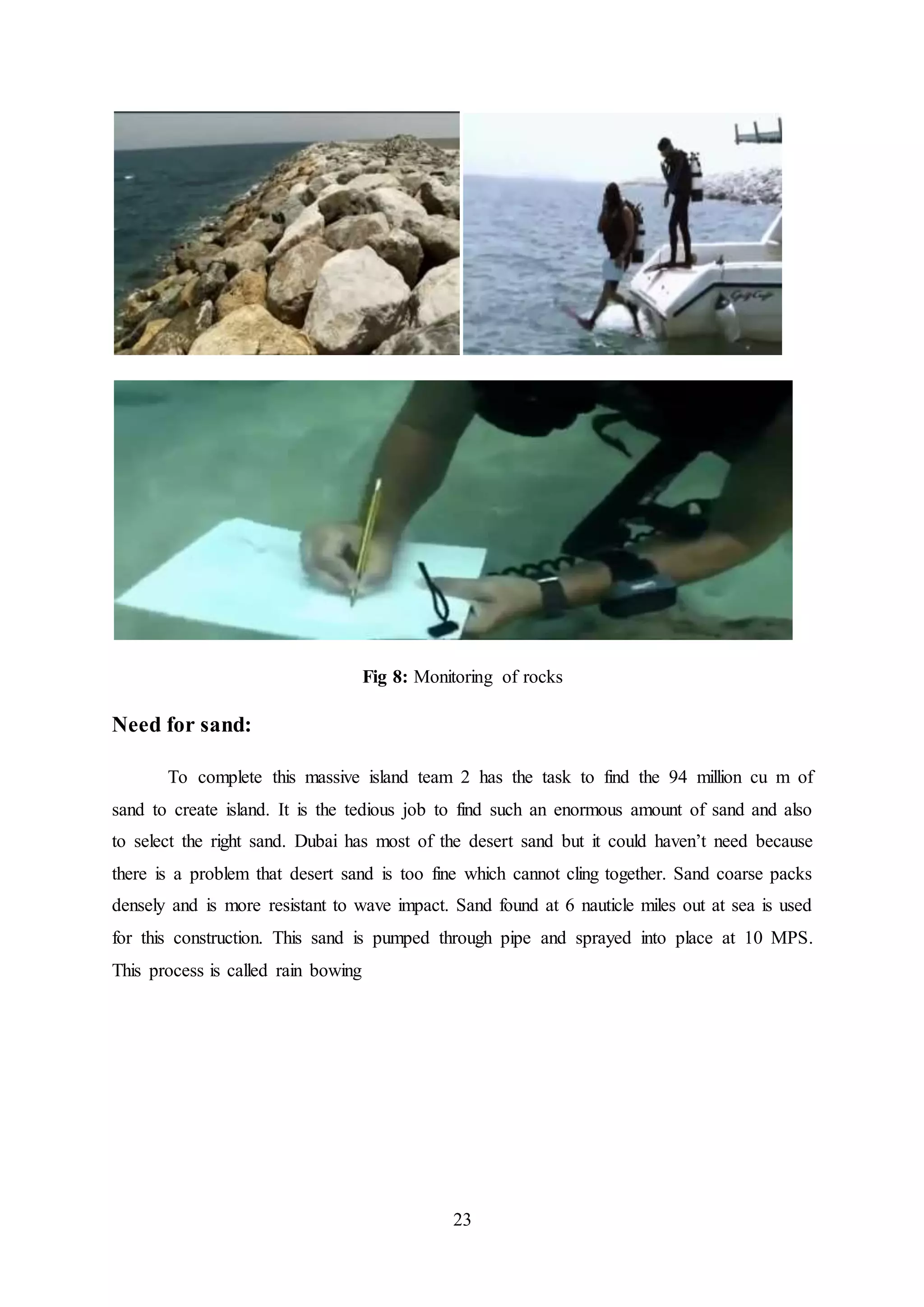
Fig 7: Barges
Upon the sea floor barge loads of rubbles are dropped on to the floor to keep the sand
floorin place. This bed of rock will raise the breakwater from 4m below sea level to 3m
above. What really create the protection to the core so for this engineers need vast lumps of
rock.
Need of rock:
Vast lumps of rock are required for the protection of core and this rock is obtained from the
quarries and mountains and to obtain these lumps of rock excavation was done across 16
quarries in UAE. Each rock weighs nearly 6 tones and daily 40000 tons of rocks were
delivered to the site. The density, size, shape and permeability of boulders are crucial.
Positions and properties are monitored daily by divers. Every 27 metres, a diver
surfaces to record the location of the rocks they're checking.
23
Fig 8: Monitoring of rocks
Need for sand:
To complete this massive island team 2 has the task to find the 94 million cu m of
sand to create island. It is the tedious job to find such an enormous amount of sand and also
to select the right sand. Dubai has most of the desert sand but it could haven’t need because
there is a problem that desert sand is too fine which cannot cling together. Sand coarse packs
densely and is more resistant to wave impact. Sand found at 6 nauticle miles out at sea is used
for this construction. This sand is pumped through pipe and sprayed into place at 10 MPS.
This process is called rain bowing
24
Fig 9: Rain bowing of sand
25
10. CHALLENGES AND MEASURES ADOPTED
Shape maintenance
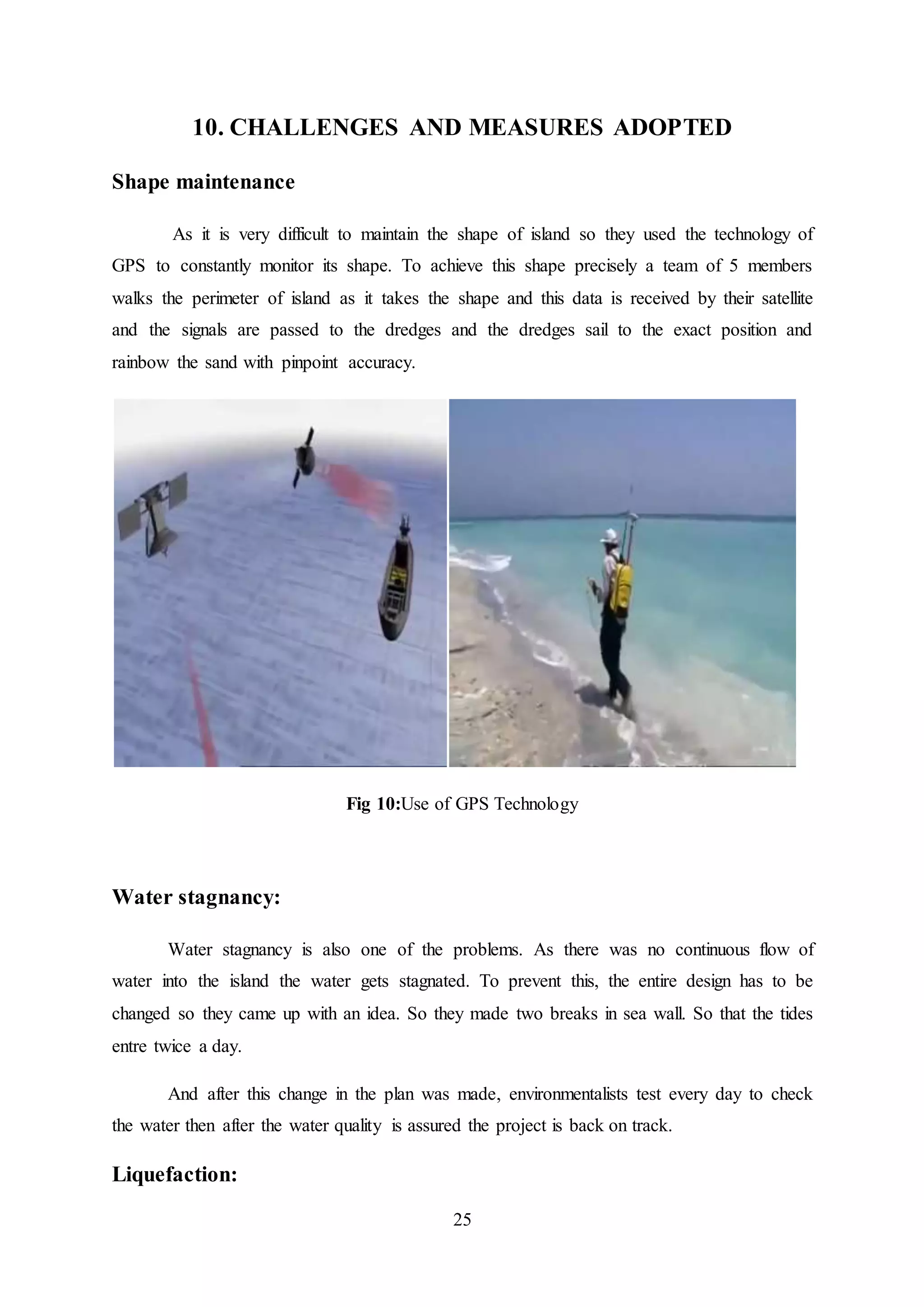
As it is very difficult to maintain the shape of island so they used the technology of
GPS to constantly monitor its shape. To achieve this shape precisely a team of 5 members
walks the perimeter of island as it takes the shape and this data is received by their satellite
and the signals are passed to the dredges and the dredges sail to the exact position and
rainbow the sand with pinpoint accuracy.
Fig 10:Use of GPS Technology
Water stagnancy:
Water stagnancy is also one of the problems. As there was no continuous flow of
water into the island the water gets stagnated. To prevent this, the entire design has to be
changed so they came up with an idea. So they made two breaks in sea wall. So that the tides
entre twice a day.
And after this change in the plan was made, environmentalists test every day to check
the water then after the water quality is assured the project is back on track.
Liquefaction:
26
Lateral forces of an earthquake can make the island disappear. This terrifying
phenomenon is called liquefaction. It happens when a quake shakes the Earth's surface,
causing sand particles to move. As the sand compacts, it pushes the water between the
particles upwards, making the ground liquefy. It means the island would sink back into the
sea. Before any houses can be built, Island must be made strong enough to prevent it from
liquefaction. The engineers work out, they need to compact a layer of sand 12 m deep, too
deep to compact by normal road roller. The only solution is a process called Vibro-
compaction.
Vibro compaction:
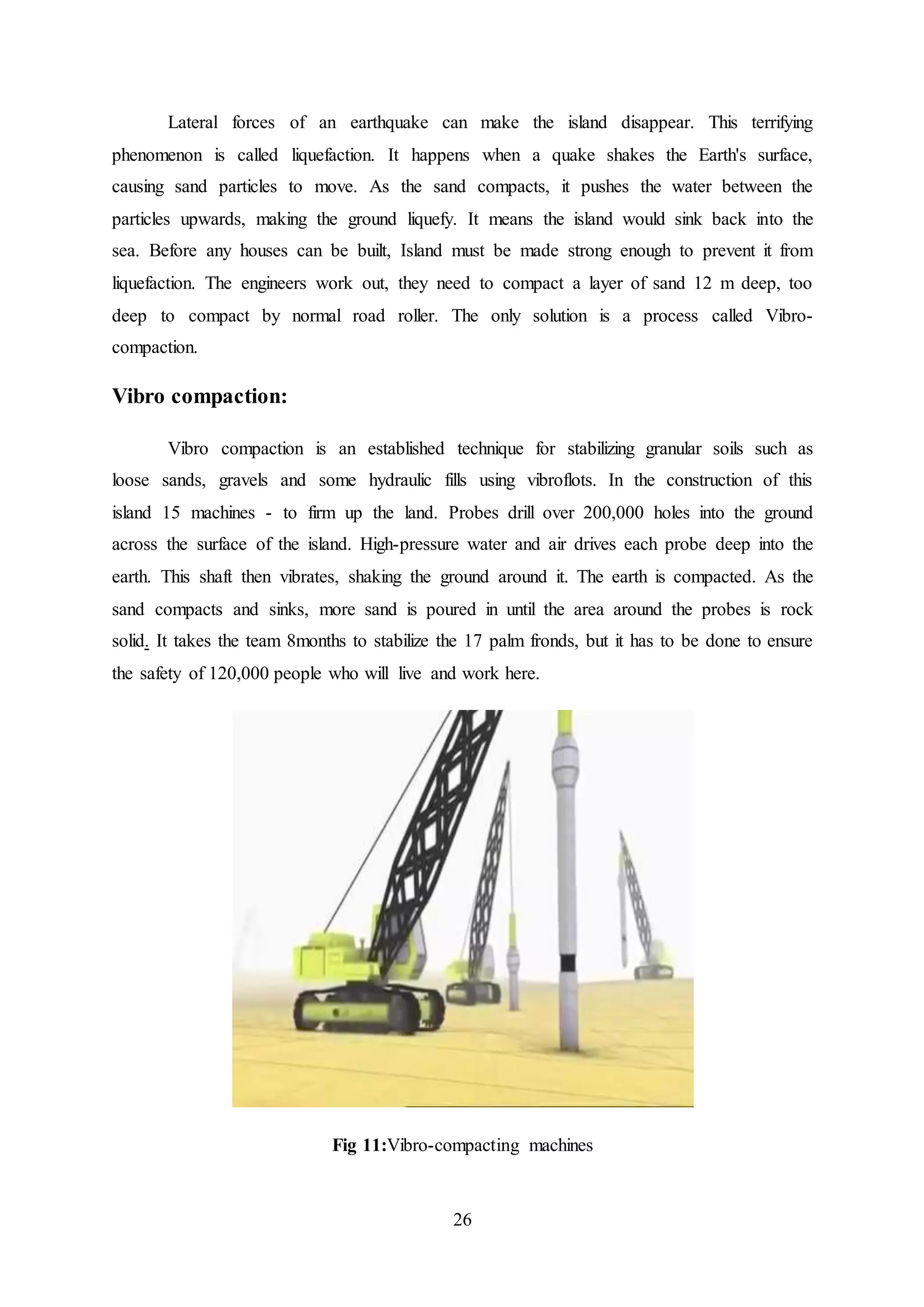
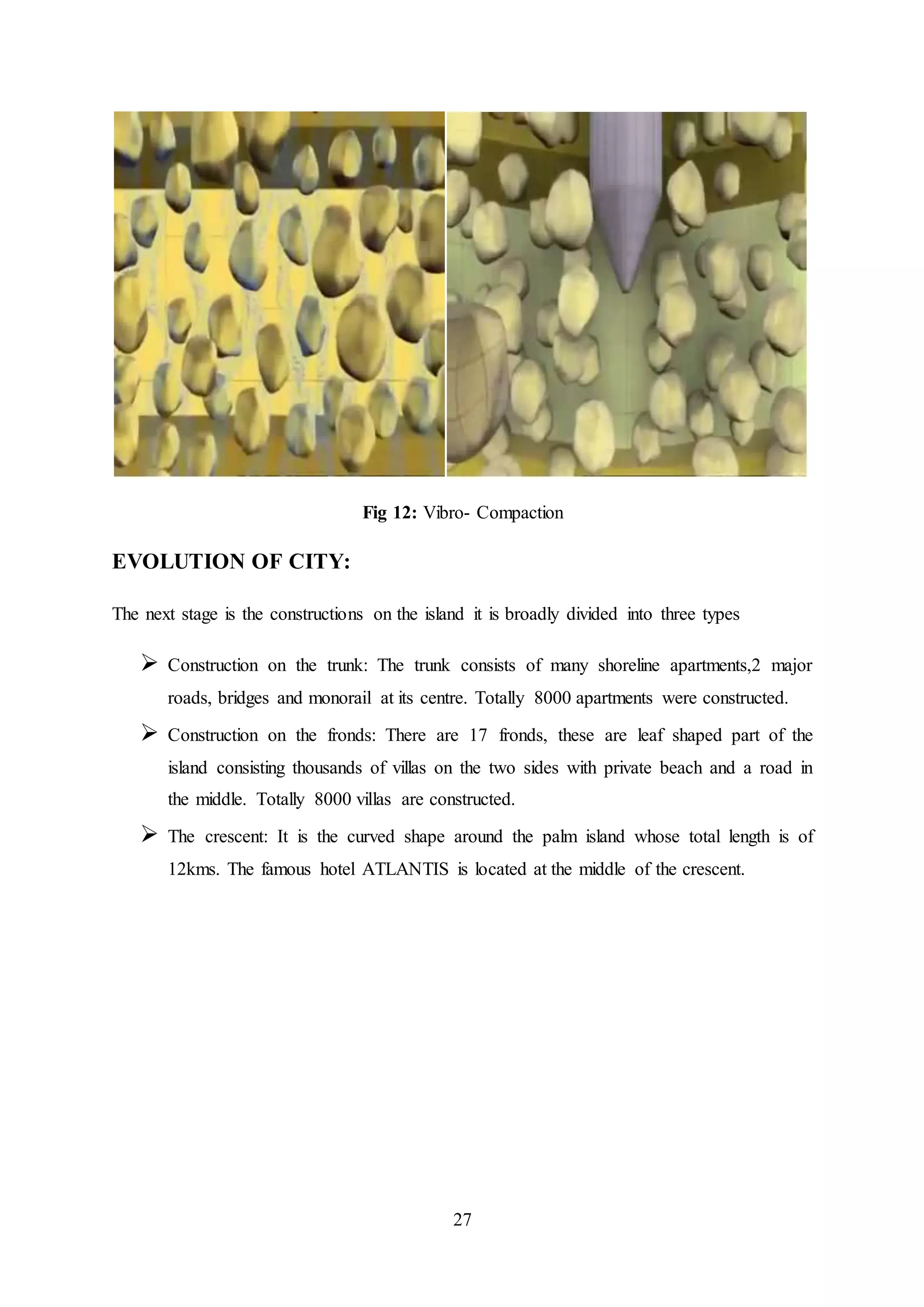
Vibro compaction is an established technique for stabilizing granular soils such as
loose sands, gravels and some hydraulic fills using vibroflots. In the construction of this
island 15 machines - to firm up the land. Probes drill over 200,000 holes into the ground
across the surface of the island. High-pressure water and air drives each probe deep into the
earth. This shaft then vibrates, shaking the ground around it. The earth is compacted. As the
sand compacts and sinks, more sand is poured in until the area around the probes is rock
solid. It takes the team 8months to stabilize the 17 palm fronds, but it has to be done to ensure
the safety of 120,000 people who will live and work here.
Fig 11:Vibro-compacting machines
27
Fig 12: Vibro- Compaction
EVOLUTION OF CITY:
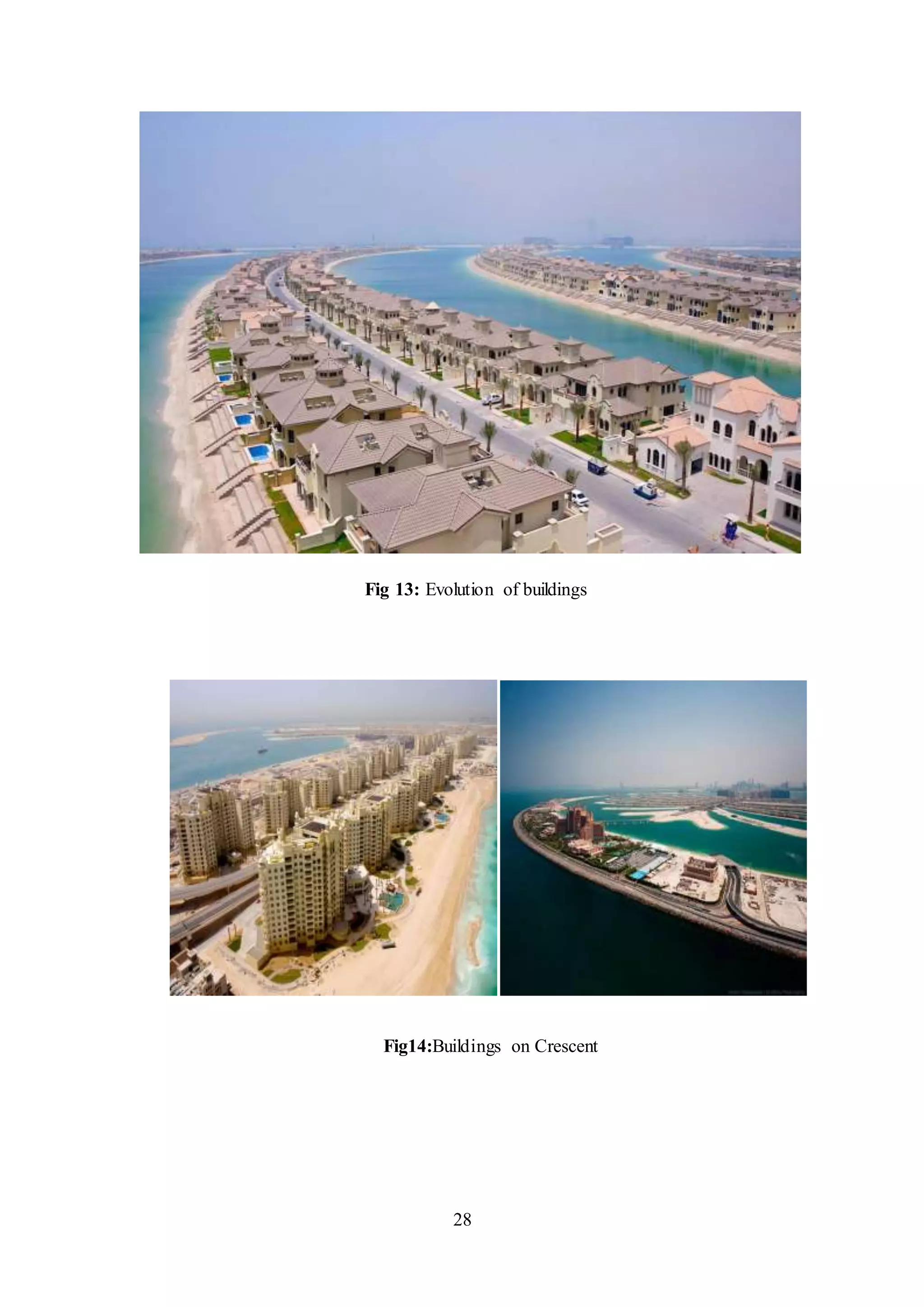
The next stage is the constructions on the island it is broadly divided into three types
 Construction on the trunk: The trunk consists of many shoreline apartments,2 major
roads, bridges and monorail at its centre. Totally 8000 apartments were constructed.
 Construction on the fronds: There are 17 fronds, these are leaf shaped part of the
island consisting thousands of villas on the two sides with private beach and a road in
the middle. Totally 8000 villas are constructed.
 The crescent: It is the curved shape around the palm island whose total length is of
12kms. The famous hotel ATLANTIS is located at the middle of the crescent.
28
Fig 13: Evolution of buildings
Fig14:Buildings on Crescent
29
11. CONCLUSION
The palm island puts DUBAI on the map. The island stands here against the nature,
proving that engineers can and will continually push the boundaries of engineering
technology, and how a perfect management and effective utilization of all resources can
create wonders in the world. The palm island is truly an marvelous mega structure the world
have ever seen.
Source of information:
https://en.wikipedia.org/wiki/Artificial_island
http://www.google.com/images
http://www.ags-hk.org/notes/18/03_Construction_Artifical_Islands_Ken.pdf
https://www.onlinejournal.in/IJIRV3I2/349.pdf
https://www.slideshare.net/MridulNaidu1/artificial-islands

The study on construction of artificial island by Ahmad Hussain

  • 1.
    1 A Technical Seminar on “TheStudy on Construction of Artificial Island” Submitted in partial fulfillment of the requirements for the award of the degree Of BACHELOR OF TECHNOLOGY In CIVIL ENGINEERING By MD Ahmad Hussain 14G71A0101 Under the guidance of Mr. B. Venkat M.Tech Head of the Department Department of Civil Engineering. Department Of CIVIL ENGINEERING MADHIRA INSTITUTE OF TECHNOLOGY AND SCIENCES (Accreditedby NBA, Approvedby A.I.C.T.E, NewDelhi,Affiliatedto JNTU,Hyd.) Madhira Nagar, Kodad, Suryapet District,Telangana-508206 Phone: 08683-240377/99.Fax:240388 WEB:www.mitskodad.ac.in; E-MAIL:mits_g7@yahoo.co.in
  • 2.
    2 MADHIRA INSTITUTE OFTECHNOLOGY AND SCIENCES (Accreditedby NBA, Approvedby A.I.C.T.E, NewDelhi,Affiliatedto JNTU, Hyd.) Madhira Nagar, Kodad, Nalgonda District,Telangana-508206 Phone: 08683-240377/99.Fax:240388 WEB:www.mitskodad.ac.in; E-MAIL:mits_g7@yahoo.co.in Department of CIVIL CERTIFICATE This is to Certified that the industry oriented project entitled “The Study on Construction of Artificial Island” is a bonafied work done by MD. Ahmad Hussain 14G71A0101 in partial fulfillment of Bachelor of Technology in “Civil Engineering” from JNTU, Hyderabad during the academic year 2017-2018. Mr. B. VENKAT M.Tech Mr. B.VENKAT M.Tech Internal Guide Head of the Department Assistant Professor Assistant Professor
  • 3.
    3 ACKNOWLEDGEMENT I express oursincere thanks to our guide Mr. B.VENKAT Asst. Prof. for giving us moral support, kind attention and valuable guidance to us throughout this project work. It isour privilege to thank, Mr. B.VENKAT, Asst. Prof. & our Head of the Department for his encouragement during the progress of this project work. It isour privilege tothank all Review Committee members for allowing us to do this report and providing us all the facilities to do our project work. It derives great pleasure in expressing our sincere gratitude to our Principal Dr. RUDRA PRATHAP DAS for his timely suggestions, which helped us to complete this work successfully. I thank to teaching and non-teaching staff members of Civil Department for their kind cooperation and all sorts of help to bring out this project work successfully. It is our privilege to thank management members for allowing us to do this project and providing us all the facilities to do our project work. In all sincerity, MD. Ahmad Hussain 14G71A0101
  • 4.
    4 CONTENTS Page No ABSTRACT 1 1.INTRODUCTION 2 2 DESIGN CONSIDERATIONS FOR ARTIFICIAL ISLAND CONSTRUCTION 4 3. LAND RECLAMATION PROCESS AND ITS ADVANTAGES ON ARTIFICIAL ISLAND CONSTRUCTION 5 4. DIFFERENT TYPES OF LOADINGS ON ARTIFICIAL ISLANDS 7 5. CONSTRUCTION AND DESIGN PROBLEMS OF AN ARTIFICIAL ISLAND 8 6. LIMITATIONS OF LAND RECLAMATION TECHNIQUES FOR ARTIFICIAL ISLAND CONSTRUCTION 9 7. CONCLUSION 10 8. CASE STUDY Palm islands an evolution of an artificial land on globe: 12 9. CONSTRUCTION OF PALM ISLANDS 15 10. CHALLENGES AND MEASURES ADOPTED 21 11. CONCLUSION 25
  • 5.
    5 ABSTRACT The advancement anddevelopment in construction field has changed the scenario of world today and an artificial island has been perfect example to represent infrastructural development at present time. An artificial island is landmark surrounded all sides by water which is constructed artificially by means of human manpower with uses of advance technologies and machineries. An artificial island is an application of various engineering concepts that has brought a drastic change on construction technology. This report incorporates the details about the construction process involved in artificial island like land reclamation, dredging, soil-bed preparation, underwater concreting with various challenges and advantages. Land Reclamation technique is the most crucial process used for construction of artificial island which means preparation of new land from oceans, river beds or lake beds. This report is all about procedures and impact analysis of land reclamation process on artificial island construction. This concept has been mostly used on developed countries like Qatar, Japan, etc and my main motive of studying about it is to grab depth knowledge about its construction technologies and requirement so that we can use it on India and many other countries to promote tourism industry as well as for geotechnical exploration. Some contemporary projects are much more ambitious. Kansai International Airport is the first airport to be built completely on an artificial island in 1994.Dubai is home to some of the largest artificial island complexes in the world, including the three Palm Islands projects, The World and the Dubai Waterfront, the last of which will be the largest in scale. -
  • 6.
    6 1. INTRODUCTION An artificialisland is man-made island constructed over sea, ocean or river beds. The construction of artificial island is done by land reclamation, expansion of existing islets, combining small group of islets and filling different materials over sea or an ocean bed. In ancient periods they were constructed over lakes by driving piles into lake beds but at present artificial islands are constructed using new technologies and land reclamation process is one of common technique. Till present dates, some of the artificial islands that exist are Kansai Airport (4km × 2.5 km) located in Osaka Bay, Japan and The Palms (50 km2 ) located in Dubai. The construction methodologies for artificial island using land reclamation techniques commonly involve three major procedures and with site conditions and requirements there may be some changes. These major three stages of artificial island construction are:  Remediation of seabed  Construction of sea defenses (sea wall)  Fill Remediation of seabed consists of reforming the seabed in case of settlement problem. Remediation process varies from island to island due to different soil characteristics and geological features. For example different type of remediation process was used to stop settlement on artificial island construction of the Kansai International Airport located in Japan. Due to presence of Holocene clay layer in seabed, there was occurring differential settlement problem and it was reduced by help of sand drain method which artificially speed up the remediation process. The sand drain process helped to minimize settlement problem within one year else it would have taken a longer period (more than a decade).
  • 7.
    7 Fig 1:Reclaimed LandType For Artificial Island Construction As in figure above, the mean sea level is maintained lower than the reclaimed ground level during construction of artificial island by land reclamation techniques. The sea defences are the structures constructed in between reclaimed land and sea water. Sea defences are constructed in different forms using cassions, rubber mould and concrete armour elements. The process of construction of sea defence is done to provide protection to the reclaimed land. Sea defences used for artificial island construction are soft defence system, hard defence system and combined defence system. The main purpose for use of sea defences is to prevent different energy waves from entering into reclaimed area so that erosion related problems on island can be minimized. Filling is the main process of land reclamation for artificial islands. Fill includes all those materials like sand, soil, gravel and rocks that are used to construct the land over the sea bed.
  • 8.
    8 2. DESIGN CONSIDERATIONSFOR ARTIFICIAL ISLAND CONSTRUCTION Before designing and commencement of artificial island constriction on any site of sea beds or river beds we should collect various data and information. Some of major information we have to collect for design of artificial islands is listed below:  Water depth  Wave height ranges  Ice conditions  Tidal range  Currents  Foundation conditions  Earthquake risk  Source of materials  Shipping lanes  Existing pipelines and cables So these are important information we should have knowledge of before designing any artificial island and on basis of these data our construction works are carried out. The construction of any structures in an island is a serious challenge due to presence of water currents, different tidal ranges, climatic variation sand earthquake; so before construction of island there should be maximum effort from every part to minimize effects of earthquake, wave currents, etc. e.g. Preparation of site by remediation of sea bed is essential to reduce the effects of earthquake on the island.
  • 9.
    9 3. LAND RECLAMATIONPROCESS AND ITS ADVANTAGES ON ARTIFICIAL ISLAND CONSTRUCTION Land reclamation is the technique by which new land is formed or gained from sea beds or wetlands. The land reclamation process for artificial island construction is common method and is more preferable over breakwater construction and vibro-compaction methods. The land reclamation method involves many steps and basic knowledge of these steps is also included in this topic. 3.1. Soil bed preparation: The preparation of soil bed on depth of ocean or sea for remediation of soil bed so that uniform settlement of soil bed will occur under different loading conditions is initial step for land reclamation. The preparation of soil bed requires a number of steps which includes formation of isolation layer, provision of ballast (small rock pieces), surcharge for preloading, drainage system construction and reducing soil voids. 3.2. Sand Placement: The sand is major construction material required for land reclamation. Coarse grained sands of good engineering qualities such as crushing strength, impact value, etc must be located near to the site of island construction. The dumping of sand in site is done by using trailers. The dumping procedure varies with the water depth of the sea bed. Rain bowing process is the common and fast method for placement of sand during land reclamation process. After the placement of sand, a bitumen emulsion and sand is sprayed over it. Finally plantation of grass is done to reduce erosion on the reclaimed land. 3.3. Dredging: The process of excavating soil from marine sites like seas, ocean bottom or coastal areas is called dredging. The dredging process is operated with help of various dredges and trailers such as trailing section hopper dredgers. These dredgers work on repeating process of dredging, loading transport to dumping site and dumping of load. The selection of dredges depends on type of soil, depth of excavation, operation area and various machineries qualities like cutter type, type and stroke of spud carriage. So, Dredging can be termed as the maritime
  • 10.
    10 transportation of thenatural minerals from water environment to any other dumping areas. There are numerous advantages of using land reclamation process for island construction. By land reclamation techniques, an artificial island can be constructed of any shape, any size & anywhere. Land reclamation will definitely increase land area for a certain country. Mining of natural resources such as oil and gas can be done with artificial island construction. The generation of tidal and wind energy can be possible on artificial island zones. Reclamation of a lot of lands from flooding will also be possible using this technique. Development of mass tourism has been possible by construction of artificial island such as Palm Island located in Dubai has collected a large amount of revenue from tourism sector.
  • 11.
    11 4. DIFFERENT TYPESOF LOADINGS ON ARTIFICIAL ISLANDS The design and construction of any types of structures require the different types of loading acting on structure, their magnitude and direction. The artificial islands are subjected to three major types of loads: permanent loads, variable loads and natural or environmental loads. 4.1. Permanentloads:  Dead loads like weight of all types of structures calculated using nominal values,  Permanently installed machineries and equipment’s  Forces due to hydrostatic pressure during calm sea conditions calculated from sea level,  Loads due to ballasts used during filling process,  Permanent earth pressure 4.2. Variable Loads:  Different types of temporarily installed machineries and equipment’s such as dredgers, trailers, etc.  Differences in internal and external pressures of natural resources like water, oil, etc caused by normal operating of structures  Loads acting on island due to movement of vessels, landing of air vehicles, use of cranes and drilling operations. 4.3. Environmental Loads:  Wind loads and other loads caused by climatic variations on surroundings  Loads due to wind, climatic variations of surrounding, tidal loads and currents  Seismic loads due to earthquake and loads due to tsunamis
  • 12.
    12 5. CONSTRUCTION ANDDESIGN PROBLEMS OF AN ARTIFICIAL ISLAND There are always numerous challenges in every construction works. With various case studies on different islands construction, some construction and design problems of an artificial island are earthquake, morphological impacts, high costs and uneven settlements. The earthquake can impact on sea defences and may cause liquefaction problems on soil. Morphological impacts include erosion and accretion of soil on coastal lines and soil removal at borrow sites. The cost of equipments during construction like dredgers, trailers and cost of fill materials and sea defence is high which need more investments. Similarly undesirable settlements of sea beds may also cause serious problem both during pre-construction and post-construction. From economical point of view the construction artificial island is restricted to water depth of 30m. So construction at depth more than the limit may cause economic problems to investors.
  • 13.
    13 6. LIMITATIONS OFLAND RECLAMATION TECHNIQUES FOR ARTIFICIAL ISLAND CONSTRUCTION There are various factors that may cause problems to use of land reclamation techniques for artificial island construction. Some are listed below:  As the process is very costly this can lead to financial crisis.  Lack of machineries like trailers and dredgers may slow down the construction procedure of island.  Land reclamation process is a time consuming process of an island construction.  Faulty construction process can cause settlement of the island in deep waters, as in the case of Kansai Airport, Japan.  Land reclamation can be damaging to corals and marine life.  High probability of occurrence of natural calamities such as tidal forces, earthquake and tsunami loads and due to these forces special provisions should be adopted during design of an artificial island.
  • 14.
    14 7. CONCLUSION The establishmentof industrial estates near to residential areas, working offices and business zones has caused a lot of problems to human life due to air, land and noise pollution. So, Construction of artificial island plays crucial role on preventing these environmental problems by providing areas for establishment of industrial estates. So, my report can be a platform of knowledge for many people and respective industrial organization about minimizing environmental problems that has been causing serious problems these days. The advancement in technologies in every field is very common these days. So artificial island can also help in construction of extended runways, infrastructures like ports and airports, etc which can bring a lot of luxury to a lot of people. We are using our natural resources as source of energy from a very past which have now resulted a vulnerable stage to a lot of nonrenewable natural resources. Artificial Island can bring a lot of help on mining of natural resource mostly nonrenewable resources that can help in our environment conservation. People are fond of recreational activities these days and construction of artificial island can be a lot of beneficial for mass tourism activity. E.g. Palm Island. So, as a student of civil engineering it has been immense pleasure for me to study about artificial island construction and I got idea that it can bring great revolution on civil engineering technologies. Only a few countries have constructed artificial island and they have been highly beneficial from environmental, economic and social point of view. Developed countries like Qatar, China, Japan, etc are able to construct artificial islands and observing its increasing benefits every country should consider the use of this technique in civil engineering technology.
  • 15.
    15 Largest artificial islandsaccording to their size (reclaimed lands) No. Name Size (km2) Location Year built Utilisation 1 Flevopolder 970 Netherlands 1968 Towns, agriculture 2 Yas Island 25 Abu Dhabi, UAE 2018 Yas Marina Circuit 4 Kansai International Airport 10.68[6] Japan 1994 Airport 3 Hong Kong International Airport 9.4 Hong Kong 1998 Airport 5 Palm Jebel Ali 8 Dubai, UAE Unknown on hold 6 ChūbuCentrair International Airport 6.8 Japan 2005 Airport 7 Palm Jumeirah[7] 6.5[7] Dubai, UAE Unknown Housing 8 Rokko Island 5.8 Japan 1992 Housing 9 Fundão Island[8] 5.23 Brazil 1983 Federal University of Rio de Janeiro 10 Port Island 5.2 Japan 1981 Housing
  • 16.
    16 8. CASE STUDY Palmislands an evolution of an artificial land on globe: The Palm Islands are two artificial islands in Dubai, United Arab Emirates in the shape of palm trees. The Belgian and Dutch dredging and marine contractors Jan De Nul and Van Oord, were hired to complete construction. The islands are the Palm Jumeirah and the Palm Jebel Ali. Each settlement will be in the shape of a palm tree, topped with a crescent. The settlements will have a large number of residential, leisure and entertainment centre’s and will add 520 kilometres of non-public beaches to the city of Dubai. The two islands will comprise approximately 100,000 cubic metres (3,500,000 cu ft) of rock and sand. All materials will be quarried in The UAE. On the two islands, there will be over 100 luxury hotels, residential beach-side villas and apartments, marinas, water theme parks, restaurants, shopping malls, sports facilities and health spas. Fig 2:Design plan of Palm Islands
  • 17.
    17 Middle East Dubaiis also called as the jewel of the Arab world due to its oil reserves. But these reserves are fast depleting so a problem was posed in front of them to search for the other sources of income so they looked into other options but tourism seemed to be a perfect option as Dubai offers sun every day in a year and it has a collection of glorious beaches. Nearly 5 million tourists visit annually so they want to increase it to 15 million, but the cost line is very small to meet the requirements of world tourism so they want to increase the present 72 kms coastline. So they came up with an idea to increase the coast. Fig 3: Coast line of Dubai. Idea of Palm Islands: To increase the length of existing coast line the prince of Dubai came up with an idea to construct a circular island which increases the coastline only by 7 KMS. But to meet the requirements of tourism the coastline should be increased by 70 KMS so the prince suggested a new idea to construct an island in the shape of palm tree as palm tree reflects the culture of Dubai.
  • 18.
    18 Fig 4:Proposedidea ofa circular island Fig 5: Proposed idea of Palm Island
  • 19.
    19 9. CONSTRUCTION OFPALM ISLANDS Break water construction: The crucial step in construction is break water construction. Breakwaters are structures constructed on coasts as part of coastal defense or to protect an anchorage from the effects of both weather and long shore drift. Breakwaters can be constructed with one end linked to the shore, in which case they are usually classified as sea walls; otherwise they are positioned offshore from as little as 100m up to 300-600m from the original shoreline. There are two main types of offshore breakwater, single and multiple; single as the name suggests means the breakwater consists of one unbroken barrier, which multiple breakwaters (in numbers anywhere from 2-20) are positioned with gaps in between (50-300m). Length of gap is largely governed by the interacting wavelengths. Breakwaters may be either fixed or floating, and impermeable or permeable to allow sediment transfer shoreward of the structures, the choice depending tidal range and water depth. They usually consist of large pieces of rock (granite) weighting up to 16 tonnes each or rubble-mound. Their design is influenced by the angle of wave approach and other environmental parameters. Breakwater construction can be either parallel or perpendicular to the coast, depending on the shoreline requirements. Fig 6: Break water Construction
  • 20.
    20 The break waterconstruction of Palm Island is taken place in following steps Machines required: 9Barges, 15 Tugboats, 4 Dredgers, 30 heavy land based machines and 10 Floating cranes. First build up the sea floor. Then massive dredges take up a thin layer of sand from barren sea bed nearby. Dump the sand up to 7.4 m thick. This is done while the sea is at its calmest. Fig 7: Dredges
  • 21.
    21 Fig 8: Heavyland based Machines Fig 8:Tugboats
  • 22.
    22 Fig 7: Barges Uponthe sea floor barge loads of rubbles are dropped on to the floor to keep the sand floorin place. This bed of rock will raise the breakwater from 4m below sea level to 3m above. What really create the protection to the core so for this engineers need vast lumps of rock. Need of rock: Vast lumps of rock are required for the protection of core and this rock is obtained from the quarries and mountains and to obtain these lumps of rock excavation was done across 16 quarries in UAE. Each rock weighs nearly 6 tones and daily 40000 tons of rocks were delivered to the site. The density, size, shape and permeability of boulders are crucial. Positions and properties are monitored daily by divers. Every 27 metres, a diver surfaces to record the location of the rocks they're checking.
  • 23.
    23 Fig 8: Monitoringof rocks Need for sand: To complete this massive island team 2 has the task to find the 94 million cu m of sand to create island. It is the tedious job to find such an enormous amount of sand and also to select the right sand. Dubai has most of the desert sand but it could haven’t need because there is a problem that desert sand is too fine which cannot cling together. Sand coarse packs densely and is more resistant to wave impact. Sand found at 6 nauticle miles out at sea is used for this construction. This sand is pumped through pipe and sprayed into place at 10 MPS. This process is called rain bowing
  • 24.
    24 Fig 9: Rainbowing of sand
  • 25.
    25 10. CHALLENGES ANDMEASURES ADOPTED Shape maintenance As it is very difficult to maintain the shape of island so they used the technology of GPS to constantly monitor its shape. To achieve this shape precisely a team of 5 members walks the perimeter of island as it takes the shape and this data is received by their satellite and the signals are passed to the dredges and the dredges sail to the exact position and rainbow the sand with pinpoint accuracy. Fig 10:Use of GPS Technology Water stagnancy: Water stagnancy is also one of the problems. As there was no continuous flow of water into the island the water gets stagnated. To prevent this, the entire design has to be changed so they came up with an idea. So they made two breaks in sea wall. So that the tides entre twice a day. And after this change in the plan was made, environmentalists test every day to check the water then after the water quality is assured the project is back on track. Liquefaction:
  • 26.
    26 Lateral forces ofan earthquake can make the island disappear. This terrifying phenomenon is called liquefaction. It happens when a quake shakes the Earth's surface, causing sand particles to move. As the sand compacts, it pushes the water between the particles upwards, making the ground liquefy. It means the island would sink back into the sea. Before any houses can be built, Island must be made strong enough to prevent it from liquefaction. The engineers work out, they need to compact a layer of sand 12 m deep, too deep to compact by normal road roller. The only solution is a process called Vibro- compaction. Vibro compaction: Vibro compaction is an established technique for stabilizing granular soils such as loose sands, gravels and some hydraulic fills using vibroflots. In the construction of this island 15 machines - to firm up the land. Probes drill over 200,000 holes into the ground across the surface of the island. High-pressure water and air drives each probe deep into the earth. This shaft then vibrates, shaking the ground around it. The earth is compacted. As the sand compacts and sinks, more sand is poured in until the area around the probes is rock solid. It takes the team 8months to stabilize the 17 palm fronds, but it has to be done to ensure the safety of 120,000 people who will live and work here. Fig 11:Vibro-compacting machines
  • 27.
    27 Fig 12: Vibro-Compaction EVOLUTION OF CITY: The next stage is the constructions on the island it is broadly divided into three types  Construction on the trunk: The trunk consists of many shoreline apartments,2 major roads, bridges and monorail at its centre. Totally 8000 apartments were constructed.  Construction on the fronds: There are 17 fronds, these are leaf shaped part of the island consisting thousands of villas on the two sides with private beach and a road in the middle. Totally 8000 villas are constructed.  The crescent: It is the curved shape around the palm island whose total length is of 12kms. The famous hotel ATLANTIS is located at the middle of the crescent.
  • 28.
    28 Fig 13: Evolutionof buildings Fig14:Buildings on Crescent
  • 29.
    29 11. CONCLUSION The palmisland puts DUBAI on the map. The island stands here against the nature, proving that engineers can and will continually push the boundaries of engineering technology, and how a perfect management and effective utilization of all resources can create wonders in the world. The palm island is truly an marvelous mega structure the world have ever seen. Source of information: https://en.wikipedia.org/wiki/Artificial_island http://www.google.com/images http://www.ags-hk.org/notes/18/03_Construction_Artifical_Islands_Ken.pdf https://www.onlinejournal.in/IJIRV3I2/349.pdf https://www.slideshare.net/MridulNaidu1/artificial-islands