Science
Earth & Space
Vocabulary
Earth
space
axis
rotation
night
day
changes
sun
revolution
orbit
moon
shadows
light
environment
sunrise
sunset
spin
phases
direction
length
planets
stars
Solar System
comet
particles
Milky Way
galaxy
• Highlight words you’ve heard and know the meaning of green.
• Highlight words you’ve heard but don’t know the meaning of yellow.
• Highlight words you don’t know at all pink.
The Solar System
The solar system consists of the sun and
everything that orbits, or travels around, the sun.
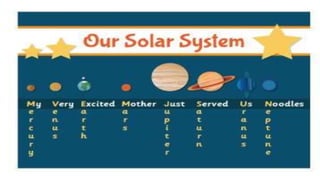
This includes the eight planets and their moons,
dwarf planets, and many asteroids and comets.
However, even with all these things, most of
the solar system is empty space.
The Sun
The sun is the star at the centre of the solar system.
It is a hot ball of gases that gives off great amounts of energy.
The solar system also contains planets, comets, and asteroids.
They all orbit, or travel around, the sun.
Earth
Earth is one of the eight planets that orbit, or travel around, the
sun in the solar system.
It is the third planet from the sun.
Earth is the only planet in the solar system that can support life
because it has water on its surface and oxygen gas in its air.
The moon
The Moon is a large natural object that orbits, or
travels around, Earth.
After the Sun, it is the brightest object in the sky.
The Moon's gravity pulls on Earth. It is too weak to
affect the whole planet, but it does make the water
move.
Lesson One:
The Solar System
LessonTwo:
Night and Day
LessonThree:
The sun, moon and Earth
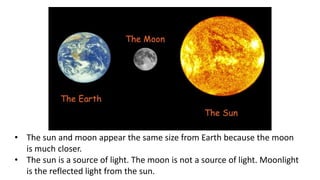
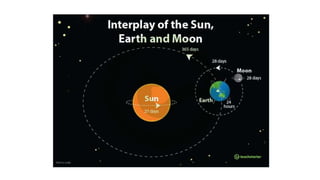
• The sun and moon appear the same size from Earth because the moon
is much closer.
• The sun is a source of light. The moon is not a source of light. Moonlight
is the reflected light from the sun.
The Sun
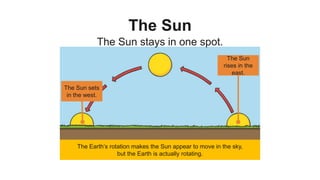
The Sun stays in one spot.
The Earth’s rotation makes the Sun appear to move in the sky,
but the Earth is actually rotating.
The Sun
rises in the
east.
The Sun sets
in the west.
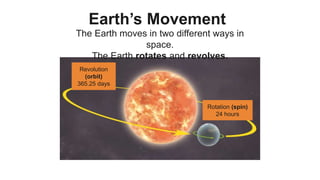
The Earth moves in two different ways in
space.
The Earth rotates and revolves.
Earth’s Movement
Revolution
(orbit)
365.25 days
Rotation (spin)
24 hours
Earth’s Rotation
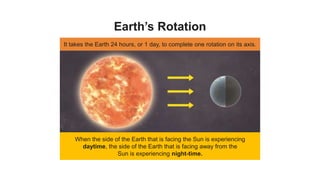
It takes the Earth 24 hours, or 1 day, to complete one rotation on its axis.
When the side of the Earth that is facing the Sun is experiencing
daytime, the side of the Earth that is facing away from the
Sun is experiencing night-time.
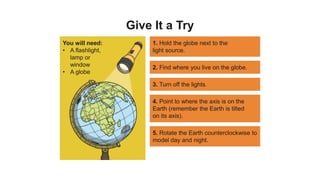
Give It a Try
You will need:
• A flashlight,
lamp or
window
• A globe
1. Hold the globe next to the
light source.
2. Find where you live on the globe.
3. Turn off the lights.
4. Point to where the axis is on the
Earth (remember the Earth is tilted
on its axis).
5. Rotate the Earth counterclockwise to
model day and night.
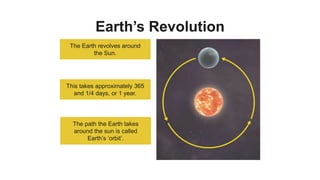
The Earth revolves around
the Sun.
Earth’s Revolution
This takes approximately 365
and 1/4 days, or 1 year.
The path the Earth takes
around the sun is called
Earth’s ‘orbit’.
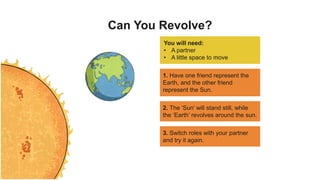
Can You Revolve?
You will need:
• A partner
• A little space to move
1. Have one friend represent the
Earth, and the other friend
represent the Sun.
2. The ‘Sun’ will stand still, while
the ‘Earth’ revolves around the sun.
3. Switch roles with your partner
and try it again.
Science blog

Science blog

  • 1.
  • 2.
    Vocabulary Earth space axis rotation night day changes sun revolution orbit moon shadows light environment sunrise sunset spin phases direction length planets stars Solar System comet particles Milky Way galaxy •Highlight words you’ve heard and know the meaning of green. • Highlight words you’ve heard but don’t know the meaning of yellow. • Highlight words you don’t know at all pink.
  • 3.
    The Solar System Thesolar system consists of the sun and everything that orbits, or travels around, the sun. This includes the eight planets and their moons, dwarf planets, and many asteroids and comets. However, even with all these things, most of the solar system is empty space.
  • 4.
    The Sun The sunis the star at the centre of the solar system. It is a hot ball of gases that gives off great amounts of energy. The solar system also contains planets, comets, and asteroids. They all orbit, or travel around, the sun.
  • 5.
    Earth Earth is oneof the eight planets that orbit, or travel around, the sun in the solar system. It is the third planet from the sun. Earth is the only planet in the solar system that can support life because it has water on its surface and oxygen gas in its air.
  • 6.
    The moon The Moonis a large natural object that orbits, or travels around, Earth. After the Sun, it is the brightest object in the sky. The Moon's gravity pulls on Earth. It is too weak to affect the whole planet, but it does make the water move.
  • 7.
  • 9.
  • 18.
  • 19.
    • The sunand moon appear the same size from Earth because the moon is much closer. • The sun is a source of light. The moon is not a source of light. Moonlight is the reflected light from the sun.
  • 20.
    The Sun The Sunstays in one spot. The Earth’s rotation makes the Sun appear to move in the sky, but the Earth is actually rotating. The Sun rises in the east. The Sun sets in the west.
  • 21.
    The Earth movesin two different ways in space. The Earth rotates and revolves. Earth’s Movement Revolution (orbit) 365.25 days Rotation (spin) 24 hours
  • 22.
    Earth’s Rotation It takesthe Earth 24 hours, or 1 day, to complete one rotation on its axis. When the side of the Earth that is facing the Sun is experiencing daytime, the side of the Earth that is facing away from the Sun is experiencing night-time.
  • 23.
    Give It aTry You will need: • A flashlight, lamp or window • A globe 1. Hold the globe next to the light source. 2. Find where you live on the globe. 3. Turn off the lights. 4. Point to where the axis is on the Earth (remember the Earth is tilted on its axis). 5. Rotate the Earth counterclockwise to model day and night.
  • 24.
    The Earth revolvesaround the Sun. Earth’s Revolution This takes approximately 365 and 1/4 days, or 1 year. The path the Earth takes around the sun is called Earth’s ‘orbit’.
  • 25.
    Can You Revolve? Youwill need: • A partner • A little space to move 1. Have one friend represent the Earth, and the other friend represent the Sun. 2. The ‘Sun’ will stand still, while the ‘Earth’ revolves around the sun. 3. Switch roles with your partner and try it again.

Editor's Notes

  • #4 https://www.youtube.com/watch?v=gKdxPw9HDUs
  • #5 https://www.youtube.com/watch?v=gKdxPw9HDUs
  • #6 https://www.youtube.com/watch?v=gKdxPw9HDUs
  • #7 https://www.youtube.com/watch?v=gKdxPw9HDUs
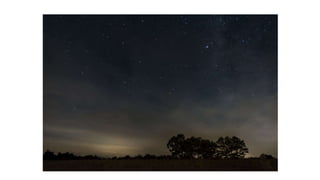
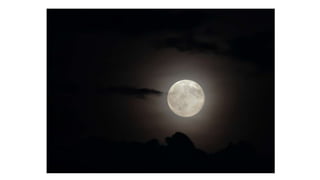
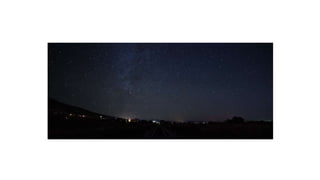
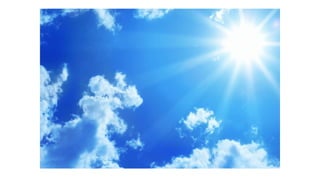
  • #11 Question: How do we know it is day? What might we see if it is day? How do we know it is night? What might we see if it is night?
  • #19 Question: What do you know about the Earth, moon and sun?