95% CI for difference: (-0.101, 0.217)
P-value = 0.475
Since the p-value is greater than 0.05, we fail to reject the null hypothesis that the difference between the two population proportions is zero.
A Market Researchon
Consumer awareness and
usage of MOBILE BANKING
BY
GROUP - 14
2.
M - Banking
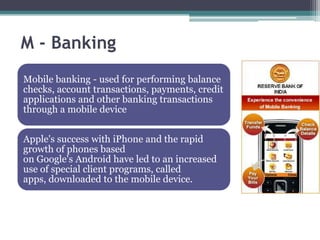
Mobilebanking - used for performing balance
checks, account transactions, payments, credit
applications and other banking transactions
through a mobile device
Apple's success with iPhone and the rapid
growth of phones based
on Google's Android have led to an increased
use of special client programs, called
apps, downloaded to the mobile device.
3.
Change in theTelecom Sector
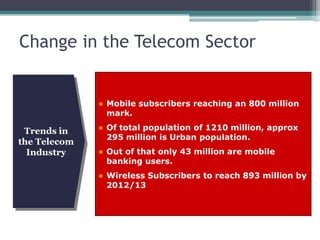
Mobile subscribers reaching an 800 million
mark.
Trends in Of total population of 1210 million, approx
295 million is Urban population.
the Telecom
Industry Out of that only 43 million are mobile
banking users.
Wireless Subscribers to reach 893 million by
2012/13
4.
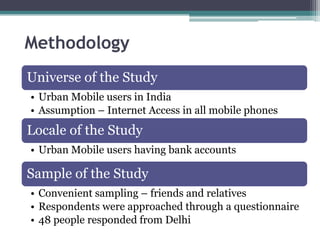
Methodology
Universe of theStudy
• Urban Mobile users in India
• Assumption – Internet Access in all mobile phones
Locale of the Study
• Urban Mobile users having bank accounts
Sample of the Study
• Convenient sampling – friends and relatives
• Respondents were approached through a questionnaire
• 48 people responded from Delhi
5.
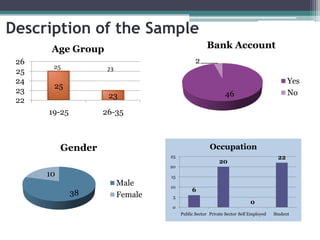
Description of theSample
Age Group Bank Account
26 2
25
25 23
24 Yes
25
23 46 No
23
22
19-25 26-35
Gender Occupation
25 22
20
20
10 15
Male 10
6
38 Female 5
0
0
Public Sector Private Sector Self Employed Student
6.
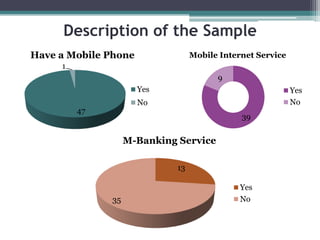
Description of theSample
Have a Mobile Phone Mobile Internet Service
1
9
Yes Yes
No No
47
39
M-Banking Service
13
Yes
35 No
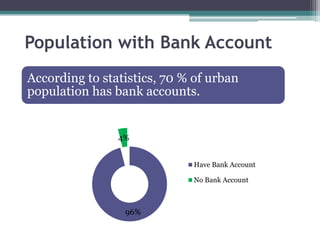
Population with BankAccount
According to statistics, 70 % of urban
population has bank accounts.
4%
Have Bank Account
No Bank Account
96%
9.
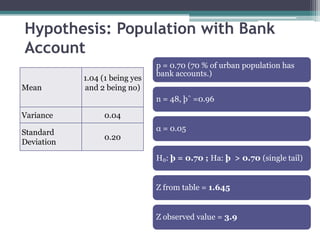
Hypothesis: Population withBank
Account
p = 0.70 (70 % of urban population has
bank accounts.)
1.04 (1 being yes
Mean and 2 being no)
n = 48, þ^ =0.96
Variance 0.04
Standard α = 0.05
0.20
Deviation
H₀: þ = 0.70 ; Ha: þ > 0.70 (single tail)
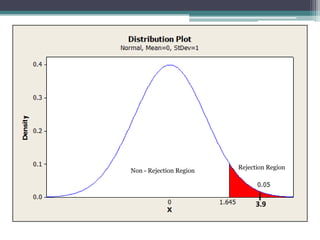
Z from table = 1.645
Z observed value = 3.9
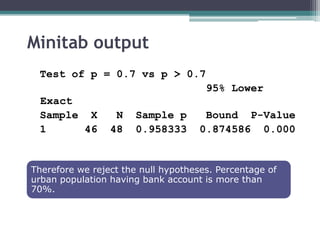
Minitab output
Testof p = 0.7 vs p > 0.7
95% Lower
Exact
Sample X N Sample p Bound P-Value
1 46 48 0.958333 0.874586 0.000
Therefore we reject the null hypotheses. Percentage of
urban population having bank account is more than
70%.
12.
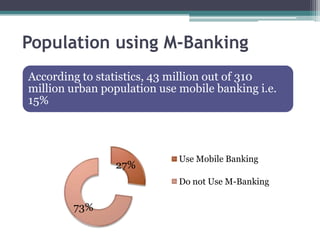
Population using M-Banking
Accordingto statistics, 43 million out of 310
million urban population use mobile banking i.e.
15%
Use Mobile Banking
27%
Do not Use M-Banking
73%
13.
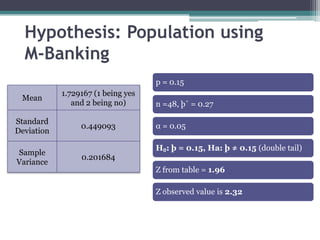
Hypothesis: Population using
M-Banking
p = 0.15
1.729167 (1 being yes
Mean
and 2 being no) n =48, þ^ = 0.27
Standard
0.449093 α = 0.05
Deviation
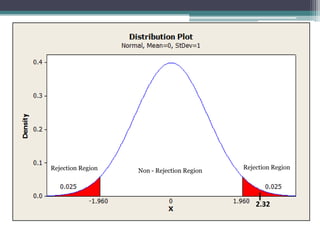
H₀: þ = 0.15, Ha: þ ≠ 0.15 (double tail)
Sample
0.201684
Variance
Z from table = 1.96
Z observed value is 2.32
Minitab output
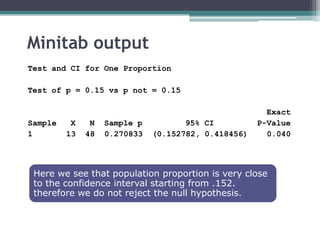
Test andCI for One Proportion
Test of p = 0.15 vs p not = 0.15
Exact
Sample X N Sample p 95% CI P-Value
1 13 48 0.270833 (0.152782, 0.418456) 0.040
Here we see that population proportion is very close
to the confidence interval starting from .152.
therefore we do not reject the null hypothesis.
16.
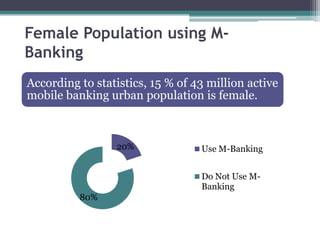
Female Population usingM-
Banking
According to statistics, 15 % of 43 million active
mobile banking urban population is female.
20% Use M-Banking
Do Not Use M-
Banking
80%
17.
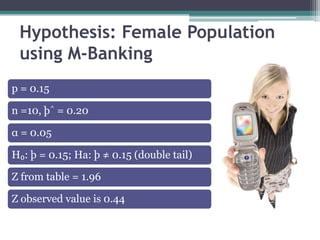
Hypothesis: Female Population
using M-Banking
p = 0.15
n =10, þ^ = 0.20
α = 0.05
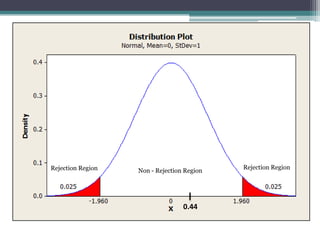
H₀: þ = 0.15; Ha: þ ≠ 0.15 (double tail)
Z from table = 1.96
Z observed value is 0.44
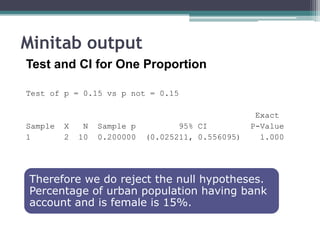
Minitab output
Test andCI for One Proportion
Test of p = 0.15 vs p not = 0.15
Exact
Sample X N Sample p 95% CI P-Value
1 2 10 0.200000 (0.025211, 0.556095) 1.000
Therefore we do reject the null hypotheses.
Percentage of urban population having bank
account and is female is 15%.
20.
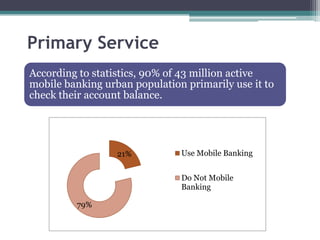
Primary Service
According tostatistics, 90% of 43 million active
mobile banking urban population primarily use it to
check their account balance.
21% Use Mobile Banking
Do Not Mobile
Banking
79%
21.
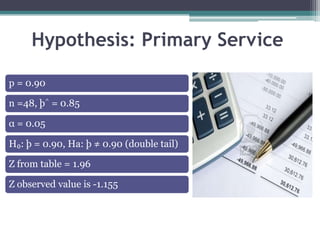
Hypothesis: Primary Service
p= 0.90
n =48, þ^ = 0.85
α = 0.05
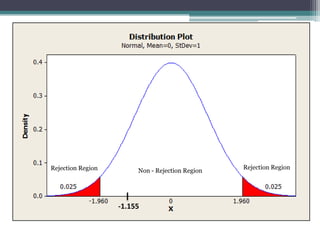
H₀: þ = 0.90, Ha: þ ≠ 0.90 (double tail)
Z from table = 1.96
Z observed value is -1.155
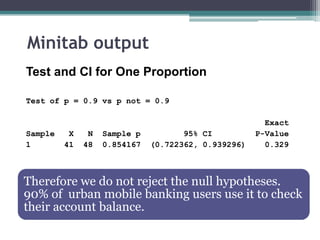
Minitab output
Test andCI for One Proportion
Test of p = 0.9 vs p not = 0.9
Exact
Sample X N Sample p 95% CI P-Value
1 41 48 0.854167 (0.722362, 0.939296) 0.329
Therefore we do not reject the null hypotheses.
90% of urban mobile banking users use it to check
their account balance.
24.
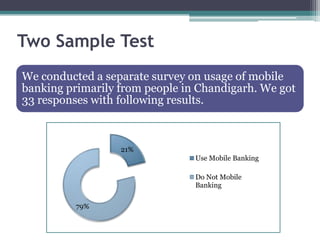
Two Sample Test
Weconducted a separate survey on usage of mobile
banking primarily from people in Chandigarh. We got
33 responses with following results.
21%
Use Mobile Banking
Do Not Mobile
Banking
79%
25.
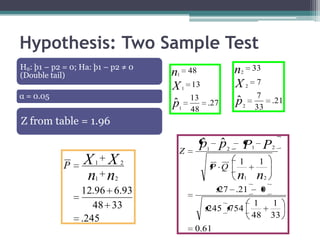
Hypothesis: Two SampleTest
H₀: þ1 – p2 = 0; Ha: þ1 – p2 ≠ 0 n 33
(Double tail) n
1
48 2
X 1
13 X 2
7
α = 0.05 7
ˆ
p
13
.27 ˆ
p
2 33
.21
1 48
Z from table = 1.96
ˆ ˆ
p p
1 2 P P 1 2
Z
P X X 1 2
P Q
1 1
n n 1 2 n n 1 2
12.96 6.93 .27 .21 0
48 33 1 1
.245 .754
.245 48 33
0.61
26.
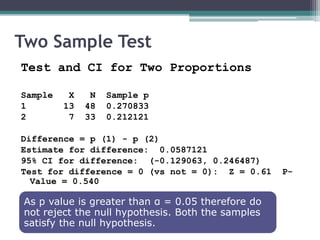
Two Sample Test
Testand CI for Two Proportions
Sample X N Sample p
1 13 48 0.270833
2 7 33 0.212121
Difference = p (1) - p (2)
Estimate for difference: 0.0587121
95% CI for difference: (-0.129063, 0.246487)
Test for difference = 0 (vs not = 0): Z = 0.61 P-
Value = 0.540
As p value is greater than α = 0.05 therefore do
not reject the null hypothesis. Both the samples
satisfy the null hypothesis.
27.
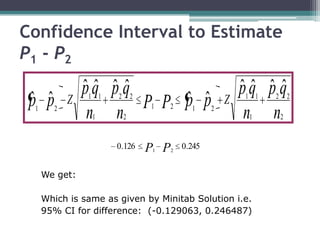
Confidence Interval toEstimate
P1 - P2
ˆˆ ˆˆ
pq p q ˆˆ ˆˆ
pq p q
ˆ ˆ
p p Z 1 1
ˆ ˆ
P P p p
2 2
1 2
Z 1 1 2 2
1 2
n n
1 2
1 2
n n
1 2
0.126 P P
1 2
0.245
We get:
Which is same as given by Minitab Solution i.e.
95% CI for difference: (-0.129063, 0.246487)
28.
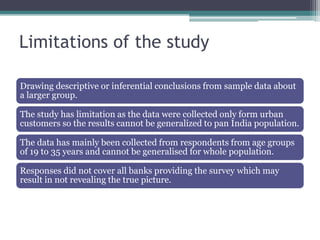
Limitations of thestudy
Drawing descriptive or inferential conclusions from sample data about
a larger group.
The study has limitation as the data were collected only form urban
customers so the results cannot be generalized to pan India population.
The data has mainly been collected from respondents from age groups
of 19 to 35 years and cannot be generalised for whole population.
Responses did not cover all banks providing the survey which may
result in not revealing the true picture.
29.
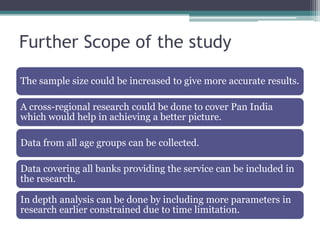
Further Scope ofthe study
The sample size could be increased to give more accurate results.
A cross-regional research could be done to cover Pan India
which would help in achieving a better picture.
Data from all age groups can be collected.
Data covering all banks providing the service can be included in
the research.
In depth analysis can be done by including more parameters in
research earlier constrained due to time limitation.