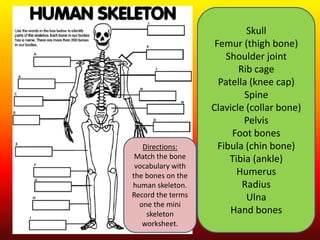
Radius                      Skull
                    Femur (thigh bone)
                       Shoulder joint
                          Rib cage
                     Patella (knee cap)
                            Spine
                   Clavicle (collar bone)
                           Pelvis
                        Foot bones
   Directions:       Fibula (chin bone)
 Match the bone         Tibia (ankle)
 vocabulary with
the bones on the          Humerus
human skeleton.            Radius
Record the terms            Ulna
  one the mini
    skeleton            Hand bones
   worksheet.
1. What is the skeletal system made of?

Bone
Cartilage (spongy tissue between bones and
 joints)
Muscle (that attach themselves and allow us
 to move many different ways)
2. How many bones are there is the
        human skeleton?


            206
3. What are the largest and smallest
        bones in our body?
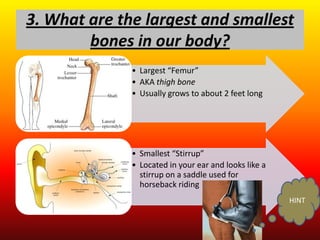
              • Largest “Femur”
              • AKA thigh bone
              • Usually grows to about 2 feet long


              • Smallest “Stirrup”
              • Located in your ear and looks like a
                stirrup on a saddle used for
                horseback riding
                                                       HINT
4. What are the 3 main functions of
        the skeletal system?
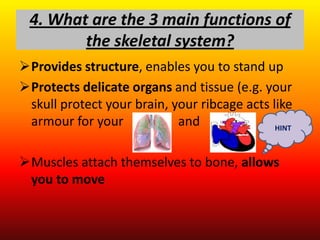
Provides structure, enables you to stand up
Protects delicate organs and tissue (e.g. your
 skull protect your brain, your ribcage acts like
 armour for your            and               HINT


Muscles attach themselves to bone, allows
 you to move
5. Why is it necessary for our survival?
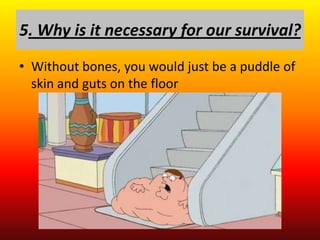
• Without bones, you would just be a puddle of
  skin and guts on the floor
6. How do our bones grow?
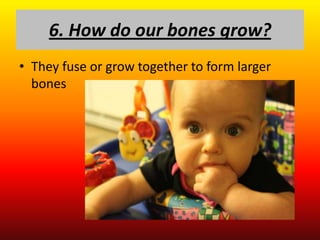
• They fuse or grow together to form larger
  bones
7. How does a baby’s skeletal system compare
    to a full grown adult’s skeletal system?
• Babies are made mostly of cartilage. The
  cartilage grows and thickens. Over time, its
  replaced by bones.
• Babies are born with over 300 bones
• A full grown adult has only 206 bones
• Why? The cartilage and bone fused together
  over time as the baby grows to be an adult
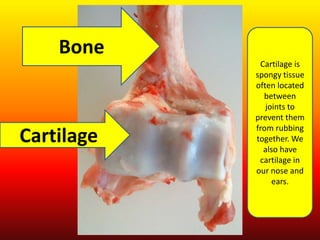
Bone
             Cartilage is
            spongy tissue
            often located
              between
               joints to
            prevent them
            from rubbing
Cartilage   together. We
              also have
             cartilage in
            our nose and
                 ears.
8. Can we do anything to help our
   bones grow better and stronger?
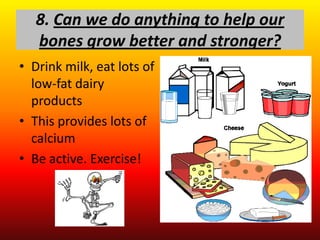
• Drink milk, eat lots of
  low-fat dairy
  products
• This provides lots of
  calcium
• Be active. Exercise!
9. What are the different ways bones
          can be injured?
• Complete fracture: bone is in 2 pieces
• Greenstick fracture: crack on one side, not all the
  way through
• Single fracture: broke in one place
• Communicated fracture: in more than 2 pieces or
  is crushed
• Bowling fracture: bends but does not break. Most
  common in kids
• Open fracture: sticking through the skin
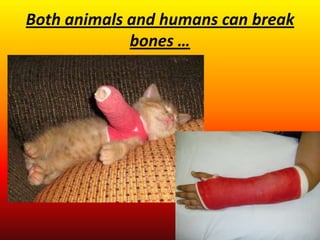
Both animals and humans can break
             bones …
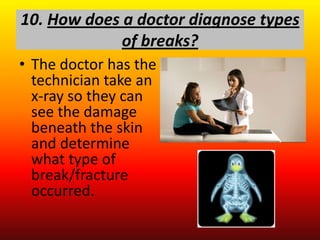
10. How does a doctor diagnose types
             of breaks?
• The doctor has the
  technician take an
  x-ray so they can
  see the damage
  beneath the skin
  and determine
  what type of
  break/fracture
  occurred.
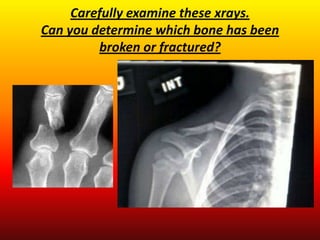
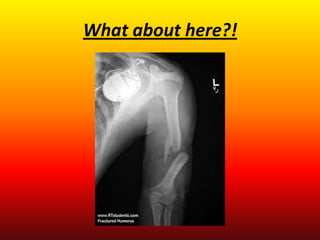
Carefully examine these xrays.
Can you determine which bone has been
         broken or fractured?
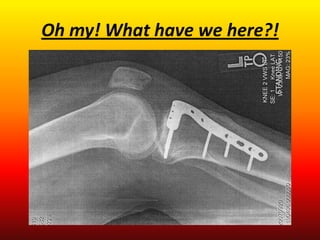
Oh my! What have we here?!
What about here?!
11. How are a break and a fracture
            different?
       The mean the SAME thing!


      Break = Fracture
      Fracture = Break
    I will need two brave volunteers…
12. How should a break/fracture be
        treated so it heals properly?
•   Step 1: determine the type of break
•   Step 2: set it (re-break, surgery, pins etc.)
•   Step 3: wrap it in a special bandage
•   Step 4: cast is required

                      Role Playing
              Volunteer 1: X-ray Technician
              Volunteer 2: Unlucky Patient
                  Ms. St. Louis: Doctor
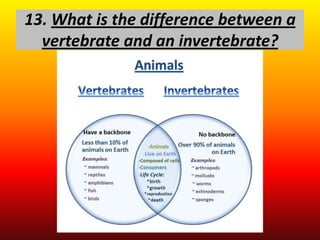
13. What is the difference between a
  vertebrate and an invertebrate?
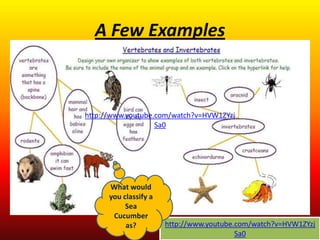
A Few Examples


http://www.youtube.com/watch?v=HVW1ZYzj
                   Sa0


      What would
      you classify a
           Sea
       Cucumber
           as?         http://www.youtube.com/watch?v=HVW1ZYzj
                                          Sa0
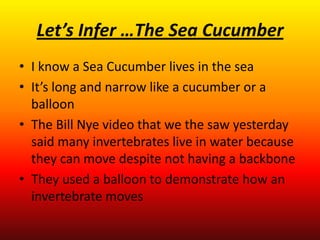
Let’s Infer …The Sea Cucumber
• I know a Sea Cucumber lives in the sea
• It’s long and narrow like a cucumber or a
  balloon
• The Bill Nye video that we the saw yesterday
  said many invertebrates live in water because
  they can move despite not having a backbone
• They used a balloon to demonstrate how an
  invertebrate moves
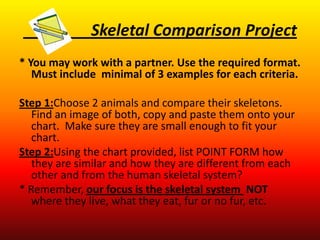
Skeletal Comparison Project
* You may work with a partner. Use the required format.
   Must include minimal of 3 examples for each criteria.

Step 1:Choose 2 animals and compare their skeletons.
   Find an image of both, copy and paste them onto your
   chart. Make sure they are small enough to fit your
   chart.
Step 2:Using the chart provided, list POINT FORM how
   they are similar and how they are different from each
   other and from the human skeletal system?
* Remember, our focus is the skeletal system NOT
   where they live, what they eat, fur or no fur, etc.
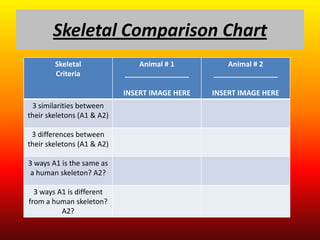
Skeletal Comparison Chart
        Skeletal                Animal # 1          Animal # 2
        Criteria            ________________    ________________

                            INSERT IMAGE HERE   INSERT IMAGE HERE
 3 similarities between
their skeletons (A1 & A2)

 3 differences between
their skeletons (A1 & A2)

3 ways A1 is the same as
 a human skeleton? A2?

  3 ways A1 is different
from a human skeleton?
          A2?
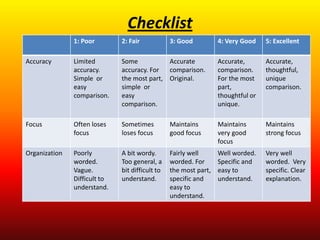
Checklist
               1: Poor        2: Fair            3: Good          4: Very Good    5: Excellent

Accuracy       Limited        Some           Accurate             Accurate,       Accurate,
               accuracy.      accuracy. For  comparison.          comparison.     thoughtful,
               Simple or      the most part, Original.            For the most    unique
               easy           simple or                           part,           comparison.
               comparison.    easy                                thoughtful or
                              comparison.                         unique.

Focus          Often loses    Sometimes          Maintains        Maintains       Maintains
               focus          loses focus        good focus       very good       strong focus
                                                                  focus
Organization   Poorly         A bit wordy.       Fairly well      Well worded.    Very well
               worded.        Too general, a     worded. For      Specific and    worded. Very
               Vague.         bit difficult to   the most part,   easy to         specific. Clear
               Difficult to   understand.        specific and     understand.     explanation.
               understand.                       easy to
                                                 understand.
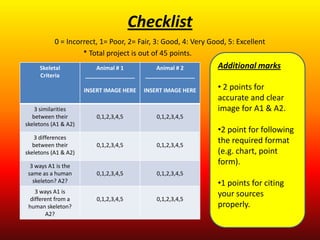
Checklist
           0 = Incorrect, 1= Poor, 2= Fair, 3: Good, 4: Very Good, 5: Excellent
                    * Total project is out of 45 points.
     Skeletal             Animal # 1          Animal # 2       Additional marks
     Criteria         ________________    ________________

                      INSERT IMAGE HERE   INSERT IMAGE HERE    • 2 points for
                                                               accurate and clear
    3 similarities                                             image for A1 & A2.
   between their          0,1,2,3,4,5         0,1,2,3,4,5
skeletons (A1 & A2)
                                                               •2 point for following
   3 differences
   between their          0,1,2,3,4,5         0,1,2,3,4,5
                                                               the required format
skeletons (A1 & A2)                                            (e.g. chart, point
  3 ways A1 is the
                                                               form).
 same as a human          0,1,2,3,4,5         0,1,2,3,4,5
   skeleton? A2?                                               •1 points for citing
    3 ways A1 is                                               your sources
  different from a        0,1,2,3,4,5         0,1,2,3,4,5
 human skeleton?                                               properly.
         A2?

The skeletal system

  • 2.
    Radius Skull Femur (thigh bone) Shoulder joint Rib cage Patella (knee cap) Spine Clavicle (collar bone) Pelvis Foot bones Directions: Fibula (chin bone) Match the bone Tibia (ankle) vocabulary with the bones on the Humerus human skeleton. Radius Record the terms Ulna one the mini skeleton Hand bones worksheet.
  • 3.
    1. What isthe skeletal system made of? Bone Cartilage (spongy tissue between bones and joints) Muscle (that attach themselves and allow us to move many different ways)
  • 4.
    2. How manybones are there is the human skeleton? 206
  • 5.
    3. What arethe largest and smallest bones in our body? • Largest “Femur” • AKA thigh bone • Usually grows to about 2 feet long • Smallest “Stirrup” • Located in your ear and looks like a stirrup on a saddle used for horseback riding HINT
  • 6.
    4. What arethe 3 main functions of the skeletal system? Provides structure, enables you to stand up Protects delicate organs and tissue (e.g. your skull protect your brain, your ribcage acts like armour for your and HINT Muscles attach themselves to bone, allows you to move
  • 7.
    5. Why isit necessary for our survival? • Without bones, you would just be a puddle of skin and guts on the floor
  • 8.
    6. How doour bones grow? • They fuse or grow together to form larger bones
  • 9.
    7. How doesa baby’s skeletal system compare to a full grown adult’s skeletal system? • Babies are made mostly of cartilage. The cartilage grows and thickens. Over time, its replaced by bones. • Babies are born with over 300 bones • A full grown adult has only 206 bones • Why? The cartilage and bone fused together over time as the baby grows to be an adult
  • 10.
    Bone Cartilage is spongy tissue often located between joints to prevent them from rubbing Cartilage together. We also have cartilage in our nose and ears.
  • 11.
    8. Can wedo anything to help our bones grow better and stronger? • Drink milk, eat lots of low-fat dairy products • This provides lots of calcium • Be active. Exercise!
  • 12.
    9. What arethe different ways bones can be injured? • Complete fracture: bone is in 2 pieces • Greenstick fracture: crack on one side, not all the way through • Single fracture: broke in one place • Communicated fracture: in more than 2 pieces or is crushed • Bowling fracture: bends but does not break. Most common in kids • Open fracture: sticking through the skin
  • 13.
    Both animals andhumans can break bones …
  • 14.
    10. How doesa doctor diagnose types of breaks? • The doctor has the technician take an x-ray so they can see the damage beneath the skin and determine what type of break/fracture occurred.
  • 15.
    Carefully examine thesexrays. Can you determine which bone has been broken or fractured?
  • 16.
    Oh my! Whathave we here?!
  • 17.
  • 18.
    11. How area break and a fracture different? The mean the SAME thing! Break = Fracture Fracture = Break I will need two brave volunteers…
  • 19.
    12. How shoulda break/fracture be treated so it heals properly? • Step 1: determine the type of break • Step 2: set it (re-break, surgery, pins etc.) • Step 3: wrap it in a special bandage • Step 4: cast is required Role Playing Volunteer 1: X-ray Technician Volunteer 2: Unlucky Patient Ms. St. Louis: Doctor
  • 20.
    13. What isthe difference between a vertebrate and an invertebrate?
  • 21.
    A Few Examples http://www.youtube.com/watch?v=HVW1ZYzj Sa0 What would you classify a Sea Cucumber as? http://www.youtube.com/watch?v=HVW1ZYzj Sa0
  • 22.
    Let’s Infer …TheSea Cucumber • I know a Sea Cucumber lives in the sea • It’s long and narrow like a cucumber or a balloon • The Bill Nye video that we the saw yesterday said many invertebrates live in water because they can move despite not having a backbone • They used a balloon to demonstrate how an invertebrate moves
  • 23.
    Skeletal Comparison Project *You may work with a partner. Use the required format. Must include minimal of 3 examples for each criteria. Step 1:Choose 2 animals and compare their skeletons. Find an image of both, copy and paste them onto your chart. Make sure they are small enough to fit your chart. Step 2:Using the chart provided, list POINT FORM how they are similar and how they are different from each other and from the human skeletal system? * Remember, our focus is the skeletal system NOT where they live, what they eat, fur or no fur, etc.
  • 24.
    Skeletal Comparison Chart Skeletal Animal # 1 Animal # 2 Criteria ________________ ________________ INSERT IMAGE HERE INSERT IMAGE HERE 3 similarities between their skeletons (A1 & A2) 3 differences between their skeletons (A1 & A2) 3 ways A1 is the same as a human skeleton? A2? 3 ways A1 is different from a human skeleton? A2?
  • 25.
    Checklist 1: Poor 2: Fair 3: Good 4: Very Good 5: Excellent Accuracy Limited Some Accurate Accurate, Accurate, accuracy. accuracy. For comparison. comparison. thoughtful, Simple or the most part, Original. For the most unique easy simple or part, comparison. comparison. easy thoughtful or comparison. unique. Focus Often loses Sometimes Maintains Maintains Maintains focus loses focus good focus very good strong focus focus Organization Poorly A bit wordy. Fairly well Well worded. Very well worded. Too general, a worded. For Specific and worded. Very Vague. bit difficult to the most part, easy to specific. Clear Difficult to understand. specific and understand. explanation. understand. easy to understand.
  • 26.
    Checklist 0 = Incorrect, 1= Poor, 2= Fair, 3: Good, 4: Very Good, 5: Excellent * Total project is out of 45 points. Skeletal Animal # 1 Animal # 2 Additional marks Criteria ________________ ________________ INSERT IMAGE HERE INSERT IMAGE HERE • 2 points for accurate and clear 3 similarities image for A1 & A2. between their 0,1,2,3,4,5 0,1,2,3,4,5 skeletons (A1 & A2) •2 point for following 3 differences between their 0,1,2,3,4,5 0,1,2,3,4,5 the required format skeletons (A1 & A2) (e.g. chart, point 3 ways A1 is the form). same as a human 0,1,2,3,4,5 0,1,2,3,4,5 skeleton? A2? •1 points for citing 3 ways A1 is your sources different from a 0,1,2,3,4,5 0,1,2,3,4,5 human skeleton? properly. A2?