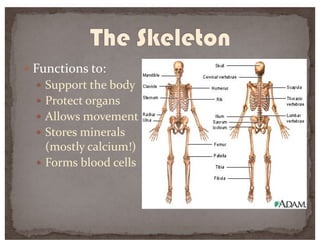
— Functions to:
—Support the body
— Protect organs
— Allows movement
— Stores minerals
(mostly calcium!)
— Forms blood cells
3.
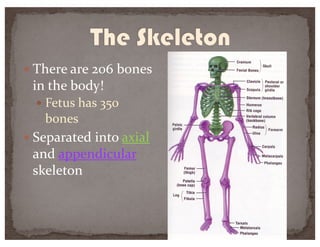
— There are206 bones
in the body!
— Fetus has 350
bones
— Separated into axial
and appendicular
skeleton
4.
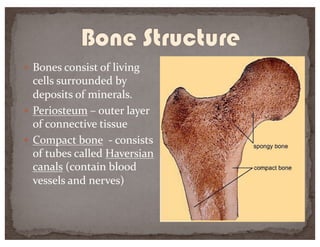
— Bones consistof living
cells surrounded by
deposits of minerals.
— Periosteum – outer layer
of connective tissue
— Compact bone - consists
of tubes called Haversian
canals (contain blood
vessels and nerves)
5.
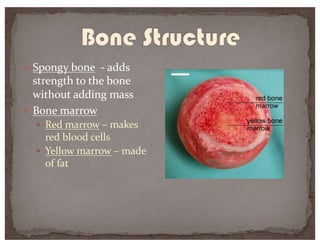
— Spongy bone- adds
strength to the bone
without adding mass
— Bone marrow
— Red marrow – makes
red blood cells
— Yellow marrow – made
of fat
6.
— Long –having a body which is longer the wide.
— Ex: Femur
— Short – Having a body which is approximately as wide
as they are long.
— Ex: Phalanges
— Flat – strong, flat plates
— Ex: Cranium
— Irregular – has no descriptive shape.
— Ex: Vertebrae
7.
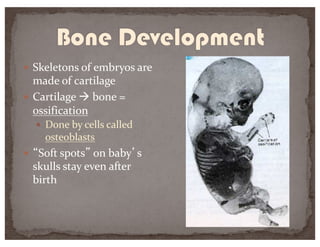
— Skeletons ofembryos are
made of cartilage
— Cartilage à bone =
ossification
— Done by cells called
osteoblasts
— Soft spots on babys
skulls stay even after
birth
8.
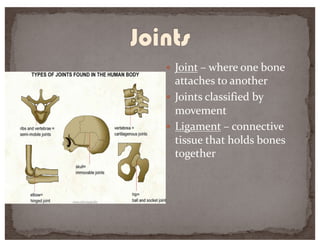
— Joint –where one bone
attaches to another
— Joints classified by
movement
— Ligament – connective
tissue that holds bones
together
9.
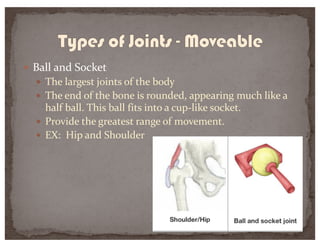
— Ball andSocket
— The largest joints of the body
— The end of the bone is rounded, appearing much like a
half ball. This ball fits into a cup-like socket.
— Provide the greatest range of movement.
— EX: Hip and Shoulder
10.
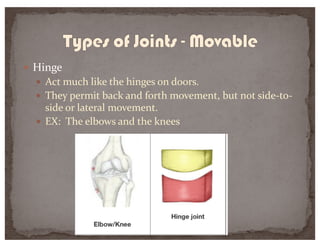
— Hinge
— Actmuch like the hinges on doors.
— They permit back and forth movement, but not side-to-
side or lateral movement.
— EX: The elbows and the knees
11.
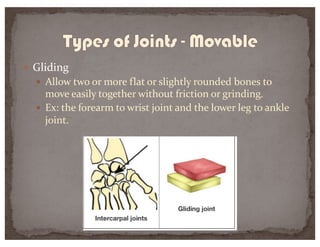
— Gliding
— Allowtwo or more flat or slightly rounded bones to
move easily together without friction or grinding.
— Ex: the forearm to wrist joint and the lower leg to ankle
joint.
12.
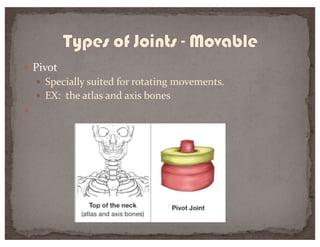
— Pivot
— Speciallysuited for rotating movements.
— EX: the atlas and axis bones
—
13.
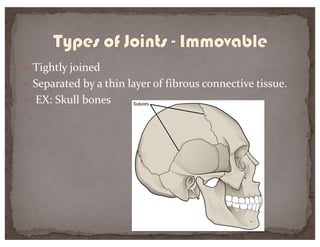
— Tightly joined
—Separated by a thin layer of fibrous connective tissue.
— EX: Skull bones
14.
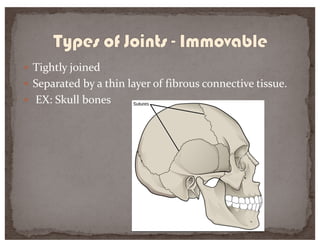
— Tightly joined
—Separated by a thin layer of fibrous connective tissue.
— EX: Skull bones
15.
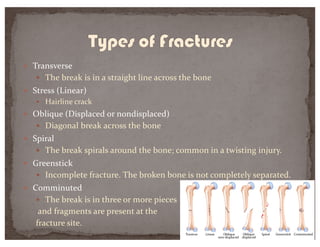
— Transverse
— Thebreak is in a straight line across the bone
— Stress (Linear)
— Hairline crack
— Oblique (Displaced or nondisplaced)
— Diagonal break across the bone
— Spiral
— The break spirals around the bone; common in a twisting injury.
— Greenstick
— Incomplete fracture. The broken bone is not completely separated.
— Comminuted
— The break is in three or more pieces
and fragments are present at the
fracture site.
16.
— Osteoporosis
— Thinningof bones, causing fractures
— Leukemia
— Cancer of White blood cells.
— Scoliosis
— Abnormalities of the spine.