The Role of National Level Statutory Bodies in Curriculum Development.pptx
1.
The Role ofNational Level
Statutory Bodies in
Curriculum Development
A comprehensive exploration of how UGC, NCTE, and Universities
collaborate to shape higher education standards in India, ensuring
quality, relevance, and innovation in curriculum development across
institutions nationwide.
by Dr Poonam Srivastava
2.
Introduction to StatutoryBodies in Higher Education
In India's higher education landscape, statutory bodies play a
crucial role in maintaining standards and driving innovation.
These institutions, mandated by the Government of India, create
the regulatory framework that guides curriculum development
across all universities and colleges.
These bodies provide the statutory foundation for curriculum
guidelines that balance national priorities with institutional
autonomy, ensuring consistency while allowing for adaptation to
regional needs.
Statutory bodies like UGC and NCTE operate under specific
legislative acts, giving them the authority to establish standards,
provide funding, and regulate educational institutions throughout
India.
3.
University Grants
Commission (UGC):Overview
Established 1956
The UGC was formally established by an Act of Parliament in 1956,
making it one of India's oldest educational regulatory bodies.
Standards Authority
As the apex body for higher education, UGC determines and maintains
educational standards across all Indian universities and colleges.
Funding Mechanism
UGC disburses grants to eligible universities and colleges, supporting
both institutional development and specific academic initiatives.
4.
Key Functions ofUGC
1 Quality Benchmarking
Establishes comprehensive quality parameters for higher education institutions
nationwide, including faculty qualifications, infrastructure requirements, and
academic standards.
2 Accreditation Authority
Works with the National Assessment and Accreditation Council (NAAC) to
evaluate and accredit universities and colleges based on established criteria.
3 Financial Support
Provides annual maintenance grants to eligible institutions while also offering
specialized funding for research projects, infrastructure development, and
innovative programs.
4 Program Approval
Reviews and approves proposals for new academic programs, ensuring they
meet national standards before implementation.
5.
UGC's Role inCurriculum Development
UGC's curriculum frameworks serve as the foundation for
universities to develop their own course structures while
maintaining national standards.
Curriculum Frameworks
Develops detailed recommendations for course structures,
learning objectives, and assessment patterns for both new
and existing academic programs.
Credit System Implementation
Introduced the Choice Based Credit System (CBCS) to
standardize curriculum across universities while offering
flexibility to students.
National Priority Integration
Guides universities on incorporating essential national
concerns like environmental education, ethics, and digital
literacy into curricula.
6.
UGC: Notable Initiatives
ModelSyllabi Development
Published comprehensive model
syllabi with defined learning
outcomes for major disciplines,
providing universities with ready
templates for adaptation.
Digital Education Push
Launched platforms like SWAYAM for
MOOCs and e-PG Pathshala for
digital content, transforming
curriculum delivery methods
nationwide.
Interdisciplinary Studies
Promotes crossing traditional subject
boundaries through guidelines for
multidisciplinary courses that
address complex contemporary
challenges.
NEP 2020 Support
Provides implementation
frameworks for the transformative
curriculum reforms outlined in the
National Education Policy 2020.
7.
National Council forTeacher Education (NCTE):
Overview
The National Council for Teacher Education was established as a
statutory body in 1993 through the NCTE Act passed by
Parliament. It serves as the cornerstone of teacher education in
India, ensuring that all teacher preparation programs meet
national standards.
NCTE's mandate extends to all forms of teacher education, from
pre-service preparation to in-service professional development,
covering everything from early childhood education specialists to
secondary school teachers.
Through its regional committees, NCTE maintains oversight of
teacher education institutions across the country, ensuring
standardized quality while allowing for regional adaptations
where appropriate.
8.
Key Functions ofNCTE
Standard Setting
Establishes comprehensive norms and standards for
teacher education programs, including infrastructure
requirements, faculty qualifications, and curriculum
frameworks.
Recognition Process
Evaluates and grants recognition to teacher education
institutions through a rigorous inspection and assessment
process to ensure compliance with established standards.
Quality Monitoring
Conducts regular monitoring and assessment of
recognized institutions to maintain quality and address any
deviations from prescribed norms.
9.
NCTE's Role inCurriculum Development
Curriculum Leadership
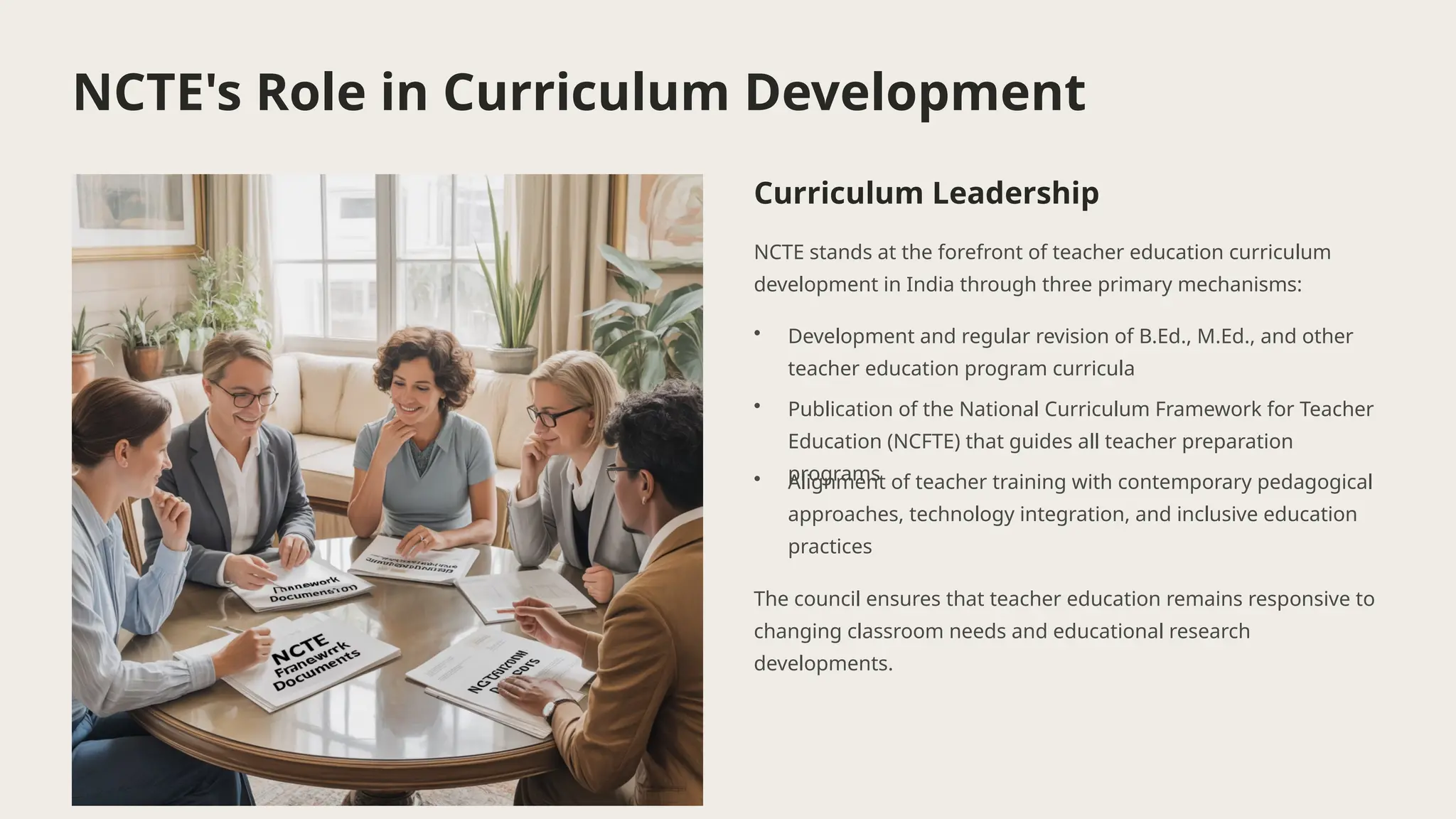
NCTE stands at the forefront of teacher education curriculum
development in India through three primary mechanisms:
• Development and regular revision of B.Ed., M.Ed., and other
teacher education program curricula
• Publication of the National Curriculum Framework for Teacher
Education (NCFTE) that guides all teacher preparation
programs
• Alignment of teacher training with contemporary pedagogical
approaches, technology integration, and inclusive education
practices
The council ensures that teacher education remains responsive to
changing classroom needs and educational research
developments.
10.
Collaboration: UGC andNCTE
1 Program Initiation
UGC recommends new teacher education programs based on national
needs assessment and higher education planning.
2 Standard Development
NCTE defines detailed curriculum standards, faculty qualifications, and
infrastructure requirements for these programs.
3 Implementation Planning
Joint committees from both bodies address implementation challenges
and develop transition strategies.
4 Policy Alignment
Regular consultation ensures coherence between broader higher
education policies and specific teacher education requirements.
11.
Structure and Autonomyof Universities
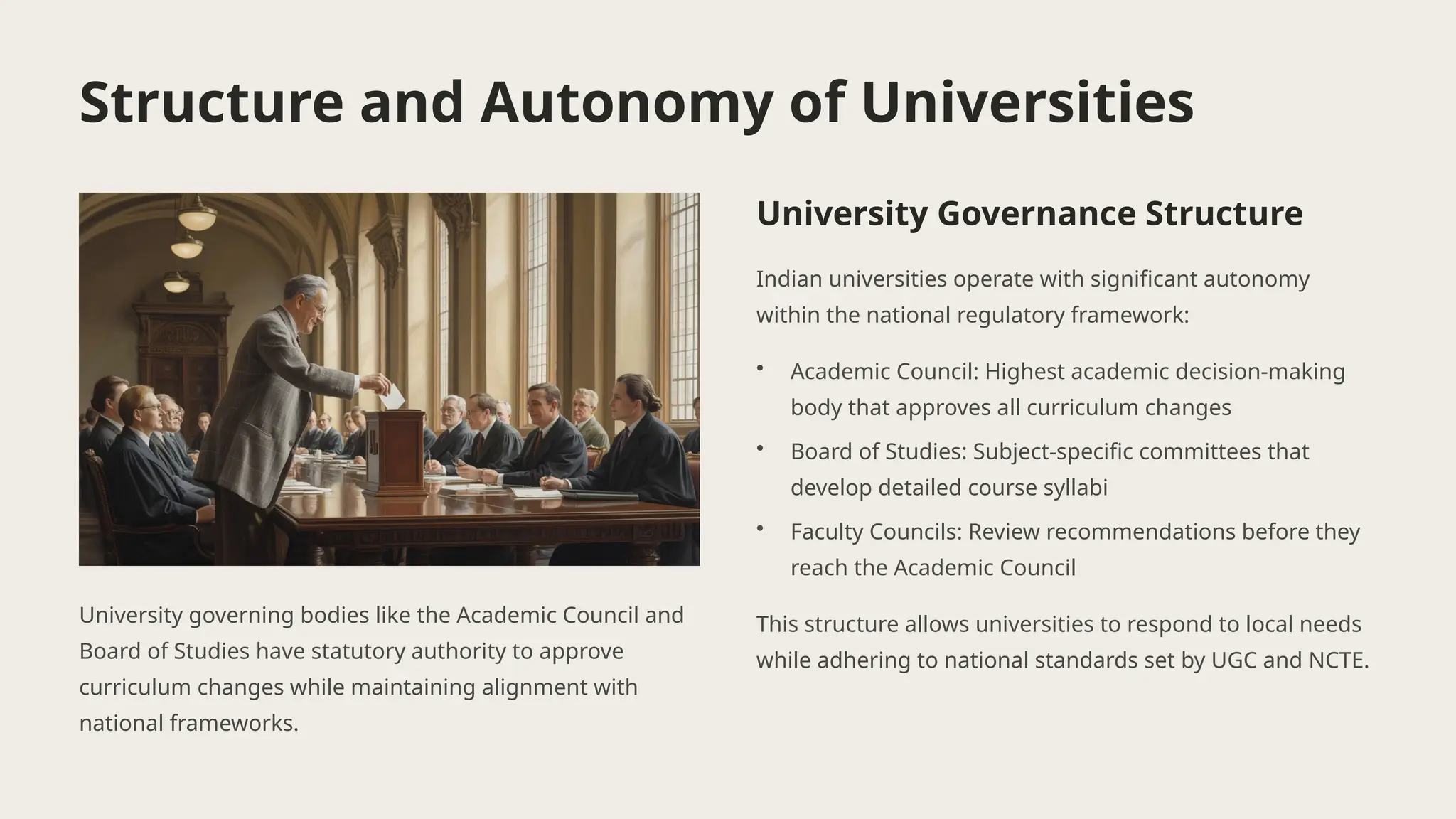
University governing bodies like the Academic Council and
Board of Studies have statutory authority to approve
curriculum changes while maintaining alignment with
national frameworks.
University Governance Structure
Indian universities operate with significant autonomy
within the national regulatory framework:
• Academic Council: Highest academic decision-making
body that approves all curriculum changes
• Board of Studies: Subject-specific committees that
develop detailed course syllabi
• Faculty Councils: Review recommendations before they
reach the Academic Council
This structure allows universities to respond to local needs
while adhering to national standards set by UGC and NCTE.
12.
University Role inCurriculum
Development
Guideline Integration
Universities interpret and incorporate UGC/NCTE frameworks into detailed syllabi
relevant to regional contexts and institutional strengths.
Regular Review Cycles
Implement systematic curriculum review processes (typically 3-5 year cycles) based on
student outcomes, faculty feedback, and emerging field developments.
Stakeholder Engagement
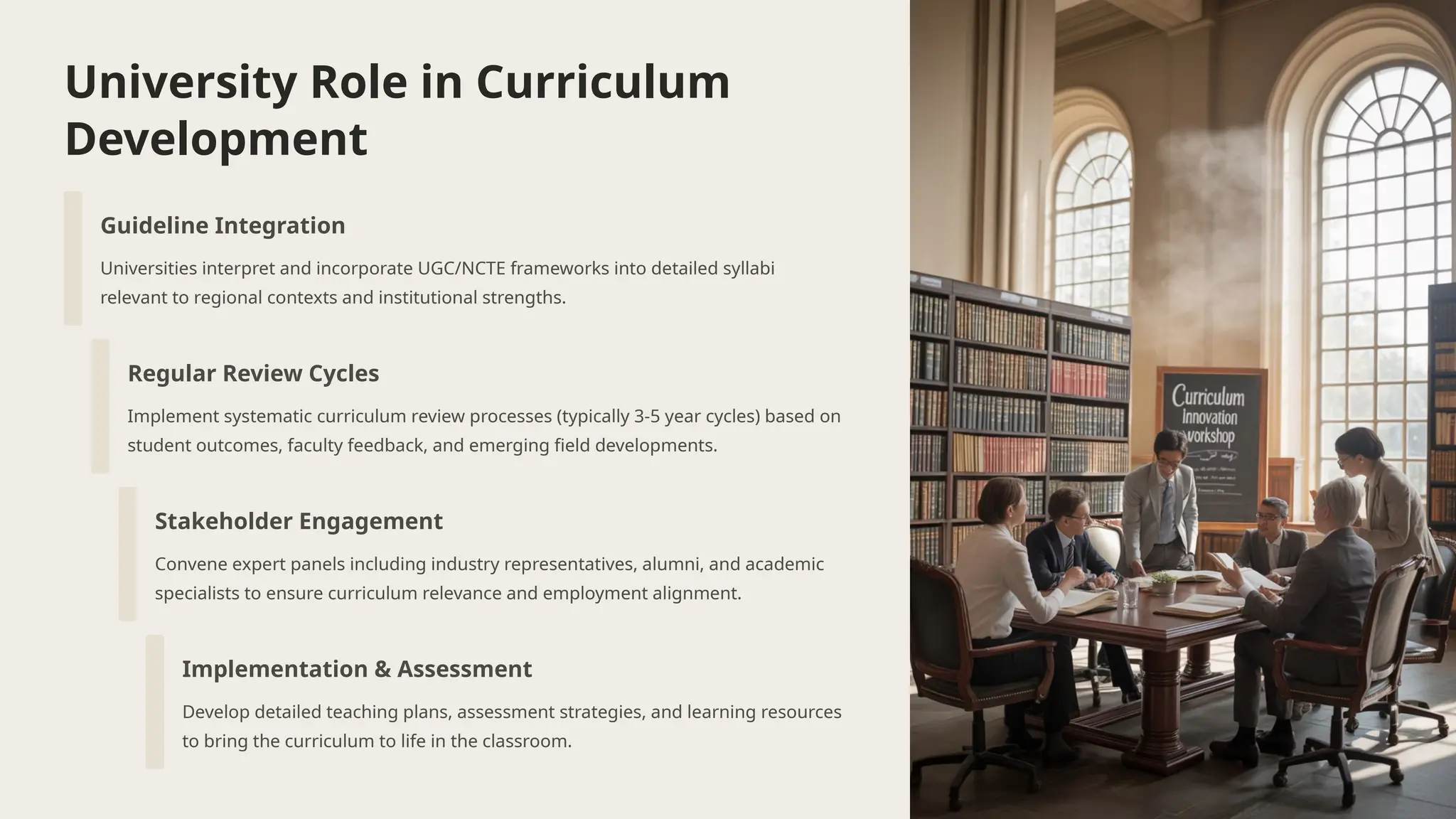
Convene expert panels including industry representatives, alumni, and academic
specialists to ensure curriculum relevance and employment alignment.
Implementation & Assessment
Develop detailed teaching plans, assessment strategies, and learning resources
to bring the curriculum to life in the classroom.
13.
Success Stories: CaseExamples
CBCS Implementation Success
The University of Delhi successfully implemented the UGC's
Choice Based Credit System, allowing students to select
courses across disciplines:
• Created 54 interdisciplinary courses available to all
students
• Enabled credit transfer between 40+ affiliated colleges
• Established student mobility agreements with 12
international universities
B.Ed. Curriculum Transformation
Following NCTE guidelines, Savitribai Phule Pune University
revamped its teacher education curriculum:
• Extended program to 2 years with enhanced practicum
• Integrated technology and inclusive education components
• Implemented school internship model with mentor
teacher support
14.
Challenges and FutureDirections
Autonomy vs. Standardization
Finding the right balance between
national standardization and
institutional autonomy remains an
ongoing challenge. Universities need
freedom to innovate while maintaining
comparable quality standards
nationwide.
Digital Transformation
The rapid pace of technological change
requires continuous curriculum
adaptation. Emerging fields like AI, data
science, and digital humanities demand
new approaches to curriculum design
and delivery.
Stakeholder Engagement
Developing mechanisms for meaningful
industry and community involvement in
curriculum development will be crucial
for ensuring relevance and
employability of graduates.
15.
Conclusion
The collaborative ecosystemof national statutory bodies
and universities creates a balanced approach to curriculum
development in Indian higher education:
UGC provides the regulatory framework and funding that
enables standardization and innovation
NCTE ensures that teacher education maintains quality and
relevance to classroom realities
Universities adapt national frameworks to local contexts
while driving ground-level implementation
Together, these institutions form the backbone of India's
quest for educational excellence, ensuring that curricula
remain dynamic, relevant, and aligned with national
priorities.
The ultimate success of curriculum development is
measured by the quality of graduates produced and their
contribution to India's knowledge economy and society.