
Where does your  knowledge  of the world come from ?  Do people in different parts of the world  see things in the same way ?  Do you think any group  should have the  power to decide  for other people  what a good society is ?  What is teaching?  What’s the  teacher’s role ?
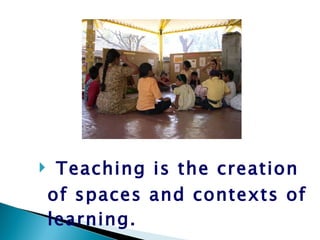
Teaching is the creation of spaces and contexts of learning.
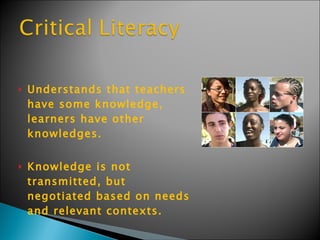
Understands that teachers have some knowledge, learners have other knowledges.  Knowledge is not transmitted, but negotiated based on needs and relevant contexts.
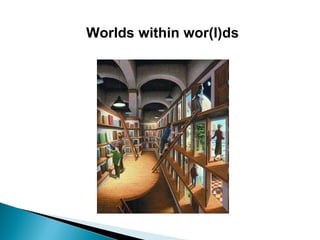
Worlds within wor(l)ds
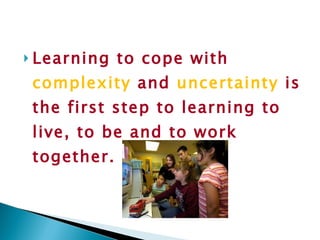
Learning to cope with  complexity  and  uncertainty  is the first step to learning to live, to be and to work together.
to engage with complex local/global processes and diverse perspectives  to examine the origins and implications of our own and other people’s assumptions and positions to negotiate change, to transform relationships, to think independently and to make responsible and conscious choices about our own lives and how we affect the lives of others to live with and learn from difference and conflict and to prevent conflict from escalating to aggression and violence to establish ethical, responsible and caring relationships within and beyond our identity groups
Within a complex environment of peer pressure, information overload and different kinds of (local and global) injustices, empowering pupils to think independently and make informed and responsible decisions become more meaningful than a rhetoric of good virtues .
What are our own questions ?
Each context will have specific characteristics related to the profile of participants. Factors like age, level of inclusion/exclusion in the social-economic system, emotional stability, communication skills, etc. directly affect how participants react to the methodology.  The right choice of content and its level of language are key in addressing these factors and the educator/facilitator who works in the context is in the best position to make decisions.  It is up to the educator/facilitator to assess the suitability of the methodology for their context, to adapt it as necessary, to evaluate its effectiveness or to choose not to use it.
Thank you!  Lucia Bodeman  Email: lu_bodeman@yahoo.com.b r Twitter:  @lu_bodeman Website: lubodeman.blogspot.com

The right to question critical literacy

  • 1.
  • 2.
  • 3.
    Where does your knowledge of the world come from ? Do people in different parts of the world see things in the same way ? Do you think any group should have the power to decide for other people what a good society is ? What is teaching? What’s the teacher’s role ?
  • 4.
    Teaching is thecreation of spaces and contexts of learning.
  • 5.
    Understands that teachershave some knowledge, learners have other knowledges. Knowledge is not transmitted, but negotiated based on needs and relevant contexts.
  • 6.
  • 7.
    Learning to copewith complexity and uncertainty is the first step to learning to live, to be and to work together.
  • 8.
    to engage withcomplex local/global processes and diverse perspectives to examine the origins and implications of our own and other people’s assumptions and positions to negotiate change, to transform relationships, to think independently and to make responsible and conscious choices about our own lives and how we affect the lives of others to live with and learn from difference and conflict and to prevent conflict from escalating to aggression and violence to establish ethical, responsible and caring relationships within and beyond our identity groups
  • 9.
    Within a complexenvironment of peer pressure, information overload and different kinds of (local and global) injustices, empowering pupils to think independently and make informed and responsible decisions become more meaningful than a rhetoric of good virtues .
  • 10.
    What are ourown questions ?
  • 11.
    Each context willhave specific characteristics related to the profile of participants. Factors like age, level of inclusion/exclusion in the social-economic system, emotional stability, communication skills, etc. directly affect how participants react to the methodology. The right choice of content and its level of language are key in addressing these factors and the educator/facilitator who works in the context is in the best position to make decisions. It is up to the educator/facilitator to assess the suitability of the methodology for their context, to adapt it as necessary, to evaluate its effectiveness or to choose not to use it.
  • 12.
    Thank you! Lucia Bodeman Email: lu_bodeman@yahoo.com.b r Twitter: @lu_bodeman Website: lubodeman.blogspot.com