1
SECTION OUTLINE 19 (Revelation 19:1-21)
Jerusalem, Judah and the nation of Israel have been destroyed by the Lord
using the Roman Army because of their persecution and killing of God’s
saints, prophets and finally their Messiah. See Matthew 23:33-38 and Luke
21:20-22 and verse 32. The Lord’s Church emerges victorious having survived
the Jewish persecution. Some persecution continued under Roman
authorities and the spiritual battle engaged in is described at the end of this
chapter.
A. Verses 1-10
1. What Did John hear next? From whom? Vs 1 – 3
He heard a great - #3173 – mega – feminine – big, literally or figuratively
Voice - #5456 – phone – through the idea of disclosure, a tone or address
Much - #4183 – singular, many – plural
People - #3793 – ochlos - #3793 – throng (as borne along) – by impl.
rabble
a. What did they ascribe to God? Have you heard this phrase before
in Revelation? If so, where?
(1.) Salvation - #4991 – soteria – rescue or safety – KJV – deliver, save,
health
Glory - #1391 – doxa – KJV – dignity, honor, praise, worship
Honor - #5092 – tim’e – a value, esteem – KJV – precious, price
Power - #1411 – dunamis – force, esp. miraculous power
(2.)Yes
Rev 7: 10-12 – blessing, glory, honor, power
Rev 12:10 – salvation and strength (#1411 – dunamis) ..is come.
Power is #1849 – exousia – privilege, force. Used in Matt 28:18 &
102 other places
b. What is said of God’s judgments? Is this phrase found elsewhere
in Revelation? If so, where?
(1.) True - #228 – truthful
(2.)Righteous - #1342 – equitable (in character or act), by impl.
Innocent, holy
Rev 15:3 – just (#1342)/ righteous and true are thy ways
2
Rev 16:7 – true and righteous are thy judgments
c. Had God been asked to avenge the blood of His servants before?
Is so, where? Vs 2
Yes.
Rev 6:9-10 – dost thou not judge and avenge our blood?
Rev 18:20 – God hath avenged you on her
Lk 21:22 – these be the days of vengeance
d. What does “alleluia” mean?
Allelouia - #239 – of Hebrew origin – Praise ye Yah (#3050 –
contraction for Jehovah)) , an adoring exclamation
In the NT only in this chapter – verses 1, 3, 4 and 6.
In the OT mostly in the Psalms.
The last 3 chapters relate to the church, the spiritual body of the
saints
2. Who fell down and worshipped God? Is this the first time these are
mentioned in Revelation? If not, where? Vs 4 – 5
The 24 elders and the 4 beasts
No.
Rev 4:4-10 - 24 elders and the 4 beasts
Rev 5:8-11 & 14 - 24 elders and the 4 beasts
Rev 11:15 – 24 elders only
Rev 15:7 – 4 beasts only
a. Which God is being talked about here?
The God that sat on the throne
Yah – God the Father
Is 12:2 - the Lord (Yah) Jehovah is my strength
1 Thess 1:9-10 – ye turned to God from idols …and wait for His Son
Matt 22:32 –God of Abraham … God is not the God of the dead but the
living
b. What does “amen” mean?
Amen - #281 - Hebrew origin (# 543) , properly, firm, (figuratively)
trustworthy, so be it.
c. What did the voice say? What does the word “fear” mean?
It answered the call to praise Ya by saying “Praise the God our”
3
Fear – phobeo - #5399 – to frighten, i.e. (passively) to be alarmed; by
analogy, to be in awe of, revere. KJV – be (+sore) afraid, fear
(exceedingly), reverence
3. What did John hear next? List the three representations. Vs 6 – 9
He heard “as it were” or “like” #5613. See Rev 18:21 and 21:11 – same
word
The voice of a great multitude – Rev 7:9 great multitude stood before the
throne
The voice of many waters – Rev 1:15 and 14:2. Ezek 43:2 – His voice like a
noise of
Waters – Rev 17:15 = people
The voice of mighty thunderings – Rev 4:5 – out of the throne proceedeth
..thunderings and voices. Rev 6:1 & 8:5. John 12:28-29 – thought it
thundered
a. What does “omnipotent” mean?
Omnipotent - #3841 – pantokrator – the all ruling, i.e. God as absolute
and universal sovereign. KJV – Almighty, Omnipotent
b. Why were they to be glad and to rejoice?
Because the Lamb’s marriage had come and His wife had made
herself ready.
2 Cor 11:2 I have espoused you to one husband
Eph 5:23-32 – but I speak of Christ and the church
c. Who was arrayed in fine linen? Is this literal linen?
The Lamb’s wife.
Rev 21:2, 9-10 – new Jerusalem prepared as a bride, I will show you
the Lamb’s bride.
No. Because it is said to be the righteousness of the saints.
d. What was John told to write?
Blessed are those who are called to the marriage supper of the Lamb
e. Did Jesus tell a parable concerning this event? If so, where?
Yes.
Matt 22:1-14 Many called but few chosen. Must have a wedding
garment
Rev 3:4 – not defiled their garments
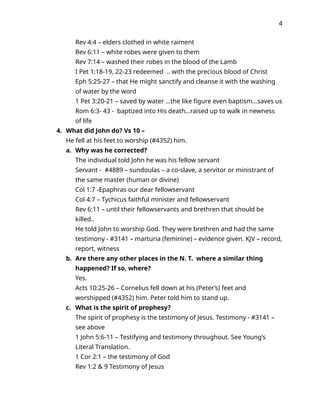
4
Rev 4:4 – elders clothed in white raiment
Rev 6:11 – white robes were given to them
Rev 7:14 – washed their robes in the blood of the Lamb
I Pet 1:18-19, 22-23 redeemed .. with the precious blood of Christ
Eph 5:25-27 – that He might sanctify and cleanse it with the washing
of water by the word
1 Pet 3:20-21 – saved by water …the like figure even baptism...saves us
Rom 6:3- 43 - baptized into His death…raised up to walk in newness
of life
4. What did John do? Vs 10 –
He fell at his feet to worship (#4352) him.
a. Why was he corrected?
The individual told John he was his fellow servant
Servant - #4889 – sundoulas – a co-slave, a servitor or ministrant of
the same master (human or divine)
Col 1:7 -Epaphras our dear fellowservant
Col 4:7 – Tychicus faithful minister and fellowservant
Rev 6:11 – until their fellowservants and brethren that should be
killed..
He told John to worship God. They were brethren and had the same
testimony - #3141 – marturia (feminine) – evidence given. KJV – record,
report, witness
b. Are there any other places in the N. T. where a similar thing
happened? If so, where?
Yes.
Acts 10:25-26 – Cornelius fell down at his (Peter’s) feet and
worshipped (#4352) him. Peter told him to stand up.
c. What is the spirit of prophesy?
The spirit of prophesy is the testimony of Jesus. Testimony - #3141 –
see above
1 John 5:6-11 – Testifying and testimony throughout. See Young’s
Literal Translation.
1 Cor 2:1 – the testimony of God
Rev 1:2 & 9 Testimony of Jesus
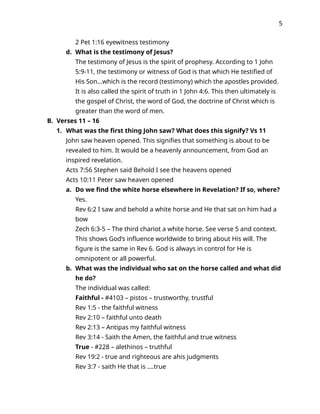
5
2 Pet 1:16 eyewitness testimony
d. What is the testimony of Jesus?
The testimony of Jesus is the spirit of prophesy. According to 1 John
5:9-11, the testimony or witness of God is that which He testified of
His Son…which is the record (testimony) which the apostles provided.
It is also called the spirit of truth in 1 John 4:6. This then ultimately is
the gospel of Christ, the word of God, the doctrine of Christ which is
greater than the word of men.
B. Verses 11 – 16
1. What was the first thing John saw? What does this signify? Vs 11
John saw heaven opened. This signifies that something is about to be
revealed to him. It would be a heavenly announcement, from God an
inspired revelation.
Acts 7:56 Stephen said Behold I see the heavens opened
Acts 10:11 Peter saw heaven opened
a. Do we find the white horse elsewhere in Revelation? If so, where?
Yes.
Rev 6:2 I saw and behold a white horse and He that sat on him had a
bow
Zech 6:3-5 – The third chariot a white horse. See verse 5 and context.
This shows God’s influence worldwide to bring about His will. The
figure is the same in Rev 6. God is always in control for He is
omnipotent or all powerful.
b. What was the individual who sat on the horse called and what did
he do?
The individual was called:
Faithful - #4103 – pistos – trustworthy, trustful
Rev 1:5 - the faithful witness
Rev 2:10 – faithful unto death
Rev 2:13 – Antipas my faithful witness
Rev 3:14 - Saith the Amen, the faithful and true witness
True - #228 – alethinos – truthful
Rev 19:2 - true and righteous are ahis judgments
Rev 3:7 - saith He that is ….true
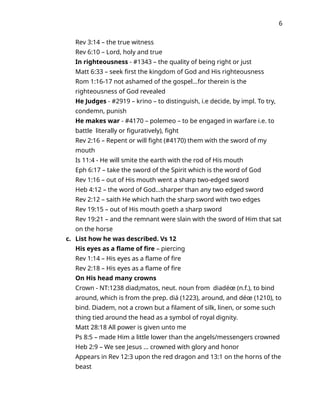
6
Rev 3:14 – the true witness
Rev 6:10 – Lord, holy and true
In righteousness - #1343 – the quality of being right or just
Matt 6:33 – seek first the kingdom of God and His righteousness
Rom 1:16-17 not ashamed of the gospel…for therein is the
righteousness of God revealed
He Judges - #2919 – krino – to distinguish, i.e decide, by impl. To try,
condemn, punish
He makes war - #4170 – polemeo – to be engaged in warfare i.e. to
battle literally or figuratively), fight
Rev 2:16 – Repent or will fight (#4170) them with the sword of my
mouth
Is 11:4 - He will smite the earth with the rod of His mouth
Eph 6:17 – take the sword of the Spirit which is the word of God
Rev 1:16 – out of His mouth went a sharp two-edged sword
Heb 4:12 – the word of God…sharper than any two edged sword
Rev 2:12 – saith He which hath the sharp sword with two edges
Rev 19:15 – out of His mouth goeth a sharp sword
Rev 19:21 – and the remnant were slain with the sword of Him that sat
on the horse
c. List how he was described. Vs 12
His eyes as a flame of fire – piercing
Rev 1:14 – His eyes as a flame of fire
Rev 2:18 – His eyes as a flame of fire
On His head many crowns
Crown - NT:1238 diad¡matos, neut. noun from diadéœ (n.f.), to bind
around, which is from the prep. diá (1223), around, and déœ (1210), to
bind. Diadem, not a crown but a filament of silk, linen, or some such
thing tied around the head as a symbol of royal dignity.
Matt 28:18 All power is given unto me
Ps 8:5 – made Him a little lower than the angels/messengers crowned
Heb 2:9 – We see Jesus … crowned with glory and honor
Appears in Rev 12:3 upon the red dragon and 13:1 on the horns of the
beast
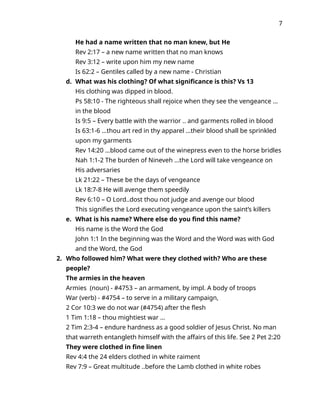
7
He had a name written that no man knew, but He
Rev 2:17 – a new name written that no man knows
Rev 3:12 – write upon him my new name
Is 62:2 – Gentiles called by a new name - Christian
d. What was his clothing? Of what significance is this? Vs 13
His clothing was dipped in blood.
Ps 58:10 - The righteous shall rejoice when they see the vengeance …
in the blood
Is 9:5 – Every battle with the warrior .. and garments rolled in blood
Is 63:1-6 …thou art red in thy apparel …their blood shall be sprinkled
upon my garments
Rev 14:20 …blood came out of the winepress even to the horse bridles
Nah 1:1-2 The burden of Nineveh …the Lord will take vengeance on
His adversaries
Lk 21:22 – These be the days of vengeance
Lk 18:7-8 He will avenge them speedily
Rev 6:10 – O Lord..dost thou not judge and avenge our blood
This signifies the Lord executing vengeance upon the saint’s killers
e. What is his name? Where else do you find this name?
His name is the Word the God
John 1:1 In the beginning was the Word and the Word was with God
and the Word, the God
2. Who followed him? What were they clothed with? Who are these
people?
The armies in the heaven
Armies (noun) - #4753 – an armament, by impl. A body of troops
War (verb) - #4754 – to serve in a military campaign,
2 Cor 10:3 we do not war (#4754) after the flesh
1 Tim 1:18 – thou mightiest war …
2 Tim 2:3-4 – endure hardness as a good soldier of Jesus Christ. No man
that warreth entangleth himself with the affairs of this life. See 2 Pet 2:20
They were clothed in fine linen
Rev 4:4 the 24 elders clothed in white raiment
Rev 7:9 – Great multitude ..before the Lamb clothed in white robes
8
Rev 19:8 – the fine linen is the righteousness of the saints
These are faithful brethren, the Lord’s people.
Heb 12:22-23 – whose names are written in heaven
Phil 4:3 – Clement also and other fellow laborers whose names are in the
book of life
a. What did he smite the nations with?
With a sharp sword that came out of His mouth.
Rev 1:16 – out of His mouth went a sharp two-edged sword
Rev 2:12 saith He that hath the sword with two edges
Rev 2:16 - fight against them with the sword of my mouth
Heb 4:12 – the word of God ..sharper than any two-edged sword
2 Thess 2:8 – the Lord shall consume with the spirit of His mouth
John 6:63 – the words I speak to you are spirit and life
b. How did he rule them?
He ruled them with a rod (#4464 – a stick or wand as a cudgel, a cane
or a baton of royalty) of iron
Ps 2:9 – Thou shall break them with a rod of iron
Rev 2:27 – He shall rule them with a rod of iron (quotes Ps 2:9)
Rev 12:5 – Same quote of Ps 2:9
1 Cor 4:21 – shall I come to you with a rod (#4464)
c. What is his name?
King of kings and Lord of lords
1 Tim 6:15 – Same
Rev 17:14 – Lord of lords and King of kings
Dan 2:47 – your God is a God of gods and a Lord of kings
d. Are there other places in the Bible that has similar wording as
verses 15 and 16 have. If so, where?
Is 11:1-10 – v4 – the rod of His mouth
Is 30:33 – the breath of the Lord doth kindle it
Is 63:1-4 – I have trodden the winepress alone …trample them in my
fury
C. Verses 17 – 21 the supper of the great God
1. What did John see next?
9
He saw an angel/messenger standing in the sun. He is about to deliver
another message. He is illuminated by the light of the sun. His message
is authoritative.
Rev 8:13 - angel/messenger flying in the midst of heaven delivering a
message
Rev 14:6 – another angel/messenger in same place to deliver a massage
a. What did he call them together for?
To participate in the supper of the great God
Ezek 39:17-20 – speak to every feathered fowl …assemble
yourselves..ye shall eat the flesh of the mighty
b. List what they were to do. Is this literal or figurative? Why or why
not?
Remember, Jerusalem is already destroyed.
Eat the flesh of kings
The flesh of captains
The flesh of mighty men
The flesh of horses
Of them that sit on them
The flesh of all men both free and bond, small and great
This is figurative language. The celebration of winning the spiritual
battle against the Roman authorities who participated in the
persecution of the saints. That battle continues and will culminate
when the Lord returns.
2. What was going to happen? Against whom?
The beast, the kings of the earth and their armies were gathered
together to make war.
Against the one who sat on the horse, the Lord, and His army
Ps 2:1-12 – Why do the heathen rage ..the rulers take counsel together
against the Lord …
a. List who was taken.
The beast
Rev 13:1-2 – I saw a beast rise up out of the sea…the dragon gave him
his power..his number is 666
The false prophet
10
Rev 16:13-14 I saw three unclean spirits come out …and out of the
mouth of the false prophet
b. What happened to them?
They were cast alive into the lake of fire
Rev 14:9-10 – any that worship the beast ..shall be tormented with fire
and brimstone
Rev 20:10 – where the beast and the false prophet are
Lk 16:24 – I am tormented in this flame
c. What was used to slay the remnant? Use other related scriptures
to explain what is happening here.
They were slain with the sword that proceeded out of mouth of the
one who sat on the horse.
Rev 2:12 – saith He which hath the sharp sword with 2 edges
Rev 2:16 – and will fight against them with the sword of my mouth
Rev 19:15 – out of His mouth goeth a sharp sword
Heb 4:12 – the word of God is quick and sharper than a two-edged
sword
Eph 6:17 – and the sword of the Spirit which is the word of God
As always, you will find that a good exhaustive concordance is one of the best
tools available for bible study. It gives you the location and definition of a
word without much commentary. You must search the scriptures to see how
the Holy Spirit uses words in the contexts they appear in order to get the
proper meaning of them. Get into the habit of reading your Bible to become
more familiar with it. If you can remember one word in a passage in the O.T or
N.T., you can find the passage it appears in by using your concordance.

The Revelation Chapter 19 Working Copy.docx

  • 1.
    1 SECTION OUTLINE 19(Revelation 19:1-21) Jerusalem, Judah and the nation of Israel have been destroyed by the Lord using the Roman Army because of their persecution and killing of God’s saints, prophets and finally their Messiah. See Matthew 23:33-38 and Luke 21:20-22 and verse 32. The Lord’s Church emerges victorious having survived the Jewish persecution. Some persecution continued under Roman authorities and the spiritual battle engaged in is described at the end of this chapter. A. Verses 1-10 1. What Did John hear next? From whom? Vs 1 – 3 He heard a great - #3173 – mega – feminine – big, literally or figuratively Voice - #5456 – phone – through the idea of disclosure, a tone or address Much - #4183 – singular, many – plural People - #3793 – ochlos - #3793 – throng (as borne along) – by impl. rabble a. What did they ascribe to God? Have you heard this phrase before in Revelation? If so, where? (1.) Salvation - #4991 – soteria – rescue or safety – KJV – deliver, save, health Glory - #1391 – doxa – KJV – dignity, honor, praise, worship Honor - #5092 – tim’e – a value, esteem – KJV – precious, price Power - #1411 – dunamis – force, esp. miraculous power (2.)Yes Rev 7: 10-12 – blessing, glory, honor, power Rev 12:10 – salvation and strength (#1411 – dunamis) ..is come. Power is #1849 – exousia – privilege, force. Used in Matt 28:18 & 102 other places b. What is said of God’s judgments? Is this phrase found elsewhere in Revelation? If so, where? (1.) True - #228 – truthful (2.)Righteous - #1342 – equitable (in character or act), by impl. Innocent, holy Rev 15:3 – just (#1342)/ righteous and true are thy ways
  • 2.
    2 Rev 16:7 –true and righteous are thy judgments c. Had God been asked to avenge the blood of His servants before? Is so, where? Vs 2 Yes. Rev 6:9-10 – dost thou not judge and avenge our blood? Rev 18:20 – God hath avenged you on her Lk 21:22 – these be the days of vengeance d. What does “alleluia” mean? Allelouia - #239 – of Hebrew origin – Praise ye Yah (#3050 – contraction for Jehovah)) , an adoring exclamation In the NT only in this chapter – verses 1, 3, 4 and 6. In the OT mostly in the Psalms. The last 3 chapters relate to the church, the spiritual body of the saints 2. Who fell down and worshipped God? Is this the first time these are mentioned in Revelation? If not, where? Vs 4 – 5 The 24 elders and the 4 beasts No. Rev 4:4-10 - 24 elders and the 4 beasts Rev 5:8-11 & 14 - 24 elders and the 4 beasts Rev 11:15 – 24 elders only Rev 15:7 – 4 beasts only a. Which God is being talked about here? The God that sat on the throne Yah – God the Father Is 12:2 - the Lord (Yah) Jehovah is my strength 1 Thess 1:9-10 – ye turned to God from idols …and wait for His Son Matt 22:32 –God of Abraham … God is not the God of the dead but the living b. What does “amen” mean? Amen - #281 - Hebrew origin (# 543) , properly, firm, (figuratively) trustworthy, so be it. c. What did the voice say? What does the word “fear” mean? It answered the call to praise Ya by saying “Praise the God our”
  • 3.
    3 Fear – phobeo- #5399 – to frighten, i.e. (passively) to be alarmed; by analogy, to be in awe of, revere. KJV – be (+sore) afraid, fear (exceedingly), reverence 3. What did John hear next? List the three representations. Vs 6 – 9 He heard “as it were” or “like” #5613. See Rev 18:21 and 21:11 – same word The voice of a great multitude – Rev 7:9 great multitude stood before the throne The voice of many waters – Rev 1:15 and 14:2. Ezek 43:2 – His voice like a noise of Waters – Rev 17:15 = people The voice of mighty thunderings – Rev 4:5 – out of the throne proceedeth ..thunderings and voices. Rev 6:1 & 8:5. John 12:28-29 – thought it thundered a. What does “omnipotent” mean? Omnipotent - #3841 – pantokrator – the all ruling, i.e. God as absolute and universal sovereign. KJV – Almighty, Omnipotent b. Why were they to be glad and to rejoice? Because the Lamb’s marriage had come and His wife had made herself ready. 2 Cor 11:2 I have espoused you to one husband Eph 5:23-32 – but I speak of Christ and the church c. Who was arrayed in fine linen? Is this literal linen? The Lamb’s wife. Rev 21:2, 9-10 – new Jerusalem prepared as a bride, I will show you the Lamb’s bride. No. Because it is said to be the righteousness of the saints. d. What was John told to write? Blessed are those who are called to the marriage supper of the Lamb e. Did Jesus tell a parable concerning this event? If so, where? Yes. Matt 22:1-14 Many called but few chosen. Must have a wedding garment Rev 3:4 – not defiled their garments
  • 4.
    4 Rev 4:4 –elders clothed in white raiment Rev 6:11 – white robes were given to them Rev 7:14 – washed their robes in the blood of the Lamb I Pet 1:18-19, 22-23 redeemed .. with the precious blood of Christ Eph 5:25-27 – that He might sanctify and cleanse it with the washing of water by the word 1 Pet 3:20-21 – saved by water …the like figure even baptism...saves us Rom 6:3- 43 - baptized into His death…raised up to walk in newness of life 4. What did John do? Vs 10 – He fell at his feet to worship (#4352) him. a. Why was he corrected? The individual told John he was his fellow servant Servant - #4889 – sundoulas – a co-slave, a servitor or ministrant of the same master (human or divine) Col 1:7 -Epaphras our dear fellowservant Col 4:7 – Tychicus faithful minister and fellowservant Rev 6:11 – until their fellowservants and brethren that should be killed.. He told John to worship God. They were brethren and had the same testimony - #3141 – marturia (feminine) – evidence given. KJV – record, report, witness b. Are there any other places in the N. T. where a similar thing happened? If so, where? Yes. Acts 10:25-26 – Cornelius fell down at his (Peter’s) feet and worshipped (#4352) him. Peter told him to stand up. c. What is the spirit of prophesy? The spirit of prophesy is the testimony of Jesus. Testimony - #3141 – see above 1 John 5:6-11 – Testifying and testimony throughout. See Young’s Literal Translation. 1 Cor 2:1 – the testimony of God Rev 1:2 & 9 Testimony of Jesus
  • 5.
    5 2 Pet 1:16eyewitness testimony d. What is the testimony of Jesus? The testimony of Jesus is the spirit of prophesy. According to 1 John 5:9-11, the testimony or witness of God is that which He testified of His Son…which is the record (testimony) which the apostles provided. It is also called the spirit of truth in 1 John 4:6. This then ultimately is the gospel of Christ, the word of God, the doctrine of Christ which is greater than the word of men. B. Verses 11 – 16 1. What was the first thing John saw? What does this signify? Vs 11 John saw heaven opened. This signifies that something is about to be revealed to him. It would be a heavenly announcement, from God an inspired revelation. Acts 7:56 Stephen said Behold I see the heavens opened Acts 10:11 Peter saw heaven opened a. Do we find the white horse elsewhere in Revelation? If so, where? Yes. Rev 6:2 I saw and behold a white horse and He that sat on him had a bow Zech 6:3-5 – The third chariot a white horse. See verse 5 and context. This shows God’s influence worldwide to bring about His will. The figure is the same in Rev 6. God is always in control for He is omnipotent or all powerful. b. What was the individual who sat on the horse called and what did he do? The individual was called: Faithful - #4103 – pistos – trustworthy, trustful Rev 1:5 - the faithful witness Rev 2:10 – faithful unto death Rev 2:13 – Antipas my faithful witness Rev 3:14 - Saith the Amen, the faithful and true witness True - #228 – alethinos – truthful Rev 19:2 - true and righteous are ahis judgments Rev 3:7 - saith He that is ….true
  • 6.
    6 Rev 3:14 –the true witness Rev 6:10 – Lord, holy and true In righteousness - #1343 – the quality of being right or just Matt 6:33 – seek first the kingdom of God and His righteousness Rom 1:16-17 not ashamed of the gospel…for therein is the righteousness of God revealed He Judges - #2919 – krino – to distinguish, i.e decide, by impl. To try, condemn, punish He makes war - #4170 – polemeo – to be engaged in warfare i.e. to battle literally or figuratively), fight Rev 2:16 – Repent or will fight (#4170) them with the sword of my mouth Is 11:4 - He will smite the earth with the rod of His mouth Eph 6:17 – take the sword of the Spirit which is the word of God Rev 1:16 – out of His mouth went a sharp two-edged sword Heb 4:12 – the word of God…sharper than any two edged sword Rev 2:12 – saith He which hath the sharp sword with two edges Rev 19:15 – out of His mouth goeth a sharp sword Rev 19:21 – and the remnant were slain with the sword of Him that sat on the horse c. List how he was described. Vs 12 His eyes as a flame of fire – piercing Rev 1:14 – His eyes as a flame of fire Rev 2:18 – His eyes as a flame of fire On His head many crowns Crown - NT:1238 diad¡matos, neut. noun from diadéœ (n.f.), to bind around, which is from the prep. diá (1223), around, and déœ (1210), to bind. Diadem, not a crown but a filament of silk, linen, or some such thing tied around the head as a symbol of royal dignity. Matt 28:18 All power is given unto me Ps 8:5 – made Him a little lower than the angels/messengers crowned Heb 2:9 – We see Jesus … crowned with glory and honor Appears in Rev 12:3 upon the red dragon and 13:1 on the horns of the beast
  • 7.
    7 He had aname written that no man knew, but He Rev 2:17 – a new name written that no man knows Rev 3:12 – write upon him my new name Is 62:2 – Gentiles called by a new name - Christian d. What was his clothing? Of what significance is this? Vs 13 His clothing was dipped in blood. Ps 58:10 - The righteous shall rejoice when they see the vengeance … in the blood Is 9:5 – Every battle with the warrior .. and garments rolled in blood Is 63:1-6 …thou art red in thy apparel …their blood shall be sprinkled upon my garments Rev 14:20 …blood came out of the winepress even to the horse bridles Nah 1:1-2 The burden of Nineveh …the Lord will take vengeance on His adversaries Lk 21:22 – These be the days of vengeance Lk 18:7-8 He will avenge them speedily Rev 6:10 – O Lord..dost thou not judge and avenge our blood This signifies the Lord executing vengeance upon the saint’s killers e. What is his name? Where else do you find this name? His name is the Word the God John 1:1 In the beginning was the Word and the Word was with God and the Word, the God 2. Who followed him? What were they clothed with? Who are these people? The armies in the heaven Armies (noun) - #4753 – an armament, by impl. A body of troops War (verb) - #4754 – to serve in a military campaign, 2 Cor 10:3 we do not war (#4754) after the flesh 1 Tim 1:18 – thou mightiest war … 2 Tim 2:3-4 – endure hardness as a good soldier of Jesus Christ. No man that warreth entangleth himself with the affairs of this life. See 2 Pet 2:20 They were clothed in fine linen Rev 4:4 the 24 elders clothed in white raiment Rev 7:9 – Great multitude ..before the Lamb clothed in white robes
  • 8.
    8 Rev 19:8 –the fine linen is the righteousness of the saints These are faithful brethren, the Lord’s people. Heb 12:22-23 – whose names are written in heaven Phil 4:3 – Clement also and other fellow laborers whose names are in the book of life a. What did he smite the nations with? With a sharp sword that came out of His mouth. Rev 1:16 – out of His mouth went a sharp two-edged sword Rev 2:12 saith He that hath the sword with two edges Rev 2:16 - fight against them with the sword of my mouth Heb 4:12 – the word of God ..sharper than any two-edged sword 2 Thess 2:8 – the Lord shall consume with the spirit of His mouth John 6:63 – the words I speak to you are spirit and life b. How did he rule them? He ruled them with a rod (#4464 – a stick or wand as a cudgel, a cane or a baton of royalty) of iron Ps 2:9 – Thou shall break them with a rod of iron Rev 2:27 – He shall rule them with a rod of iron (quotes Ps 2:9) Rev 12:5 – Same quote of Ps 2:9 1 Cor 4:21 – shall I come to you with a rod (#4464) c. What is his name? King of kings and Lord of lords 1 Tim 6:15 – Same Rev 17:14 – Lord of lords and King of kings Dan 2:47 – your God is a God of gods and a Lord of kings d. Are there other places in the Bible that has similar wording as verses 15 and 16 have. If so, where? Is 11:1-10 – v4 – the rod of His mouth Is 30:33 – the breath of the Lord doth kindle it Is 63:1-4 – I have trodden the winepress alone …trample them in my fury C. Verses 17 – 21 the supper of the great God 1. What did John see next?
  • 9.
    9 He saw anangel/messenger standing in the sun. He is about to deliver another message. He is illuminated by the light of the sun. His message is authoritative. Rev 8:13 - angel/messenger flying in the midst of heaven delivering a message Rev 14:6 – another angel/messenger in same place to deliver a massage a. What did he call them together for? To participate in the supper of the great God Ezek 39:17-20 – speak to every feathered fowl …assemble yourselves..ye shall eat the flesh of the mighty b. List what they were to do. Is this literal or figurative? Why or why not? Remember, Jerusalem is already destroyed. Eat the flesh of kings The flesh of captains The flesh of mighty men The flesh of horses Of them that sit on them The flesh of all men both free and bond, small and great This is figurative language. The celebration of winning the spiritual battle against the Roman authorities who participated in the persecution of the saints. That battle continues and will culminate when the Lord returns. 2. What was going to happen? Against whom? The beast, the kings of the earth and their armies were gathered together to make war. Against the one who sat on the horse, the Lord, and His army Ps 2:1-12 – Why do the heathen rage ..the rulers take counsel together against the Lord … a. List who was taken. The beast Rev 13:1-2 – I saw a beast rise up out of the sea…the dragon gave him his power..his number is 666 The false prophet
  • 10.
    10 Rev 16:13-14 Isaw three unclean spirits come out …and out of the mouth of the false prophet b. What happened to them? They were cast alive into the lake of fire Rev 14:9-10 – any that worship the beast ..shall be tormented with fire and brimstone Rev 20:10 – where the beast and the false prophet are Lk 16:24 – I am tormented in this flame c. What was used to slay the remnant? Use other related scriptures to explain what is happening here. They were slain with the sword that proceeded out of mouth of the one who sat on the horse. Rev 2:12 – saith He which hath the sharp sword with 2 edges Rev 2:16 – and will fight against them with the sword of my mouth Rev 19:15 – out of His mouth goeth a sharp sword Heb 4:12 – the word of God is quick and sharper than a two-edged sword Eph 6:17 – and the sword of the Spirit which is the word of God As always, you will find that a good exhaustive concordance is one of the best tools available for bible study. It gives you the location and definition of a word without much commentary. You must search the scriptures to see how the Holy Spirit uses words in the contexts they appear in order to get the proper meaning of them. Get into the habit of reading your Bible to become more familiar with it. If you can remember one word in a passage in the O.T or N.T., you can find the passage it appears in by using your concordance.