The Promise of Multi Cloud
Retain the flexibility to innovate
Plan of the talk
▪ Introduction
▪ Multi Cloud Vs Hybrid Cloud
▪ Evolution of Multi Cloud
▪ Multi Cloud as Modern Enterprise Foundation
▪ Multi Cloud Platforms
▪ Multi Cloud Challenges
▪ Considerations for Multi Cloud
▪ Takeaways
What is Multi Cloud?
Multi Cloud is the use of cloud services from
multiple cloud providers either through direct
consumption or through an abstraction layer
across various providers
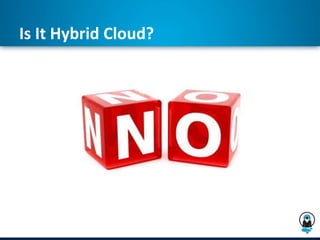
Is It Hybrid Cloud?
Evolution to Multi Cloud
Federated Clouds Multi Cloud
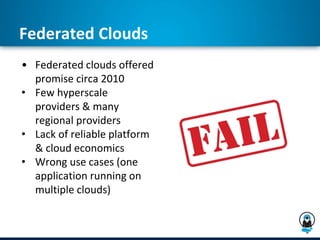
Federated Clouds
• Federated clouds offered
promise circa 2010
• Few hyperscale
providers & many
regional providers
• Lack of reliable platform
& cloud economics
• Wrong use cases (one
application running on
multiple clouds)
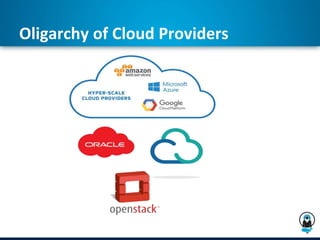
Oligarchy of Cloud Providers
Towards Multi Cloud Future
▪ By 2020, most organizations will use more
than one provider - Rishidot Research
▪ A third of organizations work with four or
more cloud vendors - 451 Research
▪ Organizations already use multiple clouds,
they will do so even more in 2017 - Forrester
▪ 1,000 IT professionals found 85% of
enterprises now have a multi-cloud strategy,
up from 82% in 2016 - Rightscale Survey
Drivers For Multi Cloud
▪ Flexibility to innovate
▪ Shadow IT to mainstream adoption
▪ Better application platform abstractions
▪ Reducing lock-in risks
▪ Enhanced portability and application
lifecycle with containers
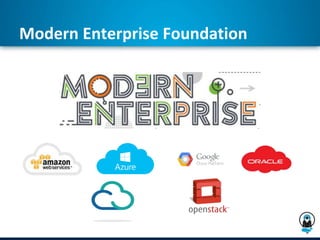
Modern Enterprise Foundation
Multi Cloud Advantages
▪ Flexibility to innovate rapidly with
right services
▪ Right platform for your workloads
▪ Geographic performance advantage
▪ Data sovereignty and compliance
▪ Price flexibility
▪ Risk mitigation and redundancy*
* This use case may not be cost effective
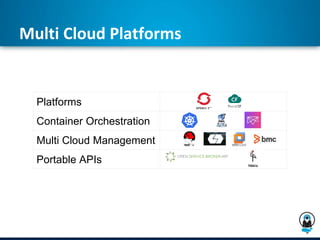
Multi Cloud Platforms
Platforms
Container Orchestration
Multi Cloud Management
Portable APIs
Multi Cloud Challenges
▪ Complexity in management
▪ Need to rethink security
▪ Difficulty in governance
▪ Cost risks in certain use cases
Multi Cloud Management
• Multiple providers +
multiple services =
Complexity
• Need for seamless
deployment across
clouds
• Programmatic
deployment options
Security & Governance
• Control over
security perimeter
across cloud
providers
• Single pane of glass
across multiple
services & multiple
providers
The Cost Factor
• Keeping control
over costs with
regular pricing
changes is tough
• Certain use cases
like HA across
providers are not
cost effective
Considerations For CIO
▪ Multi cloud as modern enterprise strategy
▪ Fostering a cultural change with focus on
rapid innovation
▪ Focus on controlling complexity and
managing security
▪ Cost control should be built into the multi
cloud strategy
▪ Plan for the skills shortage
▪ Playbook for multi cloud strategy
Considerations For Operations
▪ Single pane of glass across cloud providers
▪ Allowing developers to use cloud specific
templates for services
▪ Monitoring across cloud providers is complex
▪ Access control, bug patches, security
updates, etc. are complex and automation is
critical
▪ Establishing a programmatic provisioning and
deployment model simplifies complexity
Considerations For Developers
▪ Pick the right cloud for your application
needs
▪ Pick the right services for your application
needs
▪ Pick the right architecture to handle the
complexity of Multi Cloud deployments
▪ Abstraction is key but there is no platform
that can fit all your needs
▪ Take advantage of portable APIs
Takeaways
▪ Multi cloud is the foundation of modern
enterprises
▪ Multi cloud adds complexity and poses some
unique challenges in security and cost
▪ With right tools and abstractions, it is easy to
overcome the challenges and maintain the
flexibility to innovate rapidly
▪ Pick the right playbook for your
organizational needs
Coordinates
Founder & Chief
Research Advisor,
Rishidot Research
Email:
krishnan@rishidot.c
om
Twitter: @krishnan
Twitter: @rishidot
Facebook:
www.facebook.com/
rishidot
Video: rishidot.tv

The promise of multi cloud

  • 1.
    The Promise ofMulti Cloud Retain the flexibility to innovate
  • 2.
    Plan of thetalk ▪ Introduction ▪ Multi Cloud Vs Hybrid Cloud ▪ Evolution of Multi Cloud ▪ Multi Cloud as Modern Enterprise Foundation ▪ Multi Cloud Platforms ▪ Multi Cloud Challenges ▪ Considerations for Multi Cloud ▪ Takeaways
  • 3.
    What is MultiCloud? Multi Cloud is the use of cloud services from multiple cloud providers either through direct consumption or through an abstraction layer across various providers
  • 4.
  • 5.
    Evolution to MultiCloud Federated Clouds Multi Cloud
  • 6.
    Federated Clouds • Federatedclouds offered promise circa 2010 • Few hyperscale providers & many regional providers • Lack of reliable platform & cloud economics • Wrong use cases (one application running on multiple clouds)
  • 7.
  • 8.
    Towards Multi CloudFuture ▪ By 2020, most organizations will use more than one provider - Rishidot Research ▪ A third of organizations work with four or more cloud vendors - 451 Research ▪ Organizations already use multiple clouds, they will do so even more in 2017 - Forrester ▪ 1,000 IT professionals found 85% of enterprises now have a multi-cloud strategy, up from 82% in 2016 - Rightscale Survey
  • 9.
    Drivers For MultiCloud ▪ Flexibility to innovate ▪ Shadow IT to mainstream adoption ▪ Better application platform abstractions ▪ Reducing lock-in risks ▪ Enhanced portability and application lifecycle with containers
  • 10.
  • 11.
    Multi Cloud Advantages ▪Flexibility to innovate rapidly with right services ▪ Right platform for your workloads ▪ Geographic performance advantage ▪ Data sovereignty and compliance ▪ Price flexibility ▪ Risk mitigation and redundancy* * This use case may not be cost effective
  • 12.
    Multi Cloud Platforms Platforms ContainerOrchestration Multi Cloud Management Portable APIs
  • 13.
    Multi Cloud Challenges ▪Complexity in management ▪ Need to rethink security ▪ Difficulty in governance ▪ Cost risks in certain use cases
  • 14.
    Multi Cloud Management •Multiple providers + multiple services = Complexity • Need for seamless deployment across clouds • Programmatic deployment options
  • 15.
    Security & Governance •Control over security perimeter across cloud providers • Single pane of glass across multiple services & multiple providers
  • 16.
    The Cost Factor •Keeping control over costs with regular pricing changes is tough • Certain use cases like HA across providers are not cost effective
  • 17.
    Considerations For CIO ▪Multi cloud as modern enterprise strategy ▪ Fostering a cultural change with focus on rapid innovation ▪ Focus on controlling complexity and managing security ▪ Cost control should be built into the multi cloud strategy ▪ Plan for the skills shortage ▪ Playbook for multi cloud strategy
  • 18.
    Considerations For Operations ▪Single pane of glass across cloud providers ▪ Allowing developers to use cloud specific templates for services ▪ Monitoring across cloud providers is complex ▪ Access control, bug patches, security updates, etc. are complex and automation is critical ▪ Establishing a programmatic provisioning and deployment model simplifies complexity
  • 19.
    Considerations For Developers ▪Pick the right cloud for your application needs ▪ Pick the right services for your application needs ▪ Pick the right architecture to handle the complexity of Multi Cloud deployments ▪ Abstraction is key but there is no platform that can fit all your needs ▪ Take advantage of portable APIs
  • 20.
    Takeaways ▪ Multi cloudis the foundation of modern enterprises ▪ Multi cloud adds complexity and poses some unique challenges in security and cost ▪ With right tools and abstractions, it is easy to overcome the challenges and maintain the flexibility to innovate rapidly ▪ Pick the right playbook for your organizational needs
  • 21.
    Coordinates Founder & Chief ResearchAdvisor, Rishidot Research Email: krishnan@rishidot.c om Twitter: @krishnan Twitter: @rishidot Facebook: www.facebook.com/ rishidot Video: rishidot.tv