Multi-cloud architecture – everything you need to know
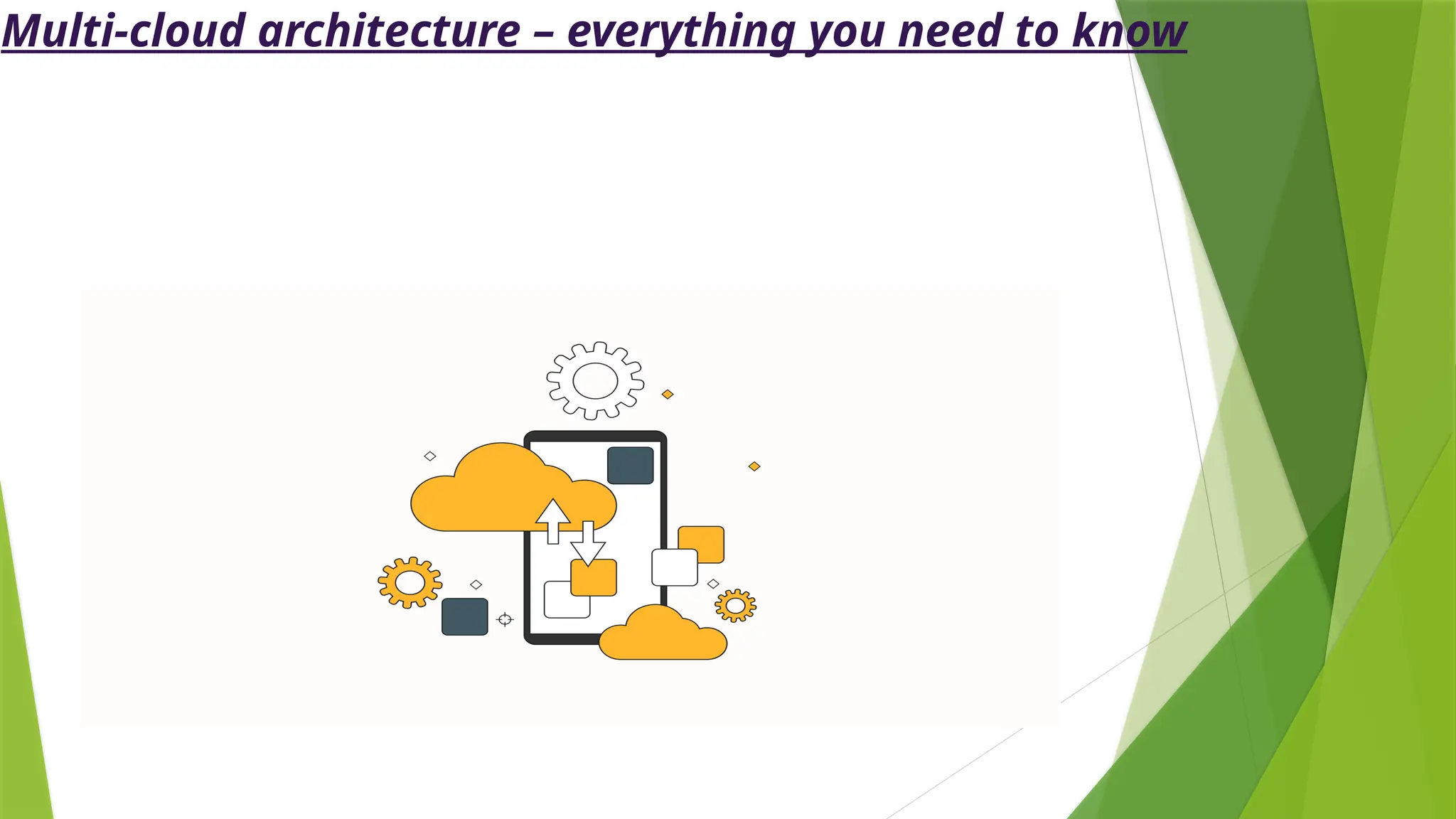
Multi-cloud refers to cloud computing services of several
public clouds from different vendors who are typically not
connected to one another. These are built on open-source
and cloud-native technologies like Kubernetes and let
businesses run workload on many clouds rather than
being restricted to a single system. For instance, Netflix
previously delivered services only via Amazon Web
Services (AWS) but has
shifted to multi-cloud and included Google Cloud Platform
into the ecosystem to cater to its AI needs and disaster
recovery in a more streamlined manner. Further, most
corporates use both Dropbox and Google Drive to store,
manage or transfer data which is a common example of
multi-cloud.
Overall, multi-cloud architecture offers ample choice to businesses
to pick the best-suited environment for unique operations while
ensuring there are no risks of a one-point failure. The good news is
that despite a multi-vendor environment, the system is set up in a
way to ensure seamless data flow among the clouds for smooth
tracking while securing workloads. No wonder,
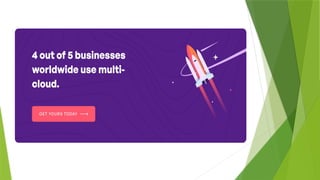
76% of organizations across the world are using multi-cloud in 2024
with one private and one shared operating model.
Now, this article provides a comprehensive guide on a multi-cloud
strategy to help both startups and enterprises make informed
decisions when upgrading efficiency, reliability, security, and
flexibility of their businesses. Read on to find more.
What are the key benefits of multi-cloud architecture?
Utilizing multi-cloud solutions means running IaaS, SaaS or
PaaS solutions from several service providers like Microsoft
Azure and GCP. Generally, this is helpful to boost IT
flexibility, proximity, reliability, and agility across all
industries. Further, multi-cloud integration is a good
investment for international companies since a single
preferred platform might not be available in all regions
where they operate.
In short, the role of cloud in digital transformation, be it
hybrid or multi-cloud, becomes quite prominent since it
leads to real-time synchronizations and exposure to
sophisticated technologies and innovations to outshine
competitors. Below are other significant benefits.
Cost-effectiveness
Minimizing IT spending is best done with a multi cloud
strategy since businesses are required to pay only for the
services they use. Additionally, the overhead cost of public
cloud is low due to resources being shared with other
businesses. Lastly, you can build in-person relationships with
multiple providers and negotiate the total cost of ownership
(TCO) which will include software licensing, infrastructure
expenses, support expenses, and network bandwidth,
regardless.
Better performance
One of the top benefits of a multi-cloud strategy is high-end
performance along with excellent frontend experience due to the
following :
• moving and managing resources
• upscaling or downscaling as and when needed
• reliability with minimal unplanned downtime
• no geographical barriers to distribute services
• minimizes latency with intelligent work distribution
• super fast data transfer which speeds up the operations
Given these benefits, almost two-thirds or 64% of organizations
worldwide predicted in 2024 that their multi-cloud usage will
increase in the next 2 years.
No vendor lock-in
With multi-cloud, businesses are not forced to continue using a
cloud service when it is not serving their purpose. You have the
flexibility to choose where to deploy workloads which helps reduce
inefficiencies, interoperability, and superfluous expenses. It also
means organizations are no longer tied to a single vendor’s
offerings, which usually limits growth potentials, but can
seamlessly migrate to other lucrative options.
Compliance
The best multi-cloud solutions typically have built-in regulatory
compliance in terms of internal standards, privacy rules, and
industry and regulatory requirements. This includes NIST, CIS, ISO,
GDPR, and HIPAA , which are typically consistent across all
business workloads. These help lower cybersecurity risks, lawsuits,
cloud misconfigurations, penalties, and reputational damage.
Fewer risks
A multi-cloud architecture is less prone to single point of
failure (SPoF) and denial of service (DDoS) since they are
built on fault tolerance and high resilience. Further, even if
a cloud is compromised due to an outage, there are
strong backups and recovery. This prevents losing core
applications and critical data or vulnerabilities and security
gaps which were quite usual in the older ways of data
storage.
Wondering how to start leveraging the benefits of multi-cloud strategy?
Consider partnering with Simublade, a cloud computing solutions
company in the heart of Houston. Our expert developers harness
futuristic technologies to deploy multi-cloud, utilizing diverse providers
to boost business performance. The cloud professionals here are also
specialized in multiple other services like cloud app development and
maintenance, cloud migration, and cloud consulting tailor to meet a
plethora of scalability, storage, and security requirements.
Multi cloud vs. hybrid cloud : a
comparison
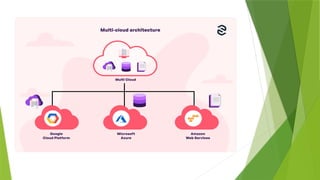
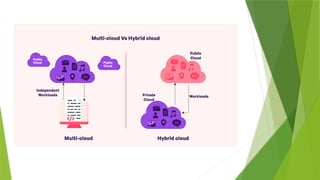
Multi-cloud is the service of ‘multiple’ public cloud environments
without any communications between them. For instance, a company
might use AWS for data storage, Google Cloud Platform for testing and
development, and Microsoft Azure for disaster management and
recovery. So, there is no single management system, unified logging, or
monitoring. Different clouds are responsible for different tasks which
saves the company from paying for in-house systems or data centers.
Hybrid cloud is the combined services of public cloud, on-
premise data centers, and private environments with one
management system, alerting stacks, and unified logging
ensuring significant interconnectivity. In short, different
components work together to run a single IT application
and companies are liable to pay for the set up expenses.
Knowing the difference between multi-cloud and hybrid
cloud is critical since hybrid work culture is forcing C-
suites to work on their digital transformation process to
make sure businesses are able to pick the right
architecture that works in their best interest.
Types of multi-cloud service models
1. SaaS or Software-as-a-Service
In this, cloud-based applications can be used on a subscription basis on
the internet instead of one-time purchase. In fact when considering
SaaS development services, cloud migration is quite a critical step.
Example: Microsoft Office 365, Papaya Global, and HubSpot.
2. PaaS or Platform-as-a-Service
Infrastructure, hardware, and software are used to build and manage
applications. This could be simple cloud-based apps or cloud-enabled
high-end applications. Example: Windows Azure, Heroku, and OpenShift.
3. IaaS or Infrastructure-as-a-Service
This offers fundamental storage, compute, and network-related activities
on a pay-as-you-go model which removes physical hardware and offers
virtualization technology. Example: Amazon Web Services (AWS), IBM
Cloud, and Cisco Metacloud.
Different multi cloud use cases for clarity
Multi cloud typically benefits industries dealing with enormous
volumes of data including healthcare, retail, education, gaming,
and manufacturing. Below are a few scenarios or use cases of the
technology to help you make informed choices:
1. a part of a company’s cloud backup strategy to avoid data loss
2. support system of an organization when it wants to expand
3. helpful to ensure round-the-cloud data availability
4. cater to specific needs of different departments of a company
5. manage a global customer base by avoiding latency issues
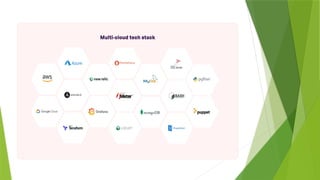
Below is an idea of the robust tech-stack that facilitates the above
functions and altogether elevates your cloud game.
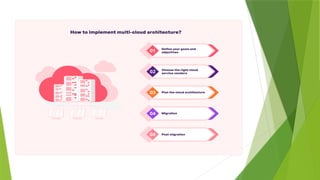
Setting up multi cloud: step-by-step process
A thoughtfully created multi-cloud strategy can help
organizations across all sectors reach their operational
goals in terms of security or data storage. In fact, cloud
adoption is likely to become a necessity by 2028 with
spending expected to surpass $1trillion by 2027.
Wondering how? Well, businesses can take advantage of
the best features of each public cloud and optimize
workloads on performance, reliability, speed, and
compliance. So, let us look at how to implement multi
cloud architecture in depth to boost productivity.
What is the cost of multi-cloud migration?
It ranges between $5,000 to $500,000 depending on the
scale of the workload. For instance, smaller workloads are
typically less costly. However, infrastructure takes up a
significant portion of the cloud migration expenses
followed by the modification requirements and chosen
strategy like re-architecting and rehosting.
How to ensure proper multi cloud cost
management?
Trusted, genuine, and skilled experts like us at Simublade help with multi-
cloud cost management so businesses can rest assured that the cloud
services budget is never spiraling out of their hands. The management
strategy includes :
• shutting down your unused resources after consultation
• cloud auto scaling as per server capacities
• routined audits of the cloud costs
• offering idea regarding how cloud budget is being spent
On your part, stay in constant touch with us, communicate your changing
requirements and concerns over time, if any, and educate your team
members thoroughly for the best use of the resources. Further, it is a good
idea to be aware of the cloud infrastructure to see how different elements in
it are in sync with your business purpose.
Conclusion: the bright future of multi cloud
Unmatched flexibility, best-of-breed vendors, rapid scalability,
broad geographic coverage, and performance optimization are
the top-tier benefits of multi-cloud strategy reshaping enterprise
IT. Studies have found that 90% of large organizations have
already implemented multi-cloud and this is likely to increase in
the near future.
However, there are plenty of considerations when adopting this
technology. So, it is important to understand what multi-cloud
architecture is and why it can be fruitful. Further, partner with
committed cloud specialists like us who are adept at handling
cloud challenges and using the best practices for a successful
migration.
Read More References:
1.
App store alternatives that businesses must consid
er in 2025 and beyond
2.
What is the cost to build a mental health insurance
platform?
3.
How to choose the right tech stack to scale your mo
bile app?
Thank You For
Watching!

Multi-Cloud Architecture – Everything You Need to Know.pptx

  • 1.
    Multi-cloud architecture –everything you need to know
  • 2.
    Multi-cloud refers tocloud computing services of several public clouds from different vendors who are typically not connected to one another. These are built on open-source and cloud-native technologies like Kubernetes and let businesses run workload on many clouds rather than being restricted to a single system. For instance, Netflix previously delivered services only via Amazon Web Services (AWS) but has shifted to multi-cloud and included Google Cloud Platform into the ecosystem to cater to its AI needs and disaster recovery in a more streamlined manner. Further, most corporates use both Dropbox and Google Drive to store, manage or transfer data which is a common example of multi-cloud.
  • 4.
    Overall, multi-cloud architectureoffers ample choice to businesses to pick the best-suited environment for unique operations while ensuring there are no risks of a one-point failure. The good news is that despite a multi-vendor environment, the system is set up in a way to ensure seamless data flow among the clouds for smooth tracking while securing workloads. No wonder, 76% of organizations across the world are using multi-cloud in 2024 with one private and one shared operating model. Now, this article provides a comprehensive guide on a multi-cloud strategy to help both startups and enterprises make informed decisions when upgrading efficiency, reliability, security, and flexibility of their businesses. Read on to find more.
  • 5.
    What are thekey benefits of multi-cloud architecture? Utilizing multi-cloud solutions means running IaaS, SaaS or PaaS solutions from several service providers like Microsoft Azure and GCP. Generally, this is helpful to boost IT flexibility, proximity, reliability, and agility across all industries. Further, multi-cloud integration is a good investment for international companies since a single preferred platform might not be available in all regions where they operate. In short, the role of cloud in digital transformation, be it hybrid or multi-cloud, becomes quite prominent since it leads to real-time synchronizations and exposure to sophisticated technologies and innovations to outshine competitors. Below are other significant benefits.
  • 6.
    Cost-effectiveness Minimizing IT spendingis best done with a multi cloud strategy since businesses are required to pay only for the services they use. Additionally, the overhead cost of public cloud is low due to resources being shared with other businesses. Lastly, you can build in-person relationships with multiple providers and negotiate the total cost of ownership (TCO) which will include software licensing, infrastructure expenses, support expenses, and network bandwidth, regardless.
  • 7.
    Better performance One ofthe top benefits of a multi-cloud strategy is high-end performance along with excellent frontend experience due to the following : • moving and managing resources • upscaling or downscaling as and when needed • reliability with minimal unplanned downtime • no geographical barriers to distribute services • minimizes latency with intelligent work distribution • super fast data transfer which speeds up the operations Given these benefits, almost two-thirds or 64% of organizations worldwide predicted in 2024 that their multi-cloud usage will increase in the next 2 years.
  • 8.
    No vendor lock-in Withmulti-cloud, businesses are not forced to continue using a cloud service when it is not serving their purpose. You have the flexibility to choose where to deploy workloads which helps reduce inefficiencies, interoperability, and superfluous expenses. It also means organizations are no longer tied to a single vendor’s offerings, which usually limits growth potentials, but can seamlessly migrate to other lucrative options. Compliance The best multi-cloud solutions typically have built-in regulatory compliance in terms of internal standards, privacy rules, and industry and regulatory requirements. This includes NIST, CIS, ISO, GDPR, and HIPAA , which are typically consistent across all business workloads. These help lower cybersecurity risks, lawsuits, cloud misconfigurations, penalties, and reputational damage.
  • 9.
    Fewer risks A multi-cloudarchitecture is less prone to single point of failure (SPoF) and denial of service (DDoS) since they are built on fault tolerance and high resilience. Further, even if a cloud is compromised due to an outage, there are strong backups and recovery. This prevents losing core applications and critical data or vulnerabilities and security gaps which were quite usual in the older ways of data storage.
  • 11.
    Wondering how tostart leveraging the benefits of multi-cloud strategy? Consider partnering with Simublade, a cloud computing solutions company in the heart of Houston. Our expert developers harness futuristic technologies to deploy multi-cloud, utilizing diverse providers to boost business performance. The cloud professionals here are also specialized in multiple other services like cloud app development and maintenance, cloud migration, and cloud consulting tailor to meet a plethora of scalability, storage, and security requirements. Multi cloud vs. hybrid cloud : a comparison Multi-cloud is the service of ‘multiple’ public cloud environments without any communications between them. For instance, a company might use AWS for data storage, Google Cloud Platform for testing and development, and Microsoft Azure for disaster management and recovery. So, there is no single management system, unified logging, or monitoring. Different clouds are responsible for different tasks which saves the company from paying for in-house systems or data centers.
  • 13.
    Hybrid cloud isthe combined services of public cloud, on- premise data centers, and private environments with one management system, alerting stacks, and unified logging ensuring significant interconnectivity. In short, different components work together to run a single IT application and companies are liable to pay for the set up expenses. Knowing the difference between multi-cloud and hybrid cloud is critical since hybrid work culture is forcing C- suites to work on their digital transformation process to make sure businesses are able to pick the right architecture that works in their best interest.
  • 14.
    Types of multi-cloudservice models 1. SaaS or Software-as-a-Service In this, cloud-based applications can be used on a subscription basis on the internet instead of one-time purchase. In fact when considering SaaS development services, cloud migration is quite a critical step. Example: Microsoft Office 365, Papaya Global, and HubSpot. 2. PaaS or Platform-as-a-Service Infrastructure, hardware, and software are used to build and manage applications. This could be simple cloud-based apps or cloud-enabled high-end applications. Example: Windows Azure, Heroku, and OpenShift. 3. IaaS or Infrastructure-as-a-Service This offers fundamental storage, compute, and network-related activities on a pay-as-you-go model which removes physical hardware and offers virtualization technology. Example: Amazon Web Services (AWS), IBM Cloud, and Cisco Metacloud.
  • 15.
    Different multi clouduse cases for clarity Multi cloud typically benefits industries dealing with enormous volumes of data including healthcare, retail, education, gaming, and manufacturing. Below are a few scenarios or use cases of the technology to help you make informed choices: 1. a part of a company’s cloud backup strategy to avoid data loss 2. support system of an organization when it wants to expand 3. helpful to ensure round-the-cloud data availability 4. cater to specific needs of different departments of a company 5. manage a global customer base by avoiding latency issues Below is an idea of the robust tech-stack that facilitates the above functions and altogether elevates your cloud game.
  • 17.
    Setting up multicloud: step-by-step process A thoughtfully created multi-cloud strategy can help organizations across all sectors reach their operational goals in terms of security or data storage. In fact, cloud adoption is likely to become a necessity by 2028 with spending expected to surpass $1trillion by 2027. Wondering how? Well, businesses can take advantage of the best features of each public cloud and optimize workloads on performance, reliability, speed, and compliance. So, let us look at how to implement multi cloud architecture in depth to boost productivity.
  • 19.
    What is thecost of multi-cloud migration? It ranges between $5,000 to $500,000 depending on the scale of the workload. For instance, smaller workloads are typically less costly. However, infrastructure takes up a significant portion of the cloud migration expenses followed by the modification requirements and chosen strategy like re-architecting and rehosting.
  • 20.
    How to ensureproper multi cloud cost management? Trusted, genuine, and skilled experts like us at Simublade help with multi- cloud cost management so businesses can rest assured that the cloud services budget is never spiraling out of their hands. The management strategy includes : • shutting down your unused resources after consultation • cloud auto scaling as per server capacities • routined audits of the cloud costs • offering idea regarding how cloud budget is being spent On your part, stay in constant touch with us, communicate your changing requirements and concerns over time, if any, and educate your team members thoroughly for the best use of the resources. Further, it is a good idea to be aware of the cloud infrastructure to see how different elements in it are in sync with your business purpose.
  • 21.
    Conclusion: the brightfuture of multi cloud Unmatched flexibility, best-of-breed vendors, rapid scalability, broad geographic coverage, and performance optimization are the top-tier benefits of multi-cloud strategy reshaping enterprise IT. Studies have found that 90% of large organizations have already implemented multi-cloud and this is likely to increase in the near future. However, there are plenty of considerations when adopting this technology. So, it is important to understand what multi-cloud architecture is and why it can be fruitful. Further, partner with committed cloud specialists like us who are adept at handling cloud challenges and using the best practices for a successful migration.
  • 22.
    Read More References: 1. Appstore alternatives that businesses must consid er in 2025 and beyond 2. What is the cost to build a mental health insurance platform? 3. How to choose the right tech stack to scale your mo bile app?
  • 23.