The Promise and Pitfalls of AI in Disease Progression Monitoring
Introduction
The healthcare industry faces challenges like inefficient systems, poor
decision-making, and strained patient relationships. Artificial intelligence (AI) offers a
potential solution by automating tasks requiring human intelligence and analyzing
complex medical data. AI-powered mobile health apps, for example, can improve
healthcare access and delivery, especially in remote areas, by leveraging
technologies like machine learning and cloud computing. While AI holds promise for
diagnosis, drug development, and personalized medicine, its integration into
healthcare workflows presents practical barriers and risks, particularly concerning
privacy and trust. This paper analyzes the opportunities and challenges of
incorporating AI into healthcare, using research, expert opinions, and real-world
examples. It aims to provide a balanced perspective, enabling healthcare
organizations to harness AI's potential while mitigating its risks and ensuring
responsible global implementation.
Administrative Burdens in Healthcare
Healthcare administrators are burdened by excessive paperwork, coding, and
regulatory requirements, forcing physicians to spend twice as much time on
administrative tasks as on direct patient care. This contributes significantly to
physician burnout, negatively impacting patient relationships and care quality. AI
integrated into electronic health records (EHRs) offers a potential solution by
automating tasks like documentation, appointment booking, and insurance
authorizations, thus streamlining workflows and reducing burnout. However,
integrating AI tools into existing systems faces challenges like interoperability issues,
cost constraints, and user resistance. Despite these barriers, thoughtful
implementation of AI-powered automation holds significant promise for optimizing
workflows and allowing clinicians to prioritize patient care.
Clinical Decision Support System
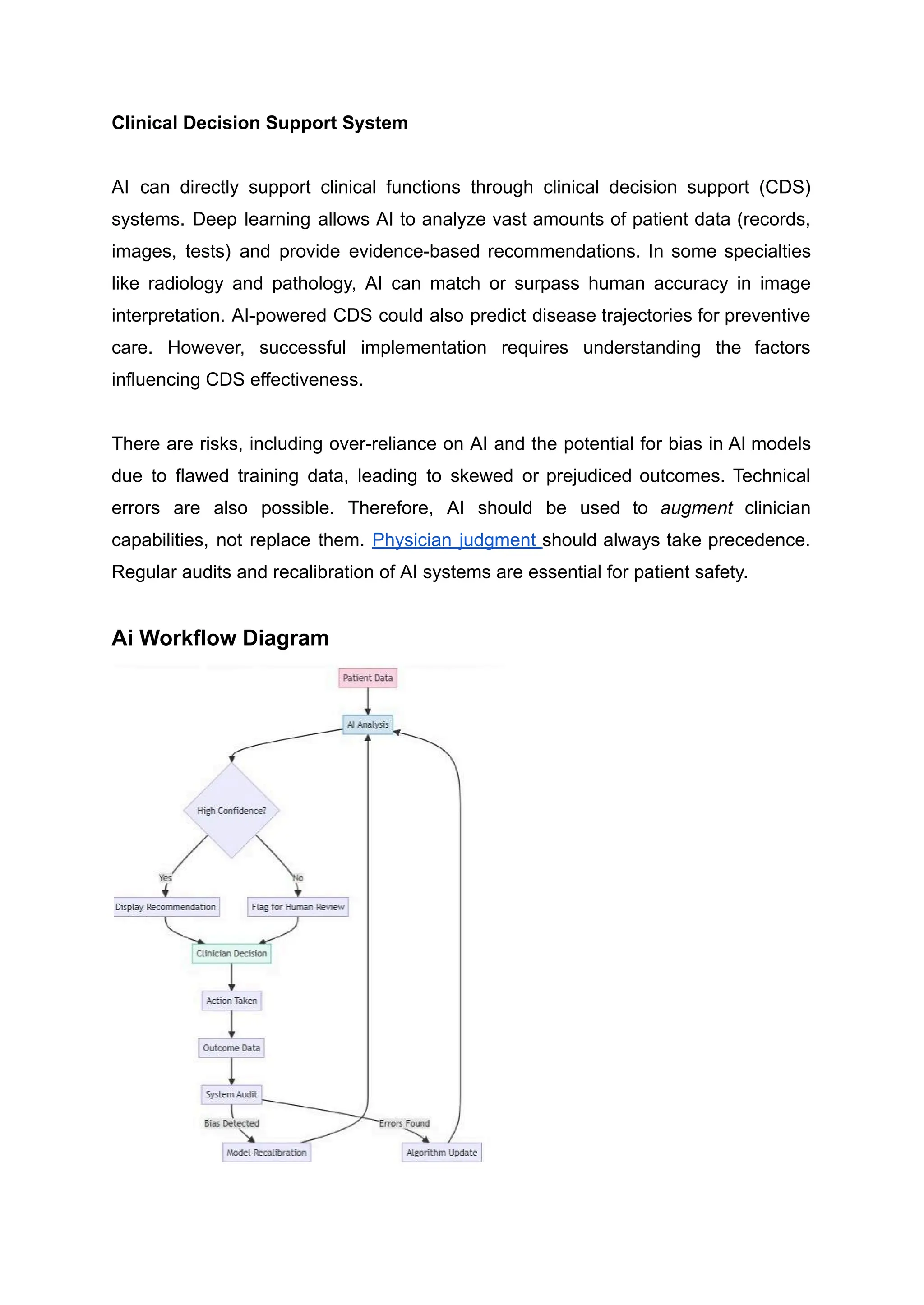
AI can directly support clinical functions through clinical decision support (CDS)
systems. Deep learning allows AI to analyze vast amounts of patient data (records,
images, tests) and provide evidence-based recommendations. In some specialties
like radiology and pathology, AI can match or surpass human accuracy in image
interpretation. AI-powered CDS could also predict disease trajectories for preventive
care. However, successful implementation requires understanding the factors
influencing CDS effectiveness.
There are risks, including over-reliance on AI and the potential for bias in AI models
due to flawed training data, leading to skewed or prejudiced outcomes. Technical
errors are also possible. Therefore, AI should be used to augment clinician
capabilities, not replace them. Physician judgment should always take precedence.
Regular audits and recalibration of AI systems are essential for patient safety.
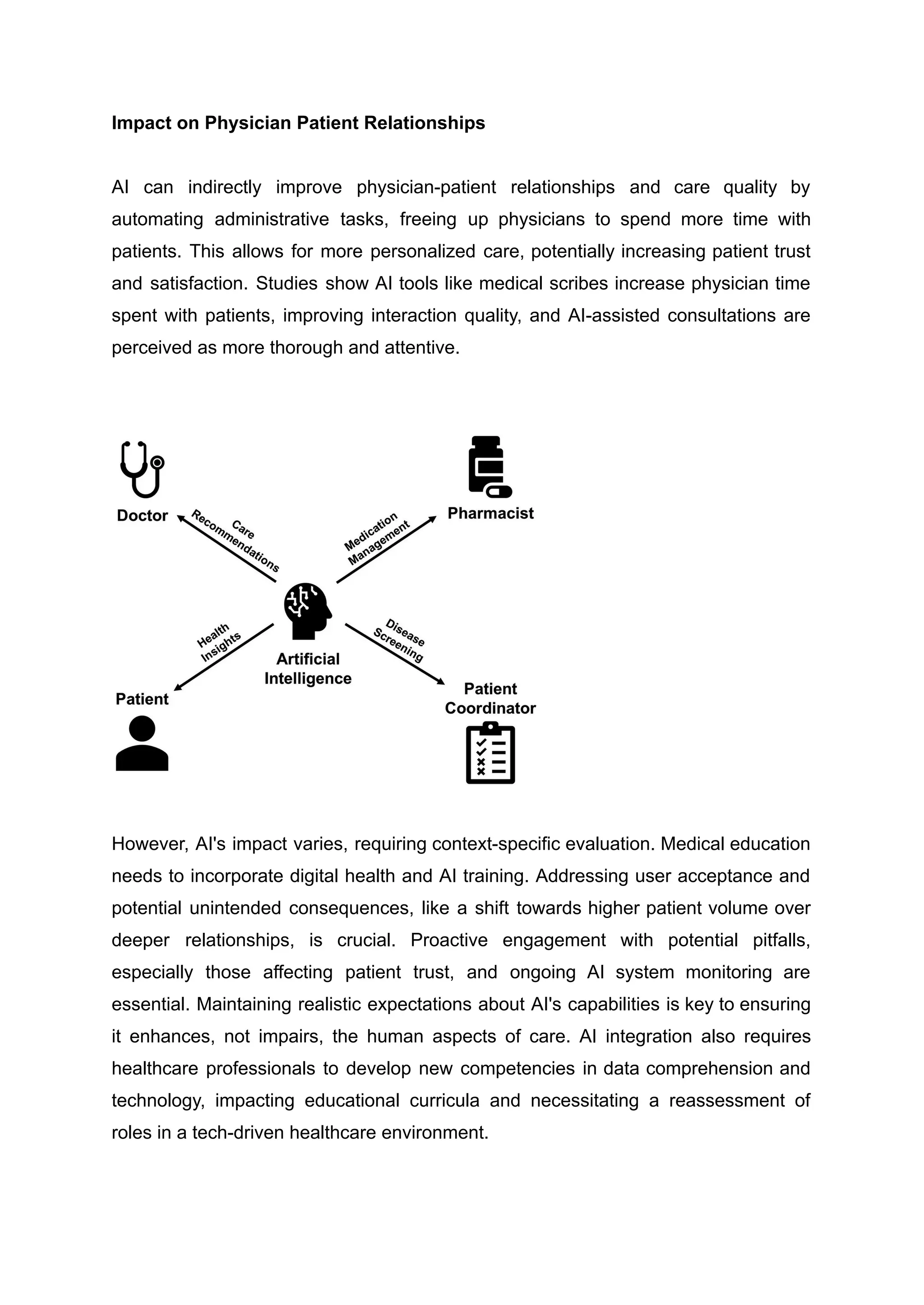
Ai Workflow Diagram
Impact on Physician Patient Relationships
AI can indirectly improve physician-patient relationships and care quality by
automating administrative tasks, freeing up physicians to spend more time with
patients. This allows for more personalized care, potentially increasing patient trust
and satisfaction. Studies show AI tools like medical scribes increase physician time
spent with patients, improving interaction quality, and AI-assisted consultations are
perceived as more thorough and attentive.
However, AI's impact varies, requiring context-specific evaluation. Medical education
needs to incorporate digital health and AI training. Addressing user acceptance and
potential unintended consequences, like a shift towards higher patient volume over
deeper relationships, is crucial. Proactive engagement with potential pitfalls,
especially those affecting patient trust, and ongoing AI system monitoring are
essential. Maintaining realistic expectations about AI's capabilities is key to ensuring
it enhances, not impairs, the human aspects of care. AI integration also requires
healthcare professionals to develop new competencies in data comprehension and
technology, impacting educational curricula and necessitating a reassessment of
roles in a tech-driven healthcare environment.
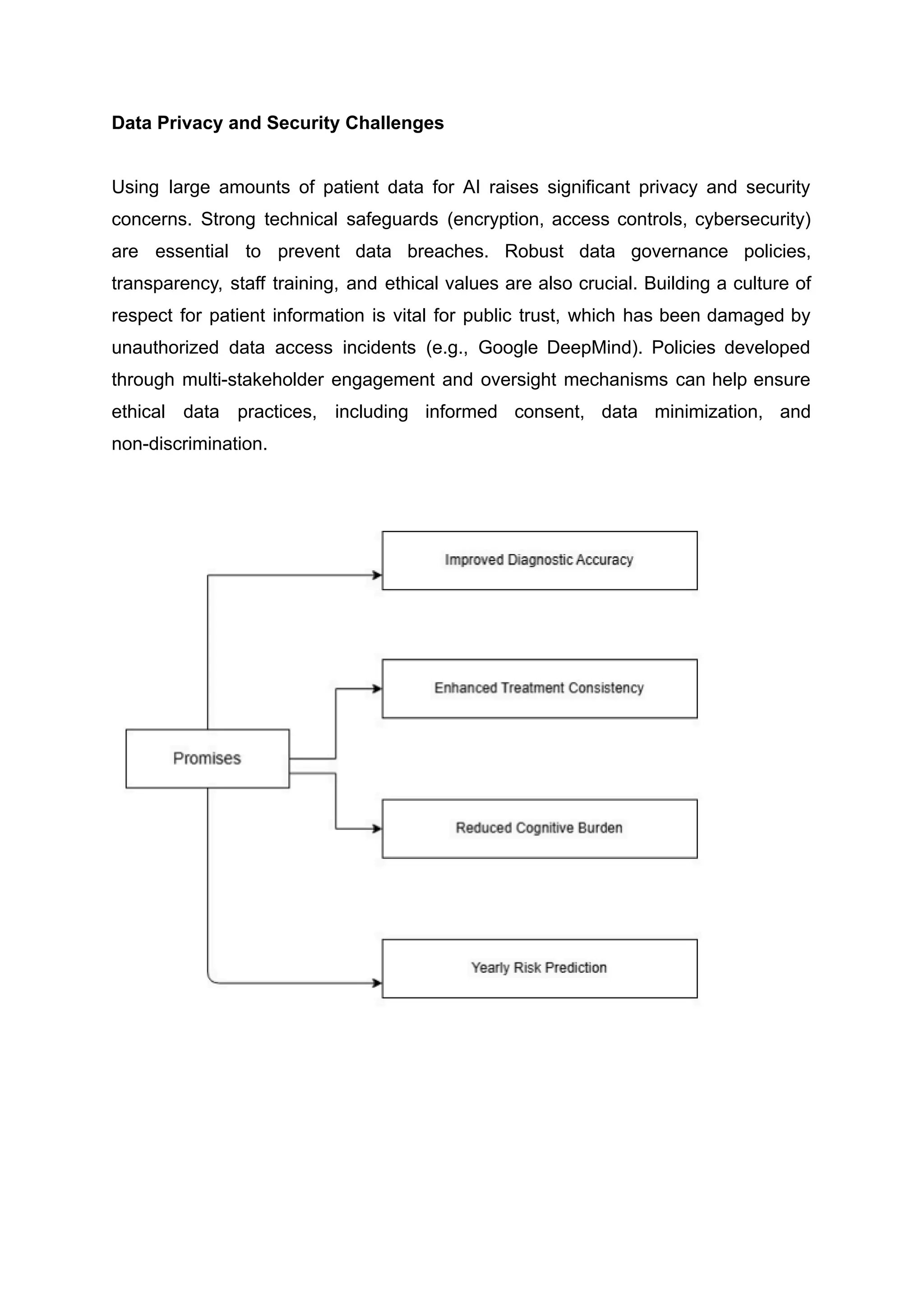
Data Privacy and Security Challenges
Using large amounts of patient data for AI raises significant privacy and security
concerns. Strong technical safeguards (encryption, access controls, cybersecurity)
are essential to prevent data breaches. Robust data governance policies,
transparency, staff training, and ethical values are also crucial. Building a culture of
respect for patient information is vital for public trust, which has been damaged by
unauthorized data access incidents (e.g., Google DeepMind). Policies developed
through multi-stakeholder engagement and oversight mechanisms can help ensure
ethical data practices, including informed consent, data minimization, and
non-discrimination.
Algorithmic Bias Risks
AI systems can inherit and amplify biases due to flawed training data, compromising
patient safety and care quality for marginalized groups. For example, an algorithm
prioritizing patients for extra care resources showed racial bias against Black
patients. Mitigating this requires integrating diversity and inclusion throughout AI
development, from data sampling to testing. However, technical solutions are
insufficient; broader efforts are needed to make healthcare and technology more
equitable. Thoughtful AI governance means involving patients and communities in
deployment decisions through open dialogue about the technology's values and
risks. Institutional self-reflection is also crucial. AI should not be seen as a simple fix,
ignoring the deep-seated biases in healthcare and society.
Governance Frameworks and Future Research Directions in AI Healthcare
Governing AI in healthcare is complex and requires iterative, adaptive approaches,
as fixed regulations often lag behind technological advancements. Effective
governance needs nuanced, contextual decision-making that evolves with AI
systems. A comprehensive framework should be based on key principles:
transparency (understandable AI decisions), accountability (mechanisms for
addressing errors and biases), equity (fair systems that don't worsen disparities), and
respect for patient autonomy (upholding patient rights and privacy).
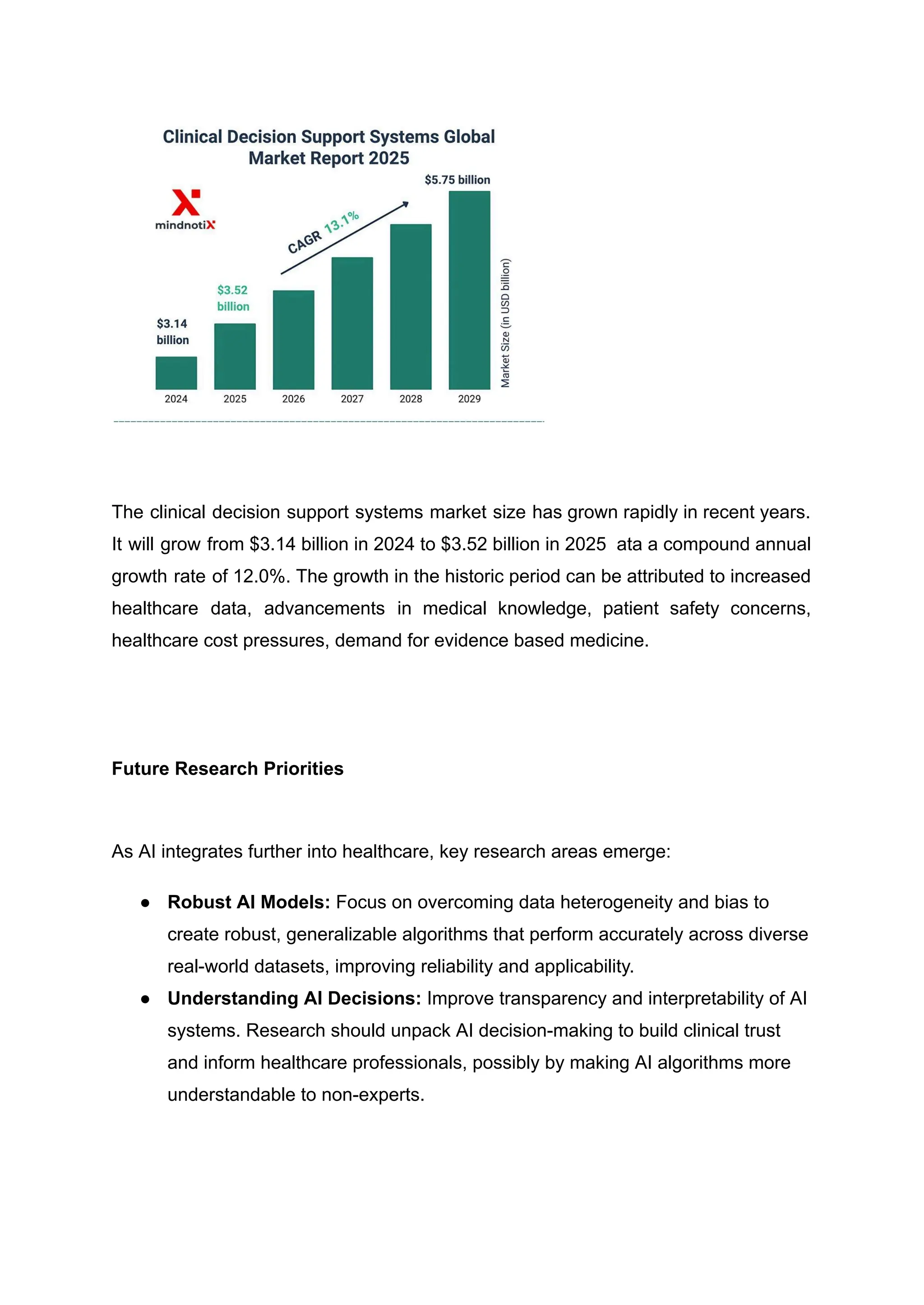
Clinical Decision Support System Market Size in 2025 and Growth Rate
The clinical decision support systems market size has grown rapidly in recent years.
It will grow from $3.14 billion in 2024 to $3.52 billion in 2025 ata a compound annual
growth rate of 12.0%. The growth in the historic period can be attributed to increased
healthcare data, advancements in medical knowledge, patient safety concerns,
healthcare cost pressures, demand for evidence based medicine.
Future Research Priorities
As AI integrates further into healthcare, key research areas emerge:
●​ Robust AI Models: Focus on overcoming data heterogeneity and bias to
create robust, generalizable algorithms that perform accurately across diverse
real-world datasets, improving reliability and applicability.
●​ Understanding AI Decisions: Improve transparency and interpretability of AI
systems. Research should unpack AI decision-making to build clinical trust
and inform healthcare professionals, possibly by making AI algorithms more
understandable to non-experts.
●​ Long-Term Impact Assessment: Systematically study AI's long-term effects
on patient outcomes and healthcare efficiency, including treatment efficacy,
cost-effectiveness, patient satisfaction, and workflow impact.
●​ Ethical Considerations: Address ethical issues like data privacy, algorithmic
bias, and equitable access. Research should develop ethical guidelines and
frameworks specific to AI in healthcare.
These areas emphasize a flexible, adaptive approach to AI governance, with
transparent collaboration among all stakeholders. The ongoing evolution of AI in
healthcare necessitates a dynamic, ethical framework to maximize potential and
minimize risks.
Conclusion
AI's integration into healthcare is transformative, impacting clinical practices,
administration, and patient care. Beyond improving decisions and efficiency, AI can
enhance the human side of healthcare – empathy and patient-centeredness.
AI-driven administrative efficiency frees up healthcare professionals to focus on
patients. Clinically, AI offers diagnostic and therapeutic accuracy, but human
judgment and physician-patient interaction remain crucial. This evolution presents
challenges: ethical considerations, data privacy, and algorithmic fairness require
robust governance and ethical commitment.
A collaborative approach is needed to navigate AI's complexities. Future research
must explore both technological advancement and the socio-ethical implications of
AI in healthcare. Prioritizing transparent, accountable, and equitable AI is key to
building trust. AI in healthcare offers balanced optimism, promising a future of
enhanced care, outcomes, and professional satisfaction through the convergence of
technology and compassion. However, this requires a conscientious, ethically driven
journey that respects the patient-caregiver relationship, ensuring a more efficient,
empathetic, and equitable healthcare system.
The Promise and Pitfalls of AI in Disease Progression Monitoring (3).pdf

The Promise and Pitfalls of AI in Disease Progression Monitoring (3).pdf

  • 1.
    The Promise andPitfalls of AI in Disease Progression Monitoring Introduction The healthcare industry faces challenges like inefficient systems, poor decision-making, and strained patient relationships. Artificial intelligence (AI) offers a potential solution by automating tasks requiring human intelligence and analyzing complex medical data. AI-powered mobile health apps, for example, can improve healthcare access and delivery, especially in remote areas, by leveraging technologies like machine learning and cloud computing. While AI holds promise for diagnosis, drug development, and personalized medicine, its integration into healthcare workflows presents practical barriers and risks, particularly concerning privacy and trust. This paper analyzes the opportunities and challenges of incorporating AI into healthcare, using research, expert opinions, and real-world examples. It aims to provide a balanced perspective, enabling healthcare organizations to harness AI's potential while mitigating its risks and ensuring responsible global implementation. Administrative Burdens in Healthcare Healthcare administrators are burdened by excessive paperwork, coding, and regulatory requirements, forcing physicians to spend twice as much time on administrative tasks as on direct patient care. This contributes significantly to physician burnout, negatively impacting patient relationships and care quality. AI integrated into electronic health records (EHRs) offers a potential solution by automating tasks like documentation, appointment booking, and insurance authorizations, thus streamlining workflows and reducing burnout. However, integrating AI tools into existing systems faces challenges like interoperability issues, cost constraints, and user resistance. Despite these barriers, thoughtful implementation of AI-powered automation holds significant promise for optimizing workflows and allowing clinicians to prioritize patient care.
  • 2.
    Clinical Decision SupportSystem AI can directly support clinical functions through clinical decision support (CDS) systems. Deep learning allows AI to analyze vast amounts of patient data (records, images, tests) and provide evidence-based recommendations. In some specialties like radiology and pathology, AI can match or surpass human accuracy in image interpretation. AI-powered CDS could also predict disease trajectories for preventive care. However, successful implementation requires understanding the factors influencing CDS effectiveness. There are risks, including over-reliance on AI and the potential for bias in AI models due to flawed training data, leading to skewed or prejudiced outcomes. Technical errors are also possible. Therefore, AI should be used to augment clinician capabilities, not replace them. Physician judgment should always take precedence. Regular audits and recalibration of AI systems are essential for patient safety. Ai Workflow Diagram
  • 3.
    Impact on PhysicianPatient Relationships AI can indirectly improve physician-patient relationships and care quality by automating administrative tasks, freeing up physicians to spend more time with patients. This allows for more personalized care, potentially increasing patient trust and satisfaction. Studies show AI tools like medical scribes increase physician time spent with patients, improving interaction quality, and AI-assisted consultations are perceived as more thorough and attentive. However, AI's impact varies, requiring context-specific evaluation. Medical education needs to incorporate digital health and AI training. Addressing user acceptance and potential unintended consequences, like a shift towards higher patient volume over deeper relationships, is crucial. Proactive engagement with potential pitfalls, especially those affecting patient trust, and ongoing AI system monitoring are essential. Maintaining realistic expectations about AI's capabilities is key to ensuring it enhances, not impairs, the human aspects of care. AI integration also requires healthcare professionals to develop new competencies in data comprehension and technology, impacting educational curricula and necessitating a reassessment of roles in a tech-driven healthcare environment.
  • 4.
    Data Privacy andSecurity Challenges Using large amounts of patient data for AI raises significant privacy and security concerns. Strong technical safeguards (encryption, access controls, cybersecurity) are essential to prevent data breaches. Robust data governance policies, transparency, staff training, and ethical values are also crucial. Building a culture of respect for patient information is vital for public trust, which has been damaged by unauthorized data access incidents (e.g., Google DeepMind). Policies developed through multi-stakeholder engagement and oversight mechanisms can help ensure ethical data practices, including informed consent, data minimization, and non-discrimination.
  • 5.
    Algorithmic Bias Risks AIsystems can inherit and amplify biases due to flawed training data, compromising patient safety and care quality for marginalized groups. For example, an algorithm prioritizing patients for extra care resources showed racial bias against Black patients. Mitigating this requires integrating diversity and inclusion throughout AI development, from data sampling to testing. However, technical solutions are insufficient; broader efforts are needed to make healthcare and technology more equitable. Thoughtful AI governance means involving patients and communities in deployment decisions through open dialogue about the technology's values and risks. Institutional self-reflection is also crucial. AI should not be seen as a simple fix, ignoring the deep-seated biases in healthcare and society. Governance Frameworks and Future Research Directions in AI Healthcare Governing AI in healthcare is complex and requires iterative, adaptive approaches, as fixed regulations often lag behind technological advancements. Effective governance needs nuanced, contextual decision-making that evolves with AI systems. A comprehensive framework should be based on key principles: transparency (understandable AI decisions), accountability (mechanisms for addressing errors and biases), equity (fair systems that don't worsen disparities), and respect for patient autonomy (upholding patient rights and privacy). Clinical Decision Support System Market Size in 2025 and Growth Rate
  • 6.
    The clinical decisionsupport systems market size has grown rapidly in recent years. It will grow from $3.14 billion in 2024 to $3.52 billion in 2025 ata a compound annual growth rate of 12.0%. The growth in the historic period can be attributed to increased healthcare data, advancements in medical knowledge, patient safety concerns, healthcare cost pressures, demand for evidence based medicine. Future Research Priorities As AI integrates further into healthcare, key research areas emerge: ●​ Robust AI Models: Focus on overcoming data heterogeneity and bias to create robust, generalizable algorithms that perform accurately across diverse real-world datasets, improving reliability and applicability. ●​ Understanding AI Decisions: Improve transparency and interpretability of AI systems. Research should unpack AI decision-making to build clinical trust and inform healthcare professionals, possibly by making AI algorithms more understandable to non-experts.
  • 7.
    ●​ Long-Term ImpactAssessment: Systematically study AI's long-term effects on patient outcomes and healthcare efficiency, including treatment efficacy, cost-effectiveness, patient satisfaction, and workflow impact. ●​ Ethical Considerations: Address ethical issues like data privacy, algorithmic bias, and equitable access. Research should develop ethical guidelines and frameworks specific to AI in healthcare. These areas emphasize a flexible, adaptive approach to AI governance, with transparent collaboration among all stakeholders. The ongoing evolution of AI in healthcare necessitates a dynamic, ethical framework to maximize potential and minimize risks. Conclusion AI's integration into healthcare is transformative, impacting clinical practices, administration, and patient care. Beyond improving decisions and efficiency, AI can enhance the human side of healthcare – empathy and patient-centeredness. AI-driven administrative efficiency frees up healthcare professionals to focus on patients. Clinically, AI offers diagnostic and therapeutic accuracy, but human judgment and physician-patient interaction remain crucial. This evolution presents challenges: ethical considerations, data privacy, and algorithmic fairness require robust governance and ethical commitment. A collaborative approach is needed to navigate AI's complexities. Future research must explore both technological advancement and the socio-ethical implications of AI in healthcare. Prioritizing transparent, accountable, and equitable AI is key to building trust. AI in healthcare offers balanced optimism, promising a future of enhanced care, outcomes, and professional satisfaction through the convergence of technology and compassion. However, this requires a conscientious, ethically driven journey that respects the patient-caregiver relationship, ensuring a more efficient, empathetic, and equitable healthcare system.