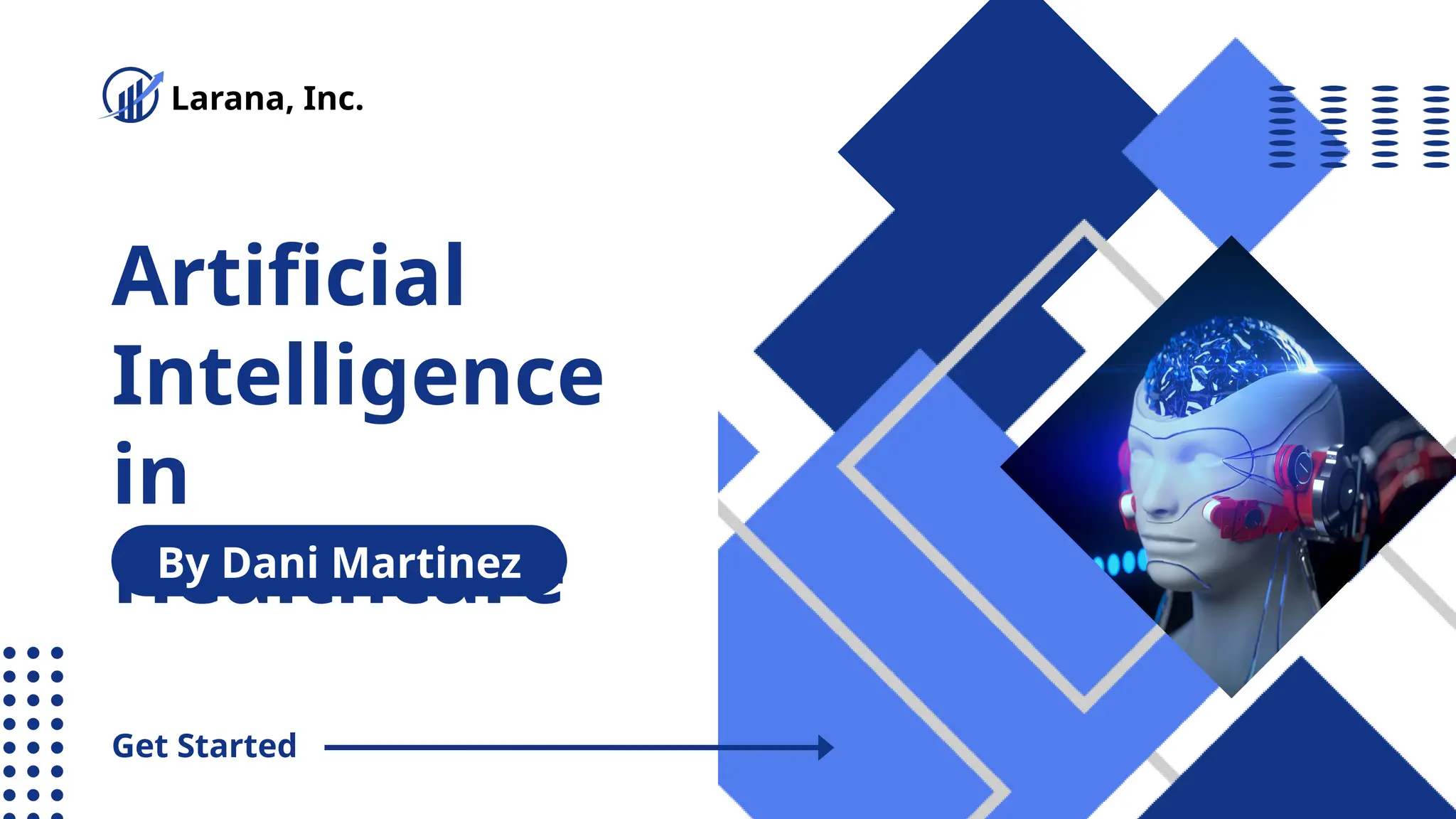
Artificial
Intelligence
in
Healthcare
Larana, Inc.
By Dani Martinez
Get Started
Introduction
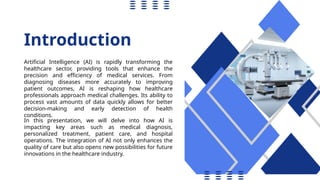
Artificial Intelligence (AI) is rapidly transforming the
healthcare sector, providing tools that enhance the
precision and efficiency of medical services. From
diagnosing diseases more accurately to improving
patient outcomes, AI is reshaping how healthcare
professionals approach medical challenges. Its ability to
process vast amounts of data quickly allows for better
decision-making and early detection of health
conditions.
In this presentation, we will delve into how AI is
impacting key areas such as medical diagnosis,
personalized treatment, patient care, and hospital
operations. The integration of AI not only enhances the
quality of care but also opens new possibilities for future
innovations in the healthcare industry.
The Role of AI in
Medical
Diagnosis
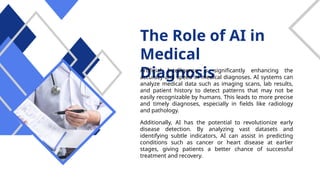
Artificial Intelligence is significantly enhancing the
accuracy and speed of medical diagnoses. AI systems can
analyze medical data such as imaging scans, lab results,
and patient history to detect patterns that may not be
easily recognizable by humans. This leads to more precise
and timely diagnoses, especially in fields like radiology
and pathology.
Additionally, AI has the potential to revolutionize early
disease detection. By analyzing vast datasets and
identifying subtle indicators, AI can assist in predicting
conditions such as cancer or heart disease at earlier
stages, giving patients a better chance of successful
treatment and recovery.
AI in Personalized Medicine
Artificial Intelligence is enabling a shift towards personalized medicine, where treatment plans are
tailored to the individual needs of each patient. By analyzing genetic information, lifestyle factors, and
medical history, AI can recommend customized treatments that are more effective and better suited to
each person’s unique profile.
AI enables the development of
customized treatment plans
based on individual patient data,
including genetic information and
lifestyle factors.
Tailored Treatment Plans
By utilizing predictive analytics, AI
helps healthcare providers
anticipate patient outcomes,
allowing for timely and proactive
interventions.
Predictive Analytics
Personalized approaches
enhance treatment effectiveness
while minimizing potential side
effects, leading to better patient
experiences and outcomes.
Improved Effectiveness
AI in Healthcare Procedures
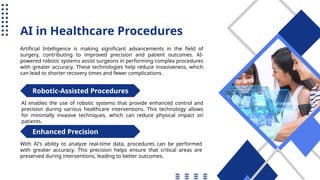
Artificial Intelligence is making significant advancements in the field of
surgery, contributing to improved precision and patient outcomes. AI-
powered robotic systems assist surgeons in performing complex procedures
with greater accuracy. These technologies help reduce invasiveness, which
can lead to shorter recovery times and fewer complications.
AI enables the use of robotic systems that provide enhanced control and
precision during various healthcare interventions. This technology allows
for minimally invasive techniques, which can reduce physical impact on
patients.
With AI's ability to analyze real-time data, procedures can be performed
with greater accuracy. This precision helps ensure that critical areas are
preserved during interventions, leading to better outcomes.
Robotic-Assisted Procedures
Enhanced Precision
AI in Medical Imaging
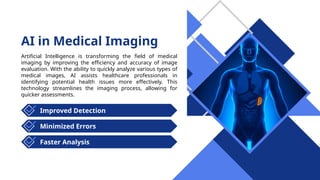
Artificial Intelligence is transforming the field of medical
imaging by improving the efficiency and accuracy of image
evaluation. With the ability to quickly analyze various types of
medical images, AI assists healthcare professionals in
identifying potential health issues more effectively. This
technology streamlines the imaging process, allowing for
quicker assessments.
Improved Detection
Faster Analysis
Minimized Errors
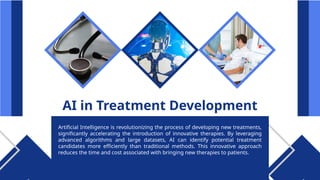
AI in Treatment Development
Artificial Intelligence is revolutionizing the process of developing new treatments,
significantly accelerating the introduction of innovative therapies. By leveraging
advanced algorithms and large datasets, AI can identify potential treatment
candidates more efficiently than traditional methods. This innovative approach
reduces the time and cost associated with bringing new therapies to patients.
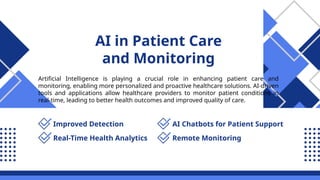
AI in Patient Care
and Monitoring
Artificial Intelligence is playing a crucial role in enhancing patient care and
monitoring, enabling more personalized and proactive healthcare solutions. AI-driven
tools and applications allow healthcare providers to monitor patient conditions in
real-time, leading to better health outcomes and improved quality of care.
Improved Detection
Real-Time Health Analytics
AI Chatbots for Patient Support
Remote Monitoring
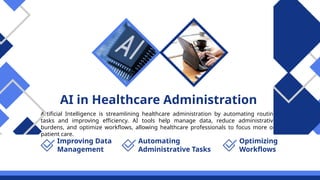
AI in Healthcare Administration
Artificial Intelligence is streamlining healthcare administration by automating routine
tasks and improving efficiency. AI tools help manage data, reduce administrative
burdens, and optimize workflows, allowing healthcare professionals to focus more on
patient care.
Improving Data
Management
Optimizing
Workflows
Automating
Administrative Tasks
Compliance
Monitoring
Incident Response
Automation
AI tools help organizations maintain
compliance with healthcare regulations by
monitoring data handling practices. This
ensures that institutions adhere to privacy
standards and reduce the risk of violations.
In the event of a security incident, AI can
automate responses to mitigate damage. This
includes isolating affected systems and
alerting IT personnel, thereby minimizing
downtime and protecting patient information.
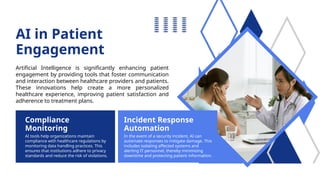
AI in Patient
Engagement
Artificial Intelligence is significantly enhancing patient
engagement by providing tools that foster communication
and interaction between healthcare providers and patients.
These innovations help create a more personalized
healthcare experience, improving patient satisfaction and
adherence to treatment plans.
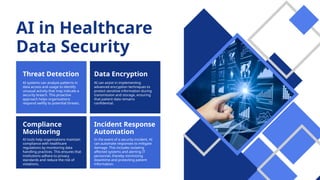
AI in Healthcare
Data Security
Threat Detection
Compliance
Monitoring
Data Encryption
Incident Response
Automation
AI systems can analyze patterns in
data access and usage to identify
unusual activity that may indicate a
security breach. This proactive
approach helps organizations
respond swiftly to potential threats.
AI tools help organizations maintain
compliance with healthcare
regulations by monitoring data
handling practices. This ensures that
institutions adhere to privacy
standards and reduce the risk of
violations.
AI can assist in implementing
advanced encryption techniques to
protect sensitive information during
transmission and storage, ensuring
that patient data remains
confidential.
In the event of a security incident, AI
can automate responses to mitigate
damage. This includes isolating
affected systems and alerting IT
personnel, thereby minimizing
downtime and protecting patient
information.
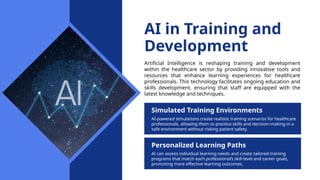
AI in Training and
Development
Artificial Intelligence is reshaping training and development
within the healthcare sector by providing innovative tools and
resources that enhance learning experiences for healthcare
professionals. This technology facilitates ongoing education and
skills development, ensuring that staff are equipped with the
latest knowledge and techniques.
Simulated Training Environments
AI-powered simulations create realistic training scenarios for healthcare
professionals, allowing them to practice skills and decision-making in a
safe environment without risking patient safety.
Personalized Learning Paths
AI can assess individual learning needs and create tailored training
programs that match each professional’s skill level and career goals,
promoting more effective learning outcomes.
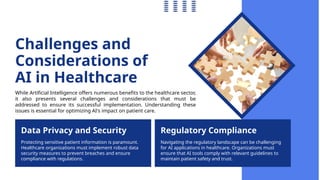
Challenges and
Considerations of
AI in Healthcare
While Artificial Intelligence offers numerous benefits to the healthcare sector,
it also presents several challenges and considerations that must be
addressed to ensure its successful implementation. Understanding these
issues is essential for optimizing AI's impact on patient care.
Data Privacy and Security Regulatory Compliance
Protecting sensitive patient information is paramount.
Healthcare organizations must implement robust data
security measures to prevent breaches and ensure
compliance with regulations.
Navigating the regulatory landscape can be challenging
for AI applications in healthcare. Organizations must
ensure that AI tools comply with relevant guidelines to
maintain patient safety and trust.
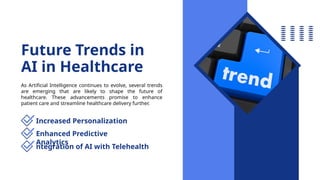
Future Trends in
AI in Healthcare
As Artificial Intelligence continues to evolve, several trends
are emerging that are likely to shape the future of
healthcare. These advancements promise to enhance
patient care and streamline healthcare delivery further.
Increased Personalization
Enhanced Predictive
Analytics
ntegration of AI with Telehealth
Thank You
For your attention! If you have any questions or would like
to discuss further, please feel free to reach out.
123-456-7890 123 Anywhere St., Any City
www.reallygreatsite.com hello@reallygreatsite.com
Larana, Inc.

Artificial Intelligence in Healthcare.pptx

  • 1.
  • 2.
    Introduction Artificial Intelligence (AI)is rapidly transforming the healthcare sector, providing tools that enhance the precision and efficiency of medical services. From diagnosing diseases more accurately to improving patient outcomes, AI is reshaping how healthcare professionals approach medical challenges. Its ability to process vast amounts of data quickly allows for better decision-making and early detection of health conditions. In this presentation, we will delve into how AI is impacting key areas such as medical diagnosis, personalized treatment, patient care, and hospital operations. The integration of AI not only enhances the quality of care but also opens new possibilities for future innovations in the healthcare industry.
  • 3.
    The Role ofAI in Medical Diagnosis Artificial Intelligence is significantly enhancing the accuracy and speed of medical diagnoses. AI systems can analyze medical data such as imaging scans, lab results, and patient history to detect patterns that may not be easily recognizable by humans. This leads to more precise and timely diagnoses, especially in fields like radiology and pathology. Additionally, AI has the potential to revolutionize early disease detection. By analyzing vast datasets and identifying subtle indicators, AI can assist in predicting conditions such as cancer or heart disease at earlier stages, giving patients a better chance of successful treatment and recovery.
  • 4.
    AI in PersonalizedMedicine Artificial Intelligence is enabling a shift towards personalized medicine, where treatment plans are tailored to the individual needs of each patient. By analyzing genetic information, lifestyle factors, and medical history, AI can recommend customized treatments that are more effective and better suited to each person’s unique profile. AI enables the development of customized treatment plans based on individual patient data, including genetic information and lifestyle factors. Tailored Treatment Plans By utilizing predictive analytics, AI helps healthcare providers anticipate patient outcomes, allowing for timely and proactive interventions. Predictive Analytics Personalized approaches enhance treatment effectiveness while minimizing potential side effects, leading to better patient experiences and outcomes. Improved Effectiveness
  • 5.
    AI in HealthcareProcedures Artificial Intelligence is making significant advancements in the field of surgery, contributing to improved precision and patient outcomes. AI- powered robotic systems assist surgeons in performing complex procedures with greater accuracy. These technologies help reduce invasiveness, which can lead to shorter recovery times and fewer complications. AI enables the use of robotic systems that provide enhanced control and precision during various healthcare interventions. This technology allows for minimally invasive techniques, which can reduce physical impact on patients. With AI's ability to analyze real-time data, procedures can be performed with greater accuracy. This precision helps ensure that critical areas are preserved during interventions, leading to better outcomes. Robotic-Assisted Procedures Enhanced Precision
  • 6.
    AI in MedicalImaging Artificial Intelligence is transforming the field of medical imaging by improving the efficiency and accuracy of image evaluation. With the ability to quickly analyze various types of medical images, AI assists healthcare professionals in identifying potential health issues more effectively. This technology streamlines the imaging process, allowing for quicker assessments. Improved Detection Faster Analysis Minimized Errors
  • 7.
    AI in TreatmentDevelopment Artificial Intelligence is revolutionizing the process of developing new treatments, significantly accelerating the introduction of innovative therapies. By leveraging advanced algorithms and large datasets, AI can identify potential treatment candidates more efficiently than traditional methods. This innovative approach reduces the time and cost associated with bringing new therapies to patients.
  • 8.
    AI in PatientCare and Monitoring Artificial Intelligence is playing a crucial role in enhancing patient care and monitoring, enabling more personalized and proactive healthcare solutions. AI-driven tools and applications allow healthcare providers to monitor patient conditions in real-time, leading to better health outcomes and improved quality of care. Improved Detection Real-Time Health Analytics AI Chatbots for Patient Support Remote Monitoring
  • 9.
    AI in HealthcareAdministration Artificial Intelligence is streamlining healthcare administration by automating routine tasks and improving efficiency. AI tools help manage data, reduce administrative burdens, and optimize workflows, allowing healthcare professionals to focus more on patient care. Improving Data Management Optimizing Workflows Automating Administrative Tasks
  • 10.
    Compliance Monitoring Incident Response Automation AI toolshelp organizations maintain compliance with healthcare regulations by monitoring data handling practices. This ensures that institutions adhere to privacy standards and reduce the risk of violations. In the event of a security incident, AI can automate responses to mitigate damage. This includes isolating affected systems and alerting IT personnel, thereby minimizing downtime and protecting patient information. AI in Patient Engagement Artificial Intelligence is significantly enhancing patient engagement by providing tools that foster communication and interaction between healthcare providers and patients. These innovations help create a more personalized healthcare experience, improving patient satisfaction and adherence to treatment plans.
  • 11.
    AI in Healthcare DataSecurity Threat Detection Compliance Monitoring Data Encryption Incident Response Automation AI systems can analyze patterns in data access and usage to identify unusual activity that may indicate a security breach. This proactive approach helps organizations respond swiftly to potential threats. AI tools help organizations maintain compliance with healthcare regulations by monitoring data handling practices. This ensures that institutions adhere to privacy standards and reduce the risk of violations. AI can assist in implementing advanced encryption techniques to protect sensitive information during transmission and storage, ensuring that patient data remains confidential. In the event of a security incident, AI can automate responses to mitigate damage. This includes isolating affected systems and alerting IT personnel, thereby minimizing downtime and protecting patient information.
  • 12.
    AI in Trainingand Development Artificial Intelligence is reshaping training and development within the healthcare sector by providing innovative tools and resources that enhance learning experiences for healthcare professionals. This technology facilitates ongoing education and skills development, ensuring that staff are equipped with the latest knowledge and techniques. Simulated Training Environments AI-powered simulations create realistic training scenarios for healthcare professionals, allowing them to practice skills and decision-making in a safe environment without risking patient safety. Personalized Learning Paths AI can assess individual learning needs and create tailored training programs that match each professional’s skill level and career goals, promoting more effective learning outcomes.
  • 13.
    Challenges and Considerations of AIin Healthcare While Artificial Intelligence offers numerous benefits to the healthcare sector, it also presents several challenges and considerations that must be addressed to ensure its successful implementation. Understanding these issues is essential for optimizing AI's impact on patient care. Data Privacy and Security Regulatory Compliance Protecting sensitive patient information is paramount. Healthcare organizations must implement robust data security measures to prevent breaches and ensure compliance with regulations. Navigating the regulatory landscape can be challenging for AI applications in healthcare. Organizations must ensure that AI tools comply with relevant guidelines to maintain patient safety and trust.
  • 14.
    Future Trends in AIin Healthcare As Artificial Intelligence continues to evolve, several trends are emerging that are likely to shape the future of healthcare. These advancements promise to enhance patient care and streamline healthcare delivery further. Increased Personalization Enhanced Predictive Analytics ntegration of AI with Telehealth
  • 15.
    Thank You For yourattention! If you have any questions or would like to discuss further, please feel free to reach out. 123-456-7890 123 Anywhere St., Any City www.reallygreatsite.com hello@reallygreatsite.com Larana, Inc.