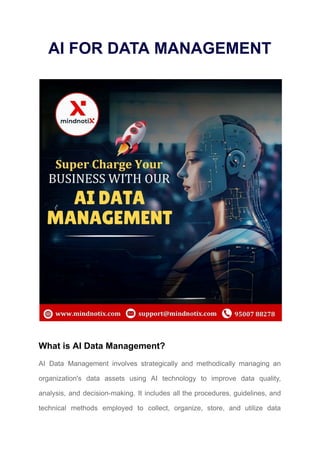
AI FOR DATA MANAGEMENT
What is AI Data Management?​
AI Data Management involves strategically and methodically managing an
organization's data assets using AI technology to improve data quality,
analysis, and decision-making. It includes all the procedures, guidelines, and
technical methods employed to collect, organize, store, and utilize data
efficiently. Corporate data management requires integrity, accessibility,
security, and compliance. Data is collected, stored, retrieved, and transformed
to guarantee accuracy, consistency, and currency. This procedure is essential
for regulatory compliance, informed decision-making, and competitive
advantage.
Automate Your Data Analysis​
Not all business decisions require complex data analytics systems. After all,
you can often uncover new insights into business processes, metrics, and
profitability through basic data analysis and visualization tools, like Excel. For
example, a simple spreadsheet tracking key performance indicators (KPIs)
can yield quick insights. ​
But as your business grows and data becomes more complex, you'll need to
lean on automation tools and data analytics systems to process, aggregate,
and visualize your data more quickly. Python, SQL, and ETL (extract,
transform, load) tools can be combined to build a data pipeline capable of
quickly extracting, processing, and modeling data. This automation can be
used by data scientists and analysts to create dashboards, graphs,
spreadsheets, or other visual elements to discover new insights or correlations
in the data. ​
Advanced machine learning models and artificial intelligence can also be
employed to automate advanced analytical tasks. Or you might leverage APIs
or connectors to access larger pools of data stored in any number of
streaming data lakes or cloud storage services.
The Benefits of Automating Data Analysis in your
Business​
Handling big data manually involves a herculean effort. The "5 Vs" are
commonly used to describe big data – Volume, Variety, Velocity, Variability,
and Veracity. That means that big data isn't just large in terms of size, but it
also involves a huge variety of fast-moving data types and sources, which
need to be handled quickly and accurately. Automating your data analytics
process will help you manage this data load much more quickly and easily.​
When moving from small data, like simple Google Sheets, to big data,
automated data analysis is essential. Automated data analysis can be used
for a wide variety of tasks ranging from data discovery, data preparation, data
replication, and data warehouse maintenance.​
Automating your data analytics means that your in-house data analysts don’t
need to spend their time on routine tasks, and can instead focus on taking
analyzed data and creating actionable plans to reach your business goals.​
For example, analysts can use the data to identify credit card users who are
likely to churn and take steps to prevent that. Many factors are involved in
whether a customer will churn, but with automated data analysis, analysts can
quickly and accurately identify patterns and correlations in the data and take
the necessary steps to reduce churn.​
This gives non-technical teams the ability to make data-driven decisions. Your
team will also have more capacity to add new data sources to your ML model
and make future insights more comprehensive. ​
And finally, automation will increase the speed of analytics - you simply need
team members who are able to set up and train the ML model, and you could
get results in minutes. With no-code and low-code platforms like Mindnotix,
even non-technical teams can take the reins of data analysis and get insights
in the least possible time.
Examples of Automated Data Analysis
Practical examples can help us put these abstract concepts into real-world
terms. As AI and data science continue to take an increasingly prominent role
in the world, the automation of data analysis has become a valuable tool for
businesses. Let's explore three different types of automated data analysis,
including business intelligence automation, ML models and big data
automation, and automated data collection
Business Intelligence Automation
Business intelligence automation is the use of AI algorithms and tools to
automate the process of gathering, storing, and analyzing data. Business
intelligence automation is used to gain insights into customer behavior, market
trends, and other business-critical information. With it, businesses can quickly
and easily analyze large sets of data to identify patterns, trends, and
correlations. This can be used to make better decisions, create more efficient
processes, and gain a competitive edge. ​
Most analysts are familiar with tools like Tableau and PowerBI, which are used
to organize and visualize data. However, these tools are often limited in their
ability to automatically uncover deeper insights. Business intelligence
automation gives users more power by allowing more complex analyses. For
example, AI algorithms can be used to detect anomalies, uncover hidden
relationships, and predict future trends.​
Anyone who has used legacy BI tools knows that the process can be tedious
and time-consuming. By automating the process, businesses can save time
and money while still receiving the same high-quality insights.
ML Models and Big Data Automation
Going beyond BI automation, ML models can be used to automate the
analysis of large datasets. ML models use algorithms to automatically detect
patterns in data, which can then be used to make predictions and decisions.
ML models can be used to analyze customer behavior, detect fraud, and
predict future events.
By automating the analysis of large datasets, businesses can gain insights
faster and make more accurate predictions. For example, an ML model can be
used to quickly detect patterns in customer behavior, which can then be used
to optimize product pricing and marketing campaigns.
Big data automation is the process of automating the analysis of large
datasets. Big data automation allows businesses to quickly and easily query
large datasets to uncover insights. With big data automation, businesses can
quickly analyze large datasets to identify patterns, trends, and correlations.
This can be used to make better decisions, create more efficient processes,
and gain a competitive edge.
​
Automated Data Collection
Finally, automated data collection is the use of AI algorithms and tools to
automatically collect data from a variety of sources. Automated data collection
can be used to quickly and easily collect data from websites, social media,
and other sources. This data can then be analyzed to gain insights into
customer behavior, market trends, and other business-critical information.
Automated data collection can be used to quickly collect large amounts of
data, which can then be used to train ML models. Automated data collection
can also be used to quickly build large datasets, which can then be used to
perform advanced analytics.
​
Current challenges of using ai for data management
​
Using AI for data management include: poor data quality, data inconsistency,
bias in AI algorithms, data privacy concerns, lack of transparency in AI
decision-making, data governance and compliance issues, limited skilled
resources to manage AI systems, and ensuring data relevance to the specific
AI application; all of which can lead to unreliable AI model outputs and
inaccurate insights if not properly addressed. Using AI for data management
offers incredible potential, but it comes with its own set of hurdles.
​
The biggest challenges boil down to these:
​
Data quality issues: Inaccurate, incomplete, or outdated data can significantly
impact the performance of AI models, leading to unreliable predictions and
decisions.
Data bias: AI algorithms can inherit biases from the data they are trained on,
leading to discriminatory outcomes in applications like hiring or loan
approvals.
Data privacy and security: Concerns about how personal data is collected,
stored, and used by AI systems raise privacy issues and require robust
security measures.
Data governance and compliance: Ensuring that AI systems adhere to
relevant regulations and data governance practices can be complex,
especially with evolving legal landscapes.
Lack of transparency: The "black box" nature of some AI algorithms can make
it difficult to understand how decisions are made, raising concerns about
accountability and fairness.
Implementation challenges: Integrating AI into existing data management
systems can be challenging due to technical complexities and the need for
skilled personnel.
Data integration complexity: Combining data from multiple sources with
different formats and structures can be difficult and require extensive data
cleaning and standardization.
Using AI for data management offers incredible potential, but it comes with its
own set of hurdles.
So, how can we overcome these challenges?
Focus on data quality: Prioritize meticulous data cleaning and preparation to
ensure the AI has a solid foundation.
Key steps in ensuring data quality
Data Cleaning: This involves identifying and correcting errors, such as missing
values, incorrect data types, and inconsistencies.
Data Transformation: This may involve techniques like normalization,
standardization, and feature engineering to prepare the data for analysis.
Data Validation: Implementing checks to ensure data integrity and consistency
throughout the data lifecycle.
Combat bias: Actively identify and address biases in data and algorithms to
ensure fair and equitable outcomes.
Increase transparency: Develop AI models that are more explainable, making
it easier to understand how they arrive at their conclusions.
Prioritize privacy: Implement strong security measures and adhere to strict
privacy regulations to protect sensitive data.
Invest in human expertise: Train and upskill professionals to effectively
manage and maintain AI systems.
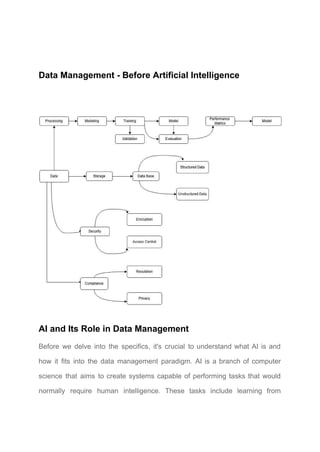
Data Management - Before Artificial Intelligence​
AI and Its Role in Data Management​
Before we delve into the specifics, it's crucial to understand what AI is and
how it fits into the data management paradigm. AI is a branch of computer
science that aims to create systems capable of performing tasks that would
normally require human intelligence. These tasks include learning from
experience, understanding natural language, recognizing patterns, and
making decisions.
AI can automate routine tasks, improve accuracy, enhance efficiency, and
provide valuable insights. It can sift through vast amounts of data, identify
errors and inconsistencies, rectify them, and even predict future trends. This
not only improves the quality of data but also enhances the reliability of the
insights derived from it.
​
AI and Data Quality
​
Data quality is a critical aspect of data management. It refers to the condition
of a set of values of qualitative or quantitative variables. High-quality data is
accurate, complete, consistent, reliable, and timely. Poor data quality can lead
to inaccurate insights, flawed decision-making, and potential financial losses.
​
One of the most significant AI use cases for data managers is enhancing data
quality. AI algorithms can process vast amounts of data at high speed, identify
errors, inconsistencies, and duplicates, and rectify them. For instance, AI can
identify and correct misspelled words, inconsistent data formats, and missing
values. It can also identify duplicates, where the same data is stored in
multiple locations, and remove them.
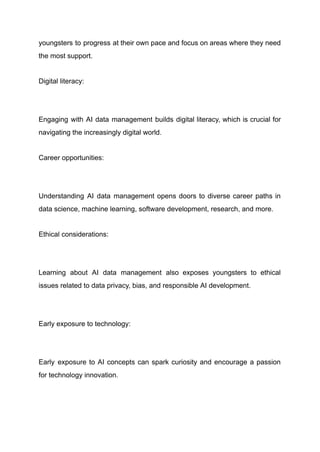
Data Management - After Artificial Intelligence​
Benefits to Peoples in ai data management
In today's rapidly evolving technological landscape, introducing AI concepts to
young students is crucial. By engaging with AI data management, youngsters
not only gain valuable technical skills but also develop essential 21st-century
competencies like critical thinking, problem-solving, and creativity. This early
exposure fosters a generation of innovators who are equipped to navigate and
shape the future of AI.
Future-proof skills:
​
Learning AI data management equips young people with highly sought-after
skills in the job market, making them competitive in fields across industries
that increasingly rely on data analysis and AI applications.
Critical thinking and problem-solving:
​
Working with AI data involves identifying patterns, analyzing complex
information, and making informed decisions, which enhances critical thinking
and problem-solving abilities.
Creativity and innovation:
​
AI data management encourages experimentation and creative approaches to
data analysis, allowing youngsters to develop innovative solutions to
real-world problems.
Personalized learning:
​
AI-powered tools can tailor learning experiences to individual needs, allowing
youngsters to progress at their own pace and focus on areas where they need
the most support.
Digital literacy:
​
Engaging with AI data management builds digital literacy, which is crucial for
navigating the increasingly digital world.
Career opportunities:
​
Understanding AI data management opens doors to diverse career paths in
data science, machine learning, software development, research, and more.
Ethical considerations:
​
Learning about AI data management also exposes youngsters to ethical
issues related to data privacy, bias, and responsible AI development.
​
Early exposure to technology:
​
Early exposure to AI concepts can spark curiosity and encourage a passion
for technology innovation.
Examples of how youngsters can benefit from AI data management
1. Data visualization projects:​
Creating interactive data visualizations using AI tools to present complex
information in an engaging way.
2. Machine learning experiments:​
Building simple machine learning models to analyze data and predict
outcomes, fostering understanding of AI algorithms.
3. Data cleaning and preparation:​
Learning to clean and prepare real-world data for analysis, developing
essential data management skills.
4. AI-powered creative tools:​
Utilizing AI tools for creative endeavors like generating art, music, or writing,
exploring the potential of AI in different fields. ​
Companies Implementing AI Data Management
The field of AI data management is rapidly evolving, with many companies
leading the charge. These companies are developing and deploying
innovative solutions that leverage AI to transform how organizations manage,
analyze, and utilize their data.
​
Databricks: A popular platform for data engineering and machine learning,
offering a unified analytics platform that seamlessly integrates data
processing, machine learning, and collaboration.
​
Snowflake: A cloud-based data warehousing and analytics platform with
strong AI and ML capabilities, enabling organizations to build and deploy
data-driven applications with ease.
​
DataRobot: Provides an AI platform that automates many aspects of the
machine learning lifecycle, making it accessible to data scientists and
business analysts alike.
​
Alteryx: Offers a data analytics platform with built-in AI capabilities for data
blending, data preparation, and predictive analytics, empowering users to gain
deeper insights from their data.
​
Tableau: A leading provider of business intelligence and data visualization
software, incorporating AI features like automated insights and predictive
modeling to enhance data exploration and discovery.
​
Mindnotix: A software solutions company specializing in mobile app
development and other IT services, likely contributing to the broader
ecosystem of AI data management by developing applications that leverage
AI capabilities.
​
These companies are at the forefront of developing and deploying AI-powered
data management solutions that are transforming how businesses operate. By
leveraging these technologies, organizations can unlock the full potential of
their data, gain a competitive edge, and drive innovation across all areas of
their business.
For more information contact : support@mindnotix.com
Mindnotix Software Development Company​
​
​
​
​
​

ARTIFICIAL INTELLIGENCE FOR DATA MANAGEMENT

  • 1.
    AI FOR DATAMANAGEMENT What is AI Data Management?​ AI Data Management involves strategically and methodically managing an organization's data assets using AI technology to improve data quality, analysis, and decision-making. It includes all the procedures, guidelines, and technical methods employed to collect, organize, store, and utilize data
  • 2.
    efficiently. Corporate datamanagement requires integrity, accessibility, security, and compliance. Data is collected, stored, retrieved, and transformed to guarantee accuracy, consistency, and currency. This procedure is essential for regulatory compliance, informed decision-making, and competitive advantage. Automate Your Data Analysis​ Not all business decisions require complex data analytics systems. After all, you can often uncover new insights into business processes, metrics, and profitability through basic data analysis and visualization tools, like Excel. For example, a simple spreadsheet tracking key performance indicators (KPIs) can yield quick insights. ​ But as your business grows and data becomes more complex, you'll need to lean on automation tools and data analytics systems to process, aggregate, and visualize your data more quickly. Python, SQL, and ETL (extract, transform, load) tools can be combined to build a data pipeline capable of quickly extracting, processing, and modeling data. This automation can be used by data scientists and analysts to create dashboards, graphs, spreadsheets, or other visual elements to discover new insights or correlations in the data. ​ Advanced machine learning models and artificial intelligence can also be employed to automate advanced analytical tasks. Or you might leverage APIs or connectors to access larger pools of data stored in any number of streaming data lakes or cloud storage services.
  • 3.
    The Benefits ofAutomating Data Analysis in your Business​ Handling big data manually involves a herculean effort. The "5 Vs" are commonly used to describe big data – Volume, Variety, Velocity, Variability, and Veracity. That means that big data isn't just large in terms of size, but it also involves a huge variety of fast-moving data types and sources, which need to be handled quickly and accurately. Automating your data analytics process will help you manage this data load much more quickly and easily.​ When moving from small data, like simple Google Sheets, to big data, automated data analysis is essential. Automated data analysis can be used for a wide variety of tasks ranging from data discovery, data preparation, data replication, and data warehouse maintenance.​ Automating your data analytics means that your in-house data analysts don’t need to spend their time on routine tasks, and can instead focus on taking analyzed data and creating actionable plans to reach your business goals.​ For example, analysts can use the data to identify credit card users who are likely to churn and take steps to prevent that. Many factors are involved in whether a customer will churn, but with automated data analysis, analysts can quickly and accurately identify patterns and correlations in the data and take the necessary steps to reduce churn.​ This gives non-technical teams the ability to make data-driven decisions. Your team will also have more capacity to add new data sources to your ML model and make future insights more comprehensive. ​ And finally, automation will increase the speed of analytics - you simply need team members who are able to set up and train the ML model, and you could
  • 4.
    get results inminutes. With no-code and low-code platforms like Mindnotix, even non-technical teams can take the reins of data analysis and get insights in the least possible time. Examples of Automated Data Analysis Practical examples can help us put these abstract concepts into real-world terms. As AI and data science continue to take an increasingly prominent role in the world, the automation of data analysis has become a valuable tool for businesses. Let's explore three different types of automated data analysis, including business intelligence automation, ML models and big data automation, and automated data collection Business Intelligence Automation Business intelligence automation is the use of AI algorithms and tools to automate the process of gathering, storing, and analyzing data. Business intelligence automation is used to gain insights into customer behavior, market trends, and other business-critical information. With it, businesses can quickly and easily analyze large sets of data to identify patterns, trends, and correlations. This can be used to make better decisions, create more efficient processes, and gain a competitive edge. ​ Most analysts are familiar with tools like Tableau and PowerBI, which are used to organize and visualize data. However, these tools are often limited in their ability to automatically uncover deeper insights. Business intelligence automation gives users more power by allowing more complex analyses. For example, AI algorithms can be used to detect anomalies, uncover hidden relationships, and predict future trends.​
  • 5.
    Anyone who hasused legacy BI tools knows that the process can be tedious and time-consuming. By automating the process, businesses can save time and money while still receiving the same high-quality insights. ML Models and Big Data Automation Going beyond BI automation, ML models can be used to automate the analysis of large datasets. ML models use algorithms to automatically detect patterns in data, which can then be used to make predictions and decisions. ML models can be used to analyze customer behavior, detect fraud, and predict future events. By automating the analysis of large datasets, businesses can gain insights faster and make more accurate predictions. For example, an ML model can be used to quickly detect patterns in customer behavior, which can then be used to optimize product pricing and marketing campaigns. Big data automation is the process of automating the analysis of large datasets. Big data automation allows businesses to quickly and easily query large datasets to uncover insights. With big data automation, businesses can quickly analyze large datasets to identify patterns, trends, and correlations. This can be used to make better decisions, create more efficient processes, and gain a competitive edge. ​ Automated Data Collection Finally, automated data collection is the use of AI algorithms and tools to automatically collect data from a variety of sources. Automated data collection
  • 6.
    can be usedto quickly and easily collect data from websites, social media, and other sources. This data can then be analyzed to gain insights into customer behavior, market trends, and other business-critical information. Automated data collection can be used to quickly collect large amounts of data, which can then be used to train ML models. Automated data collection can also be used to quickly build large datasets, which can then be used to perform advanced analytics. ​ Current challenges of using ai for data management ​ Using AI for data management include: poor data quality, data inconsistency, bias in AI algorithms, data privacy concerns, lack of transparency in AI decision-making, data governance and compliance issues, limited skilled resources to manage AI systems, and ensuring data relevance to the specific AI application; all of which can lead to unreliable AI model outputs and inaccurate insights if not properly addressed. Using AI for data management offers incredible potential, but it comes with its own set of hurdles. ​ The biggest challenges boil down to these: ​ Data quality issues: Inaccurate, incomplete, or outdated data can significantly impact the performance of AI models, leading to unreliable predictions and decisions.
  • 7.
    Data bias: AIalgorithms can inherit biases from the data they are trained on, leading to discriminatory outcomes in applications like hiring or loan approvals. Data privacy and security: Concerns about how personal data is collected, stored, and used by AI systems raise privacy issues and require robust security measures. Data governance and compliance: Ensuring that AI systems adhere to relevant regulations and data governance practices can be complex, especially with evolving legal landscapes. Lack of transparency: The "black box" nature of some AI algorithms can make it difficult to understand how decisions are made, raising concerns about accountability and fairness. Implementation challenges: Integrating AI into existing data management systems can be challenging due to technical complexities and the need for skilled personnel. Data integration complexity: Combining data from multiple sources with different formats and structures can be difficult and require extensive data cleaning and standardization. Using AI for data management offers incredible potential, but it comes with its own set of hurdles.
  • 8.
    So, how canwe overcome these challenges? Focus on data quality: Prioritize meticulous data cleaning and preparation to ensure the AI has a solid foundation. Key steps in ensuring data quality Data Cleaning: This involves identifying and correcting errors, such as missing values, incorrect data types, and inconsistencies. Data Transformation: This may involve techniques like normalization, standardization, and feature engineering to prepare the data for analysis. Data Validation: Implementing checks to ensure data integrity and consistency throughout the data lifecycle. Combat bias: Actively identify and address biases in data and algorithms to ensure fair and equitable outcomes. Increase transparency: Develop AI models that are more explainable, making it easier to understand how they arrive at their conclusions. Prioritize privacy: Implement strong security measures and adhere to strict privacy regulations to protect sensitive data. Invest in human expertise: Train and upskill professionals to effectively manage and maintain AI systems.
  • 9.
    Data Management -Before Artificial Intelligence​ AI and Its Role in Data Management​ Before we delve into the specifics, it's crucial to understand what AI is and how it fits into the data management paradigm. AI is a branch of computer science that aims to create systems capable of performing tasks that would normally require human intelligence. These tasks include learning from
  • 10.
    experience, understanding naturallanguage, recognizing patterns, and making decisions. AI can automate routine tasks, improve accuracy, enhance efficiency, and provide valuable insights. It can sift through vast amounts of data, identify errors and inconsistencies, rectify them, and even predict future trends. This not only improves the quality of data but also enhances the reliability of the insights derived from it. ​ AI and Data Quality ​ Data quality is a critical aspect of data management. It refers to the condition of a set of values of qualitative or quantitative variables. High-quality data is accurate, complete, consistent, reliable, and timely. Poor data quality can lead to inaccurate insights, flawed decision-making, and potential financial losses. ​ One of the most significant AI use cases for data managers is enhancing data quality. AI algorithms can process vast amounts of data at high speed, identify errors, inconsistencies, and duplicates, and rectify them. For instance, AI can identify and correct misspelled words, inconsistent data formats, and missing values. It can also identify duplicates, where the same data is stored in multiple locations, and remove them.
  • 11.
    Data Management -After Artificial Intelligence​ Benefits to Peoples in ai data management In today's rapidly evolving technological landscape, introducing AI concepts to young students is crucial. By engaging with AI data management, youngsters not only gain valuable technical skills but also develop essential 21st-century competencies like critical thinking, problem-solving, and creativity. This early
  • 12.
    exposure fosters ageneration of innovators who are equipped to navigate and shape the future of AI. Future-proof skills: ​ Learning AI data management equips young people with highly sought-after skills in the job market, making them competitive in fields across industries that increasingly rely on data analysis and AI applications. Critical thinking and problem-solving: ​ Working with AI data involves identifying patterns, analyzing complex information, and making informed decisions, which enhances critical thinking and problem-solving abilities. Creativity and innovation: ​ AI data management encourages experimentation and creative approaches to data analysis, allowing youngsters to develop innovative solutions to real-world problems. Personalized learning: ​ AI-powered tools can tailor learning experiences to individual needs, allowing
  • 13.
    youngsters to progressat their own pace and focus on areas where they need the most support. Digital literacy: ​ Engaging with AI data management builds digital literacy, which is crucial for navigating the increasingly digital world. Career opportunities: ​ Understanding AI data management opens doors to diverse career paths in data science, machine learning, software development, research, and more. Ethical considerations: ​ Learning about AI data management also exposes youngsters to ethical issues related to data privacy, bias, and responsible AI development. ​ Early exposure to technology: ​ Early exposure to AI concepts can spark curiosity and encourage a passion for technology innovation.
  • 14.
    Examples of howyoungsters can benefit from AI data management 1. Data visualization projects:​ Creating interactive data visualizations using AI tools to present complex information in an engaging way. 2. Machine learning experiments:​ Building simple machine learning models to analyze data and predict outcomes, fostering understanding of AI algorithms. 3. Data cleaning and preparation:​ Learning to clean and prepare real-world data for analysis, developing essential data management skills. 4. AI-powered creative tools:​ Utilizing AI tools for creative endeavors like generating art, music, or writing, exploring the potential of AI in different fields. ​ Companies Implementing AI Data Management The field of AI data management is rapidly evolving, with many companies leading the charge. These companies are developing and deploying innovative solutions that leverage AI to transform how organizations manage, analyze, and utilize their data. ​ Databricks: A popular platform for data engineering and machine learning,
  • 15.
    offering a unifiedanalytics platform that seamlessly integrates data processing, machine learning, and collaboration. ​ Snowflake: A cloud-based data warehousing and analytics platform with strong AI and ML capabilities, enabling organizations to build and deploy data-driven applications with ease. ​ DataRobot: Provides an AI platform that automates many aspects of the machine learning lifecycle, making it accessible to data scientists and business analysts alike. ​ Alteryx: Offers a data analytics platform with built-in AI capabilities for data blending, data preparation, and predictive analytics, empowering users to gain deeper insights from their data. ​ Tableau: A leading provider of business intelligence and data visualization software, incorporating AI features like automated insights and predictive modeling to enhance data exploration and discovery. ​ Mindnotix: A software solutions company specializing in mobile app development and other IT services, likely contributing to the broader ecosystem of AI data management by developing applications that leverage AI capabilities.
  • 16.
    ​ These companies areat the forefront of developing and deploying AI-powered data management solutions that are transforming how businesses operate. By leveraging these technologies, organizations can unlock the full potential of their data, gain a competitive edge, and drive innovation across all areas of their business. For more information contact : support@mindnotix.com Mindnotix Software Development Company​ ​ ​ ​ ​ ​