Artificial
Intelligence
in
HEATHCARE
Transforming the Future of
Medicine
What is Artificial Intelligence?
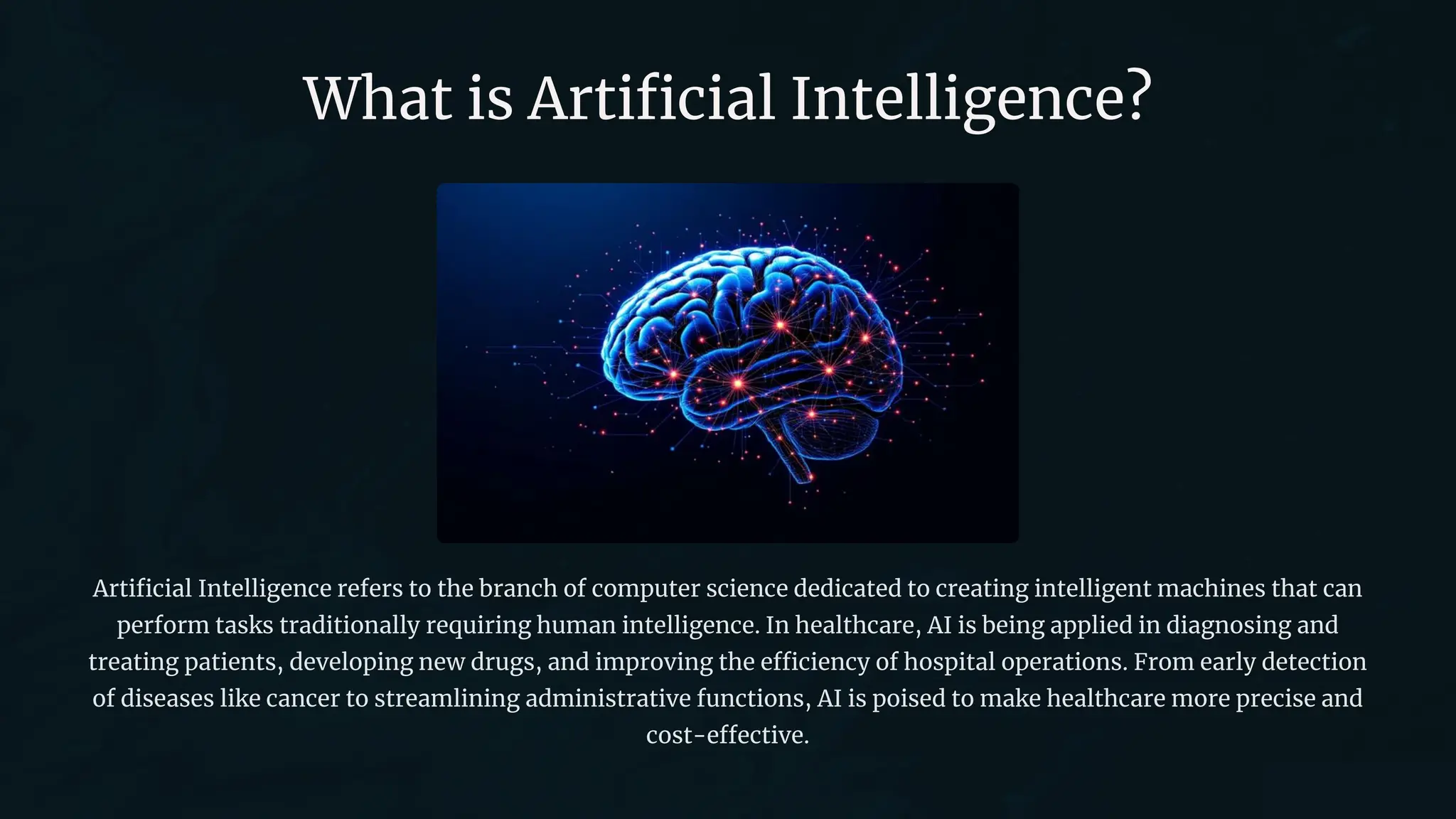
Artificial Intelligence refers to the branch of computer science dedicated to creating intelligent machines that can
perform tasks traditionally requiring human intelligence. In healthcare, AI is being applied in diagnosing and
treating patients, developing new drugs, and improving the efficiency of hospital operations. From early detection
of diseases like cancer to streamlining administrative functions, AI is poised to make healthcare more precise and
cost-effective.
The Role of AI in Healthcare
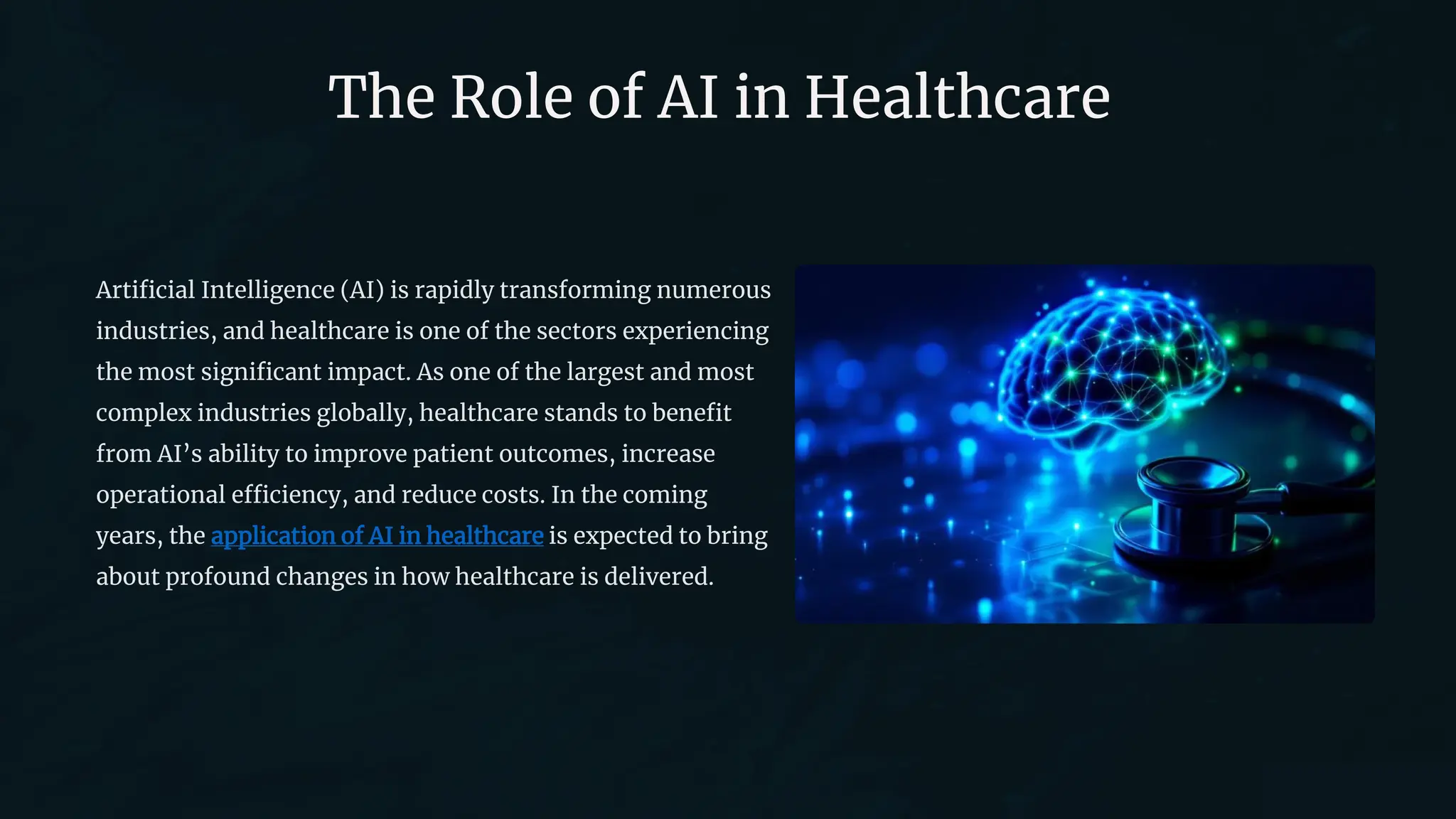
Artificial Intelligence (AI) is rapidly transforming numerous
industries, and healthcare is one of the sectors experiencing
the most significant impact. As one of the largest and most
complex industries globally, healthcare stands to benefit
from AI’s ability to improve patient outcomes, increase
operational efficiency, and reduce costs. In the coming
years, the application of AI in healthcare is expected to bring
about profound changes in how healthcare is delivered.
How AI is Transforming Healthcare
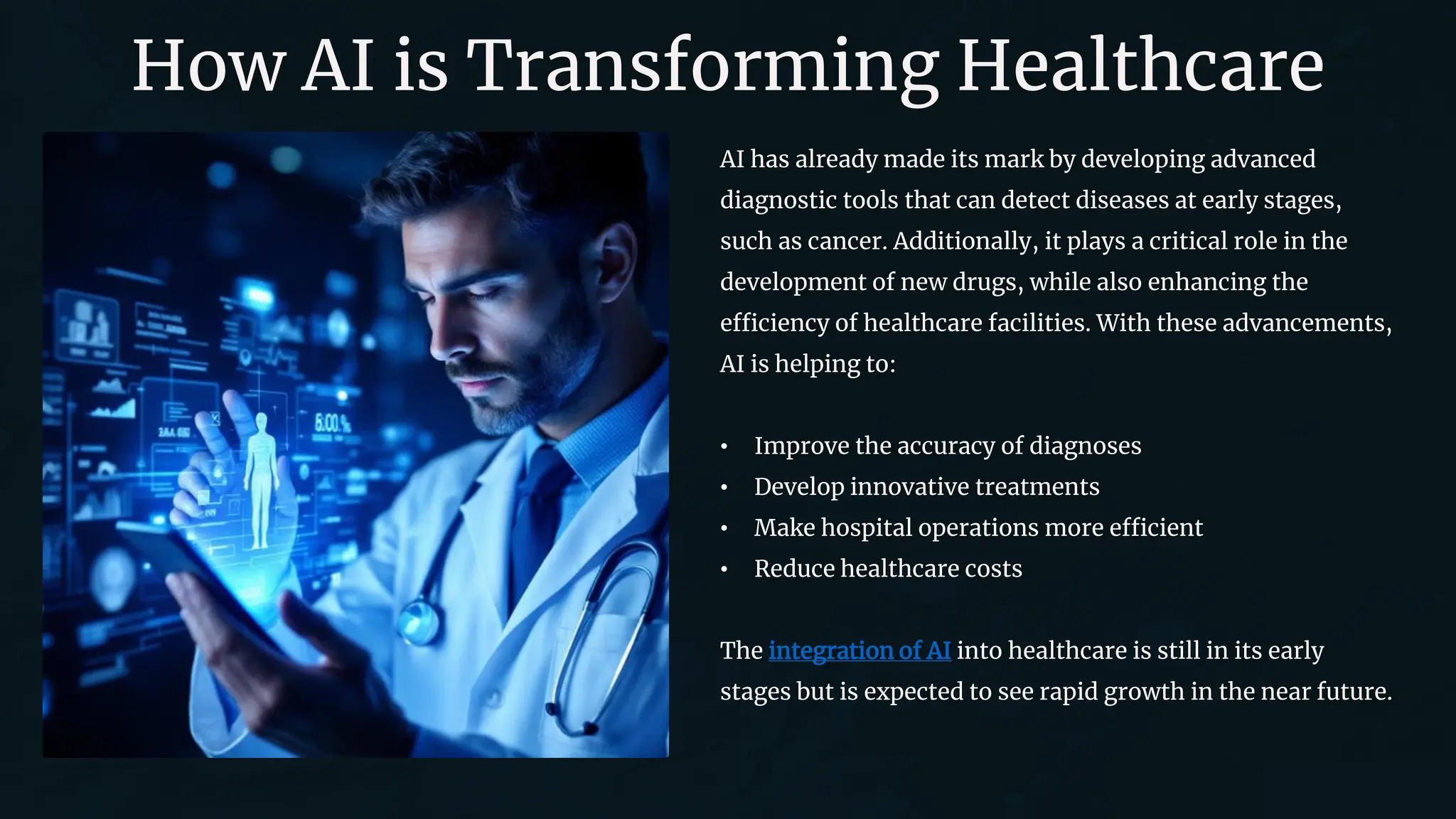
AI has already made its mark by developing advanced
diagnostic tools that can detect diseases at early stages,
such as cancer. Additionally, it plays a critical role in the
development of new drugs, while also enhancing the
efficiency of healthcare facilities. With these advancements,
AI is helping to:
• Improve the accuracy of diagnoses
• Develop innovative treatments
• Make hospital operations more efficient
• Reduce healthcare costs
The integration of AI into healthcare is still in its early
stages but is expected to see rapid growth in the near future.
Why AI in Healthcare?
AI brings several key advantages to healthcare, making it an essential tool for improving patient care
and operational efficiency:
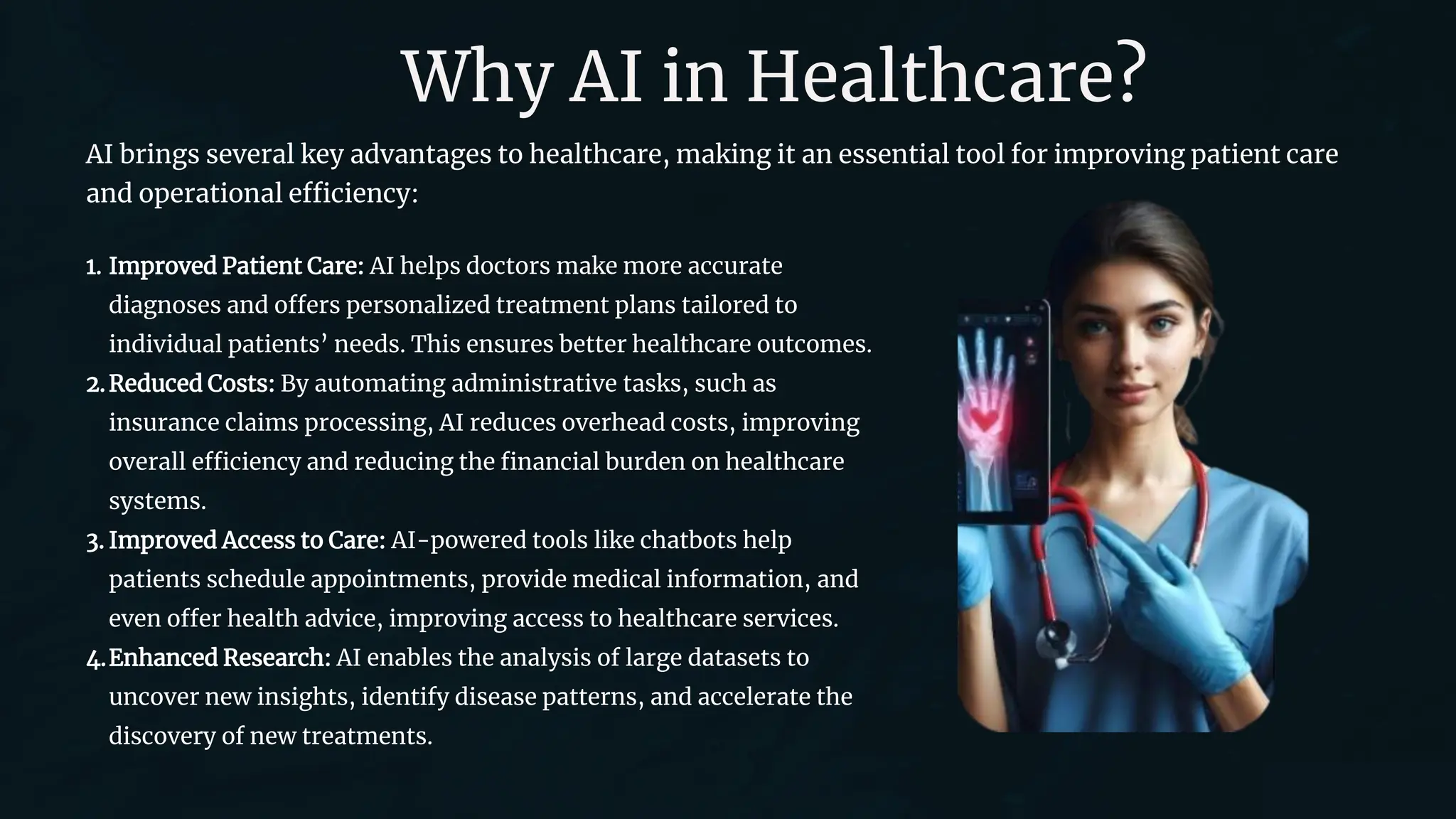
1. Improved Patient Care: AI helps doctors make more accurate
diagnoses and offers personalized treatment plans tailored to
individual patients’ needs. This ensures better healthcare outcomes.
2.Reduced Costs: By automating administrative tasks, such as
insurance claims processing, AI reduces overhead costs, improving
overall efficiency and reducing the financial burden on healthcare
systems.
3. Improved Access to Care: AI-powered tools like chatbots help
patients schedule appointments, provide medical information, and
even offer health advice, improving access to healthcare services.
4.Enhanced Research: AI enables the analysis of large datasets to
uncover new insights, identify disease patterns, and accelerate the
discovery of new treatments.
Challenges in Implementing AI
in Healthcare
While AI offers immense potential, several challenges hinder its widespread adoption in healthcare:
1. Lack of Data Standardization: Different healthcare organizations use varied Electronic Health Record
(EHR) systems, making it difficult to standardize data. This siloed data limits AI’s ability to analyze and
learn from a larger dataset.
2. Lack of Interoperability: Even with standardized data, the different formats used by various EHR systems
prevent smooth data exchange between organizations. This lack of interoperability is a significant
barrier to AI integration.
3. Ethical and Privacy Concerns: AI algorithms require large amounts of patient data to function effectively.
However, collecting, sharing, and using this data raises privacy and ethical concerns, particularly
regarding patient consent and data security.
4. Bias in Data: AI is only as reliable as the data it is trained on. If the dataset is biased, the AI’s predictions
and decisions can be skewed, affecting its accuracy, especially in diverse patient populations.
Future of AI in Healthcare
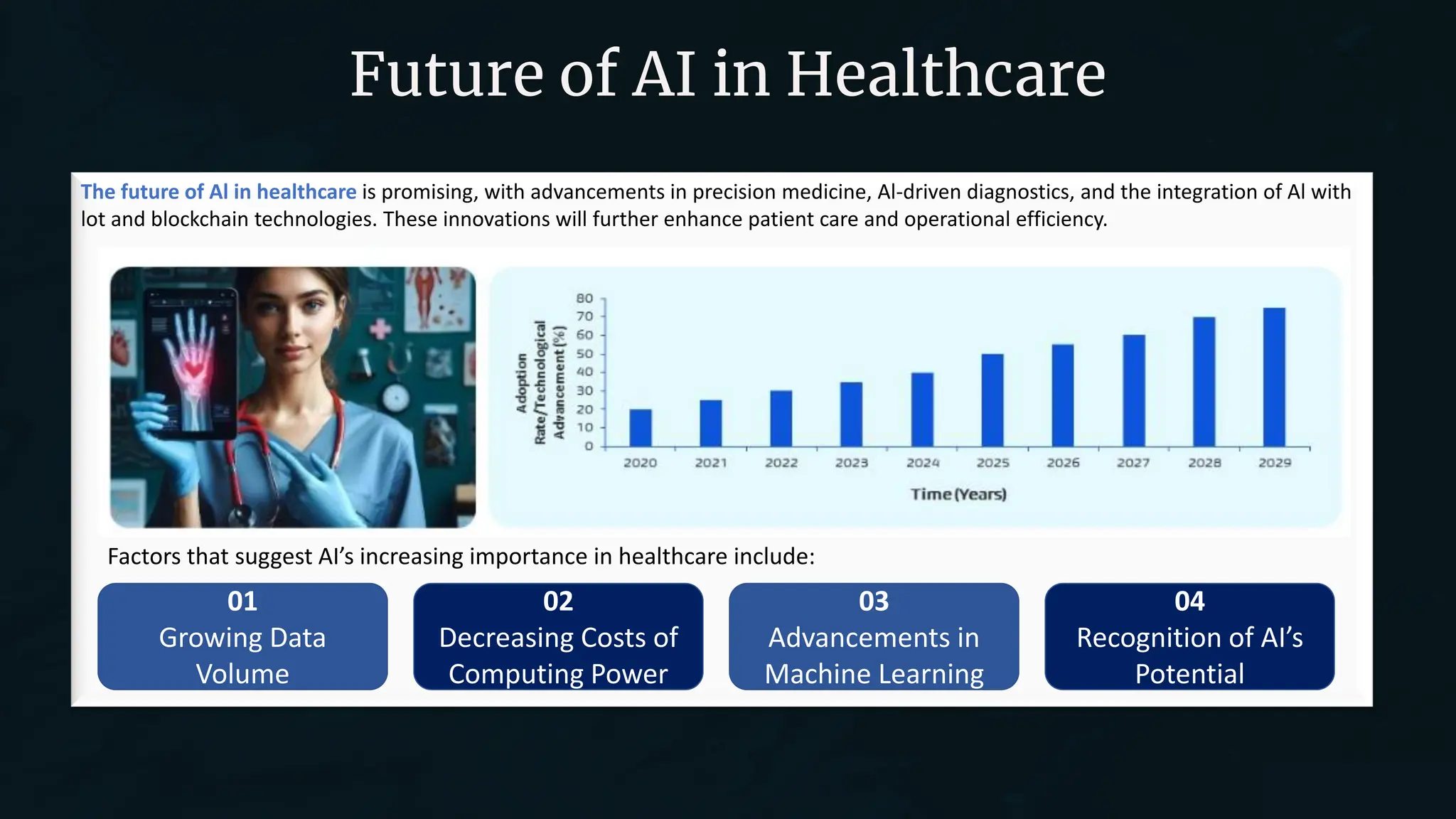
The future of Al in healthcare is promising, with advancements in precision medicine, Al-driven diagnostics, and the integration of Al with
lot and blockchain technologies. These innovations will further enhance patient care and operational efficiency.
01
Growing Data
Volume
02
Decreasing Costs of
Computing Power
03
Advancements in
Machine Learning
04
Recognition of AI’s
Potential
Factors that suggest AI’s increasing importance in healthcare include:
Conclusion
AI holds the potential to revolutionize healthcare by
improving patient outcomes, enhancing operational
efficiency, and lowering costs. However, challenges like
data privacy concerns, ethical considerations, and the
need for improved accuracy in AI systems must be
addressed. With continued research, investment, and the
development of robust AI frameworks, the healthcare
industry is poised for significant transformation in the
years to come.
Al is revolutionizing healthcare by
improving diagnostics, personalizing
treatments, and enhancing patient
monitoring. As technology advances, the
potential for Al to transform healthcare will
continue to grow, offering significant
benefits to patients and providers alike."

Artificial Intelligence in Healthcare.pdf

  • 1.
  • 2.
    What is ArtificialIntelligence? Artificial Intelligence refers to the branch of computer science dedicated to creating intelligent machines that can perform tasks traditionally requiring human intelligence. In healthcare, AI is being applied in diagnosing and treating patients, developing new drugs, and improving the efficiency of hospital operations. From early detection of diseases like cancer to streamlining administrative functions, AI is poised to make healthcare more precise and cost-effective.
  • 3.
    The Role ofAI in Healthcare Artificial Intelligence (AI) is rapidly transforming numerous industries, and healthcare is one of the sectors experiencing the most significant impact. As one of the largest and most complex industries globally, healthcare stands to benefit from AI’s ability to improve patient outcomes, increase operational efficiency, and reduce costs. In the coming years, the application of AI in healthcare is expected to bring about profound changes in how healthcare is delivered.
  • 4.
    How AI isTransforming Healthcare AI has already made its mark by developing advanced diagnostic tools that can detect diseases at early stages, such as cancer. Additionally, it plays a critical role in the development of new drugs, while also enhancing the efficiency of healthcare facilities. With these advancements, AI is helping to: • Improve the accuracy of diagnoses • Develop innovative treatments • Make hospital operations more efficient • Reduce healthcare costs The integration of AI into healthcare is still in its early stages but is expected to see rapid growth in the near future.
  • 5.
    Why AI inHealthcare? AI brings several key advantages to healthcare, making it an essential tool for improving patient care and operational efficiency: 1. Improved Patient Care: AI helps doctors make more accurate diagnoses and offers personalized treatment plans tailored to individual patients’ needs. This ensures better healthcare outcomes. 2.Reduced Costs: By automating administrative tasks, such as insurance claims processing, AI reduces overhead costs, improving overall efficiency and reducing the financial burden on healthcare systems. 3. Improved Access to Care: AI-powered tools like chatbots help patients schedule appointments, provide medical information, and even offer health advice, improving access to healthcare services. 4.Enhanced Research: AI enables the analysis of large datasets to uncover new insights, identify disease patterns, and accelerate the discovery of new treatments.
  • 6.
    Challenges in ImplementingAI in Healthcare While AI offers immense potential, several challenges hinder its widespread adoption in healthcare: 1. Lack of Data Standardization: Different healthcare organizations use varied Electronic Health Record (EHR) systems, making it difficult to standardize data. This siloed data limits AI’s ability to analyze and learn from a larger dataset. 2. Lack of Interoperability: Even with standardized data, the different formats used by various EHR systems prevent smooth data exchange between organizations. This lack of interoperability is a significant barrier to AI integration. 3. Ethical and Privacy Concerns: AI algorithms require large amounts of patient data to function effectively. However, collecting, sharing, and using this data raises privacy and ethical concerns, particularly regarding patient consent and data security. 4. Bias in Data: AI is only as reliable as the data it is trained on. If the dataset is biased, the AI’s predictions and decisions can be skewed, affecting its accuracy, especially in diverse patient populations.
  • 7.
    Future of AIin Healthcare The future of Al in healthcare is promising, with advancements in precision medicine, Al-driven diagnostics, and the integration of Al with lot and blockchain technologies. These innovations will further enhance patient care and operational efficiency. 01 Growing Data Volume 02 Decreasing Costs of Computing Power 03 Advancements in Machine Learning 04 Recognition of AI’s Potential Factors that suggest AI’s increasing importance in healthcare include:
  • 8.
    Conclusion AI holds thepotential to revolutionize healthcare by improving patient outcomes, enhancing operational efficiency, and lowering costs. However, challenges like data privacy concerns, ethical considerations, and the need for improved accuracy in AI systems must be addressed. With continued research, investment, and the development of robust AI frameworks, the healthcare industry is poised for significant transformation in the years to come. Al is revolutionizing healthcare by improving diagnostics, personalizing treatments, and enhancing patient monitoring. As technology advances, the potential for Al to transform healthcare will continue to grow, offering significant benefits to patients and providers alike."