Business
Communication Skills
Process of Preparing Effective Business
Messages
Contents
1) Preparation of Business Messages (Ali Hassan)
2) Basic Organizational Plans (Abdur Rehman)
3) Beginnings & Endings (Saim)
4) Closing Paragraph (H. Usama)
5) Composing the Messages (H. Fizan)
6) Editing and Proofreading your Messages (Asim)
1) Preparation of Business Messages
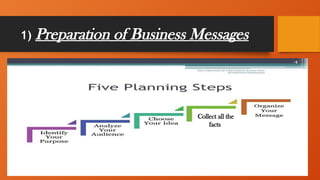
Collect all the
facts
i. Know The Purpose
 The first step is to know your specific purpose.
Example :
 Is it a replacement for defective goods
 Is your main purpose to introduce the new product
ii. Analyze Your Idea
It is very important to write the message to the receiver’s view
and needs.
• Who yore audience
• What they are thinking
• How you can best reach them
iii. Choose Your Idea
 The idea of writing a message depends on the background, cultural,
context and location of the receiver (national or international) .
iv. Collect all The Facts
You must determine whether you need specific
facts , figures or other form of evidence to
support your points .
v. Organize your message
• The order in which the idea are to be presented is as
important as the ideas themselves .
• Disorganized , rambling , messages often seem careless ,
confusing ,and unimportant .
2) Basic Organizational Plans
Four basic parts:
a. Good news messages with direct approach
b. Direct requests with direct approach
c. Bad news messages with indirect approach
d. Persuasive requests with indirect approach
3) Beginning Of Business Messages
Tips & Tricks For Effective Business Message:
While writing an E.B.M. ,
First ,
• Begin the message with some Proper and effective words.
Secondly ,
• Choose Appropriate beginning words to convey the Message.
Beginning Of Business Messages
Tips & Tricks For Effective Business Message:
• There should be main idea in a brief description.
• After order description,
A request should be made declaring your Purpose of writing.
Beginning Of Business Messages
Tips & Tricks For Effective Business Message:
• There are multiple methods or techniques to respond to someone.
• It may be :
I. Poor
II. Buffer
Beginning Of Business Messages
Examples :
Poor message :
• “It is impossible to Open an Account (Bank or Gmail)
Unless You send us the following information”
With Buffer:
• “The moment you send us the following information
Your Account will be opened”
Beginning Of Business Messages
Other Examples :
Suppose: You Are Working in an Organization as delivery Guy.
Poor message :
• “Thank You for your Order”
With Buffer:
• “Thank You for your Order for 200 Writing Pads”
4) Closing Paragraph
i. Effective Ending
ii. Five main points of closing paragraph
• Complete Sentence
• Information
• Enclose a Form
• Give Instruction
• State Your Location
iii. Reap the short
5) Composing Business Messages
 Purpose of writing.
 Rules to be followed
i. Short and simple
ii. Choosing the correct words
iii. Paragraph construction
iv. Your attitude
6) Revising the messages
• Revising is the stage of the writing process after the first draft
where we improve what we have written with additions, removals,
corrections and rephrasing
7) Editing
• Editing means checking all paragraphs for good topic
sentences,sound structure ,grammer ,spelling, and punctuation .
• Editing also mean revising your message that is still in rough
draft.
Tips for editing
• pause, then edit
• Read slow and read every word
• Read your paper backwards,
• Look over document at different times of day
• Read your papar several time
• Keep sentences shorter
Proofreading
• proofreading is the last step in the writing process before
publication.
• This consists of a final sweep through your paper, watching for
errors
Tips for proofreading
• Proofread out aloud
• Avoid distraction while Proofread.
• Proofread your sentences slowly.
• Focus on a single error at a time
THANK YOU

DOC bbbvbb-20221011- WA0001..pptx

  • 1.
    Business Communication Skills Process ofPreparing Effective Business Messages
  • 2.
    Contents 1) Preparation ofBusiness Messages (Ali Hassan) 2) Basic Organizational Plans (Abdur Rehman) 3) Beginnings & Endings (Saim) 4) Closing Paragraph (H. Usama) 5) Composing the Messages (H. Fizan) 6) Editing and Proofreading your Messages (Asim)
  • 3.
    1) Preparation ofBusiness Messages Collect all the facts
  • 4.
    i. Know ThePurpose  The first step is to know your specific purpose. Example :  Is it a replacement for defective goods  Is your main purpose to introduce the new product
  • 5.
    ii. Analyze YourIdea It is very important to write the message to the receiver’s view and needs. • Who yore audience • What they are thinking • How you can best reach them
  • 6.
    iii. Choose YourIdea  The idea of writing a message depends on the background, cultural, context and location of the receiver (national or international) .
  • 7.
    iv. Collect allThe Facts You must determine whether you need specific facts , figures or other form of evidence to support your points .
  • 8.
    v. Organize yourmessage • The order in which the idea are to be presented is as important as the ideas themselves . • Disorganized , rambling , messages often seem careless , confusing ,and unimportant .
  • 9.
    2) Basic OrganizationalPlans Four basic parts: a. Good news messages with direct approach b. Direct requests with direct approach c. Bad news messages with indirect approach d. Persuasive requests with indirect approach
  • 10.
    3) Beginning OfBusiness Messages Tips & Tricks For Effective Business Message: While writing an E.B.M. , First , • Begin the message with some Proper and effective words. Secondly , • Choose Appropriate beginning words to convey the Message.
  • 11.
    Beginning Of BusinessMessages Tips & Tricks For Effective Business Message: • There should be main idea in a brief description. • After order description, A request should be made declaring your Purpose of writing.
  • 12.
    Beginning Of BusinessMessages Tips & Tricks For Effective Business Message: • There are multiple methods or techniques to respond to someone. • It may be : I. Poor II. Buffer
  • 13.
    Beginning Of BusinessMessages Examples : Poor message : • “It is impossible to Open an Account (Bank or Gmail) Unless You send us the following information” With Buffer: • “The moment you send us the following information Your Account will be opened”
  • 14.
    Beginning Of BusinessMessages Other Examples : Suppose: You Are Working in an Organization as delivery Guy. Poor message : • “Thank You for your Order” With Buffer: • “Thank You for your Order for 200 Writing Pads”
  • 15.
    4) Closing Paragraph i.Effective Ending ii. Five main points of closing paragraph • Complete Sentence • Information • Enclose a Form • Give Instruction • State Your Location iii. Reap the short
  • 16.
    5) Composing BusinessMessages  Purpose of writing.  Rules to be followed i. Short and simple ii. Choosing the correct words iii. Paragraph construction iv. Your attitude
  • 17.
    6) Revising themessages • Revising is the stage of the writing process after the first draft where we improve what we have written with additions, removals, corrections and rephrasing
  • 18.
    7) Editing • Editingmeans checking all paragraphs for good topic sentences,sound structure ,grammer ,spelling, and punctuation . • Editing also mean revising your message that is still in rough draft.
  • 19.
    Tips for editing •pause, then edit • Read slow and read every word • Read your paper backwards, • Look over document at different times of day • Read your papar several time • Keep sentences shorter
  • 20.
    Proofreading • proofreading isthe last step in the writing process before publication. • This consists of a final sweep through your paper, watching for errors
  • 21.
    Tips for proofreading •Proofread out aloud • Avoid distraction while Proofread. • Proofread your sentences slowly. • Focus on a single error at a time
  • 22.