
Integrating picture books into an upper-elementary school classroom By Kevin H. Summer Writing Institute - 2003 The Power of Picture Books
Maurice Sendak says : “ The Picture book is a picture puzzle, badly misunderstood by its critics and condescended to by far too many as merely a trifle for ‘the kiddies’.”
Some misconceptions about picture books Only for young children Not written by ‘real authors” Pictures, not writing, are most important element No deep thematic value
Why Use Picture Books? Visually- stimulating Connects with children (and adults) of all ages Variety in genre of writing – fiction/non-fiction/poetry Reader-listener interactivity Important themes and lessons Character development Connections across the curriculum Reading-writing relationships Language acquisition tool for ESL students
How Can You Use Picture Books in Writing Class ? Journal responses Writing from a different perspective/point of view Author study Genre study Putting words to wordless books Writing own picture books Study of important issues raised Reader’s theater Study and use literary devices: alliteration, imagery, figurative language, etc Writing for a specific audience
Using Picture Books Across the Curriculum In Art : study examples of different media and techniques; investigate relationship of text and pictures; view innovative art styles In Math/Science : introduce new concepts; explore complex ideas; provide visual connections to field of study In Social Science : raise social consciousness; investigate other world cultures; examine power struggles and human condition; seek ways to make a difference
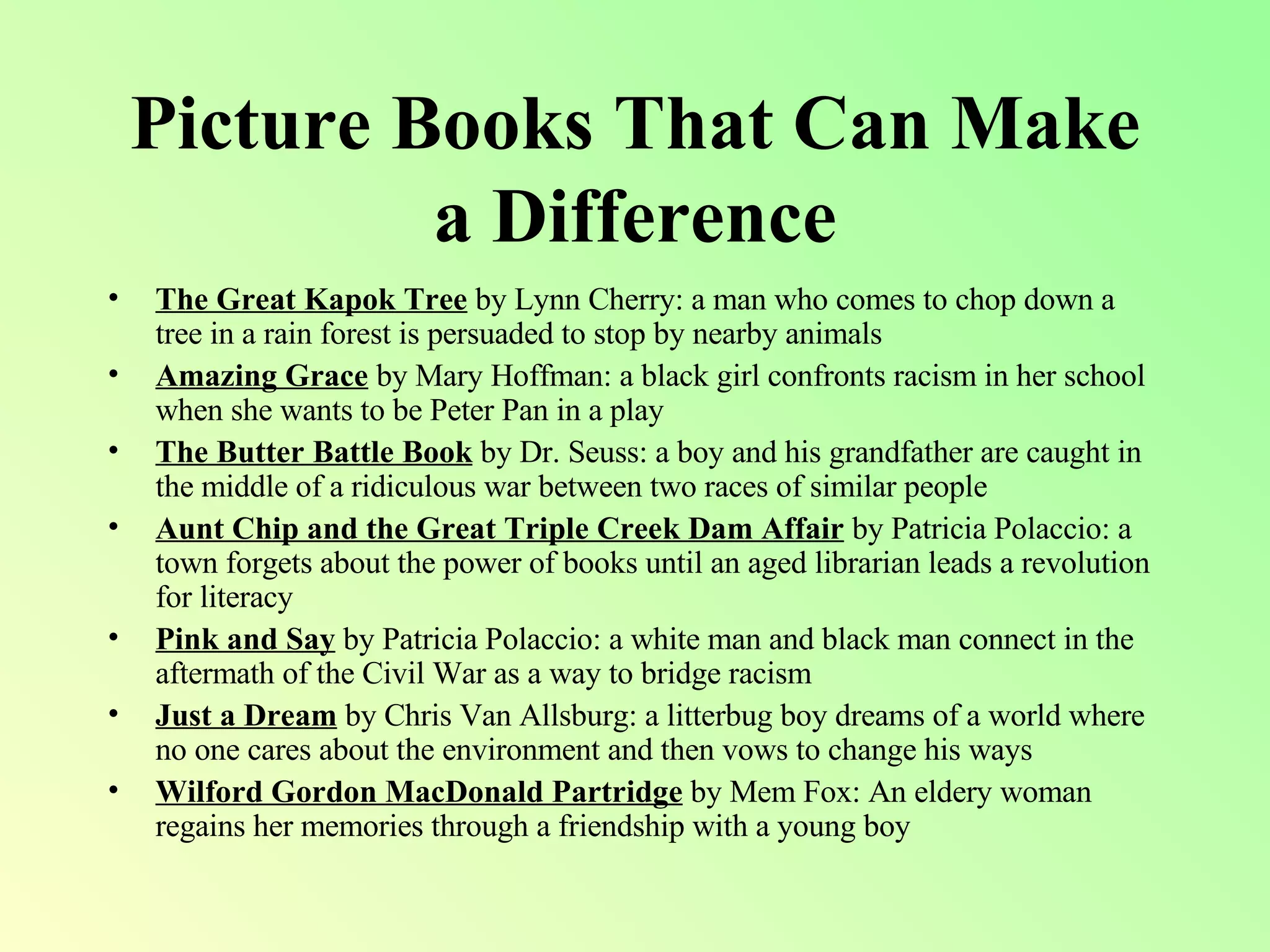
Picture Books That Can Make a Difference The Great Kapok Tree  by Lynn Cherry: a man who comes to chop down a tree in a rain forest is persuaded to stop by nearby animals Amazing Grace  by Mary Hoffman: a black girl confronts racism in her school when she wants to be Peter Pan in a play The Butter Battle Book  by Dr. Seuss: a boy and his grandfather are caught in the middle of a ridiculous war between two races of similar people Aunt Chip and the Great Triple Creek Dam Affair  by Patricia Polaccio: a town forgets about the power of books until an aged librarian leads a revolution for literacy Pink and Say  by Patricia Polaccio: a white man and black man connect in the aftermath of the Civil War as a way to bridge racism Just a Dream  by Chris Van Allsburg: a litterbug boy dreams of a world where no one cares about the environment and then vows to change his ways Wilford Gordon MacDonald Partridge  by Mem Fox: An eldery woman regains her memories through a friendship with a young boy
Quotes from the “Experts” “ The present generation of students has come of age surrounded by visual stimuli. They regularly watch television, play video games and use computers with increasingly sophisticated graphics. Picture books are a natural for them  …”   – Robin Henry and Carol Simpson, in  Teaching Librarian  journal. “ It is our contention that picture story books are more complex, challenging and provocative than is often thought to be the case.”   - William Owens and Linda Nowell, in  Social Studies  journal.  “ I search for stories that speak to difficult issues children face in today’s world: issues of war and peace, of sickness and poverty, of cultural diversity, of new family patterns, of homelessness and helplessness.”  – Maureen M. Miletta, in  In The Classroom  journal.
Thank You!  Have a Great Summer

The Power of Picture Books

  • 1.
    Integrating picture booksinto an upper-elementary school classroom By Kevin H. Summer Writing Institute - 2003 The Power of Picture Books
  • 2.
    Maurice Sendak says: “ The Picture book is a picture puzzle, badly misunderstood by its critics and condescended to by far too many as merely a trifle for ‘the kiddies’.”
  • 3.
    Some misconceptions aboutpicture books Only for young children Not written by ‘real authors” Pictures, not writing, are most important element No deep thematic value
  • 4.
    Why Use PictureBooks? Visually- stimulating Connects with children (and adults) of all ages Variety in genre of writing – fiction/non-fiction/poetry Reader-listener interactivity Important themes and lessons Character development Connections across the curriculum Reading-writing relationships Language acquisition tool for ESL students
  • 5.
    How Can YouUse Picture Books in Writing Class ? Journal responses Writing from a different perspective/point of view Author study Genre study Putting words to wordless books Writing own picture books Study of important issues raised Reader’s theater Study and use literary devices: alliteration, imagery, figurative language, etc Writing for a specific audience
  • 6.
    Using Picture BooksAcross the Curriculum In Art : study examples of different media and techniques; investigate relationship of text and pictures; view innovative art styles In Math/Science : introduce new concepts; explore complex ideas; provide visual connections to field of study In Social Science : raise social consciousness; investigate other world cultures; examine power struggles and human condition; seek ways to make a difference
  • 7.
    Picture Books ThatCan Make a Difference The Great Kapok Tree by Lynn Cherry: a man who comes to chop down a tree in a rain forest is persuaded to stop by nearby animals Amazing Grace by Mary Hoffman: a black girl confronts racism in her school when she wants to be Peter Pan in a play The Butter Battle Book by Dr. Seuss: a boy and his grandfather are caught in the middle of a ridiculous war between two races of similar people Aunt Chip and the Great Triple Creek Dam Affair by Patricia Polaccio: a town forgets about the power of books until an aged librarian leads a revolution for literacy Pink and Say by Patricia Polaccio: a white man and black man connect in the aftermath of the Civil War as a way to bridge racism Just a Dream by Chris Van Allsburg: a litterbug boy dreams of a world where no one cares about the environment and then vows to change his ways Wilford Gordon MacDonald Partridge by Mem Fox: An eldery woman regains her memories through a friendship with a young boy
  • 8.
    Quotes from the“Experts” “ The present generation of students has come of age surrounded by visual stimuli. They regularly watch television, play video games and use computers with increasingly sophisticated graphics. Picture books are a natural for them …” – Robin Henry and Carol Simpson, in Teaching Librarian journal. “ It is our contention that picture story books are more complex, challenging and provocative than is often thought to be the case.” - William Owens and Linda Nowell, in Social Studies journal. “ I search for stories that speak to difficult issues children face in today’s world: issues of war and peace, of sickness and poverty, of cultural diversity, of new family patterns, of homelessness and helplessness.” – Maureen M. Miletta, in In The Classroom journal.
  • 9.
    Thank You! Have a Great Summer