North Strabane Intermediate School
                 Room 209 and 207
Matter and Elements
Matter                            Elements
 Anything that has mass and       Make up all matter in the
  takes up space                      world
 Describes physical substances      Can be solids, liquids, or
  around us                           gases
 Is made up of elements             Sometimes they mix together
                                      physically
                                     Can be chemically combined
                                     Are made of atoms
Atoms
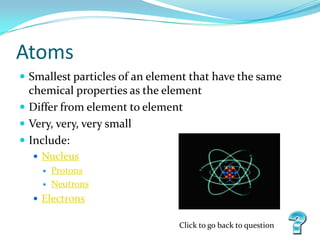
 Smallest particles of an element that have the same
  chemical properties as the element
 Differ from element to element
 Very, very, very small
 Include:
   Nucleus
       Protons
       Neutrons
   Electrons

                                Click to go back to question
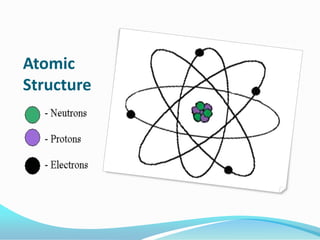
Atomic
Structure
Click for a hint   Check Answer
The Periodic Table of Elements
 Most useful tool for a chemist
 Created by Dmitry Mendeleyev
 Organized in rows by increasing atomic number (has
  periods and families)
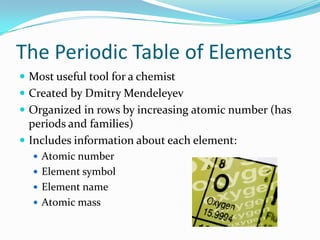
 Includes information about each element:
   Atomic number
   Element symbol
   Element name
   Atomic mass
Periods
 Each row is called a period
 Atomic number increases from left to right across a
  row
 Periods get wider as you move down the table
 The first period has only 2 elements (Hydrogen and
  Helium)
 There are 7 periods
Families
 Columns are grouped
  into families (sometimes
  called groups)
 Elements in the same
  group have similar
  properties
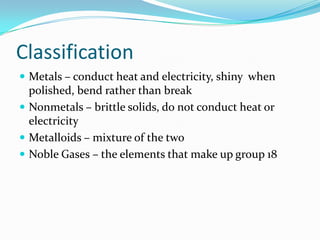
Classification
 Metals – conduct heat and electricity, shiny when
  polished, bend rather than break
 Nonmetals – brittle solids, do not conduct heat or
  electricity
 Metalloids – mixture of the two
 Noble Gases – the elements that make up group 18
Questions


  Click here to view the
Periodic Table of Elements   Check Answer
Questions


  Click here to view the
Periodic Table of Elements   Check Answer
Follow the directions to create your Acrostic Poem

The Periodic Table of Elements

  • 1.
    North Strabane IntermediateSchool Room 209 and 207
  • 2.
    Matter and Elements Matter Elements  Anything that has mass and  Make up all matter in the takes up space world  Describes physical substances  Can be solids, liquids, or around us gases  Is made up of elements  Sometimes they mix together physically  Can be chemically combined  Are made of atoms
  • 3.
    Atoms  Smallest particlesof an element that have the same chemical properties as the element  Differ from element to element  Very, very, very small  Include:  Nucleus  Protons  Neutrons  Electrons Click to go back to question
  • 4.
  • 5.
    Click for ahint Check Answer
  • 6.
    The Periodic Tableof Elements  Most useful tool for a chemist  Created by Dmitry Mendeleyev  Organized in rows by increasing atomic number (has periods and families)  Includes information about each element:  Atomic number  Element symbol  Element name  Atomic mass
  • 7.
    Periods  Each rowis called a period  Atomic number increases from left to right across a row  Periods get wider as you move down the table  The first period has only 2 elements (Hydrogen and Helium)  There are 7 periods
  • 8.
    Families  Columns aregrouped into families (sometimes called groups)  Elements in the same group have similar properties
  • 9.
    Classification  Metals –conduct heat and electricity, shiny when polished, bend rather than break  Nonmetals – brittle solids, do not conduct heat or electricity  Metalloids – mixture of the two  Noble Gases – the elements that make up group 18
  • 10.
    Questions Clickhere to view the Periodic Table of Elements Check Answer
  • 11.
    Questions Clickhere to view the Periodic Table of Elements Check Answer
  • 12.
    Follow the directionsto create your Acrostic Poem