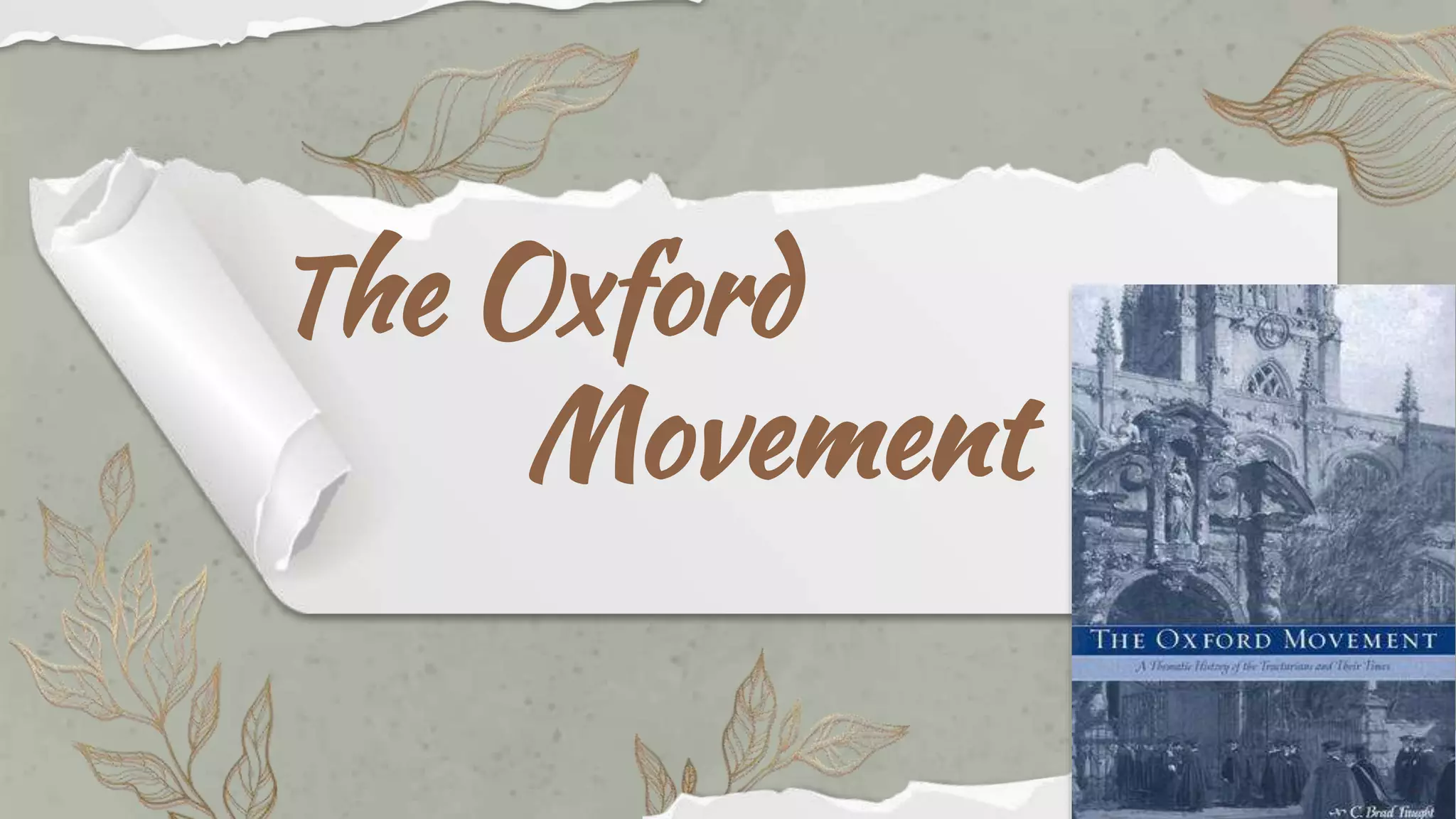
The Oxford
Movement
Name: Nirali Dabhi
Roll number: 15
Enrollment Number: 4069206420220006
Sem: 1 M.A
Paper Code Number: 22396
Paper number: 105
Paper Name: History of English Literature
Topic: The Oxford Movement
Submitted to: Smt S.B. Gardi, Department of English, M.K.B.U
Email: niralidabhi95@gmail.com
Table of Points
1. What is Oxford Movement?...
2. Leaders of this Movement
3. The high Church Background
4. The Religious Context
5. The Tractarians and History
6. Political Context
What is Oxford Movement?...
● 1833-1945
● Oxford of the 19th century was a fertile source of
both aesthetic and religious movements, out of
which the Oxford Movement emerged as the one
having the largest impact on all subsequent
intellectual formations, be they theological or
aesthetic, of the 19th century Oxford and Britain at
large.
● Oxford movement, 19th-century movement centred
at the University of Oxford that sought a renewal of
“catholic,” or Roman Catholic, thought and practice
within the Church of England in opposition to the
Protestant tendencies of the church.
● The argument was that the Anglican church was by
history and identity a truly “catholic”
church.(Starcevic)
● Laws that required members of municipal corporations and
government-office holders to receive the Lord’s Supper in the
Church of England were repealed, and a laws that required
members of municipal corporations and government-office
holders to receive the Lord’s Supper in the Church of England
were repealed, and a law was passed that removed most of the
restrictions formerly imposed on Roman Catholicsaw was passed
that removed most of the restrictions formerly imposed on
Roman Catholics.
● I Including that the Oxford Movement was a Movement that took
the English Church into Roman Catholicism.
● Leaders of the movement were John
Henry Newman (1801–90), a clergyman
and subsequently a convert to Roman
Catholicism and a cardinal; Richard
Hurrell Froude (1803–36), a clergyman;
John Keble (1792–1866), a clergyman
and poet; and Edward Pusey (1800–82),
a clergyman and professor at Oxford.
Leaders of the Movement
● The High Church tradition has its origins in
Richard Hooker and Lancelot Andrewes at the
end of the sixteenth and the beginning of the
seventeenth centuries, was daringly exhibited
by Queen Elizabeth i in her private chapel,
and flourished in the prolific writings of the
Caroline divines of the seventeenth century
those who served in the reigns of Charles i
and Charles ii and their successors in the
eighteenth.
● Government was both the champion and the
stewards of the political reforms and sought
to harness the new Middle Classes into a
frame of economic growth that had otherwise
been unknown in Britain.(Hitching)
The High Church Background
The Religious Context
● The religious context in the run up to the 1830’s
was highly complex.
● There was a universal sense of the populace
being in Spiritual exile being coupled to the
almost predictable sense of the apocalyptic that
the Napoleonic wars had created.
● The core concept being that belief as well as
practice should not dominate the life of the
Church and that what was required was to allow
the science of the age to assist the Church in an
ever-expanding view of Church, life and society.
● It is the term indifferentism that capture the life
of the English Church in the early 19th century.
—Liddon
“Thus he evoked in the Tractarian writers that
reasoned and sensitive resistance to even
incipient Rationalism which characterized all
their writings. Of Blanco White's positive
influence, it is not too much to say that he is the
real founder of the modern Latitudinarian
school in the English Church. Whately and
Hampden were in different senses his.”
John Henry Newman
Name: John Henry Newman
● Newman wrote a powerful
exposition of the principles of the
movement,work a called The
Prophetic office of the
church.(Ramsey)
● Newman was able to turn these
● associative moments into some of
the most cherished English poems
of that period.
● The Movement’s central concept
denied by Newman as the Via
Media (“the middle path”).(Starcevic)
It is that period, J.H. Newman
says, that testifies to…
“what that faith is, which was
once delivered to the saints, the
faith that will always remain in
the world, and which is the
treasure and the life of the
Church, the condition for
membership of the Church and
normative of its teaching”
The Tractarians and History
● This Movement also known as Tractarianism.
● Newman, Keble and Pusey were men of their
time and that consequently a method of
biblical study unenlightened by historical-
critical insights was all that they could have
been expected to know.
● These Broad Churchmen Dean of St Paul’s
Cathedral and the renegade Tractarian and
eventual agnostic Mark Pattison were also
accomplished critical historians though no
less ideological of course, which the
Tractarians did not attempt or wish to be.
Which brings me to a further point to which
the Handbook could have done better justice.
Political Context
● choosing “National Apostasy” as a starting
point may be historically convenient; it
does provide a specific point of reference,
much as the publication of Lyrical Ballads
did for English Romanticism and the “shot
heard round the world” did for the
American Revolution.It is not rhetorically
accurate, however, for the sermon did not
call for the audience to embrace any
theological or political agenda. In fact,
Keble warned his audience that “Public
concerns, ecclesiastical or civil, will prove
ruinous indeed to those, who permit them
to occupy all their care and thoughts.”(Ellison)
Work Cited
● Avis, Paul. “Towards a Richer Appreciation of the Oxford
Movement.” 2020,
https://brill.com/view/journals/ecso/16/2/article-
p243_243.xml?language=en. Accessed 18 October 2022.
● Bexell, Oloph. The Oxford Movement and the early High Church
spirituality in Sweden, 2019,
https://www.tandfonline.com/doi/full/10.1080/1474225X.2018.154
7538. Accessed 18 October 2022.
● Ellison, Robert. “The Tractarians Political Rhetoric.” 2008,
https://mds.marshall.edu/cgi/viewcontent.cgi?article=1001&con
text=english_faculty. Accessed 19 October 2022.
● Hitching, Bob. “(PDF) Oxford Movement An Overview.pdf |
Bob Hitching.” Academia.edu, 2017,
https://www.academia.edu/34549328/Oxford_Movement_An_O
verview_pdf. Accessed 18 October 2022.
● Ramsey, Arthur Michael. “John Henry Newman and the Oxford
Movement.” 1990, http://www.jstor.org/stable/42610425.
Accessed 18 October 2022.
● Starcevic, Mirko. “John Henry Newman and the Oxford
Movement: A Poet of the Church.” 2015,
https://www.researchgate.net/publication/288871931_John_He
nry_Newman_and_the_Oxford_Movement_A_Poet_of_the_Ch
urch. Accessed 19 October 2022.
Work Cited
Thank you

The Oxford MOvement

  • 1.
  • 2.
    Name: Nirali Dabhi Rollnumber: 15 Enrollment Number: 4069206420220006 Sem: 1 M.A Paper Code Number: 22396 Paper number: 105 Paper Name: History of English Literature Topic: The Oxford Movement Submitted to: Smt S.B. Gardi, Department of English, M.K.B.U Email: niralidabhi95@gmail.com
  • 3.
    Table of Points 1.What is Oxford Movement?... 2. Leaders of this Movement 3. The high Church Background 4. The Religious Context 5. The Tractarians and History 6. Political Context
  • 4.
    What is OxfordMovement?... ● 1833-1945 ● Oxford of the 19th century was a fertile source of both aesthetic and religious movements, out of which the Oxford Movement emerged as the one having the largest impact on all subsequent intellectual formations, be they theological or aesthetic, of the 19th century Oxford and Britain at large. ● Oxford movement, 19th-century movement centred at the University of Oxford that sought a renewal of “catholic,” or Roman Catholic, thought and practice within the Church of England in opposition to the Protestant tendencies of the church. ● The argument was that the Anglican church was by history and identity a truly “catholic” church.(Starcevic)
  • 5.
    ● Laws thatrequired members of municipal corporations and government-office holders to receive the Lord’s Supper in the Church of England were repealed, and a laws that required members of municipal corporations and government-office holders to receive the Lord’s Supper in the Church of England were repealed, and a law was passed that removed most of the restrictions formerly imposed on Roman Catholicsaw was passed that removed most of the restrictions formerly imposed on Roman Catholics. ● I Including that the Oxford Movement was a Movement that took the English Church into Roman Catholicism.
  • 6.
    ● Leaders ofthe movement were John Henry Newman (1801–90), a clergyman and subsequently a convert to Roman Catholicism and a cardinal; Richard Hurrell Froude (1803–36), a clergyman; John Keble (1792–1866), a clergyman and poet; and Edward Pusey (1800–82), a clergyman and professor at Oxford. Leaders of the Movement
  • 7.
    ● The HighChurch tradition has its origins in Richard Hooker and Lancelot Andrewes at the end of the sixteenth and the beginning of the seventeenth centuries, was daringly exhibited by Queen Elizabeth i in her private chapel, and flourished in the prolific writings of the Caroline divines of the seventeenth century those who served in the reigns of Charles i and Charles ii and their successors in the eighteenth. ● Government was both the champion and the stewards of the political reforms and sought to harness the new Middle Classes into a frame of economic growth that had otherwise been unknown in Britain.(Hitching) The High Church Background
  • 8.
    The Religious Context ●The religious context in the run up to the 1830’s was highly complex. ● There was a universal sense of the populace being in Spiritual exile being coupled to the almost predictable sense of the apocalyptic that the Napoleonic wars had created. ● The core concept being that belief as well as practice should not dominate the life of the Church and that what was required was to allow the science of the age to assist the Church in an ever-expanding view of Church, life and society. ● It is the term indifferentism that capture the life of the English Church in the early 19th century.
  • 9.
    —Liddon “Thus he evokedin the Tractarian writers that reasoned and sensitive resistance to even incipient Rationalism which characterized all their writings. Of Blanco White's positive influence, it is not too much to say that he is the real founder of the modern Latitudinarian school in the English Church. Whately and Hampden were in different senses his.”
  • 10.
    John Henry Newman Name:John Henry Newman ● Newman wrote a powerful exposition of the principles of the movement,work a called The Prophetic office of the church.(Ramsey) ● Newman was able to turn these ● associative moments into some of the most cherished English poems of that period. ● The Movement’s central concept denied by Newman as the Via Media (“the middle path”).(Starcevic)
  • 11.
    It is thatperiod, J.H. Newman says, that testifies to… “what that faith is, which was once delivered to the saints, the faith that will always remain in the world, and which is the treasure and the life of the Church, the condition for membership of the Church and normative of its teaching”
  • 12.
    The Tractarians andHistory ● This Movement also known as Tractarianism. ● Newman, Keble and Pusey were men of their time and that consequently a method of biblical study unenlightened by historical- critical insights was all that they could have been expected to know. ● These Broad Churchmen Dean of St Paul’s Cathedral and the renegade Tractarian and eventual agnostic Mark Pattison were also accomplished critical historians though no less ideological of course, which the Tractarians did not attempt or wish to be. Which brings me to a further point to which the Handbook could have done better justice.
  • 13.
    Political Context ● choosing“National Apostasy” as a starting point may be historically convenient; it does provide a specific point of reference, much as the publication of Lyrical Ballads did for English Romanticism and the “shot heard round the world” did for the American Revolution.It is not rhetorically accurate, however, for the sermon did not call for the audience to embrace any theological or political agenda. In fact, Keble warned his audience that “Public concerns, ecclesiastical or civil, will prove ruinous indeed to those, who permit them to occupy all their care and thoughts.”(Ellison)
  • 14.
    Work Cited ● Avis,Paul. “Towards a Richer Appreciation of the Oxford Movement.” 2020, https://brill.com/view/journals/ecso/16/2/article- p243_243.xml?language=en. Accessed 18 October 2022. ● Bexell, Oloph. The Oxford Movement and the early High Church spirituality in Sweden, 2019, https://www.tandfonline.com/doi/full/10.1080/1474225X.2018.154 7538. Accessed 18 October 2022. ● Ellison, Robert. “The Tractarians Political Rhetoric.” 2008, https://mds.marshall.edu/cgi/viewcontent.cgi?article=1001&con text=english_faculty. Accessed 19 October 2022.
  • 15.
    ● Hitching, Bob.“(PDF) Oxford Movement An Overview.pdf | Bob Hitching.” Academia.edu, 2017, https://www.academia.edu/34549328/Oxford_Movement_An_O verview_pdf. Accessed 18 October 2022. ● Ramsey, Arthur Michael. “John Henry Newman and the Oxford Movement.” 1990, http://www.jstor.org/stable/42610425. Accessed 18 October 2022. ● Starcevic, Mirko. “John Henry Newman and the Oxford Movement: A Poet of the Church.” 2015, https://www.researchgate.net/publication/288871931_John_He nry_Newman_and_the_Oxford_Movement_A_Poet_of_the_Ch urch. Accessed 19 October 2022. Work Cited
  • 16.