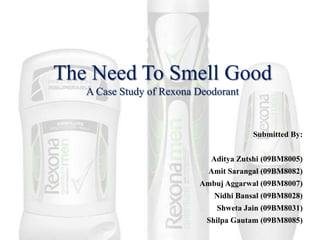
The Need To Smell GoodA Case Study of Rexona DeodorantSubmitted By:Aditya Zutshi (09BM8005)Amit Sarangal (09BM8082)Ambuj Aggarwal (09BM8007)Nidhi Bansal (09BM8028)Shweta Jain (09BM8031)Shilpa Gautam (09BM8085)
IntroductionIn mid 1990s HLL decided to create market for deodorant with “ Rexona” BrandEarlier existing brands Copper for men and Fa for women were merely focusing on customers how knew difference between perfumer and deodorantMajority of target population (90%) was in unawareness stageHLL adopted strategy to educate customer by marketing campaigns showing body odour is a problemIncreased trail ability by introducing Rs20 and Rs5 sticksAdvertisements were based upon “acceptance-rejection” theme and communicated its nothing to be ashamed of – “Shilpa Aunty” ad.New Ads focused on body-appeal confidence conceptMajor competitors is talcum and soapsTargeted “Magic Age” i.e. young population as target segment.
Q1: What aspects of Consumer Behavior has been discussed in this case?Acquired/Secondary/Psychogenic Needs:
These are needs that arise as a result of an individual’s psychological state and his/her interactions with other and motivate a consumer to buy a product.
India is a high perspiration country and with high body odour sensibility. Therefore, the deodorant market became of 1000 tonnes by the end of the millennium.
Marketers Trigger Consumer Motives
Inducing Need Recognition: Marketer steers the consumer from an actual state to a desired state.
Need Benefit Segmentation: Marketers can emphasize benefits that satisfy recognizable needs.
Triggering Sub-conscious Motivation: Many purchases reveal subconscious motivations.Trait Theory: Trait theories seek to classify individuals into group of people who share personality types. Based on consumer innovativeness and consumer susceptibility to interpersonal influence, HUL decided not to focus on the consumers above 40 years of age.
Attitude Formation & Change: A consumer with a positive attitude toward a product is more likely to buy that product. The advertisements and marketing communication done by HUL was targeted to induce a positive attitude towards using deodorants.
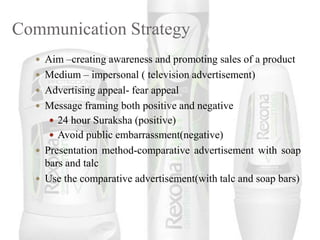
Communication Process: The marketing communication of a company is designed to induce purchase, create a positive attitude towards the product, to give the product a symbolic meaning and show that it can solve the consumer’s problem better than a competitive product.

The need to smell good

  • 1.
    The Need ToSmell GoodA Case Study of Rexona DeodorantSubmitted By:Aditya Zutshi (09BM8005)Amit Sarangal (09BM8082)Ambuj Aggarwal (09BM8007)Nidhi Bansal (09BM8028)Shweta Jain (09BM8031)Shilpa Gautam (09BM8085)
  • 2.
    IntroductionIn mid 1990sHLL decided to create market for deodorant with “ Rexona” BrandEarlier existing brands Copper for men and Fa for women were merely focusing on customers how knew difference between perfumer and deodorantMajority of target population (90%) was in unawareness stageHLL adopted strategy to educate customer by marketing campaigns showing body odour is a problemIncreased trail ability by introducing Rs20 and Rs5 sticksAdvertisements were based upon “acceptance-rejection” theme and communicated its nothing to be ashamed of – “Shilpa Aunty” ad.New Ads focused on body-appeal confidence conceptMajor competitors is talcum and soapsTargeted “Magic Age” i.e. young population as target segment.
  • 3.
    Q1: What aspectsof Consumer Behavior has been discussed in this case?Acquired/Secondary/Psychogenic Needs:
  • 4.
    These are needsthat arise as a result of an individual’s psychological state and his/her interactions with other and motivate a consumer to buy a product.
  • 5.
    India is ahigh perspiration country and with high body odour sensibility. Therefore, the deodorant market became of 1000 tonnes by the end of the millennium.
  • 6.
  • 7.
    Inducing Need Recognition:Marketer steers the consumer from an actual state to a desired state.
  • 8.
    Need Benefit Segmentation:Marketers can emphasize benefits that satisfy recognizable needs.
  • 9.
    Triggering Sub-conscious Motivation:Many purchases reveal subconscious motivations.Trait Theory: Trait theories seek to classify individuals into group of people who share personality types. Based on consumer innovativeness and consumer susceptibility to interpersonal influence, HUL decided not to focus on the consumers above 40 years of age.
  • 10.
    Attitude Formation &Change: A consumer with a positive attitude toward a product is more likely to buy that product. The advertisements and marketing communication done by HUL was targeted to induce a positive attitude towards using deodorants.
  • 11.
    Communication Process: Themarketing communication of a company is designed to induce purchase, create a positive attitude towards the product, to give the product a symbolic meaning and show that it can solve the consumer’s problem better than a competitive product.