THE PHILIPPINE
GOVERNMENT
BUDGETING
PROCESS
The Budget Process
 More than a system of procedures and structures
 Both a rigorous technical procedure and a dynamic
(and sometimes controversial) political process
 Reflects the close interplay of political and economic
factors and pressures.
 Who really holds the power of the purse?
Key Constitutional and Legal Provisions
on Budgeting
 The President has exclusive right to propose a
budget (Article VII, Sec. 22)
 Congress can only reduce or reallocate
appropriations in the proposed budget (Article VI,
Sec. 25)
 The President can use a line-item veto (Article VI,
Sec. 27)
 The previous year’s budget is automatically “re-
enacted” if the budget is not passed prior to the
start of the fiscal year (Article VI, Sec. 25)
Key Constitutional and Legal Provisions
on Budgeting
 The President can impose restrictions on the disbursement
of funds appropriated by Congress (Sec. 35, Ch. 5,
Book VI of EO 292)
 The President can augment any appropriations from
savings in other appropriations (Article VI, Sec. 25)
 Fiscal autonomy of the judiciary (Article VIII, Sec. 3),
Constitutional Commissions (Article IX, Sec. 5) and the
Office of the Ombudsman (Article XI, Sec. 14). Article
XIII, Sec. 17 provides that the appropriations for CHR
shall be automatically and regularly released.
The Budget Process: 4 Phases
Budget
Preparation
Budget
Legislation
Budget
Execution
Budget
Accountability
I. Budget Preparation
Budget Preparation Phase
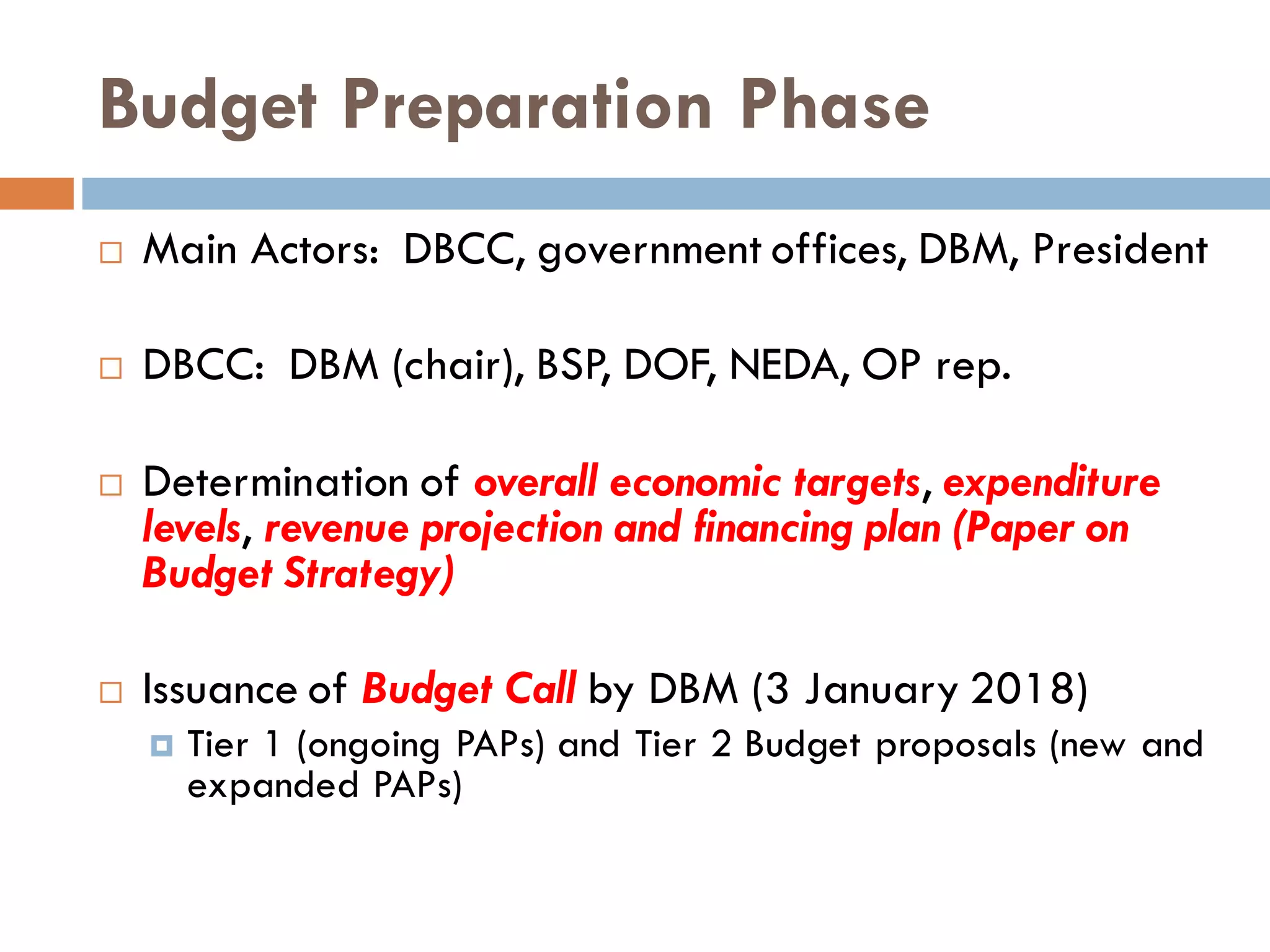
 Main Actors: DBCC, government offices, DBM, President
 DBCC: DBM (chair), BSP, DOF, NEDA, OP rep.
 Determination of overall economic targets, expenditure
levels, revenue projection and financing plan (Paper on
Budget Strategy)
 Issuance of Budget Call by DBM (3 January 2018)
 Tier 1 (ongoing PAPs) and Tier 2 Budget proposals (new and
expanded PAPs)
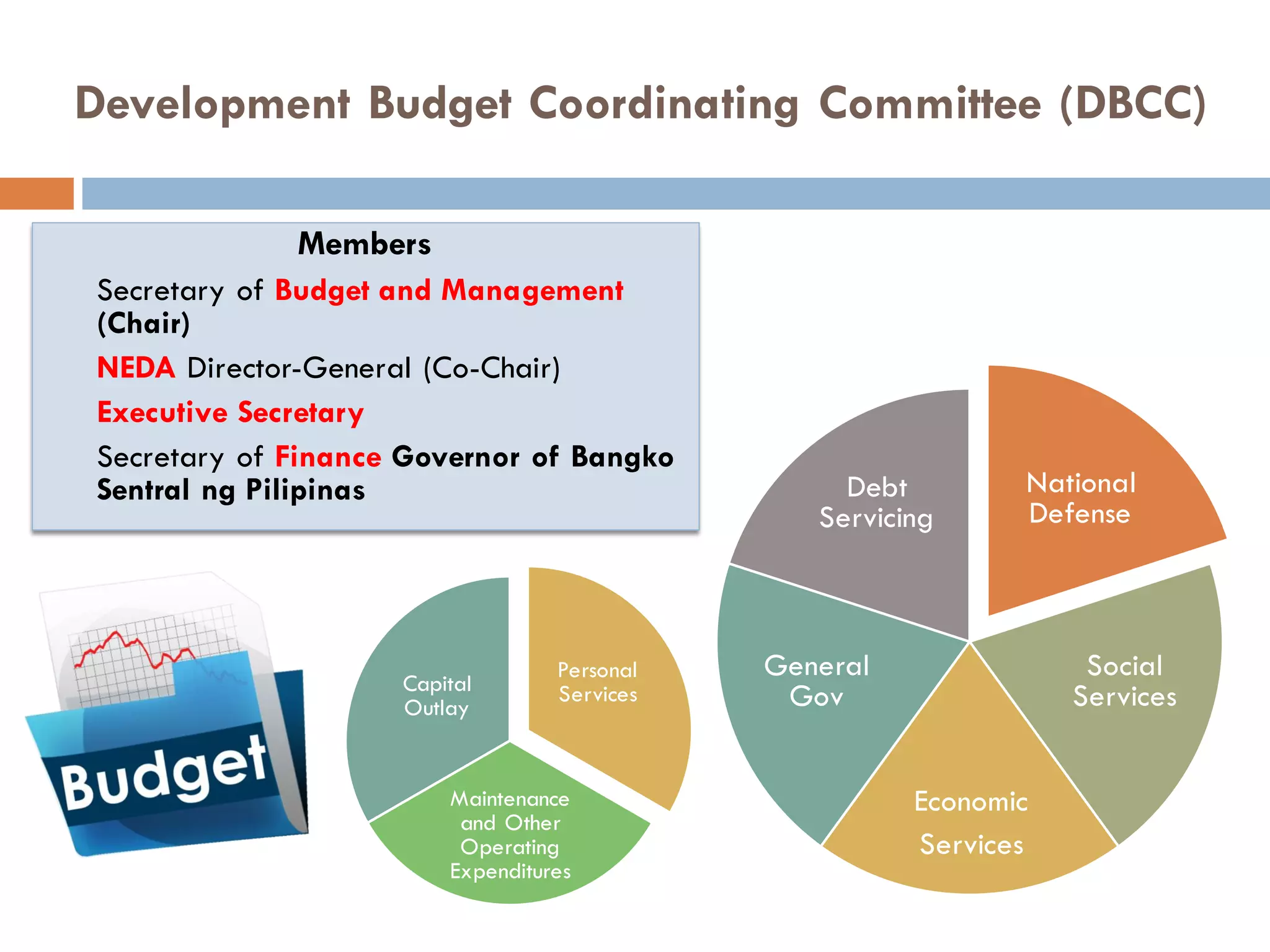
Development Budget Coordinating Committee (DBCC)
Members
Secretary of Budget and Management
(Chair)
NEDA Director-General (Co-Chair)
Executive Secretary
Secretary of Finance Governor of Bangko
Sentral ng Pilipinas National
Defense
Social
Services
Economic
Services
General
Gov
Debt
Servicing
Personal
Services
Maintenance
and Other
Operating
Expenditures
Capital
Outlay
Budget Preparation Phase
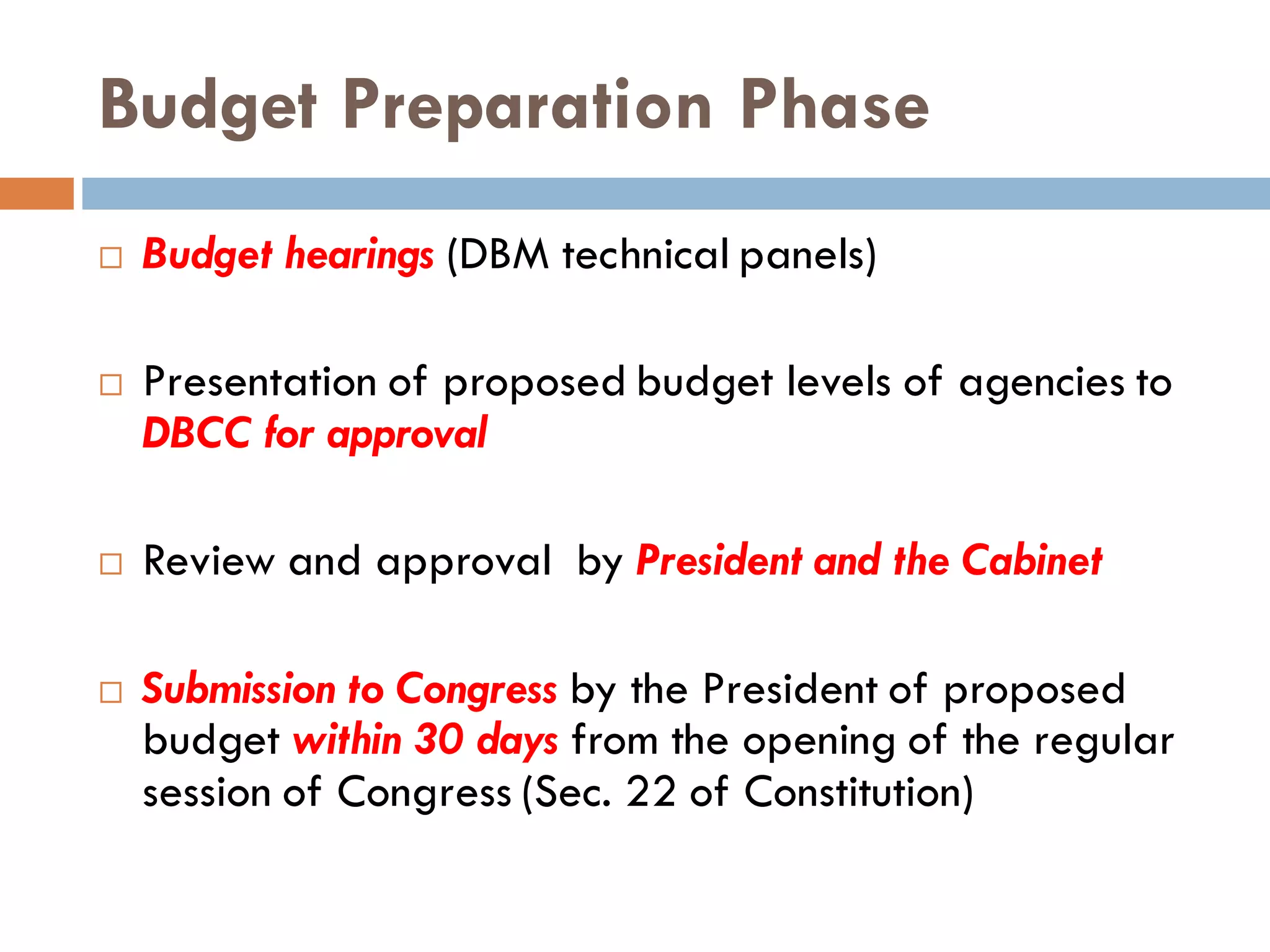
 Budget hearings (DBM technical panels)
 Presentation of proposed budget levels of agencies to
DBCC for approval
 Review and approval by President and the Cabinet
 Submission to Congress by the President of proposed
budget within 30 days from the opening of the regular
session of Congress (Sec. 22 of Constitution)
BUDGET AUTHORIZATION
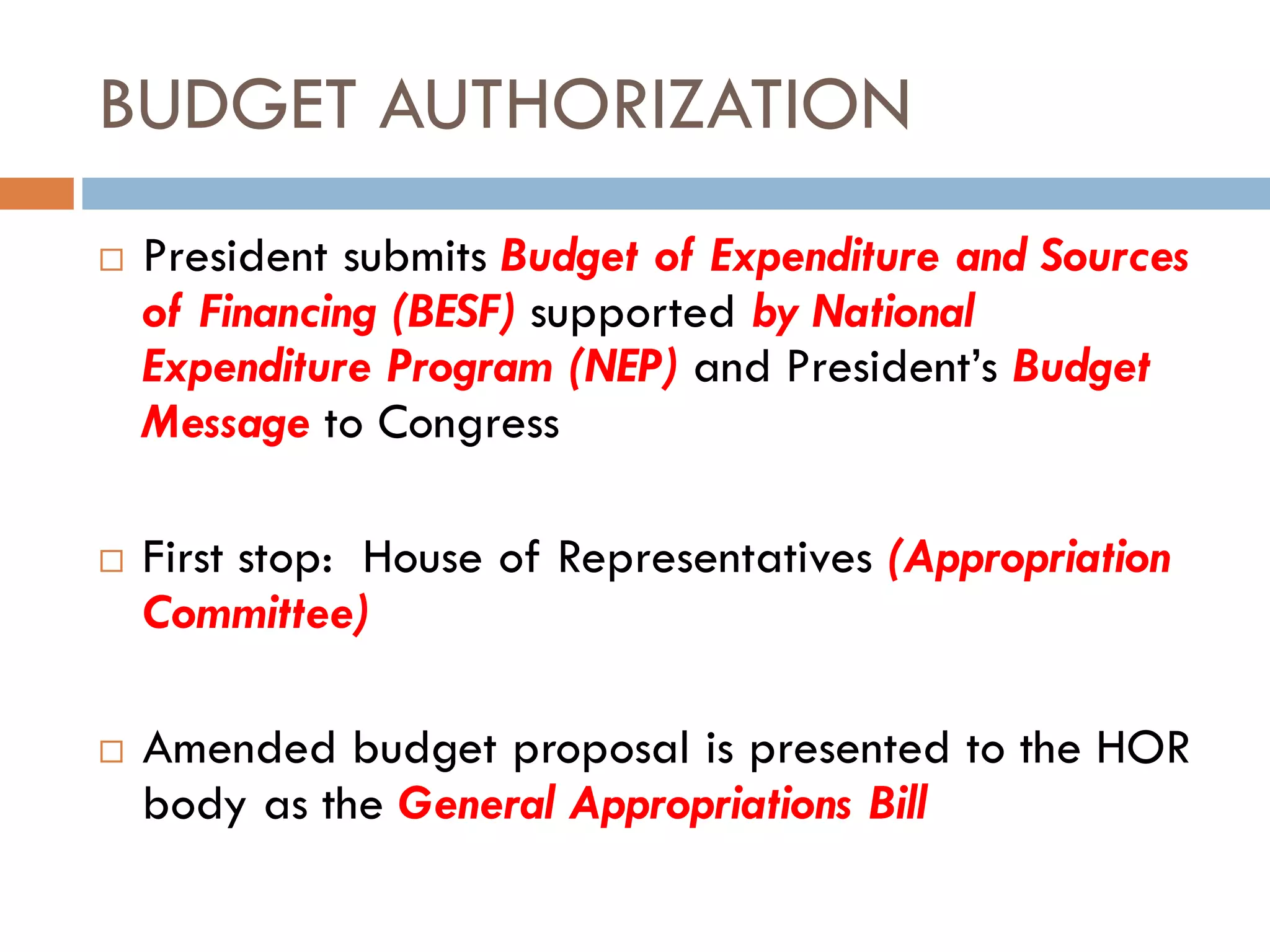
 President submits Budget of Expenditure and Sources
of Financing (BESF) supported by National
Expenditure Program (NEP) and President’s Budget
Message to Congress
 First stop: House of Representatives (Appropriation
Committee)
 Amended budget proposal is presented to the HOR
body as the General Appropriations Bill
BUDGET AUTHORIZATION
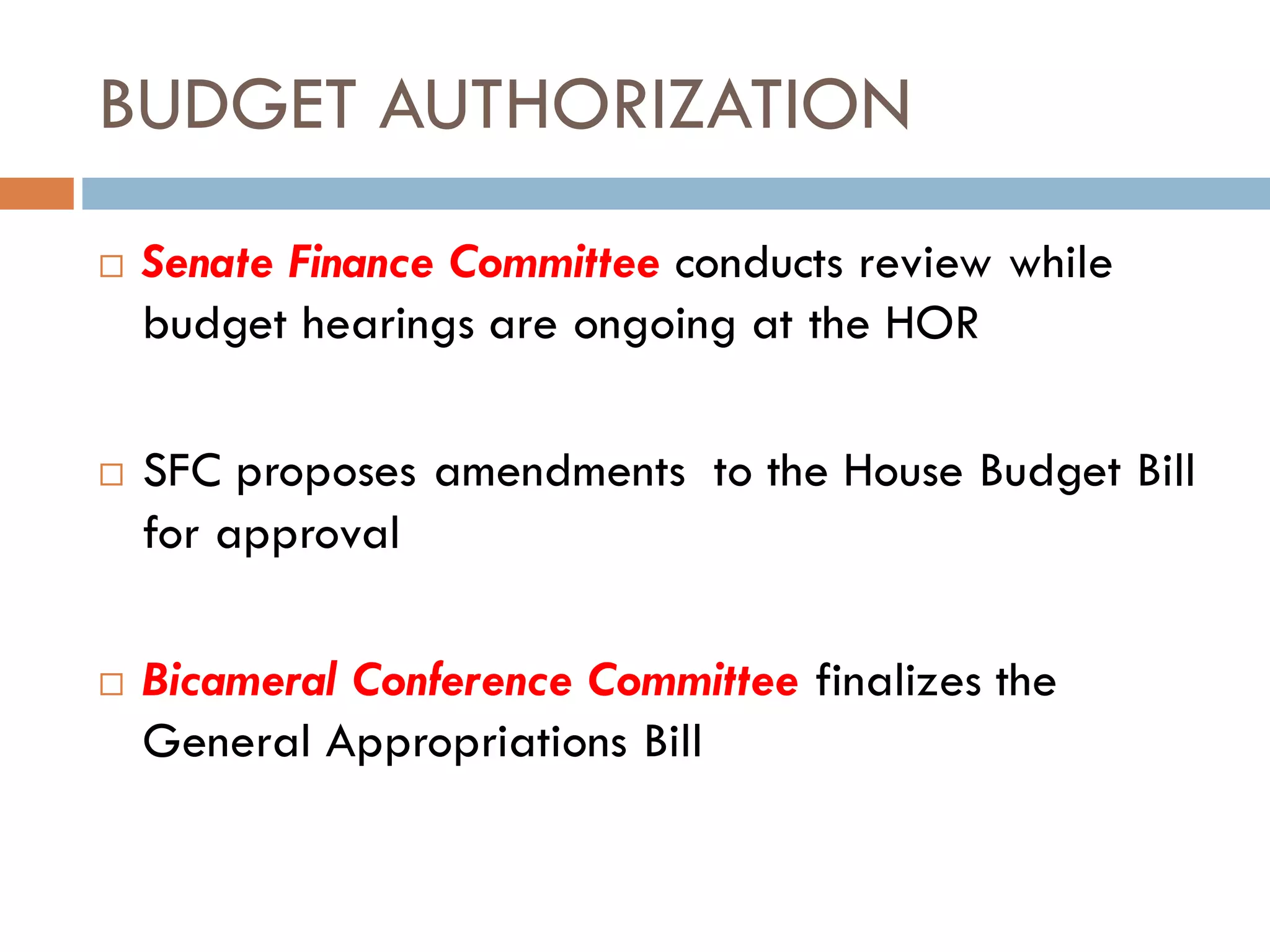
 Senate Finance Committee conducts review while
budget hearings are ongoing at the HOR
 SFC proposes amendments to the House Budget Bill
for approval
 Bicameral Conference Committee finalizes the
General Appropriations Bill
BUDGET AUTHORIZATION
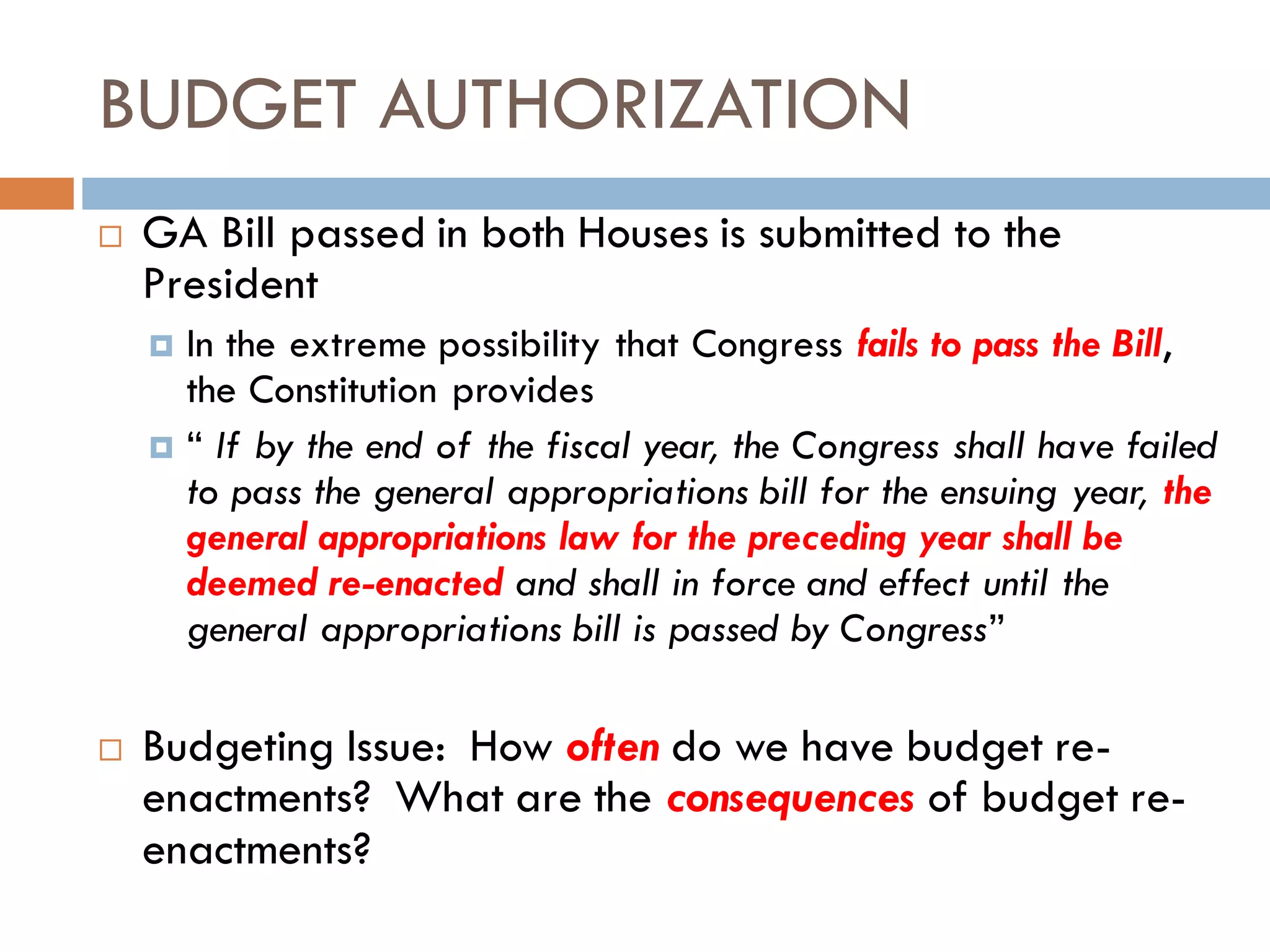
 GA Bill passed in both Houses is submitted to the
President
 In the extreme possibility that Congress fails to pass the Bill,
the Constitution provides
 “ If by the end of the fiscal year, the Congress shall have failed
to pass the general appropriations bill for the ensuing year, the
general appropriations law for the preceding year shall be
deemed re-enacted and shall in force and effect until the
general appropriations bill is passed by Congress”
 Budgeting Issue: How often do we have budget re-
enactments? What are the consequences of budget re-
enactments?
BUDGET AUTHORIZATION
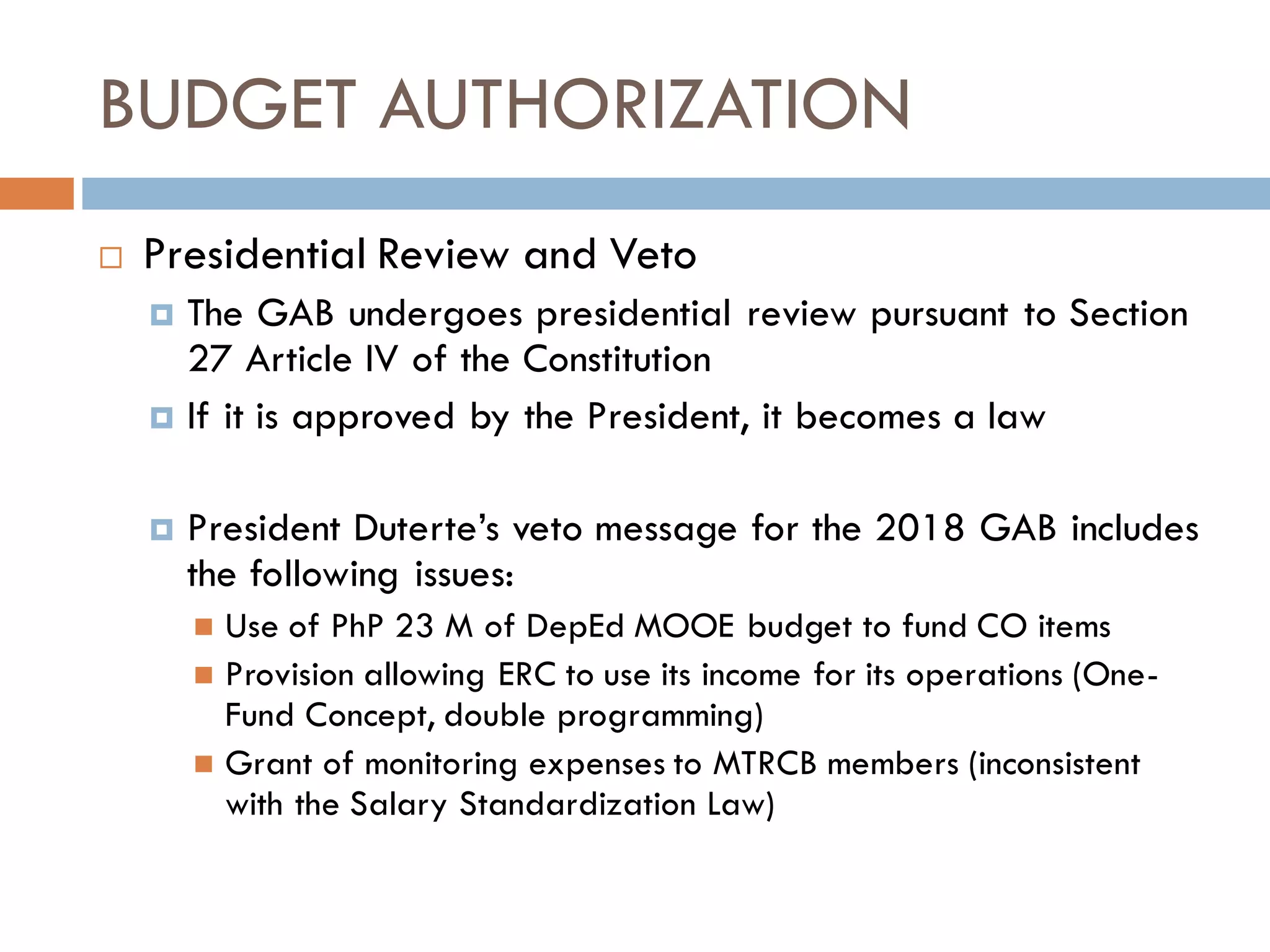
 Presidential Review and Veto
 The GAB undergoes presidential review pursuant to Section
27 Article IV of the Constitution
 If it is approved by the President, it becomes a law
 President Duterte’s veto message for the 2018 GAB includes
the following issues:
◼ Use of PhP 23 M of DepEd MOOE budget to fund CO items
◼ Provision allowing ERC to use its income for its operations (One-
Fund Concept, double programming)
◼ Grant of monitoring expenses to MTRCB members (inconsistent
with the Salary Standardization Law)
BUDGET AUTHORIZATION
 If the President chooses not to act on it, he is deemed to
have approved it after the lapse of 30 days.
 Otherwise, the President within the 30 day period must
veto the GAB or any item/s thereof by sending his veto
message to the House of Representatives
 Congress may override the veto by gathering 2/3 votes
in each House, in which case it becomes law against the
President’s will
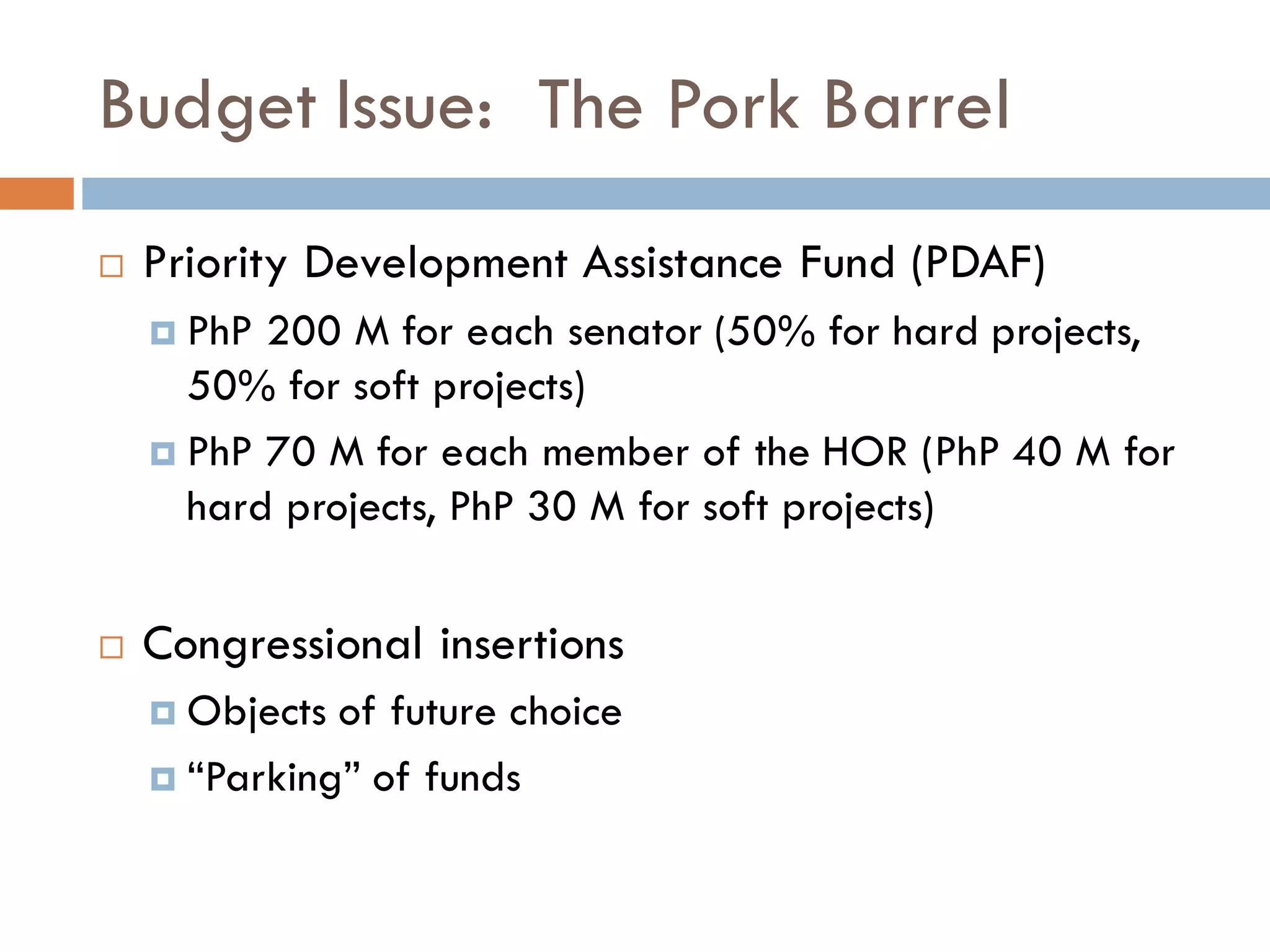
Budget Issue: The Pork Barrel
 Priority Development Assistance Fund (PDAF)
 PhP 200 M for each senator (50% for hard projects,
50% for soft projects)
 PhP 70 M for each member of the HOR (PhP 40 M for
hard projects, PhP 30 M for soft projects)
 Congressional insertions
 Objects of future choice
 “Parking” of funds
III. BUDGET EXECUTION &
IMPLEMENTATION
Additional Budget Concepts
 Continuing Appropriations
 Automatic Appropriations
 Special-Purpose Funds/ Lumpsum Appropriations
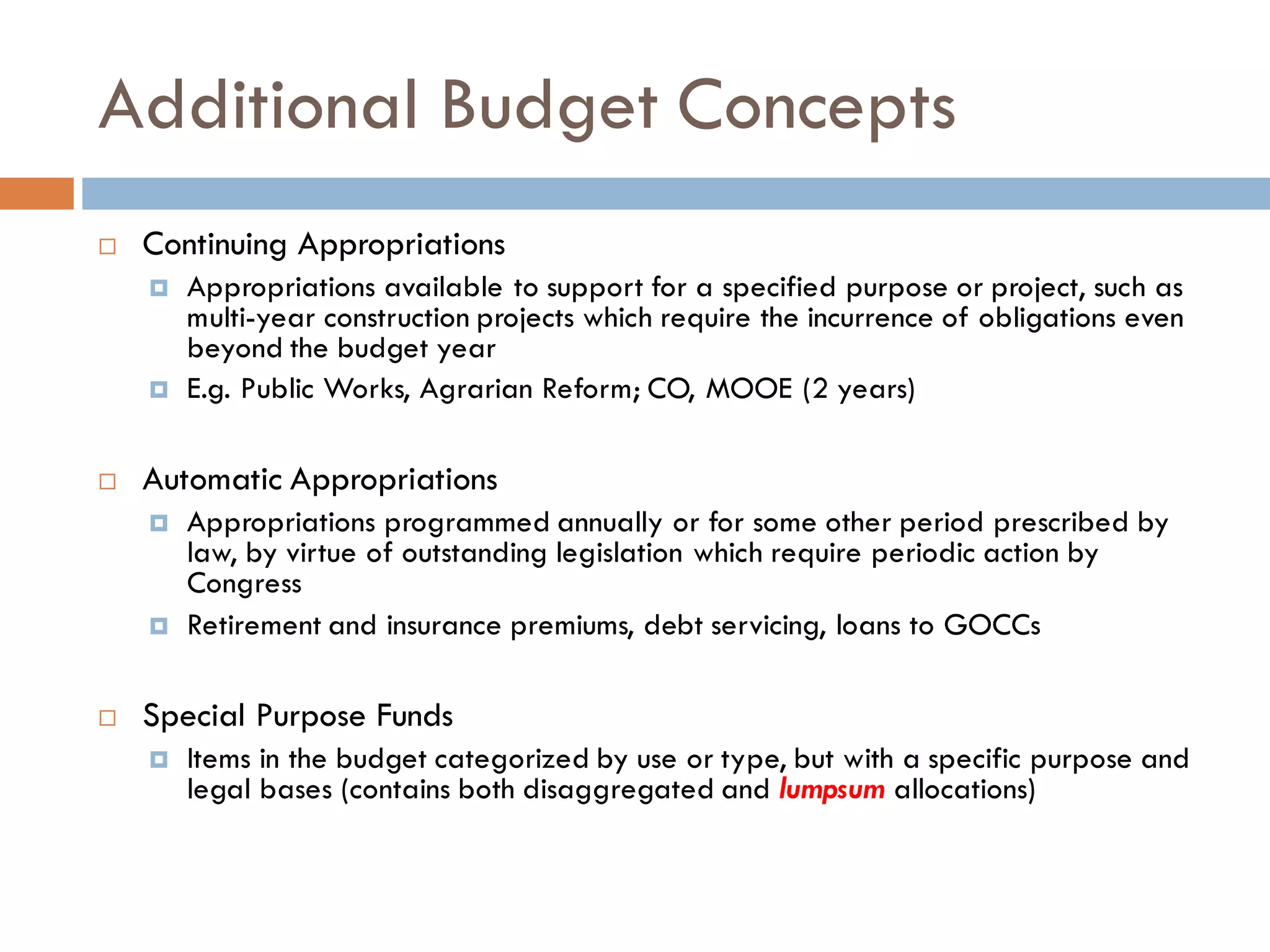
Additional Budget Concepts
 Continuing Appropriations
 Appropriations available to support for a specified purpose or project, such as
multi-year construction projects which require the incurrence of obligations even
beyond the budget year
 E.g. Public Works, Agrarian Reform; CO, MOOE (2 years)
 Automatic Appropriations
 Appropriations programmed annually or for some other period prescribed by
law, by virtue of outstanding legislation which require periodic action by
Congress
 Retirement and insurance premiums, debt servicing, loans to GOCCs
 Special Purpose Funds
 Items in the budget categorized by use or type, but with a specific purpose and
legal bases (contains both disaggregated and lumpsum allocations)
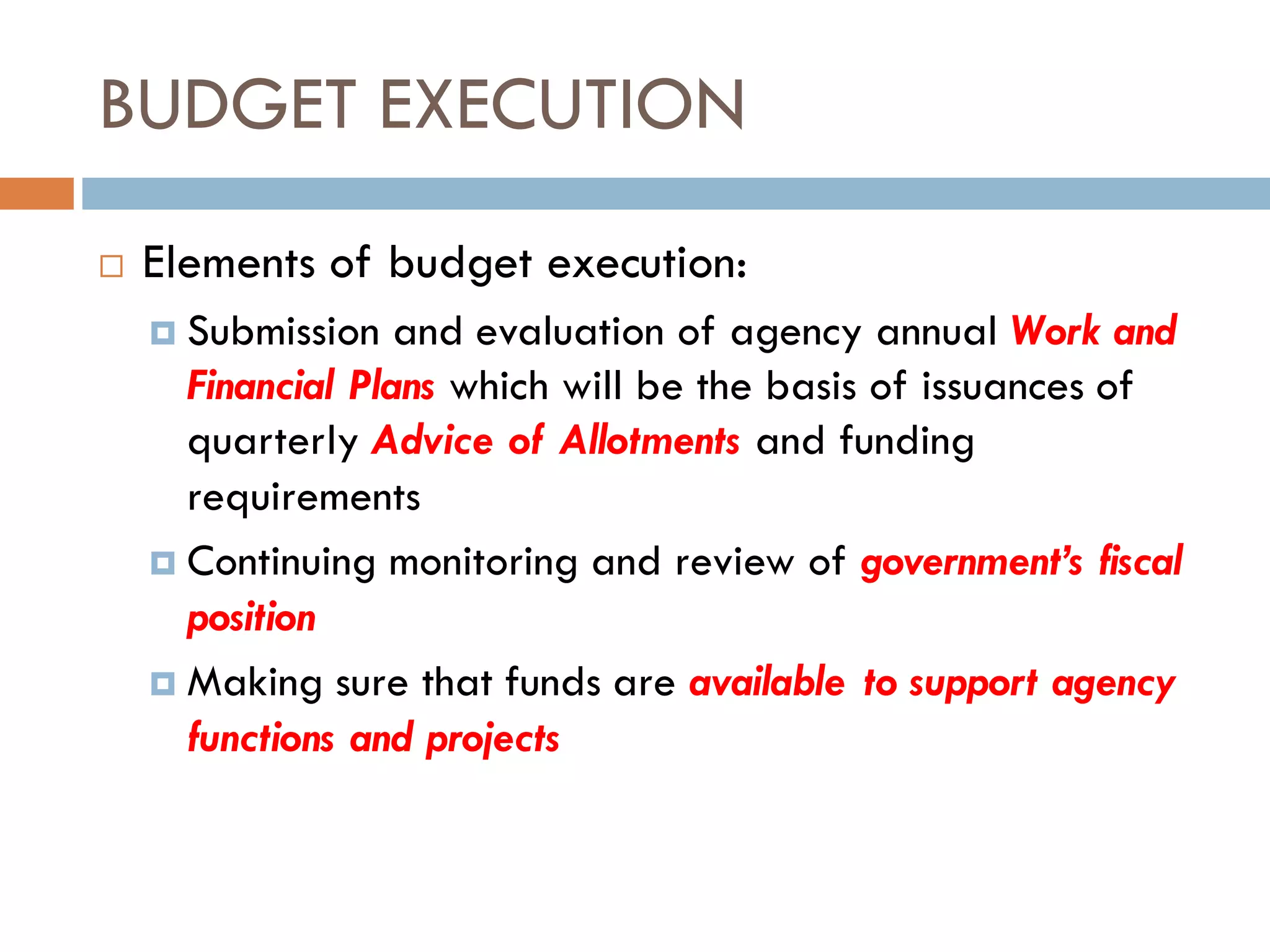
BUDGET EXECUTION
 Elements of budget execution:
 Submission and evaluation of agency annual Work and
Financial Plans which will be the basis of issuances of
quarterly Advice of Allotments and funding
requirements
 Continuing monitoring and review of government’s fiscal
position
 Making sure that funds are available to support agency
functions and projects
BUDGET EXECUTION
 Previous efforts to ensure the regular release of funds:
 Simplified Fund Release System (SFRS)
 adopted beginning 1995
 Standardized release of funds across agencies which are
similarly situated
 Agency Budget Matrix
 prepared by DBM in consultation with agencies at the
beginning of each budget year
 provides the basis for determining the timing, composition
and magnitude of the release of the budget
BUDGET EXECUTION
 Allotment Release Program
 considers updated resources and economic development thrust
 serves as basis for the issuance of either a General Allotment
Release Order (GARO) or a Special Allotment Release Order
(SARO)
 Notice of Cash Allocation (NCA)
 Released on a monthly or quarterly basis
 Specifies the maximum amount of withdrawal that an agency can
make from a government bank for the period indicated
 The ABM-SARO system has been abolished in 2014
BUDGET EXECUTION
 Basis of release of NCA
 Financial requirements of agencies as indicated in their
ABMs, cash plans and reports such as the Summary List
of Checks Issued
 The cash budget program of government and updates
on projected resources
BUDGET EXECUTION
 Reasons for Adjustments
 Enactment of new laws
 Adjustments in macroeconomic parameters
 Change in resources available
Issues in Budget Execution
 Slow implementation of programs and projects
 Low absorptive capacity of departments and agencies
 Long and meticulous procurement process
 Results in underspending
 Substandard infrastructure projects
 Due to lack of funds and very possibly corruption
 Result in wastage as these infrastructures deteriorate
almost immediately (especially due to calamities)
Issues in Budget Execution
 In order to address the problem of underspending, the
previous administration implemented the Disbursement
Acceleration Program (DAP)
 It was funded by a pooling funds from:
 Unreleased appropriations under personnel services
 Unprogrammed funds
 Carry-over appropriations unreleased during the previous
fiscal year
 Unobligated allotments from slow-moving items or projects
Issues in Budget Execution
 After allegations of misuse, the administration
terminated the implementation of DAP in December
2013
 Supreme Court Decision (Araullo, et al. vs. Aquino,
G.R. No. 209287) on DAP:
 President’s authority to augment cannot cross borders
 Savings must be understood in ordinary sense
 Savings can only be used to augment programs and
projects in the GAA
Issues in Budget Execution
 Meaning of Savings in GAA 2018
 Portions or balances of any released appropriation in
the GAA which have not been obligated as a result of
any of the following:
(a) completion, final discontinuance, or abandonment of a
program, activity or project for which the
appropriation is authorized;
(b) Implementation of measures resulting in improved
systems and efficiencies
In case of (a) discontinued or abandoned P/A/P shall not
be proposed for funding in the next 2 fiscal years
Issues in Budget Execution
 Gaming the System
 Using the rules and procedures meant to protect a
system in order, instead, to manipulate the system for a
desired outcome (also true in the case of budget
reenactments)
New Definition of Savings
 Under the 2015 GAA:
 Savings can be declared for projects mid-year (or any
time of the year), not at the end of the year
 These programs/projects should have been discontinued
with finality or should not have commenced due to
circumstances beyond the control of the implementing
agency
Budget Accountability and Review
Budget Accountability
 At the agency level, budget accountability takes the form of
management's review of actual performance or work
accomplishment in relation to the work targets of the agency
vis-à-vis the financial resources made available.
 Internal Control System (ICS) and Internal Audit
 Also, detailed examinations of each agency's book of
accounts are undertaken by a resident representative of the
Commission on Audit (COA) to ensure that all expenses have
been disbursed in accordance with accounting regulations
and the purpose(s) for which the funds have been
authorized.
Budget Accountability
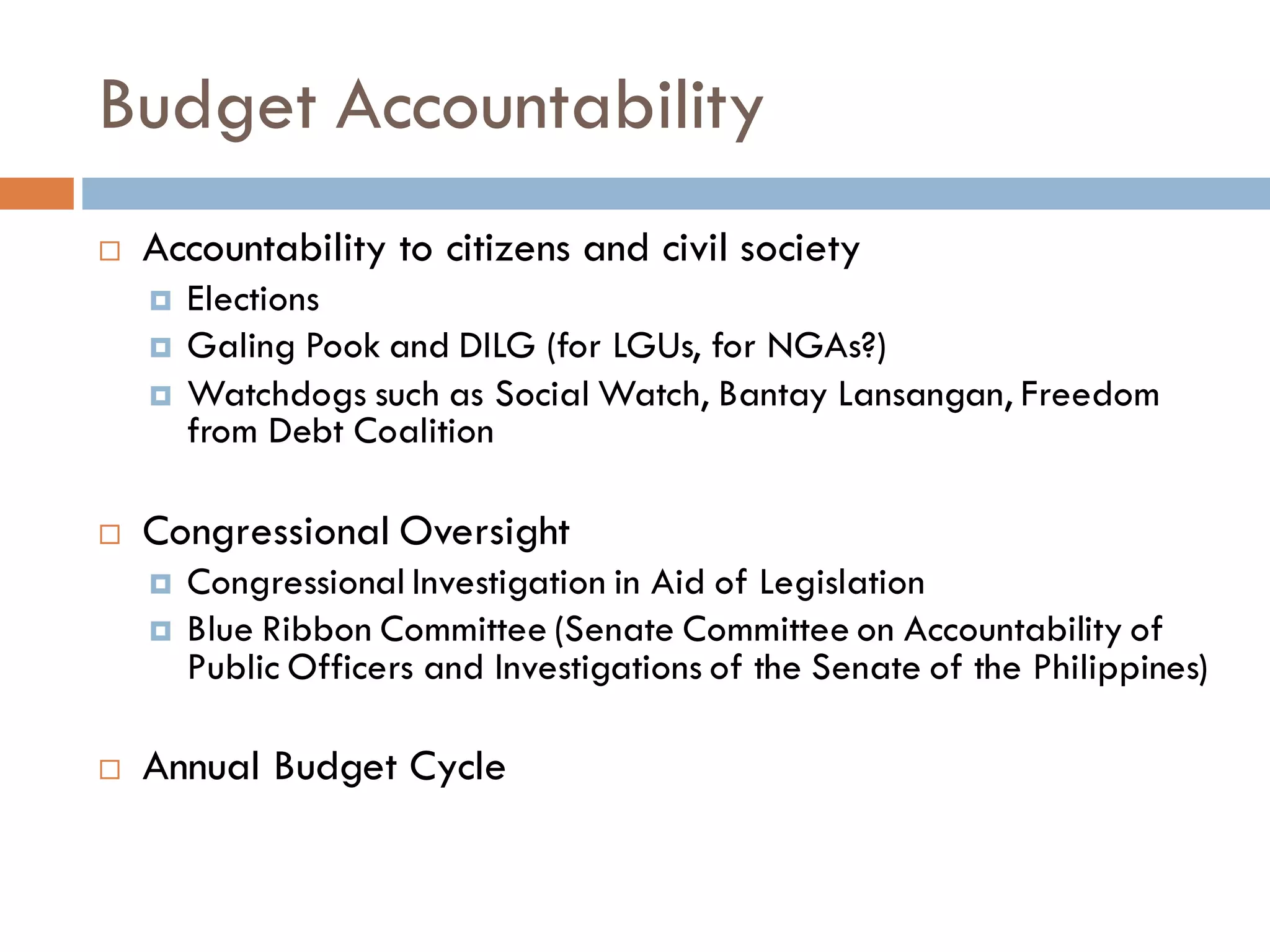
 Accountability to citizens and civil society
 Elections
 Galing Pook and DILG (for LGUs, for NGAs?)
 Watchdogs such as Social Watch, Bantay Lansangan, Freedom
from Debt Coalition
 Congressional Oversight
 Congressional Investigation in Aid of Legislation
 Blue Ribbon Committee (Senate Committee on Accountability of
Public Officers and Investigations of the Senate of the Philippines)
 Annual Budget Cycle
For further reading:
 Balisacan, Ryan Hartzell C. (2015). “Hyper-
Presidentialism in Philippine Budgeting: Toward a
Political Theory of the Budget Using Insights from a
Post-Mortem Examination of the Disbursement
Acceleration Program (DAP),” PJPA vol. LIX, no. 1
(January – June 2015).

Philippine Government Budgeting Process.pdf

  • 1.
  • 2.
    The Budget Process More than a system of procedures and structures  Both a rigorous technical procedure and a dynamic (and sometimes controversial) political process  Reflects the close interplay of political and economic factors and pressures.  Who really holds the power of the purse?
  • 3.
    Key Constitutional andLegal Provisions on Budgeting  The President has exclusive right to propose a budget (Article VII, Sec. 22)  Congress can only reduce or reallocate appropriations in the proposed budget (Article VI, Sec. 25)  The President can use a line-item veto (Article VI, Sec. 27)  The previous year’s budget is automatically “re- enacted” if the budget is not passed prior to the start of the fiscal year (Article VI, Sec. 25)
  • 4.
    Key Constitutional andLegal Provisions on Budgeting  The President can impose restrictions on the disbursement of funds appropriated by Congress (Sec. 35, Ch. 5, Book VI of EO 292)  The President can augment any appropriations from savings in other appropriations (Article VI, Sec. 25)  Fiscal autonomy of the judiciary (Article VIII, Sec. 3), Constitutional Commissions (Article IX, Sec. 5) and the Office of the Ombudsman (Article XI, Sec. 14). Article XIII, Sec. 17 provides that the appropriations for CHR shall be automatically and regularly released.
  • 5.
    The Budget Process:4 Phases Budget Preparation Budget Legislation Budget Execution Budget Accountability
  • 6.
  • 7.
    Budget Preparation Phase Main Actors: DBCC, government offices, DBM, President  DBCC: DBM (chair), BSP, DOF, NEDA, OP rep.  Determination of overall economic targets, expenditure levels, revenue projection and financing plan (Paper on Budget Strategy)  Issuance of Budget Call by DBM (3 January 2018)  Tier 1 (ongoing PAPs) and Tier 2 Budget proposals (new and expanded PAPs)
  • 8.
    Development Budget CoordinatingCommittee (DBCC) Members Secretary of Budget and Management (Chair) NEDA Director-General (Co-Chair) Executive Secretary Secretary of Finance Governor of Bangko Sentral ng Pilipinas National Defense Social Services Economic Services General Gov Debt Servicing Personal Services Maintenance and Other Operating Expenditures Capital Outlay
  • 9.
    Budget Preparation Phase Budget hearings (DBM technical panels)  Presentation of proposed budget levels of agencies to DBCC for approval  Review and approval by President and the Cabinet  Submission to Congress by the President of proposed budget within 30 days from the opening of the regular session of Congress (Sec. 22 of Constitution)
  • 10.
  • 11.
    BUDGET AUTHORIZATION  Presidentsubmits Budget of Expenditure and Sources of Financing (BESF) supported by National Expenditure Program (NEP) and President’s Budget Message to Congress  First stop: House of Representatives (Appropriation Committee)  Amended budget proposal is presented to the HOR body as the General Appropriations Bill
  • 12.
    BUDGET AUTHORIZATION  SenateFinance Committee conducts review while budget hearings are ongoing at the HOR  SFC proposes amendments to the House Budget Bill for approval  Bicameral Conference Committee finalizes the General Appropriations Bill
  • 13.
    BUDGET AUTHORIZATION  GABill passed in both Houses is submitted to the President  In the extreme possibility that Congress fails to pass the Bill, the Constitution provides  “ If by the end of the fiscal year, the Congress shall have failed to pass the general appropriations bill for the ensuing year, the general appropriations law for the preceding year shall be deemed re-enacted and shall in force and effect until the general appropriations bill is passed by Congress”  Budgeting Issue: How often do we have budget re- enactments? What are the consequences of budget re- enactments?
  • 14.
    BUDGET AUTHORIZATION  PresidentialReview and Veto  The GAB undergoes presidential review pursuant to Section 27 Article IV of the Constitution  If it is approved by the President, it becomes a law  President Duterte’s veto message for the 2018 GAB includes the following issues: ◼ Use of PhP 23 M of DepEd MOOE budget to fund CO items ◼ Provision allowing ERC to use its income for its operations (One- Fund Concept, double programming) ◼ Grant of monitoring expenses to MTRCB members (inconsistent with the Salary Standardization Law)
  • 15.
    BUDGET AUTHORIZATION  Ifthe President chooses not to act on it, he is deemed to have approved it after the lapse of 30 days.  Otherwise, the President within the 30 day period must veto the GAB or any item/s thereof by sending his veto message to the House of Representatives  Congress may override the veto by gathering 2/3 votes in each House, in which case it becomes law against the President’s will
  • 16.
    Budget Issue: ThePork Barrel  Priority Development Assistance Fund (PDAF)  PhP 200 M for each senator (50% for hard projects, 50% for soft projects)  PhP 70 M for each member of the HOR (PhP 40 M for hard projects, PhP 30 M for soft projects)  Congressional insertions  Objects of future choice  “Parking” of funds
  • 17.
    III. BUDGET EXECUTION& IMPLEMENTATION
  • 18.
    Additional Budget Concepts Continuing Appropriations  Automatic Appropriations  Special-Purpose Funds/ Lumpsum Appropriations
  • 19.
    Additional Budget Concepts Continuing Appropriations  Appropriations available to support for a specified purpose or project, such as multi-year construction projects which require the incurrence of obligations even beyond the budget year  E.g. Public Works, Agrarian Reform; CO, MOOE (2 years)  Automatic Appropriations  Appropriations programmed annually or for some other period prescribed by law, by virtue of outstanding legislation which require periodic action by Congress  Retirement and insurance premiums, debt servicing, loans to GOCCs  Special Purpose Funds  Items in the budget categorized by use or type, but with a specific purpose and legal bases (contains both disaggregated and lumpsum allocations)
  • 20.
    BUDGET EXECUTION  Elementsof budget execution:  Submission and evaluation of agency annual Work and Financial Plans which will be the basis of issuances of quarterly Advice of Allotments and funding requirements  Continuing monitoring and review of government’s fiscal position  Making sure that funds are available to support agency functions and projects
  • 21.
    BUDGET EXECUTION  Previousefforts to ensure the regular release of funds:  Simplified Fund Release System (SFRS)  adopted beginning 1995  Standardized release of funds across agencies which are similarly situated  Agency Budget Matrix  prepared by DBM in consultation with agencies at the beginning of each budget year  provides the basis for determining the timing, composition and magnitude of the release of the budget
  • 22.
    BUDGET EXECUTION  AllotmentRelease Program  considers updated resources and economic development thrust  serves as basis for the issuance of either a General Allotment Release Order (GARO) or a Special Allotment Release Order (SARO)  Notice of Cash Allocation (NCA)  Released on a monthly or quarterly basis  Specifies the maximum amount of withdrawal that an agency can make from a government bank for the period indicated  The ABM-SARO system has been abolished in 2014
  • 23.
    BUDGET EXECUTION  Basisof release of NCA  Financial requirements of agencies as indicated in their ABMs, cash plans and reports such as the Summary List of Checks Issued  The cash budget program of government and updates on projected resources
  • 24.
    BUDGET EXECUTION  Reasonsfor Adjustments  Enactment of new laws  Adjustments in macroeconomic parameters  Change in resources available
  • 25.
    Issues in BudgetExecution  Slow implementation of programs and projects  Low absorptive capacity of departments and agencies  Long and meticulous procurement process  Results in underspending  Substandard infrastructure projects  Due to lack of funds and very possibly corruption  Result in wastage as these infrastructures deteriorate almost immediately (especially due to calamities)
  • 26.
    Issues in BudgetExecution  In order to address the problem of underspending, the previous administration implemented the Disbursement Acceleration Program (DAP)  It was funded by a pooling funds from:  Unreleased appropriations under personnel services  Unprogrammed funds  Carry-over appropriations unreleased during the previous fiscal year  Unobligated allotments from slow-moving items or projects
  • 27.
    Issues in BudgetExecution  After allegations of misuse, the administration terminated the implementation of DAP in December 2013  Supreme Court Decision (Araullo, et al. vs. Aquino, G.R. No. 209287) on DAP:  President’s authority to augment cannot cross borders  Savings must be understood in ordinary sense  Savings can only be used to augment programs and projects in the GAA
  • 28.
    Issues in BudgetExecution  Meaning of Savings in GAA 2018  Portions or balances of any released appropriation in the GAA which have not been obligated as a result of any of the following: (a) completion, final discontinuance, or abandonment of a program, activity or project for which the appropriation is authorized; (b) Implementation of measures resulting in improved systems and efficiencies In case of (a) discontinued or abandoned P/A/P shall not be proposed for funding in the next 2 fiscal years
  • 29.
    Issues in BudgetExecution  Gaming the System  Using the rules and procedures meant to protect a system in order, instead, to manipulate the system for a desired outcome (also true in the case of budget reenactments)
  • 30.
    New Definition ofSavings  Under the 2015 GAA:  Savings can be declared for projects mid-year (or any time of the year), not at the end of the year  These programs/projects should have been discontinued with finality or should not have commenced due to circumstances beyond the control of the implementing agency
  • 31.
  • 32.
    Budget Accountability  Atthe agency level, budget accountability takes the form of management's review of actual performance or work accomplishment in relation to the work targets of the agency vis-à-vis the financial resources made available.  Internal Control System (ICS) and Internal Audit  Also, detailed examinations of each agency's book of accounts are undertaken by a resident representative of the Commission on Audit (COA) to ensure that all expenses have been disbursed in accordance with accounting regulations and the purpose(s) for which the funds have been authorized.
  • 33.
    Budget Accountability  Accountabilityto citizens and civil society  Elections  Galing Pook and DILG (for LGUs, for NGAs?)  Watchdogs such as Social Watch, Bantay Lansangan, Freedom from Debt Coalition  Congressional Oversight  Congressional Investigation in Aid of Legislation  Blue Ribbon Committee (Senate Committee on Accountability of Public Officers and Investigations of the Senate of the Philippines)  Annual Budget Cycle
  • 34.
    For further reading: Balisacan, Ryan Hartzell C. (2015). “Hyper- Presidentialism in Philippine Budgeting: Toward a Political Theory of the Budget Using Insights from a Post-Mortem Examination of the Disbursement Acceleration Program (DAP),” PJPA vol. LIX, no. 1 (January – June 2015).