THE MULTIMODAL TURNTHE MULTIMODAL TURN
How Technology is Changing the Way We
Read, Write & Think
ISP “Pbro. Antonio Sáenz”
Primeras Jornadas de Lenguas
Prof. Lic. Mariana Ferrarelli
June 2013
Overview
•Multimodality: Mode /
Affordances /
Technological Convergence
•Digital & Oral Culture
•Sample text
•Multiliteracies
•Political Implications
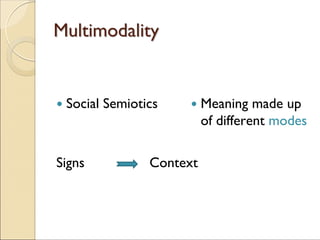
MultimodalityMultimodality
Social Semiotics
Signs Context
Meaning made up
of different modes
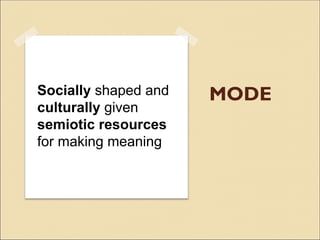
MODESocially shaped and
culturally given
semiotic resources
for making meaning
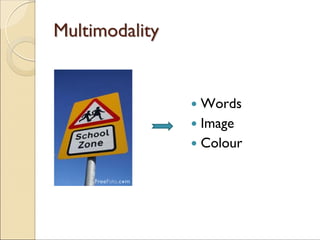
Words
Image
Colour
MultimodalityMultimodality
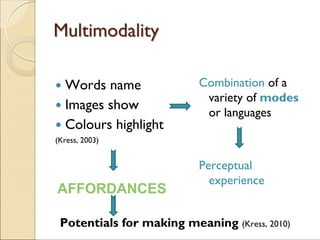
Words name
Images show
Colours highlight
(Kress, 2003)
Combination of a
variety of modes
or languages
Perceptual
experience
MultimodalityMultimodality
AFFORDANCES
Potentials for making meaning (Kress, 2010)
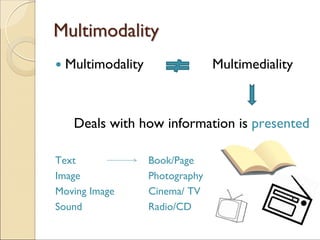
Multimodality Multimediality
Deals with how information is presented
Text Book/Page
Image Photography
Moving Image Cinema/ TV
Sound Radio/CD
MultimodalityMultimodality
TechnologicalTechnological ConvergenceConvergence
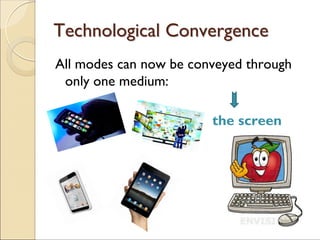
All modes can now be conveyed through
only one medium:
the screen
TechnologicalTechnological ConvergenceConvergence
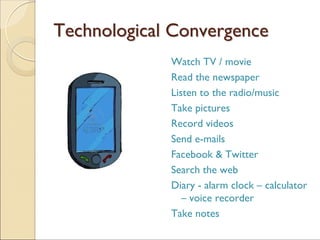
Watch TV / movie
Read the newspaper
Listen to the radio/music
Take pictures
Record videos
Send e-mails
Facebook & Twitter
Search the web
Diary - alarm clock – calculator
– voice recorder
Take notes
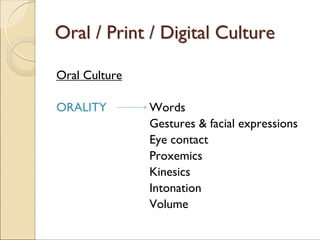
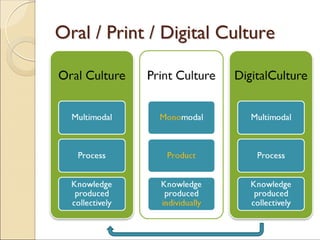
Oral /Oral / PrintPrint / Digital Culture/ Digital Culture
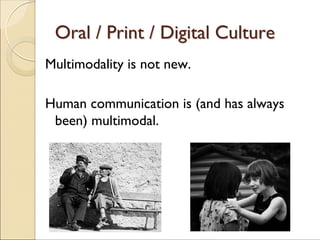
Multimodality is not new.
Human communication is (and has always
been) multimodal.
Oral Culture
ORALITY Words
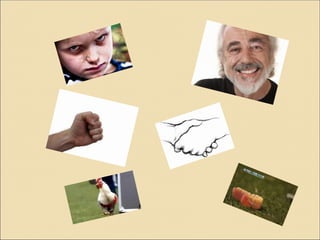
Gestures & facial expressions
Eye contact
Proxemics
Kinesics
Intonation
Volume
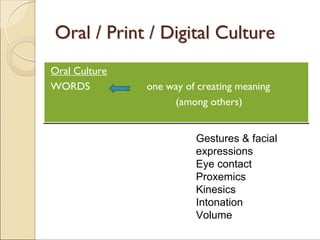
Oral /Oral / PrintPrint / Digital Culture/ Digital Culture
Oral Culture
WORDS one way of creating meaning
(among others)
Oral Culture
WORDS one way of creating meaning
(among others)
Oral /Oral / PrintPrint / Digital Culture/ Digital Culture
Gestures & facial
expressions
Eye contact
Proxemics
Kinesics
Intonation
Volume
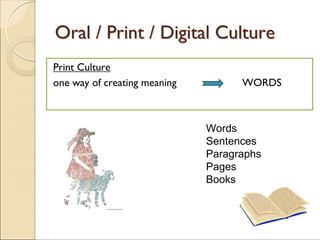
Print Culture
one way of creating meaning WORDS
Oral /Oral / PrintPrint / Digital Culture/ Digital Culture
Words
Sentences
Paragraphs
Pages
Books
Oral /Oral / PrintPrint / Digital Culture/ Digital Culture
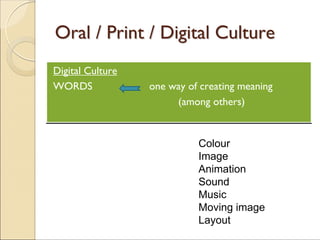
Digital Culture
WORDS one way of creating meaning
(among others)
Digital Culture
WORDS one way of creating meaning
(among others)
Colour
Image
Animation
Sound
Music
Moving image
Layout
Oral /Oral / PrintPrint / Digital Culture/ Digital Culture
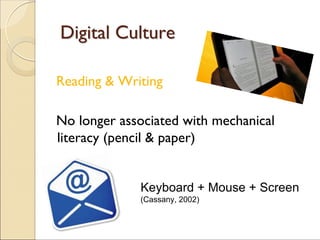
Reading & Writing
No longer associated with mechanical
literacy (pencil & paper)
Digital CultureDigital Culture
Keyboard + Mouse + Screen
(Cassany, 2002)
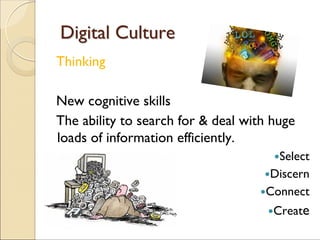
Thinking
New cognitive skills
The ability to search for & deal with huge
loads of information efficiently.
Select
Discern
Connect
Create
Digital CultureDigital Culture
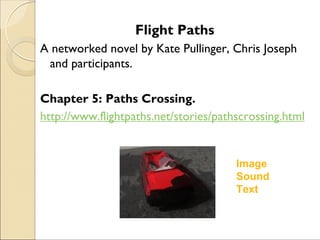
Flight Paths
A networked novel by Kate Pullinger, Chris Joseph
and participants.
Chapter 5: Paths Crossing.
http://www.flightpaths.net/stories/pathscrossing.html
Image
Sound
Text
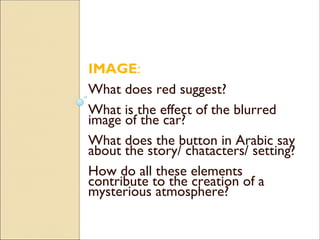
IMAGE:
What does red suggest?
What is the effect of the blurred
image of the car?
What does the button in Arabic say
about the story/ chatacters/ setting?
How do all these elements
contribute to the creation of a
mysterious atmosphere?
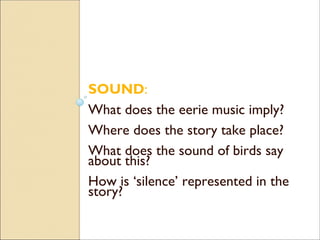
SOUND:
What does the eerie music imply?
Where does the story take place?
What does the sound of birds say
about this?
How is ‘silence’ represented in the
story?
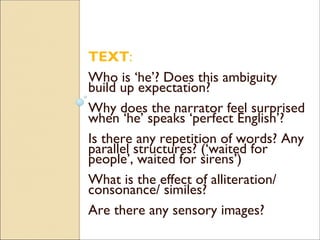
TEXT:
Who is ‘he’? Does this ambiguity
build up expectation?
Why does the narrator feel surprised
when ‘he’ speaks ‘perfect English’?
Is there any repetition of words? Any
parallel structures? (‘waited for
people’, waited for sirens’)
What is the effect of alliteration/
consonance/ similes?
Are there any sensory images?
Multimodal Texts
Andy Campbell:
Inside: A Journal of Dreams (2001)
Nightingale’s Playground (2010)
http://www.dreamingmethods.com/portfolio.html
Chris Joseph:
Bully for You (2008)
Tube Lines (2013)
http://www.chrisjoseph.org/
http://narrativa-postparentetica.blogspot.com.ar/
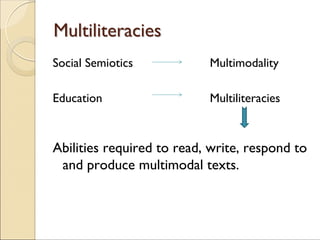
MultiliteraciesMultiliteracies
Social Semiotics Multimodality
Education Multiliteracies
Abilities required to read, write, respond to
and produce multimodal texts.
A multimodal approach to education
Draws on a wider variety of texts
Moves the focus from a language to other
forms of communication
Allows for diversity & differentiation
Rg & Wg increasingly screen-based
Author as fluid and transitory role
AFFORDANCES: potentialities &
limitations
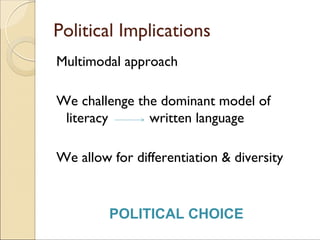
Political Implications
Multimodal approach
We challenge the dominant model of
literacy written language
We allow for differentiation & diversity
POLITICAL CHOICE
SourcesSources andand CreditsCredits
Gee, J.P. (2003), What Video Games Have to Teach Us about Learning and Literacy,
Palgrave Macmillan, New York.
Gee, J.P. (2005) Why Video Games are Good for Your Soul: Pleasure and Learning,
Common Ground, Melbourne.
Cope, B. and Kalantzis, M. (2004), ‘Text-made text’, E-Learning 1, 198–282.
Jewitt, C. (2009) The Routledge Handbook of Multimodal Analysis, Routledge, London.
Kress, G. (1990) Linguistic Process and Sociocultural Change, Oxford University Press,
Oxford, England.
Kress, G.(2003) Literacy in the New Media Age, Routledge, London.
Kress, G. (2010) Multimodality: A Social Semiotic Approach to Contemporary
Communication, Routledge, London.
Kress, G. and van Leeuwen, T.(1996) Reading Images: The Grammar of Visual Design,
Routledge, London.
Lauer, C. (2009) Contending with Terms: “Multimodal” and “Multimedia” in the
Academic and Public Spheres, Computers and Composition 26 (2009) 225–239
Mavers, D. (2011) Children’s Drawing and Writing: The Remarkable in the
Unremarkable, New York, Routledge.
New London Group.:(1996) ‘A pedagogy of multiliteracies: Designing social
futures’, Harvard Educational Review 66, 60–92.
Oliver, M. (2005)The problem with affordance’The E-Learning Journal 2 (4): 402-
413
Public Schools NSW (2012) Using digital and multimodal texts K-6, Department of
Education and Communities. Available at: www.tale.edu.au/. Retrieved: March
2013.
Siege, M. (2006) Rereading the Signs: Multimodal Transformations in the Field of
Literacy Education; Language Arts, Vol. 84, No. 1, September 2006.
Snyder, I. (2004) Alfabetismos digitales. Comunicación, innovación y educación en la
era electrónica, Colección Aulae, número 2. Ediciones Aljibe, Enseñanza
Abierta de Andalucía y Consorcio Fernando de los Ríos.
Stein, P. (2008) Multimodal Pedagogies in Diverse Classrooms: Representation, Rights
and Resources, Routledge, London.
Unsworth , L. (2001) Teaching multiliteracies across the curriculum, USA, Open
University Press.
http://www.dreamingmethods.com/portfolio.html; allposters.com;
howfreeisfreedom.wordpress.com;
http://www.chrisjoseph.org/; www.freefoto.com
pta.chaparral.groupfusion.net; www.pcadvisor.co.uk
brucethink.wordpress.com; www.123rf.com ; gamespot.com
commons.wikimedia.org ; neonumbrella.net ;
discoscicatriz.blogspot.com ; diez.hn ; https://encrypted-tbn3.gstatic.com/images;
hubpages.com; javiercordero.com; pidopaso.blogspot.com;
My special thanx to Ma.Cristina Llorente &
Patricia Onganía…!
mariana.ferrarelli@gmail.com

The multimodal turn ferrarelli m 2013 ispams

  • 1.
    THE MULTIMODAL TURNTHEMULTIMODAL TURN How Technology is Changing the Way We Read, Write & Think ISP “Pbro. Antonio Sáenz” Primeras Jornadas de Lenguas Prof. Lic. Mariana Ferrarelli June 2013
  • 2.
    Overview •Multimodality: Mode / Affordances/ Technological Convergence •Digital & Oral Culture •Sample text •Multiliteracies •Political Implications
  • 3.
  • 4.
    MODESocially shaped and culturallygiven semiotic resources for making meaning
  • 5.
  • 6.
    Words name Images show Colourshighlight (Kress, 2003) Combination of a variety of modes or languages Perceptual experience MultimodalityMultimodality AFFORDANCES Potentials for making meaning (Kress, 2010)
  • 7.
    Multimodality Multimediality Deals withhow information is presented Text Book/Page Image Photography Moving Image Cinema/ TV Sound Radio/CD MultimodalityMultimodality
  • 8.
    TechnologicalTechnological ConvergenceConvergence All modescan now be conveyed through only one medium: the screen
  • 9.
    TechnologicalTechnological ConvergenceConvergence Watch TV/ movie Read the newspaper Listen to the radio/music Take pictures Record videos Send e-mails Facebook & Twitter Search the web Diary - alarm clock – calculator – voice recorder Take notes
  • 10.
    Oral /Oral /PrintPrint / Digital Culture/ Digital Culture Multimodality is not new. Human communication is (and has always been) multimodal.
  • 12.
    Oral Culture ORALITY Words Gestures& facial expressions Eye contact Proxemics Kinesics Intonation Volume Oral /Oral / PrintPrint / Digital Culture/ Digital Culture
  • 13.
    Oral Culture WORDS oneway of creating meaning (among others) Oral Culture WORDS one way of creating meaning (among others) Oral /Oral / PrintPrint / Digital Culture/ Digital Culture Gestures & facial expressions Eye contact Proxemics Kinesics Intonation Volume
  • 14.
    Print Culture one wayof creating meaning WORDS Oral /Oral / PrintPrint / Digital Culture/ Digital Culture Words Sentences Paragraphs Pages Books
  • 15.
    Oral /Oral /PrintPrint / Digital Culture/ Digital Culture Digital Culture WORDS one way of creating meaning (among others) Digital Culture WORDS one way of creating meaning (among others) Colour Image Animation Sound Music Moving image Layout
  • 16.
    Oral /Oral /PrintPrint / Digital Culture/ Digital Culture
  • 17.
    Reading & Writing Nolonger associated with mechanical literacy (pencil & paper) Digital CultureDigital Culture Keyboard + Mouse + Screen (Cassany, 2002)
  • 18.
    Thinking New cognitive skills Theability to search for & deal with huge loads of information efficiently. Select Discern Connect Create Digital CultureDigital Culture
  • 19.
    Flight Paths A networkednovel by Kate Pullinger, Chris Joseph and participants. Chapter 5: Paths Crossing. http://www.flightpaths.net/stories/pathscrossing.html Image Sound Text
  • 20.
    IMAGE: What does redsuggest? What is the effect of the blurred image of the car? What does the button in Arabic say about the story/ chatacters/ setting? How do all these elements contribute to the creation of a mysterious atmosphere?
  • 21.
    SOUND: What does theeerie music imply? Where does the story take place? What does the sound of birds say about this? How is ‘silence’ represented in the story?
  • 22.
    TEXT: Who is ‘he’?Does this ambiguity build up expectation? Why does the narrator feel surprised when ‘he’ speaks ‘perfect English’? Is there any repetition of words? Any parallel structures? (‘waited for people’, waited for sirens’) What is the effect of alliteration/ consonance/ similes? Are there any sensory images?
  • 23.
    Multimodal Texts Andy Campbell: Inside:A Journal of Dreams (2001) Nightingale’s Playground (2010) http://www.dreamingmethods.com/portfolio.html Chris Joseph: Bully for You (2008) Tube Lines (2013) http://www.chrisjoseph.org/ http://narrativa-postparentetica.blogspot.com.ar/
  • 24.
    MultiliteraciesMultiliteracies Social Semiotics Multimodality EducationMultiliteracies Abilities required to read, write, respond to and produce multimodal texts.
  • 25.
    A multimodal approachto education Draws on a wider variety of texts Moves the focus from a language to other forms of communication Allows for diversity & differentiation Rg & Wg increasingly screen-based Author as fluid and transitory role AFFORDANCES: potentialities & limitations
  • 26.
    Political Implications Multimodal approach Wechallenge the dominant model of literacy written language We allow for differentiation & diversity POLITICAL CHOICE
  • 27.
    SourcesSources andand CreditsCredits Gee,J.P. (2003), What Video Games Have to Teach Us about Learning and Literacy, Palgrave Macmillan, New York. Gee, J.P. (2005) Why Video Games are Good for Your Soul: Pleasure and Learning, Common Ground, Melbourne. Cope, B. and Kalantzis, M. (2004), ‘Text-made text’, E-Learning 1, 198–282. Jewitt, C. (2009) The Routledge Handbook of Multimodal Analysis, Routledge, London. Kress, G. (1990) Linguistic Process and Sociocultural Change, Oxford University Press, Oxford, England. Kress, G.(2003) Literacy in the New Media Age, Routledge, London. Kress, G. (2010) Multimodality: A Social Semiotic Approach to Contemporary Communication, Routledge, London. Kress, G. and van Leeuwen, T.(1996) Reading Images: The Grammar of Visual Design, Routledge, London. Lauer, C. (2009) Contending with Terms: “Multimodal” and “Multimedia” in the Academic and Public Spheres, Computers and Composition 26 (2009) 225–239 Mavers, D. (2011) Children’s Drawing and Writing: The Remarkable in the Unremarkable, New York, Routledge. New London Group.:(1996) ‘A pedagogy of multiliteracies: Designing social futures’, Harvard Educational Review 66, 60–92.
  • 28.
    Oliver, M. (2005)Theproblem with affordance’The E-Learning Journal 2 (4): 402- 413 Public Schools NSW (2012) Using digital and multimodal texts K-6, Department of Education and Communities. Available at: www.tale.edu.au/. Retrieved: March 2013. Siege, M. (2006) Rereading the Signs: Multimodal Transformations in the Field of Literacy Education; Language Arts, Vol. 84, No. 1, September 2006. Snyder, I. (2004) Alfabetismos digitales. Comunicación, innovación y educación en la era electrónica, Colección Aulae, número 2. Ediciones Aljibe, Enseñanza Abierta de Andalucía y Consorcio Fernando de los Ríos. Stein, P. (2008) Multimodal Pedagogies in Diverse Classrooms: Representation, Rights and Resources, Routledge, London. Unsworth , L. (2001) Teaching multiliteracies across the curriculum, USA, Open University Press. http://www.dreamingmethods.com/portfolio.html; allposters.com; howfreeisfreedom.wordpress.com; http://www.chrisjoseph.org/; www.freefoto.com pta.chaparral.groupfusion.net; www.pcadvisor.co.uk brucethink.wordpress.com; www.123rf.com ; gamespot.com commons.wikimedia.org ; neonumbrella.net ; discoscicatriz.blogspot.com ; diez.hn ; https://encrypted-tbn3.gstatic.com/images; hubpages.com; javiercordero.com; pidopaso.blogspot.com;
  • 29.
    My special thanxto Ma.Cristina Llorente & Patricia Onganía…! mariana.ferrarelli@gmail.com