The motivating school
Schools as organisations
09 Oct 2015
WHAT IS AN ORGANIZATION
Any group which works together in a planned,
co-ordinated way to achieve some common
purpose could be described as an organisation
Organisations as Structures
• Human dimension
• Task dimension
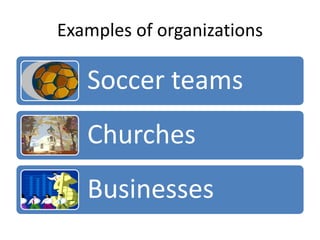
Examples of organizations
Soccer teams
Churches
Businesses
Schools as Organisations consists of:
• Groups of people
• Working together in different ways
• To meet shared goals
Is my school an organization
• Does it consist of a group of people?
• Are the individuals working together?
• In a planned, co-ordinated way to achieve a
purpose?
• Does this group have a common purpose
What is the school’s purpose?
• Good schools:
– Responsible for passing on knowledge, that is
important to society, to its young people;
– Pass on society’s values and social practices;
– Prepare people for the world of work;
– Play an important part in the intellectual, personal
and social development of young people;
– Are place of social activity, where people meet
each other, make friends, play together, fight etc.
Organization structure (1)
1
2
3
Organisational Structure
• The most structured form of organisation is the
bureaucracy;
• In bureaucracies, each person is appointed to an
office or position;
• Each office/position has clear tasks according to
fixed rules and procedures;
• Reporting structures and lines of accountability
and responsibility are clearly set out.
• Example: Government offices
Organization structure (2)
1
2
3 3
2
3
Organization structures (3)
1
2
34
4
Hierarchies
• Roles and responsibilities are clearly defined.
• They are defined in terms of position and
status.
• There are strict procedures and rules that
specify which people carry out tasks as laid
down by the school.
• The lines of authority flows down-ward, never
upwards
Hierarchies
• Strengths
– Efficiency.
– Fair amount of
transparency.
– Clear procedures.
– Accountability.
– Clear communication.
– Division of responsibility.
makes people experts. `
• Weaknesses
– Poor implementation of
the system.
– Too rigid for a changing
environment.
School Culture
• The way we do things here
• Different schools have a different ‘feel’
• In schools culture has to do with things such as:
– The values, beliefs and attitudes of the educators, the
learners and parents;
– How educators and learners dress for school;
– How people in the organisation speak to each other;
– How quickly educators and learners go to class when the
bell rings;
– What count as ‘hard work’;
– How people are expected to act when they are angry or
pleased
Rituals as a part of school culture
• Rituals are an important part of school
culture;
• The rituals that bring people together in a
school, include assemblies, ceremonies,
school uniform, school songs;
• Other rituals can keep people separate such as
age groupings and groupings by gender.
Why do the functioning in some
schools break down?
• Bad relationships;
• Confusion;
• Not focussed on learning and teaching;
• Blaming others
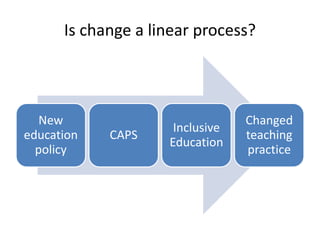
Is change a linear process?
New
education
policy
CAPS
Inclusive
Education
Changed
teaching
practice
Understanding change
• The complexities of change
• Factors influencing the process of change
• Barriers to change
BASIC Education Minister
Angie Motshekga is under
siege. The blame for the
education meltdown is
being placed squarely at
her feet, and the crisis is
getting attention from
everywhere. Everyone
from the Democratic
Alliance to the ANC Youth
League has an opinion on
what should be done, and
very few people are on
Motshekga’s side.
EC education in a crisis
• “The crisis in the Eastern Cape education
system cannot be denied. The majority of
schools in the Eastern Cape do not provide
adequate infrastructure for learning,” said EE
spokesman, Yoliswa Dwane.
• In the province 66% of schools have unreliable
to no access to water and 40% of schools have
unreliable to no access to electricity, said
Dwane, who also raised concerns over the
nearly 400 mud schools in the province.
Schools in Crises?
You as the agent of change
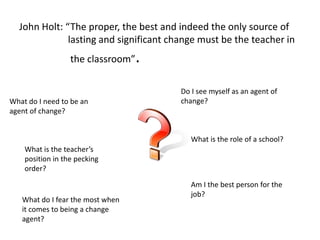
John Holt: “The proper, the best and indeed the only source of
lasting and significant change must be the teacher in
the classroom”.
Do I see myself as an agent of
change?What do I need to be an
agent of change?
Am I the best person for the
job?
What do I fear the most when
it comes to being a change
agent?
What is the role of a school?
What is the teacher’s
position in the pecking
order?
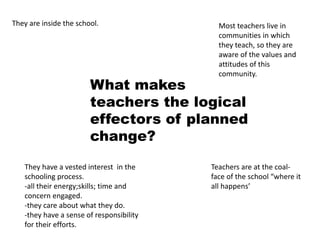
What makes
teachers the logical
effectors of planned
change?
They are inside the school.
They have a vested interest in the
schooling process.
-all their energy;skills; time and
concern engaged.
-they care about what they do.
-they have a sense of responsibility
for their efforts.
Most teachers live in
communities in which
they teach, so they are
aware of the values and
attitudes of this
community.
Teachers are at the coal-
face of the school “where it
all happens’
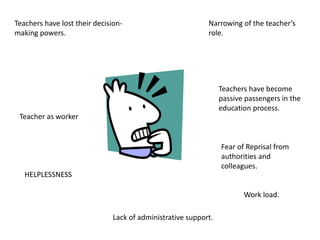
Teachers have lost their decision-
making powers.
Teacher as worker
Narrowing of the teacher’s
role.
Teachers have become
passive passengers in the
education process.
HELPLESSNESS
Fear of Reprisal from
authorities and
colleagues.
Lack of administrative support.
Work load.
Case study
• List the weaknesses in this school.
• List the strengths in this school;
• Which organisational structure do you identify
at the school;
• If you are the principal what would you
change.

The motivating school

  • 1.
    The motivating school Schoolsas organisations 09 Oct 2015
  • 2.
    WHAT IS ANORGANIZATION Any group which works together in a planned, co-ordinated way to achieve some common purpose could be described as an organisation
  • 3.
    Organisations as Structures •Human dimension • Task dimension
  • 4.
    Examples of organizations Soccerteams Churches Businesses
  • 5.
    Schools as Organisationsconsists of: • Groups of people • Working together in different ways • To meet shared goals
  • 6.
    Is my schoolan organization • Does it consist of a group of people? • Are the individuals working together? • In a planned, co-ordinated way to achieve a purpose? • Does this group have a common purpose
  • 7.
    What is theschool’s purpose? • Good schools: – Responsible for passing on knowledge, that is important to society, to its young people; – Pass on society’s values and social practices; – Prepare people for the world of work; – Play an important part in the intellectual, personal and social development of young people; – Are place of social activity, where people meet each other, make friends, play together, fight etc.
  • 8.
  • 9.
    Organisational Structure • Themost structured form of organisation is the bureaucracy; • In bureaucracies, each person is appointed to an office or position; • Each office/position has clear tasks according to fixed rules and procedures; • Reporting structures and lines of accountability and responsibility are clearly set out. • Example: Government offices
  • 10.
  • 11.
  • 12.
    Hierarchies • Roles andresponsibilities are clearly defined. • They are defined in terms of position and status. • There are strict procedures and rules that specify which people carry out tasks as laid down by the school. • The lines of authority flows down-ward, never upwards
  • 13.
    Hierarchies • Strengths – Efficiency. –Fair amount of transparency. – Clear procedures. – Accountability. – Clear communication. – Division of responsibility. makes people experts. ` • Weaknesses – Poor implementation of the system. – Too rigid for a changing environment.
  • 14.
    School Culture • Theway we do things here • Different schools have a different ‘feel’ • In schools culture has to do with things such as: – The values, beliefs and attitudes of the educators, the learners and parents; – How educators and learners dress for school; – How people in the organisation speak to each other; – How quickly educators and learners go to class when the bell rings; – What count as ‘hard work’; – How people are expected to act when they are angry or pleased
  • 15.
    Rituals as apart of school culture • Rituals are an important part of school culture; • The rituals that bring people together in a school, include assemblies, ceremonies, school uniform, school songs; • Other rituals can keep people separate such as age groupings and groupings by gender.
  • 16.
    Why do thefunctioning in some schools break down? • Bad relationships; • Confusion; • Not focussed on learning and teaching; • Blaming others
  • 17.
    Is change alinear process? New education policy CAPS Inclusive Education Changed teaching practice
  • 18.
    Understanding change • Thecomplexities of change • Factors influencing the process of change • Barriers to change
  • 19.
    BASIC Education Minister AngieMotshekga is under siege. The blame for the education meltdown is being placed squarely at her feet, and the crisis is getting attention from everywhere. Everyone from the Democratic Alliance to the ANC Youth League has an opinion on what should be done, and very few people are on Motshekga’s side.
  • 20.
    EC education ina crisis • “The crisis in the Eastern Cape education system cannot be denied. The majority of schools in the Eastern Cape do not provide adequate infrastructure for learning,” said EE spokesman, Yoliswa Dwane.
  • 21.
    • In theprovince 66% of schools have unreliable to no access to water and 40% of schools have unreliable to no access to electricity, said Dwane, who also raised concerns over the nearly 400 mud schools in the province.
  • 22.
  • 23.
    You as theagent of change
  • 24.
    John Holt: “Theproper, the best and indeed the only source of lasting and significant change must be the teacher in the classroom”. Do I see myself as an agent of change?What do I need to be an agent of change? Am I the best person for the job? What do I fear the most when it comes to being a change agent? What is the role of a school? What is the teacher’s position in the pecking order?
  • 25.
    What makes teachers thelogical effectors of planned change? They are inside the school. They have a vested interest in the schooling process. -all their energy;skills; time and concern engaged. -they care about what they do. -they have a sense of responsibility for their efforts. Most teachers live in communities in which they teach, so they are aware of the values and attitudes of this community. Teachers are at the coal- face of the school “where it all happens’
  • 26.
    Teachers have losttheir decision- making powers. Teacher as worker Narrowing of the teacher’s role. Teachers have become passive passengers in the education process. HELPLESSNESS Fear of Reprisal from authorities and colleagues. Lack of administrative support. Work load.
  • 27.
    Case study • Listthe weaknesses in this school. • List the strengths in this school; • Which organisational structure do you identify at the school; • If you are the principal what would you change.

Editor's Notes

  • #2 Schools are the main environments in which children are formally educated. Because it as important positive or negative influences on learning you need to understand the nature of the school environment. You need to understand it’s impact on you and what you do in your classroom. You also need to understand your impact on your school.
  • #3 All groups strive to accomplish goals, but in many groups the goals are very general or unstated. Because organisations are systems, what happens in one part of the system will affect all other parts. Person-centered environments – focus on the development of the people in the organisation (staff development; team building activities; student support) Environment centered interventions focus on developing the physical facilties and resources. Focus on governance; making policies and regulations and ensuring that it is carried out). In an organisation, the aims are specific, clearly stated, and unsually well understood by all the members. Within human societies, people have longed formed groups to achieve special purposes. These special-purpose groups are called organizations. Definition for the word organisation
  • #4 Human dimension – refer to the interpersonal relations within the organisation. Task Dimension, refer to the task-related activities of the people focussing on a common goal.
  • #5 Other examples of organisation: clubs, schools, hospitals, prisons, government agencies Organisations have the following basic characteristics: There is division of labour and power that is designed to make the group a more efficient agent for achieving the organisation’s goals. There is a concentration of power in the hands of leaders or executives who use that power to control the activities of the organisation and direct them towards the organisation’s goals. The group has a membership which routinely changes. The membership is not fixed. New members may be added or old ones who prove to be unsatisfactory may be removed. All groups strive to accomplish goals, but in many groups the aims can be very general or unstated. Sometimes each person in the group has a separate goal. In organisations
  • #6 Groups of people: educators, learners, principals, SMT’s, SGB’s and parents Working together in learning, teaching, managing, leading, supporting Shared Goals (educating young people – providing teaching and learning)
  • #9 The formal structure of an organisation include the formally stated rules and regulations that define the activities of the members. Mechanisms include: mission and vision statements; chain of command, time schedule for meeting goals. The formal structure has a particular function. It’s function is to enable the organisation to meet its goals effectively and efficiently. The amount of personal power each individual has is linked to his/her position in the organisation and his/her relationship with other members of the organisation. Disciplinary measures also maintain the structure. The informal structure of the organisation consists of the personal relationships in an organisation. These members form of their own accord. Different visual representation of organisation structure:
  • #19 Traditionally South African schools are structured hierarchically. In the ‘old’ system there was a high level of work specialization, little collaboration and no communication between peers. The changing global and local context suggested that South African school need to change. The new vision of schools is to have less hierarchial structures, more participative decision making, more flexible job functions, more team work, a commitment to ongoing personal and organisational development. (see the piece on the day in the life of an South African school again) Change is a complex process: It is not a linear process (next slide) It cannot be introduced in a top-down- fashion. People cannot be instructed to change. If one is to embark on organisational change, it is not an individual effort. Change needs time. For change to take place, people must ‘own’ the process. Lots of factors influence the process of change. People’s fear about their own abilities and their own future. Change require training and resources. Change within the organisation is influenced externally and internally (externally by policies and internally by attitudes) Barriers to change: Value barriers – individuals and groups have different ways of seeing things. Power barriers – there is often resistance when power changes hands specially when it involves the re-distribution of resources and a change in authority structures. Practical barriers – one of the biggest problem with change is to bridge the gap between the idea or the plan and the implementation there of in the organisation Time – on a macro and micro level. A big organisation like the DoE moves slowly, inside the school the teachers must have time to change (to try out new idea, to attend training, to discuss issues with colleagues). Too often teachers are faced with change and they are expected to do this on top of a heavy workload. Knowledge – organisation must have the knowledge about the innovation they are about to embark on.individual members must know why they are changing and how to change. Organisational development issues – the organisation need to develop the capacity to manage the change process. There must be support for the individual in terms of resources and skills development. Resources – change require resources. Specific objectives – if the innovation is going to work, everyone involved needs to know what is happening and why this is happening. If there is not information available about the innovation, organisation are less likely to adopt it. Psychological barriers – people find it difficult to change. We tend to continue with things we are familiar with. Familiarity provides security and it is difficult to enter the unknown. To be willing to change we need to believe that the change is worthwhile. We need to see some meaning and advantage for involving ourselves in the change. It does not necessarily meaning money. Key decisions are made by people at the top (see the cartoon)