The Modern Telco Network:
Defining The Telco Cloud
Marco Rodrigues – Juniper
Contrail Solutions Group
Openstack Seattle – Telcos / NFV Track
Seattle, WA (September 2016)
Telco
VNF(n)
Agenda
1. Why the Telco Cloud?
2. What is the Telco Cloud?
3. Telco Cloud Requirements
4. A Telco Cloud Use-Case (Mobile)
Why the Telco Cloud?
Why The Telco Cloud?
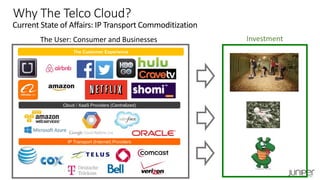
Current State of Affairs: IP Transport Commoditization
IP Transport (Internet) Providers
Cloud / XaaS Providers (Centralized)
The Customer Experience
InvestmentThe User: Consumer and Businesses
Why The Telco Cloud?
Economics and Growth
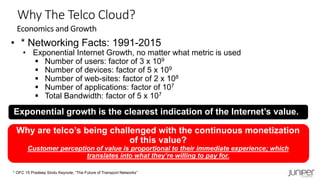
• * Networking Facts: 1991-2015
• Exponential Internet Growth, no matter what metric is used
 Number of users: factor of 3 x 10⁹
 Number of devices: factor of 5 x 10⁹
 Number of web-sites: factor of 2 x 10⁸
 Number of applications: factor of 107
 Total Bandwidth: factor of 5 x 10⁷
* OFC 15 Pradeep Sindu Keynote, “The Future of Transport Networks”
Exponential growth is the clearest indication of the Internet’s value.
Why are telco’s being challenged with the continuous monetization
of this value?
Customer perception of value is proportional to their immediate experience; which
translates into what they’re willing to pay for.
Why The Telco Cloud?
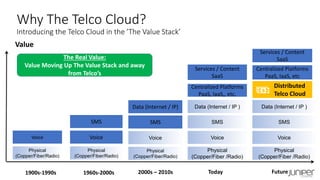
Introducing the Telco Cloud in the ’The Value Stack’
Future
SMS
Physical
(Copper/Fiber /Radio)
Voice
Data (Internet / IP )
SMS
Physical
(Copper/Fiber/Radio)
Voice
Data (Internet / IP)
2000s – 2010s
SMS
Physical
(Copper/Fiber/Radio)
Voice
1960s-2000s
Physical
(Copper/Fiber/Radio)
Voice
1900s-1990s
Services / Content
SaaS
Centralized Platforms
PaaS, IaaS, etc
SMS
Physical
(Copper/Fiber /Radio)
Voice
Data (Internet / IP )
Today
Services / Content
SaaS
Centralized Platforms
PaaS, IaaS,, etc.
Distributed
Telco Cloud
Value
The Real Value:
Value Moving Up The Value Stack and away
from Telco’s
Why The Telco Cloud?
What’s Next
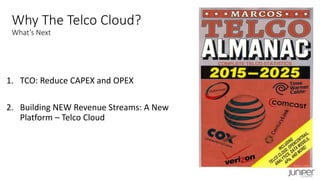
1. TCO: Reduce CAPEX and OPEX
2. Building NEW Revenue Streams: A New
Platform – Telco Cloud
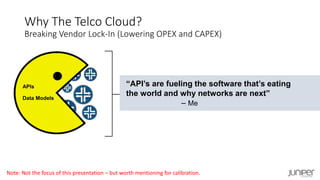
“API’s are fueling the software that’s eating
the world and why networks are next”
– Me
Why The Telco Cloud?
Breaking Vendor Lock-In (Lowering OPEX and CAPEX)
APIs
Data Models
Note: Not the focus of this presentation – but worth mentioning for calibration.
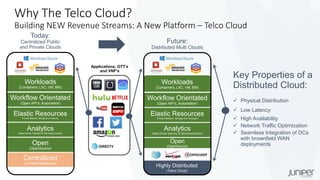
Today:
Centralized Public
and Private Clouds
Workloads
(Containers, LXC, VM, BM)
Workflow Orientated
(Open API’s, Automation)
Elastic Resources(Pooled Network, Storage and Compute)
Analytics
(Data Driven Delivery of Services/Content)
Centralized
(Limited Distribution)
Open
(OpenSource)
Workloads
(Containers, LXC, VM, BM)
Workflow Orientated
(Open API’s, Automation)
Elastic Resources
(Pooled Network, Storage and Compute)
Analytics
(Data Driven Delivery of Services/Content)
Open
(OpenSource)
Future:
Distributed Multi Clouds
Highly Distributed
(Telco Cloud)
Applications, OTT’s
and VNF’s
Key Properties of a
Distributed Cloud:
 Physical Distribution
 Low Latency
 High Availability
 Network Traffic Optimization
 Seamless Integration of DCs
with brownfield WAN
deployments
Why The Telco Cloud?
Building NEW Revenue Streams: A New Platform – Telco Cloud
What is the Telco Cloud?
Openstack
Neutron & Neutron Extensions, etc.
IP or MPLS
Transports
BGP
L3VPN,
BGP
EVPN
MPLS,
VXLAN
Service
Overlays
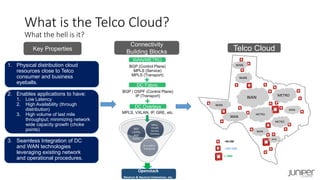
1. Physical distribution cloud
resources close to Telco
consumer and business
eyeballs.
2. Enables applications to have:
1. Low Latency
2. High Availability (through
distribution)
3. High volume of last mile
throughput; minimizing network
wide capacity growth (choke
points)
3. Seamless Integration of DC
and WAN technologies
leveraging existing network
and operational procedures.
What is the Telco Cloud?
What the hell is it?
Key Properties
~50-250
~250-1000
> 1000
Connectivity
Building Blocks
WAN/METRO
BGP (Control Plane)
MPLS (Service)
MPLS (Transport)
DC Fabric
BGP / OSPF (Control Plane)
IP (Transport)
+
DC Overlays
MPLS, VXLAN, IP, GRE, etc.
+
Telco Cloud
WAN METRO
METRO
WAN
WAN
WAN
WAN
WAN
WAN
METRO
WAN
Telco Cloud Requirements
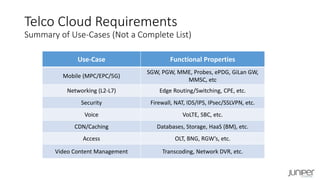
Summary of Use-Cases (Not a Complete List)
Use-Case Functional Properties
Mobile (MPC/EPC/5G)
SGW, PGW, MME, Probes, ePDG, GiLan GW,
MMSC, etc
Networking (L2-L7) Edge Routing/Switching, CPE, etc.
Security Firewall, NAT, IDS/IPS, IPsec/SSLVPN, etc.
Voice VoLTE, SBC, etc.
CDN/Caching Databases, Storage, HaaS (BM), etc.
Access OLT, BNG, RGW’s, etc.
Video Content Management Transcoding, Network DVR, etc.
Telco Cloud Requirements
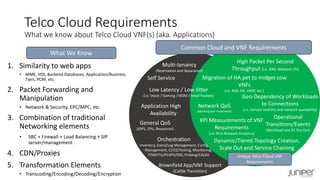
What we know about Telco Cloud VNF(s) (aka. Applications)
1. Similarity to web apps
• MME, HSS, Backend Databases, Application/Business
Tiers, PCRF, etc.
2. Packet Forwarding and
Manipulation
• Network & Security, EPC/MPC, etc.
3. Combination of traditional
Networking elements
• SBC + Firewall + Load Balancing + SIP
server/management
4. CDN/Proxies
5. Transformation Elements
• Transcoding/Encoding/Decoding/Encryption
What We Know
Self Service
Application High
Availability
General QoS
(IOPS, CPU, Resources)
Brownfield App/VNF Support
(Cattle Transition)
Common Cloud and VNF Requirements
Unique Telco Cloud VNF
Requirements
Low Latency / Low Jitter
(i.e. Voice / Gaming / M2M / Small Packets)
High Packet Per Second
Throughput (i.e. DNS, Network I/O)
Network QoS
(Marking and Treatment)
Migration of HA pet to midget cow
VNFs
(i.e. BGP, HA, VRRP, etc.)
Geo-Dependency of Workloads
to Connections
(i.e. Service mobility and network availability)
KPI Measurements of VNF
Requirements
(i.e. Rich Network Analytics)
Operational
Transitions/Events
(Workload and DC Dry Out)
Dynamic/Tiered Topology Creation,
Scale Out and Service Chaining
Multi-tenancy
(Reservation and Separation)
Orchestration
Inventory, Event/Log Management, Config
Management, CI/CD/Testing, Monitoring,
ITSM/ITIL/FCAPS/OSS, Probing/CALEA
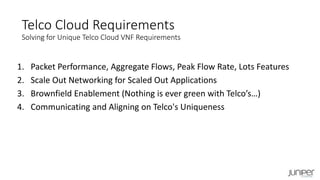
1. Packet Performance, Aggregate Flows, Peak Flow Rate, Lots Features
2. Scale Out Networking for Scaled Out Applications
3. Brownfield Enablement (Nothing is ever green with Telco’s…)
4. Communicating and Aligning on Telco's Uniqueness
Telco Cloud Requirements
Solving for Unique Telco Cloud VNF Requirements
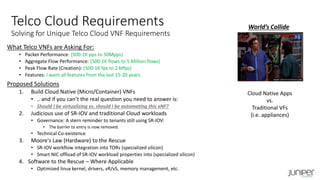
What Telco VNFs are Asking For:
• Packet Performance: (500-1K pps to 50Mpps)
• Aggregate Flow Performance: (500-1K flows to 5 Million flows)
• Peak Flow Rate (Creation): (500-1K fps to 2 Mfps)
• Features: I want all features from the last 15-20 years.
Proposed Solutions
1. Build Cloud Native (Micro/Container) VNFs
• .. and if you can’t the real question you need to answer is:
• Should I be virtualizing vs. should I be automating this xNF?
2. Judicious use of SR-IOV and traditional Cloud workloads
• Governance: A stern reminder to tenants still using SR-IOV:
• The barrier to entry is now removed.
• Technical Co-existence
3. Moore's Law (Hardware) to the Rescue
• SR-IOV workflow integration into TORs (specialized silicon)
• Smart NIC offload of SR-IOV workload properties into (specialized silicon)
4. Software to the Rescue – Where Applicable
• Optimized linux kernel, drivers, vR/vS, memory management, etc.
World’s Collide
Cloud Native Apps
vs.
Traditional VFs
(i.e. appliances)
Telco Cloud Requirements
Solving for Unique Telco Cloud VNF Requirements
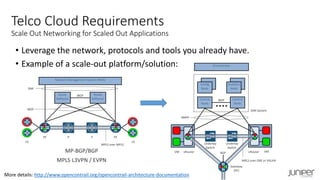
• Leverage the network, protocols and tools you already have.
• Example of a scale-out platform/solution:
Underlay
Switch
vRouter
Control
Node
Control
Node
Underlay
Switch
vRouterVM VM
IBGP
XMPP
MPLS over GRE or VXLAN
Config
Node
Orchestrator
Analytics
Node
SDN System
P PPE PE
Route
Reflector
Route
Reflector
CECE
IBGP
IBGP
MPLS over MPLS
Network Management System (NMS)
DMI
MP-BGP/BGP
MPLS L3VPN / EVPN
Gateway
(PE)
BGP
More details: http://www.opencontrail.org/opencontrail-architecture-documentation
Telco Cloud Requirements
Scale Out Networking for Scaled Out Applications
• Physical Network Functions (PNFs) by nature are legacy and expect certain
behaviors around it
• Traditional PNF vendors not incentivized to re-write/port
• PNF owners (internal or external) have moved on
• Typical technology solutions needed for PNF to VNF migration:
• Liveliness detection and High Availability
• PING, HTTP URI (TCP) level checks, BGP, BFD, etc.
• Dynamic Insertion of Network Reachability
• Think SSL/IPSec Tunnel Termination of remote endpoints (UE’s, Small Cell Site, etc.)
• i.e. BGPaaS https://blueprints.launchpad.net/juniperopenstack/+spec/bgp-as-a-service
• Live Migration of VNFs supporting legacy behaviors as a crutch
• Geo Distributing VNFs where possible
Telco Cloud Requirements
Brownfield Enablement (Nothing is ever green…)
1. Documented Telco Cloud use-cases for operational alignment
• OPNFV
2. Documented APIs and Data Models
• Openstack
• OpenConfig
• IETF
• OPNFV
• Others..
3. Many others I’m Sure…
Telco Cloud Requirements
Communicating and Aligning on Telco's Uniqueness
A Telco Cloud Use Case
(Mobile)
IoT Platform
(MVNOs, IoT LoB)
End to End Orchestration
IaaS/PaaS: Openstack & OpenContrail
Heat Orchestration (Northbound Interface)
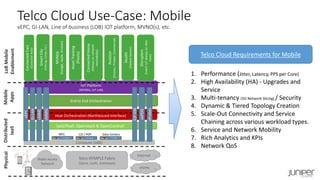
Telco Cloud Requirements for Mobile
Telco Cloud Use-Case: Mobile
vEPC, GI-LAN, Line of business (LOB) IOT platform, MVNO(s), etc.
Radio Access
Network
MEC CO / POP Data Centers
Telco IP/MPLS Fabric
(Spine, Leafs, Gateways)
Internet
PhysicalDistributed
IaaS
Compute (x86)
Mobile
Apps
IPVPN
LoBMobile
Enablement
1. Performance (Jitter, Latency, PPS per Core)
2. High Availability (HA) - Upgrades and
Service
3. Multi-tenancy (5G Network Slicing) / Security
4. Dynamic & Tiered Topology Creation
5. Scale-Out Connectivity and Service
Chaining across various workload types.
6. Service and Network Mobility
7. Rich Analytics and KPIs
8. Network QoSvProbes
vR / Agent vR / Agent vR / Agent
vePDG
SP-GW
vEPC
GI-LAN
vMME
vMMSC
ConnectedCars
(ConsumerAuto)
SmartCity
(Parking,Lamps,etc.)
MVNOs
(Google,Apple,Amazon)
Disrupters
(insertIoTalwaysonidea
here)
AssetTracking
(Fleets)
Aviation
(Drones,Private,Commercial)
ConnectedHome
(Alwaysonnetwork
reachability)
Health
(PatientSensor)
Policy & Billing
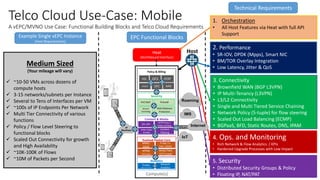
Telco Cloud Use-Case: Mobile
A vEPC/MVNO Use Case: Functional Building Blocks and Telco Cloud Requirements
HSS
CALEA
OCS
OFC
PCRF
AAA
Evolved Packet Core
MME/
SGSN
ePDG
Untrusted
P-GW / S-
GW / GGSN
WAG/TWA
G/Trusted
Security
PAT/NAT
Secure
Tunneling
Firewall
Web Malware
Protection
Content & Media
SPI, DPI
Video Adap.
& MOS
HTTP Proxy /
Video Caching
Content
Filtering
Analytics
Probes
(Data and Control)
Network
Analytics
IP
Backhaul
Heat
(Northbound Interface)
Compute(s)
GILan
Medium Sized
(Your mileage will vary)
 ~10-50 VMs across dozens of
compute hosts
 3-15 networks/subnets per Instance
 Several to Tens of Interfaces per VM
 ~100s of IP Endpoints Per Network
 Multi Tier Connectivity of various
functions
 Policy / Flow Level Steering to
functional blocks
 Scaled Out Connectivity for growth
and High Availability
 ~10K-100K of Flows
 ~10M of Packets per Second
Technical Requirements
Example Single vEPC Instance
(Host Requirements)
EPC Functional Blocks
1. Orchestration
• All Host Features via Heat with full API
Support
2. Performance
• SR-IOV, DPDK (Mpps), Smart NIC
• BM/TOR Overlay Integration
• Low Latency, Jitter & QoS
3. Connectivity
• Brownfield WAN (BGP L3VPN)
• IP Multi-Tenancy (L3VPN)
• L3/L2 Connectivity
• Single and Multi Tiered Service Chaining
• Network Policy (5-tuple) for flow steering
• Scaled Out Load Balancing (ECMP)
• BGPaaS, BFD, Static Routes, DNS, IPAM
4. Ops. and Monitoring
• Rich Network & Flow Analytics / KPIs
• Hardened Upgrade Processes with Low Impact
5. Security
• Distributed Security Groups & Policy
• Floating IP, NAT/PAT
Host
Roaming
IMS
IoT
Internet
Join the OpenContrail Community
http://www.opencontrail.org/
Thanks Ya’ll

The Modern Telco Network: Defining The Telco Cloud

  • 1.
    The Modern TelcoNetwork: Defining The Telco Cloud Marco Rodrigues – Juniper Contrail Solutions Group Openstack Seattle – Telcos / NFV Track Seattle, WA (September 2016) Telco VNF(n)
  • 2.
    Agenda 1. Why theTelco Cloud? 2. What is the Telco Cloud? 3. Telco Cloud Requirements 4. A Telco Cloud Use-Case (Mobile)
  • 3.
  • 4.
    Why The TelcoCloud? Current State of Affairs: IP Transport Commoditization IP Transport (Internet) Providers Cloud / XaaS Providers (Centralized) The Customer Experience InvestmentThe User: Consumer and Businesses
  • 5.
    Why The TelcoCloud? Economics and Growth • * Networking Facts: 1991-2015 • Exponential Internet Growth, no matter what metric is used  Number of users: factor of 3 x 10⁹  Number of devices: factor of 5 x 10⁹  Number of web-sites: factor of 2 x 10⁸  Number of applications: factor of 107  Total Bandwidth: factor of 5 x 10⁷ * OFC 15 Pradeep Sindu Keynote, “The Future of Transport Networks” Exponential growth is the clearest indication of the Internet’s value. Why are telco’s being challenged with the continuous monetization of this value? Customer perception of value is proportional to their immediate experience; which translates into what they’re willing to pay for.
  • 6.
    Why The TelcoCloud? Introducing the Telco Cloud in the ’The Value Stack’ Future SMS Physical (Copper/Fiber /Radio) Voice Data (Internet / IP ) SMS Physical (Copper/Fiber/Radio) Voice Data (Internet / IP) 2000s – 2010s SMS Physical (Copper/Fiber/Radio) Voice 1960s-2000s Physical (Copper/Fiber/Radio) Voice 1900s-1990s Services / Content SaaS Centralized Platforms PaaS, IaaS, etc SMS Physical (Copper/Fiber /Radio) Voice Data (Internet / IP ) Today Services / Content SaaS Centralized Platforms PaaS, IaaS,, etc. Distributed Telco Cloud Value The Real Value: Value Moving Up The Value Stack and away from Telco’s
  • 7.
    Why The TelcoCloud? What’s Next 1. TCO: Reduce CAPEX and OPEX 2. Building NEW Revenue Streams: A New Platform – Telco Cloud
  • 8.
    “API’s are fuelingthe software that’s eating the world and why networks are next” – Me Why The Telco Cloud? Breaking Vendor Lock-In (Lowering OPEX and CAPEX) APIs Data Models Note: Not the focus of this presentation – but worth mentioning for calibration.
  • 9.
    Today: Centralized Public and PrivateClouds Workloads (Containers, LXC, VM, BM) Workflow Orientated (Open API’s, Automation) Elastic Resources(Pooled Network, Storage and Compute) Analytics (Data Driven Delivery of Services/Content) Centralized (Limited Distribution) Open (OpenSource) Workloads (Containers, LXC, VM, BM) Workflow Orientated (Open API’s, Automation) Elastic Resources (Pooled Network, Storage and Compute) Analytics (Data Driven Delivery of Services/Content) Open (OpenSource) Future: Distributed Multi Clouds Highly Distributed (Telco Cloud) Applications, OTT’s and VNF’s Key Properties of a Distributed Cloud:  Physical Distribution  Low Latency  High Availability  Network Traffic Optimization  Seamless Integration of DCs with brownfield WAN deployments Why The Telco Cloud? Building NEW Revenue Streams: A New Platform – Telco Cloud
  • 10.
    What is theTelco Cloud?
  • 11.
    Openstack Neutron & NeutronExtensions, etc. IP or MPLS Transports BGP L3VPN, BGP EVPN MPLS, VXLAN Service Overlays 1. Physical distribution cloud resources close to Telco consumer and business eyeballs. 2. Enables applications to have: 1. Low Latency 2. High Availability (through distribution) 3. High volume of last mile throughput; minimizing network wide capacity growth (choke points) 3. Seamless Integration of DC and WAN technologies leveraging existing network and operational procedures. What is the Telco Cloud? What the hell is it? Key Properties ~50-250 ~250-1000 > 1000 Connectivity Building Blocks WAN/METRO BGP (Control Plane) MPLS (Service) MPLS (Transport) DC Fabric BGP / OSPF (Control Plane) IP (Transport) + DC Overlays MPLS, VXLAN, IP, GRE, etc. + Telco Cloud WAN METRO METRO WAN WAN WAN WAN WAN WAN METRO WAN
  • 12.
  • 13.
    Telco Cloud Requirements Summaryof Use-Cases (Not a Complete List) Use-Case Functional Properties Mobile (MPC/EPC/5G) SGW, PGW, MME, Probes, ePDG, GiLan GW, MMSC, etc Networking (L2-L7) Edge Routing/Switching, CPE, etc. Security Firewall, NAT, IDS/IPS, IPsec/SSLVPN, etc. Voice VoLTE, SBC, etc. CDN/Caching Databases, Storage, HaaS (BM), etc. Access OLT, BNG, RGW’s, etc. Video Content Management Transcoding, Network DVR, etc.
  • 14.
    Telco Cloud Requirements Whatwe know about Telco Cloud VNF(s) (aka. Applications) 1. Similarity to web apps • MME, HSS, Backend Databases, Application/Business Tiers, PCRF, etc. 2. Packet Forwarding and Manipulation • Network & Security, EPC/MPC, etc. 3. Combination of traditional Networking elements • SBC + Firewall + Load Balancing + SIP server/management 4. CDN/Proxies 5. Transformation Elements • Transcoding/Encoding/Decoding/Encryption What We Know Self Service Application High Availability General QoS (IOPS, CPU, Resources) Brownfield App/VNF Support (Cattle Transition) Common Cloud and VNF Requirements Unique Telco Cloud VNF Requirements Low Latency / Low Jitter (i.e. Voice / Gaming / M2M / Small Packets) High Packet Per Second Throughput (i.e. DNS, Network I/O) Network QoS (Marking and Treatment) Migration of HA pet to midget cow VNFs (i.e. BGP, HA, VRRP, etc.) Geo-Dependency of Workloads to Connections (i.e. Service mobility and network availability) KPI Measurements of VNF Requirements (i.e. Rich Network Analytics) Operational Transitions/Events (Workload and DC Dry Out) Dynamic/Tiered Topology Creation, Scale Out and Service Chaining Multi-tenancy (Reservation and Separation) Orchestration Inventory, Event/Log Management, Config Management, CI/CD/Testing, Monitoring, ITSM/ITIL/FCAPS/OSS, Probing/CALEA
  • 15.
    1. Packet Performance,Aggregate Flows, Peak Flow Rate, Lots Features 2. Scale Out Networking for Scaled Out Applications 3. Brownfield Enablement (Nothing is ever green with Telco’s…) 4. Communicating and Aligning on Telco's Uniqueness Telco Cloud Requirements Solving for Unique Telco Cloud VNF Requirements
  • 16.
    What Telco VNFsare Asking For: • Packet Performance: (500-1K pps to 50Mpps) • Aggregate Flow Performance: (500-1K flows to 5 Million flows) • Peak Flow Rate (Creation): (500-1K fps to 2 Mfps) • Features: I want all features from the last 15-20 years. Proposed Solutions 1. Build Cloud Native (Micro/Container) VNFs • .. and if you can’t the real question you need to answer is: • Should I be virtualizing vs. should I be automating this xNF? 2. Judicious use of SR-IOV and traditional Cloud workloads • Governance: A stern reminder to tenants still using SR-IOV: • The barrier to entry is now removed. • Technical Co-existence 3. Moore's Law (Hardware) to the Rescue • SR-IOV workflow integration into TORs (specialized silicon) • Smart NIC offload of SR-IOV workload properties into (specialized silicon) 4. Software to the Rescue – Where Applicable • Optimized linux kernel, drivers, vR/vS, memory management, etc. World’s Collide Cloud Native Apps vs. Traditional VFs (i.e. appliances) Telco Cloud Requirements Solving for Unique Telco Cloud VNF Requirements
  • 17.
    • Leverage thenetwork, protocols and tools you already have. • Example of a scale-out platform/solution: Underlay Switch vRouter Control Node Control Node Underlay Switch vRouterVM VM IBGP XMPP MPLS over GRE or VXLAN Config Node Orchestrator Analytics Node SDN System P PPE PE Route Reflector Route Reflector CECE IBGP IBGP MPLS over MPLS Network Management System (NMS) DMI MP-BGP/BGP MPLS L3VPN / EVPN Gateway (PE) BGP More details: http://www.opencontrail.org/opencontrail-architecture-documentation Telco Cloud Requirements Scale Out Networking for Scaled Out Applications
  • 18.
    • Physical NetworkFunctions (PNFs) by nature are legacy and expect certain behaviors around it • Traditional PNF vendors not incentivized to re-write/port • PNF owners (internal or external) have moved on • Typical technology solutions needed for PNF to VNF migration: • Liveliness detection and High Availability • PING, HTTP URI (TCP) level checks, BGP, BFD, etc. • Dynamic Insertion of Network Reachability • Think SSL/IPSec Tunnel Termination of remote endpoints (UE’s, Small Cell Site, etc.) • i.e. BGPaaS https://blueprints.launchpad.net/juniperopenstack/+spec/bgp-as-a-service • Live Migration of VNFs supporting legacy behaviors as a crutch • Geo Distributing VNFs where possible Telco Cloud Requirements Brownfield Enablement (Nothing is ever green…)
  • 19.
    1. Documented TelcoCloud use-cases for operational alignment • OPNFV 2. Documented APIs and Data Models • Openstack • OpenConfig • IETF • OPNFV • Others.. 3. Many others I’m Sure… Telco Cloud Requirements Communicating and Aligning on Telco's Uniqueness
  • 20.
    A Telco CloudUse Case (Mobile)
  • 21.
    IoT Platform (MVNOs, IoTLoB) End to End Orchestration IaaS/PaaS: Openstack & OpenContrail Heat Orchestration (Northbound Interface) Telco Cloud Requirements for Mobile Telco Cloud Use-Case: Mobile vEPC, GI-LAN, Line of business (LOB) IOT platform, MVNO(s), etc. Radio Access Network MEC CO / POP Data Centers Telco IP/MPLS Fabric (Spine, Leafs, Gateways) Internet PhysicalDistributed IaaS Compute (x86) Mobile Apps IPVPN LoBMobile Enablement 1. Performance (Jitter, Latency, PPS per Core) 2. High Availability (HA) - Upgrades and Service 3. Multi-tenancy (5G Network Slicing) / Security 4. Dynamic & Tiered Topology Creation 5. Scale-Out Connectivity and Service Chaining across various workload types. 6. Service and Network Mobility 7. Rich Analytics and KPIs 8. Network QoSvProbes vR / Agent vR / Agent vR / Agent vePDG SP-GW vEPC GI-LAN vMME vMMSC ConnectedCars (ConsumerAuto) SmartCity (Parking,Lamps,etc.) MVNOs (Google,Apple,Amazon) Disrupters (insertIoTalwaysonidea here) AssetTracking (Fleets) Aviation (Drones,Private,Commercial) ConnectedHome (Alwaysonnetwork reachability) Health (PatientSensor)
  • 22.
    Policy & Billing TelcoCloud Use-Case: Mobile A vEPC/MVNO Use Case: Functional Building Blocks and Telco Cloud Requirements HSS CALEA OCS OFC PCRF AAA Evolved Packet Core MME/ SGSN ePDG Untrusted P-GW / S- GW / GGSN WAG/TWA G/Trusted Security PAT/NAT Secure Tunneling Firewall Web Malware Protection Content & Media SPI, DPI Video Adap. & MOS HTTP Proxy / Video Caching Content Filtering Analytics Probes (Data and Control) Network Analytics IP Backhaul Heat (Northbound Interface) Compute(s) GILan Medium Sized (Your mileage will vary)  ~10-50 VMs across dozens of compute hosts  3-15 networks/subnets per Instance  Several to Tens of Interfaces per VM  ~100s of IP Endpoints Per Network  Multi Tier Connectivity of various functions  Policy / Flow Level Steering to functional blocks  Scaled Out Connectivity for growth and High Availability  ~10K-100K of Flows  ~10M of Packets per Second Technical Requirements Example Single vEPC Instance (Host Requirements) EPC Functional Blocks 1. Orchestration • All Host Features via Heat with full API Support 2. Performance • SR-IOV, DPDK (Mpps), Smart NIC • BM/TOR Overlay Integration • Low Latency, Jitter & QoS 3. Connectivity • Brownfield WAN (BGP L3VPN) • IP Multi-Tenancy (L3VPN) • L3/L2 Connectivity • Single and Multi Tiered Service Chaining • Network Policy (5-tuple) for flow steering • Scaled Out Load Balancing (ECMP) • BGPaaS, BFD, Static Routes, DNS, IPAM 4. Ops. and Monitoring • Rich Network & Flow Analytics / KPIs • Hardened Upgrade Processes with Low Impact 5. Security • Distributed Security Groups & Policy • Floating IP, NAT/PAT Host Roaming IMS IoT Internet
  • 23.
    Join the OpenContrailCommunity http://www.opencontrail.org/
  • 24.