
The Missing Step
in Release Management
    Andrew Phillips, XebiaLabs
Agenda
• Company
• Release Management drivers today
• Release Automation: the Missing Step
• Key considerations
• Case study
• Summary
"As software becomes more embedded in the
       business, firms are discovering that the velocity
       of business change is now limited by how
       quickly they can deploy."


“Five Ways To Streamline Release Management”, J.S. Hammond
Company

 •   The Leading Provider of Application Release Automation
 •   Offices in US, the Netherlands, France, UK, India
 •   Customers in 15 countries
 •   Global Partner Network
Time-to-market is critical


   “Our business is pushing us to deliver new features
   and functions faster”
                                     “Five Ways To Streamline Release Management”
Time-to-market is critical…across all industries

         Retail              Finance           Healthcare


      Government            Transport


   “Our business is pushing us to deliver new features
   and functions faster”
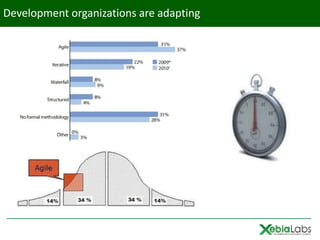
Development organizations are adapting
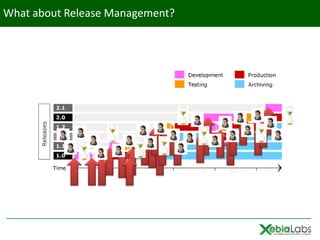
What about Release Management?


 • Fewer than 5% have release teams
   focused on continuous delivery

 “teams frustrated with slow software delivery
   and their release management process”

 “many frustrating issues that keep teams from
   releasing software with visibility,
   predictability, and speed”
 "Release Management And The 'First Rule Of Holes'", J.S. Hammond
 “Five Ways To Streamline Release Management”
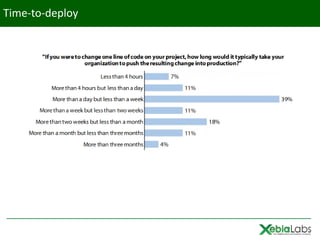
Time-to-deploy
Time-to-deploy


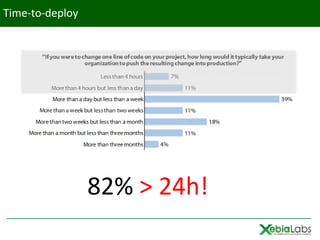
                 82% > 24h!
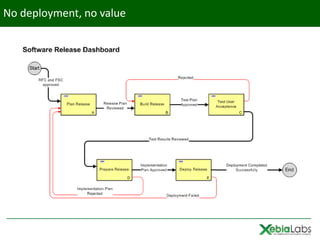
No deployment, no value


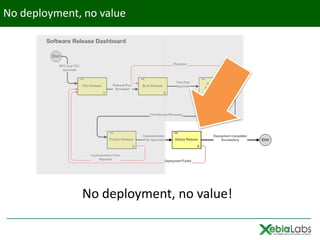
              No deployment, no value!
What about Release Management?


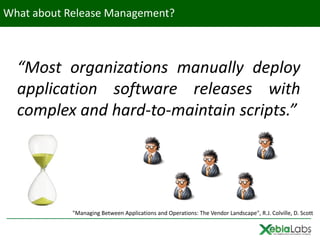
  “Most organizations manually deploy
  application software releases with
  complex and hard-to-maintain scripts.”


            "Managing Between Applications and Operations: The Vendor Landscape", R.J. Colville, D. Scott
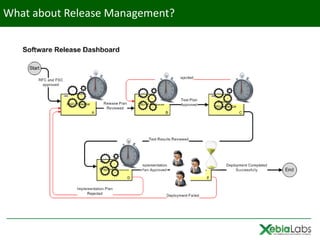
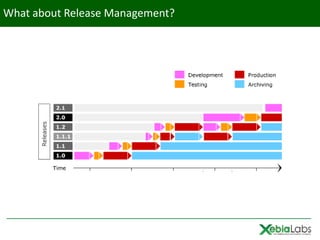
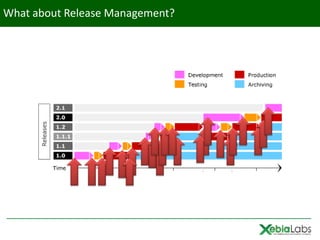
What about Release Management?
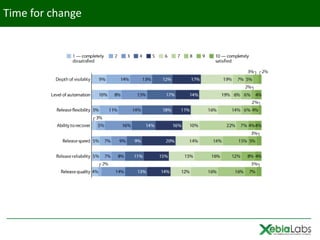
Time for change
Time for change


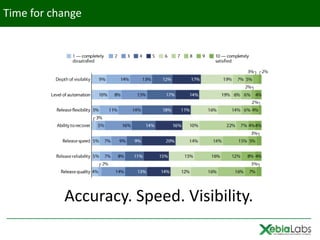
           Accuracy. Speed. Visibility.
Time for change


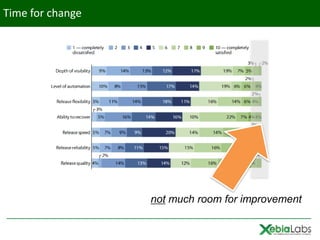
                  not much room for improvement
Time for Release Automation


   “Release management is a key
   discipline that with the right
   automation     can       significantly
   improve agility and ensure more
   reliable change activities resulting
   in improved availability.”

  "Cool Vendors in Release Management, 2011“, R.J. Colville, D. Scott (own emphasis)
Time for Release Automation


   “25% of large IT organizations will
   establish release teams that span
   application    development     and
   production focused on continuous
   delivery”


   "Managing Between Applications and Operations”
Time for Release Automation


   “Application    provisioning  and
   release automation tools can
   improve the application update
   process by delivering consistency
   and reducing time to deploy.”


   "Managing Between Applications and Operations”
Time for Release Automation


   “increase in activity for ARA and
   configuration     requirements      for
   automating the deployment, upgrade
   and configuration of custom application
   software      across      development
   environments and into production”


   "Managing Between Applications and Operations”
Time for Release Automation


   “RunBook Automation tools [...] require
   significantly more investment than
   release automation tools and do not
   meet the needs of customers today”


   "Managing Between Applications and Operations”
Key considerations


  • “Eliminate the need to build and
    maintain custom scripts for application
    updates
  • Add more reliability to the deployment
    process with less custom scripting to
    reduce configuration errors and
    downtime”


                                 "Managing Between Applications and Operations”
Key considerations


  • “Eliminate the need to build and
    maintain custom scripts for application
    updates
  • Add more reliability to the deployment
    process with less custom scripting to
    reduce configuration errors and
    downtime”

                     Accuracy.
Key considerations


  • “Move the skill base from expensive,
    specialized script programmers to less-
    costly resources”


                               "Managing Between Applications and Operations”
Key considerations


  • “Move the skill base from expensive,
    specialized script programmers to less-
    costly resources”


                     Self-service.
Key considerations


  • “Speed time to market associated with
    agile development by reducing the
    time it takes to deploy and configure
    across all environments”


                              "Managing Between Applications and Operations”
Key considerations


  • “Speed time to market associated with
    agile development by reducing the
    time it takes to deploy and configure
    across all environments”


                     Speed.
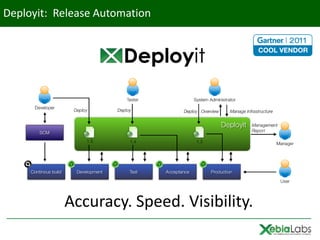
Deployit: Release Automation


           Accuracy. Speed. Visibility.
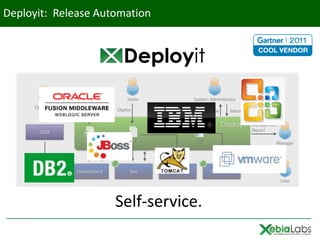
Deployit: Release Automation


                     Self-service.
Zero-maintenance Release Automation


  • “To meet the needs of application
    development, IT operations, and the business,
    follow three release management best
    practices:
     1) build a strong release team
     2) get serious about production
        readiness standards
     3) continuously tune release frequency
        and type”
                                 "Best Practices In Release Management", C. Schwaber
Zero-maintenance Release Automation


  • “To meet the needs of application development, IT
    operations, and the business, follow three release
    management best practices:
     1) build a strong release team
     2) get serious about production readiness
         standards

     3) continuously tune release
        frequency and type”
Zero-maintenance Release Automation


   Release Automation solutions
   need to adapt to your
   environment and handle
   changes to your infrastructure,
   applications and platforms
Zero-maintenance Release Automation


   Release Automation solutions need to
   adapt to your environment and
   handle changes to your infrastructure,
   applications and platforms


   Scalability requires
   “Zero-maintenance Release Automation”
Zero-maintenance Release Automation


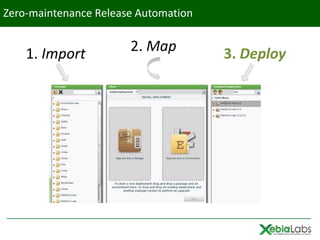
    1. Import          2. Map         3. Deploy
Zero-maintenance Release Automation


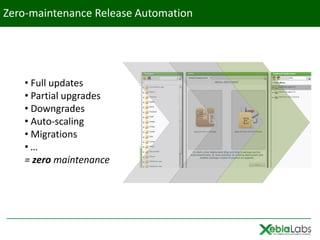
   • Full updates
   • Partial upgrades
   • Downgrades
   • Auto-scaling
   • Migrations
   •…
   = zero maintenance
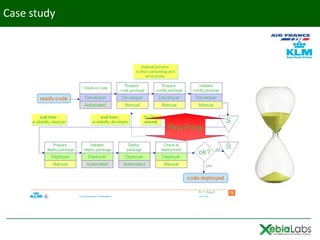
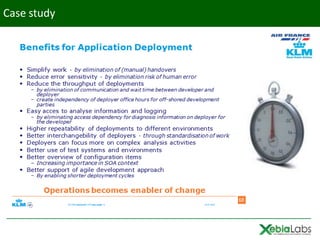
Case study
Case study
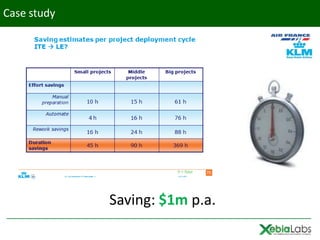
Case study
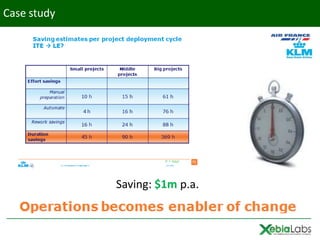
Case study


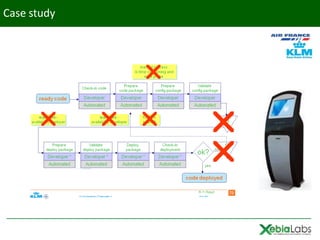
             Saving: $1m p.a.
Case study


             Saving: $1m p.a.
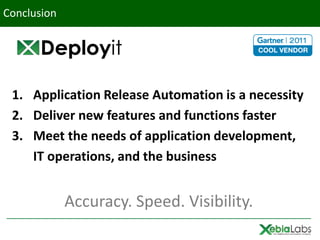
Conclusion


 1. Application Release Automation is a necessity
 2. Deliver new features and functions faster
 3. Meet the needs of application development,
    IT operations, and the business


             Accuracy. Speed. Visibility.
What can you do to learn more about
   Application Release Automation?
• A one on one call to discuss your situation

• A full free demo of Deployit’s capabilities

• A free pilot


                 aphillips@xebialabs.com
                   www.xebialabs.com

The Missing Step in Release Management

  • 1.
    The Missing Step inRelease Management Andrew Phillips, XebiaLabs
  • 2.
    Agenda • Company • ReleaseManagement drivers today • Release Automation: the Missing Step • Key considerations • Case study • Summary
  • 3.
    "As software becomesmore embedded in the business, firms are discovering that the velocity of business change is now limited by how quickly they can deploy." “Five Ways To Streamline Release Management”, J.S. Hammond
  • 4.
    Company • The Leading Provider of Application Release Automation • Offices in US, the Netherlands, France, UK, India • Customers in 15 countries • Global Partner Network
  • 5.
    Time-to-market is critical “Our business is pushing us to deliver new features and functions faster” “Five Ways To Streamline Release Management”
  • 6.
    Time-to-market is critical…acrossall industries Retail Finance Healthcare Government Transport “Our business is pushing us to deliver new features and functions faster”
  • 7.
  • 8.
    What about ReleaseManagement? • Fewer than 5% have release teams focused on continuous delivery “teams frustrated with slow software delivery and their release management process” “many frustrating issues that keep teams from releasing software with visibility, predictability, and speed” "Release Management And The 'First Rule Of Holes'", J.S. Hammond “Five Ways To Streamline Release Management”
  • 9.
  • 10.
    Time-to-deploy 82% > 24h!
  • 11.
  • 12.
    No deployment, novalue No deployment, no value!
  • 13.
    What about ReleaseManagement? “Most organizations manually deploy application software releases with complex and hard-to-maintain scripts.” "Managing Between Applications and Operations: The Vendor Landscape", R.J. Colville, D. Scott
  • 14.
    What about ReleaseManagement?
  • 15.
    What about ReleaseManagement?
  • 16.
    What about ReleaseManagement?
  • 17.
    What about ReleaseManagement?
  • 18.
  • 19.
    Time for change Accuracy. Speed. Visibility.
  • 20.
    Time for change not much room for improvement
  • 21.
    Time for ReleaseAutomation “Release management is a key discipline that with the right automation can significantly improve agility and ensure more reliable change activities resulting in improved availability.” "Cool Vendors in Release Management, 2011“, R.J. Colville, D. Scott (own emphasis)
  • 22.
    Time for ReleaseAutomation “25% of large IT organizations will establish release teams that span application development and production focused on continuous delivery” "Managing Between Applications and Operations”
  • 23.
    Time for ReleaseAutomation “Application provisioning and release automation tools can improve the application update process by delivering consistency and reducing time to deploy.” "Managing Between Applications and Operations”
  • 24.
    Time for ReleaseAutomation “increase in activity for ARA and configuration requirements for automating the deployment, upgrade and configuration of custom application software across development environments and into production” "Managing Between Applications and Operations”
  • 25.
    Time for ReleaseAutomation “RunBook Automation tools [...] require significantly more investment than release automation tools and do not meet the needs of customers today” "Managing Between Applications and Operations”
  • 26.
    Key considerations • “Eliminate the need to build and maintain custom scripts for application updates • Add more reliability to the deployment process with less custom scripting to reduce configuration errors and downtime” "Managing Between Applications and Operations”
  • 27.
    Key considerations • “Eliminate the need to build and maintain custom scripts for application updates • Add more reliability to the deployment process with less custom scripting to reduce configuration errors and downtime” Accuracy.
  • 28.
    Key considerations • “Move the skill base from expensive, specialized script programmers to less- costly resources” "Managing Between Applications and Operations”
  • 29.
    Key considerations • “Move the skill base from expensive, specialized script programmers to less- costly resources” Self-service.
  • 30.
    Key considerations • “Speed time to market associated with agile development by reducing the time it takes to deploy and configure across all environments” "Managing Between Applications and Operations”
  • 31.
    Key considerations • “Speed time to market associated with agile development by reducing the time it takes to deploy and configure across all environments” Speed.
  • 32.
    Deployit: Release Automation Accuracy. Speed. Visibility.
  • 33.
  • 34.
    Zero-maintenance Release Automation • “To meet the needs of application development, IT operations, and the business, follow three release management best practices: 1) build a strong release team 2) get serious about production readiness standards 3) continuously tune release frequency and type” "Best Practices In Release Management", C. Schwaber
  • 35.
    Zero-maintenance Release Automation • “To meet the needs of application development, IT operations, and the business, follow three release management best practices: 1) build a strong release team 2) get serious about production readiness standards 3) continuously tune release frequency and type”
  • 36.
    Zero-maintenance Release Automation Release Automation solutions need to adapt to your environment and handle changes to your infrastructure, applications and platforms
  • 37.
    Zero-maintenance Release Automation Release Automation solutions need to adapt to your environment and handle changes to your infrastructure, applications and platforms Scalability requires “Zero-maintenance Release Automation”
  • 38.
    Zero-maintenance Release Automation 1. Import 2. Map 3. Deploy
  • 39.
    Zero-maintenance Release Automation • Full updates • Partial upgrades • Downgrades • Auto-scaling • Migrations •… = zero maintenance
  • 40.
  • 41.
  • 42.
  • 43.
    Case study Saving: $1m p.a.
  • 44.
    Case study Saving: $1m p.a.
  • 45.
    Conclusion 1. ApplicationRelease Automation is a necessity 2. Deliver new features and functions faster 3. Meet the needs of application development, IT operations, and the business Accuracy. Speed. Visibility.
  • 46.
    What can youdo to learn more about Application Release Automation? • A one on one call to discuss your situation • A full free demo of Deployit’s capabilities • A free pilot aphillips@xebialabs.com www.xebialabs.com