The Lean Startup
January 2013
All information in this presentation is the sole property of Leverate Technological Trading Ltd. It may not
be distributed, presented to a third party nor used in any form or method without written permission
from the company.
Premium Broker Solutions Provider
Vision
This slide originally contained Leverate’s grand vision for 2013.
We’re very excited about it, but unfortunately we can’t show it to everyone 
The main point is: this vision, like any vision, is a startup. It looks compelling and exciting,
but it’s based on many assumptions. Could those assumptions be wrong? Should we
really invest a huge amount of capital and resources into building this thing?
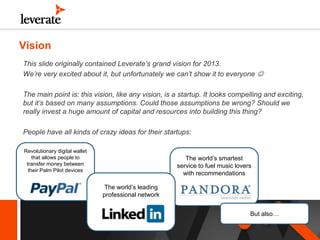
People have all kinds of crazy ideas for their startups:
Revolutionary digital wallet
that allows people to
transfer money between
their Palm Pilot devices
The world’s smartest
service to fuel music lovers
with recommendations
The world’s leading
professional network
But also…
The problem
What kills startups
• Wait… what is a startup?
• The course of a startup: funding, runway and 2+ possible outcomes
• Failure rate is high (varies between sources, commonly 60% to 99.5%)
• The problem: startups invest too much in bad vision
• List of things that won’t save you
• Being smart
• Dream up more vision and ideas ”startups don’t starve, they drown”
• Change market risk there’s not much you can do
• Add many features
• Have great technology
• Do agile R&D
• Deliver milestones under deadlines many companies “achieve failure”
• Achieve seemingly high numbers
• Developed by Eric Reis (blog: startup lessons learned)
• The Lean Startup is a toolbox that aims to increase your chance to succeed:
• Put your vision to test and fail fast
• Build exactly what people want, not what you think they want
• Strive to learn, not release new features
• Do it over and over again
• ACCELERATE
• Definition of startup is surprising:“A startup is a human institution designed to
deliver a new product or service under conditions of extreme uncertainty.”
• Geeks in garage? Software? Not only! Applied in US Government & Pentagon,
P&G, nonprofits and other areas.
• Unknowns: problem, solution, audience, business model
The Lean Startup
The Lean Startup Loop
Tool #1: Minimum Viable Product (MVP)
• Identify your assumptions and create a small set of features to validate them
• With little or no engineering at all!
• Algorithm: whatever you think it is, it’s probably way smaller
• Example: (acquired for $1.2B)
• The problem
• The solution:
Find and launch the smallest
possible product that proves that
your vision works in reality (and not only in your brain)
Examples of MVP
promotes a
product that
doesn’t exist yet
(now $3.2B) open a
WordPress blog and
offer coupons for
Pizzeria down the lobby-
20 people take it
makes a fake video
before product is
ready, 75K people
sign up overnight
Launches first
MVP, costs $1,206
wanted to be
eToro, had 450K
users but zero
revenues
launches cheap
website on a single
server, landing
page only for API
Tool #2: Actionable Metrics
• The problem
• The solution: identify your most important metrics and focus on improving only them
• The rest is vanity metrics! A great way to fall to the land of the living dead startups
• To find a local maximum, use A/B testing, landing pages, Continuous Deployment
• If things don’t look good: pivot
# active users CAC
conversion % retention /
churn %
LTV
# new users activation %
viral coefficient
Revenue
Did it right
Age 3 months:
MVP for social
activism+
doncations,
cost $1,206
:months6Age
Optimized with
A/B
Age 8 months:
rely on facebook
+ twitter, verify
voters, @2gov
Age 12
months: go
B2B after LOI
Raised
investment after
18 months,
~$120K
(exponential)
15 months:
Platform pivot-
AdWords like
(pay per
success)
PIVOT! PIVOT!PIVOT!
Tool #3: The 5 Why’s
• The problem
• Example:
• A new release broke a key feature for customers. Why?
Because a particular server failed.
• Why did the server fail?
Because an obscure subsystem was used in the wrong way.
• Why was it used in the wrong way?
The engineer who used it didn't know how to use it properly.
• Why didn't he know?
Because he was never trained.
• Why wasn't he trained?
Because his manager doesn't believe in training new engineers, because they
are "too busy.“
• Now invest proportionally in fixing the problems
Summary
• Thought tool #1: identify the hidden assumptions in what startups are building
• Thought tool #2: identify when too much work is done according to gut feeling
• Tool #1: Launch an MVP with minimal effort
• Tool #2: Rely on actionable metrics, not vanity metrics
• Tool #3: Improve your process by using the 5 why’s
• And it’s not an option because everything is changing:
• Risk- from technology risk to business risk “if you can dream it, you can build it”
• Technology- open source, cloud, hardware- competition is getting wild
• Investors & funding - be efficient and profitable
• The speed of your competitors
Questions?
Premium Broker Solutions Provider

The Lean Startup

  • 1.
    The Lean Startup January2013 All information in this presentation is the sole property of Leverate Technological Trading Ltd. It may not be distributed, presented to a third party nor used in any form or method without written permission from the company. Premium Broker Solutions Provider
  • 2.
    Vision This slide originallycontained Leverate’s grand vision for 2013. We’re very excited about it, but unfortunately we can’t show it to everyone  The main point is: this vision, like any vision, is a startup. It looks compelling and exciting, but it’s based on many assumptions. Could those assumptions be wrong? Should we really invest a huge amount of capital and resources into building this thing? People have all kinds of crazy ideas for their startups: Revolutionary digital wallet that allows people to transfer money between their Palm Pilot devices The world’s smartest service to fuel music lovers with recommendations The world’s leading professional network But also…
  • 4.
  • 5.
    What kills startups •Wait… what is a startup? • The course of a startup: funding, runway and 2+ possible outcomes • Failure rate is high (varies between sources, commonly 60% to 99.5%) • The problem: startups invest too much in bad vision • List of things that won’t save you • Being smart • Dream up more vision and ideas ”startups don’t starve, they drown” • Change market risk there’s not much you can do • Add many features • Have great technology • Do agile R&D • Deliver milestones under deadlines many companies “achieve failure” • Achieve seemingly high numbers
  • 6.
    • Developed byEric Reis (blog: startup lessons learned) • The Lean Startup is a toolbox that aims to increase your chance to succeed: • Put your vision to test and fail fast • Build exactly what people want, not what you think they want • Strive to learn, not release new features • Do it over and over again • ACCELERATE • Definition of startup is surprising:“A startup is a human institution designed to deliver a new product or service under conditions of extreme uncertainty.” • Geeks in garage? Software? Not only! Applied in US Government & Pentagon, P&G, nonprofits and other areas. • Unknowns: problem, solution, audience, business model The Lean Startup
  • 7.
  • 8.
    Tool #1: MinimumViable Product (MVP) • Identify your assumptions and create a small set of features to validate them • With little or no engineering at all! • Algorithm: whatever you think it is, it’s probably way smaller • Example: (acquired for $1.2B) • The problem • The solution: Find and launch the smallest possible product that proves that your vision works in reality (and not only in your brain)
  • 9.
    Examples of MVP promotesa product that doesn’t exist yet (now $3.2B) open a WordPress blog and offer coupons for Pizzeria down the lobby- 20 people take it makes a fake video before product is ready, 75K people sign up overnight Launches first MVP, costs $1,206 wanted to be eToro, had 450K users but zero revenues launches cheap website on a single server, landing page only for API
  • 10.
    Tool #2: ActionableMetrics • The problem • The solution: identify your most important metrics and focus on improving only them • The rest is vanity metrics! A great way to fall to the land of the living dead startups • To find a local maximum, use A/B testing, landing pages, Continuous Deployment • If things don’t look good: pivot # active users CAC conversion % retention / churn % LTV # new users activation % viral coefficient Revenue
  • 11.
    Did it right Age3 months: MVP for social activism+ doncations, cost $1,206 :months6Age Optimized with A/B Age 8 months: rely on facebook + twitter, verify voters, @2gov Age 12 months: go B2B after LOI Raised investment after 18 months, ~$120K (exponential) 15 months: Platform pivot- AdWords like (pay per success) PIVOT! PIVOT!PIVOT!
  • 12.
    Tool #3: The5 Why’s • The problem • Example: • A new release broke a key feature for customers. Why? Because a particular server failed. • Why did the server fail? Because an obscure subsystem was used in the wrong way. • Why was it used in the wrong way? The engineer who used it didn't know how to use it properly. • Why didn't he know? Because he was never trained. • Why wasn't he trained? Because his manager doesn't believe in training new engineers, because they are "too busy.“ • Now invest proportionally in fixing the problems
  • 13.
    Summary • Thought tool#1: identify the hidden assumptions in what startups are building • Thought tool #2: identify when too much work is done according to gut feeling • Tool #1: Launch an MVP with minimal effort • Tool #2: Rely on actionable metrics, not vanity metrics • Tool #3: Improve your process by using the 5 why’s • And it’s not an option because everything is changing: • Risk- from technology risk to business risk “if you can dream it, you can build it” • Technology- open source, cloud, hardware- competition is getting wild • Investors & funding - be efficient and profitable • The speed of your competitors
  • 14.