The Lean Six Sigma Curriculum


      The Lean Six Sigma

                    Curriculum

                                Presented

                                   By

                            Ciarán May


        BELSS Training & Consulting


BELSS 16/08/2010                            1/12
The Lean Six Sigma Curriculum


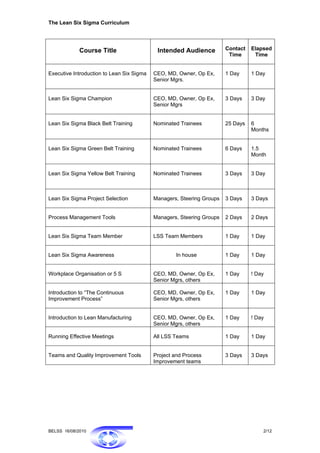
             Course Title                   Intended Audience          Contact   Elapsed
                                                                        Time      Time


Executive Introduction to Lean Six Sigma   CEO, MD, Owner, Op Ex,      1 Day     1 Day
                                           Senior Mgrs.


Lean Six Sigma Champion                    CEO, MD, Owner, Op Ex,      3 Days    3 Day
                                           Senior Mgrs


Lean Six Sigma Black Belt Training         Nominated Trainees          25 Days   6
                                                                                 Months


Lean Six Sigma Green Belt Training         Nominated Trainees          6 Days    1.5
                                                                                 Month


Lean Six Sigma Yellow Belt Training        Nominated Trainees          3 Days    3 Day


Lean Six Sigma Project Selection           Managers, Steering Groups   3 Days    3 Days


Process Management Tools                   Managers, Steering Groups   2 Days    2 Days


Lean Six Sigma Team Member                 LSS Team Members            1 Day     1 Day


Lean Six Sigma Awareness                           In house            1 Day     1 Day


Workplace Organisation or 5 S              CEO, MD, Owner, Op Ex,      1 Day     ! Day
                                           Senior Mgrs, others

Introduction to “The Continuous            CEO, MD, Owner, Op Ex,      1 Day     1 Day
Improvement Process”                       Senior Mgrs, others


Introduction to Lean Manufacturing         CEO, MD, Owner, Op Ex,      1 Day     ! Day
                                           Senior Mgrs, others

Running Effective Meetings                 All LSS Teams               1 Day     1 Day


Teams and Quality Improvement Tools        Project and Process         3 Days    3 Days
                                           Improvement teams


BELSS 16/08/2010                                                                     2/12
The Lean Six Sigma Curriculum


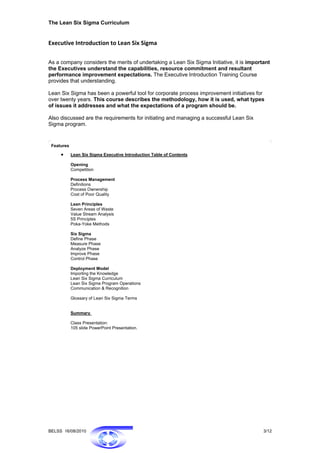
Executive Introduction to Lean Six Sigma 

As a company considers the merits of undertaking a Lean Six Sigma Initiative, it is important
the Executives understand the capabilities, resource commitment and resultant
performance improvement expectations. The Executive Introduction Training Course
provides that understanding.

Lean Six Sigma has been a powerful tool for corporate process improvement initiatives for
over twenty years. This course describes the methodology, how it is used, what types
of issues it addresses and what the expectations of a program should be.

Also discussed are the requirements for initiating and managing a successful Lean Six
Sigma program.


 Features

     •      Lean Six Sigma Executive Introduction Table of Contents

            Opening
            Competition

            Process Management
            Definitions
            Process Ownership
            Cost of Poor Quality

            Lean Principles
            Seven Areas of Waste
            Value Stream Analysis
            5S Principles
            Poka-Yoke Methods

            Six Sigma
            Define Phase
            Measure Phase
            Analyze Phase
            Improve Phase
            Control Phase

            Deployment Model
            Importing the Knowledge
            Lean Six Sigma Curriculum
            Lean Six Sigma Program Operations
            Communication & Recognition

            Glossary of Lean Six Sigma Terms


            Summary

            Class Presentation:
            105 slide PowerPoint Presentation.


BELSS 16/08/2010                                                                          3/12
The Lean Six Sigma Curriculum


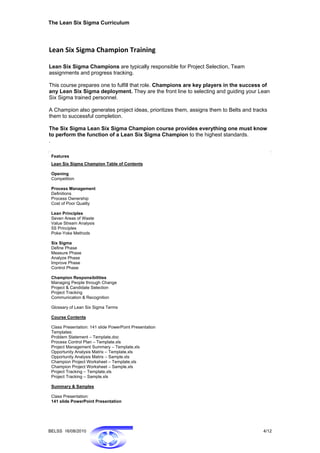
Lean Six Sigma Champion Training 
 
Lean Six Sigma Champions are typically responsible for Project Selection, Team
assignments and progress tracking.

This course prepares one to fulfill that role. Champions are key players in the success of
any Lean Six Sigma deployment. They are the front line to selecting and guiding your Lean
Six Sigma trained personnel.

A Champion also generates project ideas, prioritizes them, assigns them to Belts and tracks
them to successful completion.

The Six Sigma Lean Six Sigma Champion course provides everything one must know
to perform the function of a Lean Six Sigma Champion to the highest standards.
.

 Features
 Lean Six Sigma Champion Table of Contents

 Opening
 Competition

 Process Management
 Definitions
 Process Ownership
 Cost of Poor Quality

 Lean Principles
 Seven Areas of Waste
 Value Stream Analysis
 5S Principles
 Poke-Yoke Methods

 Six Sigma
 Define Phase
 Measure Phase
 Analyze Phase
 Improve Phase
 Control Phase

 Champion Responsibilities
 Managing People through Change
 Project & Candidate Selection
 Project Tracking
 Communication & Recognition

 Glossary of Lean Six Sigma Terms

 Course Contents

 Class Presentation: 141 slide PowerPoint Presentation
 Templates:
 Problem Statement – Template.doc
 Process Control Plan – Template.xls
 Project Management Summary – Template.xls
 Opportunity Analysis Matrix – Template.xls
 Opportunity Analysis Matrix – Sample.xls
 Champion Project Worksheet – Template.xls
 Champion Project Worksheet – Sample.xls
 Project Tracking – Template.xls
 Project Tracking – Sample.xls

 Summary & Samples

 Class Presentation:
 141 slide PowerPoint Presentation


BELSS 16/08/2010                                                                         4/12
The Lean Six Sigma Curriculum


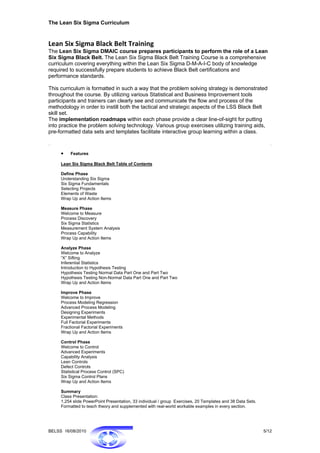
Lean Six Sigma Black Belt Training 
The Lean Six Sigma DMAIC course prepares participants to perform the role of a Lean
Six Sigma Black Belt. The Lean Six Sigma Black Belt Training Course is a comprehensive
curriculum covering everything within the Lean Six Sigma D-M-A-I-C body of knowledge
required to successfully prepare students to achieve Black Belt certifications and
performance standards.

This curriculum is formatted in such a way that the problem solving strategy is demonstrated
throughout the course. By utilizing various Statistical and Business Improvement tools
participants and trainers can clearly see and communicate the flow and process of the
methodology in order to instill both the tactical and strategic aspects of the LSS Black Belt
skill set.
The implementation roadmaps within each phase provide a clear line-of-sight for putting
into practice the problem solving technology. Various group exercises utilizing training aids,
pre-formatted data sets and templates facilitate interactive group learning within a class.


     •    Features

     Lean Six Sigma Black Belt Table of Contents

     Define Phase
     Understanding Six Sigma
     Six Sigma Fundamentals
     Selecting Projects
     Elements of Waste
     Wrap Up and Action Items

     Measure Phase
     Welcome to Measure
     Process Discovery
     Six Sigma Statistics
     Measurement System Analysis
     Process Capability
     Wrap Up and Action Items

     Analyze Phase
     Welcome to Analyze
     “X” Sifting
     Inferential Statistics
     Introduction to Hypothesis Testing
     Hypothesis Testing Normal Data Part One and Part Two
     Hypothesis Testing Non-Normal Data Part One and Part Two
     Wrap Up and Action Items

     Improve Phase
     Welcome to Improve
     Process Modeling Regression
     Advanced Process Modeling
     Designing Experiments
     Experimental Methods
     Full Factorial Experiments
     Fractional Factorial Experiments
     Wrap Up and Action Items

     Control Phase
     Welcome to Control
     Advanced Experiments
     Capability Analysis
     Lean Controls
     Defect Controls
     Statistical Process Control (SPC)
     Six Sigma Control Plans
     Wrap Up and Action Items

     Summary
     Class Presentation:
     1,254 slide PowerPoint Presentation, 33 individual / group Exercises, 20 Templates and 38 Data Sets.
     Formatted to teach theory and supplemented with real-world workable examples in every section.


BELSS 16/08/2010                                                                                            5/12
The Lean Six Sigma Curriculum


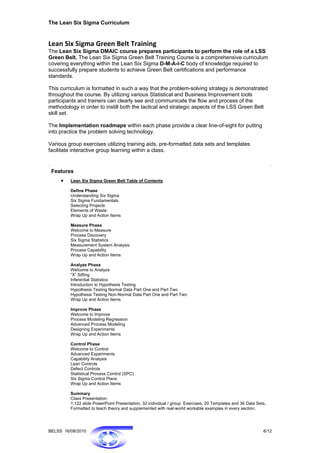
Lean Six Sigma Green Belt Training
The Lean Six Sigma DMAIC course prepares participants to perform the role of a LSS
Green Belt. The Lean Six Sigma Green Belt Training Course is a comprehensive curriculum
covering everything within the Lean Six Sigma D-M-A-I-C body of knowledge required to
successfully prepare students to achieve Green Belt certifications and performance
standards.

This curriculum is formatted in such a way that the problem-solving strategy is demonstrated
throughout the course. By utilizing various Statistical and Business Improvement tools
participants and trainers can clearly see and communicate the flow and process of the
methodology in order to instill both the tactical and strategic aspects of the LSS Green Belt
skill set.

The Implementation roadmaps within each phase provide a clear line-of-sight for putting
into practice the problem solving technology.

Various group exercises utilizing training aids, pre-formatted data sets and templates
facilitate interactive group learning within a class.


 Features
     •   Lean Six Sigma Green Belt Table of Contents

         Define Phase
         Understanding Six Sigma
         Six Sigma Fundamentals
         Selecting Projects
         Elements of Waste
         Wrap Up and Action Items

         Measure Phase
         Welcome to Measure
         Process Discovery
         Six Sigma Statistics
         Measurement System Analysis
         Process Capability
         Wrap Up and Action Items

         Analyze Phase
         Welcome to Analyze
         “X” Sifting
         Inferential Statistics
         Introduction to Hypothesis Testing
         Hypothesis Testing Normal Data Part One and Part Two
         Hypothesis Testing Non-Normal Data Part One and Part Two
         Wrap Up and Action Items

         Improve Phase
         Welcome to Improve
         Process Modeling Regression
         Advanced Process Modeling
         Designing Experiments
         Wrap Up and Action Items

         Control Phase
         Welcome to Control
         Advanced Experiments
         Capability Analysis
         Lean Controls
         Defect Controls
         Statistical Process Control (SPC)
         Six Sigma Control Plans
         Wrap Up and Action Items

         Summary
         Class Presentation:
         1,122 slide PowerPoint Presentation, 32 individual / group Exercises, 20 Templates and 36 Data Sets.
         Formatted to teach theory and supplemented with real-world workable examples in every section.


BELSS 16/08/2010                                                                                           6/12
The Lean Six Sigma Curriculum


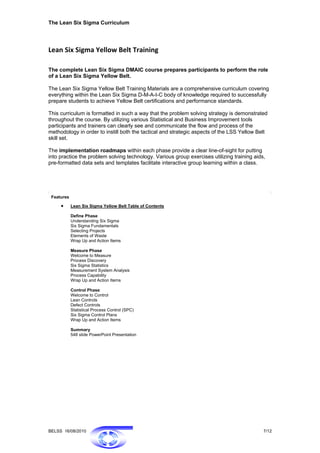
Lean Six Sigma Yellow Belt Training 

The complete Lean Six Sigma DMAIC course prepares participants to perform the role
of a Lean Six Sigma Yellow Belt.

The Lean Six Sigma Yellow Belt Training Materials are a comprehensive curriculum covering
everything within the Lean Six Sigma D-M-A-I-C body of knowledge required to successfully
prepare students to achieve Yellow Belt certifications and performance standards.

This curriculum is formatted in such a way that the problem solving strategy is demonstrated
throughout the course. By utilizing various Statistical and Business Improvement tools
participants and trainers can clearly see and communicate the flow and process of the
methodology in order to instill both the tactical and strategic aspects of the LSS Yellow Belt
skill set.

The implementation roadmaps within each phase provide a clear line-of-sight for putting
into practice the problem solving technology. Various group exercises utilizing training aids,
pre-formatted data sets and templates facilitate interactive group learning within a class.


 Features

     •      Lean Six Sigma Yellow Belt Table of Contents

            Define Phase
            Understanding Six Sigma
            Six Sigma Fundamentals
            Selecting Projects
            Elements of Waste
            Wrap Up and Action Items

            Measure Phase
            Welcome to Measure
            Process Discovery
            Six Sigma Statistics
            Measurement System Analysis
            Process Capability
            Wrap Up and Action Items

            Control Phase
            Welcome to Control
            Lean Controls
            Defect Controls
            Statistical Process Control (SPC)
            Six Sigma Control Plans
            Wrap Up and Action Items

            Summary
            548 slide PowerPoint Presentation


BELSS 16/08/2010                                                                             7/12
The Lean Six Sigma Curriculum


Lean Six Sigma Project Selection 
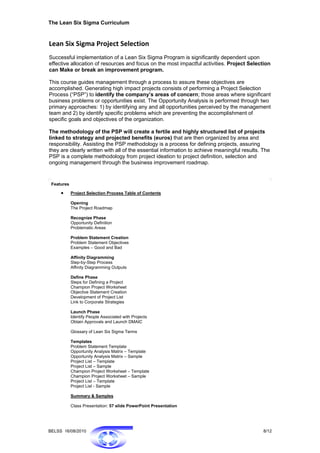
Successful implementation of a Lean Six Sigma Program is significantly dependent upon
effective allocation of resources and focus on the most impactful activities. Project Selection
can Make or break an improvement program.

This course guides management through a process to assure these objectives are
accomplished. Generating high impact projects consists of performing a Project Selection
Process (“PSP”) to identify the company’s areas of concern; those areas where significant
business problems or opportunities exist. The Opportunity Analysis is performed through two
primary approaches: 1) by identifying any and all opportunities perceived by the management
team and 2) by identify specific problems which are preventing the accomplishment of
specific goals and objectives of the organization.

The methodology of the PSP will create a fertile and highly structured list of projects
linked to strategy and projected benefits (euros) that are then organized by area and
responsibility. Assisting the PSP methodology is a process for defining projects, assuring
they are clearly written with all of the essential information to achieve meaningful results. The
PSP is a complete methodology from project ideation to project definition, selection and
ongoing management through the business improvement roadmap.


 Features

     •      Project Selection Process Table of Contents

            Opening
            The Project Roadmap

            Recognize Phase
            Opportunity Definition
            Problematic Areas

            Problem Statement Creation
            Problem Statement Objectives
            Examples – Good and Bad

            Affinity Diagramming
            Step-by-Step Process
            Affinity Diagramming Outputs

            Define Phase
            Steps for Defining a Project
            Champion Project Worksheet
            Objective Statement Creation
            Development of Project List
            Link to Corporate Strategies

            Launch Phase
            Identify People Associated with Projects
            Obtain Approvals and Launch DMAIC

            Glossary of Lean Six Sigma Terms

            Templates
            Problem Statement Template
            Opportunity Analysis Matrix – Template
            Opportunity Analysis Matrix – Sample
            Project List – Template
            Project List – Sample
            Champion Project Worksheet – Template
            Champion Project Worksheet – Sample
            Project List – Template
            Project List - Sample

            Summary & Samples

            Class Presentation: 57 slide PowerPoint Presentation


BELSS 16/08/2010                                                                              8/12
The Lean Six Sigma Curriculum


 Process Management Tools 

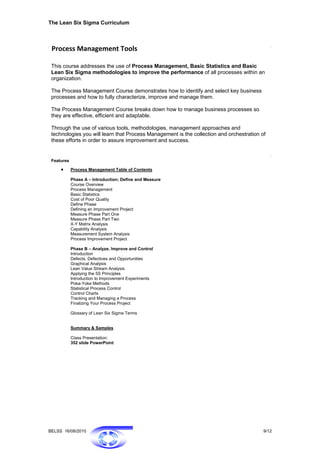
 This course addresses the use of Process Management, Basic Statistics and Basic
 Lean Six Sigma methodologies to improve the performance of all processes within an
 organization.

 The Process Management Course demonstrates how to identify and select key business
 processes and how to fully characterize, improve and manage them.

 The Process Management Course breaks down how to manage business processes so
 they are effective, efficient and adaptable.

 Through the use of various tools, methodologies, management approaches and
 technologies you will learn that Process Management is the collection and orchestration of
 these efforts in order to assure improvement and success.


 Features

     •      Process Management Table of Contents

            Phase A – Introduction; Define and Measure
            Course Overview
            Process Management
            Basic Statistics
            Cost of Poor Quality
            Define Phase
            Defining an Improvement Project
            Measure Phase Part One
            Measure Phase Part Two
            X-Y Matrix Analysis
            Capability Analysis
            Measurement System Analysis
            Process Improvement Project

            Phase B – Analyze, Improve and Control
            Introduction
            Defects, Defectives and Opportunities
            Graphical Analysis
            Lean Value Stream Analysis
            Applying the 5S Principles
            Introduction to Improvement Experiments
            Poka-Yoke Methods
            Statistical Process Control
            Control Charts
            Tracking and Managing a Process
            Finalizing Your Process Project

            Glossary of Lean Six Sigma Terms


            Summary & Samples

            Class Presentation:
            352 slide PowerPoint


BELSS 16/08/2010                                                                          9/12
The Lean Six Sigma Curriculum


Lean Six Sigma Team Member  
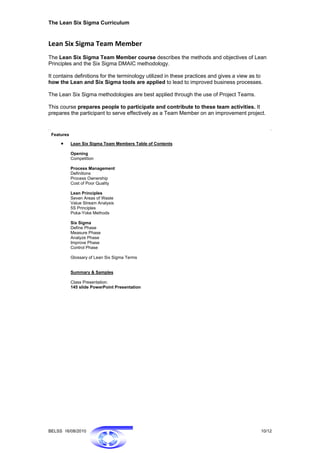
The Lean Six Sigma Team Member course describes the methods and objectives of Lean
Principles and the Six Sigma DMAIC methodology.

It contains definitions for the terminology utilized in these practices and gives a view as to
how the Lean and Six Sigma tools are applied to lead to improved business processes.

The Lean Six Sigma methodologies are best applied through the use of Project Teams.

This course prepares people to participate and contribute to these team activities. It
prepares the participant to serve effectively as a Team Member on an improvement project.


 Features

     •      Lean Six Sigma Team Members Table of Contents

            Opening
            Competition

            Process Management
            Definitions
            Process Ownership
            Cost of Poor Quality

            Lean Principles
            Seven Areas of Waste
            Value Stream Analysis
            5S Principles
            Poka-Yoke Methods

            Six Sigma
            Define Phase
            Measure Phase
            Analyze Phase
            Improve Phase
            Control Phase

            Glossary of Lean Six Sigma Terms


            Summary & Samples

            Class Presentation:
            145 slide PowerPoint Presentation


BELSS 16/08/2010                                                                             10/12
The Lean Six Sigma Curriculum


Lean Six Sigma Awareness 
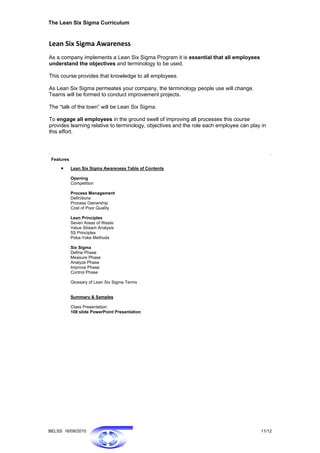
As a company implements a Lean Six Sigma Program it is essential that all employees
understand the objectives and terminology to be used.

This course provides that knowledge to all employees.

As Lean Six Sigma permeates your company, the terminology people use will change.
Teams will be formed to conduct improvement projects.

The “talk of the town” will be Lean Six Sigma.

To engage all employees in the ground swell of improving all processes this course
provides learning relative to terminology, objectives and the role each employee can play in
this effort.


 Features

     •      Lean Six Sigma Awareness Table of Contents

            Opening
            Competition

            Process Management
            Definitions
            Process Ownership
            Cost of Poor Quality

            Lean Principles
            Seven Areas of Waste
            Value Stream Analysis
            5S Principles
            Poka-Yoke Methods

            Six Sigma
            Define Phase
            Measure Phase
            Analyze Phase
            Improve Phase
            Control Phase

            Glossary of Lean Six Sigma Terms


            Summary & Samples

            Class Presentation:
            108 slide PowerPoint Presentation


BELSS 16/08/2010                                                                         11/12
The Lean Six Sigma Curriculum


Teams and Quality Improvement Tools

How Teams work to Improve Quality and Productivity


1. Doing Business in a New Business World


2. The Basics of Quality Improvement


3. Setting the Stage for a Successful Project


4. Getting Underway


5. Building and Improvement Plan


6. Learning to Work Together


7. Team Building Activities


8. Further Reading


BELSS 16/08/2010                                     12/12

The Lean Six Sigma Curriculum Rev 2

  • 1.
    The Lean SixSigma Curriculum The Lean Six Sigma Curriculum Presented By Ciarán May BELSS Training & Consulting BELSS 16/08/2010 1/12
  • 2.
    The Lean SixSigma Curriculum Course Title Intended Audience Contact Elapsed Time Time Executive Introduction to Lean Six Sigma CEO, MD, Owner, Op Ex, 1 Day 1 Day Senior Mgrs. Lean Six Sigma Champion CEO, MD, Owner, Op Ex, 3 Days 3 Day Senior Mgrs Lean Six Sigma Black Belt Training Nominated Trainees 25 Days 6 Months Lean Six Sigma Green Belt Training Nominated Trainees 6 Days 1.5 Month Lean Six Sigma Yellow Belt Training Nominated Trainees 3 Days 3 Day Lean Six Sigma Project Selection Managers, Steering Groups 3 Days 3 Days Process Management Tools Managers, Steering Groups 2 Days 2 Days Lean Six Sigma Team Member LSS Team Members 1 Day 1 Day Lean Six Sigma Awareness In house 1 Day 1 Day Workplace Organisation or 5 S CEO, MD, Owner, Op Ex, 1 Day ! Day Senior Mgrs, others Introduction to “The Continuous CEO, MD, Owner, Op Ex, 1 Day 1 Day Improvement Process” Senior Mgrs, others Introduction to Lean Manufacturing CEO, MD, Owner, Op Ex, 1 Day ! Day Senior Mgrs, others Running Effective Meetings All LSS Teams 1 Day 1 Day Teams and Quality Improvement Tools Project and Process 3 Days 3 Days Improvement teams BELSS 16/08/2010 2/12
  • 3.
    The Lean SixSigma Curriculum Executive Introduction to Lean Six Sigma  As a company considers the merits of undertaking a Lean Six Sigma Initiative, it is important the Executives understand the capabilities, resource commitment and resultant performance improvement expectations. The Executive Introduction Training Course provides that understanding. Lean Six Sigma has been a powerful tool for corporate process improvement initiatives for over twenty years. This course describes the methodology, how it is used, what types of issues it addresses and what the expectations of a program should be. Also discussed are the requirements for initiating and managing a successful Lean Six Sigma program. Features • Lean Six Sigma Executive Introduction Table of Contents Opening Competition Process Management Definitions Process Ownership Cost of Poor Quality Lean Principles Seven Areas of Waste Value Stream Analysis 5S Principles Poka-Yoke Methods Six Sigma Define Phase Measure Phase Analyze Phase Improve Phase Control Phase Deployment Model Importing the Knowledge Lean Six Sigma Curriculum Lean Six Sigma Program Operations Communication & Recognition Glossary of Lean Six Sigma Terms Summary Class Presentation: 105 slide PowerPoint Presentation. BELSS 16/08/2010 3/12
  • 4.
    The Lean SixSigma Curriculum Lean Six Sigma Champion Training    Lean Six Sigma Champions are typically responsible for Project Selection, Team assignments and progress tracking. This course prepares one to fulfill that role. Champions are key players in the success of any Lean Six Sigma deployment. They are the front line to selecting and guiding your Lean Six Sigma trained personnel. A Champion also generates project ideas, prioritizes them, assigns them to Belts and tracks them to successful completion. The Six Sigma Lean Six Sigma Champion course provides everything one must know to perform the function of a Lean Six Sigma Champion to the highest standards. . Features Lean Six Sigma Champion Table of Contents Opening Competition Process Management Definitions Process Ownership Cost of Poor Quality Lean Principles Seven Areas of Waste Value Stream Analysis 5S Principles Poke-Yoke Methods Six Sigma Define Phase Measure Phase Analyze Phase Improve Phase Control Phase Champion Responsibilities Managing People through Change Project & Candidate Selection Project Tracking Communication & Recognition Glossary of Lean Six Sigma Terms Course Contents Class Presentation: 141 slide PowerPoint Presentation Templates: Problem Statement – Template.doc Process Control Plan – Template.xls Project Management Summary – Template.xls Opportunity Analysis Matrix – Template.xls Opportunity Analysis Matrix – Sample.xls Champion Project Worksheet – Template.xls Champion Project Worksheet – Sample.xls Project Tracking – Template.xls Project Tracking – Sample.xls Summary & Samples Class Presentation: 141 slide PowerPoint Presentation BELSS 16/08/2010 4/12
  • 5.
    The Lean SixSigma Curriculum Lean Six Sigma Black Belt Training  The Lean Six Sigma DMAIC course prepares participants to perform the role of a Lean Six Sigma Black Belt. The Lean Six Sigma Black Belt Training Course is a comprehensive curriculum covering everything within the Lean Six Sigma D-M-A-I-C body of knowledge required to successfully prepare students to achieve Black Belt certifications and performance standards. This curriculum is formatted in such a way that the problem solving strategy is demonstrated throughout the course. By utilizing various Statistical and Business Improvement tools participants and trainers can clearly see and communicate the flow and process of the methodology in order to instill both the tactical and strategic aspects of the LSS Black Belt skill set. The implementation roadmaps within each phase provide a clear line-of-sight for putting into practice the problem solving technology. Various group exercises utilizing training aids, pre-formatted data sets and templates facilitate interactive group learning within a class. • Features Lean Six Sigma Black Belt Table of Contents Define Phase Understanding Six Sigma Six Sigma Fundamentals Selecting Projects Elements of Waste Wrap Up and Action Items Measure Phase Welcome to Measure Process Discovery Six Sigma Statistics Measurement System Analysis Process Capability Wrap Up and Action Items Analyze Phase Welcome to Analyze “X” Sifting Inferential Statistics Introduction to Hypothesis Testing Hypothesis Testing Normal Data Part One and Part Two Hypothesis Testing Non-Normal Data Part One and Part Two Wrap Up and Action Items Improve Phase Welcome to Improve Process Modeling Regression Advanced Process Modeling Designing Experiments Experimental Methods Full Factorial Experiments Fractional Factorial Experiments Wrap Up and Action Items Control Phase Welcome to Control Advanced Experiments Capability Analysis Lean Controls Defect Controls Statistical Process Control (SPC) Six Sigma Control Plans Wrap Up and Action Items Summary Class Presentation: 1,254 slide PowerPoint Presentation, 33 individual / group Exercises, 20 Templates and 38 Data Sets. Formatted to teach theory and supplemented with real-world workable examples in every section. BELSS 16/08/2010 5/12
  • 6.
    The Lean SixSigma Curriculum Lean Six Sigma Green Belt Training The Lean Six Sigma DMAIC course prepares participants to perform the role of a LSS Green Belt. The Lean Six Sigma Green Belt Training Course is a comprehensive curriculum covering everything within the Lean Six Sigma D-M-A-I-C body of knowledge required to successfully prepare students to achieve Green Belt certifications and performance standards. This curriculum is formatted in such a way that the problem-solving strategy is demonstrated throughout the course. By utilizing various Statistical and Business Improvement tools participants and trainers can clearly see and communicate the flow and process of the methodology in order to instill both the tactical and strategic aspects of the LSS Green Belt skill set. The Implementation roadmaps within each phase provide a clear line-of-sight for putting into practice the problem solving technology. Various group exercises utilizing training aids, pre-formatted data sets and templates facilitate interactive group learning within a class. Features • Lean Six Sigma Green Belt Table of Contents Define Phase Understanding Six Sigma Six Sigma Fundamentals Selecting Projects Elements of Waste Wrap Up and Action Items Measure Phase Welcome to Measure Process Discovery Six Sigma Statistics Measurement System Analysis Process Capability Wrap Up and Action Items Analyze Phase Welcome to Analyze “X” Sifting Inferential Statistics Introduction to Hypothesis Testing Hypothesis Testing Normal Data Part One and Part Two Hypothesis Testing Non-Normal Data Part One and Part Two Wrap Up and Action Items Improve Phase Welcome to Improve Process Modeling Regression Advanced Process Modeling Designing Experiments Wrap Up and Action Items Control Phase Welcome to Control Advanced Experiments Capability Analysis Lean Controls Defect Controls Statistical Process Control (SPC) Six Sigma Control Plans Wrap Up and Action Items Summary Class Presentation: 1,122 slide PowerPoint Presentation, 32 individual / group Exercises, 20 Templates and 36 Data Sets. Formatted to teach theory and supplemented with real-world workable examples in every section. BELSS 16/08/2010 6/12
  • 7.
    The Lean SixSigma Curriculum Lean Six Sigma Yellow Belt Training  The complete Lean Six Sigma DMAIC course prepares participants to perform the role of a Lean Six Sigma Yellow Belt. The Lean Six Sigma Yellow Belt Training Materials are a comprehensive curriculum covering everything within the Lean Six Sigma D-M-A-I-C body of knowledge required to successfully prepare students to achieve Yellow Belt certifications and performance standards. This curriculum is formatted in such a way that the problem solving strategy is demonstrated throughout the course. By utilizing various Statistical and Business Improvement tools participants and trainers can clearly see and communicate the flow and process of the methodology in order to instill both the tactical and strategic aspects of the LSS Yellow Belt skill set. The implementation roadmaps within each phase provide a clear line-of-sight for putting into practice the problem solving technology. Various group exercises utilizing training aids, pre-formatted data sets and templates facilitate interactive group learning within a class. Features • Lean Six Sigma Yellow Belt Table of Contents Define Phase Understanding Six Sigma Six Sigma Fundamentals Selecting Projects Elements of Waste Wrap Up and Action Items Measure Phase Welcome to Measure Process Discovery Six Sigma Statistics Measurement System Analysis Process Capability Wrap Up and Action Items Control Phase Welcome to Control Lean Controls Defect Controls Statistical Process Control (SPC) Six Sigma Control Plans Wrap Up and Action Items Summary 548 slide PowerPoint Presentation BELSS 16/08/2010 7/12
  • 8.
    The Lean SixSigma Curriculum Lean Six Sigma Project Selection  Successful implementation of a Lean Six Sigma Program is significantly dependent upon effective allocation of resources and focus on the most impactful activities. Project Selection can Make or break an improvement program. This course guides management through a process to assure these objectives are accomplished. Generating high impact projects consists of performing a Project Selection Process (“PSP”) to identify the company’s areas of concern; those areas where significant business problems or opportunities exist. The Opportunity Analysis is performed through two primary approaches: 1) by identifying any and all opportunities perceived by the management team and 2) by identify specific problems which are preventing the accomplishment of specific goals and objectives of the organization. The methodology of the PSP will create a fertile and highly structured list of projects linked to strategy and projected benefits (euros) that are then organized by area and responsibility. Assisting the PSP methodology is a process for defining projects, assuring they are clearly written with all of the essential information to achieve meaningful results. The PSP is a complete methodology from project ideation to project definition, selection and ongoing management through the business improvement roadmap. Features • Project Selection Process Table of Contents Opening The Project Roadmap Recognize Phase Opportunity Definition Problematic Areas Problem Statement Creation Problem Statement Objectives Examples – Good and Bad Affinity Diagramming Step-by-Step Process Affinity Diagramming Outputs Define Phase Steps for Defining a Project Champion Project Worksheet Objective Statement Creation Development of Project List Link to Corporate Strategies Launch Phase Identify People Associated with Projects Obtain Approvals and Launch DMAIC Glossary of Lean Six Sigma Terms Templates Problem Statement Template Opportunity Analysis Matrix – Template Opportunity Analysis Matrix – Sample Project List – Template Project List – Sample Champion Project Worksheet – Template Champion Project Worksheet – Sample Project List – Template Project List - Sample Summary & Samples Class Presentation: 57 slide PowerPoint Presentation BELSS 16/08/2010 8/12
  • 9.
    The Lean SixSigma Curriculum Process Management Tools  This course addresses the use of Process Management, Basic Statistics and Basic Lean Six Sigma methodologies to improve the performance of all processes within an organization. The Process Management Course demonstrates how to identify and select key business processes and how to fully characterize, improve and manage them. The Process Management Course breaks down how to manage business processes so they are effective, efficient and adaptable. Through the use of various tools, methodologies, management approaches and technologies you will learn that Process Management is the collection and orchestration of these efforts in order to assure improvement and success. Features • Process Management Table of Contents Phase A – Introduction; Define and Measure Course Overview Process Management Basic Statistics Cost of Poor Quality Define Phase Defining an Improvement Project Measure Phase Part One Measure Phase Part Two X-Y Matrix Analysis Capability Analysis Measurement System Analysis Process Improvement Project Phase B – Analyze, Improve and Control Introduction Defects, Defectives and Opportunities Graphical Analysis Lean Value Stream Analysis Applying the 5S Principles Introduction to Improvement Experiments Poka-Yoke Methods Statistical Process Control Control Charts Tracking and Managing a Process Finalizing Your Process Project Glossary of Lean Six Sigma Terms Summary & Samples Class Presentation: 352 slide PowerPoint BELSS 16/08/2010 9/12
  • 10.
    The Lean SixSigma Curriculum Lean Six Sigma Team Member   The Lean Six Sigma Team Member course describes the methods and objectives of Lean Principles and the Six Sigma DMAIC methodology. It contains definitions for the terminology utilized in these practices and gives a view as to how the Lean and Six Sigma tools are applied to lead to improved business processes. The Lean Six Sigma methodologies are best applied through the use of Project Teams. This course prepares people to participate and contribute to these team activities. It prepares the participant to serve effectively as a Team Member on an improvement project. Features • Lean Six Sigma Team Members Table of Contents Opening Competition Process Management Definitions Process Ownership Cost of Poor Quality Lean Principles Seven Areas of Waste Value Stream Analysis 5S Principles Poka-Yoke Methods Six Sigma Define Phase Measure Phase Analyze Phase Improve Phase Control Phase Glossary of Lean Six Sigma Terms Summary & Samples Class Presentation: 145 slide PowerPoint Presentation BELSS 16/08/2010 10/12
  • 11.
    The Lean SixSigma Curriculum Lean Six Sigma Awareness  As a company implements a Lean Six Sigma Program it is essential that all employees understand the objectives and terminology to be used. This course provides that knowledge to all employees. As Lean Six Sigma permeates your company, the terminology people use will change. Teams will be formed to conduct improvement projects. The “talk of the town” will be Lean Six Sigma. To engage all employees in the ground swell of improving all processes this course provides learning relative to terminology, objectives and the role each employee can play in this effort. Features • Lean Six Sigma Awareness Table of Contents Opening Competition Process Management Definitions Process Ownership Cost of Poor Quality Lean Principles Seven Areas of Waste Value Stream Analysis 5S Principles Poka-Yoke Methods Six Sigma Define Phase Measure Phase Analyze Phase Improve Phase Control Phase Glossary of Lean Six Sigma Terms Summary & Samples Class Presentation: 108 slide PowerPoint Presentation BELSS 16/08/2010 11/12
  • 12.
    The Lean SixSigma Curriculum Teams and Quality Improvement Tools How Teams work to Improve Quality and Productivity 1. Doing Business in a New Business World 2. The Basics of Quality Improvement 3. Setting the Stage for a Successful Project 4. Getting Underway 5. Building and Improvement Plan 6. Learning to Work Together 7. Team Building Activities 8. Further Reading BELSS 16/08/2010 12/12