2
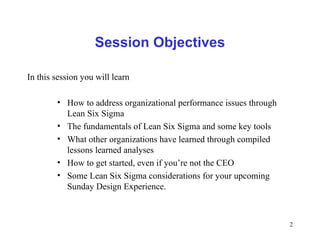
Session Objectives
In thissession you will learn
• How to address organizational performance issues through
Lean Six Sigma
• The fundamentals of Lean Six Sigma and some key tools
• What other organizations have learned through compiled
lessons learned analyses
• How to get started, even if you’re not the CEO
• Some Lean Six Sigma considerations for your upcoming
Sunday Design Experience.
6
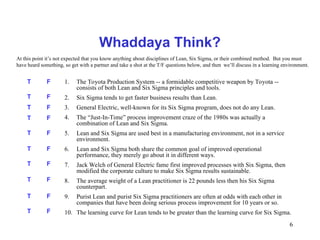
Whaddaya Think?
1. TheToyota Production System -- a formidable competitive weapon by Toyota --
consists of both Lean and Six Sigma principles and tools.
2. Six Sigma tends to get faster business results than Lean.
3. General Electric, well-known for its Six Sigma program, does not do any Lean.
4. The “Just-In-Time” process improvement craze of the 1980s was actually a
combination of Lean and Six Sigma.
5. Lean and Six Sigma are used best in a manufacturing environment, not in a service
environment.
6. Lean and Six Sigma both share the common goal of improved operational
performance, they merely go about it in different ways.
7. Jack Welch of General Electric fame first improved processes with Six Sigma, then
modified the corporate culture to make Six Sigma results sustainable.
8. The average weight of a Lean practitioner is 22 pounds less then his Six Sigma
counterpart.
9. Purist Lean and purist Six Sigma practitioners are often at odds with each other in
companies that have been doing serious process improvement for 10 years or so.
10. The learning curve for Lean tends to be greater than the learning curve for Six Sigma.
At this point it’s not expected that you know anything about disciplines of Lean, Six Sigma, or their combined method. But you must
have heard something, so get with a partner and take a shot at the T/F questions below, and then we’ll discuss in a learning environment.
T F
T F
T F
T F
T F
T F
T F
T F
T F
T F
8
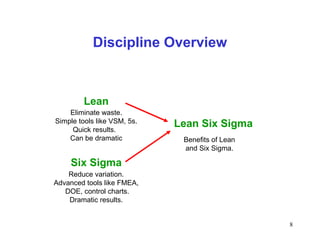
Discipline Overview
Lean
Lean SixSigma
Six Sigma
Eliminate waste.
Simple tools like VSM, 5s.
Quick results.
Can be dramatic
Reduce variation.
Advanced tools like FMEA,
DOE, control charts.
Dramatic results.
Benefits of Lean
and Six Sigma.
9.
9
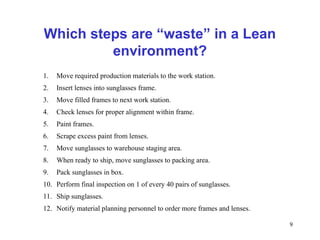
Which steps are“waste” in a Lean
environment?
1. Move required production materials to the work station.
2. Insert lenses into sunglasses frame.
3. Move filled frames to next work station.
4. Check lenses for proper alignment within frame.
5. Paint frames.
6. Scrape excess paint from lenses.
7. Move sunglasses to warehouse staging area.
8. When ready to ship, move sunglasses to packing area.
9. Pack sunglasses in box.
10. Perform final inspection on 1 of every 40 pairs of sunglasses.
11. Ship sunglasses.
12. Notify material planning personnel to order more frames and lenses.
10.
10
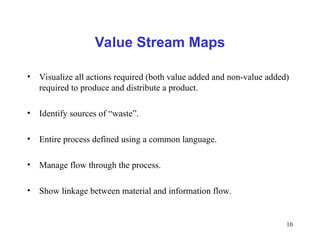
Value Stream Maps
•Visualize all actions required (both value added and non-value added)
required to produce and distribute a product.
• Identify sources of “waste”.
• Entire process defined using a common language.
• Manage flow through the process.
• Show linkage between material and information flow.
11.
11
Company confidential
Company confidential
Companyconfidential
Company confidential
Company confidential
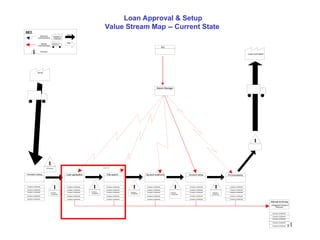
Orientation meeting Loan application Title search Ag econ eval/cons Account setup
HQ
Farmer
Loan Approval & Setup
Value Stream Map -- Current State
I
I I I I I
Pyt processing
I
(Staggered Receipt of
Records)
Manual Archiving
LOAN CUSTOMER
Branch Manager
KEY
Electronic
Communication
Manual
Communication
Supplier or
Customer
Delivery /
Shipment
I Inventory
Push
Pull
25 Batches
Company
confidential
Operators 4Q03
Company confidential
Company confidential
Company confidential
Company confidential
Company confidential
Company confidential
Company confidential
Company confidential
Company confidential
Company confidential
Company
confidential
Company confidential
Company confidential
Company confidential
Company confidential
Company confidential
Company
confidential
Company confidential
Company confidential
Company confidential
Company confidential
Company confidential
Company confidential
Company confidential
Company confidential
Company confidential
Company confidential
Company
confidential
Company confidential
Company confidential
Company confidential
Company confidential
Company confidential
Company
confidential
12.
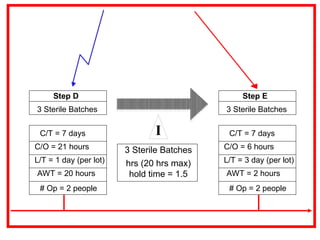
C/T = 7days
C/O = 21 hours
L/T = 1 day (per lot)
AWT = 20 hours
# Op = 2 people
3 Sterile Batches
Step D
3 Sterile Batches
hold time = 1.5
hrs (20 hrs max)
I C/T = 7 days
C/O = 6 hours
L/T = 3 day (per lot)
AWT = 2 hours
# Op = 2 people
3 Sterile Batches
Step E
13.
13
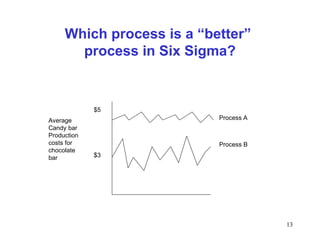
Which process isa “better”
process in Six Sigma?
Average
Candy bar
Production
costs for
chocolate
bar
$5
$3
Process A
Process B
16
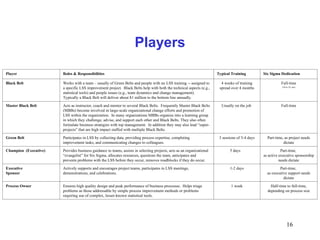
Players
Player Roles &Responsibilities Typical Training Six Sigma Dedication
Black Belt Works with a team – usually of Green Belts and people with no LSS training -- assigned to
a specific LSS improvement project. Black Belts help with both the technical aspects (e.g.,
statistical tools) and people issues (e.g., team dynamics and change management).
Typically a Black Belt will deliver about $1 million to the bottom line annually.
4 weeks of training
spread over 4 months
Full-time
(18 to 24 mo)
Master Black Belt Acts as instructor, coach and mentor to several Black Belts. Frequently Master Black Belts
(MBBs) become involved in large-scale organizational change efforts and promotion of
LSS within the organization. In many organizations MBBs organize into a learning group
in which they challenge, advise, and support each other and Black Belts. They also often
formulate business strategies with top management. In addition they may also lead “super-
projects” that are high impact staffed with multiple Black Belts.
Usually on the job Full-time
Green Belt Participates in LSS by collecting data, providing process expertise, completing
improvement tasks, and communicating changes to colleagues.
3 sessions of 3-4 days Part-time, as project needs
dictate
Champion (Executive) Provides business guidance to teams, assists in selecting projects, acts as an organizational
“evangelist” for Six Sigma, allocates resources, questions the team, anticipates and
prevents problems with the LSS before they occur, removes roadblocks if they do occur.
5 days Part-time,
as active executive sponsorship
needs dictate
Executive
Sponsor
Actively supports and encourages project teams, participates in LSS meetings,
demonstrations, and celebrations.
1-2 days Part-time,
as executive support needs
dictate
Process Owner Ensures high quality design and peak performance of business processes. Helps triage
problems as those addressable by simple process improvement methods or problems
requiring use of complex, lesser-known statistical tools.
1 week Half-time to full-time,
depending on process size
17.
17
Who you gonnacall?
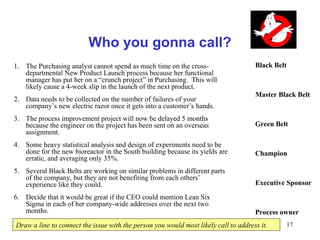
1. The Purchasing analyst cannot spend as much time on the cross-
departmental New Product Launch process because her functional
manager has put her on a “crunch project” in Purchasing. This will
likely cause a 4-week slip in the launch of the next product.
2. Data needs to be collected on the number of failures of your
company’s new electric razor once it gets into a customer’s hands.
3. The process improvement project will now be delayed 5 months
because the engineer on the project has been sent on an overseas
assignment.
4. Some heavy statistical analysis and design of experiments need to be
done for the new bioreactor in the South building because its yields are
erratic, and averaging only 35%.
5. Several Black Belts are working on similar problems in different parts
of the company, but they are not benefiting from each others’
experience like they could.
6. Decide that it would be great if the CEO could mention Lean Six
Sigma in each of her company-wide addresses over the next two
months.
Black Belt
Master Black Belt
Green Belt
Champion
Executive Sponsor
Process owner
Draw a line to connect the issue with the person you would most likely call to address it.
18.
18
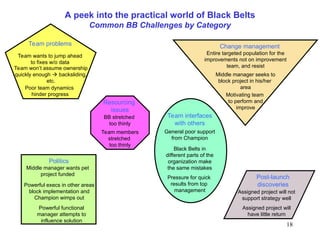
A peek intothe practical world of Black Belts
Common BB Challenges by Category
BB stretched
too thinly
Team members
stretched
too thinly
Assigned project will not
support strategy well
Assigned project will
have little return
Entire targeted population for the
improvements not on improvement
team, and resist
Motivating team
to perform and
improve
Middle manager seeks to
block project in his/her
area
General poor support
from Champion
Pressure for quick
results from top
management
Black Belts in
different parts of the
organization make
the same mistakes
Team wants to jump ahead
to fixes w/o data
Team won’t assume ownership
quickly enough backsliding,
etc.
Poor team dynamics
hinder progress
Powerful execs in other areas
block implementation and
Champion wimps out
Powerful functional
manager attempts to
influence solution
Middle manager wants pet
project funded
Change management
Post-launch
discoveries
Politics
Team problems
Team interfaces
with others
Resourcing
issues
19.
19
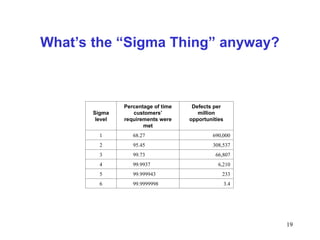
Sigma
level
Percentage of time
customers’
requirementswere
met
Defects per
million
opportunities
1 68.27 690,000
2 95.45 308,537
3 99.73 66,807
4 99.9937 6,210
5 99.999943 233
6 99.9999998 3.4
What’s the “Sigma Thing” anyway?
20.
20
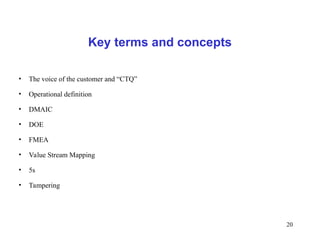
• The voiceof the customer and “CTQ”
• Operational definition
• DMAIC
• DOE
• FMEA
• Value Stream Mapping
• 5s
• Tampering
Key terms and concepts
21.
21
What it’s not
Inhelping to define what Lean Six Sigma is, it is also helpful to consider what it is not:
• It is not just a collection of tools that people can be trained in and shortly thereafter deliver
outstanding results. Successful LSS efforts require strong management support, training, and formal
ties to the organization’s management system.
• It is not just a statistics program. It is a results program.
• It is not a recycled Total Quality Management program from the 1970s. While many tools and some
methods from the quality movement are present in LSS, it distinguishes itself by having formal links
to the compensation system, financial screening of potential projects, and a fanatical emphasis on the
needs of the external customer.
• It is not a training program, as many Total Quality Management programs became. It is a system of
tools, principles, and management practices that are applied to a improve processes.
22.
22
3. Case Study1
Biopharmaceutical division
of a global pharma company
24
Hit performance issueson
multiple fronts
• Lean training for all managers and supervisors
• Basic Six Sigma training for all managers and supervisors
• Center of Excellence leaders – located in all departments -- trained in
advanced Six Sigma methods and philosophy
• Leadership development occurred simultaneously to address critical
change management issues within, and among departments
25.
25
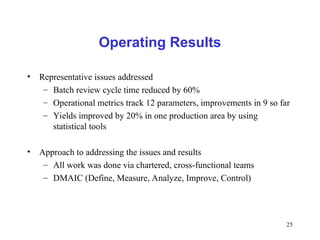
Operating Results
• Representativeissues addressed
– Batch review cycle time reduced by 60%
– Operational metrics track 12 parameters, improvements in 9 so far
– Yields improved by 20% in one production area by using
statistical tools
• Approach to addressing the issues and results
– All work was done via chartered, cross-functional teams
– DMAIC (Define, Measure, Analyze, Improve, Control)
26.
26
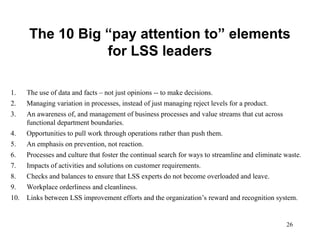
The 10 Big“pay attention to” elements
for LSS leaders
1. The use of data and facts – not just opinions -- to make decisions.
2. Managing variation in processes, instead of just managing reject levels for a product.
3. An awareness of, and management of business processes and value streams that cut across
functional department boundaries.
4. Opportunities to pull work through operations rather than push them.
5. An emphasis on prevention, not reaction.
6. Processes and culture that foster the continual search for ways to streamline and eliminate waste.
7. Impacts of activities and solutions on customer requirements.
8. Checks and balances to ensure that LSS experts do not become overloaded and leave.
9. Workplace orderliness and cleanliness.
10. Links between LSS improvement efforts and the organization’s reward and recognition system.
28
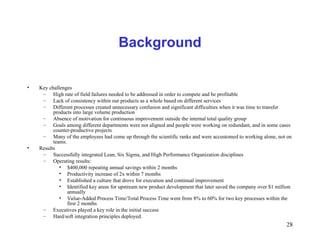
Background
• Key challenges
–High rate of field failures needed to be addressed in order to compete and be profitable
– Lack of consistency within our products as a whole based on different services
– Different processes created unnecessary confusion and significant difficulties when it was time to transfer
products into large volume production
– Absence of motivation for continuous improvement outside the internal total quality group
– Goals among different departments were not aligned and people were working on redundant, and in some cases
counter-productive projects
– Many of the employees had come up through the scientific ranks and were accustomed to working alone, not on
teams.
• Results
– Successfully integrated Lean, Six Sigma, and High Performance Organization disciplines
– Operating results:
• $400,000 repeating annual savings within 2 months
• Productivity increase of 2x within 7 months
• Established a culture that drove for execution and continual improvement
• Identified key areas for upstream new product development that later saved the company over $1 million
annually
• Value-Added Process Time/Total Process Time went from 8% to 60% for two key processes within the
first 2 months
– Executives played a key role in the initial success
– Hard/soft integration principles deployed.
29.
29
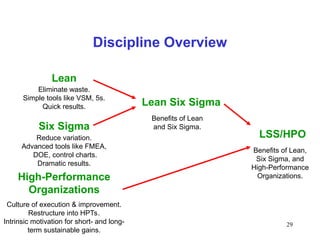
Discipline Overview
Lean
Lean SixSigma
Six Sigma
Eliminate waste.
Simple tools like VSM, 5s.
Quick results.
Reduce variation.
Advanced tools like FMEA,
DOE, control charts.
Dramatic results.
Benefits of Lean
and Six Sigma.
High-Performance
Organizations
LSS/HPO
Culture of execution & improvement.
Restructure into HPTs.
Intrinsic motivation for short- and long-
term sustainable gains.
Benefits of Lean,
Six Sigma, and
High-Performance
Organizations.
30.
30
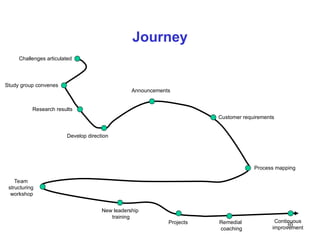
Journey
Challenges articulated
Study groupconvenes
Develop direction
Research results
New leadership
training
Announcements
Customer requirements
Process mapping
Team
structuring
workshop
Projects Remedial
coaching
Continuous
improvement
31.
31
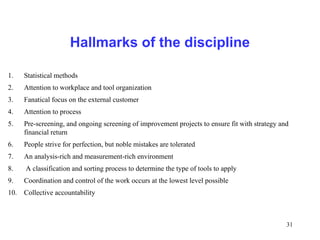
Hallmarks of thediscipline
1. Statistical methods
2. Attention to workplace and tool organization
3. Fanatical focus on the external customer
4. Attention to process
5. Pre-screening, and ongoing screening of improvement projects to ensure fit with strategy and
financial return
6. People strive for perfection, but noble mistakes are tolerated
7. An analysis-rich and measurement-rich environment
8. A classification and sorting process to determine the type of tools to apply
9. Coordination and control of the work occurs at the lowest level possible
10. Collective accountability
33
Sunday pre-thought
• Whatwould a Lean Six Sigma “foundation building block” look like?
How would it be described?
• What other methods might enhance Lean Six Sigma?
• What other methods might Lean Six Sigma enhance?
35
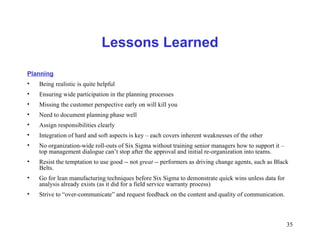
Lessons Learned
Planning
• Beingrealistic is quite helpful
• Ensuring wide participation in the planning processes
• Missing the customer perspective early on will kill you
• Need to document planning phase well
• Assign responsibilities clearly
• Integration of hard and soft aspects is key – each covers inherent weaknesses of the other
• No organization-wide roll-outs of Six Sigma without training senior managers how to support it –
top management dialogue can’t stop after the approval and initial re-organization into teams.
• Resist the temptation to use good -- not great -- performers as driving change agents, such as Black
Belts.
• Go for lean manufacturing techniques before Six Sigma to demonstrate quick wins unless data for
analysis already exists (as it did for a field service warranty process)
• Strive to “over-communicate” and request feedback on the content and quality of communication.
36.
36
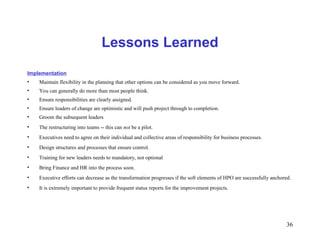
Lessons Learned
Implementation
• Maintainflexibility in the planning that other options can be considered as you move forward.
• You can generally do more than most people think.
• Ensure responsibilities are clearly assigned.
• Ensure leaders of change are optimistic and will push project through to completion.
• Groom the subsequent leaders
• The restructuring into teams -- this can not be a pilot.
• Executives need to agree on their individual and collective areas of responsibility for business processes.
• Design structures and processes that ensure control.
• Training for new leaders needs to mandatory, not optional
• Bring Finance and HR into the process soon.
• Executive efforts can decrease as the transformation progresses if the soft elements of HPO are successfully anchored.
• It is extremely important to provide frequent status reports for the improvement projects.
37.
37
Sounds great. Buthow do I
get something going with Lean
Six Sigma if I’m not the CEO?
38.
38
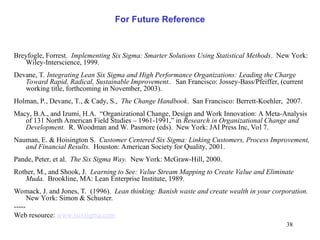
For Future Reference
Breyfogle,Forrest. Implementing Six Sigma: Smarter Solutions Using Statistical Methods. New York:
Wiley-Interscience, 1999.
Devane, T. Integrating Lean Six Sigma and High Performance Organizations: Leading the Charge
Toward Rapid, Radical, Sustainable Improvement.. San Francisco: Jossey-Bass/Pfeiffer, (current
working title, forthcoming in November, 2003).
Holman, P., Devane, T., & Cady, S., The Change Handbook. San Francisco: Berrett-Koehler, 2007.
Macy, B.A., and Izumi, H.A. “Organizational Change, Design and Work Innovation: A Meta-Analysis
of 131 North American Field Studies – 1961-1991,” in Research in Organizational Change and
Development. R. Woodman and W. Pasmore (eds). New York: JAI Press Inc, Vol 7.
Nauman, E. & Hoisington S. Customer Centered Six Sigma: Linking Customers, Process Improvement,
and Financial Results. Houston: American Society for Quality, 2001.
Pande, Peter, et al. The Six Sigma Way. New York: McGraw-Hill, 2000.
Rother, M., and Shook, J. Learning to See: Value Stream Mapping to Create Value and Eliminate
Muda. Brookline, MA: Lean Enterprise Institute, 1989.
Womack, J. and Jones, T. (1996). Lean thinking: Banish waste and create wealth in your corporation.
New York: Simon & Schuster.
-----
Web resource: www.isixsigma.com
Editor's Notes
#6 Both go after the same big goal, but in a different way.
Great companies doing process improvement don’t distinguish; they do both.
#8 Audience participation: how many people ever been on a great team? What were charactersistics of, what feel like? Ever probls protecting from rest of org to do work? Well HPO is about not needing protectoin because all have team values, practices (not just sense of “teamwork” Dilbert cartoon)
So, why fix something that isn’t broken by adding a component (in electrical products this is bad!) Success like GE, AlliedSignal, Honeywell (truth is, they DID) and this is the change management portion-often cited as the most problematic!
Most leadership tips over next two days apply to LSS and LSS/HPO
#10 Phil
Define value added and non-value added. Give examples.
Decreasing proportion of non-value added activity will improve efficiency.
Give examples of waste (i.e. inventory stops, inefficiencies in material and information flow, etc.)
Express inventory in common unit throughout. Unit should be meaningful to your customers.
Try to maintain “pull” through system.
Inefficiencies in information flow can be as critical as material inefficiencies.
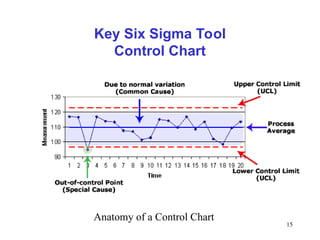
#15 A Control Chart is a graphic that monitors an important characteristic of a process over time. A Control Chart is useful for:
Answering the first of two key questions about your process:
Is the process in control? That is, is it predictable and stable over time? (process control)
If the process is in control, then, is it capable of meeting your customer’s requirements? (process capability, see Capability Analysis)
The ability to distinguish between the two sources of variation as a guide to taking appropriate management action
Common Cause Variation: the natural, inherent variability of the process due to people, methods, materials, equipment, machines, and environment that are used. Common cause variation is present in the system or process at all times; the people working in the system can do nothing about it. Therefore, it is the responsibility of management to change the system or process to improve it.
Special Cause Variation: the variability which results from a unique, or special circumstance, usually attributed to one individual or piece of equipment. It is not a normal part of the process. It is the responsibility of the individual working at the point of the process where the special cause occurred to improve it.
Upper and Lower Control Limits on a Control Chart, help in determining the source of variation and who has the responsibility for eliminating it.
A Control Chart is also useful for:
Documenting a team’s effort to effectively change a process. That is:
Sets the baseline or current operating level.
Show’s the change to the improved operating level.
Helping the process perform consistently and predictably to allow the process to achieve higher quality, lower unit cost, and a higher effective capacity.
#20 The “DMAIC”Improvement Process
DMAIC is the Six Sigma problem-solving process teams use. It stands for Define-Measure-Analyze-Improve-Control. (It is pronounced duh-MAY-ick.) By methodically following this simple, but highly effective five step process, teams can make significant process improvements. DMAIC is useful for:
Helping teams design solutions that are sustainable once implemented
Providing a framework for when tools should be used
Providing a sequence of optimal tool usage and linkages among tools.
Helping practitioners understand how the tools and improvement phases are related, and how the tools support each other to produce an output that can be acted upon.
It is essential that leaders understand the high level steps of the DMAIC improvement process. In project status meetings leaders should require that teams state which DMAIC phase they are in to provide a context for productive discussion. This provides a common ground for discussion, a context for applying lessons learned from previous similar steps, and a useful context for applying step-specific questions to the discussion of process improvements.
A Control Chart is a graphic that monitors an important characteristic of a process over time. A Control Chart is useful for:
Answering the first of two key questions about your process:
Is the process in control? That is, is it predictable and stable over time? (process control)
If the process is in control, then, is it capable of meeting your customer’s requirements? (process capability, see Capability Analysis)
The ability to distinguish between the two sources of variation as a guide to taking appropriate management action
Common Cause Variation: the natural, inherent variability of the process due to people, methods, materials, equipment, machines, and environment that are used. Common cause variation is present in the system or process at all times; the people working in the system can do nothing about it. Therefore, it is the responsibility of management to change the system or process to improve it.
Special Cause Variation: the variability which results from a unique, or special circumstance, usually attributed to one individual or piece of equipment. It is not a normal part of the process. It is the responsibility of the individual working at the point of the process where the special cause occurred to improve it.
Upper and Lower Control Limits on a Control Chart, help in determining the source of variation and who has the responsibility for eliminating it.
A Control Chart is also useful for:
Documenting a team’s effort to effectively change a process. That is:
Sets the baseline or current operating level.
Show’s the change to the improved operating level.
Helping the process perform consistently and predictably to allow the process to achieve higher quality, lower unit cost, and a higher effective capacity.
#25 Trina.
Dashboard – 12 charts
SPC many more
Cell culture --
#28 Multi-billion dollar manufacturer of data storage equipment
Departments involved: four knowledge work groups
Manufacturing engineering
Information systems
Test engineering
Total quality group
Total quality group had matured from old TQM days – ready to move from a central department to a situation in which quality professionals were members of operating departments
#29 Audience participation: how many people ever been on a great team? What were charactersistics of, what feel like? Ever probls protecting from rest of org to do work? Well HPO is about not needing protectoin because all have team values, practices (not just sense of “teamwork” Dilbert cartoon)
So, why fix something that isn’t broken by adding a component (in electrical products this is bad!) Success like GE, AlliedSignal, Honeywell (truth is, they DID) and this is the change management portion-often cited as the most problematic!
Most leadership tips over next two days apply to LSS and LSS/HPO
#31 There are seven hallmarks of the discipline of LSS:
Statistical methods. Methods that collect and analyze data are an important part of reducing variation in processes.
Attention to workplace and tool organization. A set of mindsets, practices, and discipline that keeps work areas clean and uncluttered with tools and materials, and instead sorts and neatly arranges these items for easy retrieval and use.
Fanatical focus on the external customer. One key element that distinguishes LSS from earlier Total Quality efforts is the high amount of attention paid to meeting external customer requirements and expectations. Senior managers as well as team members alike constantly ask, “How will what we’re doing here affect the external customer?”
Attention to process. A process is a set of activities and decisions that collectively produce an output for an internal or an external customer. Often these processes span departmental boundaries, and improving these tend to have the highest likelihood of producing significant financial gain. Processes are the heart of “where the action is” with LSS.
Pre-screening, and ongoing screening of improvement projects to ensure fit with strategy and financial return. Another important departure from traditional quality efforts is LSS’s initial, and ongoing requirement that projects must support strategy and yield a targeted financial return. This hallmark is true at the start of, and throughout the project.
People strive for perfection, but noble mistakes are tolerated. While 3.4 parts per million is near perfection, along the way people must feel safe to make a mistake. If they don’t, then it is unlikely they will try anything really different that could yield significant gains. Obviously, certain types of mistakes – e.g., repeated mistakes and lack of follow-through -- can not be tolerated, but other types of mistakes should be considered potential learning opportunities.
An analysis-rich and measurement-rich environment. LSS environments collect lots of data and project participants perform numerous data analyses – far more than typical organizations without LSS. In addition, in LSS companies, measurement is something that happens everywhere.
A classification and sorting process to determine the type of tools to apply. Some problems are simple, while others are complex. Organizations need to develop internal rules that specify when a problem would benefit from simple tools like process maps and the application of streamlining principles, and when a problem would require more extensive data collection and statistical analyses.


![[DSC Europe 25] Marcos Heidemann - Beyond the Hype: Making AI Coding Assistan...](https://cdn.slidesharecdn.com/ss_thumbnails/eexkhvldrjsopspdjbur-marcos-heidemann-beyond-the-hype-getting-real-value-out-of-ai-assisted-coding-260121115910-7e9d41ec-thumbnail.jpg?width=640&height=640&fit=bounds)
![[DSC Europe 25] Borko Kozomora - Optimizing business workflows with advances ...](https://cdn.slidesharecdn.com/ss_thumbnails/hbgekyb0txw0xpo4yfml-borko-kozomora-leading-ai-transformation-260122103838-cc29ee38-thumbnail.jpg?width=640&height=640&fit=bounds)


![[DSC Europe 25] Andrzej Kowalczyk - AI - how to start small and grow in the f...](https://cdn.slidesharecdn.com/ss_thumbnails/oy1zmo94qv6vpcqjvno2-andrzej-kowalczyk-ai-how-to-start-small-and-grow-in-the-future-1-260119121559-cf093b23-thumbnail.jpg?width=640&height=640&fit=bounds)


![[DSC Europe 25] Paula Garcia Esteban -Building the Future: The Role of Data S...](https://cdn.slidesharecdn.com/ss_thumbnails/9ld1r1bsqpwve8qfvphy-paula-garcia-esteban-building-the-future-260122103838-4171f5cb-thumbnail.jpg?width=640&height=640&fit=bounds)
![[DSC Europe 25] Gordana Milutinovic Dumbelovic - From Insight to Oversight: A...](https://cdn.slidesharecdn.com/ss_thumbnails/t7dkjsfxqwwzceropjv4-gordana-milutinovicdumbelovic-from-insight-to-oversight-ai-driven-power-bi-moni-260119121559-9e0bf11b-thumbnail.jpg?width=640&height=640&fit=bounds)
![[DSC Europe 25] Jovan Sumarac - Real-World Applications of Computer Vision in...](https://cdn.slidesharecdn.com/ss_thumbnails/fiksms22smcpopvvld03-jovan-sumarac-real-life-applications-of-computer-vision-in-automotive-systems-260120105855-de622abb-thumbnail.jpg?width=640&height=640&fit=bounds)
![[DSC Europe 25] Milovan Jovicic - Beyond AI's Reach: The Enduring Value of Ev...](https://cdn.slidesharecdn.com/ss_thumbnails/pyeij0hurgwq5jugmtnv-2-milovan-jovicic-beyond-ais-reach-the-enduring-value-of-evergreen-design-v2-260120105856-d6ee57e5-thumbnail.jpg?width=640&height=640&fit=bounds)
![[DSC Europe 25] Bojan Djuricic - Predictive Design Process.pdf](https://cdn.slidesharecdn.com/ss_thumbnails/5awdrbedqdek3gqu2ezy-4-the-predictive-design-bojan-djuricic-260120105856-6c399e9b-thumbnail.jpg?width=640&height=640&fit=bounds)


![[DSC Europe 25] Tamas Srancsik - How To Teach Your AI Football? An Argument f...](https://cdn.slidesharecdn.com/ss_thumbnails/bcjh1m9xtbosv20ucftb-tamas-srancsik-how-to-teach-your-ai-football-260121115910-08b53e9e-thumbnail.jpg?width=640&height=640&fit=bounds)


