




The Key Elementsof Customer Journey Mapping
Companies are from Venus
&
Customers are from Mars!
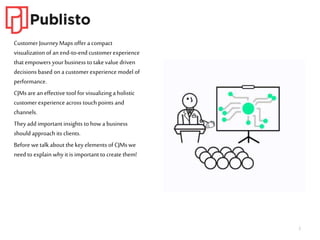
Customer JourneyMaps offer a compact
visualization of an end-to-endcustomer experience
that empowers yourbusiness to takevalue driven
decisions based on a customer experience model of
performance.
CJMsare an effective tool for visualizing a holistic
customer experience across touchpoints and
channels.
Theyadd important insights to how a business
should approach its clients.
Before wetalk about the keyelements of CJMswe
need to explain whyit is important to create them!
2
3
You should create CJMsbecause theyare powerful tools but also:
• For designers they help understand the contextof users; wherethey come from and what they
are tryingto achieve.
• For copywriters they help understand what questions users haveand how theyfeel.
• For managers they provide an overview for the customer experience; theyshow how the
enhancedcustomer service can differentiate the organization’s digital experience.
• For UXdesigners theyhelp identify the gaps i.e. the points inthe customer experience that are
disjointed or painful.
Now we can move on to what youshould watch out for in orderto build effective CJMs.
4
1
Customer Orientation
5
An effective journey map needs to be built from the customer’s point of view instead of an internal
business one.
The journey needs to be based on what the customers do; what they think and how they feel while they
interact with your brand across multiple touch points and/or relationship stages.
In effect, CJMs should be designed with specific customers in mind and based on a research-driven
understanding of your customers experiences; they should clearly communicate on which segments or
personas journeys are being modeled. You should start by building an hypothesis CJM based on
knowledge and existing customer data.
This moves us on to the next point.
6
2
Research
7
You need to do the necessary research in orderto get to know yourtarget audience:
• Analytical whereusers arecoming from and what they
aretryingto achieve.
• Anecdotal anecdotes of user experiences speaking to users in interviews
and/or social media.
• Qualitative
& will help uncover the customer’s experiences
Quantitative and emotional states throughoutthe journey.
8
3
Presentation
9
Thepresentation of yourCJMs is keyto better understanding what you’reseeing:
• Youshould use an infographic with a timeline of the users experience; this can be a storyboard or
even a video.
• It should beas clear as possible.
• It should highlightthe users needs, questions and feelings throughouttheir interaction with the
organization.
• It shouldn’t betoo complex. Instead, it should tell a simple story focusing people’s attention on the
customer’s needs.
• Itshould focus on momentsof truth. Thesearethe individual interactions that havethebiggest
impact oncustomer loyalty.
• It should illustrate the customer’s currentor futurejourneyacross multiple touch points ratherthan
focusing onone single touch point.
• It should identify the threeelements of customer experience: success, effort, emotion.
10
4
Indicators
11
Youneed to incorporate keyperformanceindicators so as to identify critical opportunity areas based on an
understanding on yourcustomer’s perceptions of their experiences. Moreover performanceindicators
provide the evaluative frameworkfor makingCJMsactionable.
12
5
Multiple Maps
13
Youneed to visualize the customer journeyto optimize the stakeholder’s engagement, understanding and
decision-makingbased on the journeymap story.
Multiple versions of a customer journeymap might be the most effective approach to meet the needs of
different stakeholder audiences.
14
6
Analysis
15
Naturally making CJMs is key but they are pretty useless if you do not analyze and evaluate the insights
they offer.
Once the map is made and the journey has ended you need to assess it. It is key to understanding your
customers reactions and to use the data to build moreeffective futuremaps.
The map will tell you the story of your customers experience from his/her initial contact, through the
process of engagement and into a long-term relationship. It will identify the key interactions that the
customer has with the organization and talk about the user’s feelings, motivations and questions for
each of these touch-points.
Andyouneed to be readyto assess all this data and reuseit for future actions. Youneed to ask yourself:
• What went right?
&
• What went wrong?
16
Effective CJMs are one of the best storytelling tools about customer engagement and reaction to your
business.
They offer, “an illustrated representation of customer’s expectations, experiences and reflections as it
unfolds over time across multiple stages and touch points while using a product or consuming a
service”.*
New digital technologies offer companies the tools not only to simplify customer journey mapping but
also to turn the valuable flow of data theyproduce into actionable information.
So focus on your customer journey mappings and seek new technologies to make the best and most
useful CJMs.
Good luckand don’t hesitate to contact us if youneed help!
To Conclude
*SiddharthGaikwad, practiceheadof digitalexperience,at NTTDATA.
17
Wetake ourclients by thehand and turnthem to successful solution owners.
Weoffer digital transformation, web and nativeapp design and development, machinelearning,
analytics and data miningservices for full end-to-endmobile solutions ina varietyof industries.
Weinvite our clients to share their business with a mobile world.
Specialties: Digital Strategy and Transformation,User Experience Design, Digital Project Management,
Software Engineering, App Development, Cloud Services, Data Sciences &MachineLearning, and
AugmentedReality.
Visit us at www.publisto.com

The Key Elements of Customer Journey Mapping

  • 1.
    The Key ElementsofCustomer Journey Mapping Companies are from Venus & Customers are from Mars!
  • 2.
    Customer JourneyMaps offera compact visualization of an end-to-endcustomer experience that empowers yourbusiness to takevalue driven decisions based on a customer experience model of performance. CJMsare an effective tool for visualizing a holistic customer experience across touchpoints and channels. Theyadd important insights to how a business should approach its clients. Before wetalk about the keyelements of CJMswe need to explain whyit is important to create them! 2
  • 3.
    3 You should createCJMsbecause theyare powerful tools but also: • For designers they help understand the contextof users; wherethey come from and what they are tryingto achieve. • For copywriters they help understand what questions users haveand how theyfeel. • For managers they provide an overview for the customer experience; theyshow how the enhancedcustomer service can differentiate the organization’s digital experience. • For UXdesigners theyhelp identify the gaps i.e. the points inthe customer experience that are disjointed or painful. Now we can move on to what youshould watch out for in orderto build effective CJMs.
  • 4.
  • 5.
    5 An effective journeymap needs to be built from the customer’s point of view instead of an internal business one. The journey needs to be based on what the customers do; what they think and how they feel while they interact with your brand across multiple touch points and/or relationship stages. In effect, CJMs should be designed with specific customers in mind and based on a research-driven understanding of your customers experiences; they should clearly communicate on which segments or personas journeys are being modeled. You should start by building an hypothesis CJM based on knowledge and existing customer data. This moves us on to the next point.
  • 6.
  • 7.
    7 You need todo the necessary research in orderto get to know yourtarget audience: • Analytical whereusers arecoming from and what they aretryingto achieve. • Anecdotal anecdotes of user experiences speaking to users in interviews and/or social media. • Qualitative & will help uncover the customer’s experiences Quantitative and emotional states throughoutthe journey.
  • 8.
  • 9.
    9 Thepresentation of yourCJMsis keyto better understanding what you’reseeing: • Youshould use an infographic with a timeline of the users experience; this can be a storyboard or even a video. • It should beas clear as possible. • It should highlightthe users needs, questions and feelings throughouttheir interaction with the organization. • It shouldn’t betoo complex. Instead, it should tell a simple story focusing people’s attention on the customer’s needs. • Itshould focus on momentsof truth. Thesearethe individual interactions that havethebiggest impact oncustomer loyalty. • It should illustrate the customer’s currentor futurejourneyacross multiple touch points ratherthan focusing onone single touch point. • It should identify the threeelements of customer experience: success, effort, emotion.
  • 10.
  • 11.
    11 Youneed to incorporatekeyperformanceindicators so as to identify critical opportunity areas based on an understanding on yourcustomer’s perceptions of their experiences. Moreover performanceindicators provide the evaluative frameworkfor makingCJMsactionable.
  • 12.
  • 13.
    13 Youneed to visualizethe customer journeyto optimize the stakeholder’s engagement, understanding and decision-makingbased on the journeymap story. Multiple versions of a customer journeymap might be the most effective approach to meet the needs of different stakeholder audiences.
  • 14.
  • 15.
    15 Naturally making CJMsis key but they are pretty useless if you do not analyze and evaluate the insights they offer. Once the map is made and the journey has ended you need to assess it. It is key to understanding your customers reactions and to use the data to build moreeffective futuremaps. The map will tell you the story of your customers experience from his/her initial contact, through the process of engagement and into a long-term relationship. It will identify the key interactions that the customer has with the organization and talk about the user’s feelings, motivations and questions for each of these touch-points. Andyouneed to be readyto assess all this data and reuseit for future actions. Youneed to ask yourself: • What went right? & • What went wrong?
  • 16.
    16 Effective CJMs areone of the best storytelling tools about customer engagement and reaction to your business. They offer, “an illustrated representation of customer’s expectations, experiences and reflections as it unfolds over time across multiple stages and touch points while using a product or consuming a service”.* New digital technologies offer companies the tools not only to simplify customer journey mapping but also to turn the valuable flow of data theyproduce into actionable information. So focus on your customer journey mappings and seek new technologies to make the best and most useful CJMs. Good luckand don’t hesitate to contact us if youneed help! To Conclude *SiddharthGaikwad, practiceheadof digitalexperience,at NTTDATA.
  • 17.
    17 Wetake ourclients bythehand and turnthem to successful solution owners. Weoffer digital transformation, web and nativeapp design and development, machinelearning, analytics and data miningservices for full end-to-endmobile solutions ina varietyof industries. Weinvite our clients to share their business with a mobile world. Specialties: Digital Strategy and Transformation,User Experience Design, Digital Project Management, Software Engineering, App Development, Cloud Services, Data Sciences &MachineLearning, and AugmentedReality. Visit us at www.publisto.com