9/16/16, 1:03 PMThe nature lover’s guide to cybersecurity
Page 1 of 6http://fedscoop.com/the-nature-lovers-guide-to-cybersecurity
September 16, 2016
The nature lover’s guide to
cybersecurity
Commentary: Biomimicry is catching on in the
cybersecurity field, as engineers seek to protect
data and thwart cybercrime using mechanisms
found in nature.
BIO
By JR Reagan
DECEMBER 15, 2015 4:00 PM
CYBERSECURITY
So, you've assumed
compromise. Now
what?
CYBERSECURITY
NSA: no zero days
were used in any
high profile
breaches over last
24 months
HOUSE OF
REPRESENTATIVES
Election systems
safe from
cyberattacks,
experts believe
PRIVACY
White House calls
for updated senior
agency privacy
positions
RELATED ARTICLES
NEWS EVENTS TV RADIO PEOPLE SUBSCRIBE CHANGE SCOOP !"
SUBSCRIBE CONNECT WITH US
9/16/16, 1:03 PMThe nature lover’s guide to cybersecurity
Page 2 of 6http://fedscoop.com/the-nature-lovers-guide-to-cybersecurity
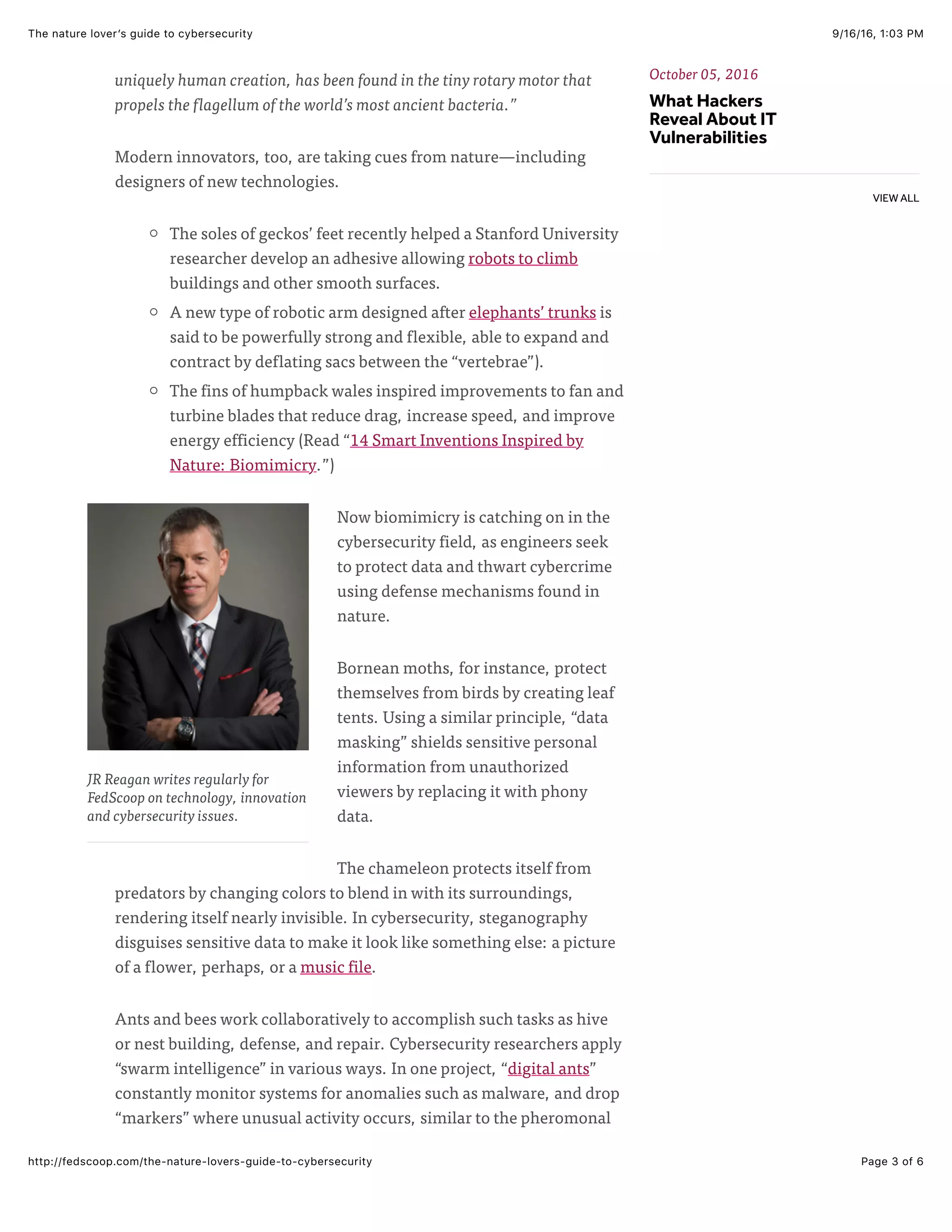
Author JR Reagan argues cybersecurity designers could borrow concepts from nature,
suggesting data, like salmon, might simply expire when their mission is completed.
(USFWS Marvina Munch)
Imitation, it’s said, is the sincerest form of flattery. It is also
antithetical to innovation, which is supposed to be entirely new. No
one wants to be accused of plagiarism, right? Today, though, being a
“copycat” is de rigueur if the source material comes from nature.
Biomemetics, or, as it’s popularly known, “biomimicry,” is a fast-
growing field in which researchers explore how animals, plants,
humans, and even micro-organisms perform certain tasks, and
appropriate their designs to endow technologies with the same
powers. Rather than re-invent the wheel, developers of medicine,
agriculture, the military, fashion, computers and more are making
improvements based on what already exists in the natural world.
The implications are many, and varied. Nature already precedes
human ingenuity in a plethora of ways, scientist Janine M. Benyus
points out in her book, “Biomimicry: Innovation Inspired by Nature”:
“Our most clever architectural struts and beams are already featured in
lily pads and bamboo stems. Our central heating and air-conditioning are
bested by the termite tower’s steady 86 degrees F. Our most stealthy radar
is hard of hearing compared to the bat’s multifrequency transmission. And
our new ‘smart materials’ can’t hold a candle to the dolphin’s skin or the
butterfly’s proboscis. Even the wheel, which we always took to be a
Cybersecurity Insights &
Perspectives
Invincea's Anup
Ghosh on using
machine learning
to improve
cybersecurity
detection
capabilities
Cybersecurity Insights &
Perspectives
Veracode's Chris
Wysopal talks
about the impact
of '90s hacker
think tank
Content from Sponsors
DHS' Vincent
Sritapan on federal
IT modernization
September 20, 2016
Leveraging Your
Workforce in the
New
Communications
Era
September 28, 2016
Privileged User &
Insider Threat
Federal 2016
Ponemon Survey
Findings
October 05, 2016
VIEW ALL
TV/RADIO
EVENTS
9/16/16, 1:03 PMThe nature lover’s guide to cybersecurity
Page 3 of 6http://fedscoop.com/the-nature-lovers-guide-to-cybersecurity
JR Reagan writes regularly for
FedScoop on technology, innovation
and cybersecurity issues.
uniquely human creation, has been found in the tiny rotary motor that
propels the flagellum of the world’s most ancient bacteria.”
Modern innovators, too, are taking cues from nature—including
designers of new technologies.
The soles of geckos’ feet recently helped a Stanford University
researcher develop an adhesive allowing robots to climb
buildings and other smooth surfaces.
A new type of robotic arm designed after elephants’ trunks is
said to be powerfully strong and flexible, able to expand and
contract by deflating sacs between the “vertebrae”).
The fins of humpback wales inspired improvements to fan and
turbine blades that reduce drag, increase speed, and improve
energy efficiency (Read “14 Smart Inventions Inspired by
Nature: Biomimicry.”)
Now biomimicry is catching on in the
cybersecurity field, as engineers seek
to protect data and thwart cybercrime
using defense mechanisms found in
nature.
Bornean moths, for instance, protect
themselves from birds by creating leaf
tents. Using a similar principle, “data
masking” shields sensitive personal
information from unauthorized
viewers by replacing it with phony
data.
The chameleon protects itself from
predators by changing colors to blend in with its surroundings,
rendering itself nearly invisible. In cybersecurity, steganography
disguises sensitive data to make it look like something else: a picture
of a flower, perhaps, or a music file.
Ants and bees work collaboratively to accomplish such tasks as hive
or nest building, defense, and repair. Cybersecurity researchers apply
“swarm intelligence” in various ways. In one project, “digital ants”
constantly monitor systems for anomalies such as malware, and drop
“markers” where unusual activity occurs, similar to the pheromonal
October 05, 2016
What Hackers
Reveal About IT
Vulnerabilities
VIEW ALL
9/16/16, 1:03 PMThe nature lover’s guide to cybersecurity
Page 4 of 6http://fedscoop.com/the-nature-lovers-guide-to-cybersecurity
-In this Story-
markers ants place along paths to food. When enough markers
appear at a location, an alarm is triggered.
The body’s immune system is a popular source of inspiration for
cybersecurity design: immunity-based systems are always on; alert to
anything out of the ordinary; able to quickly rush in to attack and
repair; and adaptive, “remembering” the intruder for increasingly
efficient and effective defenses. Some data security systems operate
similarly, knowing the “baseline” for normal behaviors such as the
keystroke speeds and patterns of specific users in order to detect
“insider”
What other functions might cybersecurity designers borrow from
nature?
Capsids, the strong, stable containers housing viral DNA, assemble
themselves automatically. Could we design digital security that does
the same, with multiple organizations on a network all responding
automatically and in sync to defend against an attack?
After leaving their chicks to find food, returning penguins can
identify their offspring even in a crowd. How might we program our
security systems to identify which users don’t belong, such as
“advanced persistent threat” data thieves hiding in our networks?
Salmon hurl themselves upstream to spawn in the place where they
were hatched. They then die, their life’s work completed. What if
data, after serving its purpose, “expired” and disappeared, no longer
vulnerable to theft?
It seems paradoxical, this borrowing from the natural world to
safeguard a virtual one. But humans have engaged in biomimicry for
eons, starting, perhaps, with wearing animal hides for warmth. Now,
as then, we may find some of the best solutions to our problems in
our own backyards—on nature’s path.
JR Reagan is the global chief information security officer of Deloitte. He
also serves as professional faculty at Johns Hopkins, Cornell and Columbia
universities. Follow him @IdeaXplorer. Read more from JR Reagan.
9/16/16, 1:03 PMThe nature lover’s guide to cybersecurity
Page 5 of 6http://fedscoop.com/the-nature-lovers-guide-to-cybersecurity
-Explore Stories in Tech- NEWS > TECH
Tech, Cybersecurity, Commentary, Guest Columns
Stay alert to all the latest government IT news.
SIGN UP TODAY
0 Comments FedScoop SherryJones!
Share⤤ Sort by Best
Start the discussion…
Be the first to comment.
Subscribe✉ Add Disqus to your site Add Disqus Addd Privacy%
Recommend♥
JOIN THE CONVERSATION
ABOUT / CONTACT LEADERSHIP TEAM EDITORIAL TEAM
CONTRIBUTE CAREERS
# $ % & ' + )
So, you've
assumed
compromise. Now
what?
NSA: no zero days
were used in any
high profile
breaches over last
24 months
Election systems
safe from
cyberattacks,
experts believe
9/16/16, 1:03 PMThe nature lover’s guide to cybersecurity
Page 6 of 6http://fedscoop.com/the-nature-lovers-guide-to-cybersecurity
BACK TO TOP
COPYRIGHT 2008-2016 FEDSCOOP. ALL RIGHTS RESERVED.
∠

The nature lover’s guide to cybersecurity

  • 1.
    9/16/16, 1:03 PMThenature lover’s guide to cybersecurity Page 1 of 6http://fedscoop.com/the-nature-lovers-guide-to-cybersecurity September 16, 2016 The nature lover’s guide to cybersecurity Commentary: Biomimicry is catching on in the cybersecurity field, as engineers seek to protect data and thwart cybercrime using mechanisms found in nature. BIO By JR Reagan DECEMBER 15, 2015 4:00 PM CYBERSECURITY So, you've assumed compromise. Now what? CYBERSECURITY NSA: no zero days were used in any high profile breaches over last 24 months HOUSE OF REPRESENTATIVES Election systems safe from cyberattacks, experts believe PRIVACY White House calls for updated senior agency privacy positions RELATED ARTICLES NEWS EVENTS TV RADIO PEOPLE SUBSCRIBE CHANGE SCOOP !" SUBSCRIBE CONNECT WITH US
  • 2.
    9/16/16, 1:03 PMThenature lover’s guide to cybersecurity Page 2 of 6http://fedscoop.com/the-nature-lovers-guide-to-cybersecurity Author JR Reagan argues cybersecurity designers could borrow concepts from nature, suggesting data, like salmon, might simply expire when their mission is completed. (USFWS Marvina Munch) Imitation, it’s said, is the sincerest form of flattery. It is also antithetical to innovation, which is supposed to be entirely new. No one wants to be accused of plagiarism, right? Today, though, being a “copycat” is de rigueur if the source material comes from nature. Biomemetics, or, as it’s popularly known, “biomimicry,” is a fast- growing field in which researchers explore how animals, plants, humans, and even micro-organisms perform certain tasks, and appropriate their designs to endow technologies with the same powers. Rather than re-invent the wheel, developers of medicine, agriculture, the military, fashion, computers and more are making improvements based on what already exists in the natural world. The implications are many, and varied. Nature already precedes human ingenuity in a plethora of ways, scientist Janine M. Benyus points out in her book, “Biomimicry: Innovation Inspired by Nature”: “Our most clever architectural struts and beams are already featured in lily pads and bamboo stems. Our central heating and air-conditioning are bested by the termite tower’s steady 86 degrees F. Our most stealthy radar is hard of hearing compared to the bat’s multifrequency transmission. And our new ‘smart materials’ can’t hold a candle to the dolphin’s skin or the butterfly’s proboscis. Even the wheel, which we always took to be a Cybersecurity Insights & Perspectives Invincea's Anup Ghosh on using machine learning to improve cybersecurity detection capabilities Cybersecurity Insights & Perspectives Veracode's Chris Wysopal talks about the impact of '90s hacker think tank Content from Sponsors DHS' Vincent Sritapan on federal IT modernization September 20, 2016 Leveraging Your Workforce in the New Communications Era September 28, 2016 Privileged User & Insider Threat Federal 2016 Ponemon Survey Findings October 05, 2016 VIEW ALL TV/RADIO EVENTS
  • 3.
    9/16/16, 1:03 PMThenature lover’s guide to cybersecurity Page 3 of 6http://fedscoop.com/the-nature-lovers-guide-to-cybersecurity JR Reagan writes regularly for FedScoop on technology, innovation and cybersecurity issues. uniquely human creation, has been found in the tiny rotary motor that propels the flagellum of the world’s most ancient bacteria.” Modern innovators, too, are taking cues from nature—including designers of new technologies. The soles of geckos’ feet recently helped a Stanford University researcher develop an adhesive allowing robots to climb buildings and other smooth surfaces. A new type of robotic arm designed after elephants’ trunks is said to be powerfully strong and flexible, able to expand and contract by deflating sacs between the “vertebrae”). The fins of humpback wales inspired improvements to fan and turbine blades that reduce drag, increase speed, and improve energy efficiency (Read “14 Smart Inventions Inspired by Nature: Biomimicry.”) Now biomimicry is catching on in the cybersecurity field, as engineers seek to protect data and thwart cybercrime using defense mechanisms found in nature. Bornean moths, for instance, protect themselves from birds by creating leaf tents. Using a similar principle, “data masking” shields sensitive personal information from unauthorized viewers by replacing it with phony data. The chameleon protects itself from predators by changing colors to blend in with its surroundings, rendering itself nearly invisible. In cybersecurity, steganography disguises sensitive data to make it look like something else: a picture of a flower, perhaps, or a music file. Ants and bees work collaboratively to accomplish such tasks as hive or nest building, defense, and repair. Cybersecurity researchers apply “swarm intelligence” in various ways. In one project, “digital ants” constantly monitor systems for anomalies such as malware, and drop “markers” where unusual activity occurs, similar to the pheromonal October 05, 2016 What Hackers Reveal About IT Vulnerabilities VIEW ALL
  • 4.
    9/16/16, 1:03 PMThenature lover’s guide to cybersecurity Page 4 of 6http://fedscoop.com/the-nature-lovers-guide-to-cybersecurity -In this Story- markers ants place along paths to food. When enough markers appear at a location, an alarm is triggered. The body’s immune system is a popular source of inspiration for cybersecurity design: immunity-based systems are always on; alert to anything out of the ordinary; able to quickly rush in to attack and repair; and adaptive, “remembering” the intruder for increasingly efficient and effective defenses. Some data security systems operate similarly, knowing the “baseline” for normal behaviors such as the keystroke speeds and patterns of specific users in order to detect “insider” What other functions might cybersecurity designers borrow from nature? Capsids, the strong, stable containers housing viral DNA, assemble themselves automatically. Could we design digital security that does the same, with multiple organizations on a network all responding automatically and in sync to defend against an attack? After leaving their chicks to find food, returning penguins can identify their offspring even in a crowd. How might we program our security systems to identify which users don’t belong, such as “advanced persistent threat” data thieves hiding in our networks? Salmon hurl themselves upstream to spawn in the place where they were hatched. They then die, their life’s work completed. What if data, after serving its purpose, “expired” and disappeared, no longer vulnerable to theft? It seems paradoxical, this borrowing from the natural world to safeguard a virtual one. But humans have engaged in biomimicry for eons, starting, perhaps, with wearing animal hides for warmth. Now, as then, we may find some of the best solutions to our problems in our own backyards—on nature’s path. JR Reagan is the global chief information security officer of Deloitte. He also serves as professional faculty at Johns Hopkins, Cornell and Columbia universities. Follow him @IdeaXplorer. Read more from JR Reagan.
  • 5.
    9/16/16, 1:03 PMThenature lover’s guide to cybersecurity Page 5 of 6http://fedscoop.com/the-nature-lovers-guide-to-cybersecurity -Explore Stories in Tech- NEWS > TECH Tech, Cybersecurity, Commentary, Guest Columns Stay alert to all the latest government IT news. SIGN UP TODAY 0 Comments FedScoop SherryJones! Share⤤ Sort by Best Start the discussion… Be the first to comment. Subscribe✉ Add Disqus to your site Add Disqus Addd Privacy% Recommend♥ JOIN THE CONVERSATION ABOUT / CONTACT LEADERSHIP TEAM EDITORIAL TEAM CONTRIBUTE CAREERS # $ % & ' + ) So, you've assumed compromise. Now what? NSA: no zero days were used in any high profile breaches over last 24 months Election systems safe from cyberattacks, experts believe
  • 6.
    9/16/16, 1:03 PMThenature lover’s guide to cybersecurity Page 6 of 6http://fedscoop.com/the-nature-lovers-guide-to-cybersecurity BACK TO TOP COPYRIGHT 2008-2016 FEDSCOOP. ALL RIGHTS RESERVED. ∠