Applying the
Hothouse
Technique…
…TO SUPPORT AN INFORMED BUSINESS CASE
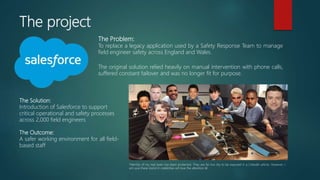
The project
The Solution:
Introduction of Salesforce to support
critical operational and safety processes
across 2,000 field engineers
The Outcome:
A safer working environment for all field-
based staff
The Problem:
To replace a legacy application used by a Safety Response Team to manage
field engineer safety across England and Wales.
The original solution relied heavily on manual intervention with phone calls,
suffered constant failover and was no longer fit for purpose.
*Identity of my real team has been protected. They are far too shy to be exposed in a LinkedIn article. However, I
am sure these stand-in celebrities will love the attention 
The approach
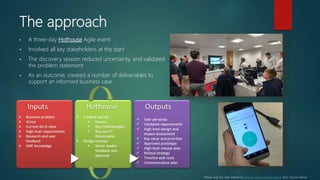
 A three-day Hothouse Agile event
 Involved all key stakeholders at the start
 The discovery session reduced uncertainty, and validated
the problem statement
 As an outcome, created a number of deliverables to
support an informed business case.
*Please note this slide references “How to make a tortoise dance” from Shardul Mehta
Hothouse theory
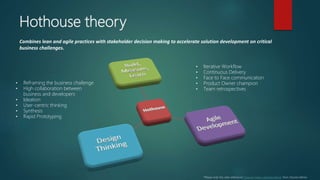
Combines lean and agile practices with stakeholder decision making to accelerate solution development on critical
business challenges.
*Please note this slide references “How to make a tortoise dance” from Shardul Mehta
• Reframing the business challenge
• High collaboration between
business and developers
• Ideation
• User-centric thinking
• Synthesis
• Rapid Prototyping
• Iterative Workflow
• Continuous Delivery
• Face to Face communication
• Product Owner champion
• Team retrospectives
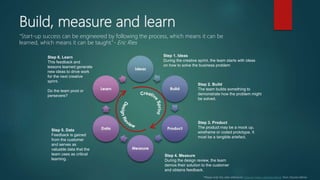
Build, measure and learn
“Start-up success can be engineered by following the process, which means it can be
learned, which means it can be taught.”- Eric Ries
*Please note this slide references “How to make a tortoise dance” from Shardul Mehta
Step 2. Build
The team builds something to
demonstrate how the problem might
be solved.
Step 3. Product
The product may be a mock up,
wireframe or coded prototype. It
must be a tangible artefact.
Step 4. Measure
During the design review, the team
demos their solution to the customer
and obtains feedback.
Step 1. Ideas
During the creative sprint, the team starts with ideas
on how to solve the business problem
Step 5. Data
Feedback is gained
from the customer
and serves as
valuable data that the
team uses as critical
learning.
Step 6. Learn
This feedback and
lessons learned generate
new ideas to drive work
for the next creative
sprint.
Do the team pivot or
persevere?
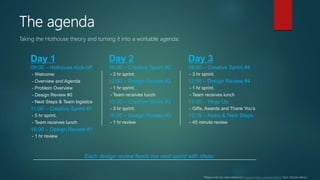
The agenda
Day 1
09:00 – Hothouse Kick-off
- Welcome
- Overview and Agenda
- Problem Overview
- Design Review #0
- Next Steps & Team logistics
11:00 – Creative Sprint #1
- 5 hr sprint.
- Team receives lunch
16:00 – Design Review #1
- 1 hr review
Each design review feeds the next sprint with ideas
Day 2
09:00 – Creative Sprint #2
- 3 hr sprint.
12:00 – Design Review #2
- 1 hr sprint.
- Team receives lunch
13:00 – Creative Sprint #3
- 3 hr sprint.
16:00 – Design Review #3
- 1 hr review
Day 3
09:00 – Creative Sprint #4
- 3 hr sprint.
12:00 – Design Review #4
- 1 hr sprint.
- Team receives lunch
13:00 – Wrap Up
- Gifts, Awards and Thank You’s
13:15 – Retro & Next Steps
- 45 minute review
Taking the Hothouse theory and turning it into a workable agenda:
*Please note this slide references “How to make a tortoise dance” from Shardul Mehta
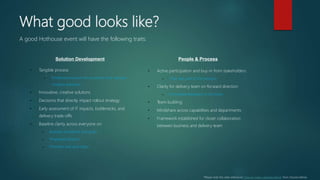
What good looks like?
Solution Development People & Process
• Active participation and buy-in from stakeholders
– They feel part of the process
• Clarity for delivery team on forward direction
– Immediate feedback to the team
• Team building
• Mindshare across capabilities and departments
• Framework established for closer collaboration
between business and delivery team
• Tangible process
– Timeboxed session forces action and reduces
“analysis paralysis”
• Innovative, creative solutions
• Decisions that directly impact rollout strategy
• Early assessment of IT impacts, bottlenecks, and
delivery trade-offs
• Baseline clarity across everyone on:
– Business problems and goals
– Proposed solution
– Priorities and next steps
A good Hothouse event will have the following traits:
*Please note this slide references “How to make a tortoise dance” from Shardul Mehta
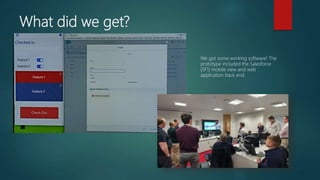
What did we get?
We got some working software! The
prototype included the Salesforce
(SF1) mobile view and web
application back end.
Feature 1
Feature 2
Feature 1
Feature 2
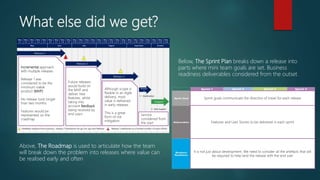
What else did we get?
Above, The Roadmap is used to articulate how the team
will break down the problem into releases where value can
be realised early and often.
Below, The Sprint Plan breaks down a release into
parts where mini team goals are set. Business
readiness deliverables considered from the outset.
Incremental approach
with multiple releases
Release 1 was
considered to be the
minimum viable
product (MVP)
No release took longer
than two months
Features would be
represented on the
roadmap
Future releases
would build on
the MVP and
deliver new
features, whilst
taking into
account feedback
being received by
end users
Although scope is
flexible in an Agile
delivery, most
value is delivered
in early releases
This is a great
form of risk
mitigation
Service
considered from
the start
Sprint goals communicate the direction of travel for each release
Features and User Stories to be delivered in each sprint
It is not just about development. We need to consider all the artefacts that will
be required to help land the release with the end user
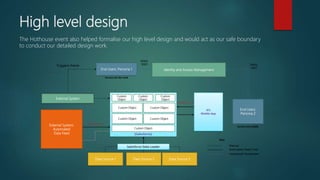
High level design
End Users: Persona 1
End Users:
Persona 2
Data Source 1 Data Source 2 Data Source 3
Custom
Object
Custom
Object
Custom
Object
Custom Object Custom Object
Custom ObjectCustom Object
External System
Custom Object
Identity and Access Management
External System:
Automated
Data Feed
The Hothouse event also helped formalise our high level design and would act as our safe boundary
to conduct our detailed design work.
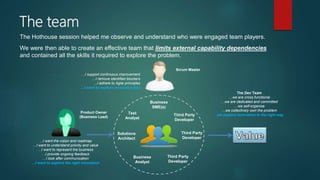
The team
The Dev Team
…we are cross functional
…we are dedicated and committed
…we self-organise
…we collectively own the problem
..we explore innovation in the right way
…I want the vision and roadmap
…I want to understand priority and value
…I want to represent the business
…I provide ongoing feedback
…I look after communication
…I want to explore the right innovation
…I support continuous improvement
…I remove identified blockers
…I adhere to Agile principles
…I want to explore innovation fast
Scrum Master
Business
SME(s)
Test
Analyst
Solutions
Architect
Third Party
Developer
Third Party
Developer
Third Party
Developer
Business
Analyst
Product Owner
(Business Lead)
The Hothouse session helped me observe and understand who were engaged team players.
We were then able to create an effective team that limits external capability dependencies
and contained all the skills it required to explore the problem.
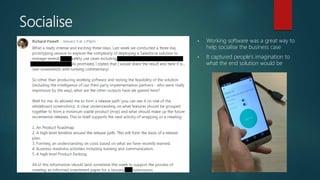
Socialise
 Working software was a great way to
help socialise the business case
 It captured people’s imagination to
what the end solution would be
The benefits
• Stakeholders are fully represented
– Business and senior decision makers
– Solution provider
– Third party implementation team
– Wider IT team
• Ideation without being limited by existing technology or entrenched business practices
– Rapid prototyping pushes the envelope on what is possible
• Accelerated solution development
• High degree of collaboration and cooperation
• High use of visual artefacts (mock-ups, screenshots, prototypes etc.) forces customer first thinking
• Faster time to market
• Saves money through Lean-Thinking. Salesforce licencing costs limited to the amount of custom objects
required.
*Please note this slide references “How to make a tortoise dance” from Shardul Mehta
Appreciation
1. A big thank you to Shardul Mehta who’s process for Agile innovation I have partially included
within this presentation. For a full read of his work, please click here.
2. Also, this presentation references the Build, Measure, Learn process created by Eric Ries. More
information can be found here.
3. My colleagues that attended the hothouse. You know who you are and you made the whole
thing work! Thank you.

The hothouse approach

  • 1.
  • 2.
    The project The Solution: Introductionof Salesforce to support critical operational and safety processes across 2,000 field engineers The Outcome: A safer working environment for all field- based staff The Problem: To replace a legacy application used by a Safety Response Team to manage field engineer safety across England and Wales. The original solution relied heavily on manual intervention with phone calls, suffered constant failover and was no longer fit for purpose. *Identity of my real team has been protected. They are far too shy to be exposed in a LinkedIn article. However, I am sure these stand-in celebrities will love the attention 
  • 3.
    The approach  Athree-day Hothouse Agile event  Involved all key stakeholders at the start  The discovery session reduced uncertainty, and validated the problem statement  As an outcome, created a number of deliverables to support an informed business case. *Please note this slide references “How to make a tortoise dance” from Shardul Mehta
  • 4.
    Hothouse theory Combines leanand agile practices with stakeholder decision making to accelerate solution development on critical business challenges. *Please note this slide references “How to make a tortoise dance” from Shardul Mehta • Reframing the business challenge • High collaboration between business and developers • Ideation • User-centric thinking • Synthesis • Rapid Prototyping • Iterative Workflow • Continuous Delivery • Face to Face communication • Product Owner champion • Team retrospectives
  • 5.
    Build, measure andlearn “Start-up success can be engineered by following the process, which means it can be learned, which means it can be taught.”- Eric Ries *Please note this slide references “How to make a tortoise dance” from Shardul Mehta Step 2. Build The team builds something to demonstrate how the problem might be solved. Step 3. Product The product may be a mock up, wireframe or coded prototype. It must be a tangible artefact. Step 4. Measure During the design review, the team demos their solution to the customer and obtains feedback. Step 1. Ideas During the creative sprint, the team starts with ideas on how to solve the business problem Step 5. Data Feedback is gained from the customer and serves as valuable data that the team uses as critical learning. Step 6. Learn This feedback and lessons learned generate new ideas to drive work for the next creative sprint. Do the team pivot or persevere?
  • 6.
    The agenda Day 1 09:00– Hothouse Kick-off - Welcome - Overview and Agenda - Problem Overview - Design Review #0 - Next Steps & Team logistics 11:00 – Creative Sprint #1 - 5 hr sprint. - Team receives lunch 16:00 – Design Review #1 - 1 hr review Each design review feeds the next sprint with ideas Day 2 09:00 – Creative Sprint #2 - 3 hr sprint. 12:00 – Design Review #2 - 1 hr sprint. - Team receives lunch 13:00 – Creative Sprint #3 - 3 hr sprint. 16:00 – Design Review #3 - 1 hr review Day 3 09:00 – Creative Sprint #4 - 3 hr sprint. 12:00 – Design Review #4 - 1 hr sprint. - Team receives lunch 13:00 – Wrap Up - Gifts, Awards and Thank You’s 13:15 – Retro & Next Steps - 45 minute review Taking the Hothouse theory and turning it into a workable agenda: *Please note this slide references “How to make a tortoise dance” from Shardul Mehta
  • 7.
    What good lookslike? Solution Development People & Process • Active participation and buy-in from stakeholders – They feel part of the process • Clarity for delivery team on forward direction – Immediate feedback to the team • Team building • Mindshare across capabilities and departments • Framework established for closer collaboration between business and delivery team • Tangible process – Timeboxed session forces action and reduces “analysis paralysis” • Innovative, creative solutions • Decisions that directly impact rollout strategy • Early assessment of IT impacts, bottlenecks, and delivery trade-offs • Baseline clarity across everyone on: – Business problems and goals – Proposed solution – Priorities and next steps A good Hothouse event will have the following traits: *Please note this slide references “How to make a tortoise dance” from Shardul Mehta
  • 8.
    What did weget? We got some working software! The prototype included the Salesforce (SF1) mobile view and web application back end. Feature 1 Feature 2 Feature 1 Feature 2
  • 9.
    What else didwe get? Above, The Roadmap is used to articulate how the team will break down the problem into releases where value can be realised early and often. Below, The Sprint Plan breaks down a release into parts where mini team goals are set. Business readiness deliverables considered from the outset. Incremental approach with multiple releases Release 1 was considered to be the minimum viable product (MVP) No release took longer than two months Features would be represented on the roadmap Future releases would build on the MVP and deliver new features, whilst taking into account feedback being received by end users Although scope is flexible in an Agile delivery, most value is delivered in early releases This is a great form of risk mitigation Service considered from the start Sprint goals communicate the direction of travel for each release Features and User Stories to be delivered in each sprint It is not just about development. We need to consider all the artefacts that will be required to help land the release with the end user
  • 10.
    High level design EndUsers: Persona 1 End Users: Persona 2 Data Source 1 Data Source 2 Data Source 3 Custom Object Custom Object Custom Object Custom Object Custom Object Custom ObjectCustom Object External System Custom Object Identity and Access Management External System: Automated Data Feed The Hothouse event also helped formalise our high level design and would act as our safe boundary to conduct our detailed design work.
  • 11.
    The team The DevTeam …we are cross functional …we are dedicated and committed …we self-organise …we collectively own the problem ..we explore innovation in the right way …I want the vision and roadmap …I want to understand priority and value …I want to represent the business …I provide ongoing feedback …I look after communication …I want to explore the right innovation …I support continuous improvement …I remove identified blockers …I adhere to Agile principles …I want to explore innovation fast Scrum Master Business SME(s) Test Analyst Solutions Architect Third Party Developer Third Party Developer Third Party Developer Business Analyst Product Owner (Business Lead) The Hothouse session helped me observe and understand who were engaged team players. We were then able to create an effective team that limits external capability dependencies and contained all the skills it required to explore the problem.
  • 12.
    Socialise  Working softwarewas a great way to help socialise the business case  It captured people’s imagination to what the end solution would be
  • 13.
    The benefits • Stakeholdersare fully represented – Business and senior decision makers – Solution provider – Third party implementation team – Wider IT team • Ideation without being limited by existing technology or entrenched business practices – Rapid prototyping pushes the envelope on what is possible • Accelerated solution development • High degree of collaboration and cooperation • High use of visual artefacts (mock-ups, screenshots, prototypes etc.) forces customer first thinking • Faster time to market • Saves money through Lean-Thinking. Salesforce licencing costs limited to the amount of custom objects required. *Please note this slide references “How to make a tortoise dance” from Shardul Mehta
  • 14.
    Appreciation 1. A bigthank you to Shardul Mehta who’s process for Agile innovation I have partially included within this presentation. For a full read of his work, please click here. 2. Also, this presentation references the Build, Measure, Learn process created by Eric Ries. More information can be found here. 3. My colleagues that attended the hothouse. You know who you are and you made the whole thing work! Thank you.

Editor's Notes

  • #3 Collaboration – Business and IS working hand in hand to deliver value. A solution looking to automate interactions and move to management by exception model. THE BENEFITS!!! Pushing TNCC Response to a management by exception
  • #4 Start up discovery technique to remove uncertainty and help create an informed investment paper early in the lifecycle of the project. Explores the problem statement as a team building exercise.
  • #5 Start up discovery technique to remove uncertainty and help create an informed investment paper early in the lifecycle of the project. Explores the problem statement as a team building exercise.
  • #6 Start up discovery technique to remove uncertainty and help create an informed investment paper early in the lifecycle of the project. Explores the problem statement as a team building exercise.
  • #7 Start up discovery technique to remove uncertainty and help create an informed investment paper early in the lifecycle of the project. Explores the problem statement as a team building exercise.
  • #8 Start up discovery technique to remove uncertainty and help create an informed investment paper early in the lifecycle of the project. Explores the problem statement as a team building exercise.
  • #9 Start up discovery technique to remove uncertainty and help create an informed investment paper early in the lifecycle of the project. Explores the problem statement as a team building exercise.
  • #10 Release value early Allows the Product Team to visualise the solution to the end customer on a continuous basis, where we can collect feedback and adapt the solution to better meet the business need. Stepping stone to release more competitively – for example within a sprint. Supports future
  • #11 From a Field Engineer perspective, they will now be able to check in on a tower or substation anywhere across England and Wales using GPS. From a TNCC Response perspective…
  • #13 From a Field Engineer perspective, they will now be able to check in on a tower or substation anywhere across England and Wales using GPS. From a TNCC Response perspective…
  • #14 From a Field Engineer perspective, they will now be able to check in on a tower or substation anywhere across England and Wales using GPS. From a TNCC Response perspective…
  • #15 Start up discovery technique to remove uncertainty and help create an informed investment paper early in the lifecycle of the project. Explores the problem statement as a team building exercise.