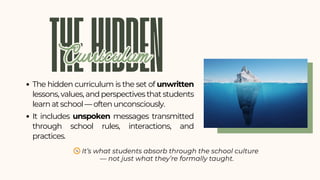
The hidden curriculumis the set of unwritten
lessons, values, and perspectives that students
learn at school — often unconsciously.
It includes unspoken messages transmitted
through school rules, interactions, and
practices.
THEHIDDEN
Curriculum
Curriculum
🧭It’s what students absorb through the school culture
— not just what they’re formally taught.
4.
ABRIEF
Introduced by PhilipW. Jackson (1968) in Life in Classrooms.
He observed that students weren’t only learning academics, they were also
learning obedience, patience, and competition through everyday school life.
Later scholars expanded the idea:
They argued that the hidden curriculum often reproduces social inequalities,
privileging certain groups and silencing others.
Schools can unintentionally mirror societal hierarchies (gender, class, race).
History
5.
WHYITMATTERS
As education transformsglobally, we can’t just
measure learning through grades.
As educators, we must ask:
Hidden curriculum forms students’ attitudes,
values, and worldviews — the foundation of
social cohesion and global competence.
“What kind of citizens are we shaping?”
Now
6.
WHEREIT
The hidden curriculumis not in the lesson plan — it’s in the everyday moments
of school life. Each practice silently teaches students what we truly value.
Happens
7.
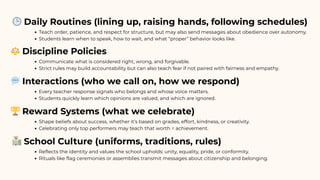
🕒Daily Routines (liningup, raising hands, following schedules)
Teach order, patience, and respect for structure, but may also send messages about obedience over autonomy.
Students learn when to speak, how to wait, and what “proper” behavior looks like.
⚖️Discipline Policies
Communicate what is considered right, wrong, and forgivable.
Strict rules may build accountability but can also teach fear if not paired with fairness and empathy.
💬Interactions (who we call on, how we respond)
Every teacher response signals who belongs and whose voice matters.
Students quickly learn which opinions are valued, and which are ignored.
🏆Reward Systems (what we celebrate)
Shape beliefs about success, whether it’s based on grades, effort, kindness, or creativity.
Celebrating only top performers may teach that worth = achievement.
🏫School Culture (uniforms, traditions, rules)
Reflects the identity and values the school upholds: unity, equality, pride, or conformity.
Rituals like flag ceremonies or assemblies transmit messages about citizenship and belonging.
8.
EVERYDAY
Beyond the curriculum,students constantly absorb lessons about how the
world works, through what they see, experience, and feel each day.
Every action in school life communicates what is truly valued.
examples
9.
🏆Competition – fromgrading and ranking
Students learn that success is comparative; someone must “win” for others to “lose.”
This can foster motivation, but also pressure and rivalry.
🙇♀️Obedience – from strict rules and compliance-focused routine
Students internalize that being “good” means following orders and not questioning authority.
While structure builds discipline, it may silence curiosity or critical thinking.
👑Power and Authority – from teacher-student dynamics
The way teachers assert authority models how power is used, with fairness or dominance.
Respectful authority teaches justice; harsh control teaches fear.
🧍♂️Gender Roles – from classroom responsibilities or expectations
Assigning boys to carry chairs and girls to decorate boards teaches subtle messages about roles.
Even unintentional patterns reinforce stereotypes.
💬Voice and Silence – from who gets to speak or lead
Students learn whose ideas matter and whose are ignored.
Those often left unheard may internalize silence as safety.
10.
💞How to TreatOthers – Empathy or Exclusion
IMPLICIT
Values and Norms
Values and Norms
Every interaction teaches a moral lesson: kindness builds
belonging, while indifference breeds division.
When respect, fairness, and inclusion are modeled, students learn
that every voice matters.
11.
🏆What Success Means– Grades or Growth
IMPLICIT
Values and Norms
Values and Norms
When the spotlight shines only on grades, students learn that
worth is measured by numbers.
When effort, curiosity, and improvement are valued, they learn that
growth is the true goal.
12.
❓Whether Questioning IsSafe
IMPLICIT
Values and Norms
Values and Norms
A classroom that welcomes curiosity teaches that critical thinking
is courage.
A classroom that discourages dissent teaches that silence ensures
survival.
13.
👑How Authority Operates
IMPLICIT
Valuesand Norms
Values and Norms
Fair, consistent, and compassionate authority nurtures trust,
dignity, and a sense of justice.
Harsh or arbitrary authority breeds fear, silence, and obedience
without understanding.
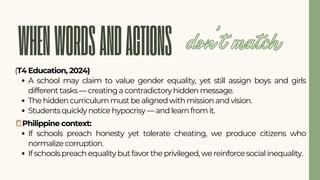
WHENWORDSANDACTIONS
(T4 Education, 2024)
Aschool may claim to value gender equality, yet still assign boys and girls
different tasks — creating a contradictory hidden message.
The hidden curriculum must be aligned with mission and vision.
Students quickly notice hypocrisy — and learn from it.
🪞Philippine context:
If schools preach honesty yet tolerate cheating, we produce citizens who
normalize corruption.
If schools preach equality but favor the privileged, we reinforce social inequality.
don’t match
16.
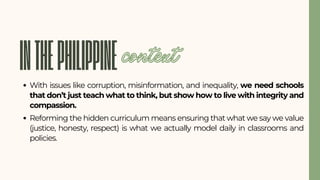
INTHEPHILIPPINE
With issues likecorruption, misinformation, and inequality, we need schools
that don’t just teach what to think, but show how to live with integrity and
compassion.
Reforming the hidden curriculum means ensuring that what we say we value
(justice, honesty, respect) is what we actually model daily in classrooms and
policies.
context
17.
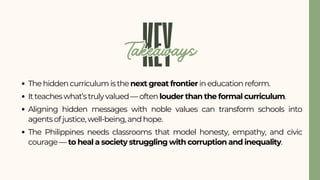
The hidden curriculumis the next great frontier in education reform.
It teaches what’s truly valued — often louder than the formal curriculum.
Aligning hidden messages with noble values can transform schools into
agents of justice, well-being, and hope.
The Philippines needs classrooms that model honesty, empathy, and civic
courage — to heal a society struggling with corruption and inequality.
KEY
Takeaways
Takeaways
18.
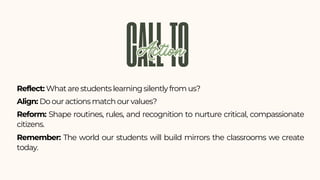
Reflect: What arestudents learning silently from us?
Align: Do our actions match our values?
Reform: Shape routines, rules, and recognition to nurture critical, compassionate
citizens.
Remember: The world our students will build mirrors the classrooms we create
today.
CALLTO
Action
Action
19.
“What we teachis important —
but what students learn silently may matter even more.”
Schleicher, A. (2024,November 18). The Hidden Curriculum is the next frontier in
transforming global education. OECD Education and Skills Today.
https://oecdedutoday.com/the-hidden-curriculum-is-the-next-frontier-in-
transforming-global-education/
Caceres, C. (2024, July 9). Defining the Hidden Curriculum: The Silent Force Behind
Student Success - T4 Education. T4 Education. https://t4.education/blog/what-is-
the-hidden-curriculum/
References:
References: