Professor Nick Mansfield
Dean, HDR
THE ROAD TO COMPLETION
The HDR Thesis Examination Process
The HDR Thesis Examination
Process
• MQ thesis examination requires 3 examiners for PhD and 2 for MPhil
• Examination is by written report (students in joint PhD programs are
required to meet examination requirements of the partner University, which
might include an oral examination or public defence)
• In general all examiners are external to the University ~60% are not
resident in Australia
• 3 months before your scheduled submission date HDRO contacts your
Principal Supervisor requesting nomination of examiners
• Supervisors must consult with you in formulating the list of prospective
examiners, including recommendation of examiners and reserve
examiners
• It is the University (through PESC/HDRC) which makes the appointment of
the examiners, and if there are perceived conflicts of interest the
University may seek further nominations from your supervisors (and you)
Choosing PhD/MPhil Examiners
• Examiners should be chosen carefully – they are an
important resource and potential influence on your ongoing
career. Appropriate examiners are:
• a significant figure in the field identified through publications
• a session chair or panellist at a conference presentation you
have made
• an editor/subeditor of a journal in your area
• otherwise be aware of your work through a seminar/visit to
another university or through your supervisors’ networks of
colleagues
• not personally close to you or your supervisors (e.g. no recent
joint publications)
Choosing PhD/MPhil Examiners
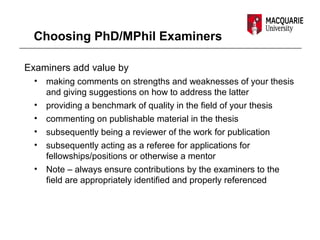
Examiners add value by
• making comments on strengths and weaknesses of your thesis
and giving suggestions on how to address the latter
• providing a benchmark of quality in the field of your thesis
• commenting on publishable material in the thesis
• subsequently being a reviewer of the work for publication
• subsequently acting as a referee for applications for
fellowships/positions or otherwise a mentor
• Note – always ensure contributions by the examiners to the
field are appropriately identified and properly referenced
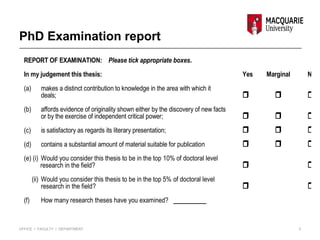
PhD Examination report
REPORT OF EXAMINATION: Please tick appropriate boxes.
In my judgement this thesis: Yes Marginal No
(a) makes a distinct contribution to knowledge in the area with which it
deals;   
(b) affords evidence of originality shown either by the discovery of new facts
or by the exercise of independent critical power;   
(c) is satisfactory as regards its literary presentation;   
(d) contains a substantial amount of material suitable for publication   
(e) (i) Would you consider this thesis to be in the top 10% of doctoral level
research in the field?  
(ii) Would you consider this thesis to be in the top 5% of doctoral level
research in the field?  
(f) How many research theses have you examined? __________
5OFFICE I FACULTY I DEPARTMENT
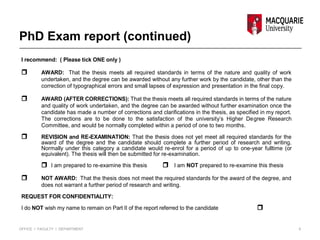
PhD Exam report (continued)
I recommend: ( Please tick ONE only )
 AWARD: That the thesis meets all required standards in terms of the nature and quality of work
undertaken, and the degree can be awarded without any further work by the candidate, other than the
correction of typographical errors and small lapses of expression and presentation in the final copy.
 AWARD (AFTER CORRECTIONS): That the thesis meets all required standards in terms of the nature
and quality of work undertaken, and the degree can be awarded without further examination once the
candidate has made a number of corrections and clarifications in the thesis, as specified in my report.
The corrections are to be done to the satisfaction of the university’s Higher Degree Research
Committee, and would be normally completed within a period of one to two months.
 REVISION and RE-EXAMINATION: That the thesis does not yet meet all required standards for the
award of the degree and the candidate should complete a further period of research and writing.
Normally under this category a candidate would re-enrol for a period of up to one-year fulltime (or
equivalent). The thesis will then be submitted for re-examination.
 I am prepared to re-examine this thesis  I am NOT prepared to re-examine this thesis
 NOT AWARD: That the thesis does not meet the required standards for the award of the degree, and
does not warrant a further period of research and writing.
REQUEST FOR CONFIDENTIALITY:
I do NOT wish my name to remain on Part II of the report referred to the candidate 
6OFFICE I FACULTY I DEPARTMENT
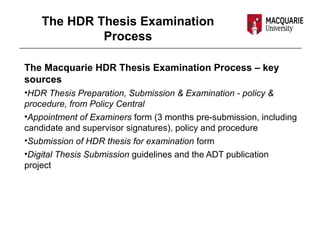
The HDR Thesis Examination
Process
The Macquarie HDR Thesis Examination Process – key
sources
•HDR Thesis Preparation, Submission & Examination - policy &
procedure, from Policy Central
•Appointment of Examiners form (3 months pre-submission, including
candidate and supervisor signatures), policy and procedure
•Submission of HDR thesis for examination form
•Digital Thesis Submission guidelines and the ADT publication
project
The HDR Thesis Examination
Process
The Macquarie HDR process after thesis submission
•Examiners’ reports are received within 2 months of submission (examiners
may recommend award, award with corrections, revise and resubmit, not
award)
•Principal supervisor is invited to respond to examiners’ reports and make a
recommendation, endorsed by Faculty Associate Dean HDR
•Examiners reports and faculty recommendations are considered by PESC,
which forwards a recommendation to HDRC
•HDRC advice and examiners’ reports go to candidate and principal
supervisor to guide any further work required
•For corrections up to 2 months is allowed
•In cases where it is determined that the thesis falls within the top 5% of PhD
theses in the field (based on examiners recommendations) a Vice-
Chancellors Commendation is awarded

The HDR Examination Process at MQ

  • 1.
    Professor Nick Mansfield Dean,HDR THE ROAD TO COMPLETION The HDR Thesis Examination Process
  • 2.
    The HDR ThesisExamination Process • MQ thesis examination requires 3 examiners for PhD and 2 for MPhil • Examination is by written report (students in joint PhD programs are required to meet examination requirements of the partner University, which might include an oral examination or public defence) • In general all examiners are external to the University ~60% are not resident in Australia • 3 months before your scheduled submission date HDRO contacts your Principal Supervisor requesting nomination of examiners • Supervisors must consult with you in formulating the list of prospective examiners, including recommendation of examiners and reserve examiners • It is the University (through PESC/HDRC) which makes the appointment of the examiners, and if there are perceived conflicts of interest the University may seek further nominations from your supervisors (and you)
  • 3.
    Choosing PhD/MPhil Examiners •Examiners should be chosen carefully – they are an important resource and potential influence on your ongoing career. Appropriate examiners are: • a significant figure in the field identified through publications • a session chair or panellist at a conference presentation you have made • an editor/subeditor of a journal in your area • otherwise be aware of your work through a seminar/visit to another university or through your supervisors’ networks of colleagues • not personally close to you or your supervisors (e.g. no recent joint publications)
  • 4.
    Choosing PhD/MPhil Examiners Examinersadd value by • making comments on strengths and weaknesses of your thesis and giving suggestions on how to address the latter • providing a benchmark of quality in the field of your thesis • commenting on publishable material in the thesis • subsequently being a reviewer of the work for publication • subsequently acting as a referee for applications for fellowships/positions or otherwise a mentor • Note – always ensure contributions by the examiners to the field are appropriately identified and properly referenced
  • 5.
    PhD Examination report REPORTOF EXAMINATION: Please tick appropriate boxes. In my judgement this thesis: Yes Marginal No (a) makes a distinct contribution to knowledge in the area with which it deals;    (b) affords evidence of originality shown either by the discovery of new facts or by the exercise of independent critical power;    (c) is satisfactory as regards its literary presentation;    (d) contains a substantial amount of material suitable for publication    (e) (i) Would you consider this thesis to be in the top 10% of doctoral level research in the field?   (ii) Would you consider this thesis to be in the top 5% of doctoral level research in the field?   (f) How many research theses have you examined? __________ 5OFFICE I FACULTY I DEPARTMENT
  • 6.
    PhD Exam report(continued) I recommend: ( Please tick ONE only )  AWARD: That the thesis meets all required standards in terms of the nature and quality of work undertaken, and the degree can be awarded without any further work by the candidate, other than the correction of typographical errors and small lapses of expression and presentation in the final copy.  AWARD (AFTER CORRECTIONS): That the thesis meets all required standards in terms of the nature and quality of work undertaken, and the degree can be awarded without further examination once the candidate has made a number of corrections and clarifications in the thesis, as specified in my report. The corrections are to be done to the satisfaction of the university’s Higher Degree Research Committee, and would be normally completed within a period of one to two months.  REVISION and RE-EXAMINATION: That the thesis does not yet meet all required standards for the award of the degree and the candidate should complete a further period of research and writing. Normally under this category a candidate would re-enrol for a period of up to one-year fulltime (or equivalent). The thesis will then be submitted for re-examination.  I am prepared to re-examine this thesis  I am NOT prepared to re-examine this thesis  NOT AWARD: That the thesis does not meet the required standards for the award of the degree, and does not warrant a further period of research and writing. REQUEST FOR CONFIDENTIALITY: I do NOT wish my name to remain on Part II of the report referred to the candidate  6OFFICE I FACULTY I DEPARTMENT
  • 7.
    The HDR ThesisExamination Process The Macquarie HDR Thesis Examination Process – key sources •HDR Thesis Preparation, Submission & Examination - policy & procedure, from Policy Central •Appointment of Examiners form (3 months pre-submission, including candidate and supervisor signatures), policy and procedure •Submission of HDR thesis for examination form •Digital Thesis Submission guidelines and the ADT publication project
  • 8.
    The HDR ThesisExamination Process The Macquarie HDR process after thesis submission •Examiners’ reports are received within 2 months of submission (examiners may recommend award, award with corrections, revise and resubmit, not award) •Principal supervisor is invited to respond to examiners’ reports and make a recommendation, endorsed by Faculty Associate Dean HDR •Examiners reports and faculty recommendations are considered by PESC, which forwards a recommendation to HDRC •HDRC advice and examiners’ reports go to candidate and principal supervisor to guide any further work required •For corrections up to 2 months is allowed •In cases where it is determined that the thesis falls within the top 5% of PhD theses in the field (based on examiners recommendations) a Vice- Chancellors Commendation is awarded