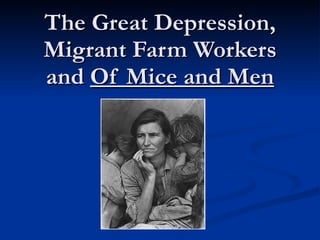
The Great Depression, Migrant Farm Workers and  Of Mice and Men
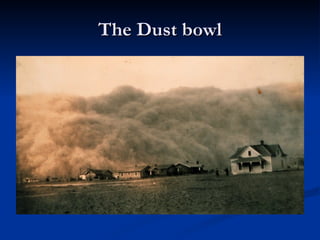
The 1930’s The Great Depression, severe drought in Midwest-dust bowl-forces shift to urban  Spurs industrialization-less labor needed Labor unions grow-strikes Roosevelt-Nat’l Labor Relations Act facilitates unionization Communism—popular social movement- “red decade” Social Security Act, repeal prohibition, New Deal
The Dust bowl
Agriculture during the Great Depression Economic problems and severe labor strife Labor conflicts—docks, packing sheds, and fields Steinbeck wrote about their struggles in  Of Mice and Men 1938—half the nation’s grain harvested by combines—took only five men, compared to 350
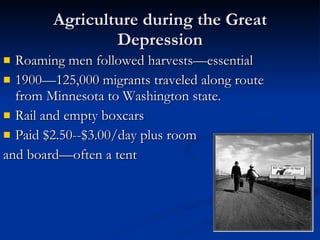
Agriculture during the Great Depression Roaming men followed harvests—essential 1900—125,000 migrants traveled along route from Minnesota to Washington state. Rail and empty boxcars Paid $2.50--$3.00/day plus room  and board—often a tent
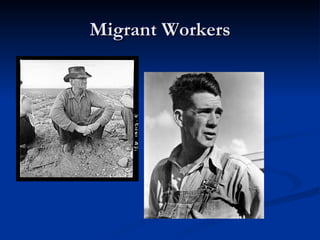
Agriculture during the Great Depression World War I—wages rose because of Industrial Workers of the World—800 mile picket line across Great Plains states But… Late 1930’s 200,000-350,000 migrants underpaid, underfed and underemployed Yet, California’s agricultural system could not exist without migrant workers
Migrant Workers
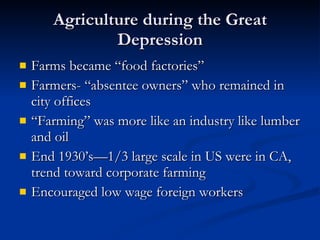
Agriculture during the Great Depression Farms became “food factories” Farmers- “absentee owners” who remained in city offices “Farming” was more like an industry like lumber and oil End 1930’s—1/3 large scale in US were in CA, trend toward corporate farming Encouraged low wage foreign workers
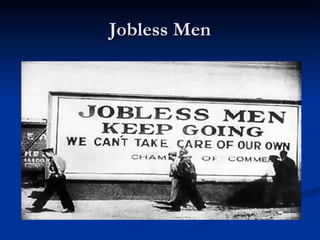
Jobless Men
Agriculture during the Great Depression “Bindle-stiffs”—white Americans among the migrants, single, followed harvests No union representation No money to pay dues Move too much Unskilled workers Cannery and Agricultural  Workers Industrial Union— Communist led union
Agriculture during the Great Depression By mid 1934—led 50 strikes, claimed to raise wages by 2 cents Summer 1934 union broken by anti-Communist activities of employers and state authorities Trial—convicted of treason Later freed and appealed  Workers and strike breakers battled
Agriculture during the Great Depression After harvest workers weren’t needed Growers wouldn’t pay all year Steady work impossible Steinbeck wrote  Of Mice and Men  when becoming involved in CA’s social and economic problems WWII absorbed many workers, “bindle stiffs” disappeared from American culture
Criticism Popular at first, criticized after  The Grapes of Wrath Dismissed as communist or leftist Still read by public “Compassion balanced by an objective view of the world and man” One of the most frequently challenged books by school censors today
“ The best-laid schemes o’ mice an’ men Gang aft agley” —Robert Burns, “To a Mouse”

The great-depression-migrant-farm-workers-and

  • 1.
    The Great Depression,Migrant Farm Workers and Of Mice and Men
  • 2.
    The 1930’s TheGreat Depression, severe drought in Midwest-dust bowl-forces shift to urban Spurs industrialization-less labor needed Labor unions grow-strikes Roosevelt-Nat’l Labor Relations Act facilitates unionization Communism—popular social movement- “red decade” Social Security Act, repeal prohibition, New Deal
  • 3.
  • 4.
    Agriculture during theGreat Depression Economic problems and severe labor strife Labor conflicts—docks, packing sheds, and fields Steinbeck wrote about their struggles in Of Mice and Men 1938—half the nation’s grain harvested by combines—took only five men, compared to 350
  • 5.
    Agriculture during theGreat Depression Roaming men followed harvests—essential 1900—125,000 migrants traveled along route from Minnesota to Washington state. Rail and empty boxcars Paid $2.50--$3.00/day plus room and board—often a tent
  • 6.
    Agriculture during theGreat Depression World War I—wages rose because of Industrial Workers of the World—800 mile picket line across Great Plains states But… Late 1930’s 200,000-350,000 migrants underpaid, underfed and underemployed Yet, California’s agricultural system could not exist without migrant workers
  • 7.
  • 8.
    Agriculture during theGreat Depression Farms became “food factories” Farmers- “absentee owners” who remained in city offices “Farming” was more like an industry like lumber and oil End 1930’s—1/3 large scale in US were in CA, trend toward corporate farming Encouraged low wage foreign workers
  • 9.
  • 10.
    Agriculture during theGreat Depression “Bindle-stiffs”—white Americans among the migrants, single, followed harvests No union representation No money to pay dues Move too much Unskilled workers Cannery and Agricultural Workers Industrial Union— Communist led union
  • 11.
    Agriculture during theGreat Depression By mid 1934—led 50 strikes, claimed to raise wages by 2 cents Summer 1934 union broken by anti-Communist activities of employers and state authorities Trial—convicted of treason Later freed and appealed Workers and strike breakers battled
  • 12.
    Agriculture during theGreat Depression After harvest workers weren’t needed Growers wouldn’t pay all year Steady work impossible Steinbeck wrote Of Mice and Men when becoming involved in CA’s social and economic problems WWII absorbed many workers, “bindle stiffs” disappeared from American culture
  • 13.
    Criticism Popular atfirst, criticized after The Grapes of Wrath Dismissed as communist or leftist Still read by public “Compassion balanced by an objective view of the world and man” One of the most frequently challenged books by school censors today
  • 14.
    “ The best-laidschemes o’ mice an’ men Gang aft agley” —Robert Burns, “To a Mouse”

Editor's Notes

  • #2 1. Inventory the items in this picture - list all nouns. 2. Who is in this picture? 3. Where is the picture set? 4. When is the picture set? Time of day, time of year? 5. What story does this picture tell? 6. What emotional, moral, or legal questions does the picture raise? 7. What event do you think happened before this photo was taken? What will happen next?