








By Mike Wilcox
May 2012
The Great Semicolon
                 Debate
By Mike Wilcox
May 2012
or how the semicolon
     may bring down society
By Mike Wilcox
May 2012
By Mike Wilcox
May 2012
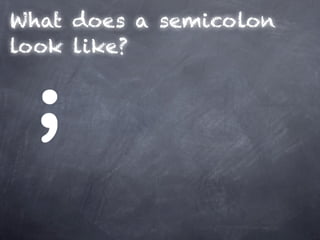
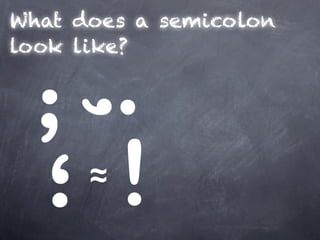
What does a semicolon
look like?
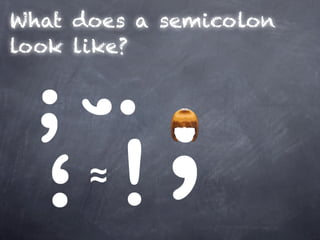
What does a semicolon
look like?
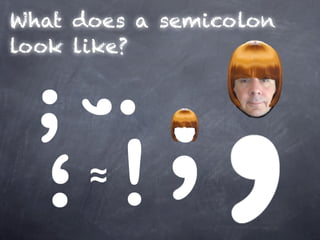
What does a semicolon
look like?
What does a semicolon
look like?
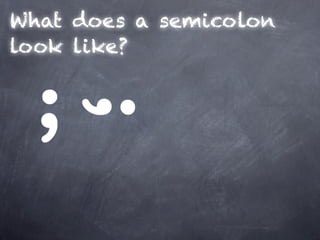
What does a semicolon
look like?


      ~
      ~   !
What does a semicolon
look like?


      ~
      ~   !
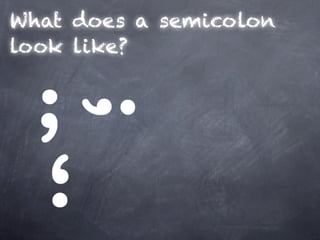
What does a semicolon
look like?


      ~
      ~   !
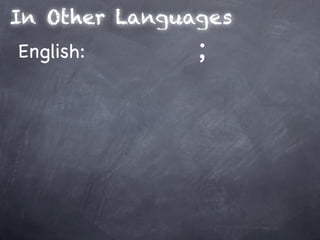
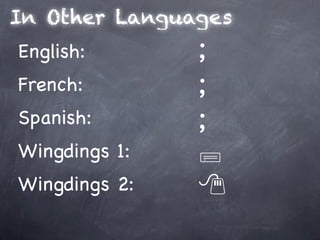
In Other Languages
In Other Languages
English:       ;
In Other Languages
English:       ;
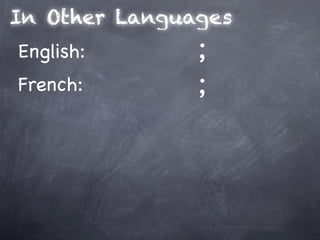
French:        ;
In Other Languages
English:       ;
French:        ;
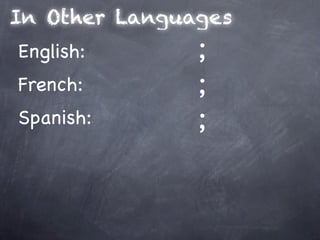
Spanish:       ;
In Other Languages
English:       ;
French:        ;
Spanish:       ;
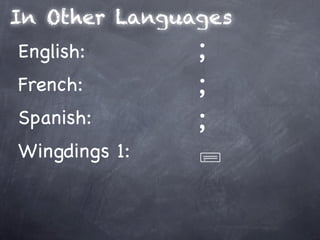
Wingdings 1:   
In Other Languages
English:       ;
French:        ;
Spanish:       ;
Wingdings 1:   
Wingdings 2:   
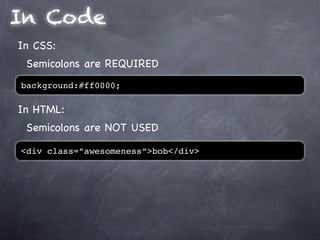
In Code
In Code
In CSS:
 Semicolons are REQUIRED
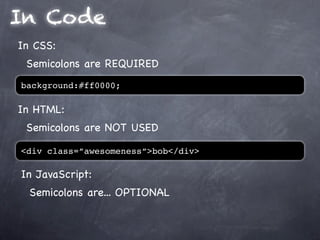
In Code
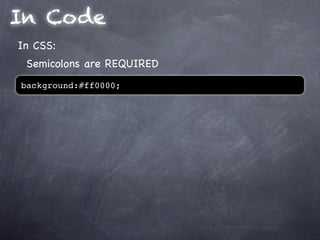
In CSS:
 Semicolons are REQUIRED
background:#ff0000;
In Code
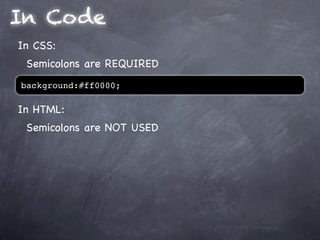
In CSS:
 Semicolons are REQUIRED
background:#ff0000;

In HTML:
 Semicolons are NOT USED
In Code
In CSS:
 Semicolons are REQUIRED
background:#ff0000;

In HTML:
 Semicolons are NOT USED

<div class=”awesomeness”>bob</div>
In Code
In CSS:
 Semicolons are REQUIRED
background:#ff0000;

In HTML:
 Semicolons are NOT USED

<div class=”awesomeness”>bob</div>

In JavaScript:
  Semicolons are... OPTIONAL
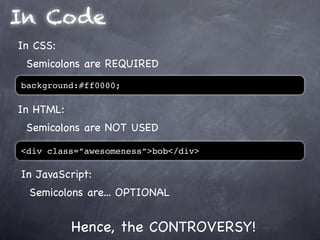
In Code
In CSS:
 Semicolons are REQUIRED
background:#ff0000;

In HTML:
 Semicolons are NOT USED

<div class=”awesomeness”>bob</div>

In JavaScript:
  Semicolons are... OPTIONAL


           Hence, the CONTROVERSY!
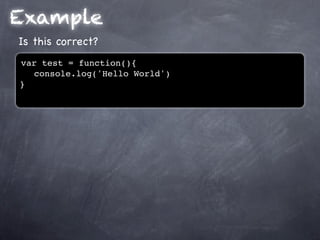
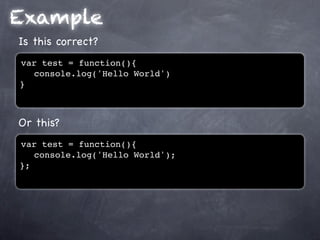
Example
Example
Is this correct?
var test = function(){
! console.log('Hello World')
}
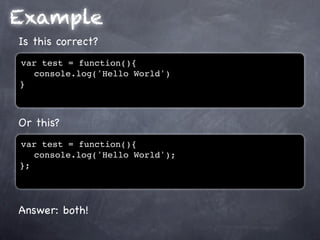
Example
Is this correct?
var test = function(){
! console.log('Hello World')
}


Or this?
var test = function(){
! console.log('Hello World');
};
Example
Is this correct?
var test = function(){
! console.log('Hello World')
}


Or this?
var test = function(){
! console.log('Hello World');
};


Answer: both!
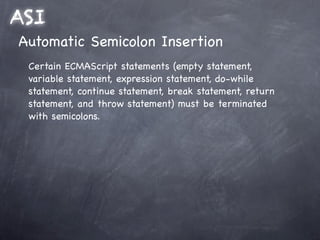
ASI
ASI
Automatic Semicolon Insertion
ASI
Automatic Semicolon Insertion
 Certain ECMAScript statements (empty statement,
 variable statement, expression statement, do-while
 statement, continue statement, break statement, return
 statement, and throw statement) must be terminated
 with semicolons.
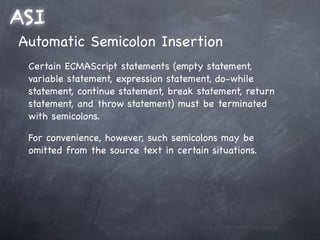
ASI
Automatic Semicolon Insertion
 Certain ECMAScript statements (empty statement,
 variable statement, expression statement, do-while
 statement, continue statement, break statement, return
 statement, and throw statement) must be terminated
 with semicolons.

 For convenience, however, such semicolons may be
 omitted from the source text in certain situations.
ASI
Automatic Semicolon Insertion
 Certain ECMAScript statements (empty statement,
 variable statement, expression statement, do-while
 statement, continue statement, break statement, return
 statement, and throw statement) must be terminated
 with semicolons.

 For convenience, however, such semicolons may be
 omitted from the source text in certain situations.


 These situations are described by saying that
 semicolons are automatically inserted into the source
 code token stream in those situations.
Uh, no. I really
didn’t get that.
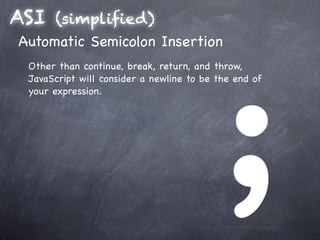
ASI   (simplified)
ASI  (simplified)
Automatic Semicolon Insertion
ASI  (simplified)
Automatic Semicolon Insertion
 Other than continue, break, return, and throw,
 JavaScript will consider a newline to be the end of
 your expression.
ASI Examples
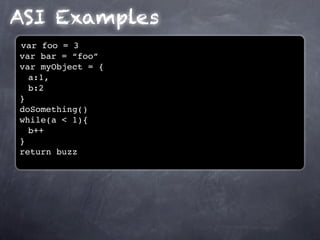
ASI Examples
var foo = 3
var bar = “foo”
var myObject = {
  a:1,
  b:2
}
doSomething()
while(a < 1){
  b++
}
return buzz
ASI Examples
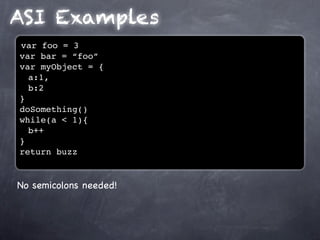
var foo = 3
var bar = “foo”
var myObject = {
  a:1,
  b:2
}
doSomething()
while(a < 1){
  b++
}
return buzz


No semicolons needed!
What’s the Point?
What’s the Point?
ASI Examples
ASI Examples
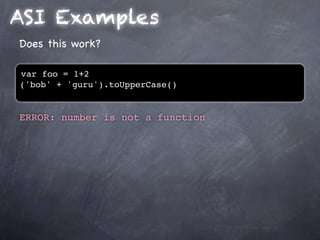
Does this work?
ASI Examples
Does this work?

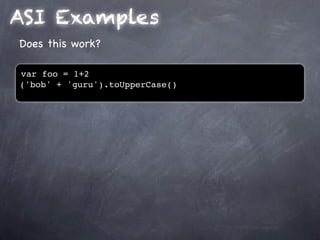
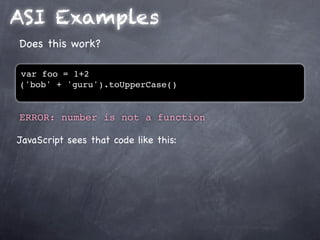
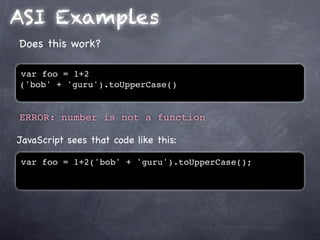
var foo = 1+2
('bob' + 'guru').toUpperCase()
ASI Examples
Does this work?

var foo = 1+2
('bob' + 'guru').toUpperCase()


ERROR: number is not a function
ASI Examples
Does this work?

var foo = 1+2
('bob' + 'guru').toUpperCase()


ERROR: number is not a function

JavaScript sees that code like this:
ASI Examples
Does this work?

var foo = 1+2
('bob' + 'guru').toUpperCase()


ERROR: number is not a function

JavaScript sees that code like this:

var foo = 1+2('bob' + 'guru').toUpperCase();
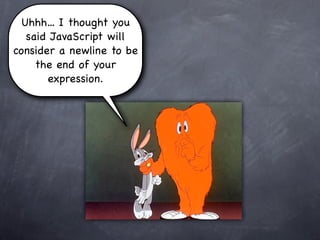
Uhhh... I thought you
   said JavaScript will
consider a newline to be
     the end of your
       expression.
ASI
ASI
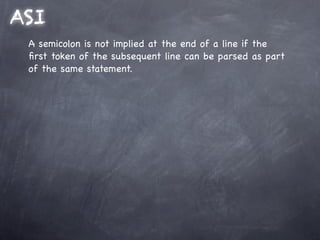
 A semicolon is not implied at the end of a line if the
 first token of the subsequent line can be parsed as part
 of the same statement.
ASI
 A semicolon is not implied at the end of a line if the
 first token of the subsequent line can be parsed as part
 of the same statement.

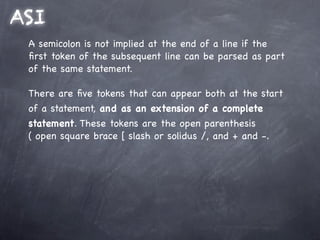
 There are five tokens that can appear both at the start
 of a statement, and as an extension of a complete
 statement. These tokens are the open parenthesis
 ( open square brace [ slash or solidus /, and + and -.
ASI
 A semicolon is not implied at the end of a line if the
 first token of the subsequent line can be parsed as part
 of the same statement.

 There are five tokens that can appear both at the start
 of a statement, and as an extension of a complete
 statement. These tokens are the open parenthesis
 ( open square brace [ slash or solidus /, and + and -.


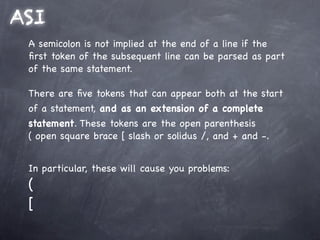
 In particular, these will cause you problems:
 (
 [
ASI Examples
ASI Examples
Does this work?
ASI Examples
Does this work?
var foo = 'asdf'
[1,2,3].forEach(function(n){log(n)})
ASI Examples
Does this work?
var foo = 'asdf'
[1,2,3].forEach(function(n){log(n)})


"asdf"[1, 2, 3].forEach is not a function
ASI Examples
Does this work?
var foo = 'asdf'
[1,2,3].forEach(function(n){log(n)})


"asdf"[1, 2, 3].forEach is not a function


What’s wrong with this?
ASI Examples
Does this work?
var foo = 'asdf'
[1,2,3].forEach(function(n){log(n)})


"asdf"[1, 2, 3].forEach is not a function


What’s wrong with this?

i=0
/[a-z]/g.exec(s)
ASI Examples
Does this work?
var foo = 'asdf'
[1,2,3].forEach(function(n){log(n)})


"asdf"[1, 2, 3].forEach is not a function


What’s wrong with this?

i=0
/[a-z]/g.exec(s)


a is not defined
ASI Examples
ASI Examples
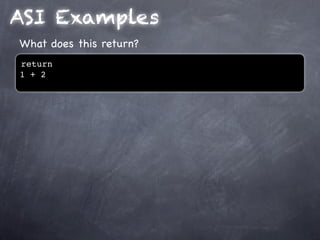
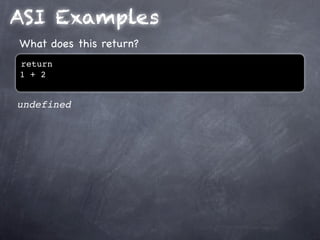
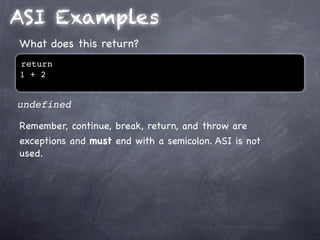
What does this return?
ASI Examples
What does this return?
return
1 + 2
ASI Examples
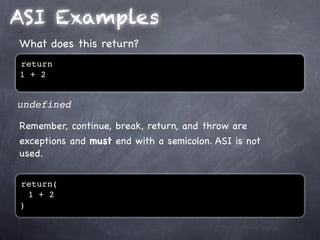
What does this return?
return
1 + 2


undefined
ASI Examples
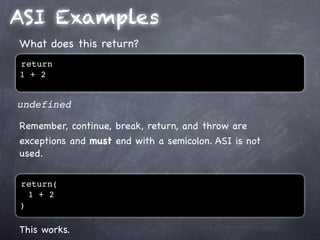
What does this return?
return
1 + 2


undefined

Remember, continue, break, return, and throw are
exceptions and must end with a semicolon. ASI is not
used.
ASI Examples
What does this return?
return
1 + 2


undefined

Remember, continue, break, return, and throw are
exceptions and must end with a semicolon. ASI is not
used.


return(
  1 + 2
)
ASI Examples
What does this return?
return
1 + 2


undefined

Remember, continue, break, return, and throw are
exceptions and must end with a semicolon. ASI is not
used.


return(
  1 + 2
)

This works.
Newbie does what
Newbie does what
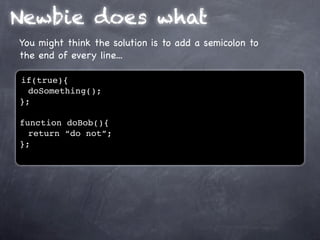
You might think the solution is to add a semicolon to
the end of every line...
Newbie does what
You might think the solution is to add a semicolon to
the end of every line...

if(true){
  doSomething();
};

function doBob(){
  return “do not”;
};
Newbie does what
You might think the solution is to add a semicolon to
the end of every line...

if(true){
  doSomething();
};

function doBob(){
  return “do not”;
};


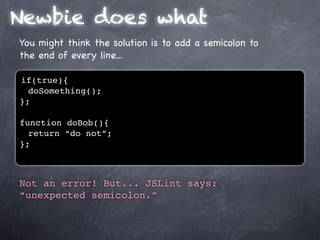
Not an error! But... JSLint says:
“unexpected semicolon.”
Newbie does what
You might think the solution is to add a semicolon to
the end of every line...

if(true){
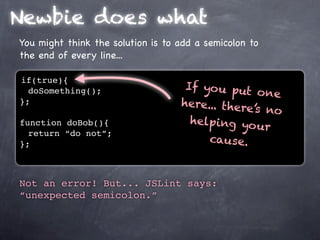
                                    If yo u put
  doSomething();                                 o ne
};                                 here... there
                                                ’s no
function doBob(){                    helping yo u
                                                   r
  return “do not”;
};                                      cause.


Not an error! But... JSLint says:
“unexpected semicolon.”
No ASI to see here
No ASI to see here
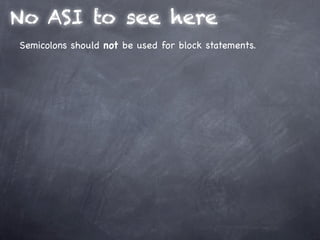
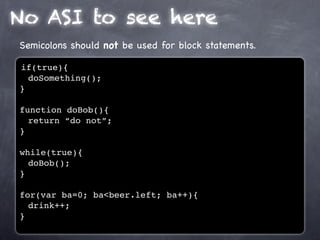
Semicolons should not be used for block statements.
No ASI to see here
Semicolons should not be used for block statements.

if(true){
  doSomething();
}

function doBob(){
  return “do not”;
}

while(true){
  doBob();
}

for(var ba=0; ba<beer.left; ba++){
  drink++;
}
This is News?
This is News?
The Trigger


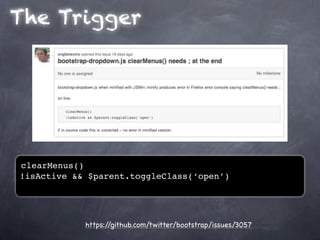
      https://github.com/twitter/bootstrap/issues/3057
The Trigger


clearMenus()
!isActive && $parent.toggleClass(‘open’)


            https://github.com/twitter/bootstrap/issues/3057
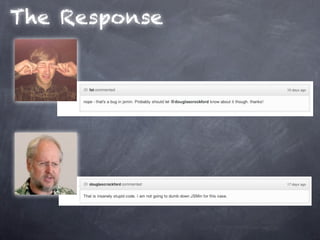
The Response
The Response
The Response
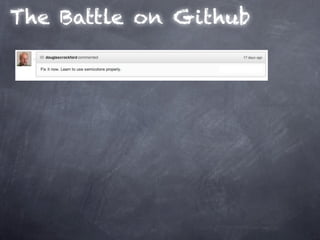
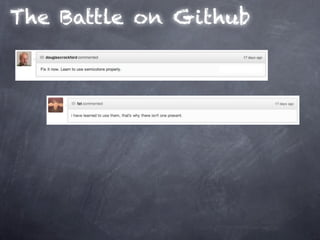
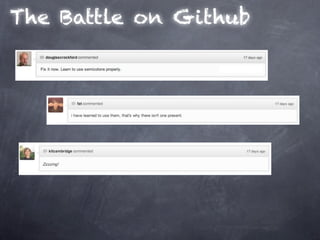
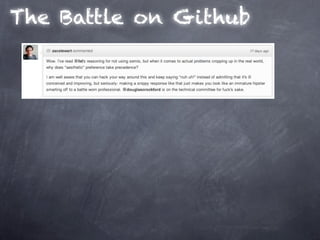
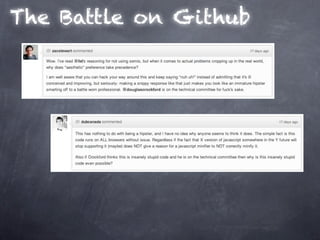
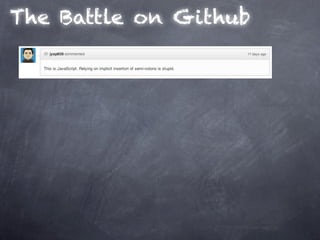
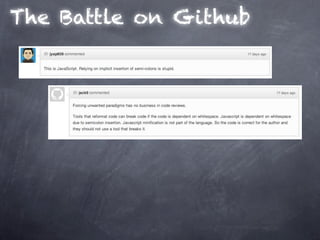
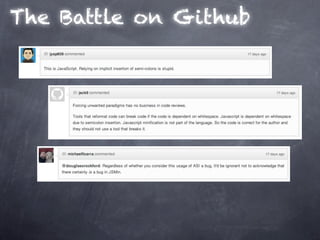
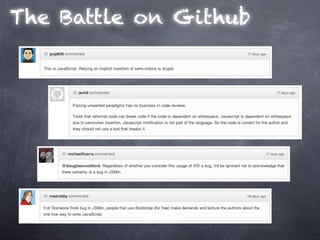
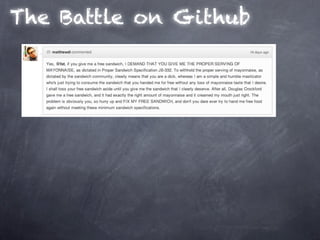
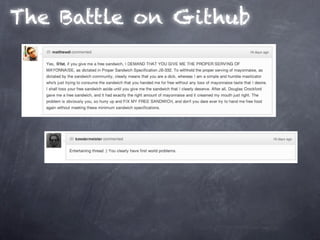
The Battle on Github
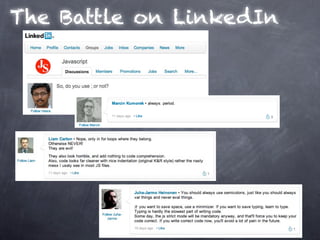
The Battle on LinkedIn
Library Solution
Library Solution
Library Solution
        Tho mas Fu
                   chs,
          author of
        Scriptaculo
                    us
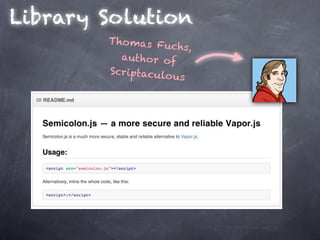
Library Solution
        Tho mas Fu
                   chs,
          author of
        Scriptaculo
                    us
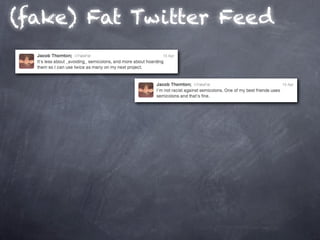
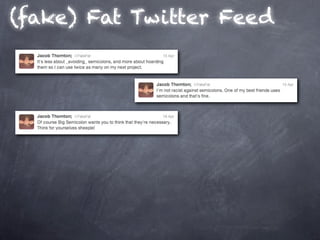
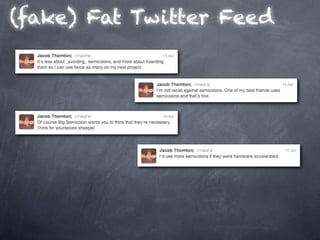
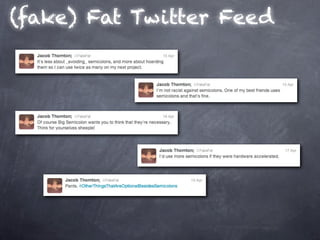
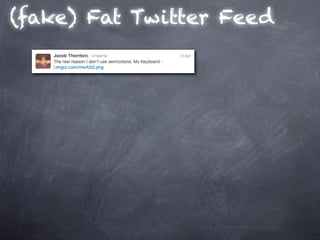
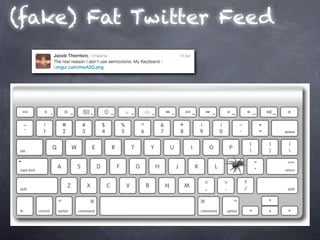
(fake) Fat Twitter Feed
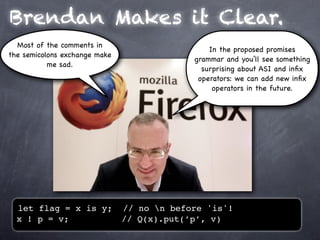
Brendan Makes it Clear.
  Most of the comments in
the semicolons exchange make
           me sad.
Brendan Makes it Clear.
  Most of the comments in
                                   In the proposed promises
the semicolons exchange make
                               grammar and you’ll see something
           me sad.
                                 surprising about ASI and infix
                                operators: we can add new infix
                                    operators in the future.
Brendan Makes it Clear.
  Most of the comments in
                                                In the proposed promises
the semicolons exchange make
                                            grammar and you’ll see something
           me sad.
                                              surprising about ASI and infix
                                             operators: we can add new infix
                                                 operators in the future.


  let flag = x is y;           // no n before 'is'!
  x ! p = v;                   // Q(x).put(’p’, v)
Brendan Makes it Clear.
  Most of the comments in
                                                 In the proposed promises
the semicolons exchange make
                                             grammar and you’ll see something
           me sad.
                                               surprising about ASI and infix
                                              operators: we can add new infix
                                                  operators in the future.


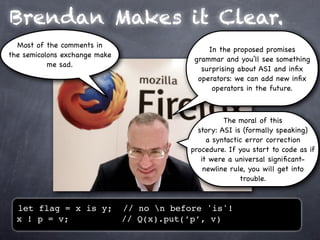
                                                      The moral of this
                                              story: ASI is (formally speaking)
                                                 a syntactic error correction
                                            procedure. If you start to code as if
                                               it were a universal significant-
                                                newline rule, you will get into
                                                           trouble.


  let flag = x is y;           // no n before 'is'!
  x ! p = v;                   // Q(x).put(’p’, v)

is an infix?
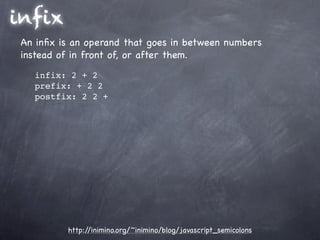
infix


        http://inimino.org/~inimino/blog/javascript_semicolons
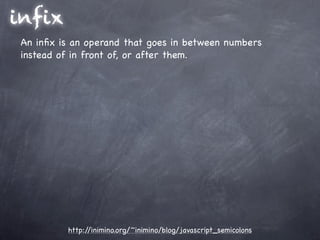
infix
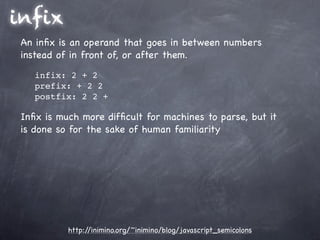
 An infix is an operand that goes in between numbers
 instead of in front of, or after them.


          http://inimino.org/~inimino/blog/javascript_semicolons
infix
 An infix is an operand that goes in between numbers
 instead of in front of, or after them.
   infix: 2 + 2
   prefix: + 2 2
   postfix: 2 2 +


          http://inimino.org/~inimino/blog/javascript_semicolons
infix
 An infix is an operand that goes in between numbers
 instead of in front of, or after them.
    infix: 2 + 2
    prefix: + 2 2
    postfix: 2 2 +

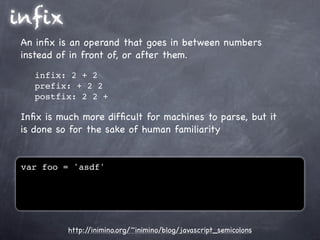
 Infix is much more difficult for machines to parse, but it
 is done so for the sake of human familiarity


           http://inimino.org/~inimino/blog/javascript_semicolons
infix
 An infix is an operand that goes in between numbers
 instead of in front of, or after them.
    infix: 2 + 2
    prefix: + 2 2
    postfix: 2 2 +

 Infix is much more difficult for machines to parse, but it
 is done so for the sake of human familiarity


 var foo = 'asdf'


           http://inimino.org/~inimino/blog/javascript_semicolons
infix
 An infix is an operand that goes in between numbers
 instead of in front of, or after them.
    infix: 2 + 2
    prefix: + 2 2
    postfix: 2 2 +

 Infix is much more difficult for machines to parse, but it
 is done so for the sake of human familiarity


 var foo = 'asdf'

[1,2,3].forEach(function(n){log(n)})


           http://inimino.org/~inimino/blog/javascript_semicolons
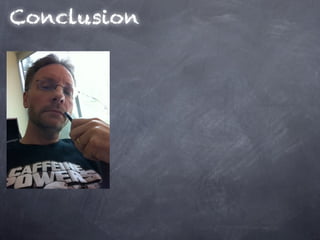
Conclusion
Conclusion
Conclusion
Conclusion
        David Flanagan's JS Definitive Guide on semi-
        colons: "Omitting semi-colons is not good
        programming practice; you should get in the
        habit of using them."
Conclusion
        David Flanagan's JS Definitive Guide on semi-
        colons: "Omitting semi-colons is not good
        programming practice; you should get in the
        habit of using them."

        Brendan Eich designed newline-terminators quite
        consciously, and they will not break in strict-
        mode (I've tested that).
Conclusion
        David Flanagan's JS Definitive Guide on semi-
        colons: "Omitting semi-colons is not good
        programming practice; you should get in the
        habit of using them."

        Brendan Eich designed newline-terminators quite
        consciously, and they will not break in strict-
        mode (I've tested that).

        Don't forget, there are plenty of places where
        you are *not* supposed to use a semicolon. So
        really, it's ultimately a matter of understanding
        the rules.
The Great Semicolon Debate

The Great Semicolon Debate

  • 1.
  • 2.
    The Great Semicolon Debate By Mike Wilcox May 2012
  • 3.
    or how thesemicolon may bring down society By Mike Wilcox May 2012
  • 4.
  • 5.
    What does asemicolon look like?
  • 6.
    What does asemicolon look like?
  • 7.
    What does asemicolon look like?
  • 8.
    What does asemicolon look like?
  • 9.
    What does asemicolon look like? ~ ~ !
  • 10.
    What does asemicolon look like? ~ ~ !
  • 11.
    What does asemicolon look like? ~ ~ !
  • 12.
  • 13.
  • 14.
  • 15.
    In Other Languages English: ; French: ; Spanish: ;
  • 16.
    In Other Languages English: ; French: ; Spanish: ; Wingdings 1: 
  • 17.
    In Other Languages English: ; French: ; Spanish: ; Wingdings 1:  Wingdings 2: 
  • 18.
  • 19.
    In Code In CSS: Semicolons are REQUIRED
  • 20.
    In Code In CSS: Semicolons are REQUIRED background:#ff0000;
  • 21.
    In Code In CSS: Semicolons are REQUIRED background:#ff0000; In HTML: Semicolons are NOT USED
  • 22.
    In Code In CSS: Semicolons are REQUIRED background:#ff0000; In HTML: Semicolons are NOT USED <div class=”awesomeness”>bob</div>
  • 23.
    In Code In CSS: Semicolons are REQUIRED background:#ff0000; In HTML: Semicolons are NOT USED <div class=”awesomeness”>bob</div> In JavaScript: Semicolons are... OPTIONAL
  • 24.
    In Code In CSS: Semicolons are REQUIRED background:#ff0000; In HTML: Semicolons are NOT USED <div class=”awesomeness”>bob</div> In JavaScript: Semicolons are... OPTIONAL Hence, the CONTROVERSY!
  • 25.
  • 26.
    Example Is this correct? vartest = function(){ ! console.log('Hello World') }
  • 27.
    Example Is this correct? vartest = function(){ ! console.log('Hello World') } Or this? var test = function(){ ! console.log('Hello World'); };
  • 28.
    Example Is this correct? vartest = function(){ ! console.log('Hello World') } Or this? var test = function(){ ! console.log('Hello World'); }; Answer: both!
  • 29.
  • 30.
  • 31.
    ASI Automatic Semicolon Insertion Certain ECMAScript statements (empty statement, variable statement, expression statement, do-while statement, continue statement, break statement, return statement, and throw statement) must be terminated with semicolons.
  • 32.
    ASI Automatic Semicolon Insertion Certain ECMAScript statements (empty statement, variable statement, expression statement, do-while statement, continue statement, break statement, return statement, and throw statement) must be terminated with semicolons. For convenience, however, such semicolons may be omitted from the source text in certain situations.
  • 33.
    ASI Automatic Semicolon Insertion Certain ECMAScript statements (empty statement, variable statement, expression statement, do-while statement, continue statement, break statement, return statement, and throw statement) must be terminated with semicolons. For convenience, however, such semicolons may be omitted from the source text in certain situations. These situations are described by saying that semicolons are automatically inserted into the source code token stream in those situations.
  • 35.
    Uh, no. Ireally didn’t get that.
  • 36.
    ASI (simplified)
  • 37.
    ASI (simplified) AutomaticSemicolon Insertion
  • 38.
    ASI (simplified) AutomaticSemicolon Insertion Other than continue, break, return, and throw, JavaScript will consider a newline to be the end of your expression.
  • 39.
  • 40.
    ASI Examples var foo= 3 var bar = “foo” var myObject = { a:1, b:2 } doSomething() while(a < 1){ b++ } return buzz
  • 41.
    ASI Examples var foo= 3 var bar = “foo” var myObject = { a:1, b:2 } doSomething() while(a < 1){ b++ } return buzz No semicolons needed!
  • 43.
  • 44.
  • 45.
  • 46.
  • 47.
    ASI Examples Does thiswork? var foo = 1+2 ('bob' + 'guru').toUpperCase()
  • 48.
    ASI Examples Does thiswork? var foo = 1+2 ('bob' + 'guru').toUpperCase() ERROR: number is not a function
  • 49.
    ASI Examples Does thiswork? var foo = 1+2 ('bob' + 'guru').toUpperCase() ERROR: number is not a function JavaScript sees that code like this:
  • 50.
    ASI Examples Does thiswork? var foo = 1+2 ('bob' + 'guru').toUpperCase() ERROR: number is not a function JavaScript sees that code like this: var foo = 1+2('bob' + 'guru').toUpperCase();
  • 52.
    Uhhh... I thoughtyou said JavaScript will consider a newline to be the end of your expression.
  • 53.
  • 54.
    ASI A semicolonis not implied at the end of a line if the first token of the subsequent line can be parsed as part of the same statement.
  • 55.
    ASI A semicolonis not implied at the end of a line if the first token of the subsequent line can be parsed as part of the same statement. There are five tokens that can appear both at the start of a statement, and as an extension of a complete statement. These tokens are the open parenthesis ( open square brace [ slash or solidus /, and + and -.
  • 56.
    ASI A semicolonis not implied at the end of a line if the first token of the subsequent line can be parsed as part of the same statement. There are five tokens that can appear both at the start of a statement, and as an extension of a complete statement. These tokens are the open parenthesis ( open square brace [ slash or solidus /, and + and -. In particular, these will cause you problems: ( [
  • 57.
  • 58.
  • 59.
    ASI Examples Does thiswork? var foo = 'asdf' [1,2,3].forEach(function(n){log(n)})
  • 60.
    ASI Examples Does thiswork? var foo = 'asdf' [1,2,3].forEach(function(n){log(n)}) "asdf"[1, 2, 3].forEach is not a function
  • 61.
    ASI Examples Does thiswork? var foo = 'asdf' [1,2,3].forEach(function(n){log(n)}) "asdf"[1, 2, 3].forEach is not a function What’s wrong with this?
  • 62.
    ASI Examples Does thiswork? var foo = 'asdf' [1,2,3].forEach(function(n){log(n)}) "asdf"[1, 2, 3].forEach is not a function What’s wrong with this? i=0 /[a-z]/g.exec(s)
  • 63.
    ASI Examples Does thiswork? var foo = 'asdf' [1,2,3].forEach(function(n){log(n)}) "asdf"[1, 2, 3].forEach is not a function What’s wrong with this? i=0 /[a-z]/g.exec(s) a is not defined
  • 64.
  • 65.
  • 66.
    ASI Examples What doesthis return? return 1 + 2
  • 67.
    ASI Examples What doesthis return? return 1 + 2 undefined
  • 68.
    ASI Examples What doesthis return? return 1 + 2 undefined Remember, continue, break, return, and throw are exceptions and must end with a semicolon. ASI is not used.
  • 69.
    ASI Examples What doesthis return? return 1 + 2 undefined Remember, continue, break, return, and throw are exceptions and must end with a semicolon. ASI is not used. return( 1 + 2 )
  • 70.
    ASI Examples What doesthis return? return 1 + 2 undefined Remember, continue, break, return, and throw are exceptions and must end with a semicolon. ASI is not used. return( 1 + 2 ) This works.
  • 71.
  • 72.
    Newbie does what Youmight think the solution is to add a semicolon to the end of every line...
  • 73.
    Newbie does what Youmight think the solution is to add a semicolon to the end of every line... if(true){ doSomething(); }; function doBob(){ return “do not”; };
  • 74.
    Newbie does what Youmight think the solution is to add a semicolon to the end of every line... if(true){ doSomething(); }; function doBob(){ return “do not”; }; Not an error! But... JSLint says: “unexpected semicolon.”
  • 75.
    Newbie does what Youmight think the solution is to add a semicolon to the end of every line... if(true){ If yo u put doSomething(); o ne }; here... there ’s no function doBob(){ helping yo u r return “do not”; }; cause. Not an error! But... JSLint says: “unexpected semicolon.”
  • 76.
    No ASI tosee here
  • 77.
    No ASI tosee here Semicolons should not be used for block statements.
  • 78.
    No ASI tosee here Semicolons should not be used for block statements. if(true){ doSomething(); } function doBob(){ return “do not”; } while(true){ doBob(); } for(var ba=0; ba<beer.left; ba++){ drink++; }
  • 80.
  • 81.
  • 82.
    The Trigger https://github.com/twitter/bootstrap/issues/3057
  • 83.
    The Trigger clearMenus() !isActive &&$parent.toggleClass(‘open’) https://github.com/twitter/bootstrap/issues/3057
  • 84.
  • 85.
  • 86.
  • 87.
  • 88.
  • 89.
  • 90.
  • 91.
  • 92.
  • 93.
  • 94.
  • 95.
  • 96.
  • 97.
  • 98.
  • 99.
  • 100.
  • 101.
  • 102.
    The Battle onLinkedIn
  • 103.
    The Battle onLinkedIn
  • 104.
    The Battle onLinkedIn
  • 105.
    The Battle onLinkedIn
  • 106.
    The Battle onLinkedIn
  • 107.
  • 108.
  • 109.
    Library Solution Tho mas Fu chs, author of Scriptaculo us
  • 110.
    Library Solution Tho mas Fu chs, author of Scriptaculo us
  • 111.
  • 112.
  • 113.
  • 114.
  • 115.
  • 116.
  • 117.
  • 118.
  • 119.
  • 120.
  • 121.
    Brendan Makes itClear. Most of the comments in the semicolons exchange make me sad.
  • 122.
    Brendan Makes itClear. Most of the comments in In the proposed promises the semicolons exchange make grammar and you’ll see something me sad. surprising about ASI and infix operators: we can add new infix operators in the future.
  • 123.
    Brendan Makes itClear. Most of the comments in In the proposed promises the semicolons exchange make grammar and you’ll see something me sad. surprising about ASI and infix operators: we can add new infix operators in the future. let flag = x is y; // no n before 'is'! x ! p = v; // Q(x).put(’p’, v)
  • 124.
    Brendan Makes itClear. Most of the comments in In the proposed promises the semicolons exchange make grammar and you’ll see something me sad. surprising about ASI and infix operators: we can add new infix operators in the future. The moral of this story: ASI is (formally speaking) a syntactic error correction procedure. If you start to code as if it were a universal significant- newline rule, you will get into trouble. let flag = x is y; // no n before 'is'! x ! p = v; // Q(x).put(’p’, v)
  • 126.
  • 127.
    infix http://inimino.org/~inimino/blog/javascript_semicolons
  • 128.
    infix An infixis an operand that goes in between numbers instead of in front of, or after them. http://inimino.org/~inimino/blog/javascript_semicolons
  • 129.
    infix An infixis an operand that goes in between numbers instead of in front of, or after them. infix: 2 + 2 prefix: + 2 2 postfix: 2 2 + http://inimino.org/~inimino/blog/javascript_semicolons
  • 130.
    infix An infixis an operand that goes in between numbers instead of in front of, or after them. infix: 2 + 2 prefix: + 2 2 postfix: 2 2 + Infix is much more difficult for machines to parse, but it is done so for the sake of human familiarity http://inimino.org/~inimino/blog/javascript_semicolons
  • 131.
    infix An infixis an operand that goes in between numbers instead of in front of, or after them. infix: 2 + 2 prefix: + 2 2 postfix: 2 2 + Infix is much more difficult for machines to parse, but it is done so for the sake of human familiarity var foo = 'asdf' http://inimino.org/~inimino/blog/javascript_semicolons
  • 132.
    infix An infixis an operand that goes in between numbers instead of in front of, or after them. infix: 2 + 2 prefix: + 2 2 postfix: 2 2 + Infix is much more difficult for machines to parse, but it is done so for the sake of human familiarity var foo = 'asdf' [1,2,3].forEach(function(n){log(n)}) http://inimino.org/~inimino/blog/javascript_semicolons
  • 133.
  • 134.
  • 135.
  • 136.
    Conclusion David Flanagan's JS Definitive Guide on semi- colons: "Omitting semi-colons is not good programming practice; you should get in the habit of using them."
  • 137.
    Conclusion David Flanagan's JS Definitive Guide on semi- colons: "Omitting semi-colons is not good programming practice; you should get in the habit of using them." Brendan Eich designed newline-terminators quite consciously, and they will not break in strict- mode (I've tested that).
  • 138.
    Conclusion David Flanagan's JS Definitive Guide on semi- colons: "Omitting semi-colons is not good programming practice; you should get in the habit of using them." Brendan Eich designed newline-terminators quite consciously, and they will not break in strict- mode (I've tested that). Don't forget, there are plenty of places where you are *not* supposed to use a semicolon. So really, it's ultimately a matter of understanding the rules.