GOAN
ARCHITECTURE
VERNACULAR
ARCHITECTURE
BHAVANA CHUNDURU
160160004
ANU HARSHA GRANDHI
160160006
K.V.L.L.L.MANOGNA
160160009
KOTHARU MIDHULA
160160010
KAKARLAPUDI THANUJA
160160012
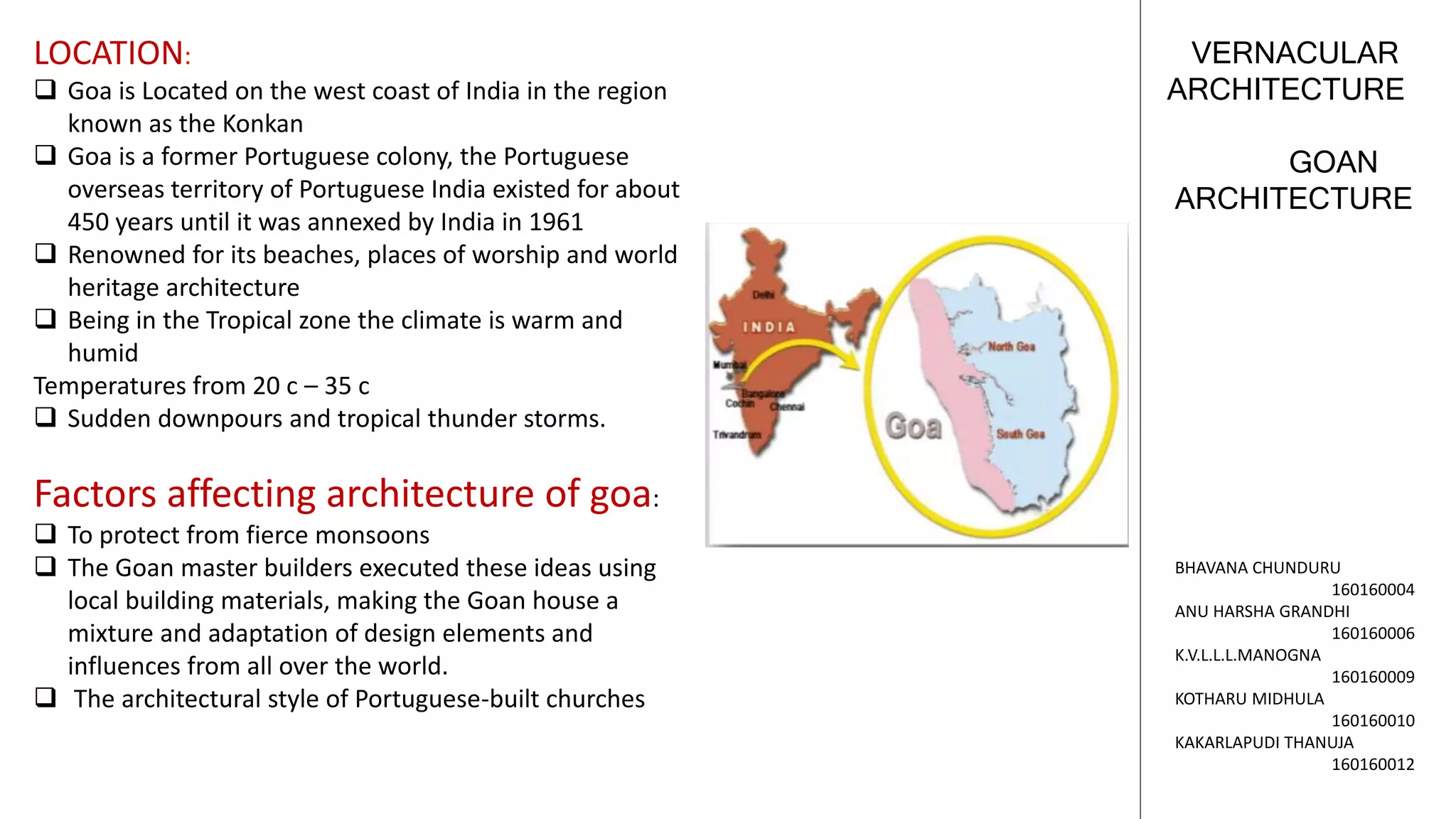
LOCATION:
 Goa is Located on the west coast of India in the region
known as the Konkan
 Goa is a former Portuguese colony, the Portuguese
overseas territory of Portuguese India existed for about
450 years until it was annexed by India in 1961
 Renowned for its beaches, places of worship and world
heritage architecture
 Being in the Tropical zone the climate is warm and
humid
Temperatures from 20 c – 35 c
 Sudden downpours and tropical thunder storms.
Factors affecting architecture of goa:
 To protect from fierce monsoons
 The Goan master builders executed these ideas using
local building materials, making the Goan house a
mixture and adaptation of design elements and
influences from all over the world.
 The architectural style of Portuguese-built churches
GOAN
ARCHITECTURE
VERNACULAR
ARCHITECTURE
BHAVANA CHUNDURU
160160004
ANU HARSHA GRANDHI
160160006
K.V.L.L.L.MANOGNA
160160009
KOTHARU MIDHULA
160160010
KAKARLAPUDI THANUJA
160160012
Portuguese houses:
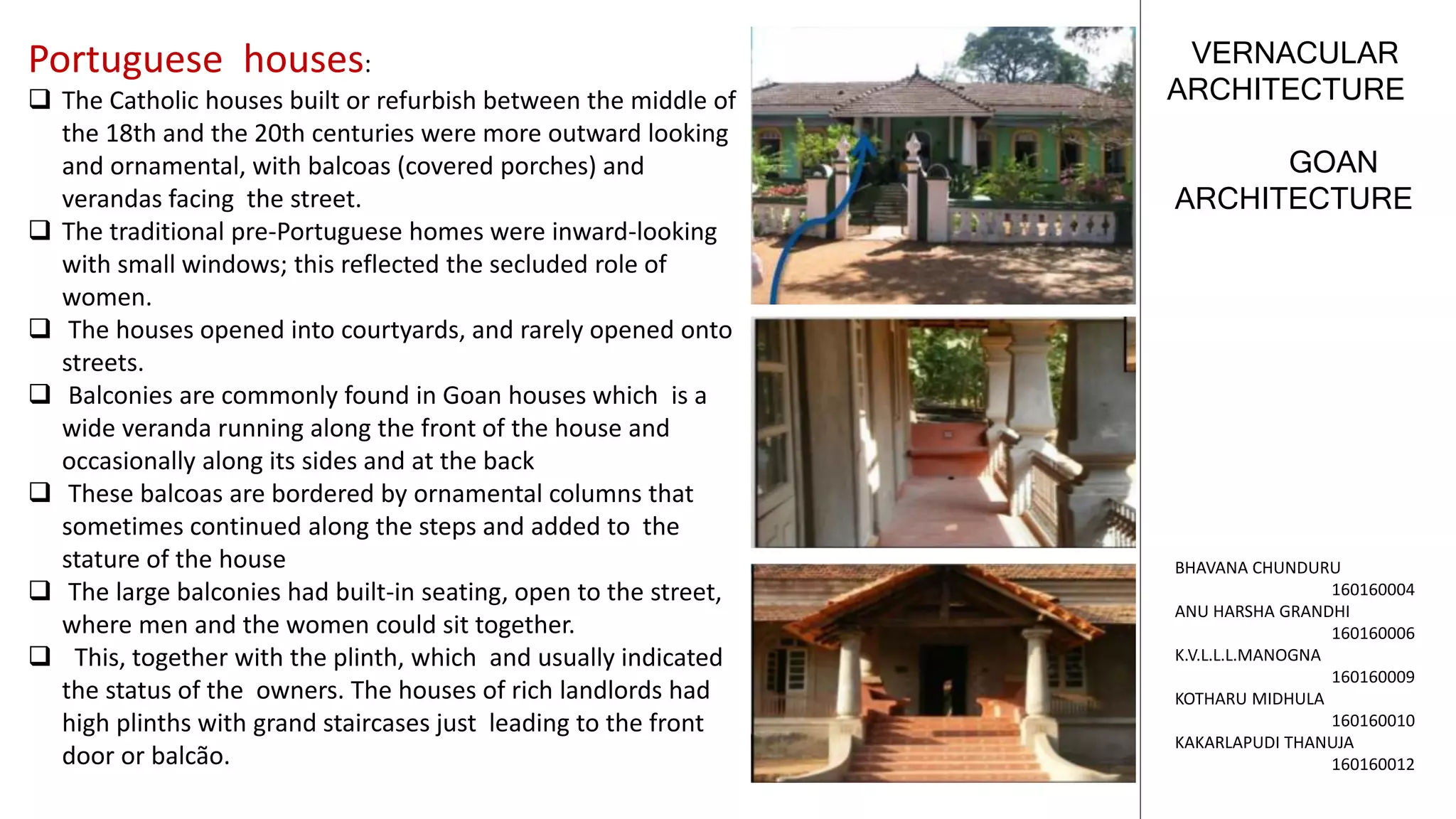
 The Catholic houses built or refurbish between the middle of
the 18th and the 20th centuries were more outward looking
and ornamental, with balcoas (covered porches) and
verandas facing the street.
 The traditional pre-Portuguese homes were inward-looking
with small windows; this reflected the secluded role of
women.
 The houses opened into courtyards, and rarely opened onto
streets.
 Balconies are commonly found in Goan houses which is a
wide veranda running along the front of the house and
occasionally along its sides and at the back
 These balcoas are bordered by ornamental columns that
sometimes continued along the steps and added to the
stature of the house
 The large balconies had built-in seating, open to the street,
where men and the women could sit together.
 This, together with the plinth, which and usually indicated
the status of the owners. The houses of rich landlords had
high plinths with grand staircases just leading to the front
door or balcão.
GOAN
ARCHITECTURE
VERNACULAR
ARCHITECTURE
BHAVANA CHUNDURU
160160004
ANU HARSHA GRANDHI
160160006
K.V.L.L.L.MANOGNA
160160009
KOTHARU MIDHULA
160160010
KAKARLAPUDI THANUJA
160160012
WINDOWS
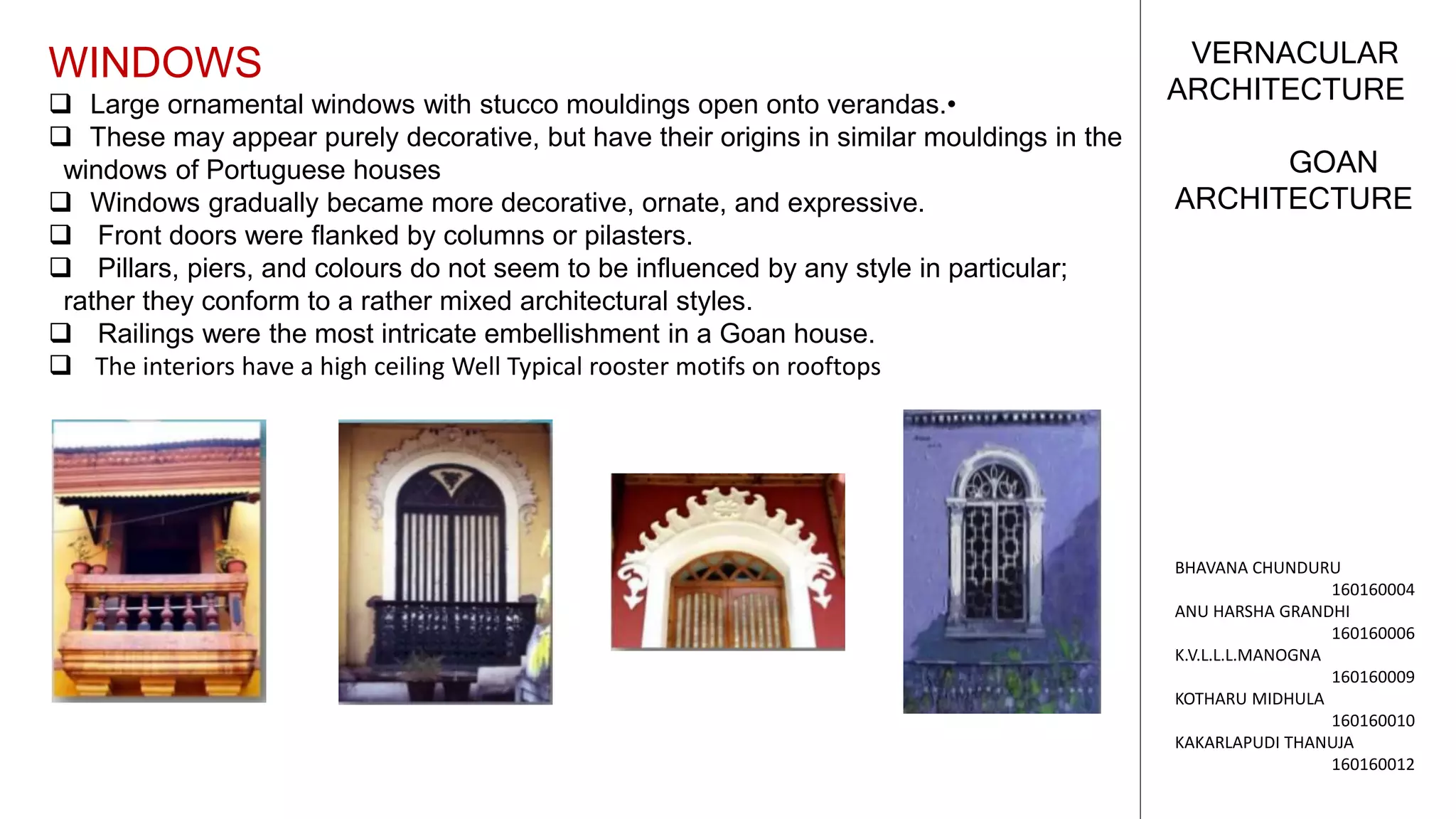
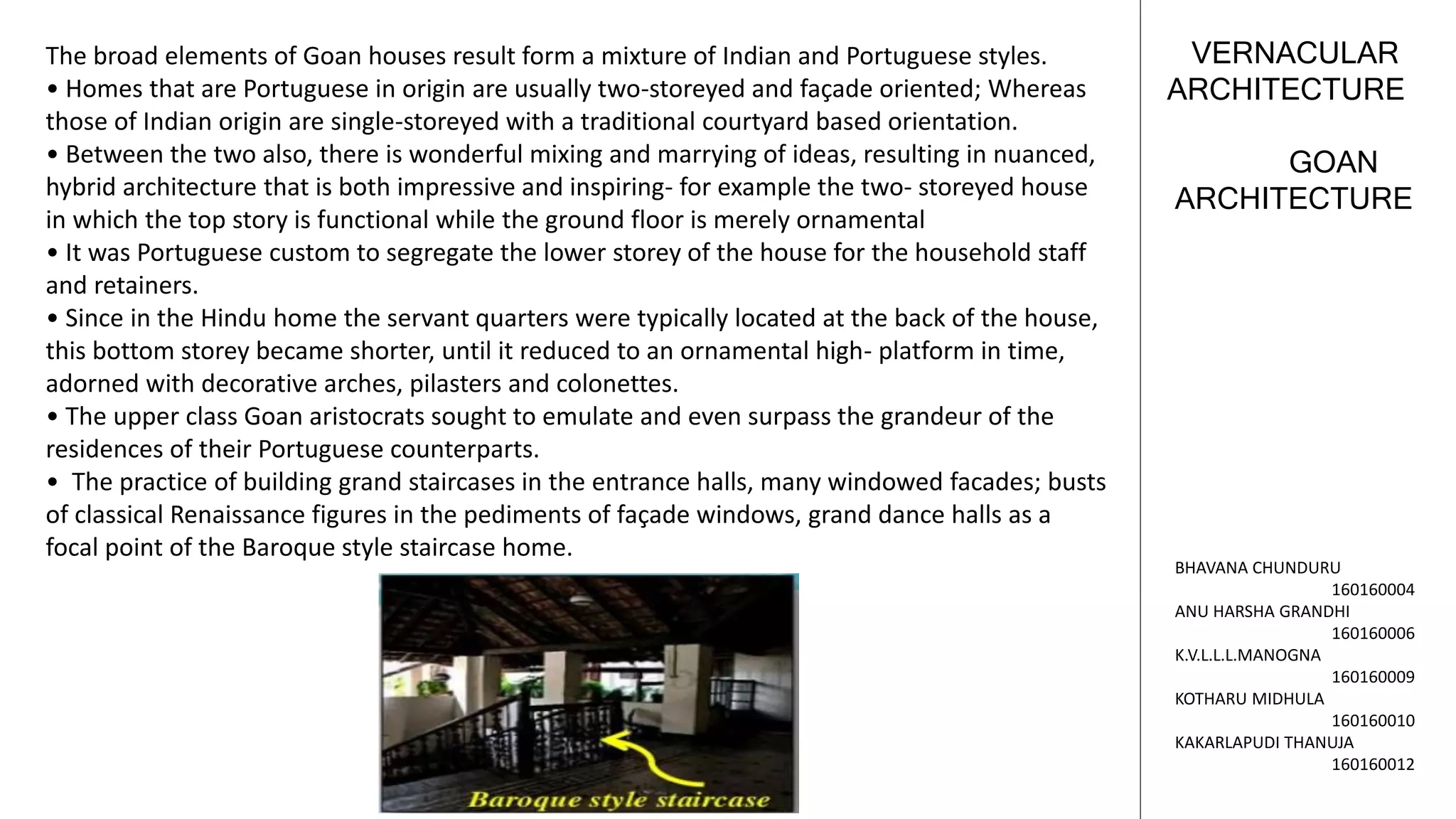
 Large ornamental windows with stucco mouldings open onto verandas.•
 These may appear purely decorative, but have their origins in similar mouldings in the
windows of Portuguese houses
 Windows gradually became more decorative, ornate, and expressive.
 Front doors were flanked by columns or pilasters.
 Pillars, piers, and colours do not seem to be influenced by any style in particular;
rather they conform to a rather mixed architectural styles.
 Railings were the most intricate embellishment in a Goan house.
 The interiors have a high ceiling Well Typical rooster motifs on rooftops
GOAN
ARCHITECTURE
VERNACULAR
ARCHITECTURE
BHAVANA CHUNDURU
160160004
ANU HARSHA GRANDHI
160160006
K.V.L.L.L.MANOGNA
160160009
KOTHARU MIDHULA
160160010
KAKARLAPUDI THANUJA
160160012
GOAN HOUSES HINDU HOUSES
• Style : Indo Portuguese Style
• Internal courtyard with rooms built
• Building Materials : Laterite stones, Baked clay tiles
• Ancestral Hindu houses in the town are plain, closed structures which
conceal the illustrious tradition of the inhabitants
• The goan Hindu Architectural style is different from the Portuguese-
influenced style.
• Hindu houses have little colonial influence
• Most of the houses are symmetrical
• Rectangular in plan
• Single storey
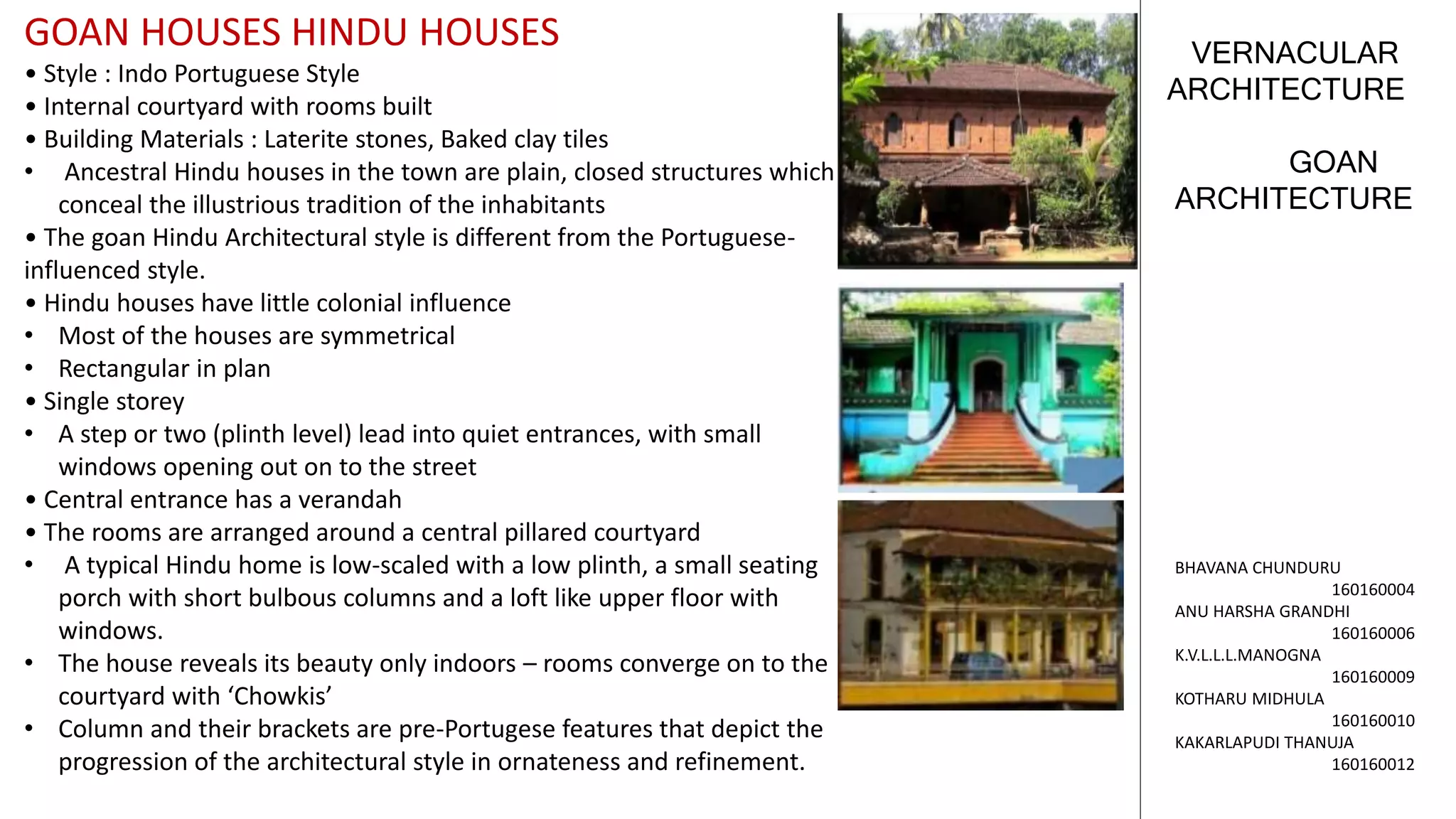
• A step or two (plinth level) lead into quiet entrances, with small
windows opening out on to the street
• Central entrance has a verandah
• The rooms are arranged around a central pillared courtyard
• A typical Hindu home is low-scaled with a low plinth, a small seating
porch with short bulbous columns and a loft like upper floor with
windows.
• The house reveals its beauty only indoors – rooms converge on to the
courtyard with ‘Chowkis’
• Column and their brackets are pre-Portugese features that depict the
progression of the architectural style in ornateness and refinement.
GOAN
ARCHITECTURE
VERNACULAR
ARCHITECTURE
BHAVANA CHUNDURU
160160004
ANU HARSHA GRANDHI
160160006
K.V.L.L.L.MANOGNA
160160009
KOTHARU MIDHULA
160160010
KAKARLAPUDI THANUJA
160160012
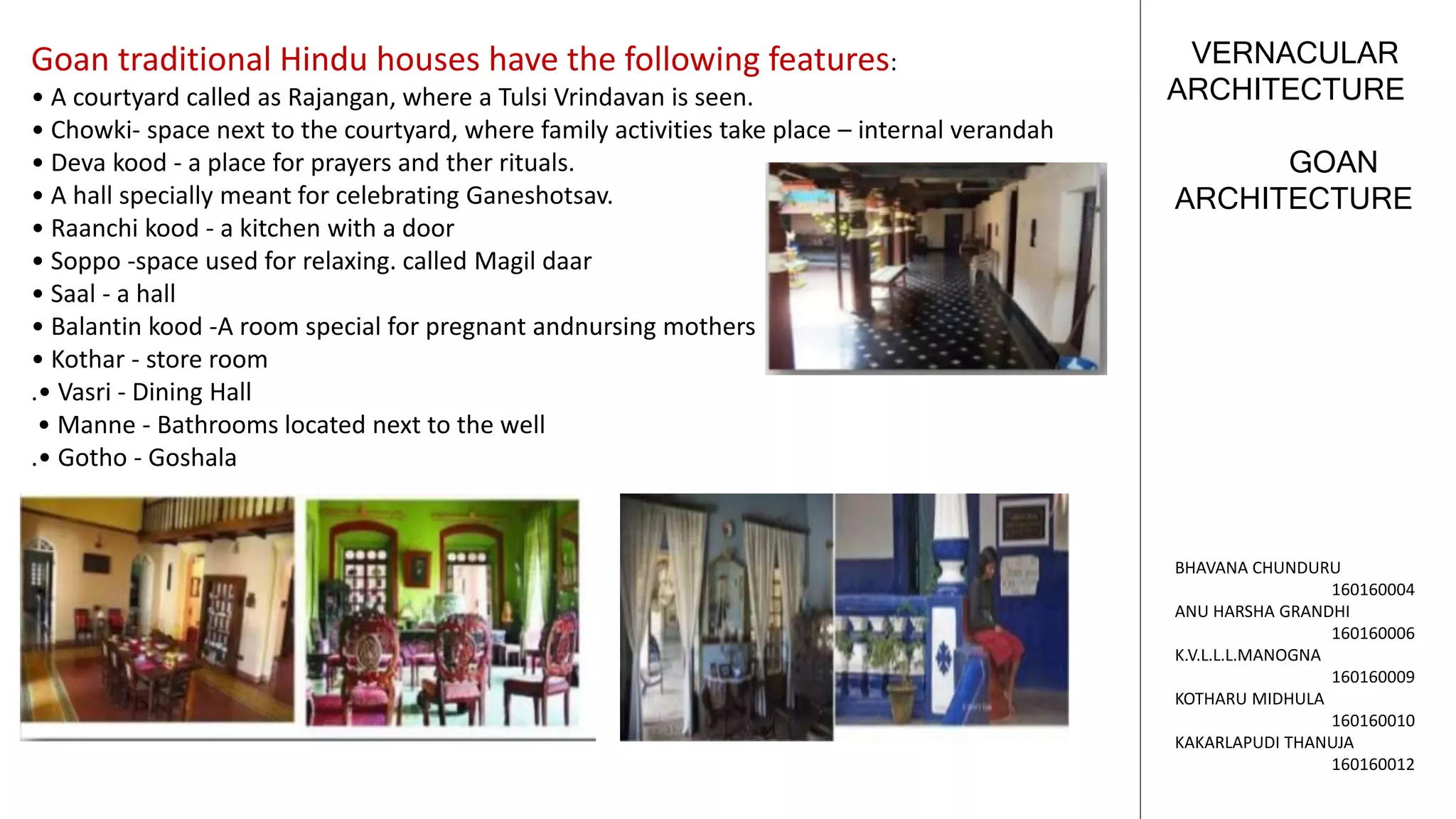
Goan traditional Hindu houses have the following features:
• A courtyard called as Rajangan, where a Tulsi Vrindavan is seen.
• Chowki- space next to the courtyard, where family activities take place – internal verandah
• Deva kood - a place for prayers and ther rituals.
• A hall specially meant for celebrating Ganeshotsav.
• Raanchi kood - a kitchen with a door
• Soppo -space used for relaxing. called Magil daar
• Saal - a hall
• Balantin kood -A room special for pregnant andnursing mothers
• Kothar - store room
.• Vasri - Dining Hall
• Manne - Bathrooms located next to the well
.• Gotho - Goshala
GOAN
ARCHITECTURE
VERNACULAR
ARCHITECTURE
BHAVANA CHUNDURU
160160004
ANU HARSHA GRANDHI
160160006
K.V.L.L.L.MANOGNA
160160009
KOTHARU MIDHULA
160160010
KAKARLAPUDI THANUJA
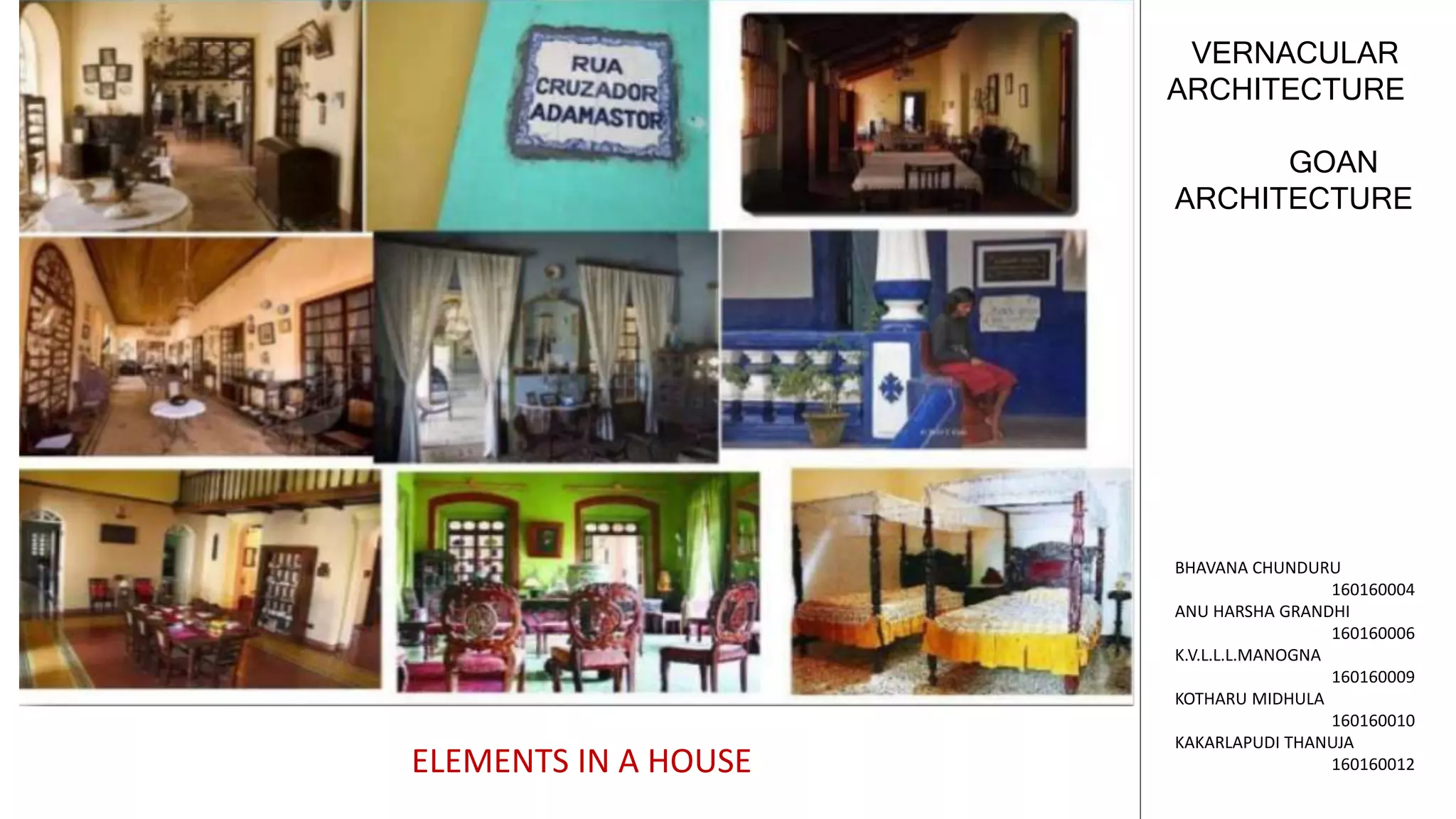
160160012ELEMENTS IN A HOUSE
GOAN
ARCHITECTURE
VERNACULAR
ARCHITECTURE
BHAVANA CHUNDURU
160160004
ANU HARSHA GRANDHI
160160006
K.V.L.L.L.MANOGNA
160160009
KOTHARU MIDHULA
160160010
KAKARLAPUDI THANUJA
160160012
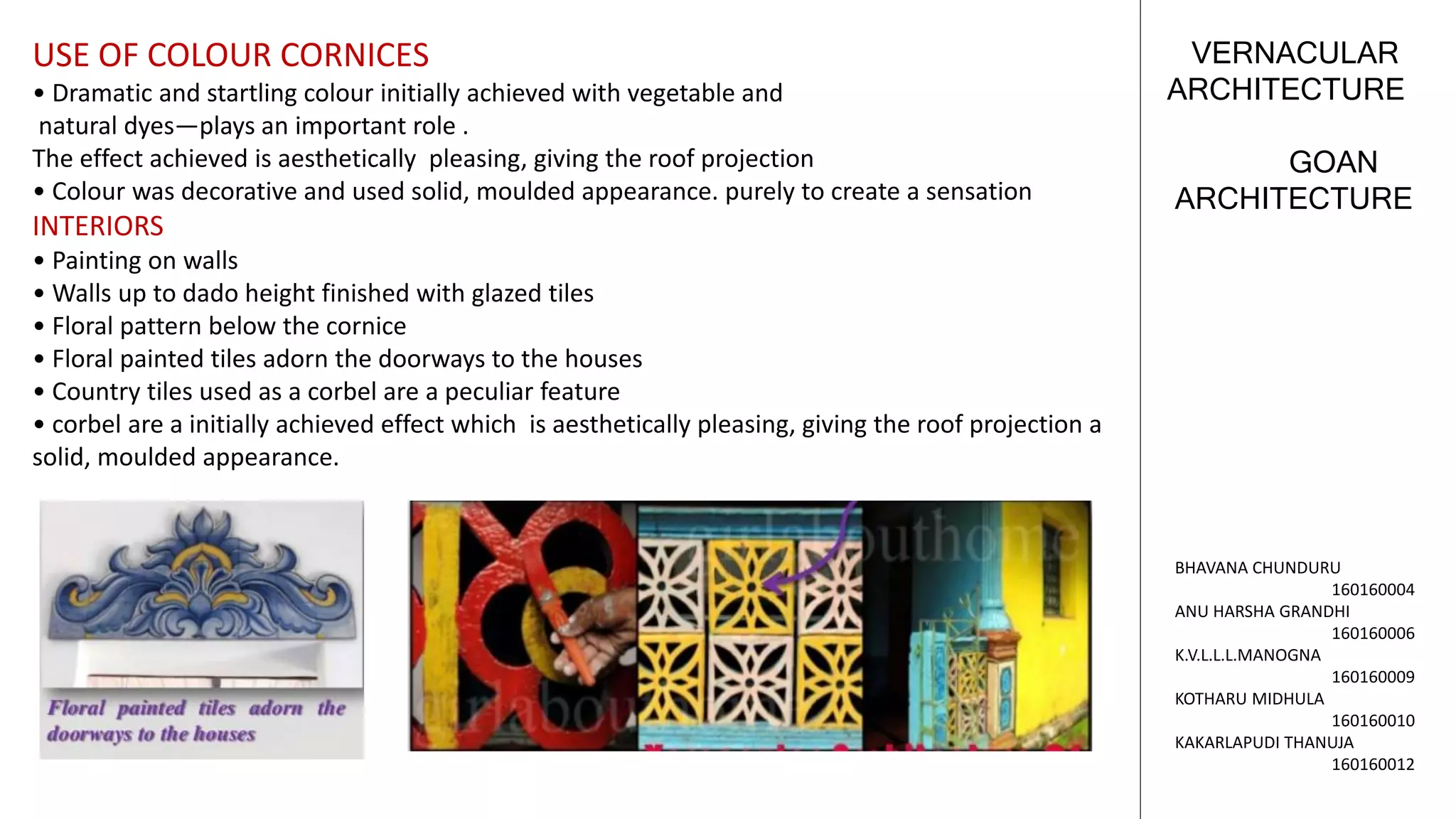
USE OF COLOUR CORNICES
• Dramatic and startling colour initially achieved with vegetable and
natural dyes—plays an important role .
The effect achieved is aesthetically pleasing, giving the roof projection
• Colour was decorative and used solid, moulded appearance. purely to create a sensation
INTERIORS
• Painting on walls
• Walls up to dado height finished with glazed tiles
• Floral pattern below the cornice
• Floral painted tiles adorn the doorways to the houses
• Country tiles used as a corbel are a peculiar feature
• corbel are a initially achieved effect which is aesthetically pleasing, giving the roof projection a
solid, moulded appearance.
GOAN
ARCHITECTURE
VERNACULAR
ARCHITECTURE
BHAVANA CHUNDURU
160160004
ANU HARSHA GRANDHI
160160006
K.V.L.L.L.MANOGNA
160160009
KOTHARU MIDHULA
160160010
KAKARLAPUDI THANUJA
160160012
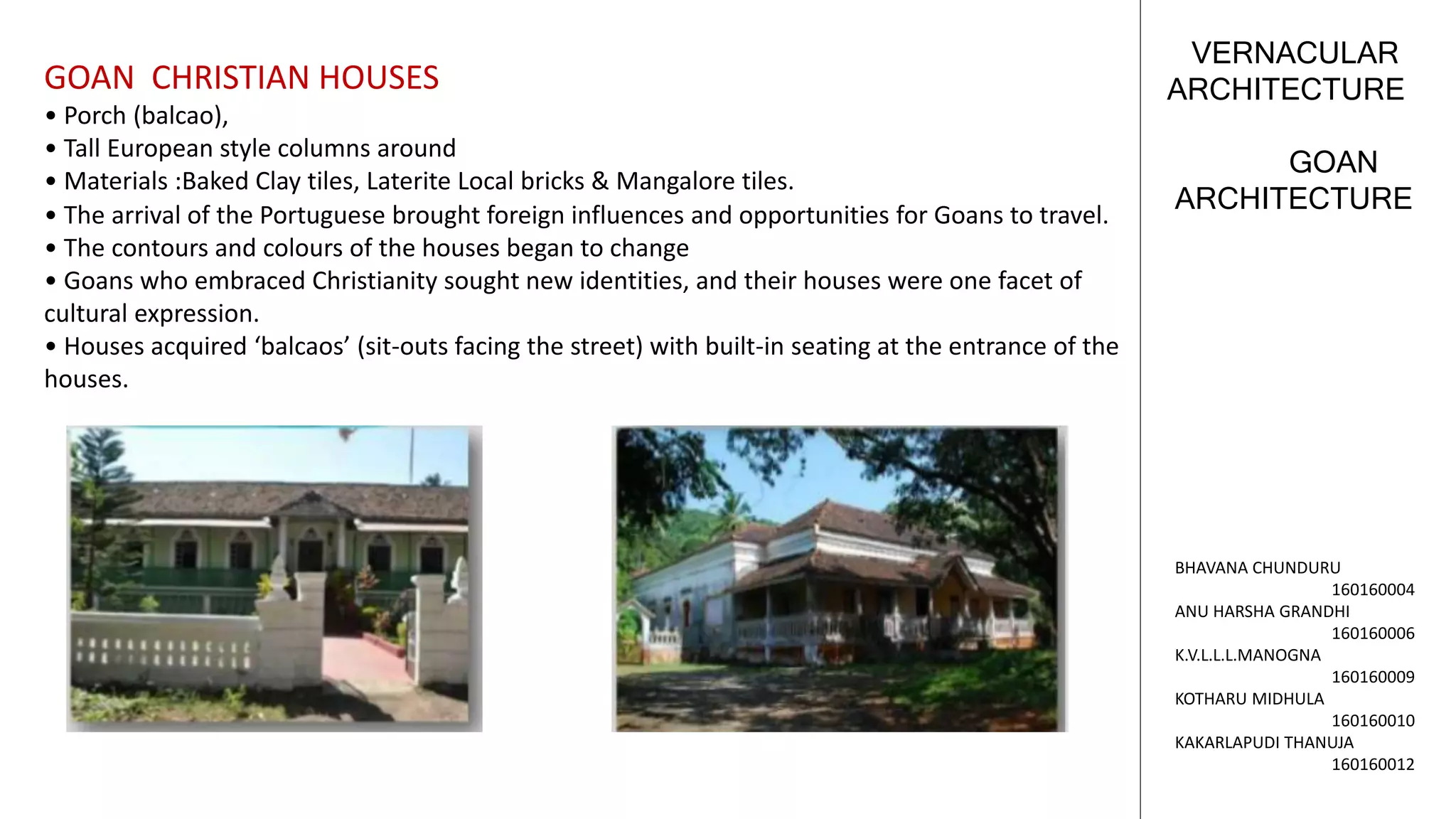
GOAN CHRISTIAN HOUSES
• Porch (balcao),
• Tall European style columns around
• Materials :Baked Clay tiles, Laterite Local bricks & Mangalore tiles.
• The arrival of the Portuguese brought foreign influences and opportunities for Goans to travel.
• The contours and colours of the houses began to change
• Goans who embraced Christianity sought new identities, and their houses were one facet of
cultural expression.
• Houses acquired ‘balcaos’ (sit-outs facing the street) with built-in seating at the entrance of the
houses.
GOAN
ARCHITECTURE
VERNACULAR
ARCHITECTURE
BHAVANA CHUNDURU
160160004
ANU HARSHA GRANDHI
160160006
K.V.L.L.L.MANOGNA
160160009
KOTHARU MIDHULA
160160010
KAKARLAPUDI THANUJA
160160012
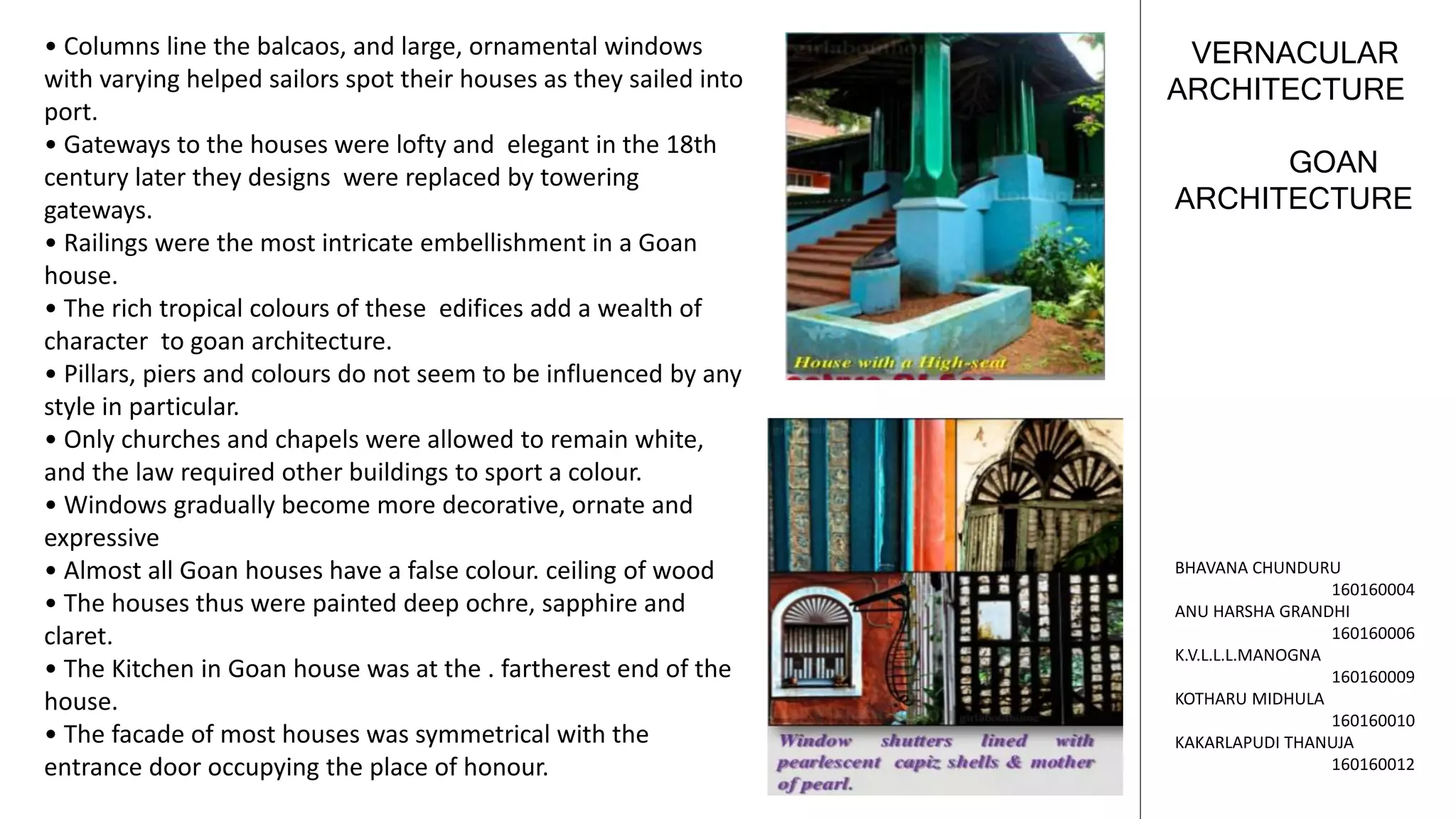
• Columns line the balcaos, and large, ornamental windows
with varying helped sailors spot their houses as they sailed into
port.
• Gateways to the houses were lofty and elegant in the 18th
century later they designs were replaced by towering
gateways.
• Railings were the most intricate embellishment in a Goan
house.
• The rich tropical colours of these edifices add a wealth of
character to goan architecture.
• Pillars, piers and colours do not seem to be influenced by any
style in particular.
• Only churches and chapels were allowed to remain white,
and the law required other buildings to sport a colour.
• Windows gradually become more decorative, ornate and
expressive
• Almost all Goan houses have a false colour. ceiling of wood
• The houses thus were painted deep ochre, sapphire and
claret.
• The Kitchen in Goan house was at the . fartherest end of the
house.
• The facade of most houses was symmetrical with the
entrance door occupying the place of honour.
GOAN
ARCHITECTURE
VERNACULAR
ARCHITECTURE
BHAVANA CHUNDURU
160160004
ANU HARSHA GRANDHI
160160006
K.V.L.L.L.MANOGNA
160160009
KOTHARU MIDHULA
160160010
KAKARLAPUDI THANUJA
160160012
The broad elements of Goan houses result form a mixture of Indian and Portuguese styles.
• Homes that are Portuguese in origin are usually two-storeyed and façade oriented; Whereas
those of Indian origin are single-storeyed with a traditional courtyard based orientation.
• Between the two also, there is wonderful mixing and marrying of ideas, resulting in nuanced,
hybrid architecture that is both impressive and inspiring- for example the two- storeyed house
in which the top story is functional while the ground floor is merely ornamental
• It was Portuguese custom to segregate the lower storey of the house for the household staff
and retainers.
• Since in the Hindu home the servant quarters were typically located at the back of the house,
this bottom storey became shorter, until it reduced to an ornamental high- platform in time,
adorned with decorative arches, pilasters and colonettes.
• The upper class Goan aristocrats sought to emulate and even surpass the grandeur of the
residences of their Portuguese counterparts.
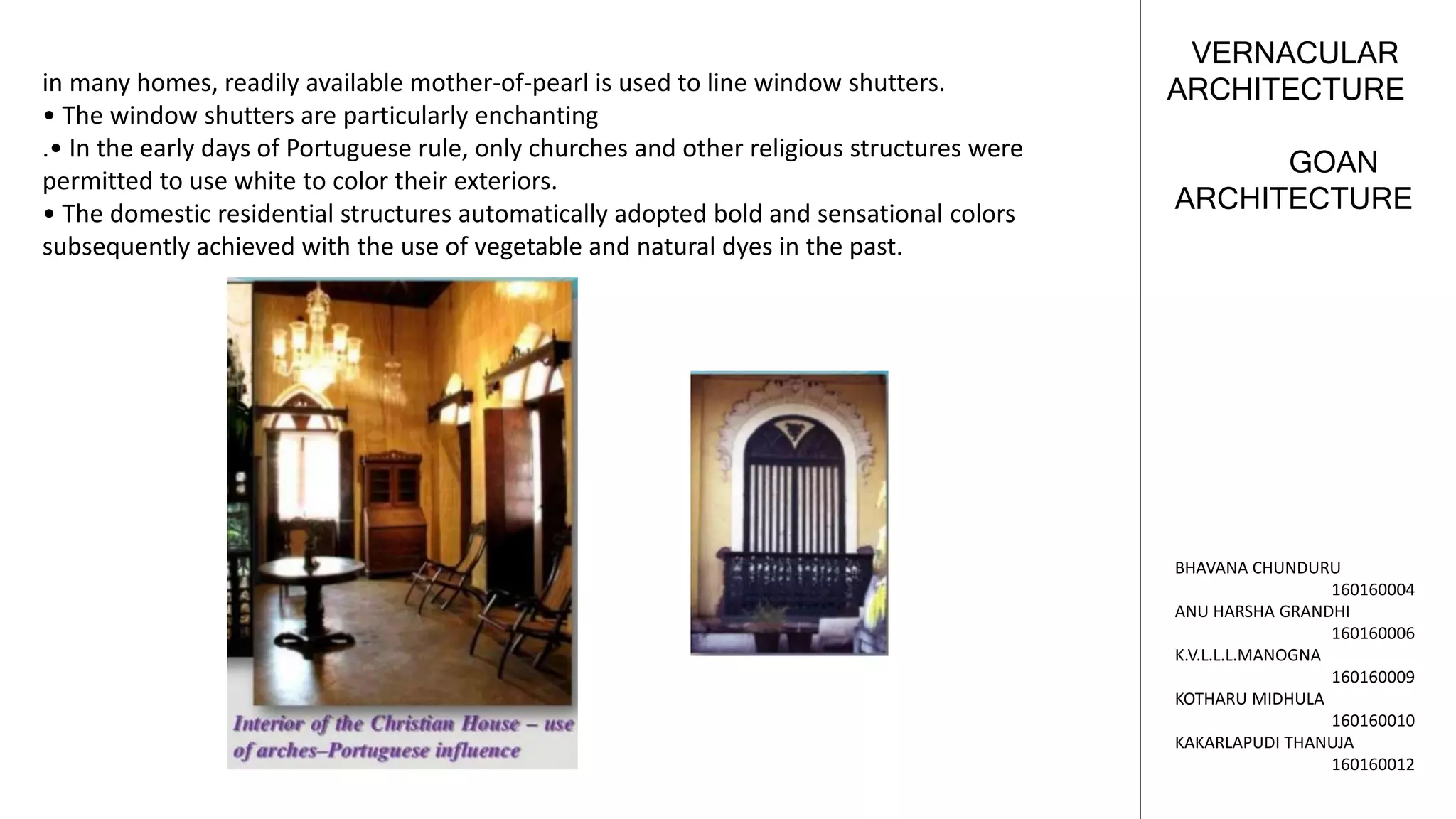
• The practice of building grand staircases in the entrance halls, many windowed facades; busts
of classical Renaissance figures in the pediments of façade windows, grand dance halls as a
focal point of the Baroque style staircase home.
GOAN
ARCHITECTURE
VERNACULAR
ARCHITECTURE
BHAVANA CHUNDURU
160160004
ANU HARSHA GRANDHI
160160006
K.V.L.L.L.MANOGNA
160160009
KOTHARU MIDHULA
160160010
KAKARLAPUDI THANUJA
160160012
in many homes, readily available mother-of-pearl is used to line window shutters.
• The window shutters are particularly enchanting
.• In the early days of Portuguese rule, only churches and other religious structures were
permitted to use white to color their exteriors.
• The domestic residential structures automatically adopted bold and sensational colors
subsequently achieved with the use of vegetable and natural dyes in the past.
GOAN
ARCHITECTURE
VERNACULAR
ARCHITECTURE
BHAVANA CHUNDURU
160160004
ANU HARSHA GRANDHI
160160006
K.V.L.L.L.MANOGNA
160160009
KOTHARU MIDHULA
160160010
KAKARLAPUDI THANUJA
160160012
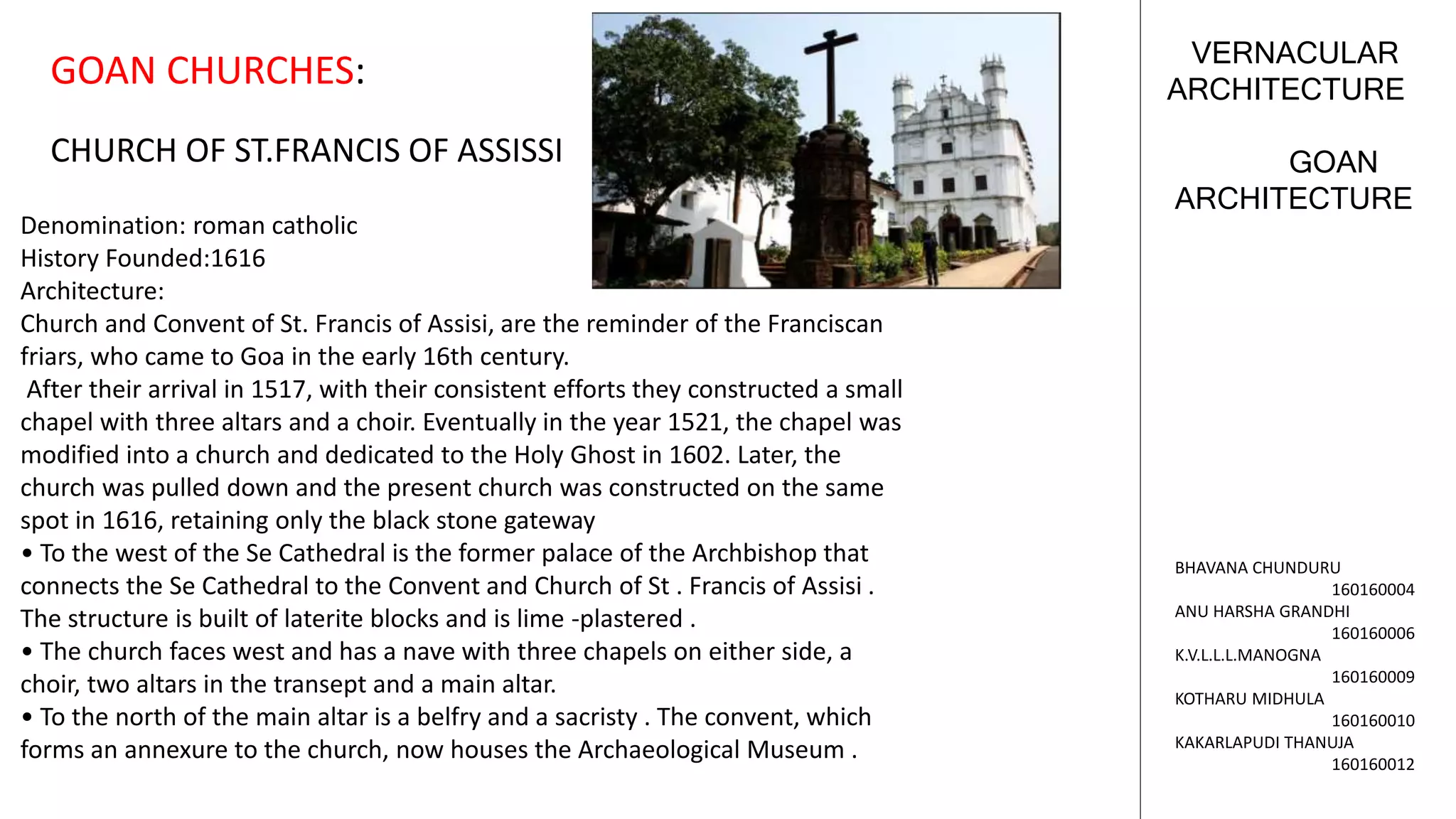
GOAN CHURCHES:
CHURCH OF ST.FRANCIS OF ASSISSI
Denomination: roman catholic
History Founded:1616
Architecture:
Church and Convent of St. Francis of Assisi, are the reminder of the Franciscan
friars, who came to Goa in the early 16th century.
After their arrival in 1517, with their consistent efforts they constructed a small
chapel with three altars and a choir. Eventually in the year 1521, the chapel was
modified into a church and dedicated to the Holy Ghost in 1602. Later, the
church was pulled down and the present church was constructed on the same
spot in 1616, retaining only the black stone gateway
• To the west of the Se Cathedral is the former palace of the Archbishop that
connects the Se Cathedral to the Convent and Church of St . Francis of Assisi .
The structure is built of laterite blocks and is lime -plastered .
• The church faces west and has a nave with three chapels on either side, a
choir, two altars in the transept and a main altar.
• To the north of the main altar is a belfry and a sacristy . The convent, which
forms an annexure to the church, now houses the Archaeological Museum .
GOAN
ARCHITECTURE
VERNACULAR
ARCHITECTURE
BHAVANA CHUNDURU
160160004
ANU HARSHA GRANDHI
160160006
K.V.L.L.L.MANOGNA
160160009
KOTHARU MIDHULA
160160010
KAKARLAPUDI THANUJA
160160012
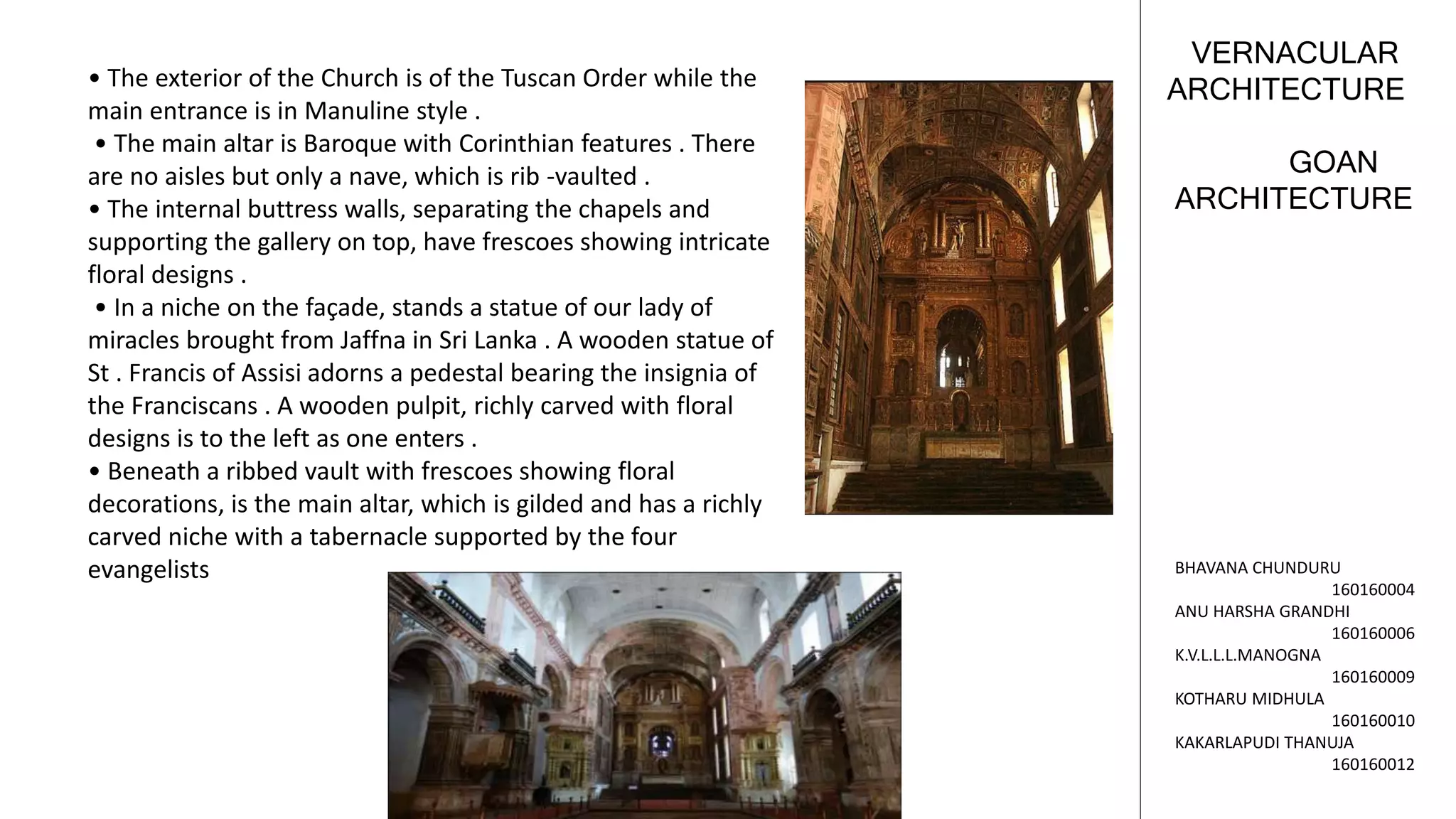
• The exterior of the Church is of the Tuscan Order while the
main entrance is in Manuline style .
• The main altar is Baroque with Corinthian features . There
are no aisles but only a nave, which is rib -vaulted .
• The internal buttress walls, separating the chapels and
supporting the gallery on top, have frescoes showing intricate
floral designs .
• In a niche on the façade, stands a statue of our lady of
miracles brought from Jaffna in Sri Lanka . A wooden statue of
St . Francis of Assisi adorns a pedestal bearing the insignia of
the Franciscans . A wooden pulpit, richly carved with floral
designs is to the left as one enters .
• Beneath a ribbed vault with frescoes showing floral
decorations, is the main altar, which is gilded and has a richly
carved niche with a tabernacle supported by the four
evangelists

Goa vernacular architecture

  • 1.
    GOAN ARCHITECTURE VERNACULAR ARCHITECTURE BHAVANA CHUNDURU 160160004 ANU HARSHAGRANDHI 160160006 K.V.L.L.L.MANOGNA 160160009 KOTHARU MIDHULA 160160010 KAKARLAPUDI THANUJA 160160012 LOCATION:  Goa is Located on the west coast of India in the region known as the Konkan  Goa is a former Portuguese colony, the Portuguese overseas territory of Portuguese India existed for about 450 years until it was annexed by India in 1961  Renowned for its beaches, places of worship and world heritage architecture  Being in the Tropical zone the climate is warm and humid Temperatures from 20 c – 35 c  Sudden downpours and tropical thunder storms. Factors affecting architecture of goa:  To protect from fierce monsoons  The Goan master builders executed these ideas using local building materials, making the Goan house a mixture and adaptation of design elements and influences from all over the world.  The architectural style of Portuguese-built churches
  • 2.
    GOAN ARCHITECTURE VERNACULAR ARCHITECTURE BHAVANA CHUNDURU 160160004 ANU HARSHAGRANDHI 160160006 K.V.L.L.L.MANOGNA 160160009 KOTHARU MIDHULA 160160010 KAKARLAPUDI THANUJA 160160012 Portuguese houses:  The Catholic houses built or refurbish between the middle of the 18th and the 20th centuries were more outward looking and ornamental, with balcoas (covered porches) and verandas facing the street.  The traditional pre-Portuguese homes were inward-looking with small windows; this reflected the secluded role of women.  The houses opened into courtyards, and rarely opened onto streets.  Balconies are commonly found in Goan houses which is a wide veranda running along the front of the house and occasionally along its sides and at the back  These balcoas are bordered by ornamental columns that sometimes continued along the steps and added to the stature of the house  The large balconies had built-in seating, open to the street, where men and the women could sit together.  This, together with the plinth, which and usually indicated the status of the owners. The houses of rich landlords had high plinths with grand staircases just leading to the front door or balcão.
  • 3.
    GOAN ARCHITECTURE VERNACULAR ARCHITECTURE BHAVANA CHUNDURU 160160004 ANU HARSHAGRANDHI 160160006 K.V.L.L.L.MANOGNA 160160009 KOTHARU MIDHULA 160160010 KAKARLAPUDI THANUJA 160160012 WINDOWS  Large ornamental windows with stucco mouldings open onto verandas.•  These may appear purely decorative, but have their origins in similar mouldings in the windows of Portuguese houses  Windows gradually became more decorative, ornate, and expressive.  Front doors were flanked by columns or pilasters.  Pillars, piers, and colours do not seem to be influenced by any style in particular; rather they conform to a rather mixed architectural styles.  Railings were the most intricate embellishment in a Goan house.  The interiors have a high ceiling Well Typical rooster motifs on rooftops
  • 4.
    GOAN ARCHITECTURE VERNACULAR ARCHITECTURE BHAVANA CHUNDURU 160160004 ANU HARSHAGRANDHI 160160006 K.V.L.L.L.MANOGNA 160160009 KOTHARU MIDHULA 160160010 KAKARLAPUDI THANUJA 160160012 GOAN HOUSES HINDU HOUSES • Style : Indo Portuguese Style • Internal courtyard with rooms built • Building Materials : Laterite stones, Baked clay tiles • Ancestral Hindu houses in the town are plain, closed structures which conceal the illustrious tradition of the inhabitants • The goan Hindu Architectural style is different from the Portuguese- influenced style. • Hindu houses have little colonial influence • Most of the houses are symmetrical • Rectangular in plan • Single storey • A step or two (plinth level) lead into quiet entrances, with small windows opening out on to the street • Central entrance has a verandah • The rooms are arranged around a central pillared courtyard • A typical Hindu home is low-scaled with a low plinth, a small seating porch with short bulbous columns and a loft like upper floor with windows. • The house reveals its beauty only indoors – rooms converge on to the courtyard with ‘Chowkis’ • Column and their brackets are pre-Portugese features that depict the progression of the architectural style in ornateness and refinement.
  • 5.
    GOAN ARCHITECTURE VERNACULAR ARCHITECTURE BHAVANA CHUNDURU 160160004 ANU HARSHAGRANDHI 160160006 K.V.L.L.L.MANOGNA 160160009 KOTHARU MIDHULA 160160010 KAKARLAPUDI THANUJA 160160012 Goan traditional Hindu houses have the following features: • A courtyard called as Rajangan, where a Tulsi Vrindavan is seen. • Chowki- space next to the courtyard, where family activities take place – internal verandah • Deva kood - a place for prayers and ther rituals. • A hall specially meant for celebrating Ganeshotsav. • Raanchi kood - a kitchen with a door • Soppo -space used for relaxing. called Magil daar • Saal - a hall • Balantin kood -A room special for pregnant andnursing mothers • Kothar - store room .• Vasri - Dining Hall • Manne - Bathrooms located next to the well .• Gotho - Goshala
  • 6.
    GOAN ARCHITECTURE VERNACULAR ARCHITECTURE BHAVANA CHUNDURU 160160004 ANU HARSHAGRANDHI 160160006 K.V.L.L.L.MANOGNA 160160009 KOTHARU MIDHULA 160160010 KAKARLAPUDI THANUJA 160160012ELEMENTS IN A HOUSE
  • 7.
    GOAN ARCHITECTURE VERNACULAR ARCHITECTURE BHAVANA CHUNDURU 160160004 ANU HARSHAGRANDHI 160160006 K.V.L.L.L.MANOGNA 160160009 KOTHARU MIDHULA 160160010 KAKARLAPUDI THANUJA 160160012 USE OF COLOUR CORNICES • Dramatic and startling colour initially achieved with vegetable and natural dyes—plays an important role . The effect achieved is aesthetically pleasing, giving the roof projection • Colour was decorative and used solid, moulded appearance. purely to create a sensation INTERIORS • Painting on walls • Walls up to dado height finished with glazed tiles • Floral pattern below the cornice • Floral painted tiles adorn the doorways to the houses • Country tiles used as a corbel are a peculiar feature • corbel are a initially achieved effect which is aesthetically pleasing, giving the roof projection a solid, moulded appearance.
  • 8.
    GOAN ARCHITECTURE VERNACULAR ARCHITECTURE BHAVANA CHUNDURU 160160004 ANU HARSHAGRANDHI 160160006 K.V.L.L.L.MANOGNA 160160009 KOTHARU MIDHULA 160160010 KAKARLAPUDI THANUJA 160160012 GOAN CHRISTIAN HOUSES • Porch (balcao), • Tall European style columns around • Materials :Baked Clay tiles, Laterite Local bricks & Mangalore tiles. • The arrival of the Portuguese brought foreign influences and opportunities for Goans to travel. • The contours and colours of the houses began to change • Goans who embraced Christianity sought new identities, and their houses were one facet of cultural expression. • Houses acquired ‘balcaos’ (sit-outs facing the street) with built-in seating at the entrance of the houses.
  • 9.
    GOAN ARCHITECTURE VERNACULAR ARCHITECTURE BHAVANA CHUNDURU 160160004 ANU HARSHAGRANDHI 160160006 K.V.L.L.L.MANOGNA 160160009 KOTHARU MIDHULA 160160010 KAKARLAPUDI THANUJA 160160012 • Columns line the balcaos, and large, ornamental windows with varying helped sailors spot their houses as they sailed into port. • Gateways to the houses were lofty and elegant in the 18th century later they designs were replaced by towering gateways. • Railings were the most intricate embellishment in a Goan house. • The rich tropical colours of these edifices add a wealth of character to goan architecture. • Pillars, piers and colours do not seem to be influenced by any style in particular. • Only churches and chapels were allowed to remain white, and the law required other buildings to sport a colour. • Windows gradually become more decorative, ornate and expressive • Almost all Goan houses have a false colour. ceiling of wood • The houses thus were painted deep ochre, sapphire and claret. • The Kitchen in Goan house was at the . fartherest end of the house. • The facade of most houses was symmetrical with the entrance door occupying the place of honour.
  • 10.
    GOAN ARCHITECTURE VERNACULAR ARCHITECTURE BHAVANA CHUNDURU 160160004 ANU HARSHAGRANDHI 160160006 K.V.L.L.L.MANOGNA 160160009 KOTHARU MIDHULA 160160010 KAKARLAPUDI THANUJA 160160012 The broad elements of Goan houses result form a mixture of Indian and Portuguese styles. • Homes that are Portuguese in origin are usually two-storeyed and façade oriented; Whereas those of Indian origin are single-storeyed with a traditional courtyard based orientation. • Between the two also, there is wonderful mixing and marrying of ideas, resulting in nuanced, hybrid architecture that is both impressive and inspiring- for example the two- storeyed house in which the top story is functional while the ground floor is merely ornamental • It was Portuguese custom to segregate the lower storey of the house for the household staff and retainers. • Since in the Hindu home the servant quarters were typically located at the back of the house, this bottom storey became shorter, until it reduced to an ornamental high- platform in time, adorned with decorative arches, pilasters and colonettes. • The upper class Goan aristocrats sought to emulate and even surpass the grandeur of the residences of their Portuguese counterparts. • The practice of building grand staircases in the entrance halls, many windowed facades; busts of classical Renaissance figures in the pediments of façade windows, grand dance halls as a focal point of the Baroque style staircase home.
  • 11.
    GOAN ARCHITECTURE VERNACULAR ARCHITECTURE BHAVANA CHUNDURU 160160004 ANU HARSHAGRANDHI 160160006 K.V.L.L.L.MANOGNA 160160009 KOTHARU MIDHULA 160160010 KAKARLAPUDI THANUJA 160160012 in many homes, readily available mother-of-pearl is used to line window shutters. • The window shutters are particularly enchanting .• In the early days of Portuguese rule, only churches and other religious structures were permitted to use white to color their exteriors. • The domestic residential structures automatically adopted bold and sensational colors subsequently achieved with the use of vegetable and natural dyes in the past.
  • 12.
    GOAN ARCHITECTURE VERNACULAR ARCHITECTURE BHAVANA CHUNDURU 160160004 ANU HARSHAGRANDHI 160160006 K.V.L.L.L.MANOGNA 160160009 KOTHARU MIDHULA 160160010 KAKARLAPUDI THANUJA 160160012 GOAN CHURCHES: CHURCH OF ST.FRANCIS OF ASSISSI Denomination: roman catholic History Founded:1616 Architecture: Church and Convent of St. Francis of Assisi, are the reminder of the Franciscan friars, who came to Goa in the early 16th century. After their arrival in 1517, with their consistent efforts they constructed a small chapel with three altars and a choir. Eventually in the year 1521, the chapel was modified into a church and dedicated to the Holy Ghost in 1602. Later, the church was pulled down and the present church was constructed on the same spot in 1616, retaining only the black stone gateway • To the west of the Se Cathedral is the former palace of the Archbishop that connects the Se Cathedral to the Convent and Church of St . Francis of Assisi . The structure is built of laterite blocks and is lime -plastered . • The church faces west and has a nave with three chapels on either side, a choir, two altars in the transept and a main altar. • To the north of the main altar is a belfry and a sacristy . The convent, which forms an annexure to the church, now houses the Archaeological Museum .
  • 13.
    GOAN ARCHITECTURE VERNACULAR ARCHITECTURE BHAVANA CHUNDURU 160160004 ANU HARSHAGRANDHI 160160006 K.V.L.L.L.MANOGNA 160160009 KOTHARU MIDHULA 160160010 KAKARLAPUDI THANUJA 160160012 • The exterior of the Church is of the Tuscan Order while the main entrance is in Manuline style . • The main altar is Baroque with Corinthian features . There are no aisles but only a nave, which is rib -vaulted . • The internal buttress walls, separating the chapels and supporting the gallery on top, have frescoes showing intricate floral designs . • In a niche on the façade, stands a statue of our lady of miracles brought from Jaffna in Sri Lanka . A wooden statue of St . Francis of Assisi adorns a pedestal bearing the insignia of the Franciscans . A wooden pulpit, richly carved with floral designs is to the left as one enters . • Beneath a ribbed vault with frescoes showing floral decorations, is the main altar, which is gilded and has a richly carved niche with a tabernacle supported by the four evangelists