ITALY
104
ITALY
Marco Mazzeschi
Summary
Italy is divided into 20 regions and each region is further divided into
more than 100 provinces. Immigration matters are handled by local
also became and remains to this day a member of the Group of seven
National Income per capita of EUR 24,700.
In 2002, Italy converted its currency from the Lira to the Euro. Italy has
the fourth largest economy in Europe, which is primarily fueled by the
production of high quality consumer products, engineering products,
agriculture, and tourism. In fact, over 42 million tourists visit Italy
annually.
The Italian government has a bicameral structure. The Parliament,
having legislative power, is composed of two Houses: the Chamber
of Deputies and the Senate. The Prime Minister is the head of the
matters and decrees.
GLOBAL MOBILITY
105
Legal System
Immigration issues at the national level are governed by the
within the Ministry
to the various provincial departments regarding the interpretation and
implementation of the law.
Immigrazione
Questura
Immigration law is enforced by the Prefetto
and
Department of Labor.
A person who enters or takes up residence in Italy illegally may be
deported if any of the following circumstances apply:
majeure
60 days and the renewal has not yet been requested.
A foreign national may be granted leave to appeal an order of
deportation within 60 days by petitioning the judge in the pertinent court.
Heavy sanctions and penalties are imposed on companies and
employers aiding the illegal entry of foreign nationals as well as hiring
foreign nationals without complying with immigration and labor laws.
Visas
Temporary Visas
ITALY
106
days without needing to obtain a visa. All other foreign nationals need
to obtain a business visa to enter the country even for a few days.
Business activities include:
seminars; and
In general terms, business visitors cannot carry out any activities for the
their own employer.
Long Term Visas (more than 90 days)
longer than 90 days duration.
Subordinate Workers (Lavoratori Dipendenti)
The direct hiring of a non-EU citizen by an Italian company is subject to
the availability of quotas which are released annually by the government
clearance from the Department of Labor and the Police and then obtain
each time the government does release a new set of quotas, there are
several hundred thousand applicants seeking to receive these quotas
and as such, the wait for a work permit is very extensive, often lasting
beyond a year.
Autonomous Workers (Lavoratori Autonomi)
Autonomous workers are basically independent consultants who come to
Italy to do consulting work for a company, to set up a new company, or
to function as a legal representative in Italy for an already existing entity.
The work permits for this type of work are also subject to the availability
of government quotas with a few exceptions. The application must be
some supporting documents issued by the company.
Each consulate has a certain amount of discretion when issuing an
autonomous work visa and therefore the issuance of a work permit does
not automatically guarantee the subsequent issuance of the pertinent visa.
GLOBAL MOBILITY
107
Assigned Workers (Lavoratori Distaccati)
The temporary transfer of nationals from a foreign company to an Italian
company, when the employee remains hired by the sending company, is
a preferential route as it is not subject to the availability of yearly quotas.
The temporary assignment can be initially for a maximum period of two
years with the possibility of:
Intra-company Transfers
If the foreign national employee has at least six months’ experience in
manager, and if the foreign company and the Italian company are both
part of the same group of companies, the foreign national employee can
obtain an intra-company work permit.
Service Agreement Assignments
If the foreign company and the Italian company are not part of the
the two companies can enter into a service agreement regulating the
terms and conditions of the assignment. The Italian company will need
to inform the local Unions and additional documents must be submitted
permit.
Fast-track Procedure for Intra-company Transfers
Ministero dell'Interno
procedure for the companies willing to host non-EU highly specialized
workers coming to Italy on intra-company assignments. This consists of
a registration with the Ministry of Interior that allows the companies to
Labor Board. These applications are, in fact, directly processed by
submitted for the application to be approved.
To register with the Ministry, employers must satisfy certain mandatory
compliance requirements and must execute a framework agreement with
the Ministry. Once registered, employers receive a password to access
the online system and check on the status of their applications.
ITALY
108
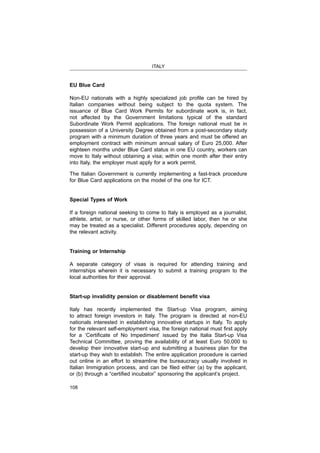
EU Blue Card
Italian companies without being subject to the quota system. The
issuance of Blue Card Work Permits for subordinate work is, in fact,
not affected by the Government limitations typical of the standard
Subordinate Work Permit applications. The foreign national must be in
possession of a University Degree obtained from a post-secondary study
program with a minimum duration of three years and must be offered an
employment contract with minimum annual salary of Euro 25,000. After
eighteen months under Blue Card status in one EU country, workers can
move to Italy without obtaining a visa; within one month after their entry
into Italy, the employer must apply for a work permit.
The Italian Government is currently implementing a fast-track procedure
for Blue Card applications on the model of the one for ICT.
Special Types of Work
If a foreign national seeking to come to Italy is employed as a journalist,
athlete, artist, or nurse, or other forms of skilled labor, then he or she
may be treated as a specialist. Different procedures apply, depending on
the relevant activity.
Training or Internship
A separate category of visas is required for attending training and
internships wherein it is necessary to submit a training program to the
local authorities for their approval.
Italy has recently implemented the Start-up Visa program, aiming
to attract foreign investors in Italy. The program is directed at non-EU
nationals interested in establishing innovative startups in Italy. To apply
Technical Committee, proving the availability of at least Euro 50,000 to
develop their innovative start-up and submitting a business plan for the
start-up they wish to establish. The entire application procedure is carried
out online in an effort to streamline the bureaucracy usually involved in
GLOBAL MOBILITY
109
The issuance of start-up visas is subject to the availability of Government
quotas.
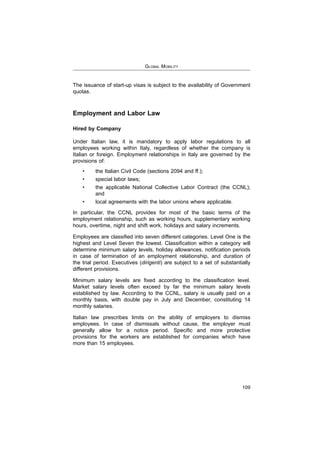
Employment and Labor Law
Hired by Company
Under Italian law, it is mandatory to apply labor regulations to all
employees working within Italy, regardless of whether the company is
Italian or foreign. Employment relationships in Italy are governed by the
provisions of:
and
In particular, the CCNL provides for most of the basic terms of the
employment relationship, such as working hours, supplementary working
hours, overtime, night and shift work, holidays and salary increments.
in case of termination of an employment relationship, and duration of
dirigenti
different provisions.
Market salary levels often exceed by far the minimum salary levels
established by law. According to the CCNL, salary is usually paid on a
monthly basis, with double pay in July and December, constituting 14
monthly salaries.
Italian law prescribes limits on the ability of employers to dismiss
employees. In case of dismissals without cause, the employer must
provisions for the workers are established for companies which have
more than 15 employees.
ITALY
110
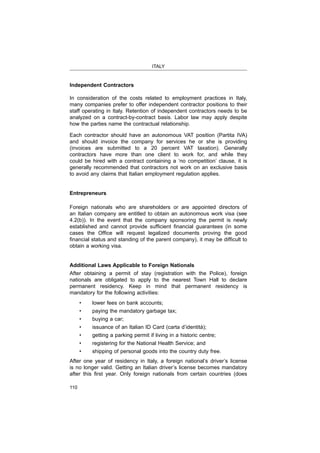
Independent Contractors
In consideration of the costs related to employment practices in Italy,
many companies prefer to offer independent contractor positions to their
staff operating in Italy. Retention of independent contractors needs to be
analyzed on a contract-by-contract basis. Labor law may apply despite
how the parties name the contractual relationship.
and should invoice the company for services he or she is providing
contractors have more than one client to work for, and while they
could be hired with a contract containing a ‘no competition’ clause, it is
generally recommended that contractors not work on an exclusive basis
to avoid any claims that Italian employment regulation applies.
Entrepreneurs
Foreign nationals who are shareholders or are appointed directors of
obtain a working visa.
Additional Laws Applicable to Foreign Nationals
nationals are obligated to apply to the nearest Town Hall to declare
permanent residency. Keep in mind that permanent residency is
mandatory for the following activities:
After one year of residency in Italy, a foreign national’s driver’s license
is no longer valid. Getting an Italian driver’s license becomes mandatory
GLOBAL MOBILITY
111
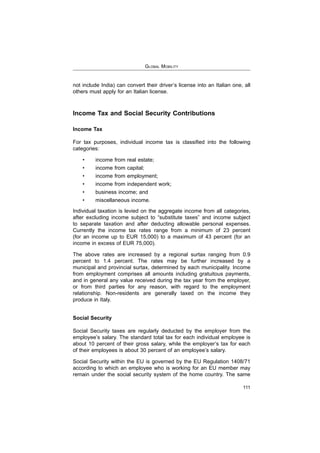
others must apply for an Italian license.
Income Tax and Social Security Contributions
Income Tax
categories:
Individual taxation is levied on the aggregate income from all categories,
to separate taxation and after deducting allowable personal expenses.
Currently the income tax rates range from a minimum of 23 percent
The above rates are increased by a regional surtax ranging from 0.9
percent to 1.4 percent. The rates may be further increased by a
municipal and provincial surtax, determined by each municipality. Income
from employment comprises all amounts including gratuitous payments,
and in general any value received during the tax year from the employer,
or from third parties for any reason, with regard to the employment
relationship. Non-residents are generally taxed on the income they
produce in Italy.
Social Security
Social Security taxes are regularly deducted by the employer from the
employee’s salary. The standard total tax for each individual employee is
about 10 percent of their gross salary, while the employer’s tax for each
of their employees is about 30 percent of an employee’s salary.
Social Security within the EU is governed by the EU Regulation 1408/71
according to which an employee who is working for an EU member may
remain under the social security system of the home country. The same
ITALY
112
is extended to nationals of those countries who are not already covered
by the provisions solely on the ground of their nationality, as well as to
members of their families, provided that they are legally resident in the
territory of a Member State.
Italy has agreements in place with 40 countries including members of
This allows foreign national employees from these countries to remain
for whom the employee is working will be required to pay a reduced
Social Security fee for this employee, approximately nine percent of the
employee’s salary. With this arrangement, the company is responsible for
providing evidence that the employee is in fact paying the Social Security
taxes abroad.
Employees from those countries with whom Italy does not have an
Italian tax system, which in the aggregate is approximately 39 percent of
the employee’s salary.

The global mobility handbook (Italy chapter)

  • 1.
    ITALY 104 ITALY Marco Mazzeschi Summary Italy isdivided into 20 regions and each region is further divided into more than 100 provinces. Immigration matters are handled by local also became and remains to this day a member of the Group of seven National Income per capita of EUR 24,700. In 2002, Italy converted its currency from the Lira to the Euro. Italy has the fourth largest economy in Europe, which is primarily fueled by the production of high quality consumer products, engineering products, agriculture, and tourism. In fact, over 42 million tourists visit Italy annually. The Italian government has a bicameral structure. The Parliament, having legislative power, is composed of two Houses: the Chamber of Deputies and the Senate. The Prime Minister is the head of the matters and decrees.
  • 2.
    GLOBAL MOBILITY 105 Legal System Immigrationissues at the national level are governed by the within the Ministry to the various provincial departments regarding the interpretation and implementation of the law. Immigrazione Questura Immigration law is enforced by the Prefetto and Department of Labor. A person who enters or takes up residence in Italy illegally may be deported if any of the following circumstances apply: majeure 60 days and the renewal has not yet been requested. A foreign national may be granted leave to appeal an order of deportation within 60 days by petitioning the judge in the pertinent court. Heavy sanctions and penalties are imposed on companies and employers aiding the illegal entry of foreign nationals as well as hiring foreign nationals without complying with immigration and labor laws. Visas Temporary Visas
  • 3.
    ITALY 106 days without needingto obtain a visa. All other foreign nationals need to obtain a business visa to enter the country even for a few days. Business activities include: seminars; and In general terms, business visitors cannot carry out any activities for the their own employer. Long Term Visas (more than 90 days) longer than 90 days duration. Subordinate Workers (Lavoratori Dipendenti) The direct hiring of a non-EU citizen by an Italian company is subject to the availability of quotas which are released annually by the government clearance from the Department of Labor and the Police and then obtain each time the government does release a new set of quotas, there are several hundred thousand applicants seeking to receive these quotas and as such, the wait for a work permit is very extensive, often lasting beyond a year. Autonomous Workers (Lavoratori Autonomi) Autonomous workers are basically independent consultants who come to Italy to do consulting work for a company, to set up a new company, or to function as a legal representative in Italy for an already existing entity. The work permits for this type of work are also subject to the availability of government quotas with a few exceptions. The application must be some supporting documents issued by the company. Each consulate has a certain amount of discretion when issuing an autonomous work visa and therefore the issuance of a work permit does not automatically guarantee the subsequent issuance of the pertinent visa.
  • 4.
    GLOBAL MOBILITY 107 Assigned Workers(Lavoratori Distaccati) The temporary transfer of nationals from a foreign company to an Italian company, when the employee remains hired by the sending company, is a preferential route as it is not subject to the availability of yearly quotas. The temporary assignment can be initially for a maximum period of two years with the possibility of: Intra-company Transfers If the foreign national employee has at least six months’ experience in manager, and if the foreign company and the Italian company are both part of the same group of companies, the foreign national employee can obtain an intra-company work permit. Service Agreement Assignments If the foreign company and the Italian company are not part of the the two companies can enter into a service agreement regulating the terms and conditions of the assignment. The Italian company will need to inform the local Unions and additional documents must be submitted permit. Fast-track Procedure for Intra-company Transfers Ministero dell'Interno procedure for the companies willing to host non-EU highly specialized workers coming to Italy on intra-company assignments. This consists of a registration with the Ministry of Interior that allows the companies to Labor Board. These applications are, in fact, directly processed by submitted for the application to be approved. To register with the Ministry, employers must satisfy certain mandatory compliance requirements and must execute a framework agreement with the Ministry. Once registered, employers receive a password to access the online system and check on the status of their applications.
  • 5.
    ITALY 108 EU Blue Card Italiancompanies without being subject to the quota system. The issuance of Blue Card Work Permits for subordinate work is, in fact, not affected by the Government limitations typical of the standard Subordinate Work Permit applications. The foreign national must be in possession of a University Degree obtained from a post-secondary study program with a minimum duration of three years and must be offered an employment contract with minimum annual salary of Euro 25,000. After eighteen months under Blue Card status in one EU country, workers can move to Italy without obtaining a visa; within one month after their entry into Italy, the employer must apply for a work permit. The Italian Government is currently implementing a fast-track procedure for Blue Card applications on the model of the one for ICT. Special Types of Work If a foreign national seeking to come to Italy is employed as a journalist, athlete, artist, or nurse, or other forms of skilled labor, then he or she may be treated as a specialist. Different procedures apply, depending on the relevant activity. Training or Internship A separate category of visas is required for attending training and internships wherein it is necessary to submit a training program to the local authorities for their approval. Italy has recently implemented the Start-up Visa program, aiming to attract foreign investors in Italy. The program is directed at non-EU nationals interested in establishing innovative startups in Italy. To apply Technical Committee, proving the availability of at least Euro 50,000 to develop their innovative start-up and submitting a business plan for the start-up they wish to establish. The entire application procedure is carried out online in an effort to streamline the bureaucracy usually involved in
  • 6.
    GLOBAL MOBILITY 109 The issuanceof start-up visas is subject to the availability of Government quotas. Employment and Labor Law Hired by Company Under Italian law, it is mandatory to apply labor regulations to all employees working within Italy, regardless of whether the company is Italian or foreign. Employment relationships in Italy are governed by the provisions of: and In particular, the CCNL provides for most of the basic terms of the employment relationship, such as working hours, supplementary working hours, overtime, night and shift work, holidays and salary increments. in case of termination of an employment relationship, and duration of dirigenti different provisions. Market salary levels often exceed by far the minimum salary levels established by law. According to the CCNL, salary is usually paid on a monthly basis, with double pay in July and December, constituting 14 monthly salaries. Italian law prescribes limits on the ability of employers to dismiss employees. In case of dismissals without cause, the employer must provisions for the workers are established for companies which have more than 15 employees.
  • 7.
    ITALY 110 Independent Contractors In considerationof the costs related to employment practices in Italy, many companies prefer to offer independent contractor positions to their staff operating in Italy. Retention of independent contractors needs to be analyzed on a contract-by-contract basis. Labor law may apply despite how the parties name the contractual relationship. and should invoice the company for services he or she is providing contractors have more than one client to work for, and while they could be hired with a contract containing a ‘no competition’ clause, it is generally recommended that contractors not work on an exclusive basis to avoid any claims that Italian employment regulation applies. Entrepreneurs Foreign nationals who are shareholders or are appointed directors of obtain a working visa. Additional Laws Applicable to Foreign Nationals nationals are obligated to apply to the nearest Town Hall to declare permanent residency. Keep in mind that permanent residency is mandatory for the following activities: After one year of residency in Italy, a foreign national’s driver’s license is no longer valid. Getting an Italian driver’s license becomes mandatory
  • 8.
    GLOBAL MOBILITY 111 others mustapply for an Italian license. Income Tax and Social Security Contributions Income Tax categories: Individual taxation is levied on the aggregate income from all categories, to separate taxation and after deducting allowable personal expenses. Currently the income tax rates range from a minimum of 23 percent The above rates are increased by a regional surtax ranging from 0.9 percent to 1.4 percent. The rates may be further increased by a municipal and provincial surtax, determined by each municipality. Income from employment comprises all amounts including gratuitous payments, and in general any value received during the tax year from the employer, or from third parties for any reason, with regard to the employment relationship. Non-residents are generally taxed on the income they produce in Italy. Social Security Social Security taxes are regularly deducted by the employer from the employee’s salary. The standard total tax for each individual employee is about 10 percent of their gross salary, while the employer’s tax for each of their employees is about 30 percent of an employee’s salary. Social Security within the EU is governed by the EU Regulation 1408/71 according to which an employee who is working for an EU member may remain under the social security system of the home country. The same
  • 9.
    ITALY 112 is extended tonationals of those countries who are not already covered by the provisions solely on the ground of their nationality, as well as to members of their families, provided that they are legally resident in the territory of a Member State. Italy has agreements in place with 40 countries including members of This allows foreign national employees from these countries to remain for whom the employee is working will be required to pay a reduced Social Security fee for this employee, approximately nine percent of the employee’s salary. With this arrangement, the company is responsible for providing evidence that the employee is in fact paying the Social Security taxes abroad. Employees from those countries with whom Italy does not have an Italian tax system, which in the aggregate is approximately 39 percent of the employee’s salary.