THE FUTURE OF
PHARMACOVIGILANCE
Leveraging Technology to Transform the
Safety Continuum
The pharmaceutical industry is set to embrace transformation
initiatives at a faster pace over the coming years, across clinical,
regulatory and safety practices. In product development,
companies are focused on streamlining end-to-end processes
to speed time to market and maintain regulatory compliance at
all times1. Similarly, there is an increased focus on streamlining
post-market safety and risk management (SRM) activities to
enable proactive identification (or even prediction) of safety
signals and benefit-risk evaluation for marketed products, along
with integrating data sets across the stakeholder continuum
(pharma, regulators, patients, providers and doctors) to enable
full transparency, sharing and collaboration.
The challenges of establishing and maintaining progressively more complex pharmacovigilance (PV)
systems in a globally diverse and evolving regulatory environment are increasing day by day. As more and
more drugs receive regulatory approval there is growing public awareness, social media connectivity and
media scrutiny, pharmaceutical companies therefore need to manage PV activities more diligently and
efficiently than ever.
With cost-reduction pressures on one hand and dwindling safety talent (versus demand) on the other, there
is a need to rethink existing traditional PV strategies. As pharmaceutical companies step up their global
PV transformation strategies, more effective PV processes and robust technologies, including cloud-based
solutions, mobile applications, robotic automation, artificial intelligence (AI) and big data analytics are
required. This translates into smarter, but not necessarily higher, spend for PV activities.
Technology solutions are already a vital cog in safety operations in the pharmaceutical industry, given their
strategic role in worldwide PV systems. While this notion of technology as an enabler to transformation
carries across all areas of product development, it is evident that applying innovative technology
automation tools and processes to PV is no longer an option but a must have. Companies that recognize
the importance of integrating newer, disruptive technologies and use these to fundamentally alter the drug
safety continuum will see greater success in managing the safety of their products.
The Changing Pharmacovigilance Landscape
Effective PV entails critical coordination of numerous end-to-end safety surveillance activities across the
SRM continuum, from individual case management through aggregate reporting, signal detection, benefit-
risk evaluation and risk minimization. Typically, thousands of adverse event (AE) cases are processed
manually by global case processing teams that are involved in data entry, quality review and medical review
of individual case safety reports in the safety database. Some of these are reported on an expedited basis
to regulatory authorities by submission teams. In addition, periodic aggregate reporting to regulators
worldwide involves the review of cumulative safety information from a wide range of sources. Specialized
domain experts further focus on complex safety areas like signaling, benefit-risk evaluation and risk
minimization activities for safety issues.
Industry Responses to the Changing Environment
As the industry is gearing up to better manage PV activities, modern technologies are already being
utilized by regulatory authorities to collect, characterize and evaluate the adverse events associated with
medicinal products.
In response to the U.S. Food and Drug Administration (FDA) Amendments Act (FDAAA) of 2007, the
Sentinel Initiative was launched in May 2008. The U.S. FDA Sentinel system is an integrated electronic
system that enhances the FDA’s ability to proactively monitor and assess medical product safety after they
have reached the market (real world conditions) and complements existing FAERS (FDA Adverse Event
Reporting System) post-marketing monitoring capabilities. Through Sentinel, the FDA can rapidly and
securely access information from large amounts of electronic healthcare data, such as electronic health
records (EHR), insurance claims data and registries, from a diverse group of data partners. Sentinel uses a
distributed data approach which allows the FDA to monitor the safety of regulated medical products, while
securing and safeguarding patient privacy2.
Similarly, the European Medicines Agency (EMA) continuously monitors adverse drug reaction (ADR)
data through the EudraVigilance database, a comprehensive multi-component system that facilitates
data collection, data management and the analysis in a secure manner. The post-authorization module
of EudraVigilance has about one million ADR reports. It is used to determine whether there are new or
changed risks and whether those risks have an impact on a medicine’s overall benefit-risk balance.
Another initiative is the WEB-RADR (Recognizing Adverse Drug Reactions), which is led by a consortium
of world-leading experts from industry, regulatory agencies and academia. It aims to deliver an EU-wide
mobile phone app that would enable users to report Adverse Drug Reactions (ADRs) directly to their
National Competent Authority (NCA). Furthermore, there is potential to use the app as a platform for
patients and clinicians to access accurate, timely and up-to-date information on PV issues and develop text
mining techniques for publicly available data on social media sites, complementing existing methods of
signal detection3.
Technological overlay in the form of off-the-shelf, customized or homegrown solutions for case intake,
processing and submission, as well as tools for data mining and analytics, enable pharmaceutical
organizations to deliver successful PV programs and enrich innovation to support changing business
needs. Today, companies sense the need for advanced technological capabilities and expertise to build PV
IT reference architectures, deploy appropriate automated applications and create enterprise portals for
safety analytics. Companies require a well-established overarching IT framework providing appropriate
infrastructure (high performance and scalability) coupled with relevant domain expertise (system
validation and information security) for effective design and deployment of automation initiatives.
Integrated drug safety solutions combining scientific and technological expertise have the power to
successfully deliver high operational efficiency, quality and regulatory compliance.
Automation Paves the Way Forward
Increasing market and regulatory pressures have led companies to reassess their safety business
operations and how they impact productivity, operational costs, quality, compliance and audit readiness.
For a pharmaceutical company to be successful, drug safety has to be at the core of all discussions across
the organization. PV has to be embedded into the day-to-day operations of the company. However, it
should be noted that many of the issues surrounding PV systems are not Information Technology (IT)
problems, but rather inefficiencies or issues in the processes or people managing the systems. Tools,
including IT solutions, must be implemented in the context of addressing such process improvements and
organizational needs4.
In order to truly unlock the power of technology for optimal and proactive PV, a combination of process
improvements across the safety and risk management continuum is required, including solutions to better
receive and manage data from disparate, global sources coupled with targeted automation initiatives. The
first step towards PV transformation is process mapping and evaluation to drive process improvements,
making end-to-end safety processes leaner and better and eliminating non-value adding and redundant
steps in existing processes. It is essential to integrate global systems and processes, which lend themselves
to further automation for efficiency gains and quality improvements.
Levels of Automation
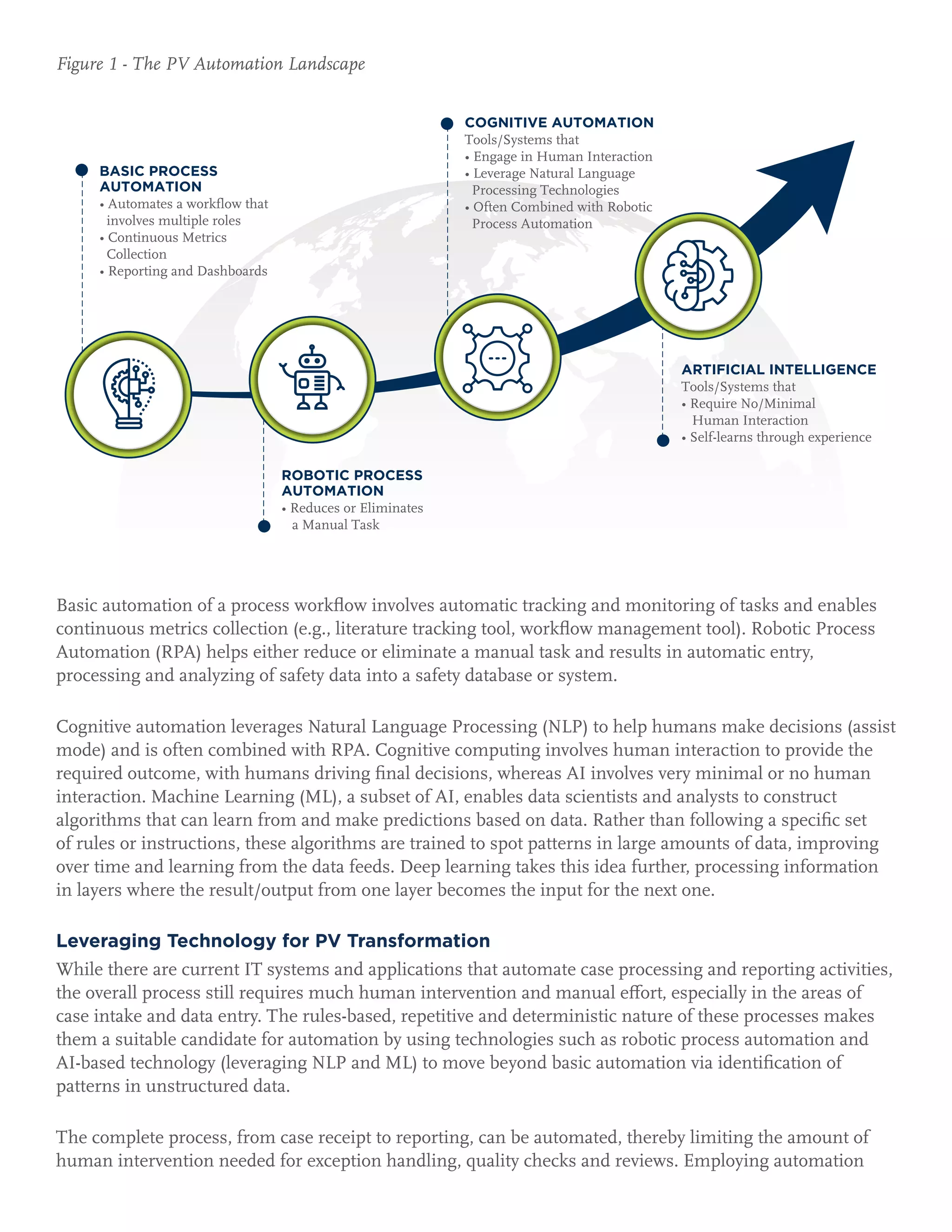
To achieve full PV transformation, multiple stages or levels of automation are required to ensure processes
are completed correctly. Starting with basic automation, through robotic process automation, to cognitive
computing and eventually leading up to Artificial Intelligence (AI), each stage involves reduced human
involvement.
Figure 1 - The PV Automation Landscape
Basic automation of a process workflow involves automatic tracking and monitoring of tasks and enables
continuous metrics collection (e.g., literature tracking tool, workflow management tool). Robotic Process
Automation (RPA) helps either reduce or eliminate a manual task and results in automatic entry,
processing and analyzing of safety data into a safety database or system.
Cognitive automation leverages Natural Language Processing (NLP) to help humans make decisions (assist
mode) and is often combined with RPA. Cognitive computing involves human interaction to provide the
required outcome, with humans driving final decisions, whereas AI involves very minimal or no human
interaction. Machine Learning (ML), a subset of AI, enables data scientists and analysts to construct
algorithms that can learn from and make predictions based on data. Rather than following a specific set
of rules or instructions, these algorithms are trained to spot patterns in large amounts of data, improving
over time and learning from the data feeds. Deep learning takes this idea further, processing information
in layers where the result/output from one layer becomes the input for the next one.
Leveraging Technology for PV Transformation
While there are current IT systems and applications that automate case processing and reporting activities,
the overall process still requires much human intervention and manual effort, especially in the areas of
case intake and data entry. The rules-based, repetitive and deterministic nature of these processes makes
them a suitable candidate for automation by using technologies such as robotic process automation and
AI-based technology (leveraging NLP and ML) to move beyond basic automation via identification of
patterns in unstructured data.
The complete process, from case receipt to reporting, can be automated, thereby limiting the amount of
human intervention needed for exception handling, quality checks and reviews. Employing automation
BASIC PROCESS
AUTOMATION
• Automates a workflow that
involves multiple roles
• Continuous Metrics
Collection
• Reporting and Dashboards
ROBOTIC PROCESS
AUTOMATION
• Reduces or Eliminates
a Manual Task
ARTIFICIAL INTELLIGENCE
Tools/Systems that
• Require No/Minimal
Human Interaction
• Self-learns through experience
COGNITIVE AUTOMATION
Tools/Systems that
• Engage in Human Interaction
• Leverage Natural Language
Processing Technologies
• Often Combined with Robotic
Process Automation
in safety case processing will not only reduce costs and accelerate processing; it will also eliminate the
chance of human error and improve quality and accuracy. Cost savings in case processing can then be
utilized to establish a comprehensive PV system that is global in nature and utilizes modern technology
to capture and analyze new sources of medical information. In this way, the current reactive model will be
transformed into a more proactive risk benefit management system.
Automation when implemented fully holds the promise of multiple benefits including nearly 100%
regulatory compliance due to faster turnaround time (reduced cycle time), improved quality and accuracy
through standardized inputs and automated case intake and processing and enhanced productivity
via automation with expected efficiency gains of up to 50% and more. Such automation solutions
implemented with zero or minimal disruption to existing safety systems and processes would represent
scalable future-ready solutions, capable of handling increasing safety data volumes from multiple sources
and diverse incoming data formats.
Advanced technological solutions for better PV include digitized medicines (smart pills with ingestible
sensors to track and collect patients’ health data including AE detection), mobile applications for rapid
collection of AE data, cloud-based integrated global ADR repositories, big data analytics and advanced
systems for proactive monitoring of drug safety during the clinical development process and post-launch.
Implementing an Automation Strategy Now and into the Future
There are three key areas within the safety realm which can be transformed through the appropriate
and effective use of technology4. Firstly, standardization and automation of PV processes and safety data
management is required to gain efficiencies while maintaining quality and compliance. This can be
achieved through integration of safety data by application of appropriate data and system interoperability
standards, implementation of best practices and technological concepts including work flow management
technology to ensure appropriate transparency and accessibility of safety information and targeted
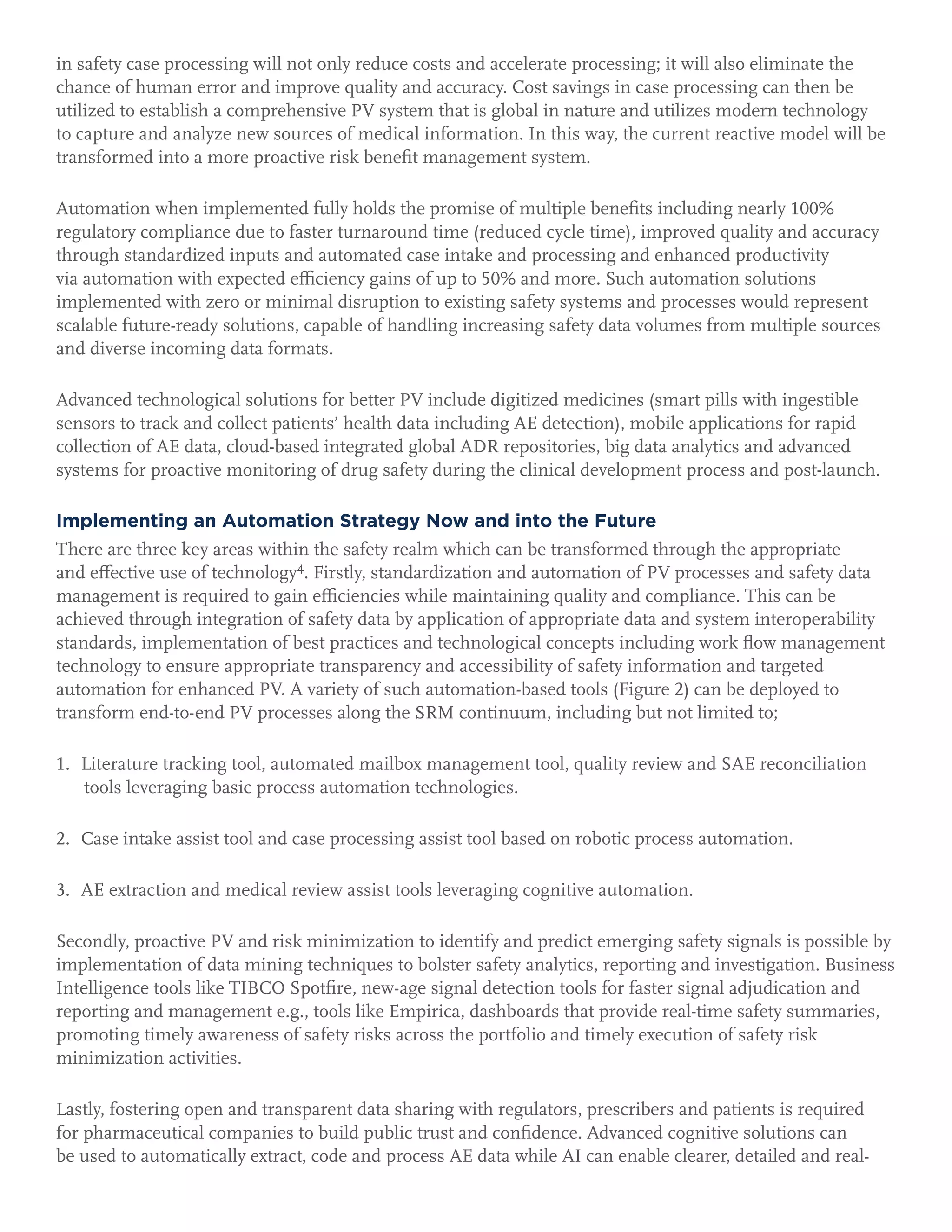
automation for enhanced PV. A variety of such automation-based tools (Figure 2) can be deployed to
transform end-to-end PV processes along the SRM continuum, including but not limited to;
1.	 Literature tracking tool, automated mailbox management tool, quality review and SAE reconciliation
tools leveraging basic process automation technologies.
2.	 Case intake assist tool and case processing assist tool based on robotic process automation.
3.	 AE extraction and medical review assist tools leveraging cognitive automation.
Secondly, proactive PV and risk minimization to identify and predict emerging safety signals is possible by
implementation of data mining techniques to bolster safety analytics, reporting and investigation. Business
Intelligence tools like TIBCO Spotfire, new-age signal detection tools for faster signal adjudication and
reporting and management e.g., tools like Empirica, dashboards that provide real-time safety summaries,
promoting timely awareness of safety risks across the portfolio and timely execution of safety risk
minimization activities.
Lastly, fostering open and transparent data sharing with regulators, prescribers and patients is required
for pharmaceutical companies to build public trust and confidence. Advanced cognitive solutions can
be used to automatically extract, code and process AE data while AI can enable clearer, detailed and real-
time views of safety issues proactively, providing more opportunities to stay transparent with patients,
regulators and prescribers. Emerging tools will also encourage greater openness across the industry and
promote impartial comparisons of alternative products. This will drive more trust, collaboration and
ultimately fewer ADRs. The U.S. FDA Sentinel system, EMA‘s EudraVigilance database and WEB-RADR
are examples that just scratch the surface of how the industry is implementing tools that allow for full data
transparency.
Figure 2 - PV Automation Roadmap
Considerations when Developing a Roadmap
Strong technical and PV knowledge is key to successfully navigate the highly regulated space while
delivering comprehensive end-to-end automation solutions, specifically geared for the management of PV
activities. To fully leverage technology for optimal PV management, pharma companies must begin with
establishing a clear and robust vision, strategies and initiatives with specified milestones to track progress
to reach the defined end goals. Partnering with outsourcing service providers with a proven track record
in PV delivery, safety technology and regulatory reporting including call center, case data entry, literature
review, aggregate reporting and PV quality assurance will go a long way in enabling this vision
of transformation.
Assistance from a third-party advisor in the development of the automation strategy and specialized
technology vendors to fill technology gaps is an important part of planning for the overall transformation.
SAFETY OPERATIONAL METRICS REPORTING
HCP,
PATIENTS,
AE/E2B
Forms, Emails,
Fax, Social
Media Sources
CISCO CONTACT
CENTRE
OBA IRMS
ORACLE ARGUS ENTERPRISE
MS OFFICE
BUSINESS APPS
Report Type
• Spontaneous
Report
• Clinical Report
• Literature Case
Case Intake
• Call Center
• Email
• Fax
Case Processing
• Triage
• Data Entry
• Queries
• Narratives
• QC
Medical Review
• Case Assessment
• Medical Coding
• Narrative Review
Case Output
• CIOMS-I Form
• MedWatch
• Other Forms/
Formats for
Aggregate Reports
• PADER
• CAR
• PBRER/PSUR
• DSUR
• IND AR
Scignal Plus
(Signal Detection)
Disproportionality
Analysis / Signal
Detection
Benefit Risk
Assessment
Report
ScilitPro
Literature
Tracking
Mailbox
Management
Auto Narrative
Auto Narrative
Case Processing
Assist
Case Intake
Assist
Medical
Review Assist
SAE
Reconciliation
Axway
Gateway
(FDA, EMA)
Case
Submission
LEGEND
Covance Automation Tools
Industry Leading Tool
Covance Service Offerings
Regulatory
Agencies
Developing a common safety platform that allows ingestion of data from all sources and stakeholders is
a vital step towards developing a complete safety surveillance and risk management application. Pharma
companies have traditionally been slow to adopt technology in PV. However, the time has come for
technology to play a greater role in delivering solutions, with technology vendors and outsourcing service
providers serving as force multipliers.
Conclusions
Driven by a continued demand for more affordable treatments that better meet patients’ needs, the
healthcare industry has undergone a revolution over the last thirty years5. Automation is critical to
reducing the costs and complexities of clinical trials and can act as a catalyst by providing the performance
metrics to empower business intelligence (e.g., benchmarking, predictive or forecasting projections),
process optimization and efficient resource allocation, while improving collaboration among stakeholders.
Automation is thus key to modernizing clinical trials, streamlining communications and enabling real-
time decision making.
Available technology systems and applications automate certain aspects of post-marketing safety such
as case intake (cloud-based call center solutions, medical information solutions like information request
management systems [IRMS]), case processing (cloud-based safety databases/systems including ARGUS
and ArisG) and reporting activities to regulatory agencies conducted via electronic gateways. The overall
process still requires much human intervention and manual effort, especially in the areas of case intake
and data entry. By using robotic automation, cognitive computing and artificial intelligence technologies,
companies can reduce the effort and spend required for safety case processing, thus allowing resources to
focus on proactive identification, evaluation and minimization of risks.
Embracing technologies like cloud-based solutions, mobile applications, technology for big data analytics
etc. will further help companies to move towards end-to-end automation across the PV spectrum.
Companies which embrace advanced technology solutions and next generation automation as a key part
of their PV strategies are well-placed to meet the growing demands of the PV practices of the future, while
ensuring compliance and quality.
www.covance.com/marketaccess
Covance is the drug, medical device and diagnostics business segment of LabCorp, a leading global life
sciences company. COVANCE is a registered trademark and the marketing name for Covance Inc. and
its subsidiaries around the world.
The Americas +1.888.COVANCE (+1.888.268.2623)  +1.609.452.4440
Europe / Africa  +00.800.2682.2682 +44.1423.500888
Asia Pacific  +800.6568.3000 +65.6.5686588
© Copyright 2019 Covance Inc. WPCMA013-0919
References
1.	 Growing trends of optimization and efficiency in life science.
http://www.pharmexec.com/12-life-sciences-trends-look-forward-2018
2.	 https://www.fda.gov/Safety/FDAsSentinelInitiative/ucm2007250.htm
3.	 https://web-radr.eu/
4.	 https://www.pwc.com/th/en/publications/assets/pharmacovigilance_ final.pdf
5.	 http://www.pharmatimes.com/magazine/2018/janfeb/the_changing_ face_of_post-
marketing_research

The Future of Pharmacovigilance

  • 1.
    THE FUTURE OF PHARMACOVIGILANCE LeveragingTechnology to Transform the Safety Continuum The pharmaceutical industry is set to embrace transformation initiatives at a faster pace over the coming years, across clinical, regulatory and safety practices. In product development, companies are focused on streamlining end-to-end processes to speed time to market and maintain regulatory compliance at all times1. Similarly, there is an increased focus on streamlining post-market safety and risk management (SRM) activities to enable proactive identification (or even prediction) of safety signals and benefit-risk evaluation for marketed products, along with integrating data sets across the stakeholder continuum (pharma, regulators, patients, providers and doctors) to enable full transparency, sharing and collaboration.
  • 2.
    The challenges ofestablishing and maintaining progressively more complex pharmacovigilance (PV) systems in a globally diverse and evolving regulatory environment are increasing day by day. As more and more drugs receive regulatory approval there is growing public awareness, social media connectivity and media scrutiny, pharmaceutical companies therefore need to manage PV activities more diligently and efficiently than ever. With cost-reduction pressures on one hand and dwindling safety talent (versus demand) on the other, there is a need to rethink existing traditional PV strategies. As pharmaceutical companies step up their global PV transformation strategies, more effective PV processes and robust technologies, including cloud-based solutions, mobile applications, robotic automation, artificial intelligence (AI) and big data analytics are required. This translates into smarter, but not necessarily higher, spend for PV activities. Technology solutions are already a vital cog in safety operations in the pharmaceutical industry, given their strategic role in worldwide PV systems. While this notion of technology as an enabler to transformation carries across all areas of product development, it is evident that applying innovative technology automation tools and processes to PV is no longer an option but a must have. Companies that recognize the importance of integrating newer, disruptive technologies and use these to fundamentally alter the drug safety continuum will see greater success in managing the safety of their products. The Changing Pharmacovigilance Landscape Effective PV entails critical coordination of numerous end-to-end safety surveillance activities across the SRM continuum, from individual case management through aggregate reporting, signal detection, benefit- risk evaluation and risk minimization. Typically, thousands of adverse event (AE) cases are processed manually by global case processing teams that are involved in data entry, quality review and medical review of individual case safety reports in the safety database. Some of these are reported on an expedited basis to regulatory authorities by submission teams. In addition, periodic aggregate reporting to regulators worldwide involves the review of cumulative safety information from a wide range of sources. Specialized domain experts further focus on complex safety areas like signaling, benefit-risk evaluation and risk minimization activities for safety issues. Industry Responses to the Changing Environment As the industry is gearing up to better manage PV activities, modern technologies are already being utilized by regulatory authorities to collect, characterize and evaluate the adverse events associated with medicinal products. In response to the U.S. Food and Drug Administration (FDA) Amendments Act (FDAAA) of 2007, the Sentinel Initiative was launched in May 2008. The U.S. FDA Sentinel system is an integrated electronic system that enhances the FDA’s ability to proactively monitor and assess medical product safety after they have reached the market (real world conditions) and complements existing FAERS (FDA Adverse Event Reporting System) post-marketing monitoring capabilities. Through Sentinel, the FDA can rapidly and securely access information from large amounts of electronic healthcare data, such as electronic health records (EHR), insurance claims data and registries, from a diverse group of data partners. Sentinel uses a distributed data approach which allows the FDA to monitor the safety of regulated medical products, while securing and safeguarding patient privacy2. Similarly, the European Medicines Agency (EMA) continuously monitors adverse drug reaction (ADR) data through the EudraVigilance database, a comprehensive multi-component system that facilitates
  • 3.
    data collection, datamanagement and the analysis in a secure manner. The post-authorization module of EudraVigilance has about one million ADR reports. It is used to determine whether there are new or changed risks and whether those risks have an impact on a medicine’s overall benefit-risk balance. Another initiative is the WEB-RADR (Recognizing Adverse Drug Reactions), which is led by a consortium of world-leading experts from industry, regulatory agencies and academia. It aims to deliver an EU-wide mobile phone app that would enable users to report Adverse Drug Reactions (ADRs) directly to their National Competent Authority (NCA). Furthermore, there is potential to use the app as a platform for patients and clinicians to access accurate, timely and up-to-date information on PV issues and develop text mining techniques for publicly available data on social media sites, complementing existing methods of signal detection3. Technological overlay in the form of off-the-shelf, customized or homegrown solutions for case intake, processing and submission, as well as tools for data mining and analytics, enable pharmaceutical organizations to deliver successful PV programs and enrich innovation to support changing business needs. Today, companies sense the need for advanced technological capabilities and expertise to build PV IT reference architectures, deploy appropriate automated applications and create enterprise portals for safety analytics. Companies require a well-established overarching IT framework providing appropriate infrastructure (high performance and scalability) coupled with relevant domain expertise (system validation and information security) for effective design and deployment of automation initiatives. Integrated drug safety solutions combining scientific and technological expertise have the power to successfully deliver high operational efficiency, quality and regulatory compliance. Automation Paves the Way Forward Increasing market and regulatory pressures have led companies to reassess their safety business operations and how they impact productivity, operational costs, quality, compliance and audit readiness. For a pharmaceutical company to be successful, drug safety has to be at the core of all discussions across the organization. PV has to be embedded into the day-to-day operations of the company. However, it should be noted that many of the issues surrounding PV systems are not Information Technology (IT) problems, but rather inefficiencies or issues in the processes or people managing the systems. Tools, including IT solutions, must be implemented in the context of addressing such process improvements and organizational needs4. In order to truly unlock the power of technology for optimal and proactive PV, a combination of process improvements across the safety and risk management continuum is required, including solutions to better receive and manage data from disparate, global sources coupled with targeted automation initiatives. The first step towards PV transformation is process mapping and evaluation to drive process improvements, making end-to-end safety processes leaner and better and eliminating non-value adding and redundant steps in existing processes. It is essential to integrate global systems and processes, which lend themselves to further automation for efficiency gains and quality improvements. Levels of Automation To achieve full PV transformation, multiple stages or levels of automation are required to ensure processes are completed correctly. Starting with basic automation, through robotic process automation, to cognitive computing and eventually leading up to Artificial Intelligence (AI), each stage involves reduced human involvement.
  • 4.
    Figure 1 -The PV Automation Landscape Basic automation of a process workflow involves automatic tracking and monitoring of tasks and enables continuous metrics collection (e.g., literature tracking tool, workflow management tool). Robotic Process Automation (RPA) helps either reduce or eliminate a manual task and results in automatic entry, processing and analyzing of safety data into a safety database or system. Cognitive automation leverages Natural Language Processing (NLP) to help humans make decisions (assist mode) and is often combined with RPA. Cognitive computing involves human interaction to provide the required outcome, with humans driving final decisions, whereas AI involves very minimal or no human interaction. Machine Learning (ML), a subset of AI, enables data scientists and analysts to construct algorithms that can learn from and make predictions based on data. Rather than following a specific set of rules or instructions, these algorithms are trained to spot patterns in large amounts of data, improving over time and learning from the data feeds. Deep learning takes this idea further, processing information in layers where the result/output from one layer becomes the input for the next one. Leveraging Technology for PV Transformation While there are current IT systems and applications that automate case processing and reporting activities, the overall process still requires much human intervention and manual effort, especially in the areas of case intake and data entry. The rules-based, repetitive and deterministic nature of these processes makes them a suitable candidate for automation by using technologies such as robotic process automation and AI-based technology (leveraging NLP and ML) to move beyond basic automation via identification of patterns in unstructured data. The complete process, from case receipt to reporting, can be automated, thereby limiting the amount of human intervention needed for exception handling, quality checks and reviews. Employing automation BASIC PROCESS AUTOMATION • Automates a workflow that involves multiple roles • Continuous Metrics Collection • Reporting and Dashboards ROBOTIC PROCESS AUTOMATION • Reduces or Eliminates a Manual Task ARTIFICIAL INTELLIGENCE Tools/Systems that • Require No/Minimal Human Interaction • Self-learns through experience COGNITIVE AUTOMATION Tools/Systems that • Engage in Human Interaction • Leverage Natural Language Processing Technologies • Often Combined with Robotic Process Automation
  • 5.
    in safety caseprocessing will not only reduce costs and accelerate processing; it will also eliminate the chance of human error and improve quality and accuracy. Cost savings in case processing can then be utilized to establish a comprehensive PV system that is global in nature and utilizes modern technology to capture and analyze new sources of medical information. In this way, the current reactive model will be transformed into a more proactive risk benefit management system. Automation when implemented fully holds the promise of multiple benefits including nearly 100% regulatory compliance due to faster turnaround time (reduced cycle time), improved quality and accuracy through standardized inputs and automated case intake and processing and enhanced productivity via automation with expected efficiency gains of up to 50% and more. Such automation solutions implemented with zero or minimal disruption to existing safety systems and processes would represent scalable future-ready solutions, capable of handling increasing safety data volumes from multiple sources and diverse incoming data formats. Advanced technological solutions for better PV include digitized medicines (smart pills with ingestible sensors to track and collect patients’ health data including AE detection), mobile applications for rapid collection of AE data, cloud-based integrated global ADR repositories, big data analytics and advanced systems for proactive monitoring of drug safety during the clinical development process and post-launch. Implementing an Automation Strategy Now and into the Future There are three key areas within the safety realm which can be transformed through the appropriate and effective use of technology4. Firstly, standardization and automation of PV processes and safety data management is required to gain efficiencies while maintaining quality and compliance. This can be achieved through integration of safety data by application of appropriate data and system interoperability standards, implementation of best practices and technological concepts including work flow management technology to ensure appropriate transparency and accessibility of safety information and targeted automation for enhanced PV. A variety of such automation-based tools (Figure 2) can be deployed to transform end-to-end PV processes along the SRM continuum, including but not limited to; 1. Literature tracking tool, automated mailbox management tool, quality review and SAE reconciliation tools leveraging basic process automation technologies. 2. Case intake assist tool and case processing assist tool based on robotic process automation. 3. AE extraction and medical review assist tools leveraging cognitive automation. Secondly, proactive PV and risk minimization to identify and predict emerging safety signals is possible by implementation of data mining techniques to bolster safety analytics, reporting and investigation. Business Intelligence tools like TIBCO Spotfire, new-age signal detection tools for faster signal adjudication and reporting and management e.g., tools like Empirica, dashboards that provide real-time safety summaries, promoting timely awareness of safety risks across the portfolio and timely execution of safety risk minimization activities. Lastly, fostering open and transparent data sharing with regulators, prescribers and patients is required for pharmaceutical companies to build public trust and confidence. Advanced cognitive solutions can be used to automatically extract, code and process AE data while AI can enable clearer, detailed and real-
  • 6.
    time views ofsafety issues proactively, providing more opportunities to stay transparent with patients, regulators and prescribers. Emerging tools will also encourage greater openness across the industry and promote impartial comparisons of alternative products. This will drive more trust, collaboration and ultimately fewer ADRs. The U.S. FDA Sentinel system, EMA‘s EudraVigilance database and WEB-RADR are examples that just scratch the surface of how the industry is implementing tools that allow for full data transparency. Figure 2 - PV Automation Roadmap Considerations when Developing a Roadmap Strong technical and PV knowledge is key to successfully navigate the highly regulated space while delivering comprehensive end-to-end automation solutions, specifically geared for the management of PV activities. To fully leverage technology for optimal PV management, pharma companies must begin with establishing a clear and robust vision, strategies and initiatives with specified milestones to track progress to reach the defined end goals. Partnering with outsourcing service providers with a proven track record in PV delivery, safety technology and regulatory reporting including call center, case data entry, literature review, aggregate reporting and PV quality assurance will go a long way in enabling this vision of transformation. Assistance from a third-party advisor in the development of the automation strategy and specialized technology vendors to fill technology gaps is an important part of planning for the overall transformation. SAFETY OPERATIONAL METRICS REPORTING HCP, PATIENTS, AE/E2B Forms, Emails, Fax, Social Media Sources CISCO CONTACT CENTRE OBA IRMS ORACLE ARGUS ENTERPRISE MS OFFICE BUSINESS APPS Report Type • Spontaneous Report • Clinical Report • Literature Case Case Intake • Call Center • Email • Fax Case Processing • Triage • Data Entry • Queries • Narratives • QC Medical Review • Case Assessment • Medical Coding • Narrative Review Case Output • CIOMS-I Form • MedWatch • Other Forms/ Formats for Aggregate Reports • PADER • CAR • PBRER/PSUR • DSUR • IND AR Scignal Plus (Signal Detection) Disproportionality Analysis / Signal Detection Benefit Risk Assessment Report ScilitPro Literature Tracking Mailbox Management Auto Narrative Auto Narrative Case Processing Assist Case Intake Assist Medical Review Assist SAE Reconciliation Axway Gateway (FDA, EMA) Case Submission LEGEND Covance Automation Tools Industry Leading Tool Covance Service Offerings Regulatory Agencies
  • 7.
    Developing a commonsafety platform that allows ingestion of data from all sources and stakeholders is a vital step towards developing a complete safety surveillance and risk management application. Pharma companies have traditionally been slow to adopt technology in PV. However, the time has come for technology to play a greater role in delivering solutions, with technology vendors and outsourcing service providers serving as force multipliers. Conclusions Driven by a continued demand for more affordable treatments that better meet patients’ needs, the healthcare industry has undergone a revolution over the last thirty years5. Automation is critical to reducing the costs and complexities of clinical trials and can act as a catalyst by providing the performance metrics to empower business intelligence (e.g., benchmarking, predictive or forecasting projections), process optimization and efficient resource allocation, while improving collaboration among stakeholders. Automation is thus key to modernizing clinical trials, streamlining communications and enabling real- time decision making. Available technology systems and applications automate certain aspects of post-marketing safety such as case intake (cloud-based call center solutions, medical information solutions like information request management systems [IRMS]), case processing (cloud-based safety databases/systems including ARGUS and ArisG) and reporting activities to regulatory agencies conducted via electronic gateways. The overall process still requires much human intervention and manual effort, especially in the areas of case intake and data entry. By using robotic automation, cognitive computing and artificial intelligence technologies, companies can reduce the effort and spend required for safety case processing, thus allowing resources to focus on proactive identification, evaluation and minimization of risks. Embracing technologies like cloud-based solutions, mobile applications, technology for big data analytics etc. will further help companies to move towards end-to-end automation across the PV spectrum. Companies which embrace advanced technology solutions and next generation automation as a key part of their PV strategies are well-placed to meet the growing demands of the PV practices of the future, while ensuring compliance and quality.
  • 8.
    www.covance.com/marketaccess Covance is thedrug, medical device and diagnostics business segment of LabCorp, a leading global life sciences company. COVANCE is a registered trademark and the marketing name for Covance Inc. and its subsidiaries around the world. The Americas +1.888.COVANCE (+1.888.268.2623)  +1.609.452.4440 Europe / Africa  +00.800.2682.2682 +44.1423.500888 Asia Pacific  +800.6568.3000 +65.6.5686588 © Copyright 2019 Covance Inc. WPCMA013-0919 References 1. Growing trends of optimization and efficiency in life science. http://www.pharmexec.com/12-life-sciences-trends-look-forward-2018 2. https://www.fda.gov/Safety/FDAsSentinelInitiative/ucm2007250.htm 3. https://web-radr.eu/ 4. https://www.pwc.com/th/en/publications/assets/pharmacovigilance_ final.pdf 5. http://www.pharmatimes.com/magazine/2018/janfeb/the_changing_ face_of_post- marketing_research