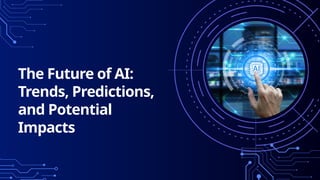
The Future of AI:
Trends, Predictions,
and Potential
Impacts
The Rise of Artificial General Intelligence (AGI)
AGI, often referred to as "strong AI," refers to the hypothetical development of
AI systems with human-level intelligence and capabilities. The pursuit of AGI is a
major focus for AI research, with potential implications for various fields.
AGI systems would possess cognitive abilities similar to humans,
including problem- solving, reasoning, and learning.
Cognitive Abilities
AGI could potentially surpass human creativity and contribute to
groundbreaking advancements in science, art, and technology.
Creativity and Innovation
The development and deployment of AGI raise critical ethical concerns,
requiring careful consideration of its potential impact on society.
Ethical Considerations
Advancements in Machine Learning
and Deep Learning
Machine learning (ML) and deep learning (DL) are driving significant advancements in AI. These
techniques enable computers to learn from data and make predictions or decisions.
ML algorithms learn from data to identify
patterns and make predictions. Applications
include image recognition, natural language
processing, and fraud detection.
DL is a subfield of ML that uses artificial neural
networks with multiple layers to learn complex
patterns. It has revolutionized areas like
computer vision and speech recognition.
Machine Learning Deep Learning
The Impact of AI on the Job Market
and the Future of Work
The rapid adoption of AI is transforming the job market, with both opportunities and challenges. AI
is automating tasks, creating new jobs, and changing the nature of work.
AI is automating routine tasks in various
industries, leading to increased efficiency and
productivity.
Automation of Tasks
01
AI is also creating new job opportunities in
fields related to AI development, data science,
and AI ethics.
New Job Creation
02
Workers need to adapt to the changing job
market, requiring upskilling and reskilling to
remain competitive.
Upskilling and Reskilling
03
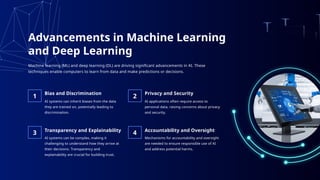
Advancements in Machine Learning
and Deep Learning
AI systems can inherit biases from the data
they are trained on, potentially leading to
discrimination.
Bias and Discrimination
AI applications often require access to
personal data, raising concerns about privacy
and security.
Privacy and Security
AI systems can be complex, making it
challenging to understand how they arrive at
their decisions. Transparency and
explainability are crucial for building trust.
Transparency and Explainability
1 2
3 4
Mechanisms for accountability and oversight
are needed to ensure responsible use of AI
and address potential harms.
Accountability and Oversight
Machine learning (ML) and deep learning (DL) are driving significant advancements in AI. These
techniques enable computers to learn from data and make predictions or decisions.
AI-powered automation can enhance productivity and
efficiency by automating tasks, leading to faster
urnaround times.
Increased Productivity
Automation may displace some jobs, particularly those
involving routine and repetitive tasks, requiring
workforce adaptation.
Job Displacement
AI automation can stimulate economic growth by
creating new industries, enhancing existing ones, and
increasing overall efficiency.
Economic Growth
AI-Powered Automation and its
Societal Implications
AI-powered automation is transforming various sectors, from manufacturing to healthcare.This
automation has significant societal implications, affecting employment, productivity, and economic
growth.
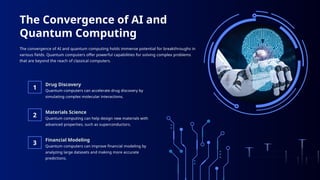
Drug Discovery
Materials Science
Financial Modeling
The Convergence of AI and
Quantum Computing
The convergence of AI and quantum computing holds immense potential for breakthroughs in
various fields. Quantum computers offer powerful capabilities for solving complex problems
that are beyond the reach of classical computers.
1
2
3 Quantum computers can improve financial modeling by
analyzing large datasets and making more accurate
predictions.
Quantum computers can accelerate drug discovery by
simulating complex molecular interactions.
Quantum computing can help design new materials with
advanced properties, such as superconductors.
AI's Role in Solving Global
Challenges
AI has the potential to play a significant role in addressing global challenges, such
as climate change, poverty, and disease.
Climate Change Global Health Sustainable Development
AI can contribute to sustainable
development by optimizing resource
management, promoting renewable
energy, and reducing waste.
AI can be used to optimize
energy consumption, develop
sustainable technologies, and
monitor environmental
changes.
AI can aid in disease diagnosis,
drug discovery, and
personalized medicine,
improving healthcare outcomes.
The Potential Risks and
Mitigation Strategies for AI
While AI offers enormous benefits, there are also potential risks that need to be addressed. It is
crucial to mitigate these risks through responsible development and regulation.
AI Safety and Security
Ensuring that AI systems are safe and secure is essential
to prevent unintended consequences and malicious use.
Job Displacement and Economic Disruption
The impact of AI on employment requires careful consideration
and strategies to mitigate potential job displacement.
The Future of Human-AI
Collaboration and Coexistence
The future of AI is likely to involve close collaboration between humans and AI. AI
will augment human capabilities, while humans will provide direction, ethical
guidance, and creativity.
AI will enhance human intelligence by providing insights,
automating tasks, and supporting decision-making.
Humans and AI will work together to solve complex problems,
with humans providing ethical guidance and AI offering
insights and data analysis.
Human-AI collaboration will drive innovation and creativity,
leading to new solutions and advancements across various
fields.
Augmented Intelligence
Shared Decision-Making
Co-Creation and Innovation
01
02
03
THANK YOU

The future of artificial intelligence ppt

  • 1.
    The Future ofAI: Trends, Predictions, and Potential Impacts
  • 2.
    The Rise ofArtificial General Intelligence (AGI) AGI, often referred to as "strong AI," refers to the hypothetical development of AI systems with human-level intelligence and capabilities. The pursuit of AGI is a major focus for AI research, with potential implications for various fields. AGI systems would possess cognitive abilities similar to humans, including problem- solving, reasoning, and learning. Cognitive Abilities AGI could potentially surpass human creativity and contribute to groundbreaking advancements in science, art, and technology. Creativity and Innovation The development and deployment of AGI raise critical ethical concerns, requiring careful consideration of its potential impact on society. Ethical Considerations
  • 3.
    Advancements in MachineLearning and Deep Learning Machine learning (ML) and deep learning (DL) are driving significant advancements in AI. These techniques enable computers to learn from data and make predictions or decisions. ML algorithms learn from data to identify patterns and make predictions. Applications include image recognition, natural language processing, and fraud detection. DL is a subfield of ML that uses artificial neural networks with multiple layers to learn complex patterns. It has revolutionized areas like computer vision and speech recognition. Machine Learning Deep Learning
  • 4.
    The Impact ofAI on the Job Market and the Future of Work The rapid adoption of AI is transforming the job market, with both opportunities and challenges. AI is automating tasks, creating new jobs, and changing the nature of work. AI is automating routine tasks in various industries, leading to increased efficiency and productivity. Automation of Tasks 01 AI is also creating new job opportunities in fields related to AI development, data science, and AI ethics. New Job Creation 02 Workers need to adapt to the changing job market, requiring upskilling and reskilling to remain competitive. Upskilling and Reskilling 03
  • 5.
    Advancements in MachineLearning and Deep Learning AI systems can inherit biases from the data they are trained on, potentially leading to discrimination. Bias and Discrimination AI applications often require access to personal data, raising concerns about privacy and security. Privacy and Security AI systems can be complex, making it challenging to understand how they arrive at their decisions. Transparency and explainability are crucial for building trust. Transparency and Explainability 1 2 3 4 Mechanisms for accountability and oversight are needed to ensure responsible use of AI and address potential harms. Accountability and Oversight Machine learning (ML) and deep learning (DL) are driving significant advancements in AI. These techniques enable computers to learn from data and make predictions or decisions.
  • 6.
    AI-powered automation canenhance productivity and efficiency by automating tasks, leading to faster urnaround times. Increased Productivity Automation may displace some jobs, particularly those involving routine and repetitive tasks, requiring workforce adaptation. Job Displacement AI automation can stimulate economic growth by creating new industries, enhancing existing ones, and increasing overall efficiency. Economic Growth AI-Powered Automation and its Societal Implications AI-powered automation is transforming various sectors, from manufacturing to healthcare.This automation has significant societal implications, affecting employment, productivity, and economic growth.
  • 7.
    Drug Discovery Materials Science FinancialModeling The Convergence of AI and Quantum Computing The convergence of AI and quantum computing holds immense potential for breakthroughs in various fields. Quantum computers offer powerful capabilities for solving complex problems that are beyond the reach of classical computers. 1 2 3 Quantum computers can improve financial modeling by analyzing large datasets and making more accurate predictions. Quantum computers can accelerate drug discovery by simulating complex molecular interactions. Quantum computing can help design new materials with advanced properties, such as superconductors.
  • 8.
    AI's Role inSolving Global Challenges AI has the potential to play a significant role in addressing global challenges, such as climate change, poverty, and disease. Climate Change Global Health Sustainable Development AI can contribute to sustainable development by optimizing resource management, promoting renewable energy, and reducing waste. AI can be used to optimize energy consumption, develop sustainable technologies, and monitor environmental changes. AI can aid in disease diagnosis, drug discovery, and personalized medicine, improving healthcare outcomes.
  • 9.
    The Potential Risksand Mitigation Strategies for AI While AI offers enormous benefits, there are also potential risks that need to be addressed. It is crucial to mitigate these risks through responsible development and regulation. AI Safety and Security Ensuring that AI systems are safe and secure is essential to prevent unintended consequences and malicious use. Job Displacement and Economic Disruption The impact of AI on employment requires careful consideration and strategies to mitigate potential job displacement.
  • 10.
    The Future ofHuman-AI Collaboration and Coexistence The future of AI is likely to involve close collaboration between humans and AI. AI will augment human capabilities, while humans will provide direction, ethical guidance, and creativity. AI will enhance human intelligence by providing insights, automating tasks, and supporting decision-making. Humans and AI will work together to solve complex problems, with humans providing ethical guidance and AI offering insights and data analysis. Human-AI collaboration will drive innovation and creativity, leading to new solutions and advancements across various fields. Augmented Intelligence Shared Decision-Making Co-Creation and Innovation 01 02 03
  • 11.