Doing More with Less.....
Using IVR to Enhance the Customer Experience


             Government Contact Centres
               Technology Focus Day
                           Sydney

                     2nd December 2009

                      Steve Mitchinson
                      Managing Partner
                     TeamRed Solutions
                 www.teamredsolutions.com.au
Introduction


     According to the Gartner report, Predicts 2009:
     CRM Customer Service and Support: “Even with budget
     constraints tightening, the demand for service is not
     decreasing. The power of customer demands is
     increasing, as multiple sellers compete for the same
     share of budget. Customer service requirements are
     heightened and enterprises must streamline the
     customer experience and curtail associated costs, while
     adding value and efficiency to the service of transaction.”


                                               So why do so many enterprises get
                                               their IVR and self service strategies
                                               so wrong?


                                  Putting you and your business in the fast lane
What is the Research really telling us

   74 percent of customers would prefer to talk to a business representative over
   the phone (versus other channels),

   What callers actually hate is badly set-up IVR menus.

   Why

   •The “solution” often creates a bigger problem than you started with

   •Complex menus that achieve nothing – for either party. Callers just hit random
   responses because they know in the end it does not make a difference

   •The whole point of IVR was to make it simple to collect some basic caller data
   and use that to route the call to the most suitable agent to deal with that
   customer and their issue.
                                                   IVR Horror Stories
                                                   •17 options, 12 skill sets – all arriving at one agent
                                                   group

                                                      •Staff transferring calls back to “correct option” and
                                                      then going into ACW so they don’t get the call back
                                                      as they in fact have the skill set

                                                      •25 calls arriving with a single agent on just one
                                                      day were due to failure within IVR or self service
                                                      application

                                    Putting you and your business in the fast lane
The Purpose of IVR and ASR systems

     1. Efficiency - Directing customers to
        the most effective answer in the
        quickest an most direct manner

     2. Cost Reduction - Deflecting routine
        calls from live agents to self service
        options

     3. Convenience - Providing the right
        channel for customers to resolve
        their inquiries in an automated, easy
        to use manner

     4. Revenue – Intuitive design increases the
        likelihood and propensity of customer
        repurchase


                             Putting you and your business in the fast lane
Building an IVR that Customers will use


   Know Your Customers
       •External perspective – not internal

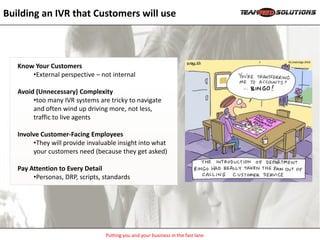
   Avoid (Unnecessary) Complexity
        •too many IVR systems are tricky to navigate
        and often wind up driving more, not less,
        traffic to live agents

   Involve Customer-Facing Employees
        •They will provide invaluable insight into what
        your customers need (because they get asked)

   Pay Attention to Every Detail
        •Personas, DRP, scripts, standards


                                 Putting you and your business in the fast lane
Where does self service fit


   Customers need two kinds of responsiveness:

       1. Informational responsiveness

       2. Emotional responsiveness

   Customers require both – but at the right times and
     for their right reasons – not yours!


                           Putting you and your business in the fast lane
The Business Case

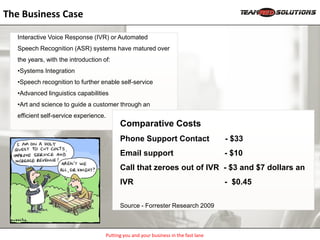
   Interactive Voice Response (IVR) or Automated
   Speech Recognition (ASR) systems have matured over
   the years, with the introduction of:
   •Systems Integration
   •Speech recognition to further enable self-service
   •Advanced linguistics capabilities
   •Art and science to guide a customer through an
   efficient self-service experience.
                                           Comparative Costs
                                           Phone Support Contact                      - $33
                                           Email support                              - $10
                                           Call that zeroes out of IVR - $3 and $7 dollars an
                                           IVR                                        - $0.45

                                           Source - Forrester Research 2009


                                     Putting you and your business in the fast lane
Doing more with less

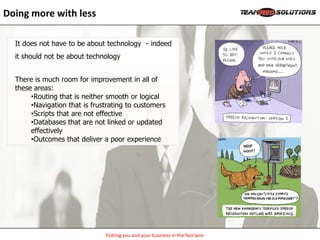
  It does not have to be about technology - indeed
  it should not be about technology


  There is much room for improvement in all of
  these areas:
       •Routing that is neither smooth or logical
       •Navigation that is frustrating to customers
       •Scripts that are not effective
       •Databases that are not linked or updated
       effectively
       •Outcomes that deliver a poor experience


                               Putting you and your business in the fast lane
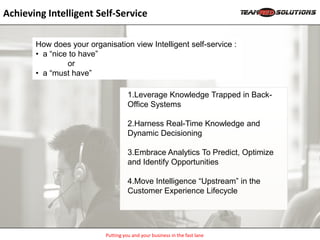
Achieving Intelligent Self-Service

       How does your organisation view Intelligent self-service :
       • a “nice to have”
                or
       • a “must have”

                                     1.Leverage Knowledge Trapped in Back-
                                     Office Systems

                                     2.Harness Real-Time Knowledge and
                                     Dynamic Decisioning

                                     3.Embrace Analytics To Predict, Optimize
                                     and Identify Opportunities

                                     4.Move Intelligence “Upstream” in the
                                     Customer Experience Lifecycle


                           Putting you and your business in the fast lane
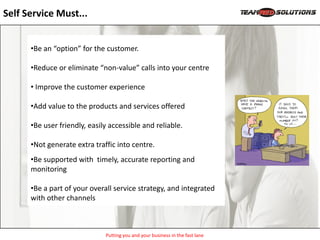
Self Service Must...


      •Be an “option” for the customer.

      •Reduce or eliminate “non-value” calls into your centre

      • Improve the customer experience

      •Add value to the products and services offered

      •Be user friendly, easily accessible and reliable.

      •Not generate extra traffic into centre.
      •Be supported with timely, accurate reporting and
      monitoring

      •Be a part of your overall service strategy, and integrated
      with other channels


                              Putting you and your business in the fast lane
Five Common Self Service Myths


1. Self – service is a fool proof way to reduce costs

BEST PRACTISE : Implement self service right or don’t implement at all
2. Self-Service means eliminating customer interactions
BEST PRACTISE : Should be part of a multichannel service strategy to create more valuable interactions
3. Self-Service is a quick fix
BEST PRACTISE : should be an “outside in” strategy across the business, not siloed in a department

4. One self-service method fits all customers (and their needs)
BEST PRACTISE : Monitor and analyse for customer behaviour: to sell, not just problem solve

5. Deploying self service and contact centre volume will go down
BEST PRACTISE : Some customers prefer self service: Find out who and why – self service volumes
   will increase – customer satisfaction will improve, and call volumes will drop


                                                                  Source: Neil Harrison, Project Manager, IInet


                                  Putting you and your business in the fast lane
The 5 Steps to a Successful Business Case


        Step 1 – Understand and state the problem or issue you
        plan to address

        Step 2 – Identify the costs and potential benefits

        Step 3 - Define Success - How will you measure the
        results?

        Step 4 - Have all options been explored?

        Step 5 – Answer this question - What is the likelihood
        that gains will actually be less than predicted?


                            Putting you and your business in the fast lane
Aligning the People and Technology


       Know your client base
           •how will it affect take up
       Know your contact reasons
           •What should you or could you automate
       Create meaningful jobs
           •What will be impacts on contact centre resourcing
       Reward uptake
           •How do you encourage and reward customers for
           take up
       Reward promotion
           •How do you get employee buy in


                           Putting you and your business in the fast lane
The Costs of Getting it wrong


   The truth is, very few companies actually know if they have it right

   Start with this list and add your own specific issues:

   1. Failed transactions = lost revenue or slower cash flow

   2. Abandonment rates - why and where = higher costs & lost
      customers

   3. User errors = frustrated, angry customers diverted to live
      agents – or your competitors

   4. Increased call durations required to complete those
      transactions

   5. Declining channel traffic volumes = Increased live call volumes
      = Increased costs


                            Putting you and your business in the fast lane
Doing More with Less.....
Using IVR to Enhance the Customer Experience


             Government Contact Centres
               Technology Focus Day
                                 Sydney

                          2nd December 2009

                        Steve Mitchinson
                        Managing Partner
                       TeamRed Solutions
                   www.teamredsolutions.com.au


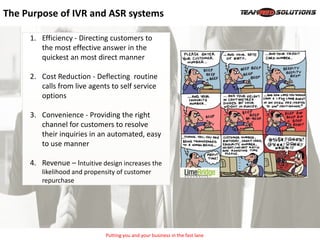
              Cartoons courtesy Limebridge Australia

The future in_ivr_iqpc_dec_09

  • 1.
    Doing More withLess..... Using IVR to Enhance the Customer Experience Government Contact Centres Technology Focus Day Sydney 2nd December 2009 Steve Mitchinson Managing Partner TeamRed Solutions www.teamredsolutions.com.au
  • 2.
    Introduction According to the Gartner report, Predicts 2009: CRM Customer Service and Support: “Even with budget constraints tightening, the demand for service is not decreasing. The power of customer demands is increasing, as multiple sellers compete for the same share of budget. Customer service requirements are heightened and enterprises must streamline the customer experience and curtail associated costs, while adding value and efficiency to the service of transaction.” So why do so many enterprises get their IVR and self service strategies so wrong? Putting you and your business in the fast lane
  • 3.
    What is theResearch really telling us 74 percent of customers would prefer to talk to a business representative over the phone (versus other channels), What callers actually hate is badly set-up IVR menus. Why •The “solution” often creates a bigger problem than you started with •Complex menus that achieve nothing – for either party. Callers just hit random responses because they know in the end it does not make a difference •The whole point of IVR was to make it simple to collect some basic caller data and use that to route the call to the most suitable agent to deal with that customer and their issue. IVR Horror Stories •17 options, 12 skill sets – all arriving at one agent group •Staff transferring calls back to “correct option” and then going into ACW so they don’t get the call back as they in fact have the skill set •25 calls arriving with a single agent on just one day were due to failure within IVR or self service application Putting you and your business in the fast lane
  • 4.
    The Purpose ofIVR and ASR systems 1. Efficiency - Directing customers to the most effective answer in the quickest an most direct manner 2. Cost Reduction - Deflecting routine calls from live agents to self service options 3. Convenience - Providing the right channel for customers to resolve their inquiries in an automated, easy to use manner 4. Revenue – Intuitive design increases the likelihood and propensity of customer repurchase Putting you and your business in the fast lane
  • 5.
    Building an IVRthat Customers will use Know Your Customers •External perspective – not internal Avoid (Unnecessary) Complexity •too many IVR systems are tricky to navigate and often wind up driving more, not less, traffic to live agents Involve Customer-Facing Employees •They will provide invaluable insight into what your customers need (because they get asked) Pay Attention to Every Detail •Personas, DRP, scripts, standards Putting you and your business in the fast lane
  • 6.
    Where does selfservice fit Customers need two kinds of responsiveness: 1. Informational responsiveness 2. Emotional responsiveness Customers require both – but at the right times and for their right reasons – not yours! Putting you and your business in the fast lane
  • 7.
    The Business Case Interactive Voice Response (IVR) or Automated Speech Recognition (ASR) systems have matured over the years, with the introduction of: •Systems Integration •Speech recognition to further enable self-service •Advanced linguistics capabilities •Art and science to guide a customer through an efficient self-service experience. Comparative Costs Phone Support Contact - $33 Email support - $10 Call that zeroes out of IVR - $3 and $7 dollars an IVR - $0.45 Source - Forrester Research 2009 Putting you and your business in the fast lane
  • 8.
    Doing more withless It does not have to be about technology - indeed it should not be about technology There is much room for improvement in all of these areas: •Routing that is neither smooth or logical •Navigation that is frustrating to customers •Scripts that are not effective •Databases that are not linked or updated effectively •Outcomes that deliver a poor experience Putting you and your business in the fast lane
  • 9.
    Achieving Intelligent Self-Service How does your organisation view Intelligent self-service : • a “nice to have” or • a “must have” 1.Leverage Knowledge Trapped in Back- Office Systems 2.Harness Real-Time Knowledge and Dynamic Decisioning 3.Embrace Analytics To Predict, Optimize and Identify Opportunities 4.Move Intelligence “Upstream” in the Customer Experience Lifecycle Putting you and your business in the fast lane
  • 10.
    Self Service Must... •Be an “option” for the customer. •Reduce or eliminate “non-value” calls into your centre • Improve the customer experience •Add value to the products and services offered •Be user friendly, easily accessible and reliable. •Not generate extra traffic into centre. •Be supported with timely, accurate reporting and monitoring •Be a part of your overall service strategy, and integrated with other channels Putting you and your business in the fast lane
  • 11.
    Five Common SelfService Myths 1. Self – service is a fool proof way to reduce costs BEST PRACTISE : Implement self service right or don’t implement at all 2. Self-Service means eliminating customer interactions BEST PRACTISE : Should be part of a multichannel service strategy to create more valuable interactions 3. Self-Service is a quick fix BEST PRACTISE : should be an “outside in” strategy across the business, not siloed in a department 4. One self-service method fits all customers (and their needs) BEST PRACTISE : Monitor and analyse for customer behaviour: to sell, not just problem solve 5. Deploying self service and contact centre volume will go down BEST PRACTISE : Some customers prefer self service: Find out who and why – self service volumes will increase – customer satisfaction will improve, and call volumes will drop Source: Neil Harrison, Project Manager, IInet Putting you and your business in the fast lane
  • 12.
    The 5 Stepsto a Successful Business Case Step 1 – Understand and state the problem or issue you plan to address Step 2 – Identify the costs and potential benefits Step 3 - Define Success - How will you measure the results? Step 4 - Have all options been explored? Step 5 – Answer this question - What is the likelihood that gains will actually be less than predicted? Putting you and your business in the fast lane
  • 13.
    Aligning the Peopleand Technology Know your client base •how will it affect take up Know your contact reasons •What should you or could you automate Create meaningful jobs •What will be impacts on contact centre resourcing Reward uptake •How do you encourage and reward customers for take up Reward promotion •How do you get employee buy in Putting you and your business in the fast lane
  • 14.
    The Costs ofGetting it wrong The truth is, very few companies actually know if they have it right Start with this list and add your own specific issues: 1. Failed transactions = lost revenue or slower cash flow 2. Abandonment rates - why and where = higher costs & lost customers 3. User errors = frustrated, angry customers diverted to live agents – or your competitors 4. Increased call durations required to complete those transactions 5. Declining channel traffic volumes = Increased live call volumes = Increased costs Putting you and your business in the fast lane
  • 15.
    Doing More withLess..... Using IVR to Enhance the Customer Experience Government Contact Centres Technology Focus Day Sydney 2nd December 2009 Steve Mitchinson Managing Partner TeamRed Solutions www.teamredsolutions.com.au Cartoons courtesy Limebridge Australia