Origins
of the
Food Service
Industry
TWO CATEGORIES OF FOOD SERVICE
INDUSTRY
a. COMMERCIAL ESTABLISHMENTS
b. INSTITUTIONAL CATERING
a. COMMERCIAL ESTABLISHMENTS
Committed to earn profit through
the sale of food and beverages.
b. INSTITUTIONAL CATERING
 Provides volume food and beverage
service to institutions such as factories,
business houses, schools, military,
prisons, railways, airlines, etc.
CLASSIFICATION
OF
F&B FACILITIES
There are many ways to classify food and
beverage facilities:
1. Commercial enterprises like restaurants
and cafes that are committed to making
profit.
2. Institutional catering that are operations
that serve food in large quantities to
institutions like schools, hospitals, pension
homes, etc.
There are many ways to classify food and
beverage facilities:
3. They may be commercial or institutional
operations that do not make distinctions as
to whom they serve.
4. Those that serve restricted groups of
people like passengers on a flight or
member of a club.
There are many ways to classify food and
beverage facilities:
5. Government bodies who may want to
subsidise food programs as a perquisite to
their employees.
6. Private ownership that provides food
strictly for commercial purposes.
COMMERCIAL
RESTAURANTS
A huge part of the food service business
and create extensive employment.
May be independent or part of hotel
operations.
Latin word resturare meaning “to
restore”.
RESTAURANTS
Is a commercial establishment
committed to the sale of food and
beverage.
The first big chain restaurant operator in
the US was Fred Harvey.
RESTAURANTS
COFFEESHOP was an early type of
restaurant, which appeared in England
in the mid-1600s.
JOHN R. THOMPSON was another early
chain operator.
Restaurants can be further
categorized by ownership:
1. A restaurant may be a licensed part of a hotel
operation, whereby the sales of the restaurant
contributes to the sales performance of the hotel.
2. An independent business entity under individual
ownership and management.
Restaurants can be further
categorized by ownership:
3. A chain restaurant that is part of a multi-unit
organization, offering standardized menus, décor, type
of service and marketing strategy.
Restaurants may provide the
following facilities:
 Bar
 Entertainment
 Children party facilities
 Home delivery services
 Take away services
 Outdoor catering
COFFEE SHOP
Distinguished by its quick service.
Food is pre-plated from the kitchen.
Menus are quite light and simple.
Informal which means that guests
can come in casual wear.
SPECIALTY RESTAURANT
The entire atmosphere and décor is geared to a
particular theme normally related to a regional
cuisine.
Giving the public ethnic foods within a region.
Concentrate on a particular food item.
Can range from very up-market and exclusive
places to very casual ones.
GRILL ROOM or ROTISSERIE
A restaurant that specializes itself in grills of
different meats, fish and poultry.
Is a glass partition that separates the kitchen
from the seating area so that guests can see the
grill preparation of their choice.
DINING ROOMS
Are found in smaller hotels, motels, resorts, inns,
clubs or heritage hotels.
Specialize in a good buffet spreads or a choice
of two table d’ hote menus.
DISCOTHEQUE
It is a restaurant which is principally meant for
dancing to recorded music.
NIGHT CLUBS
It is principally open at night for dinner, dance,
and live entertainment.
FOOD BARS
This is a collective name to cover informal
snack bars, milk bars, kiosks, frozen yoghurt
stands, theatre counters, etc..
FAST FOOD RESTAURANTS
Had a great impact on the food service
industry.
Standardized ready-to-eat food and
service.
CASUAL DINING
This is a relatively new classification of
restaurant where delectable pre-plated meals
are served in an informal atmosphere, yet
formal in presentation.
FOOD COURTS
This is a variant to fast food operations brought
about by the emergence of mega malls.
Is a dedicated place for eating where several
fast food franchises can hire food booths and
set up their operations.
CAFES
Are casual restaurants found in commercial
and entertainment districts. Café means
“coffee” in French.
They are meant to serve only coffee or tea.
CAFETERIAS
Are found in institutional catering, industrial
canteens, army messes, residential colleges etc.
adopt this type of service for expediency and
least fuss..
BARS
Where liquor is sold and consumed. They are
called inns in Europe; pubs and taverns in the
UK.
INSTITUTIONAL
INSTITUTIONAL CATERING
Standardized ready-to-eat food and
service.
A huge business that is marked with
volume.
INDUSTRIAL CATERING
Refers to food programs in factories and
corporate houses.
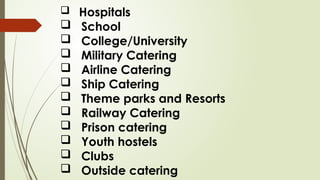
 Hospitals
 School
 College/University
 Military Catering
 Airline Catering
 Ship Catering
 Theme parks and Resorts
 Railway Catering
 Prison catering
 Youth hostels
 Clubs
 Outside catering
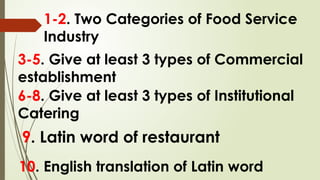
1-2. Two Categories of Food Service
Industry
3-5. Give at least 3 types of Commercial
establishment
6-8. Give at least 3 types of Institutional
Catering
9. Latin word of restaurant
10. English translation of Latin word
catering masteral report powerpoint presentation

catering masteral report powerpoint presentation

  • 1.
  • 2.
    TWO CATEGORIES OFFOOD SERVICE INDUSTRY a. COMMERCIAL ESTABLISHMENTS b. INSTITUTIONAL CATERING
  • 3.
    a. COMMERCIAL ESTABLISHMENTS Committedto earn profit through the sale of food and beverages.
  • 4.
    b. INSTITUTIONAL CATERING Provides volume food and beverage service to institutions such as factories, business houses, schools, military, prisons, railways, airlines, etc.
  • 5.
  • 6.
    There are manyways to classify food and beverage facilities: 1. Commercial enterprises like restaurants and cafes that are committed to making profit. 2. Institutional catering that are operations that serve food in large quantities to institutions like schools, hospitals, pension homes, etc.
  • 7.
    There are manyways to classify food and beverage facilities: 3. They may be commercial or institutional operations that do not make distinctions as to whom they serve. 4. Those that serve restricted groups of people like passengers on a flight or member of a club.
  • 8.
    There are manyways to classify food and beverage facilities: 5. Government bodies who may want to subsidise food programs as a perquisite to their employees. 6. Private ownership that provides food strictly for commercial purposes.
  • 9.
  • 10.
    RESTAURANTS A huge partof the food service business and create extensive employment. May be independent or part of hotel operations. Latin word resturare meaning “to restore”.
  • 11.
    RESTAURANTS Is a commercialestablishment committed to the sale of food and beverage. The first big chain restaurant operator in the US was Fred Harvey.
  • 12.
    RESTAURANTS COFFEESHOP was anearly type of restaurant, which appeared in England in the mid-1600s. JOHN R. THOMPSON was another early chain operator.
  • 13.
    Restaurants can befurther categorized by ownership: 1. A restaurant may be a licensed part of a hotel operation, whereby the sales of the restaurant contributes to the sales performance of the hotel. 2. An independent business entity under individual ownership and management.
  • 14.
    Restaurants can befurther categorized by ownership: 3. A chain restaurant that is part of a multi-unit organization, offering standardized menus, décor, type of service and marketing strategy.
  • 15.
    Restaurants may providethe following facilities:  Bar  Entertainment  Children party facilities  Home delivery services  Take away services  Outdoor catering
  • 16.
    COFFEE SHOP Distinguished byits quick service. Food is pre-plated from the kitchen. Menus are quite light and simple. Informal which means that guests can come in casual wear.
  • 17.
    SPECIALTY RESTAURANT The entireatmosphere and décor is geared to a particular theme normally related to a regional cuisine. Giving the public ethnic foods within a region. Concentrate on a particular food item. Can range from very up-market and exclusive places to very casual ones.
  • 18.
    GRILL ROOM orROTISSERIE A restaurant that specializes itself in grills of different meats, fish and poultry. Is a glass partition that separates the kitchen from the seating area so that guests can see the grill preparation of their choice.
  • 19.
    DINING ROOMS Are foundin smaller hotels, motels, resorts, inns, clubs or heritage hotels. Specialize in a good buffet spreads or a choice of two table d’ hote menus.
  • 20.
    DISCOTHEQUE It is arestaurant which is principally meant for dancing to recorded music.
  • 21.
    NIGHT CLUBS It isprincipally open at night for dinner, dance, and live entertainment.
  • 22.
    FOOD BARS This isa collective name to cover informal snack bars, milk bars, kiosks, frozen yoghurt stands, theatre counters, etc..
  • 23.
    FAST FOOD RESTAURANTS Hada great impact on the food service industry. Standardized ready-to-eat food and service.
  • 24.
    CASUAL DINING This isa relatively new classification of restaurant where delectable pre-plated meals are served in an informal atmosphere, yet formal in presentation.
  • 25.
    FOOD COURTS This isa variant to fast food operations brought about by the emergence of mega malls. Is a dedicated place for eating where several fast food franchises can hire food booths and set up their operations.
  • 26.
    CAFES Are casual restaurantsfound in commercial and entertainment districts. Café means “coffee” in French. They are meant to serve only coffee or tea.
  • 27.
    CAFETERIAS Are found ininstitutional catering, industrial canteens, army messes, residential colleges etc. adopt this type of service for expediency and least fuss..
  • 28.
    BARS Where liquor issold and consumed. They are called inns in Europe; pubs and taverns in the UK.
  • 29.
  • 30.
    INSTITUTIONAL CATERING Standardized ready-to-eatfood and service. A huge business that is marked with volume.
  • 31.
    INDUSTRIAL CATERING Refers tofood programs in factories and corporate houses.
  • 32.
     Hospitals  School College/University  Military Catering  Airline Catering  Ship Catering  Theme parks and Resorts  Railway Catering  Prison catering  Youth hostels  Clubs  Outside catering
  • 33.
    1-2. Two Categoriesof Food Service Industry 3-5. Give at least 3 types of Commercial establishment 6-8. Give at least 3 types of Institutional Catering 9. Latin word of restaurant 10. English translation of Latin word