1	
The Experience of Creative Interchange i
1. Introduction
The first time I heard about the living process I was born with was mid October 1992 in Atlanta
(US). Not that it is of any direct importance, it happened during the week of the first baseball
World Series in which games were played outside the United States. This particular World Series
pitted the American League (AL) champion Toronto Blue Jays against the National
League (NL) champion Atlanta Braves. During that exceptional week I learned more about the
Creative Interchange process than about the baseball game and I still remember those experiences
as if they happened yesterday; both were great fun and a proof that Creative Interchange is a living
process!
I happened to be in Atlanta for an ODR’s certification MOC®
course level II. ODR’s CEO Daryl
Conner, what I’d expected, did not run this course. Sharp on time another fellow stumbled into the
Olton room of Atlanta’s Swissotel: he presented, and at the same time excused himself for, his
bruised appearance (he fell the day before while running down his favorite hill ‘Stone Mountain’).
I’ll never forget his opening phrase: “Our learning systems focus on what we got wrong, better
approach is to look what was done right and to build on it the next day.” Officially it was a five
day MOC®
course. In what Charlie Palmgren taught us had extremely more deepness than what
I’ve experienced during the three day Level III course run by Daryl Conner earlier that year. It took
me some time to appreciatively understand that Charlie smuggled into the ODR course a basic
introduction of Creative Interchange. And there was more, during the presentation of the ODR part
around FOR (Frame of Reference), Charlie presented his own vision on the Vicious Circle, the
process that hinders Creative Interchange.
At that course there were five participants: two ODR junior consultants and three ‘foreigners’.
Those three stuck together for evening meals, to talk about what we’ve learned (for instance
regarding Charlie’s one liners as “Culture teach us hypocrisy”) and to watch in the restaurant
baseball games of the Atlanta Braves vs Toronto Blue Jays. One our company of three was a
Canadian lady from Toronto and the other two European gents (A Dutch KPMG fellow and
myself). Needless to say that we acted during those evenings as Blue Jay fans in the hometown of
the Braves. Although I learned a lot during that unforgettable week about Baseball game rules, it
was Creative Interchange that impressed me most.
A year later I found out that Charlie had been the ghostwriter of a chapter of Daryl Conner’s
bestseller ‘Managing at the speed of Change’ ii
: Chapter 12: The Synergistic Process. Charlie called
the Creative Interchange process in those years the Synergistic Process, although, off the record, as
in the course in Swisotell, he called it by its genuine name: Creative Interchange.
I became a follower of Charlie Palmgren in 1994, learned more about Creative Interchange and
slowly started to live it, from January 1995 on.
2	
2. Creative Interchange defined
For Henry Nelson Wieman (Charlie’s Palmgren’s mentor), Creative Interchange is an experience,
the kind of experience that transforms us in ways in which we cannot transform ourselves.
According to him, Creative Interchange is the experience of spontaneous human-heartedness and
human-thoughtfulness that opens us to an increasingly widened and deepened appreciation and
understanding of ourselves as individual persons and of all other persons we encounter.
Ordinarily, the experience of most of us is dominated by the concerns of survival and security.
This survival-security orientation easily minimizes Creative Interchange between people since it is
an orientation fed by the Vicious Circle iii
. In fact, the harder we try to live within our Vicious
Circle, the more intolerable life becomes. Charlie Palmgren has described the obstacles to Creative
Interchange brilliantly in ‘The Chicken Conspiracy’. His mentor, Henry Nelson Wieman
emphasizes, in his book, Man’s Ultimate Commitment, the obstacles as:
“These barriers to creative interchange are not only internal to
the individual. They are also social. Barriers are built into all our
social institutions.”
The reality is that the experience of Creative Interchange is a somehow difficult to attain
experience of individuals and societies. Wieman is calling for the experience of Creative
Interchange as something more than an occasional interlude in our lives; he is calling for the
experience of creative interchange as the nurturing matrix out of which we continuously build,
correct, and rebuild our individual lives, our societies, and the one world to which we are
inescapably connected:
“Creative Interchange is that kind of interchange which creates
in those who engage in it an appreciative understanding of the
original experience of one another. … Creative Interchange has
two aspects, which are two sides of the same thing. One aspect
is the understanding in some measure of the original experience
of the other person. The other aspect is the integration of what
one gets from others in such a way as to create progressively the
original experience, which is oneself.”
3. The Nurturing Matrix of Creative Interchange
Creative Interchange is that kind of experience that confirms and assures us of our sense
of individuality, both apart from and in connection with other human beings. Human
nature needs Creative Interchange more than anything else, if it is to be satisfied in the
deepest and most far reaching ways.
Creative Interchange is not limited to the acquisition of information alone.
3	
“Creative communication in its most complete form can be
described thus:
You express your whole self and your entire mind freely and
fully and deeply an truly to the other persons who understand
you most completely and appreciatively with joy in what you are
as so expressed, and you yourself respond to others who express
themselves freely and fully and deeply and truly while you
understand them most completely and appreciatively with joy in
the spirits they are.”
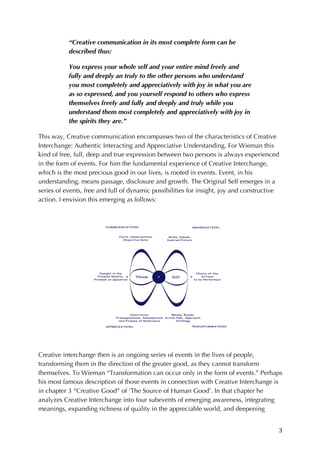
This way, Creative communication encompasses two of the characteristics of Creative
Interchange: Authentic Interacting and Appreciative Understanding. For Wieman this
kind of free, full, deep and true expression between two persons is always experienced
in the form of events. For him the fundamental experience of Creative Interchange,
which is the most precious good in our lives, is rooted in events. Event, in his
understanding, means passage, disclosure and growth. The Original Self emerges in a
series of events, free and full of dynamic possibilities for insight, joy and constructive
action. I envision this emerging as follows:
Creative interchange then is an ongoing series of events in the lives of people,
transforming them in the direction of the greater good, as they cannot transform
themselves. To Wieman “Transformation can occur only in the form of events.” Perhaps
his most famous description of those events in connection with Creative Interchange is
in chapter 3 “Creative Good” of ‘The Source of Human Good’. In that chapter he
analyzes Creative Interchange into four subevents of emerging awareness, integrating
meanings, expanding richness of quality in the appreciable world, and deepening
4	
community. His summary statement on these subevents is:
“The four subevents are: emerging awareness of qualitative
meaning derived from other persons through communication
[Authentic Interaction]; integrating these new meanings with
others previously acquired [Appreciative Understanding];
expanding the richness of quality in the appreciable world by
enlarging its meaning [Creative Integrating]; deepening the
community among those who participate in this total creative
event [Creative Interchange] of intercommunication [Crucial
Dialogue].”
It has to be underlined that those four subevents, or characteristics as Charlie Palmgren
calls them, or phases as I has called them in ‘Crucial dialogues’ (one of the applications
of Creative Interchange), are working together and not any one of them working apart
from the others constitute Creative interchange. Each may occur without the others, and
often does and that’s ok. In that case though it is not Creative Interchange. The four can
be distinguished and together they constitute Creative Interchange.
I described those subevents one by one in my books – ‘Creatieve wisselwerking’ as
characteristics & ‘Cruciale dialogen’ as phases – and many articles. Mostly even as a
‘logic chain of events’. I made nevertheless clear that distinctions made for the purpose
of analysis and understanding should not obscure the unitary and complexity of the
four-fold combination of Creative Interchange.
The experience of Creative Interchange is in itself an event with different dimensions.
At its best it is the always moving, free, unplanned emerging, understanding, feeling,
integrating, expanding and deepening qualities in our lives. It is our way of being in the
world (and not of the world) with openness to new insights, new experiences and
trusting new relationships. Through this living Creative Interchange from within we are
able to think, feel, and act based on our core values and core qualities; we are willing
and eager to be corrected, transformed and enriched by the novel possibilities inherent
in shared experience.
Through Creative Interchange we have relational power. By this I mean the ability to
affect others and to be affected by them. Relational power is opposed of unilateral
power as Creative Interchange is opposed to the Vicious Circle. Unilateral power grows
out of the dominant desire for survival, security and domination towards others and is
the fruit of the Vicious Circle. Relational power nurtures a particular kind of human
development and, if at work in Organizations, a particular kind of Organizational
development. The secret of relational power lies in its capacity to enable people to
meet one another with a basic openness of heart, mind and will, thereby rendering the
progressively yielding, whenever appropriate, their most treasured and cherished beliefs
5	
and even values. Creative Interchange is the expression of relational power and, as
such, is the experience of self-correction. From the perspective of Creative Interchange
as relational power, we are open and expect to be transformed in the direction of the
Greatest Good, i.e. our Original Self, as we meet others in moments of genuine
dialogue. From Wieman’s point of view, any amount of knowledge, beliefs and values
is fallible, and the insistence upon them as absolutely true and final is a direct blockage
of the exercise of relational power, and thereby weakens the possibilities of Creative
Interchange.
Creative Interchange is a self-corrective experience, and as such it is the unending
experience of emerging, understanding, feeling, integrating/expanding and deepening.
Therefor I use as ‘image’ of Creative Interchange the Lemniscate, which is the infinite
symbol. In Wieman’s words:
“Every value pursued in modern life can become demonic –
beauty, truth, morality alike – if and when it excludes the
demands of creative good in the name of the false finality of
what has been created.”
Charles Palmgren calls this the false finality of the created self. From Wieman and
Palmgren’s frame of reference, any and every finality is false, and it is finality in its
many forms that blocks and sometimes kills altogether this life enhancing self-corrective
experience of Creative Interchange. Wieman makes this point extremely clear when he
emphasizes that:
“At the ultimate level of commitment one commits [oneself] to
the actuality, holding [one’s] beliefs about it subject to
correction because [one] knows that [one’s] knowledge false
short of omniscience.” iv
Palmgren makes his observations most forcibly when he points out that:
“Most people are just scared to death to ask them [the crucial
questions regarding their created self]. For if we ask them, we
may discover that we were wrong. Being wrong means being
inadequate, and being inadequate means putting our worth on
the line. The vicious circle plays itself out so strongly in the lives
of many people that they won’t even let themselves think about
ideas, ask questions, or expose topics that are beyond their
current demands and expectations [i.e. their current mindset].” v
Those two quotes emphasize the duality between creative interchange and the vicious
circle.
6	
Our primary commitment must be to Creative Interchange, for Creative Interchange and
Creative Interchange alone can transform us in ways we cannot transform ourselves.
We must seek to imbed Creative Interchange into the center of all of our experiences,
as the guiding principle for all that we think, express, understand, feel, imagine, decide
and do in our lives. In order to do this we must abandon many of our habits, fruits of
our personal Vicious Circle, thus much of our mindsets. This seems and is a very simple
proposition, but like other simple propositions, we – curiously enough – have the
greatest difficulty to successfully adopt it.
4. Creative Interchange as Paradigm
An important element in Wieman’s view on Creative Interchange is the distinction
between “created good” and “Creative Good.” Created good is all that is the result of
past operation of Creative Good (i.e. Creative Interchange): objects, ideas, actions and
alike. Creative Good or Creative Interchange is that process by which we move beyond
currently existing created goods toward a deeper insight and moral commitment. I have
edited the following for gender-neutral language, of which I am sure Wieman would
approve.
“All the indications of maturity sum up to the first of
them: Putting one’s self and all that one can command under
the supreme control of what generates all value and not under
the supreme control of any good that has, to date, been created
in existence or envisioned in the mind. Mature people find their
ultimate security and stability not in any created good and not in
any vision of ideal possibilities but solely in that creativity which
transforms the mind of the individual, the world relative to their
mind, and all their community with other people…Thus, to
reject every basis for ultimate security and stability other than
the creative process itself is to meet the final test of maturity.” vi
Thus Wieman called for – half a century ago (!) – leaving the old Command & Control
paradigm, with its illusions ‘security’ and ‘stability’, and to choose for the new Creative
Interchange paradigm. Creative Interchange – that can be lived from within but not
controlled ‘from the outside in’ – is the creative process that will lead to a new Mindset,
where embracing ambiguity and trusting the process are the new security and stability.
For Wieman Creative Interchange encourages people to sacrifice existing created good
for the sake of newly emerging good. The Creative Interchange beliefs and practices
encourage openness to and trust in transformation and the letting go of the present
order of the self and society. In other words, people who live Creative Interchange from
7	
within are open to being changed by a power greater than themselves; a power that
transforms human life in ways that could not be planned or controlled. Creative
Interchange may lessen the hold of fear and desire, diminish the tendency to cling to
the present beliefs, suppositions and mental models and inculcate trust in the process of
growth and transformation. Creative Interchange is the answer to W. Edwards Deming
‘s command: Drive Out Fear (point #8 of Deming’s Way ‘Out of the Crisis’). vii
For Wieman, the greatest barrier to emergence of the new is the convulsive clinging to
present beliefs, values, and habits giving them the loyalty and commitment that should
be given to the Creative Good. Wieman’s central theme is self-commitment to growth
and transformation through Creative Interchange. The Creative Interchange process
transforms human life toward the Greatest Human Good. viii
Creative Interchange changes the mind in ways that the mind cannot do this by itself.
The challenge of life is not to realize goods that we can now imagine but to undergo a
change in consciousness in which there will arise possibilities of value that we cannot
imagine on basis of our present awareness. This transformation of the mindset cannot
be imagined before it arises and therefor cannot be planned or controlled, neither from
the outside nor from the inside. One must cultivate a willingness to set aside present
held values and open oneself to a creativity that leads the mind toward a wider
awareness and a new consciousness. The human task is not to contrive a better form of
living based on present understanding but rather to set the conditions under which
Creative Interchange may operate to expand our awareness. The good of human life
increases, as the mind becomes a more richly interconnected network of meanings.
Creative Interchange is a Paradigm since it needs a Shift of Mind in order to see the
World Anew. The essence of the discipline Creative Interchange lies in a mind shift:
• Embracing interdependence rather than dependence or independence;
• Living the process of transformation rather than the process that leads to
personal stress and organizational mediocrity.
5. The conditions for Creative Interchange to thrive
The concept of Creative Interchange makes it possible to study the conditions necessary
for the occurrence of creative transformation toward greater good. Wieman started this
study and found that the conditions for creative communication, the first characteristic
of Creative Interchange, include honesty and authenticity in expressing our particular
way of seeing reality. He also found that those involved in Creative Interchange must
not cling to or insist upon the keeping of their present patterns of interpretation. In other
words, they must not cling to their ‘truth’. Not only one must be open to express ‘his
8	
truth’, one must be open to this ‘truth’ being changed by new insights. Not only one has
to trust the other involved in Creative Interchange, one has the have trust in the process
of creative transformation.
Charlie Palmgren took the challenge of continuing the search for the conditions
necessary for Creative Interchange to thrive. His first contribution was to make the
barriers within ourselves regarding Creative Interchange visible by discovering the
counter productive process: the Vicious Circle. The Vicious Circle is Palmgren’s view of
how humans become disconnected from their innate Worth. He believes that human
worth is the capacity to participate in transforming creativity. Worth is innate! Worth is
the innate need for creative transformation. He drives home his point clearly:
“Our need for creative transformation is to our psychological
and spiritual survival what oxygen, water, food, exercise, and
sleep are to physical well-being.” ix
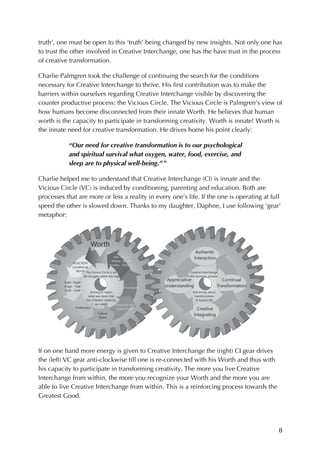
Charlie helped me to understand that Creative Interchange (CI) is innate and the
Vicious Circle (VC) is induced by conditioning, parenting and education. Both are
processes that are more or less a reality in every one’s life. If the one is operating at full
speed the other is slowed down. Thanks to my daughter, Daphne, I use following ‘gear’
metaphor:
If on one hand more energy is given to Creative Interchange the (right) CI gear drives
the (left) VC gear anti-clockwise till one is re-connected with his Worth and thus with
his capacity to participate in transforming creativity. The more you live Creative
Interchange from within, the more you recognize your Worth and the more you are
able to live Creative Interchange from within. This is a reinforcing process towards the
Greatest Good.
9	
If on the other had more energy is given to the Vicious Circle the VC gear drives the CI
gear anti-clockwise till one is not expressing himself authentically any more and loses
his capacity to participate in transforming creativity. This is in fact (another) reinforcing
process that Peter Senge in his bestseller ‘The Fifth Discipline’ not surprisingly calls the
‘Vicious Cycle’ x
towards the defending of the actual created good and thus resistance
to transforming creativity or Creative Good.
6. Creative Interchange is a kind of dialogue
This dialogue begins with the candid expression (communication) by the ‘sender’ of
one’s unique, personal perspective, which goes beyond the superficiality of much
conversation. This perspective needs to be expressed without the desire to impress or to
manipulate the other. Since those elicit a defensive or rejecting response.
The ‘receiver’ of the message must be free of self-preoccupation and not project
interpretations or feelings onto what is said. In addition, the receiver does not cling to
the present state of self (the ‘created self’) and is open to change, to transformation. He
understands the message appreciatively (appreciation).
The Authentic Interaction and Appreciative Understanding characteristics of the
Creative Interchange process create in this dialogue a new insight and a new common
meaning.
This new meaning or insight is then integrated into the mind, and this addition of a new
perspective or pattern of interpretation leads to a novel mind (imagination) and if
sustained through action (transformation) the process creates a new enlarged mindset
which increases what the sender and receiver can know, feel, imagine and control
(from the outside in).
In his poem ‘Revelation’ xi
[vi] Robert Frost talks about people that don’t live Creative
Interchange being stuck in their Vicious Circle:
We make ourselves a place apart!
Behind light words that tease and flout,!
But oh, the agitated heart!
Till someone find us really out.
‘Tis pity if the case require
(Or so we say) that in the end
We speak the literal to inspire
The understanding of a friend.
10	
But so with all, from babes that play
At hide-and-seek to God afar,
So all who hide too well away
Must speak and tell us where they are.
Let’s analyze this poem:
Frost paints the picture that people who don’t interact authentically who they really are
disguise their true image with lies or “light words that tease”. This far from authentic
interaction (communication) tends to deceive, or tease. He goes on to say that “But, oh,
the agitated hear, till someone really finds us out.” In this phrase he is basically saying,
people tend to believe your story, they appreciatively understand (appreciation) it, …
until they find out otherwise through other facts. If that’s the case, the liar mostly loses a
lot of respect.
In the second stanza, Frost says, “We speak the literal to inspire, the understanding of a
friend.” This further defines Frost’s point of lying to make someone think that you are
something you are not.
But after all of the deception and lying, in the end of the poem, Frost wants to the
reader to “see the light”. He says, “So all who hide to well away, must speak and tell us
where they are.”
Frost’s message is, don’t make it seem like you are something you’re not. Just be you.
The real you, the Original Self or Creative Self (the one who “hides too well away”)
must come out in Authentic Interaction. The created self must stop lying, and speak
form the Original or Creative Self. In Frost’s words: the “inner you” must speak and tell
us where he or she is.
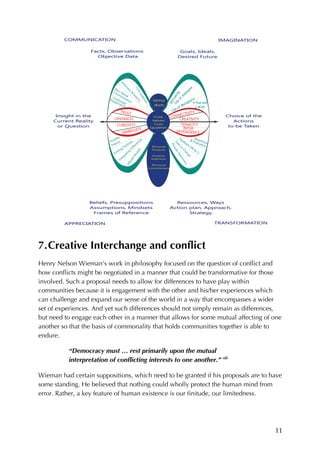
So genuine dialogue the Creative Interchange way starts with Authentic Interaction,
which I’ve called in my book ‘Cruciale dialogen’ xii
‘Communication’. The second
phase is Appreciation of what’s being said. In dialogue we form a ‘common meaning’
about the question, the topic at hand. And from this place the right part of the model
leads to action: Imagination, choice and Transformation:
11	
7.Creative Interchange and conflict
Henry Nelson Wieman’s work in philosophy focused on the question of conflict and
how conflicts might be negotiated in a manner that could be transformative for those
involved. Such a proposal needs to allow for differences to have play within
communities because it is engagement with the other and his/her experiences which
can challenge and expand our sense of the world in a way that encompasses a wider
set of experiences. And yet such differences should not simply remain as differences,
but need to engage each other in a manner that allows for some mutual affecting of one
another so that the basis of commonality that holds communities together is able to
endure.
“Democracy must … rest primarily upon the mutual
interpretation of conflicting interests to one another.” xiii
Wieman had certain suppositions, which need to be granted if his proposals are to have
some standing. He believed that nothing could wholly protect the human mind from
error. Rather, a key feature of human existence is our finitude, our limitedness.
12	
Therefore nothing coming from the minds of humans could be understood as infallible
and beyond revision.
The created good is finite, has value only in relation to a set situation and can be
subject to revision and even dismissal as the situation changes. The intractability of
human conflict many times is found in the failure to accept the created basis of any
human idea, institution, and belief. If beliefs can be made absolute and impossible to
modify in any manner, then there is little basis to engage those who disagree with
whatever is in question.
Failure to recognize the finite basis of our beliefs, practices, and institutions, produces
the result of treating them as if they were divine and therefore immune, to some degree,
from criticism and modifications. Such a move misdirects our energies and loyalties to
what merely is, or what is within the realm of our present appreciation, instead of
towards what could be. That is, if there is some belief in a [creative good] who remains
active in the creation of the new, we should focus on what is directs our attention away
from [that creative good], and away from the source of new possibilities outside of our
range of appreciation.
What is the range of our appreciation? For Wieman, this could be understood, in some
sense, to be our world. A world is constructed out of the range of experiences,
interactions, events, and meanings, which constitute our life. Recognizing the finitude
of the human condition, we can recognize that our world has limits. The range of
experiences and interactions we have engaged in imposes the limits. In this sense a
world is not fixed but ever changing, even growing, as more aspects of life, of
experience, gained from interactions with others, can be incorporated into a coherent
whole within a person.
Given that our worlds are as varied as the range of interactions and experiences
constituting the life of humans and given that we regularly fail to estimate properly our
values, beliefs, and what we hold dear but instead imagine that they have somehow
escaped the limits and finitude of the human condition, the basis of intractable conflicts
becomes clearer. We come to interact with others, with what we consider to be the
best good for the situation, but the range of our appreciation is what produces this
vision of the good.
The problem is that other people with a different range of experiences, events, and
relations have constructed a different vision of the good and so there is a clash. If
ultimacy is given to the good we hold there can only be two responses. One could seek
through battle to defeat the competing vision. Or one could organize life in such a
manner that the competing vision is ignored. The so-called ‘fight-freeze-flight’
syndrome.
13	
During a conflict both positions are ill equipped to ascertain goods, experiences, and
values from the other and therefore are unable to modify their positions in light of
missing interactions. Such interactions when they do occur Wieman calls Creative
Interchange. In his work Religious Inquiry, Wieman breaks down creativity into four
phases. First there is an awareness of a value, which is is transmitted to the other
through communication and is to be found by the other. Secondly, this value and then
is integrated into one’s previously held values. Third is the resultant expansion in the
individual or group of what is to be valued. This occurs because the integration of the
values of the other has now modified my own valuing in such a manner as to take into
account the newer values. Fourth, such transformed valuing leads to a widening
community whereby our values no longer clash but can support and mutually enhance
one another since they are now sensitive to the experiences and values of the other. xiv
This is the basic four-fold structure that Wieman developed in the 1930s and which
would come to serve as the basis for his work on the question of value, the resolution of
conflict. In The Source of Human Good, Wieman works out how meaning can be
understood given this structure. First there is an emerging awareness of meaning to be
derived from the other through communication. Second there is integration of the new
meaning with those previously acquired. Third there is an enlargement of the world one
experiences because of the newly formed mindset. Fourth, there is a widening of
community because of those now shared common meanings.
What is key, regardless of what is evaluated within this structure, is the way that the
interaction of the other and the receiving of experience, meaning, knowledge, and
value from the other is appreciatively understood and creatively integrated into one’s
self in a way that transforms my previous appreciable world. The role of integration is
central to the transformative power of creativity. Our success or failure at the process of
such integration determines whether the interaction in question can be labeled as
‘creative’.
Integration happens when one’s values, in interaction with other people’s values, are so
modified that they are able to sustain and enhance the values of both the self and the
other. A value for Wieman could be a liking or interest or a goal seeking activity.
“If I can come to recognize as worthy particular values through
conversation with those in opposition, then I can open myself up
to having my values modified through the conversation. My
modified values now seek to take into account the other
person’s values in my assessment. And the other’s valuations are
likewise modified in relation to the reception of my values. It is
in that context that our activities may be in a position to
enhance each other’s values and perhaps provide a basis for
14	
working ourselves through the conflict in a manner which does
not do violence against certain values.” xv
What is important is that this growth should not be understood as simply a
compromise, meeting each other half way. The result may look like this, but what
needs to transpire, which is not always the case with compromise, is a genuine valuing
of what the other values, seeing the world through the eyes of the other in a way that
transforms my own way of seeing the world. The goal is to integrate with one’s
previously held values ways of seeing the world, such that both sides can come up with
a solution inclusive of both values which are felt to be such by both parties.
Not each and every interaction can be marked as Creative Interchange. Some
ingredients need to come into play, in the interaction of two people or two groups, if
the interaction is to be labeled as Creative Interchange. Both sides must be committed
to having their own valuations transformed in the interaction. If one is committed to
retaining one’s own views without modification and one holds firm to such a goal, then
no transformation can take place. If one side is transformed and the other is not, the
ability for both to relate to each other in a constructive way breaks down. There is no
deepening of community, the fourth element in a creative interaction.
Another limitation is due to the kind of values that are in conflict. One might have the
value of racial purity. Such a value, because of its very make up precludes it from
linking up with other values across a broad range of different peoples in a way that
mutually enhances others and their values. In such a situation, the best way that the
activities of people can be constructive is when such a value is no longer under
consideration.
There are certain values that cannot connect up with and support other values. But one
should not seek ignorance of the values found in such groups. One should seek to
understand, even if it is to reject, such values in the ongoing activities one engages in.
To take note of a value, even negatively, is to have widened one’s appreciable world
because the world has to include the recognition of the existence and impact of such a
value.
In this understanding, the values of one group could link up with another group but
they may not be inclusive enough to link up with the wider world. Too much of the
world, too many events, experiences, factors, are not being included which would
allow these values to connect with a wider set of values. The question is whether
groups that have marked differences can be included, that is, can our valuings include
a much wider range of differences?
The goal, for Wieman, is the widest number of values and goods being held together in
such a fashion as to mutually enhance and sustain one another. As he writes:
15	
“Human existence is better to the degree that all goal-seeking
activities are brought into relations of mutual support across the
widest ranges of diversity to form an expanding system of
activities when this system is so symbolized so that the
individual participant can be conscious of the values of it.” xvi
When creativity dominates such interactions with the other, there ideally should be an
expansion of what is known, what can be controlled; a greater ability to distinguish
good and evil in a situation, and a larger awareness of one’s self and others. These four
elements working together provide the basis for living together but if some of the
elements are not there, then havoc can be the result.
This becomes a source of tension within Wieman’s vision. There need to be differences
sufficient to challenge our values, beliefs, experiences, so that we are moved to modify
them in our interactions with others. Thus our world can be enlarged. T he changes
required need to be in a position to be integrated with our previous experiences, taking
account of our past such that the sense of self does not dissolve but is enlarged. It calls
for openness to difference and a commitment to integrate this into a self, which can be
held together meaningfully.
If, on one hand, the differences are not sufficient, we find our beliefs and ways of
experiencing the world always re-enforced, a sort of herd mentality can grow even if
there is interaction with other groups, as long as these groups re-enforce our sense of
the world instead of challenge it. If, on the other hand, the differences are so stark that
they cannot be integrated with our previous self, they fail in influencing, challenging, or
expanding us. The goal is to have as much diversity as possible in a way that can be
connected with, and integrated with others in a given community.
This becomes the basis for the critique of both the local option and forced singular
positions, in that one allows for differences to develop in a manner which does not
affect or expand the other while the second option seeks to squash differences all
together.
8.The barriers to Creative Interchange
One breakdown has been discussed: the failure to integrate meanings from one
another. Given the explosion of information and tools for communication, such a thing
might strike one as ironic. Wieman would undoubtedly have been excited by the rise of
such technologies from cell phones to the Internet. But the rise of technologies cannot
guarantee communication. It is just as easy to fail to communicate now as prior to such
an age, if not easier.
16	
For one thing, we may be suffering from information overload, where information
simply passes over us with little or no effect. Therefore, the central issue is not simply
the amount of information one receives but whether one has been in a position to let
the process of integration do its work in a way that changes the person for the better. If
there is a lack of meaning and context associated with this information, then all that has
occurred is the transaction of a barrage of disconnected bits of information. Flashes of
information disconnected cannot bring greater meaning or value. Coherence and
connection of what is received and integration of this with a self is central for creativity
to work in our lives because this is the basis by which a self can be a self, a
requirement to being engaged with others.
Worship provides a context by which people can seek to undergo the process of
integration and can come to recognize the connection of events and their meaning to
our lives. This may be done with sermons, rituals and the like, establishing a link
between the world of today’s experiences and a rich past. They can direct our full
bodily self to openness towards creativity. But there is another form of worship, which
is best done alone, in a reflective mode. Leaving the clamor of life to reflect provides a
needed basis to integrate previous interactions. Jesus in the wilderness, in solitude, was
able to take his experiences to forge a new life purpose, which infused his life with
meaning and direction.
Another feature of integration is that a sense of self is required, with which these new
experiences, meanings, and values are integrated. One mistake some people make is to
believe that openness to others requires a shedding of those distinctive features of our
own selfhood. The sort of creative interactions that expand both sides require each to
bring selfhood and tradition to the table. Eliminating that which is distinctive about us
so as to get along may produce a getting along but it does so at the cost of the
expansion of both worlds.
The second important feature, which allows for creative interaction to do its work, is
a particular openness to the other. So we must become open to the “modification of our
minds, our sensitivities, and our judgments” through our interactions with others. That
is, we come to recognize that our beliefs, as good as they are, cannot account for the
whole of life and need to be expanded, refined through the interaction with others, so
that we gain new experiences, new ways of seeing the world, and thus provide the
basis for a wider world. A wider world with more material to draw from creates some
basis for better determining what the good is in a given situation. When we isolate our
interactions apart from such a world, what may seem like a good in a particular context
can provide the basis of greater evils for those outside our sphere of sympathy.
For this reason, the goal is always to increase the range and quality of interactions and
relations that one engages in. There is always a wider world than the current range of
interactions and experiences, informing us. The task is to expand this to take account of
17	
a greater and wider world. Through this expansion the likelihood that a local good
could be serving a greater evil lessens.
Therefore we need to direct our attention to possible values, experiences, which are not
in our realm of our appreciation yet. We need to “open avenues of communication
between one’s self and other individuals, other cultures, other races, and other classes.”
That is, differences must be sought out and included in how we engage the world.
Someone is invariably not at the table and some perspective or experience of the world
is not included in the discussion and therefore some element, which could rectify our
understanding of a situation, is not present. They may be voices we do not appreciate
or ones that seem to go against much of what we believe, but they have a range of
experiences and values, which we have not engaged and which could provide the basis
for expanding our sense of a world.
What are the barriers to engaging the other in a way, which could transform and widen
our world? It could be a particular self-image that one seeks to protect, an image which
could be torn down if evaluated within some forms of interaction wherein who we are
and what we value could be called into account. If one were a racist, the sort of
possible interactions with someone of another race could be so unsettling to one’s self-
image that such interactions are avoided at all costs.
If one’s identity is determined by our current sense of self, the desire to have that
challenged is greatly lessened. That is, the sense of our own identity has some of the
greatest and dearest meaning to us. It is what makes life coherent, something required
for human life and conduct. If our interactions with others call this into question, then
we may fear our own sense of self could be dissolved. Understandably this is a situation
that most humans seek to avoid. And there is a good reason for this. Selfhood is a
precarious achievement.
Wieman is not calling us to be dissolved but transformed and the line between one and
the other is not always clearly apparent, especially for someone who is examining this
prospect prior to transformation. Sometimes the refusal to undergo such a
transformation is rooted in the quality of the good itself that we seek to protect,
including our own sense of self. Goods can have a precarious existence and only
through hard work and dedication can they be brought about. It is natural that if such
goods become endangered, that our reaction is to seek to protect them. It is ironically
through this very protection that we can transform such a good, as a sense of self, into
an evil. This can occur when the dedication to the existent good blocks any attempts to
recognize or nurture other possible goods, goods that we may not yet recognize or
appreciate. Our actions, without reference to a wider world, a wider set of experiences
can do great harm without any awareness of this result.
18	
For even well meaning people operating out of the best sense of their world, their
experiences can inflict great evils because their world, their sense of the best, is too
provincial, too limited, and does not include enough people, enough experiences, and
enough factors. And they resist any correction because what they now think is good
might be endangered and how they now see themselves in relation to this good could
fall apart. Many foreign policy failures are the result of such a process.
This is why Wieman stresses the need to give oneself up for a radical commitment to
this creative process, which can expand our world, expand our range of appreciation
and sympathy. It means putting trust in a process that can create more than we can
currently imagine, appreciate, or value. That is, radical commitment calls us to place
priority with the possible over what is actual, the creator over the created, a wider
world over the world we currently inhabit and are comfortable in.
Conflict means differences and this becomes central in Wieman’s account because
without such differences clashing with one another, there would be no basis for
expanding our world or even having it challenged. A complacent herd mentality where
our beliefs and prejudices are re-enforced would grow. This could produce an
“absence of conflict”, which is not peace. Peace is what happens when the conflicts are
transformed in a form of creative interaction where our valuations and our sense of our
world have now been expanded to take account of our encounter with the other.
To the degree that such an encounter has taken place so that new values are created,
which are inclusive of the whole community, one finds a deepened sense of
community. Such a process could never have happened if conflict was avoided at all
costs. The two proposals before the mainline, agreeing to mutual isolation from one
another in the form of local option or separation, minimizes conflict through
minimizing interactions with the other. In this proposal, addressing conflict means
engagement with the other in a manner that allows for mutual influence so as to create
values inclusive of the conflicting parties.
The more common route is to avoid conflict or to minimize the influence of the other
who is conflict with us. Wieman calls this process supra human but this is not to
suggest that humans do not participate in the process of Creative Interchange. Rather it
means that human actions alone are not sufficient. This is because what we imagine as
the highest good for ourselves and our communities are subject to the range of
experiences and events that have marked our life. So our imaginings must be changed
and expanded through the incorporation of a wider world. This occurs when we are
able to integrate experiences we’ve never had, events that have not marked our life and
now do shape it as a result of receiving them from the other and incorporating them
into ourselves. A wider sense of the world that takes account of factors, events, and
relations we had not considered prior to the interaction.
19	
When these experiences and values from the other are incorporated into our previous
experiences a sort of reorganization of self transpires which takes account of the
previous interaction and our previous sense of self. Imagination alone cannot effect
such a change because as Wieman writes “profound insights emerge by way of
reorganization of the personality of such sort that the individual, prior to this
reorganization is unable to accept, appreciate, understand or receive in any way the
insight which finally comes”.
Recognizing that it is not us but this creative process, which can create the good
adequate for a common life together means that we have to look beyond ourselves and
our best sense of things to something that can transform our vision. Trust in ourselves
and failure to recognize, that which is beyond us, means placing trust in our present
sense of the good and this leads to the intractable conflicts.
The language surrounding the death of the old self and the creation of a new self takes
on a new kind of significance. For Wieman, such a person is able to have the old self
transformed in a way that takes on a wider world, a wider range of concerns,
experiences, and valuations.
Wieman warns: “creativity is not omnipotent. It often fails against the inertia in man
himself, in social institutions and in subhuman conditions.” That is, if we will not
engage others, the possible goods that can result become limited if not stymied.
Nothing makes a wider cooperative fellowship, fully engaged and appreciative of the
other necessary or even a likely event.
There are also barriers to communication and openness to the other, which need to be
searched out and removed to allow for more possibilities of creative interaction taking
hold. Some of these were discussed, but simply being aware of the problem is not
enough. The barriers are deeper seated than that which can simply be changed by
resolve. As Wieman notes, “they are in part psychological, internal to the individual
himself.” These conditions were focused on previously. “They are in part biological,
requiring development of the sensitivities and other capacities of the biological
organism of man.” Wieman recognizes the sort of limitations our own physicality can
place in creatively being engaged with another. It may be that we are not biologically
equipped to have the required sensitivity for humans to live together creatively. Are
there ways in which this can be modified? It shouldn’t be outside of the purview of
those interested in removing barriers to creative interaction.
Some of the barriers are physical, “requiring continuous reconstruction of the physical
environment so that men can live together with sensitivity and appreciative
understanding of one another.” The sense of neighborhood where people interact
versus the suburbs where privacy is upheld are two different environments, which lead
20	
to greater or lesser creative intercommunication. Greater levels of interaction may
require the construction of more public spaces from city parks to library cafes.
But there is another kind of public space that is needed. A space where people get to
exercise for themselves and others a good, which is recognized by all involved. That is,
there is the need for the creation of genuine communities. An example could be as
simple as the ‘Warmest Week’ endeavor of Studio Brussels (a Flemish Radio Broadcast)
the week before Christmas. All of a sudden unknown fellowmen are working together
and become friends and allies even as they have a whole range of differences in regards
to race, gender, and religion. They relate to each other to accomplish a common end.
Wieman’s vision of communities could play a similar role in our national life so that a
great diversity of people from a range of backgrounds, classes, and races can come
together because it is in that context that possibilities can open to allow for mutual
learning and therefore creative interactions.
Barriers to Creative Interchange in major ‘institutions’
Other barriers for Wieman are “institutional, requiring continuous modification of the
social order.” Whether it is our educational system or the way our economy is
organized, a number of features of such institutions impede giving ourselves to the
creative process in a spirit of openness and trust. Usually they center on preservation
and continuance of the institution at the expense of the required openness to change
and transformation, which could make unstable the status quo.
One example in government might be as simple as the current fear the whistleblowers
have in the institutions; following numerous financial scandals, such as Luxleaks or the
Panama Papers, the European Parliament has taken a proactive role in demanding
effective protection for whistleblowers at EU level. The text is innovative, but the work
of the Commission on this topic will be challenging. Until then this fear prevents a
number of possible creative interactions. It may be the obedience to a political party or
to those who hold office that prevents diverse responses to the situations governments
are called to deal with. In this loyalty is placed in the state and those in authority and
dissent can be seen as an attack instead of a possible place of transformation to a more
inclusive vision of the world and ourselves.
Another barrier to creative interaction can be found in education with the growth of
religious and politically defined schools where parents are able to send their children
so as to not have them confronted with ideas that are not their own, with differences
that may challenge them. The Internet can also act as a barrier to creative interaction to
the degree that it allows people to self-segregate. This can be done reading only those
news sites and discussion groups, which buttress their own beliefs and valuations
instead of challenging and expanding them. There are other kinds of media from
21	
television to print, which must pander, to both advertisers and to a public, which wants
to have its sense of the world reflected back to itself through the media instead of being
challenged and questioned.
Another barrier can be found in organizations where policies can be used to prevent
workers from fraternizing with each other in and out of the workplace. When there is a
lack of accountability in companies and the workplace this re-enforces the idea that
these are not participatory institutions, which require discussion, dialogue and debate.
Obedience not creative interaction becomes the prime value at work.
Rituals, like any form of practice, habituate their ends within us physically, emotionally,
and cognitively. Like football practice they act not as much to perform the act called for
but rather to ready us for when such an act is required. That is, rituals develop in us the
sort of habits of response to the world that can prepare us to meet the world with the
kind of openness required in forms of creative interactions. Rituals, when done poorly,
point to themselves for the sake of themselves or the institution which gave them birth.
Rituals need to direct our whole selves, including our feelings, habits, even bodily
reactions to Creative Interchange or otherwise they are misplaced.
Self reflection can be directed to the sort of world we live in, in what ways can it be
organized to move to this vision of increasing mutual appreciation and learning and in
what ways has it failed in this regard. We have to call us to reflect on the way that we
as individuals block the possibilities of creativity in our life with others. Such a self-
reflective mode is required if we to remove such barriers.
But such reflection requires the building of a community of people who are dedicated
to such a task. That is a group of people who can mutually criticize, build up, support
in this task of both societal and individual reflection. Both the individual reflection and
the communal response to this become central in such an account.
For instance, a church, which is able to direct us to this creative process, must be open
to learning from any and all disciplines and communities, including that of other
religions and other religious perspectives. There is recognition of our limited
understanding of where and what is God doing in the lives of others, which needs to
influence our sense of God and the world. There is also a recognition that other
disciplines can engage in areas of specialization, such as the sciences. While the
church recognizes the finitude of its own understanding, it strives to surrender its life to
this creative process in all things. The whole church becomes united for a common
end, something the mainline is missing. Wieman writes: “the weakness of liberal
religion is due to the inability of liberals to agree on what is supremely important and
the consequent inability to unite in a common commitment.” The same sentence can
be paraphrased in every institutional context.
22	
This brings us to Wieman’s two-fold commitment, which keeps the “old” from
obstructing the emergence of the “new” and keeps the “new” from abandoning and
discarding the value of the “old.” A commitment to act on the current best we know
and a commitment to remain open to what in truth can transform our current best to
what is better; thus to remain open to the Force, to Creative Interchange!
																																																								
i
Based on:
• Henry Nelson Wieman, The Wrestle of Religion with Truth. New York, NY: The MacMillan
Company, 1927.
• Henry Nelson Wieman, The Source of Human Good. Carbondale, IL: SIU Press, 1946.
• Henry Nelson Wieman, Man’s Ultimate Commitment. Lanham, MD: University Press of
America ®
, Inc. Reprint, Originally published: Carbondale, IL: Southern Illinois University Press,
1958.
• Henry Nelson Wieman, Intellectual Foundations of Faith. New York, NY: Philosophic Library,
1961.
• Henry Nelson Wieman, “Intelectual Autobiography,” in The Emperical Theology of Henry
Nelson Wieamn, edited by Robert W. Bretall, The Library of Living Theology. New York, NY:
Macmillan, 1963 & http://urantiabook.org/sources/wieman_autobiography.htm
• Henry Nelson Wieman, Religious Inquiry. Boston, MA: Beacon Press, 1968.
• Henry Nelson Wieman, ed. and intro. Cedric L. Hepler, Seeking A Faith for a New Age: Essays
on the Interdependence of Religion, Science and Philosophy. Metuchen, NJ: The ScareCrow
Press, Inc, 1975.
• Henry Nelson Wieman, Creative Freedom. New York, NY: Pilgrim Press, 1982.
• John Cobb, Can Christ Become Good News Again. St. Louis, MO: Chalice Press, 1991).
ii
Daryl R. Conner, Managing at the speed of Change. How resilient Managers Succed and Prosper Where
Others Fail. New York, NY: Villard Books, 1993, pp. 200-215.
iii
Stacie Hagan and Charlie Palmgren, The Chicken Conspiracy, Breaking The Cycle of Personal Stress
and Organizational Mediocrity. Baltimore, MA: Recovery Communications, Inc. 1998.	
iv	Henry Nelson Wieman, “Commitment for Theological Inquiry” in Seeking a Faith for a New Age:
Essays on the Interdependence of Religion, Science and Philosophy, ed. and intro. by Cedric L. Hepler.
Metuchen, NJ: The Scarecrow Press, Inc. 1975. p. 145.
v
Stacie Hagan and Charlie Palmgren, The Chicken Conspiracy, Breaking The Cycle of Personal Stress
and Organizational Mediocrity. Baltimore, MA: Recovery Communications, Inc. 1998. pp. 105-106.
vi
Henry Nelson Wieman, The Source of Human Good. Carbondale, IL: Southern Illinois University Press,
1964 (2nd
printing 1967), p. 101.
vii
W. Edwards Deming, Out of the Crisis. Cambridge, MA: MIT, Center of Advanced Engineering Study,
1983.
viii
Johan Roels, Creative Interchange and the Greatest Human Good,
https://www.slideshare.net/johanroels33/essay-creative-interchange-and-the-greatest-human-good	
ix
Stacie Hagan and Charlie Palmgren, The Chicken Conspiracy: Breaking The Cycle of Personal Stress
and Organizational Mediocrity. Baltimore, MA: Recovery Communications, Inc. 1998. p. 21.
x
Peter M. Senge, The Fifth Discipline: The Art & Practice of the Learning Organization. New York NY: A
Currency Book, Doubleday, a division of Bantam Doubleday Dell Publishing Group, Inc. 1990. p. 81.	
xi
Robert Frost, A boy’s will. New York, NY: Henry Holt and Company. 1915. Poem #21.
xii
Roels Johan, Cruciale dialogen. Het dagelijks beleven van ‘creatieve wisselwerking’. Antwerpen-
Apeldoorn: Garant. 2012.
xiii
Henry Nelson Wieman, Now We Must Choose, New York, NY: Macmillan Press, 194. 63.
xiv
Henry Nelson Wieman, Religious Inquiry, op. cit. 22.	
xv	Henry Nelson Wieman, Religious Inquiry, op. cit. 15.
xvi
Ibid

Essay: The experience of creative interchange

  • 1.
    1 The Experience ofCreative Interchange i 1. Introduction The first time I heard about the living process I was born with was mid October 1992 in Atlanta (US). Not that it is of any direct importance, it happened during the week of the first baseball World Series in which games were played outside the United States. This particular World Series pitted the American League (AL) champion Toronto Blue Jays against the National League (NL) champion Atlanta Braves. During that exceptional week I learned more about the Creative Interchange process than about the baseball game and I still remember those experiences as if they happened yesterday; both were great fun and a proof that Creative Interchange is a living process! I happened to be in Atlanta for an ODR’s certification MOC® course level II. ODR’s CEO Daryl Conner, what I’d expected, did not run this course. Sharp on time another fellow stumbled into the Olton room of Atlanta’s Swissotel: he presented, and at the same time excused himself for, his bruised appearance (he fell the day before while running down his favorite hill ‘Stone Mountain’). I’ll never forget his opening phrase: “Our learning systems focus on what we got wrong, better approach is to look what was done right and to build on it the next day.” Officially it was a five day MOC® course. In what Charlie Palmgren taught us had extremely more deepness than what I’ve experienced during the three day Level III course run by Daryl Conner earlier that year. It took me some time to appreciatively understand that Charlie smuggled into the ODR course a basic introduction of Creative Interchange. And there was more, during the presentation of the ODR part around FOR (Frame of Reference), Charlie presented his own vision on the Vicious Circle, the process that hinders Creative Interchange. At that course there were five participants: two ODR junior consultants and three ‘foreigners’. Those three stuck together for evening meals, to talk about what we’ve learned (for instance regarding Charlie’s one liners as “Culture teach us hypocrisy”) and to watch in the restaurant baseball games of the Atlanta Braves vs Toronto Blue Jays. One our company of three was a Canadian lady from Toronto and the other two European gents (A Dutch KPMG fellow and myself). Needless to say that we acted during those evenings as Blue Jay fans in the hometown of the Braves. Although I learned a lot during that unforgettable week about Baseball game rules, it was Creative Interchange that impressed me most. A year later I found out that Charlie had been the ghostwriter of a chapter of Daryl Conner’s bestseller ‘Managing at the speed of Change’ ii : Chapter 12: The Synergistic Process. Charlie called the Creative Interchange process in those years the Synergistic Process, although, off the record, as in the course in Swisotell, he called it by its genuine name: Creative Interchange. I became a follower of Charlie Palmgren in 1994, learned more about Creative Interchange and slowly started to live it, from January 1995 on.
  • 2.
    2 2. Creative Interchangedefined For Henry Nelson Wieman (Charlie’s Palmgren’s mentor), Creative Interchange is an experience, the kind of experience that transforms us in ways in which we cannot transform ourselves. According to him, Creative Interchange is the experience of spontaneous human-heartedness and human-thoughtfulness that opens us to an increasingly widened and deepened appreciation and understanding of ourselves as individual persons and of all other persons we encounter. Ordinarily, the experience of most of us is dominated by the concerns of survival and security. This survival-security orientation easily minimizes Creative Interchange between people since it is an orientation fed by the Vicious Circle iii . In fact, the harder we try to live within our Vicious Circle, the more intolerable life becomes. Charlie Palmgren has described the obstacles to Creative Interchange brilliantly in ‘The Chicken Conspiracy’. His mentor, Henry Nelson Wieman emphasizes, in his book, Man’s Ultimate Commitment, the obstacles as: “These barriers to creative interchange are not only internal to the individual. They are also social. Barriers are built into all our social institutions.” The reality is that the experience of Creative Interchange is a somehow difficult to attain experience of individuals and societies. Wieman is calling for the experience of Creative Interchange as something more than an occasional interlude in our lives; he is calling for the experience of creative interchange as the nurturing matrix out of which we continuously build, correct, and rebuild our individual lives, our societies, and the one world to which we are inescapably connected: “Creative Interchange is that kind of interchange which creates in those who engage in it an appreciative understanding of the original experience of one another. … Creative Interchange has two aspects, which are two sides of the same thing. One aspect is the understanding in some measure of the original experience of the other person. The other aspect is the integration of what one gets from others in such a way as to create progressively the original experience, which is oneself.” 3. The Nurturing Matrix of Creative Interchange Creative Interchange is that kind of experience that confirms and assures us of our sense of individuality, both apart from and in connection with other human beings. Human nature needs Creative Interchange more than anything else, if it is to be satisfied in the deepest and most far reaching ways. Creative Interchange is not limited to the acquisition of information alone.
  • 3.
    3 “Creative communication inits most complete form can be described thus: You express your whole self and your entire mind freely and fully and deeply an truly to the other persons who understand you most completely and appreciatively with joy in what you are as so expressed, and you yourself respond to others who express themselves freely and fully and deeply and truly while you understand them most completely and appreciatively with joy in the spirits they are.” This way, Creative communication encompasses two of the characteristics of Creative Interchange: Authentic Interacting and Appreciative Understanding. For Wieman this kind of free, full, deep and true expression between two persons is always experienced in the form of events. For him the fundamental experience of Creative Interchange, which is the most precious good in our lives, is rooted in events. Event, in his understanding, means passage, disclosure and growth. The Original Self emerges in a series of events, free and full of dynamic possibilities for insight, joy and constructive action. I envision this emerging as follows: Creative interchange then is an ongoing series of events in the lives of people, transforming them in the direction of the greater good, as they cannot transform themselves. To Wieman “Transformation can occur only in the form of events.” Perhaps his most famous description of those events in connection with Creative Interchange is in chapter 3 “Creative Good” of ‘The Source of Human Good’. In that chapter he analyzes Creative Interchange into four subevents of emerging awareness, integrating meanings, expanding richness of quality in the appreciable world, and deepening
  • 4.
    4 community. His summarystatement on these subevents is: “The four subevents are: emerging awareness of qualitative meaning derived from other persons through communication [Authentic Interaction]; integrating these new meanings with others previously acquired [Appreciative Understanding]; expanding the richness of quality in the appreciable world by enlarging its meaning [Creative Integrating]; deepening the community among those who participate in this total creative event [Creative Interchange] of intercommunication [Crucial Dialogue].” It has to be underlined that those four subevents, or characteristics as Charlie Palmgren calls them, or phases as I has called them in ‘Crucial dialogues’ (one of the applications of Creative Interchange), are working together and not any one of them working apart from the others constitute Creative interchange. Each may occur without the others, and often does and that’s ok. In that case though it is not Creative Interchange. The four can be distinguished and together they constitute Creative Interchange. I described those subevents one by one in my books – ‘Creatieve wisselwerking’ as characteristics & ‘Cruciale dialogen’ as phases – and many articles. Mostly even as a ‘logic chain of events’. I made nevertheless clear that distinctions made for the purpose of analysis and understanding should not obscure the unitary and complexity of the four-fold combination of Creative Interchange. The experience of Creative Interchange is in itself an event with different dimensions. At its best it is the always moving, free, unplanned emerging, understanding, feeling, integrating, expanding and deepening qualities in our lives. It is our way of being in the world (and not of the world) with openness to new insights, new experiences and trusting new relationships. Through this living Creative Interchange from within we are able to think, feel, and act based on our core values and core qualities; we are willing and eager to be corrected, transformed and enriched by the novel possibilities inherent in shared experience. Through Creative Interchange we have relational power. By this I mean the ability to affect others and to be affected by them. Relational power is opposed of unilateral power as Creative Interchange is opposed to the Vicious Circle. Unilateral power grows out of the dominant desire for survival, security and domination towards others and is the fruit of the Vicious Circle. Relational power nurtures a particular kind of human development and, if at work in Organizations, a particular kind of Organizational development. The secret of relational power lies in its capacity to enable people to meet one another with a basic openness of heart, mind and will, thereby rendering the progressively yielding, whenever appropriate, their most treasured and cherished beliefs
  • 5.
    5 and even values.Creative Interchange is the expression of relational power and, as such, is the experience of self-correction. From the perspective of Creative Interchange as relational power, we are open and expect to be transformed in the direction of the Greatest Good, i.e. our Original Self, as we meet others in moments of genuine dialogue. From Wieman’s point of view, any amount of knowledge, beliefs and values is fallible, and the insistence upon them as absolutely true and final is a direct blockage of the exercise of relational power, and thereby weakens the possibilities of Creative Interchange. Creative Interchange is a self-corrective experience, and as such it is the unending experience of emerging, understanding, feeling, integrating/expanding and deepening. Therefor I use as ‘image’ of Creative Interchange the Lemniscate, which is the infinite symbol. In Wieman’s words: “Every value pursued in modern life can become demonic – beauty, truth, morality alike – if and when it excludes the demands of creative good in the name of the false finality of what has been created.” Charles Palmgren calls this the false finality of the created self. From Wieman and Palmgren’s frame of reference, any and every finality is false, and it is finality in its many forms that blocks and sometimes kills altogether this life enhancing self-corrective experience of Creative Interchange. Wieman makes this point extremely clear when he emphasizes that: “At the ultimate level of commitment one commits [oneself] to the actuality, holding [one’s] beliefs about it subject to correction because [one] knows that [one’s] knowledge false short of omniscience.” iv Palmgren makes his observations most forcibly when he points out that: “Most people are just scared to death to ask them [the crucial questions regarding their created self]. For if we ask them, we may discover that we were wrong. Being wrong means being inadequate, and being inadequate means putting our worth on the line. The vicious circle plays itself out so strongly in the lives of many people that they won’t even let themselves think about ideas, ask questions, or expose topics that are beyond their current demands and expectations [i.e. their current mindset].” v Those two quotes emphasize the duality between creative interchange and the vicious circle.
  • 6.
    6 Our primary commitmentmust be to Creative Interchange, for Creative Interchange and Creative Interchange alone can transform us in ways we cannot transform ourselves. We must seek to imbed Creative Interchange into the center of all of our experiences, as the guiding principle for all that we think, express, understand, feel, imagine, decide and do in our lives. In order to do this we must abandon many of our habits, fruits of our personal Vicious Circle, thus much of our mindsets. This seems and is a very simple proposition, but like other simple propositions, we – curiously enough – have the greatest difficulty to successfully adopt it. 4. Creative Interchange as Paradigm An important element in Wieman’s view on Creative Interchange is the distinction between “created good” and “Creative Good.” Created good is all that is the result of past operation of Creative Good (i.e. Creative Interchange): objects, ideas, actions and alike. Creative Good or Creative Interchange is that process by which we move beyond currently existing created goods toward a deeper insight and moral commitment. I have edited the following for gender-neutral language, of which I am sure Wieman would approve. “All the indications of maturity sum up to the first of them: Putting one’s self and all that one can command under the supreme control of what generates all value and not under the supreme control of any good that has, to date, been created in existence or envisioned in the mind. Mature people find their ultimate security and stability not in any created good and not in any vision of ideal possibilities but solely in that creativity which transforms the mind of the individual, the world relative to their mind, and all their community with other people…Thus, to reject every basis for ultimate security and stability other than the creative process itself is to meet the final test of maturity.” vi Thus Wieman called for – half a century ago (!) – leaving the old Command & Control paradigm, with its illusions ‘security’ and ‘stability’, and to choose for the new Creative Interchange paradigm. Creative Interchange – that can be lived from within but not controlled ‘from the outside in’ – is the creative process that will lead to a new Mindset, where embracing ambiguity and trusting the process are the new security and stability. For Wieman Creative Interchange encourages people to sacrifice existing created good for the sake of newly emerging good. The Creative Interchange beliefs and practices encourage openness to and trust in transformation and the letting go of the present order of the self and society. In other words, people who live Creative Interchange from
  • 7.
    7 within are opento being changed by a power greater than themselves; a power that transforms human life in ways that could not be planned or controlled. Creative Interchange may lessen the hold of fear and desire, diminish the tendency to cling to the present beliefs, suppositions and mental models and inculcate trust in the process of growth and transformation. Creative Interchange is the answer to W. Edwards Deming ‘s command: Drive Out Fear (point #8 of Deming’s Way ‘Out of the Crisis’). vii For Wieman, the greatest barrier to emergence of the new is the convulsive clinging to present beliefs, values, and habits giving them the loyalty and commitment that should be given to the Creative Good. Wieman’s central theme is self-commitment to growth and transformation through Creative Interchange. The Creative Interchange process transforms human life toward the Greatest Human Good. viii Creative Interchange changes the mind in ways that the mind cannot do this by itself. The challenge of life is not to realize goods that we can now imagine but to undergo a change in consciousness in which there will arise possibilities of value that we cannot imagine on basis of our present awareness. This transformation of the mindset cannot be imagined before it arises and therefor cannot be planned or controlled, neither from the outside nor from the inside. One must cultivate a willingness to set aside present held values and open oneself to a creativity that leads the mind toward a wider awareness and a new consciousness. The human task is not to contrive a better form of living based on present understanding but rather to set the conditions under which Creative Interchange may operate to expand our awareness. The good of human life increases, as the mind becomes a more richly interconnected network of meanings. Creative Interchange is a Paradigm since it needs a Shift of Mind in order to see the World Anew. The essence of the discipline Creative Interchange lies in a mind shift: • Embracing interdependence rather than dependence or independence; • Living the process of transformation rather than the process that leads to personal stress and organizational mediocrity. 5. The conditions for Creative Interchange to thrive The concept of Creative Interchange makes it possible to study the conditions necessary for the occurrence of creative transformation toward greater good. Wieman started this study and found that the conditions for creative communication, the first characteristic of Creative Interchange, include honesty and authenticity in expressing our particular way of seeing reality. He also found that those involved in Creative Interchange must not cling to or insist upon the keeping of their present patterns of interpretation. In other words, they must not cling to their ‘truth’. Not only one must be open to express ‘his
  • 8.
    8 truth’, one mustbe open to this ‘truth’ being changed by new insights. Not only one has to trust the other involved in Creative Interchange, one has the have trust in the process of creative transformation. Charlie Palmgren took the challenge of continuing the search for the conditions necessary for Creative Interchange to thrive. His first contribution was to make the barriers within ourselves regarding Creative Interchange visible by discovering the counter productive process: the Vicious Circle. The Vicious Circle is Palmgren’s view of how humans become disconnected from their innate Worth. He believes that human worth is the capacity to participate in transforming creativity. Worth is innate! Worth is the innate need for creative transformation. He drives home his point clearly: “Our need for creative transformation is to our psychological and spiritual survival what oxygen, water, food, exercise, and sleep are to physical well-being.” ix Charlie helped me to understand that Creative Interchange (CI) is innate and the Vicious Circle (VC) is induced by conditioning, parenting and education. Both are processes that are more or less a reality in every one’s life. If the one is operating at full speed the other is slowed down. Thanks to my daughter, Daphne, I use following ‘gear’ metaphor: If on one hand more energy is given to Creative Interchange the (right) CI gear drives the (left) VC gear anti-clockwise till one is re-connected with his Worth and thus with his capacity to participate in transforming creativity. The more you live Creative Interchange from within, the more you recognize your Worth and the more you are able to live Creative Interchange from within. This is a reinforcing process towards the Greatest Good.
  • 9.
    9 If on theother had more energy is given to the Vicious Circle the VC gear drives the CI gear anti-clockwise till one is not expressing himself authentically any more and loses his capacity to participate in transforming creativity. This is in fact (another) reinforcing process that Peter Senge in his bestseller ‘The Fifth Discipline’ not surprisingly calls the ‘Vicious Cycle’ x towards the defending of the actual created good and thus resistance to transforming creativity or Creative Good. 6. Creative Interchange is a kind of dialogue This dialogue begins with the candid expression (communication) by the ‘sender’ of one’s unique, personal perspective, which goes beyond the superficiality of much conversation. This perspective needs to be expressed without the desire to impress or to manipulate the other. Since those elicit a defensive or rejecting response. The ‘receiver’ of the message must be free of self-preoccupation and not project interpretations or feelings onto what is said. In addition, the receiver does not cling to the present state of self (the ‘created self’) and is open to change, to transformation. He understands the message appreciatively (appreciation). The Authentic Interaction and Appreciative Understanding characteristics of the Creative Interchange process create in this dialogue a new insight and a new common meaning. This new meaning or insight is then integrated into the mind, and this addition of a new perspective or pattern of interpretation leads to a novel mind (imagination) and if sustained through action (transformation) the process creates a new enlarged mindset which increases what the sender and receiver can know, feel, imagine and control (from the outside in). In his poem ‘Revelation’ xi [vi] Robert Frost talks about people that don’t live Creative Interchange being stuck in their Vicious Circle: We make ourselves a place apart! Behind light words that tease and flout,! But oh, the agitated heart! Till someone find us really out. ‘Tis pity if the case require (Or so we say) that in the end We speak the literal to inspire The understanding of a friend.
  • 10.
    10 But so withall, from babes that play At hide-and-seek to God afar, So all who hide too well away Must speak and tell us where they are. Let’s analyze this poem: Frost paints the picture that people who don’t interact authentically who they really are disguise their true image with lies or “light words that tease”. This far from authentic interaction (communication) tends to deceive, or tease. He goes on to say that “But, oh, the agitated hear, till someone really finds us out.” In this phrase he is basically saying, people tend to believe your story, they appreciatively understand (appreciation) it, … until they find out otherwise through other facts. If that’s the case, the liar mostly loses a lot of respect. In the second stanza, Frost says, “We speak the literal to inspire, the understanding of a friend.” This further defines Frost’s point of lying to make someone think that you are something you are not. But after all of the deception and lying, in the end of the poem, Frost wants to the reader to “see the light”. He says, “So all who hide to well away, must speak and tell us where they are.” Frost’s message is, don’t make it seem like you are something you’re not. Just be you. The real you, the Original Self or Creative Self (the one who “hides too well away”) must come out in Authentic Interaction. The created self must stop lying, and speak form the Original or Creative Self. In Frost’s words: the “inner you” must speak and tell us where he or she is. So genuine dialogue the Creative Interchange way starts with Authentic Interaction, which I’ve called in my book ‘Cruciale dialogen’ xii ‘Communication’. The second phase is Appreciation of what’s being said. In dialogue we form a ‘common meaning’ about the question, the topic at hand. And from this place the right part of the model leads to action: Imagination, choice and Transformation:
  • 11.
    11 7.Creative Interchange andconflict Henry Nelson Wieman’s work in philosophy focused on the question of conflict and how conflicts might be negotiated in a manner that could be transformative for those involved. Such a proposal needs to allow for differences to have play within communities because it is engagement with the other and his/her experiences which can challenge and expand our sense of the world in a way that encompasses a wider set of experiences. And yet such differences should not simply remain as differences, but need to engage each other in a manner that allows for some mutual affecting of one another so that the basis of commonality that holds communities together is able to endure. “Democracy must … rest primarily upon the mutual interpretation of conflicting interests to one another.” xiii Wieman had certain suppositions, which need to be granted if his proposals are to have some standing. He believed that nothing could wholly protect the human mind from error. Rather, a key feature of human existence is our finitude, our limitedness.
  • 12.
    12 Therefore nothing comingfrom the minds of humans could be understood as infallible and beyond revision. The created good is finite, has value only in relation to a set situation and can be subject to revision and even dismissal as the situation changes. The intractability of human conflict many times is found in the failure to accept the created basis of any human idea, institution, and belief. If beliefs can be made absolute and impossible to modify in any manner, then there is little basis to engage those who disagree with whatever is in question. Failure to recognize the finite basis of our beliefs, practices, and institutions, produces the result of treating them as if they were divine and therefore immune, to some degree, from criticism and modifications. Such a move misdirects our energies and loyalties to what merely is, or what is within the realm of our present appreciation, instead of towards what could be. That is, if there is some belief in a [creative good] who remains active in the creation of the new, we should focus on what is directs our attention away from [that creative good], and away from the source of new possibilities outside of our range of appreciation. What is the range of our appreciation? For Wieman, this could be understood, in some sense, to be our world. A world is constructed out of the range of experiences, interactions, events, and meanings, which constitute our life. Recognizing the finitude of the human condition, we can recognize that our world has limits. The range of experiences and interactions we have engaged in imposes the limits. In this sense a world is not fixed but ever changing, even growing, as more aspects of life, of experience, gained from interactions with others, can be incorporated into a coherent whole within a person. Given that our worlds are as varied as the range of interactions and experiences constituting the life of humans and given that we regularly fail to estimate properly our values, beliefs, and what we hold dear but instead imagine that they have somehow escaped the limits and finitude of the human condition, the basis of intractable conflicts becomes clearer. We come to interact with others, with what we consider to be the best good for the situation, but the range of our appreciation is what produces this vision of the good. The problem is that other people with a different range of experiences, events, and relations have constructed a different vision of the good and so there is a clash. If ultimacy is given to the good we hold there can only be two responses. One could seek through battle to defeat the competing vision. Or one could organize life in such a manner that the competing vision is ignored. The so-called ‘fight-freeze-flight’ syndrome.
  • 13.
    13 During a conflictboth positions are ill equipped to ascertain goods, experiences, and values from the other and therefore are unable to modify their positions in light of missing interactions. Such interactions when they do occur Wieman calls Creative Interchange. In his work Religious Inquiry, Wieman breaks down creativity into four phases. First there is an awareness of a value, which is is transmitted to the other through communication and is to be found by the other. Secondly, this value and then is integrated into one’s previously held values. Third is the resultant expansion in the individual or group of what is to be valued. This occurs because the integration of the values of the other has now modified my own valuing in such a manner as to take into account the newer values. Fourth, such transformed valuing leads to a widening community whereby our values no longer clash but can support and mutually enhance one another since they are now sensitive to the experiences and values of the other. xiv This is the basic four-fold structure that Wieman developed in the 1930s and which would come to serve as the basis for his work on the question of value, the resolution of conflict. In The Source of Human Good, Wieman works out how meaning can be understood given this structure. First there is an emerging awareness of meaning to be derived from the other through communication. Second there is integration of the new meaning with those previously acquired. Third there is an enlargement of the world one experiences because of the newly formed mindset. Fourth, there is a widening of community because of those now shared common meanings. What is key, regardless of what is evaluated within this structure, is the way that the interaction of the other and the receiving of experience, meaning, knowledge, and value from the other is appreciatively understood and creatively integrated into one’s self in a way that transforms my previous appreciable world. The role of integration is central to the transformative power of creativity. Our success or failure at the process of such integration determines whether the interaction in question can be labeled as ‘creative’. Integration happens when one’s values, in interaction with other people’s values, are so modified that they are able to sustain and enhance the values of both the self and the other. A value for Wieman could be a liking or interest or a goal seeking activity. “If I can come to recognize as worthy particular values through conversation with those in opposition, then I can open myself up to having my values modified through the conversation. My modified values now seek to take into account the other person’s values in my assessment. And the other’s valuations are likewise modified in relation to the reception of my values. It is in that context that our activities may be in a position to enhance each other’s values and perhaps provide a basis for
  • 14.
    14 working ourselves throughthe conflict in a manner which does not do violence against certain values.” xv What is important is that this growth should not be understood as simply a compromise, meeting each other half way. The result may look like this, but what needs to transpire, which is not always the case with compromise, is a genuine valuing of what the other values, seeing the world through the eyes of the other in a way that transforms my own way of seeing the world. The goal is to integrate with one’s previously held values ways of seeing the world, such that both sides can come up with a solution inclusive of both values which are felt to be such by both parties. Not each and every interaction can be marked as Creative Interchange. Some ingredients need to come into play, in the interaction of two people or two groups, if the interaction is to be labeled as Creative Interchange. Both sides must be committed to having their own valuations transformed in the interaction. If one is committed to retaining one’s own views without modification and one holds firm to such a goal, then no transformation can take place. If one side is transformed and the other is not, the ability for both to relate to each other in a constructive way breaks down. There is no deepening of community, the fourth element in a creative interaction. Another limitation is due to the kind of values that are in conflict. One might have the value of racial purity. Such a value, because of its very make up precludes it from linking up with other values across a broad range of different peoples in a way that mutually enhances others and their values. In such a situation, the best way that the activities of people can be constructive is when such a value is no longer under consideration. There are certain values that cannot connect up with and support other values. But one should not seek ignorance of the values found in such groups. One should seek to understand, even if it is to reject, such values in the ongoing activities one engages in. To take note of a value, even negatively, is to have widened one’s appreciable world because the world has to include the recognition of the existence and impact of such a value. In this understanding, the values of one group could link up with another group but they may not be inclusive enough to link up with the wider world. Too much of the world, too many events, experiences, factors, are not being included which would allow these values to connect with a wider set of values. The question is whether groups that have marked differences can be included, that is, can our valuings include a much wider range of differences? The goal, for Wieman, is the widest number of values and goods being held together in such a fashion as to mutually enhance and sustain one another. As he writes:
  • 15.
    15 “Human existence isbetter to the degree that all goal-seeking activities are brought into relations of mutual support across the widest ranges of diversity to form an expanding system of activities when this system is so symbolized so that the individual participant can be conscious of the values of it.” xvi When creativity dominates such interactions with the other, there ideally should be an expansion of what is known, what can be controlled; a greater ability to distinguish good and evil in a situation, and a larger awareness of one’s self and others. These four elements working together provide the basis for living together but if some of the elements are not there, then havoc can be the result. This becomes a source of tension within Wieman’s vision. There need to be differences sufficient to challenge our values, beliefs, experiences, so that we are moved to modify them in our interactions with others. Thus our world can be enlarged. T he changes required need to be in a position to be integrated with our previous experiences, taking account of our past such that the sense of self does not dissolve but is enlarged. It calls for openness to difference and a commitment to integrate this into a self, which can be held together meaningfully. If, on one hand, the differences are not sufficient, we find our beliefs and ways of experiencing the world always re-enforced, a sort of herd mentality can grow even if there is interaction with other groups, as long as these groups re-enforce our sense of the world instead of challenge it. If, on the other hand, the differences are so stark that they cannot be integrated with our previous self, they fail in influencing, challenging, or expanding us. The goal is to have as much diversity as possible in a way that can be connected with, and integrated with others in a given community. This becomes the basis for the critique of both the local option and forced singular positions, in that one allows for differences to develop in a manner which does not affect or expand the other while the second option seeks to squash differences all together. 8.The barriers to Creative Interchange One breakdown has been discussed: the failure to integrate meanings from one another. Given the explosion of information and tools for communication, such a thing might strike one as ironic. Wieman would undoubtedly have been excited by the rise of such technologies from cell phones to the Internet. But the rise of technologies cannot guarantee communication. It is just as easy to fail to communicate now as prior to such an age, if not easier.
  • 16.
    16 For one thing,we may be suffering from information overload, where information simply passes over us with little or no effect. Therefore, the central issue is not simply the amount of information one receives but whether one has been in a position to let the process of integration do its work in a way that changes the person for the better. If there is a lack of meaning and context associated with this information, then all that has occurred is the transaction of a barrage of disconnected bits of information. Flashes of information disconnected cannot bring greater meaning or value. Coherence and connection of what is received and integration of this with a self is central for creativity to work in our lives because this is the basis by which a self can be a self, a requirement to being engaged with others. Worship provides a context by which people can seek to undergo the process of integration and can come to recognize the connection of events and their meaning to our lives. This may be done with sermons, rituals and the like, establishing a link between the world of today’s experiences and a rich past. They can direct our full bodily self to openness towards creativity. But there is another form of worship, which is best done alone, in a reflective mode. Leaving the clamor of life to reflect provides a needed basis to integrate previous interactions. Jesus in the wilderness, in solitude, was able to take his experiences to forge a new life purpose, which infused his life with meaning and direction. Another feature of integration is that a sense of self is required, with which these new experiences, meanings, and values are integrated. One mistake some people make is to believe that openness to others requires a shedding of those distinctive features of our own selfhood. The sort of creative interactions that expand both sides require each to bring selfhood and tradition to the table. Eliminating that which is distinctive about us so as to get along may produce a getting along but it does so at the cost of the expansion of both worlds. The second important feature, which allows for creative interaction to do its work, is a particular openness to the other. So we must become open to the “modification of our minds, our sensitivities, and our judgments” through our interactions with others. That is, we come to recognize that our beliefs, as good as they are, cannot account for the whole of life and need to be expanded, refined through the interaction with others, so that we gain new experiences, new ways of seeing the world, and thus provide the basis for a wider world. A wider world with more material to draw from creates some basis for better determining what the good is in a given situation. When we isolate our interactions apart from such a world, what may seem like a good in a particular context can provide the basis of greater evils for those outside our sphere of sympathy. For this reason, the goal is always to increase the range and quality of interactions and relations that one engages in. There is always a wider world than the current range of interactions and experiences, informing us. The task is to expand this to take account of
  • 17.
    17 a greater andwider world. Through this expansion the likelihood that a local good could be serving a greater evil lessens. Therefore we need to direct our attention to possible values, experiences, which are not in our realm of our appreciation yet. We need to “open avenues of communication between one’s self and other individuals, other cultures, other races, and other classes.” That is, differences must be sought out and included in how we engage the world. Someone is invariably not at the table and some perspective or experience of the world is not included in the discussion and therefore some element, which could rectify our understanding of a situation, is not present. They may be voices we do not appreciate or ones that seem to go against much of what we believe, but they have a range of experiences and values, which we have not engaged and which could provide the basis for expanding our sense of a world. What are the barriers to engaging the other in a way, which could transform and widen our world? It could be a particular self-image that one seeks to protect, an image which could be torn down if evaluated within some forms of interaction wherein who we are and what we value could be called into account. If one were a racist, the sort of possible interactions with someone of another race could be so unsettling to one’s self- image that such interactions are avoided at all costs. If one’s identity is determined by our current sense of self, the desire to have that challenged is greatly lessened. That is, the sense of our own identity has some of the greatest and dearest meaning to us. It is what makes life coherent, something required for human life and conduct. If our interactions with others call this into question, then we may fear our own sense of self could be dissolved. Understandably this is a situation that most humans seek to avoid. And there is a good reason for this. Selfhood is a precarious achievement. Wieman is not calling us to be dissolved but transformed and the line between one and the other is not always clearly apparent, especially for someone who is examining this prospect prior to transformation. Sometimes the refusal to undergo such a transformation is rooted in the quality of the good itself that we seek to protect, including our own sense of self. Goods can have a precarious existence and only through hard work and dedication can they be brought about. It is natural that if such goods become endangered, that our reaction is to seek to protect them. It is ironically through this very protection that we can transform such a good, as a sense of self, into an evil. This can occur when the dedication to the existent good blocks any attempts to recognize or nurture other possible goods, goods that we may not yet recognize or appreciate. Our actions, without reference to a wider world, a wider set of experiences can do great harm without any awareness of this result.
  • 18.
    18 For even wellmeaning people operating out of the best sense of their world, their experiences can inflict great evils because their world, their sense of the best, is too provincial, too limited, and does not include enough people, enough experiences, and enough factors. And they resist any correction because what they now think is good might be endangered and how they now see themselves in relation to this good could fall apart. Many foreign policy failures are the result of such a process. This is why Wieman stresses the need to give oneself up for a radical commitment to this creative process, which can expand our world, expand our range of appreciation and sympathy. It means putting trust in a process that can create more than we can currently imagine, appreciate, or value. That is, radical commitment calls us to place priority with the possible over what is actual, the creator over the created, a wider world over the world we currently inhabit and are comfortable in. Conflict means differences and this becomes central in Wieman’s account because without such differences clashing with one another, there would be no basis for expanding our world or even having it challenged. A complacent herd mentality where our beliefs and prejudices are re-enforced would grow. This could produce an “absence of conflict”, which is not peace. Peace is what happens when the conflicts are transformed in a form of creative interaction where our valuations and our sense of our world have now been expanded to take account of our encounter with the other. To the degree that such an encounter has taken place so that new values are created, which are inclusive of the whole community, one finds a deepened sense of community. Such a process could never have happened if conflict was avoided at all costs. The two proposals before the mainline, agreeing to mutual isolation from one another in the form of local option or separation, minimizes conflict through minimizing interactions with the other. In this proposal, addressing conflict means engagement with the other in a manner that allows for mutual influence so as to create values inclusive of the conflicting parties. The more common route is to avoid conflict or to minimize the influence of the other who is conflict with us. Wieman calls this process supra human but this is not to suggest that humans do not participate in the process of Creative Interchange. Rather it means that human actions alone are not sufficient. This is because what we imagine as the highest good for ourselves and our communities are subject to the range of experiences and events that have marked our life. So our imaginings must be changed and expanded through the incorporation of a wider world. This occurs when we are able to integrate experiences we’ve never had, events that have not marked our life and now do shape it as a result of receiving them from the other and incorporating them into ourselves. A wider sense of the world that takes account of factors, events, and relations we had not considered prior to the interaction.
  • 19.
    19 When these experiencesand values from the other are incorporated into our previous experiences a sort of reorganization of self transpires which takes account of the previous interaction and our previous sense of self. Imagination alone cannot effect such a change because as Wieman writes “profound insights emerge by way of reorganization of the personality of such sort that the individual, prior to this reorganization is unable to accept, appreciate, understand or receive in any way the insight which finally comes”. Recognizing that it is not us but this creative process, which can create the good adequate for a common life together means that we have to look beyond ourselves and our best sense of things to something that can transform our vision. Trust in ourselves and failure to recognize, that which is beyond us, means placing trust in our present sense of the good and this leads to the intractable conflicts. The language surrounding the death of the old self and the creation of a new self takes on a new kind of significance. For Wieman, such a person is able to have the old self transformed in a way that takes on a wider world, a wider range of concerns, experiences, and valuations. Wieman warns: “creativity is not omnipotent. It often fails against the inertia in man himself, in social institutions and in subhuman conditions.” That is, if we will not engage others, the possible goods that can result become limited if not stymied. Nothing makes a wider cooperative fellowship, fully engaged and appreciative of the other necessary or even a likely event. There are also barriers to communication and openness to the other, which need to be searched out and removed to allow for more possibilities of creative interaction taking hold. Some of these were discussed, but simply being aware of the problem is not enough. The barriers are deeper seated than that which can simply be changed by resolve. As Wieman notes, “they are in part psychological, internal to the individual himself.” These conditions were focused on previously. “They are in part biological, requiring development of the sensitivities and other capacities of the biological organism of man.” Wieman recognizes the sort of limitations our own physicality can place in creatively being engaged with another. It may be that we are not biologically equipped to have the required sensitivity for humans to live together creatively. Are there ways in which this can be modified? It shouldn’t be outside of the purview of those interested in removing barriers to creative interaction. Some of the barriers are physical, “requiring continuous reconstruction of the physical environment so that men can live together with sensitivity and appreciative understanding of one another.” The sense of neighborhood where people interact versus the suburbs where privacy is upheld are two different environments, which lead
  • 20.
    20 to greater orlesser creative intercommunication. Greater levels of interaction may require the construction of more public spaces from city parks to library cafes. But there is another kind of public space that is needed. A space where people get to exercise for themselves and others a good, which is recognized by all involved. That is, there is the need for the creation of genuine communities. An example could be as simple as the ‘Warmest Week’ endeavor of Studio Brussels (a Flemish Radio Broadcast) the week before Christmas. All of a sudden unknown fellowmen are working together and become friends and allies even as they have a whole range of differences in regards to race, gender, and religion. They relate to each other to accomplish a common end. Wieman’s vision of communities could play a similar role in our national life so that a great diversity of people from a range of backgrounds, classes, and races can come together because it is in that context that possibilities can open to allow for mutual learning and therefore creative interactions. Barriers to Creative Interchange in major ‘institutions’ Other barriers for Wieman are “institutional, requiring continuous modification of the social order.” Whether it is our educational system or the way our economy is organized, a number of features of such institutions impede giving ourselves to the creative process in a spirit of openness and trust. Usually they center on preservation and continuance of the institution at the expense of the required openness to change and transformation, which could make unstable the status quo. One example in government might be as simple as the current fear the whistleblowers have in the institutions; following numerous financial scandals, such as Luxleaks or the Panama Papers, the European Parliament has taken a proactive role in demanding effective protection for whistleblowers at EU level. The text is innovative, but the work of the Commission on this topic will be challenging. Until then this fear prevents a number of possible creative interactions. It may be the obedience to a political party or to those who hold office that prevents diverse responses to the situations governments are called to deal with. In this loyalty is placed in the state and those in authority and dissent can be seen as an attack instead of a possible place of transformation to a more inclusive vision of the world and ourselves. Another barrier to creative interaction can be found in education with the growth of religious and politically defined schools where parents are able to send their children so as to not have them confronted with ideas that are not their own, with differences that may challenge them. The Internet can also act as a barrier to creative interaction to the degree that it allows people to self-segregate. This can be done reading only those news sites and discussion groups, which buttress their own beliefs and valuations instead of challenging and expanding them. There are other kinds of media from
  • 21.
    21 television to print,which must pander, to both advertisers and to a public, which wants to have its sense of the world reflected back to itself through the media instead of being challenged and questioned. Another barrier can be found in organizations where policies can be used to prevent workers from fraternizing with each other in and out of the workplace. When there is a lack of accountability in companies and the workplace this re-enforces the idea that these are not participatory institutions, which require discussion, dialogue and debate. Obedience not creative interaction becomes the prime value at work. Rituals, like any form of practice, habituate their ends within us physically, emotionally, and cognitively. Like football practice they act not as much to perform the act called for but rather to ready us for when such an act is required. That is, rituals develop in us the sort of habits of response to the world that can prepare us to meet the world with the kind of openness required in forms of creative interactions. Rituals, when done poorly, point to themselves for the sake of themselves or the institution which gave them birth. Rituals need to direct our whole selves, including our feelings, habits, even bodily reactions to Creative Interchange or otherwise they are misplaced. Self reflection can be directed to the sort of world we live in, in what ways can it be organized to move to this vision of increasing mutual appreciation and learning and in what ways has it failed in this regard. We have to call us to reflect on the way that we as individuals block the possibilities of creativity in our life with others. Such a self- reflective mode is required if we to remove such barriers. But such reflection requires the building of a community of people who are dedicated to such a task. That is a group of people who can mutually criticize, build up, support in this task of both societal and individual reflection. Both the individual reflection and the communal response to this become central in such an account. For instance, a church, which is able to direct us to this creative process, must be open to learning from any and all disciplines and communities, including that of other religions and other religious perspectives. There is recognition of our limited understanding of where and what is God doing in the lives of others, which needs to influence our sense of God and the world. There is also a recognition that other disciplines can engage in areas of specialization, such as the sciences. While the church recognizes the finitude of its own understanding, it strives to surrender its life to this creative process in all things. The whole church becomes united for a common end, something the mainline is missing. Wieman writes: “the weakness of liberal religion is due to the inability of liberals to agree on what is supremely important and the consequent inability to unite in a common commitment.” The same sentence can be paraphrased in every institutional context.
  • 22.
    22 This brings usto Wieman’s two-fold commitment, which keeps the “old” from obstructing the emergence of the “new” and keeps the “new” from abandoning and discarding the value of the “old.” A commitment to act on the current best we know and a commitment to remain open to what in truth can transform our current best to what is better; thus to remain open to the Force, to Creative Interchange! i Based on: • Henry Nelson Wieman, The Wrestle of Religion with Truth. New York, NY: The MacMillan Company, 1927. • Henry Nelson Wieman, The Source of Human Good. Carbondale, IL: SIU Press, 1946. • Henry Nelson Wieman, Man’s Ultimate Commitment. Lanham, MD: University Press of America ® , Inc. Reprint, Originally published: Carbondale, IL: Southern Illinois University Press, 1958. • Henry Nelson Wieman, Intellectual Foundations of Faith. New York, NY: Philosophic Library, 1961. • Henry Nelson Wieman, “Intelectual Autobiography,” in The Emperical Theology of Henry Nelson Wieamn, edited by Robert W. Bretall, The Library of Living Theology. New York, NY: Macmillan, 1963 & http://urantiabook.org/sources/wieman_autobiography.htm • Henry Nelson Wieman, Religious Inquiry. Boston, MA: Beacon Press, 1968. • Henry Nelson Wieman, ed. and intro. Cedric L. Hepler, Seeking A Faith for a New Age: Essays on the Interdependence of Religion, Science and Philosophy. Metuchen, NJ: The ScareCrow Press, Inc, 1975. • Henry Nelson Wieman, Creative Freedom. New York, NY: Pilgrim Press, 1982. • John Cobb, Can Christ Become Good News Again. St. Louis, MO: Chalice Press, 1991). ii Daryl R. Conner, Managing at the speed of Change. How resilient Managers Succed and Prosper Where Others Fail. New York, NY: Villard Books, 1993, pp. 200-215. iii Stacie Hagan and Charlie Palmgren, The Chicken Conspiracy, Breaking The Cycle of Personal Stress and Organizational Mediocrity. Baltimore, MA: Recovery Communications, Inc. 1998. iv Henry Nelson Wieman, “Commitment for Theological Inquiry” in Seeking a Faith for a New Age: Essays on the Interdependence of Religion, Science and Philosophy, ed. and intro. by Cedric L. Hepler. Metuchen, NJ: The Scarecrow Press, Inc. 1975. p. 145. v Stacie Hagan and Charlie Palmgren, The Chicken Conspiracy, Breaking The Cycle of Personal Stress and Organizational Mediocrity. Baltimore, MA: Recovery Communications, Inc. 1998. pp. 105-106. vi Henry Nelson Wieman, The Source of Human Good. Carbondale, IL: Southern Illinois University Press, 1964 (2nd printing 1967), p. 101. vii W. Edwards Deming, Out of the Crisis. Cambridge, MA: MIT, Center of Advanced Engineering Study, 1983. viii Johan Roels, Creative Interchange and the Greatest Human Good, https://www.slideshare.net/johanroels33/essay-creative-interchange-and-the-greatest-human-good ix Stacie Hagan and Charlie Palmgren, The Chicken Conspiracy: Breaking The Cycle of Personal Stress and Organizational Mediocrity. Baltimore, MA: Recovery Communications, Inc. 1998. p. 21. x Peter M. Senge, The Fifth Discipline: The Art & Practice of the Learning Organization. New York NY: A Currency Book, Doubleday, a division of Bantam Doubleday Dell Publishing Group, Inc. 1990. p. 81. xi Robert Frost, A boy’s will. New York, NY: Henry Holt and Company. 1915. Poem #21. xii Roels Johan, Cruciale dialogen. Het dagelijks beleven van ‘creatieve wisselwerking’. Antwerpen- Apeldoorn: Garant. 2012. xiii Henry Nelson Wieman, Now We Must Choose, New York, NY: Macmillan Press, 194. 63. xiv Henry Nelson Wieman, Religious Inquiry, op. cit. 22. xv Henry Nelson Wieman, Religious Inquiry, op. cit. 15. xvi Ibid