The Convergent Approach for
theTreatment of Persistent
Atrial Fibrillation
Bryan Piedad, MD, FACC
Wellstar Medical Group
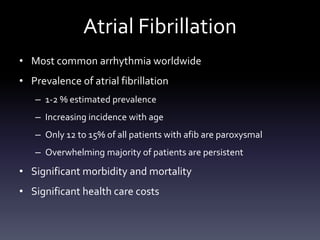
Atrial Fibrillation
• Most common arrhythmia worldwide
• Prevalence of atrial fibrillation
– 1-2 % estimated prevalence
– Increasing incidence with age
– Only 12 to 15% of all patients with afib are paroxysmal
– Overwhelming majority of patients are persistent
• Significant morbidity and mortality
• Significant health care costs
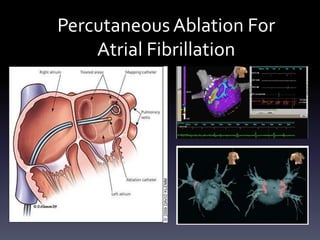
PercutaneousAblation For
Atrial Fibrillation
Percutaneous Ablation for
Atrial Fibrillation
• Primary strategy in paroxysmal afib is
electrical isolation of the pulmonary veins
• Good success rate for paroxysmal atrial
fibrillation (70 to 80%)
• Low complication rate (2-4%)
• Minimally invasive
Wellstar Electrophysiology
• Calendar year 2012
– 130 percutaneous ablations
• Calendar year 2013
– 200 percutaneous ablations
– Highest volume cryo-ablation center in the Southeast
– Top 10 in the country for cryo-ablation volume
– Training center for cryo-ablation
– Research site for cryo-ablation
Limitations of Percutaneous Ablation
• Lower success rates for persistent atrial fibrillation (50% to
60%), especially with enlarged and fibrotic atria
• Need for repeat ablation in up to 50% of patients
– Average number of procedures is 2.3 per patient
• Difficulty in delivering and confirming contiguous lesions
• Extensive endocardial lesions and the risk for embolus
• Potential esophageal damage and risk for esophageal-
atrial fistula formation
Convergent Approach
• Multi-disciplinary approach
– Cardiac Anesthesiology
– Cardiothoracic Surgery
• Linear lesions via an epicardial approach
• Closed chest, trans-diaphragmatic endoscopic approach
– Cardiac Electrophysiology
• Percutaneous EP testing and ablation (PVI and CTI ablation)
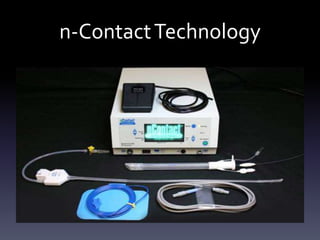
n-ContactTechnology
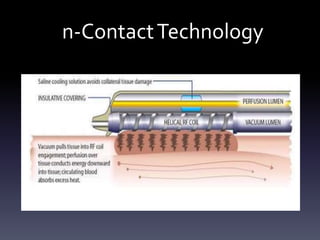
n-ContactTechnology
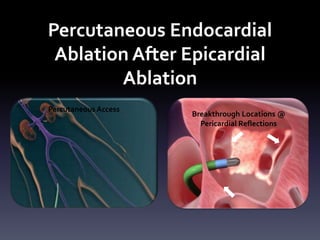
Percutaneous Endocardial
Ablation After Epicardial
Ablation
Percutaneous Access
Breakthrough Locations @
Pericardial Reflections
Study
% Persistent /
Longstanding AF
Monitoring Level Procedure Efficacy Redos
Serious Adverse
Event Rate4
Allegheny CV StudyB
AER 2013
N=43
86%
Med
2wk Monitors
89% @ 6 mo1 NR 0%
2-Site US CV StudyA
Heart Rhythm
N=101
83%
(Avg CHADS = 2.1)
Med
Reveal & Holter
79.7% @ 12 mo1
70.5% @ 12 mo1
(Survival Analysis)
6% 6%
4-Site US CV StudyB
Boston AF 2012
N=115
83.5%
Med
72h Holter
84% @ 11.4 mo1
77% @ 11.4 mo2
64% @ 11.4 mo3
4% 6.1%
Slovenia CV StudyA,B
Boston AF 2012, JCE
N=50
94%
High
All Reveals
91% @ 1 yr1
78% @ 1 yr3
2% 10.0%
OLOL CV StudyB
HRS 2012
N=104
73%
Med
72h Holter
92% @ 8 mo1
68% @ 8 mo3
4%
0%
(5.8% > 30d)
CPW CV StudyB
HRS 2012
N=39
79%
Med
72h Holter
94% @ 12.6 mo1
68% @ 12.6 mo3
6% 2.6%
STV CV StudyB
HRS 2012
N=61
88%
Med
72h Holter
79% @ 11 mo1
66% @ 11 mo3
8% 3.3%
4-Site EU CV StudyD
EU Journal
N=73
100%
High
Reveals or 7d Holters
79% @ 1 yr1 4% 11.0%
2-Site CV StudyA
Innovations 2011
N=65
92%
Med/High
Reveal or 24h Holter
88% @ 1 yr1
83% @ 1 yr3
NR 7.7%
1Efficacy = Sinus Rhythm; 2Efficacy = Sinus Rhythm & No AAD Tx; 3Efficacy = Sinus Rhythm & Off AADs, 4Safety = 30-Day Adverse Events
APublished Article; BPublished/Presented Abstract; CAccepted Abstract; DSubmitted Article; EAccepted Article
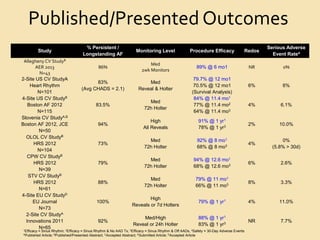
Published/Presented Outcomes
Summary
• 1. Highly effective therapy for patients with persistent atrial
fibrillation that still maintains a minimally invasive approach
• 2. Reduction in repeat procedures
• 3. Providing a new treatment option for a significant proportion of
the afib population which has been somewhat “forgotten”
• 4. Marketing opportunity for the health care system, cardiology,
cardiac electrophysiology and CT surgery

Convergent%20 ablation%20without%20movie

  • 1.
    The Convergent Approachfor theTreatment of Persistent Atrial Fibrillation Bryan Piedad, MD, FACC Wellstar Medical Group
  • 2.
    Atrial Fibrillation • Mostcommon arrhythmia worldwide • Prevalence of atrial fibrillation – 1-2 % estimated prevalence – Increasing incidence with age – Only 12 to 15% of all patients with afib are paroxysmal – Overwhelming majority of patients are persistent • Significant morbidity and mortality • Significant health care costs
  • 3.
  • 4.
    Percutaneous Ablation for AtrialFibrillation • Primary strategy in paroxysmal afib is electrical isolation of the pulmonary veins • Good success rate for paroxysmal atrial fibrillation (70 to 80%) • Low complication rate (2-4%) • Minimally invasive
  • 5.
    Wellstar Electrophysiology • Calendaryear 2012 – 130 percutaneous ablations • Calendar year 2013 – 200 percutaneous ablations – Highest volume cryo-ablation center in the Southeast – Top 10 in the country for cryo-ablation volume – Training center for cryo-ablation – Research site for cryo-ablation
  • 6.
    Limitations of PercutaneousAblation • Lower success rates for persistent atrial fibrillation (50% to 60%), especially with enlarged and fibrotic atria • Need for repeat ablation in up to 50% of patients – Average number of procedures is 2.3 per patient • Difficulty in delivering and confirming contiguous lesions • Extensive endocardial lesions and the risk for embolus • Potential esophageal damage and risk for esophageal- atrial fistula formation
  • 7.
    Convergent Approach • Multi-disciplinaryapproach – Cardiac Anesthesiology – Cardiothoracic Surgery • Linear lesions via an epicardial approach • Closed chest, trans-diaphragmatic endoscopic approach – Cardiac Electrophysiology • Percutaneous EP testing and ablation (PVI and CTI ablation)
  • 8.
  • 9.
  • 10.
    Percutaneous Endocardial Ablation AfterEpicardial Ablation Percutaneous Access Breakthrough Locations @ Pericardial Reflections
  • 11.
    Study % Persistent / LongstandingAF Monitoring Level Procedure Efficacy Redos Serious Adverse Event Rate4 Allegheny CV StudyB AER 2013 N=43 86% Med 2wk Monitors 89% @ 6 mo1 NR 0% 2-Site US CV StudyA Heart Rhythm N=101 83% (Avg CHADS = 2.1) Med Reveal & Holter 79.7% @ 12 mo1 70.5% @ 12 mo1 (Survival Analysis) 6% 6% 4-Site US CV StudyB Boston AF 2012 N=115 83.5% Med 72h Holter 84% @ 11.4 mo1 77% @ 11.4 mo2 64% @ 11.4 mo3 4% 6.1% Slovenia CV StudyA,B Boston AF 2012, JCE N=50 94% High All Reveals 91% @ 1 yr1 78% @ 1 yr3 2% 10.0% OLOL CV StudyB HRS 2012 N=104 73% Med 72h Holter 92% @ 8 mo1 68% @ 8 mo3 4% 0% (5.8% > 30d) CPW CV StudyB HRS 2012 N=39 79% Med 72h Holter 94% @ 12.6 mo1 68% @ 12.6 mo3 6% 2.6% STV CV StudyB HRS 2012 N=61 88% Med 72h Holter 79% @ 11 mo1 66% @ 11 mo3 8% 3.3% 4-Site EU CV StudyD EU Journal N=73 100% High Reveals or 7d Holters 79% @ 1 yr1 4% 11.0% 2-Site CV StudyA Innovations 2011 N=65 92% Med/High Reveal or 24h Holter 88% @ 1 yr1 83% @ 1 yr3 NR 7.7% 1Efficacy = Sinus Rhythm; 2Efficacy = Sinus Rhythm & No AAD Tx; 3Efficacy = Sinus Rhythm & Off AADs, 4Safety = 30-Day Adverse Events APublished Article; BPublished/Presented Abstract; CAccepted Abstract; DSubmitted Article; EAccepted Article Published/Presented Outcomes
  • 12.
    Summary • 1. Highlyeffective therapy for patients with persistent atrial fibrillation that still maintains a minimally invasive approach • 2. Reduction in repeat procedures • 3. Providing a new treatment option for a significant proportion of the afib population which has been somewhat “forgotten” • 4. Marketing opportunity for the health care system, cardiology, cardiac electrophysiology and CT surgery