The EU - 'Should we stay or should we go?’
Annual “Europe in Question” lecture,
LSE, May 10th 2016
Danny Dorling
School of Geography
and the
Environment
University of Oxford
Maps by Ben Hennig – this is “remoteness”
What is a
confused
young
person to
believe?
Private Eye 29th April 2016
Cover of issue 1417, Image of small
boy blurred to protect anonymity 
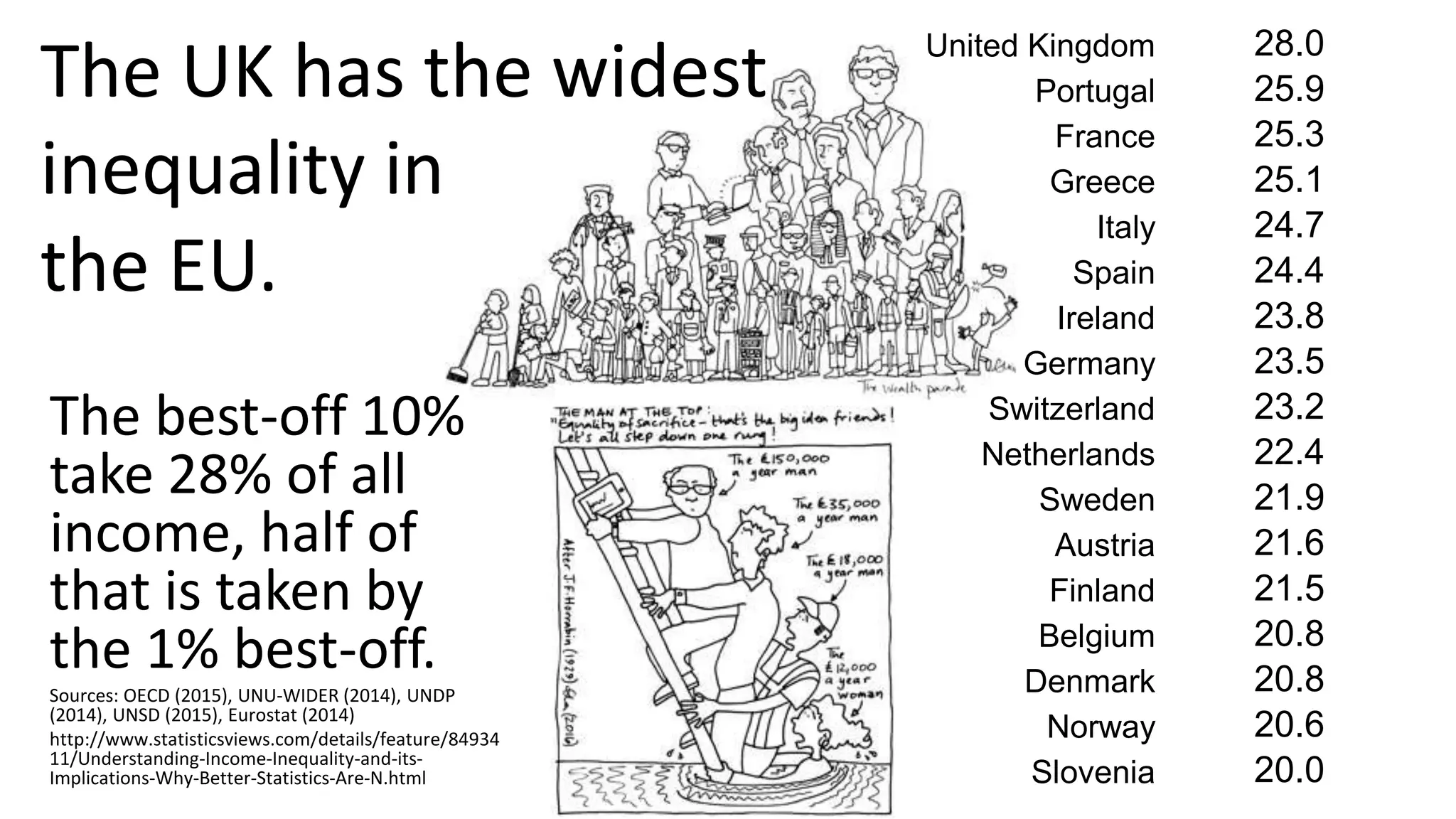
The UK has the widest
inequality in
the EU.
The best-off 10%
take 28% of all
income, half of
that is taken by
the 1% best-off.
Sources: OECD (2015), UNU-WIDER (2014), UNDP
(2014), UNSD (2015), Eurostat (2014)
http://www.statisticsviews.com/details/feature/84934
11/Understanding-Income-Inequality-and-its-
Implications-Why-Better-Statistics-Are-N.html
United Kingdom 28.0
Portugal 25.9
France 25.3
Greece 25.1
Italy 24.7
Spain 24.4
Ireland 23.8
Germany 23.5
Switzerland 23.2
Netherlands 22.4
Sweden 21.9
Austria 21.6
Finland 21.5
Belgium 20.8
Denmark 20.8
Norway 20.6
Slovenia 20.0
“The official
‘Remain’ campaign
feels lame and is
lacking in passion.”
Posters courtesy of Wolfgang Tillmans -the first
non-English person awarded the Turner Prize
http://www.dezeen.com/2016/04/26/wolfgang-
tillmans-eu-referendum-posters-anti-brexit-
campaign-uk-remain/
The UK is more polarized
now than ever before
1975 referendum promised by
the 1974 Labour government
2016 referendum
promised by the
2015 Tory
government
EU 28 states, candidate states, pre-
candidate, EEA, EMU and Schengen
area… coloured by year of entry
(rainbow scale)
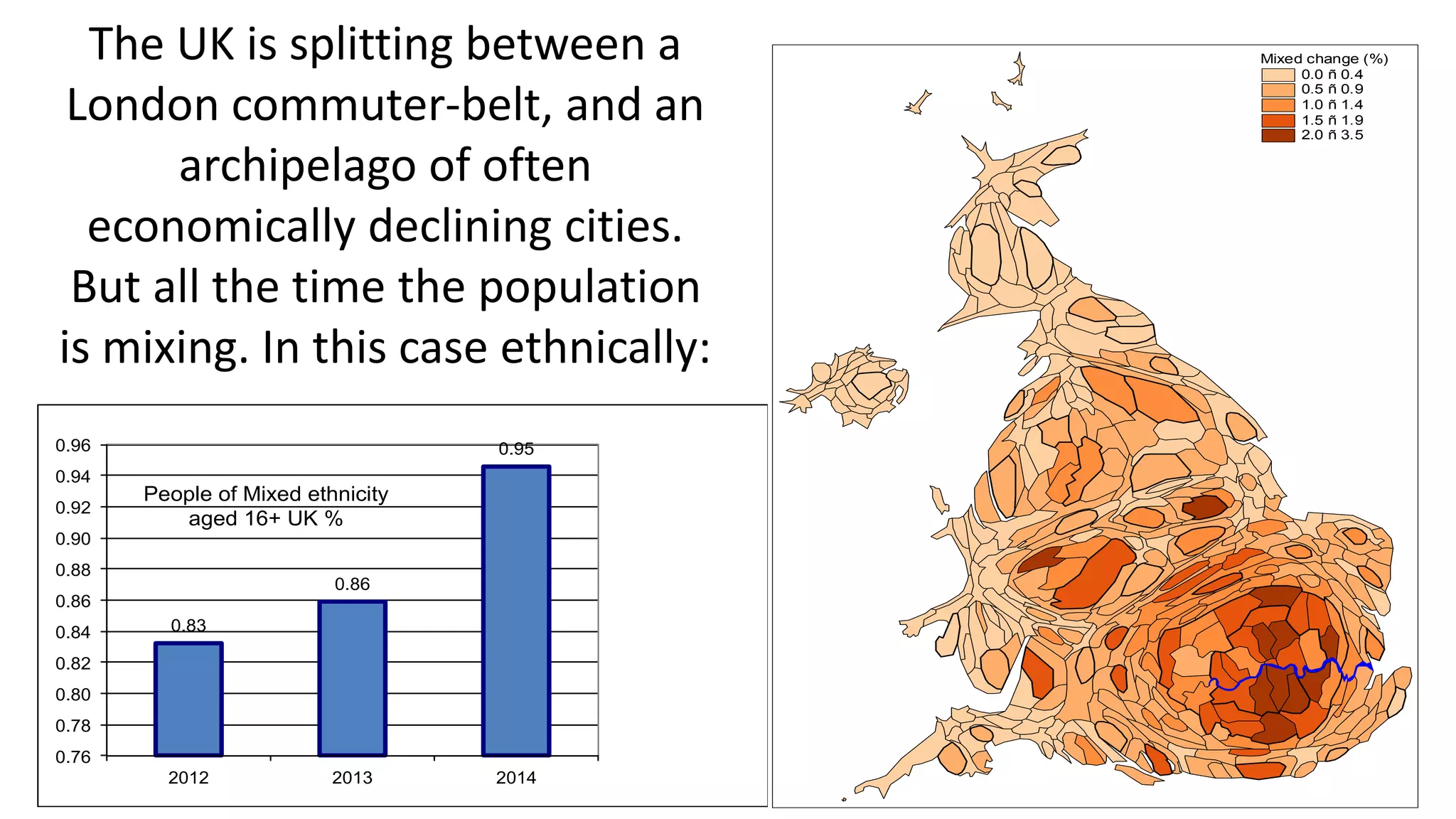
The UK is splitting between a
London commuter-belt, and an
archipelago of often
economically declining cities.
But all the time the population
is mixing. In this case ethnically:
Mixed change (%)
0.0 ñ 0.4
0.5 ñ 0.9
1.0 ñ 1.4
1.5 ñ 1.9
2.0 ñ 3.5
0.83
0.86
0.95
0.76
0.78
0.80
0.82
0.84
0.86
0.88
0.90
0.92
0.94
0.96
2012 2013 2014
People of Mixed ethnicity
aged 16+ UK %
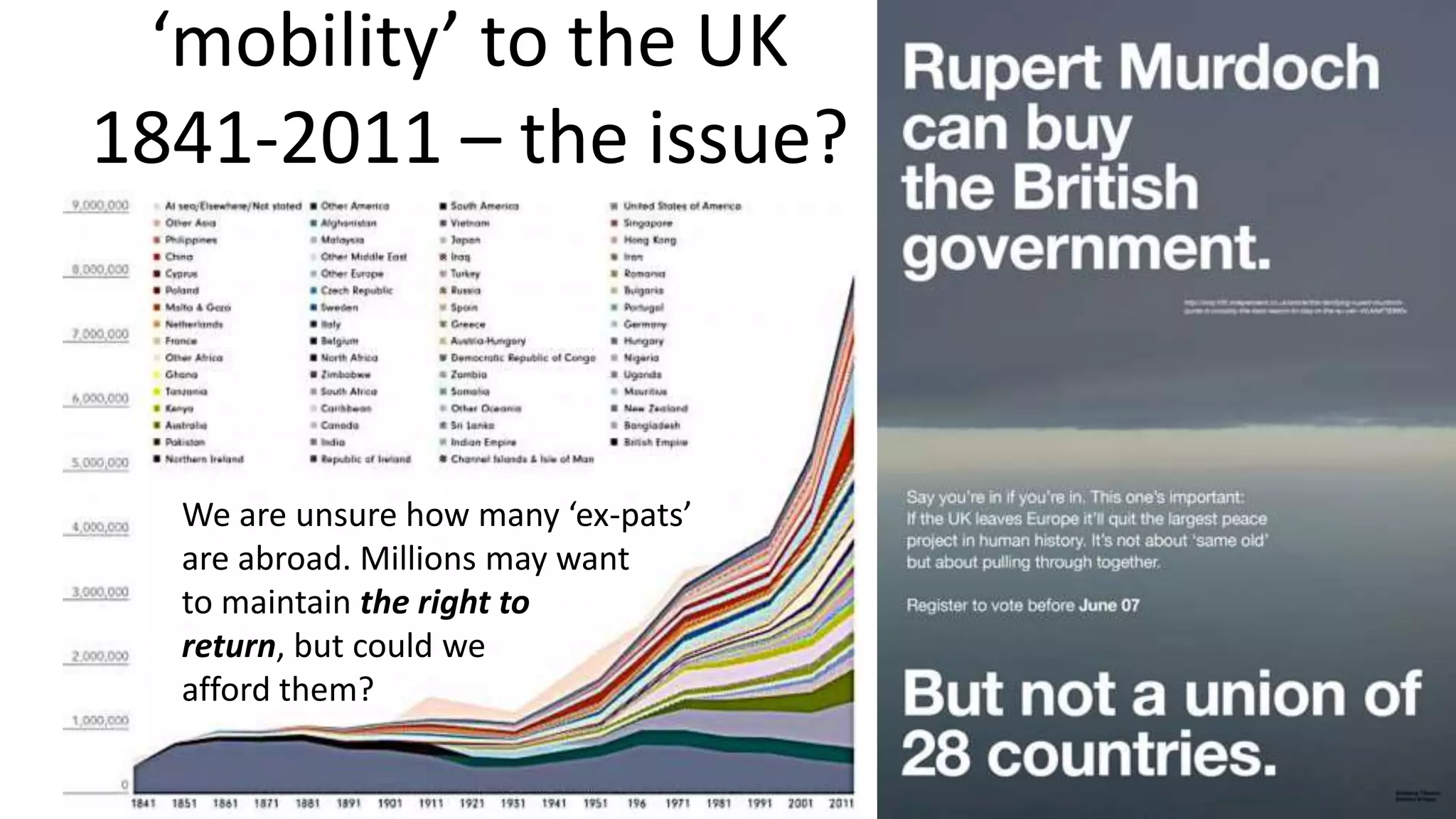
‘mobility’ to the UK
1841-2011 – the issue?
We are unsure how many ‘ex-pats’
are abroad. Millions may want
to maintain the right to
return, but could we
afford them?
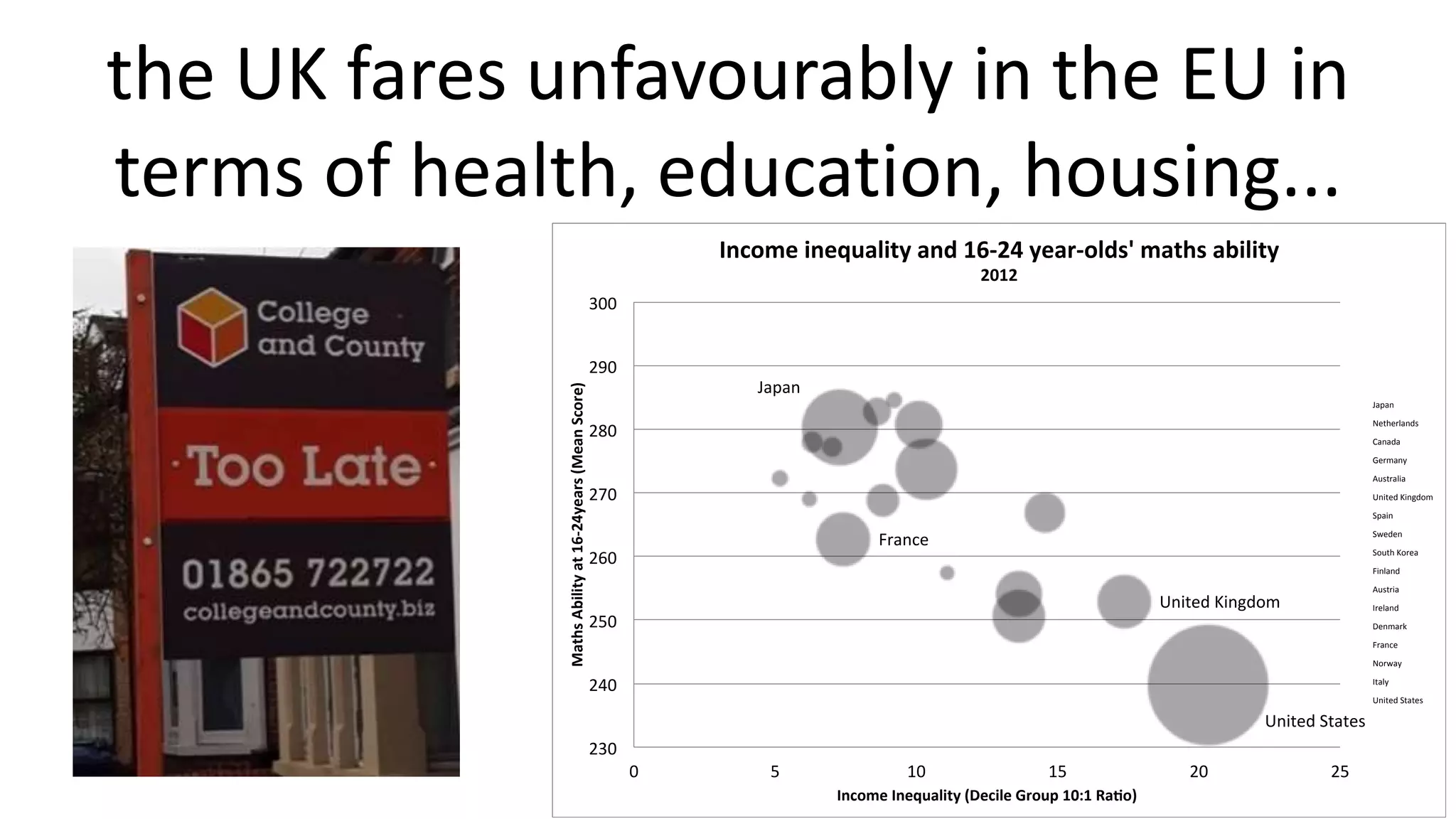
the UK fares unfavourably in the EU in
terms of health, education, housing...
Japan
United Kingdom
France
United States
230
240
250
260
270
280
290
300
0 5 10 15 20 25
MathsAbilityat16-24years(MeanScore)
Income Inequality (Decile Group 10:1 Ra o)
Income inequality and 16-24 year-olds' maths ability
2012
Japan
Netherlands
Canada
Germany
Australia
United Kingdom
Spain
Sweden
South Korea
Finland
Austria
Ireland
Denmark
France
Norway
Italy
United States
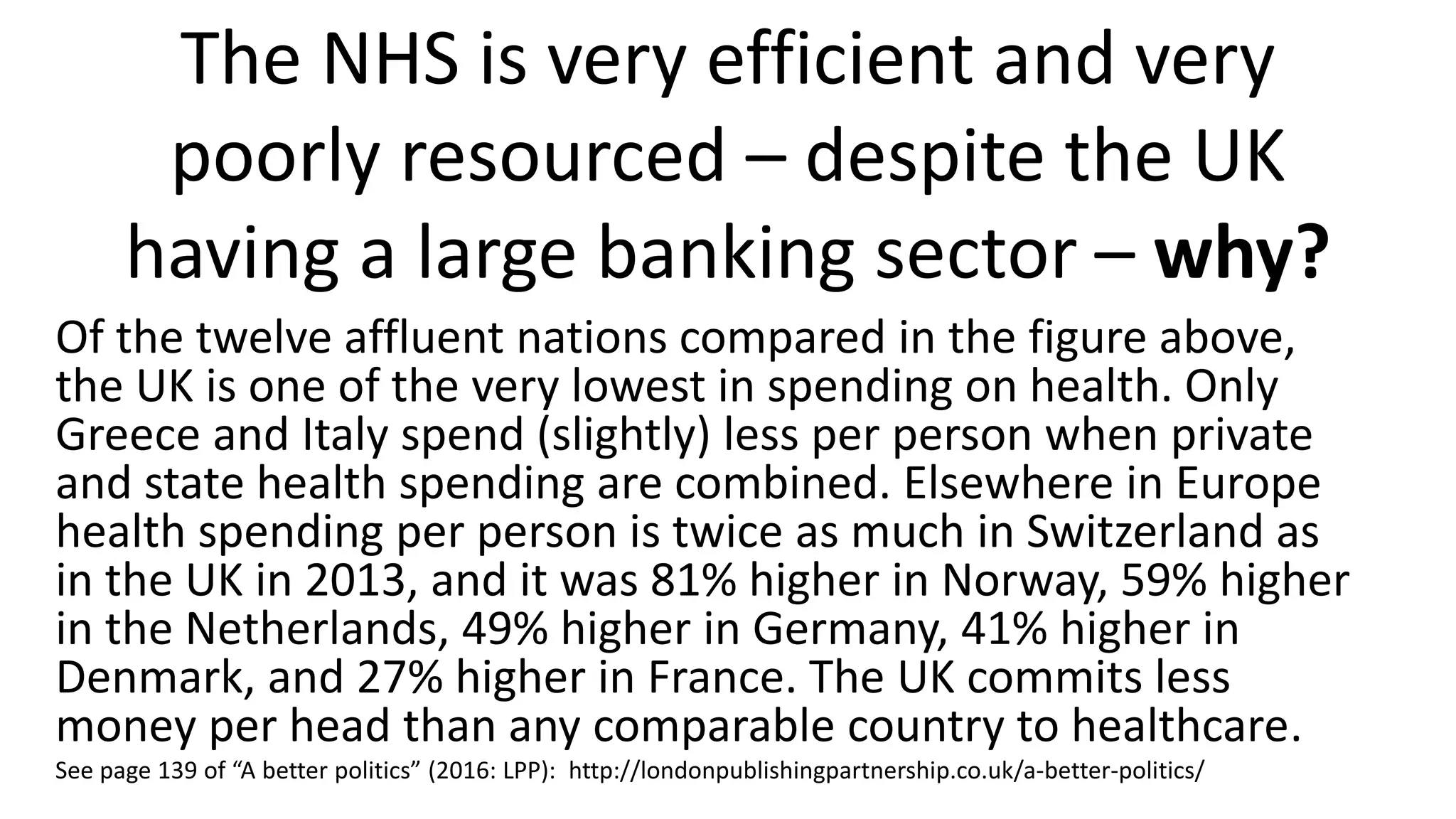
The NHS is very efficient and very
poorly resourced – despite the UK
having a large banking sector – why?
Of the twelve affluent nations compared in the figure above,
the UK is one of the very lowest in spending on health. Only
Greece and Italy spend (slightly) less per person when private
and state health spending are combined. Elsewhere in Europe
health spending per person is twice as much in Switzerland as
in the UK in 2013, and it was 81% higher in Norway, 59% higher
in the Netherlands, 49% higher in Germany, 41% higher in
Denmark, and 27% higher in France. The UK commits less
money per head than any comparable country to healthcare.
See page 139 of “A better politics” (2016: LPP): http://londonpublishingpartnership.co.uk/a-better-politics/
Outside of London and Oxford
the UK does not have a high
proportion of ‘foreign born’
(2014)
Spain does and that includes
many UK emigrants
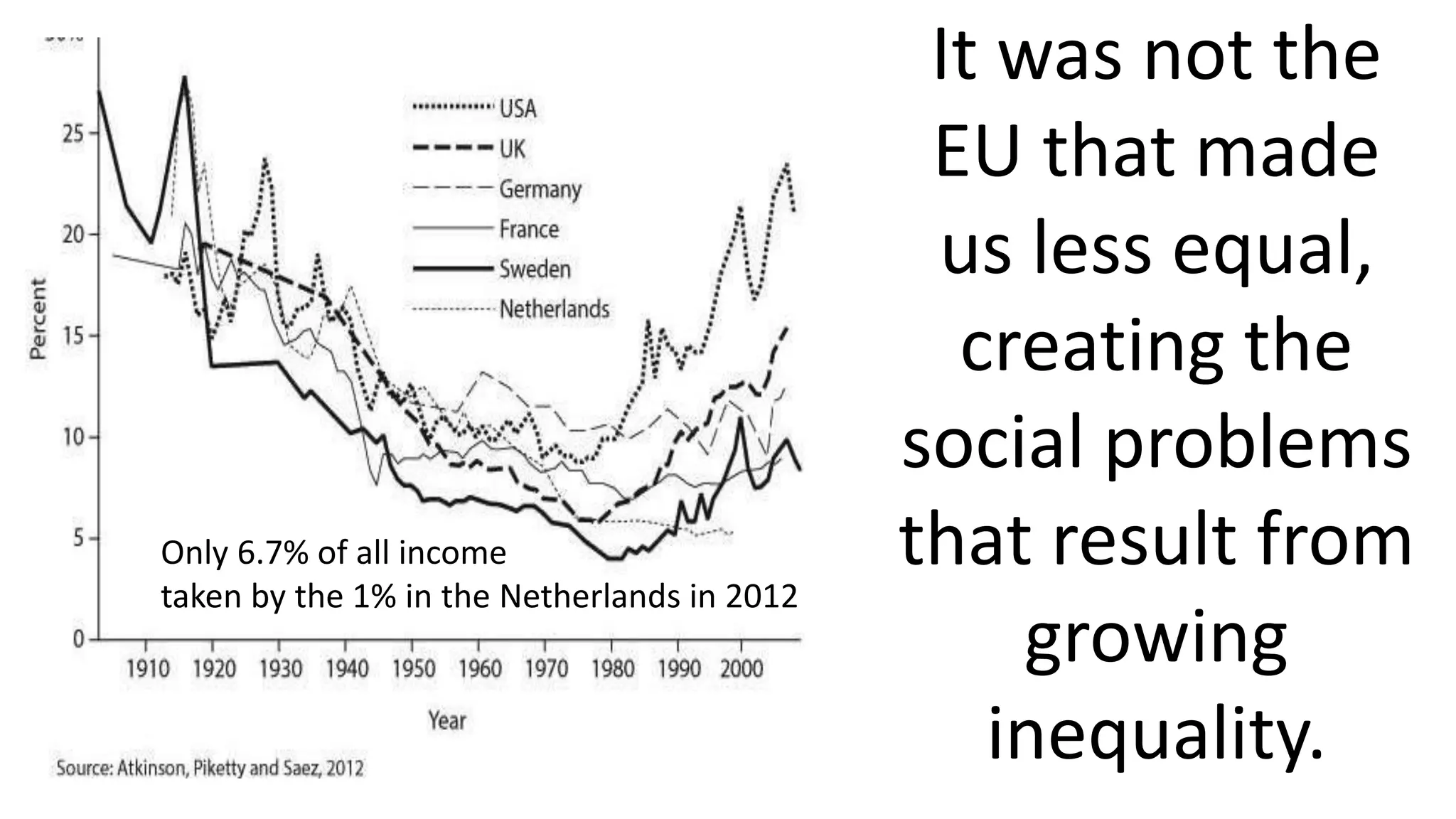
It was not the
EU that made
us less equal,
creating the
social problems
that result from
growing
inequality.
Only 6.7% of all income
taken by the 1% in the Netherlands in 2012
Our health is poorer than in much of
the rest of Europe. See: respiratory
disease death rates in recent years per
100,000 people per year (esp. 2015):
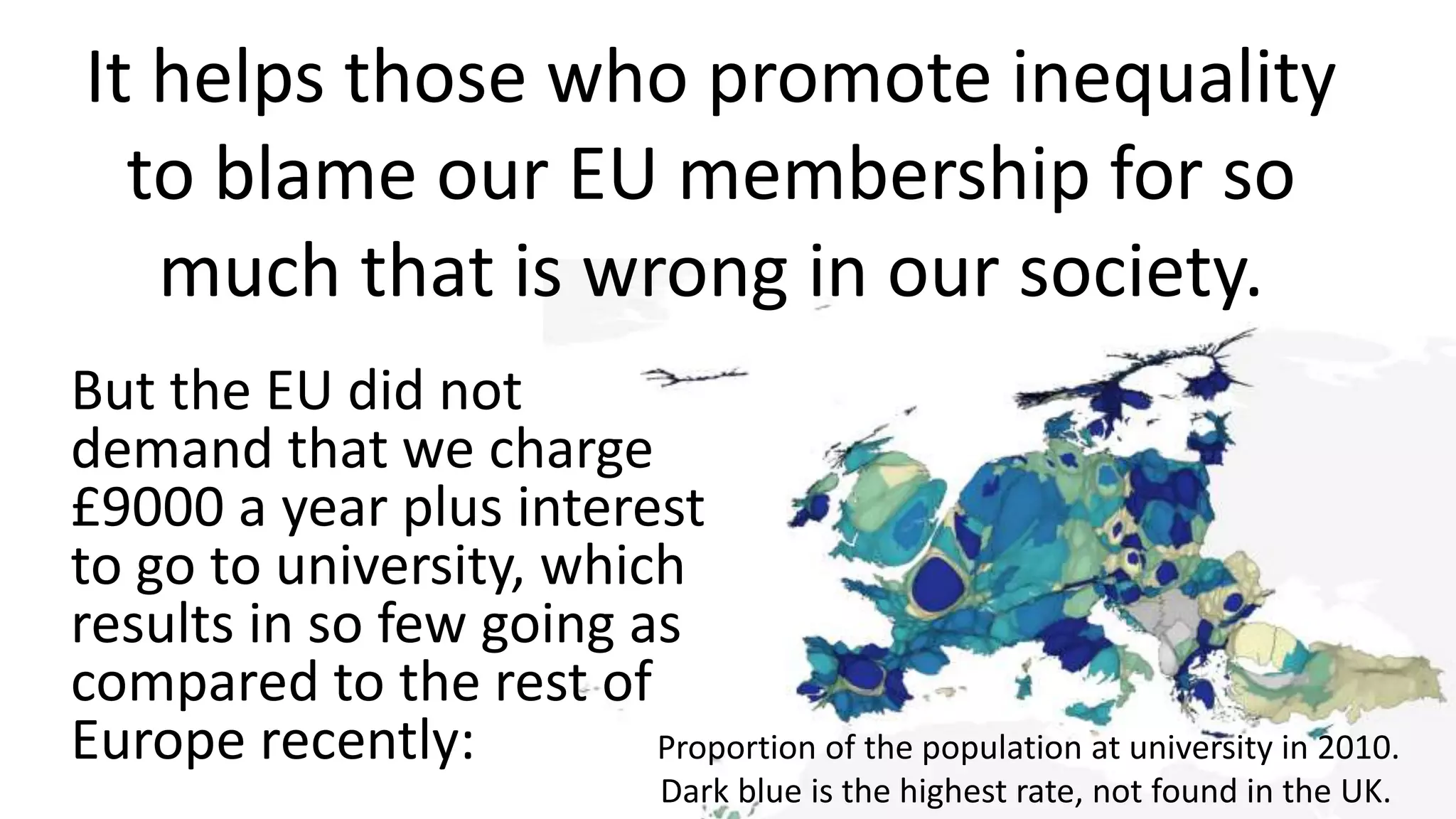
It helps those who promote inequality
to blame our EU membership for so
much that is wrong in our society.
But the EU did not
demand that we charge
£9000 a year plus interest
to go to university, which
results in so few going as
compared to the rest of
Europe recently: Proportion of the population at university in 2010.
Dark blue is the highest rate, not found in the UK.
We do far better for
postgraduate students
(aged 25+, PhDs…)
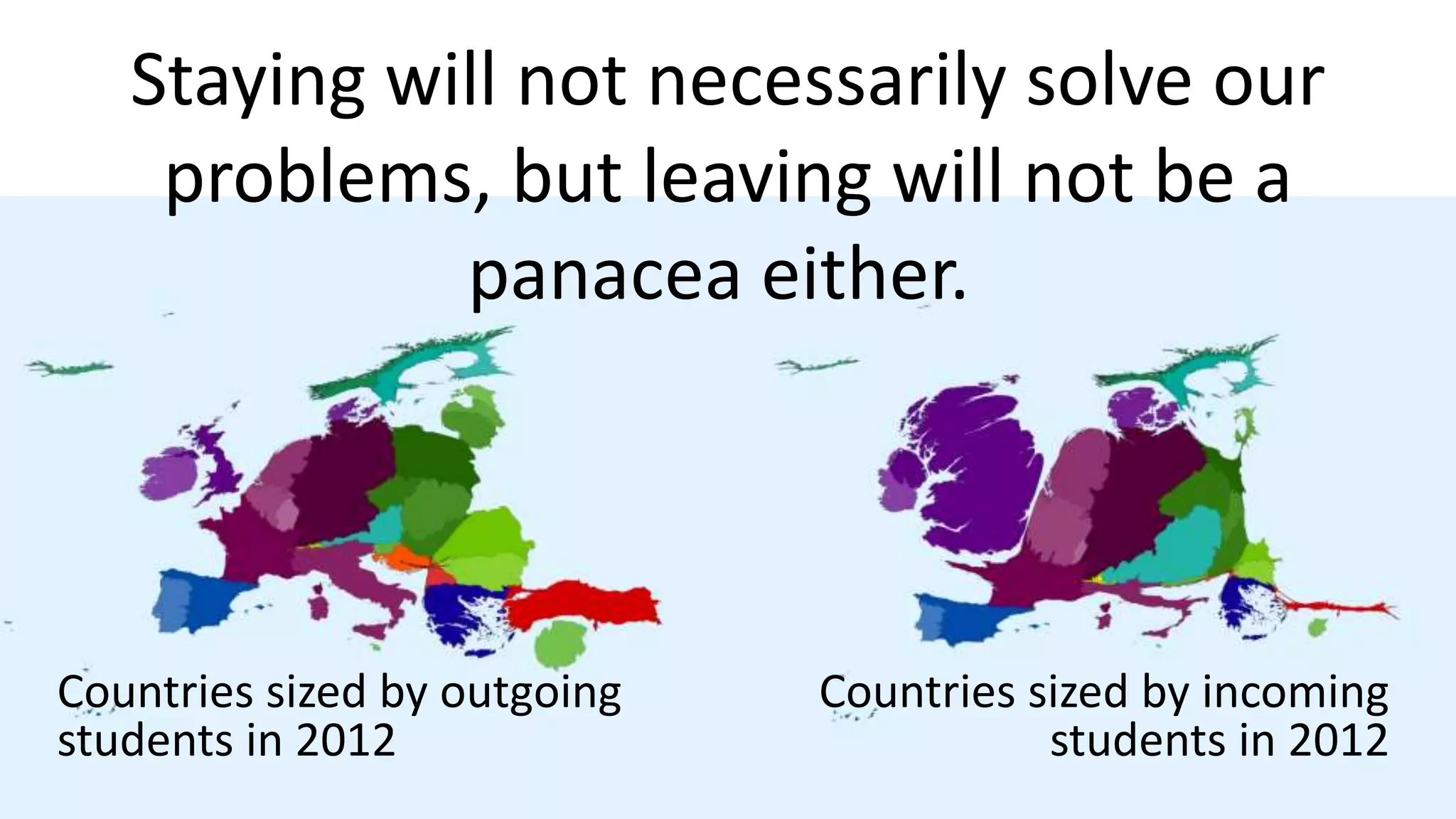
Countries sized by incoming
students in 2012
Countries sized by outgoing
students in 2012
Staying will not necessarily solve our
problems, but leaving will not be a
panacea either.
Are you afraid of losing your
national identity/culture?
Map of: “Very much afraid (2008)”
Countries sized by the number of people
who said they were “very afraid” in 2008…
Who pays in the most and who votes?
• And why does anyone who had a vote in the 1975 European Economic Community
Referendum have a second vote now? Anyone aged 60+
• Why do 16 and 17 year olds, non-British and Irish EU Citizens living in the UK, and
prisoners get no vote? It effects all of them – most.
Countries sized by the amount of funds
going (net) into the EU budget (2013)
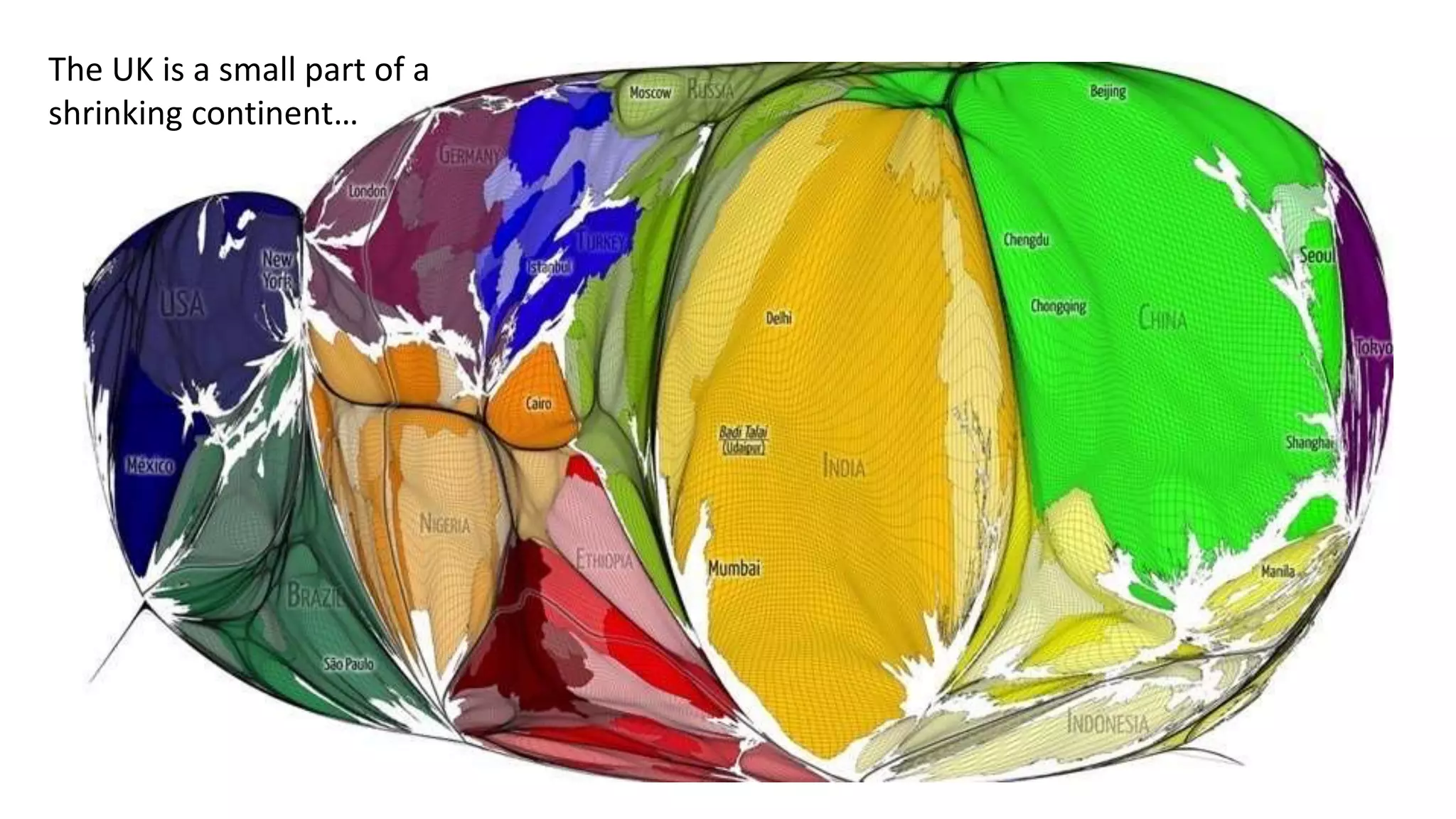
The UK is a small part of a
shrinking continent…
The pink bits of 1897 are no more
“Pink Bits 1897” - http://www.britishempire.co.uk/maproom/pinkbits1897.htm
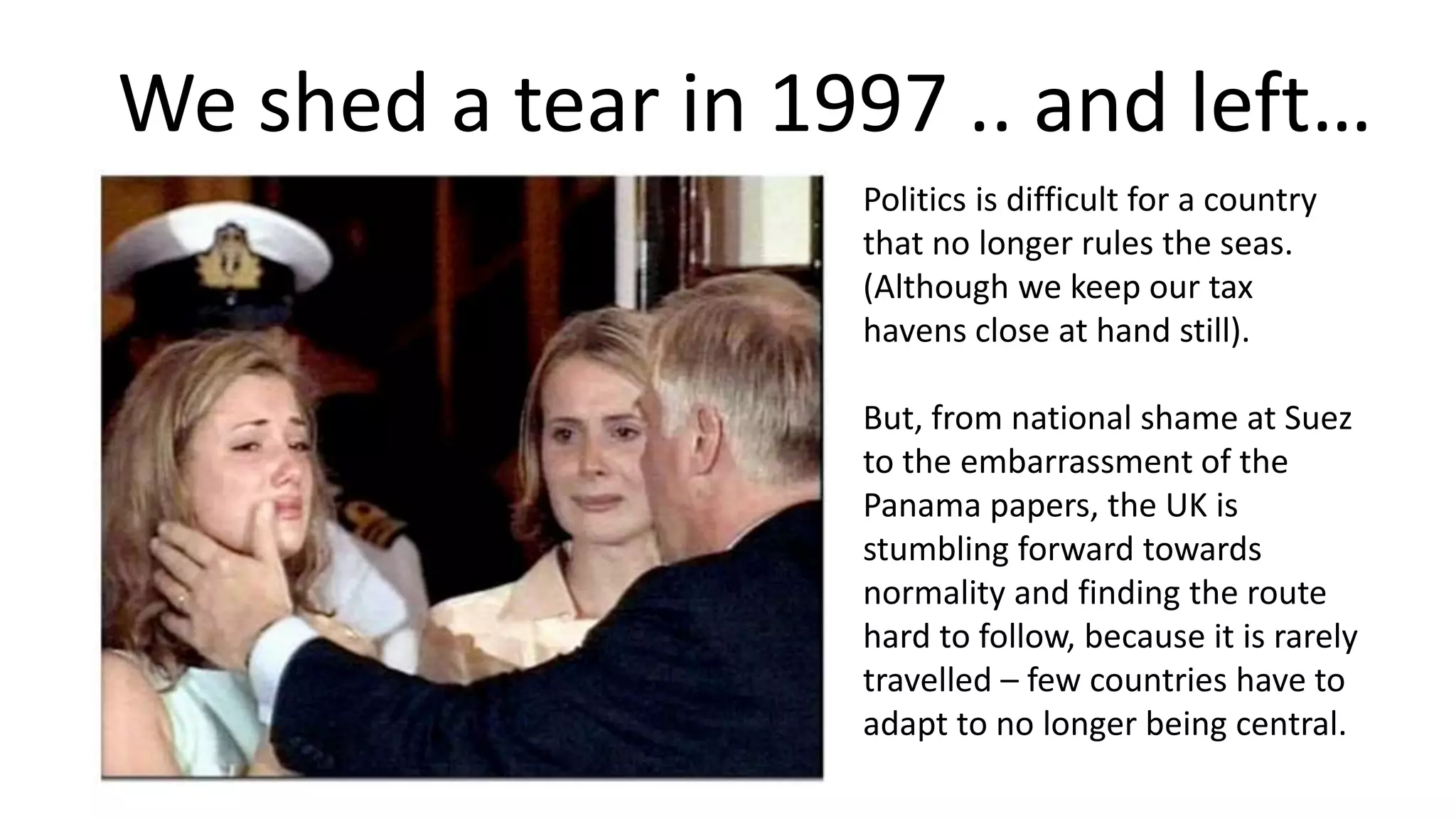
We shed a tear in 1997 .. and left…
Politics is difficult for a country
that no longer rules the seas.
(Although we keep our tax
havens close at hand still).
But, from national shame at Suez
to the embarrassment of the
Panama papers, the UK is
stumbling forward towards
normality and finding the route
hard to follow, because it is rarely
travelled – few countries have to
adapt to no longer being central.
And so we try to keep the children out again, as some tried
in 1939, despite our continent shrinking in population
Photograph by Phil Jones, super-hero cape supplied by Sheffield
University students who were visiting the camp as part of a
Geography field-trip. Photograph taken with parents’ permission.
And despite our complicity with what lead to exodus.
….We send gunboats again. Photograph by Dimitris
Ballas, taken April 3rd 2016, Mytilini, Lesvos, Greece.
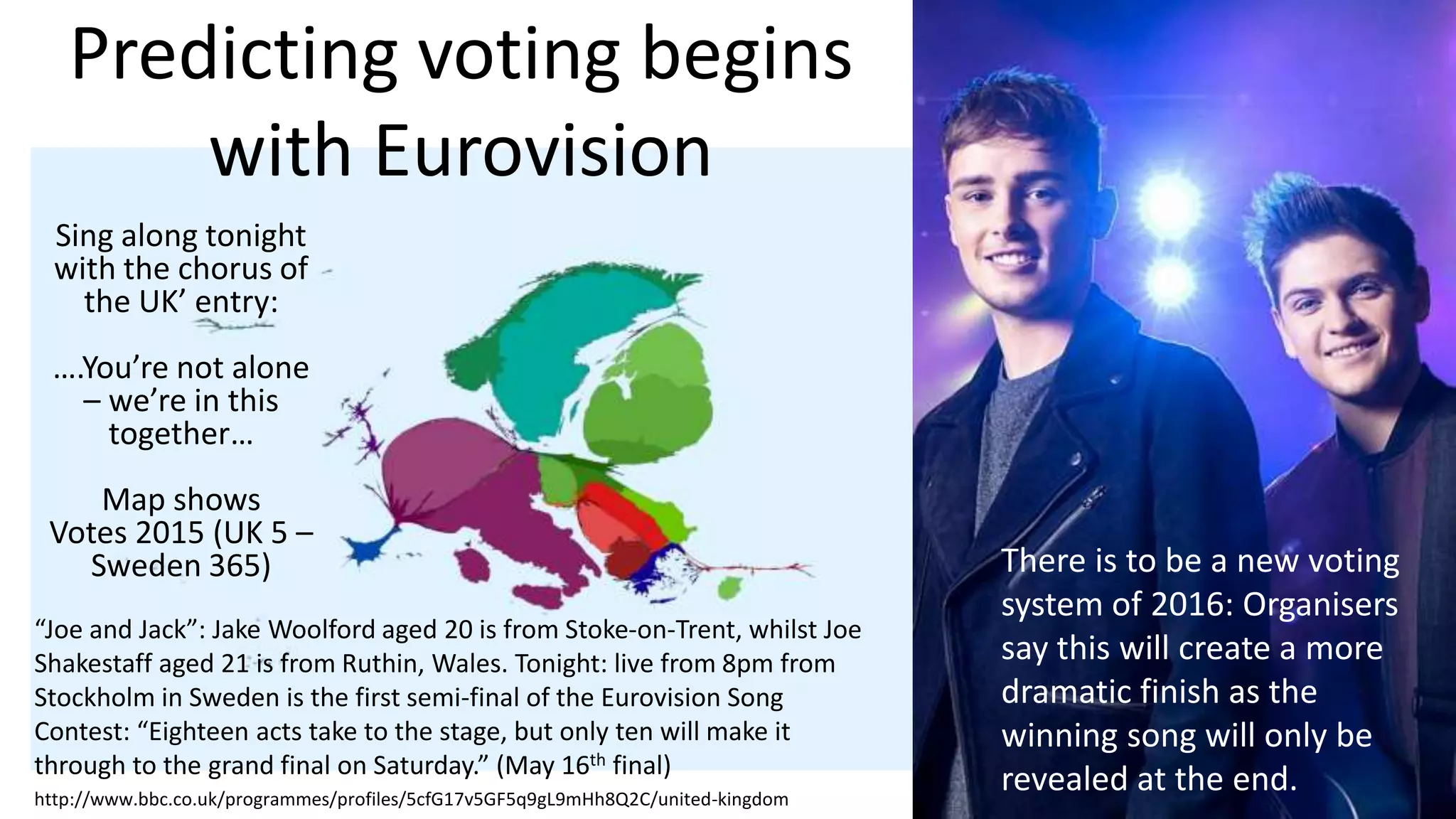
Predicting voting begins
with Eurovision
“Joe and Jack”: Jake Woolford aged 20 is from Stoke-on-Trent, whilst Joe
Shakestaff aged 21 is from Ruthin, Wales. Tonight: live from 8pm from
Stockholm in Sweden is the first semi-final of the Eurovision Song
Contest: “Eighteen acts take to the stage, but only ten will make it
through to the grand final on Saturday.” (May 16th final)
http://www.bbc.co.uk/programmes/profiles/5cfG17v5GF5q9gL9mHh8Q2C/united-kingdom
Sing along tonight
with the chorus of
the UK’ entry:
….You’re not alone
– we’re in this
together…
Map shows
Votes 2015 (UK 5 –
Sweden 365) There is to be a new voting
system of 2016: Organisers
say this will create a more
dramatic finish as the
winning song will only be
revealed at the end.

The EU - Should we stay or should we go?

  • 1.
    The EU -'Should we stay or should we go?’ Annual “Europe in Question” lecture, LSE, May 10th 2016 Danny Dorling School of Geography and the Environment University of Oxford Maps by Ben Hennig – this is “remoteness”
  • 2.
    What is a confused young personto believe? Private Eye 29th April 2016 Cover of issue 1417, Image of small boy blurred to protect anonymity 
  • 3.
    The UK hasthe widest inequality in the EU. The best-off 10% take 28% of all income, half of that is taken by the 1% best-off. Sources: OECD (2015), UNU-WIDER (2014), UNDP (2014), UNSD (2015), Eurostat (2014) http://www.statisticsviews.com/details/feature/84934 11/Understanding-Income-Inequality-and-its- Implications-Why-Better-Statistics-Are-N.html United Kingdom 28.0 Portugal 25.9 France 25.3 Greece 25.1 Italy 24.7 Spain 24.4 Ireland 23.8 Germany 23.5 Switzerland 23.2 Netherlands 22.4 Sweden 21.9 Austria 21.6 Finland 21.5 Belgium 20.8 Denmark 20.8 Norway 20.6 Slovenia 20.0
  • 4.
    “The official ‘Remain’ campaign feelslame and is lacking in passion.” Posters courtesy of Wolfgang Tillmans -the first non-English person awarded the Turner Prize http://www.dezeen.com/2016/04/26/wolfgang- tillmans-eu-referendum-posters-anti-brexit- campaign-uk-remain/
  • 5.
    The UK ismore polarized now than ever before 1975 referendum promised by the 1974 Labour government 2016 referendum promised by the 2015 Tory government
  • 6.
    EU 28 states,candidate states, pre- candidate, EEA, EMU and Schengen area… coloured by year of entry (rainbow scale)
  • 7.
    The UK issplitting between a London commuter-belt, and an archipelago of often economically declining cities. But all the time the population is mixing. In this case ethnically: Mixed change (%) 0.0 ñ 0.4 0.5 ñ 0.9 1.0 ñ 1.4 1.5 ñ 1.9 2.0 ñ 3.5 0.83 0.86 0.95 0.76 0.78 0.80 0.82 0.84 0.86 0.88 0.90 0.92 0.94 0.96 2012 2013 2014 People of Mixed ethnicity aged 16+ UK %
  • 8.
    ‘mobility’ to theUK 1841-2011 – the issue? We are unsure how many ‘ex-pats’ are abroad. Millions may want to maintain the right to return, but could we afford them?
  • 9.
    the UK faresunfavourably in the EU in terms of health, education, housing... Japan United Kingdom France United States 230 240 250 260 270 280 290 300 0 5 10 15 20 25 MathsAbilityat16-24years(MeanScore) Income Inequality (Decile Group 10:1 Ra o) Income inequality and 16-24 year-olds' maths ability 2012 Japan Netherlands Canada Germany Australia United Kingdom Spain Sweden South Korea Finland Austria Ireland Denmark France Norway Italy United States
  • 11.
    The NHS isvery efficient and very poorly resourced – despite the UK having a large banking sector – why? Of the twelve affluent nations compared in the figure above, the UK is one of the very lowest in spending on health. Only Greece and Italy spend (slightly) less per person when private and state health spending are combined. Elsewhere in Europe health spending per person is twice as much in Switzerland as in the UK in 2013, and it was 81% higher in Norway, 59% higher in the Netherlands, 49% higher in Germany, 41% higher in Denmark, and 27% higher in France. The UK commits less money per head than any comparable country to healthcare. See page 139 of “A better politics” (2016: LPP): http://londonpublishingpartnership.co.uk/a-better-politics/
  • 12.
    Outside of Londonand Oxford the UK does not have a high proportion of ‘foreign born’ (2014) Spain does and that includes many UK emigrants
  • 13.
    It was notthe EU that made us less equal, creating the social problems that result from growing inequality. Only 6.7% of all income taken by the 1% in the Netherlands in 2012
  • 14.
    Our health ispoorer than in much of the rest of Europe. See: respiratory disease death rates in recent years per 100,000 people per year (esp. 2015):
  • 15.
    It helps thosewho promote inequality to blame our EU membership for so much that is wrong in our society. But the EU did not demand that we charge £9000 a year plus interest to go to university, which results in so few going as compared to the rest of Europe recently: Proportion of the population at university in 2010. Dark blue is the highest rate, not found in the UK.
  • 16.
    We do farbetter for postgraduate students (aged 25+, PhDs…)
  • 17.
    Countries sized byincoming students in 2012 Countries sized by outgoing students in 2012 Staying will not necessarily solve our problems, but leaving will not be a panacea either.
  • 18.
    Are you afraidof losing your national identity/culture? Map of: “Very much afraid (2008)” Countries sized by the number of people who said they were “very afraid” in 2008…
  • 19.
    Who pays inthe most and who votes? • And why does anyone who had a vote in the 1975 European Economic Community Referendum have a second vote now? Anyone aged 60+ • Why do 16 and 17 year olds, non-British and Irish EU Citizens living in the UK, and prisoners get no vote? It effects all of them – most. Countries sized by the amount of funds going (net) into the EU budget (2013)
  • 20.
    The UK isa small part of a shrinking continent…
  • 21.
    The pink bitsof 1897 are no more “Pink Bits 1897” - http://www.britishempire.co.uk/maproom/pinkbits1897.htm
  • 22.
    We shed atear in 1997 .. and left… Politics is difficult for a country that no longer rules the seas. (Although we keep our tax havens close at hand still). But, from national shame at Suez to the embarrassment of the Panama papers, the UK is stumbling forward towards normality and finding the route hard to follow, because it is rarely travelled – few countries have to adapt to no longer being central.
  • 23.
    And so wetry to keep the children out again, as some tried in 1939, despite our continent shrinking in population Photograph by Phil Jones, super-hero cape supplied by Sheffield University students who were visiting the camp as part of a Geography field-trip. Photograph taken with parents’ permission. And despite our complicity with what lead to exodus. ….We send gunboats again. Photograph by Dimitris Ballas, taken April 3rd 2016, Mytilini, Lesvos, Greece.
  • 24.
    Predicting voting begins withEurovision “Joe and Jack”: Jake Woolford aged 20 is from Stoke-on-Trent, whilst Joe Shakestaff aged 21 is from Ruthin, Wales. Tonight: live from 8pm from Stockholm in Sweden is the first semi-final of the Eurovision Song Contest: “Eighteen acts take to the stage, but only ten will make it through to the grand final on Saturday.” (May 16th final) http://www.bbc.co.uk/programmes/profiles/5cfG17v5GF5q9gL9mHh8Q2C/united-kingdom Sing along tonight with the chorus of the UK’ entry: ….You’re not alone – we’re in this together… Map shows Votes 2015 (UK 5 – Sweden 365) There is to be a new voting system of 2016: Organisers say this will create a more dramatic finish as the winning song will only be revealed at the end.