Population revision
PopulationDemographic transition – main thing here is that you can interpret the diagram in case it comes up + relate it to examples (MEDCs at Stage 4, NICs at Stage 3, LEDCs and LDCs mostly at Stage 2. Only really bad places could possibly be in Stage 1 like Zimbabwe)You need to know the reasons for UK population change:Family size (smaller, more single parents, lone house- holds, more older people in 1-2 person households)Population structure (as shown in a pyramid, longer life expectancy, lower birth rate)Migration (people moving within UK from north to south for jobs, now 26% live in South East, moving to rural areas (counterurbanisation), older people moving to the coastMore service sector jobs, fewer people in primary/ secondary sector jobsLess “working class”, more “middle class” because more people own property and fewer do manual or unskilled work. More going to university (huge change in life chances). The “upper class” haven’t changed really, they still go to top private schools, like Eton (David Cameron, Boris Johnson, etc) then onto Oxford and Cambridge and then top jobs.Ethnicity  (8% of population now black or other ethnic minority group, many have come from our former colonies (in the empire) like India, Pakistan, Jamaica, etc. Ethnic minorities tend to be concentrated in cities (because it’s easier to find other people from your country, work, housing, etc when you first arrive). In some cities there is quite strong ethnic segregation (people from different groups live separate lives to the remaining population, this is a negative factor for “social cohesion”, cities where there is segregation often have more problems of racism because the groups don’t mix/understand each other, kids don’t go to school together, etc. Bradford a few years ago had bad violence between the white and Pakistani populations one of the reasons was the segregated housing and schooling. The BNP are very active there.
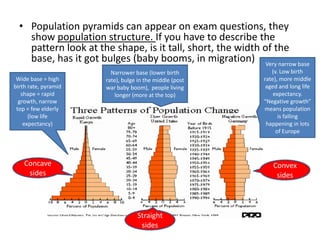
Population pyramids can appear on exam questions, they show population structure. If you have to describe the pattern look at the shape, is it tall, short, the width of the base, has it got bulges (baby booms, in migration)Very narrow base (v. Low birth rate), more middle aged and long life expectancy. “Negative growth” means population is falling happening in lots of EuropeNarrower base (lower birth rate), bulge in the middle (post war baby boom),  people living longer (more at the top)Wide base = high birth rate, pyramid shape = rapid growth, narrow top = few elderly (low life expectancy)Concave sidesConvex sidesStraight sides
Ageing population means that a country has a high proportion of elderly people in the population,  this is due to better healthcare, good quality of life (nutrition, etc), pensions, etc.All benefits have to be paid for out of current taxation, in other words money collected this month from taxes will be paid out next month in pensions.An ageing population therefore means you’ve got a lot of old people dependent on the working population. In other words the people who are working have to pay for all the care, health, pensions, benefits, etc that elderly people get. In MEDCs that is a huge variety of stuff, in the UK this is just a selection:pensions, attendance allowance, lots of NHS care (hospitalisation, physiotherapy, check ups, vaccinations), meals on wheels, winter heating allowance, equipment for the house to help them live independently (my mother’s house is full of equipment – special bed, zimmer frames, stool to prop her up at the sink, bath life, to say nothing of the step at front and back door so she can get in and out).free local bus pass (nationally)day centres where people can go to meet others, do activities.care in the home (dressing, feeding, bathing, etc)
Because of the expense of providing for an ageing population countries are increasingly taking steps to reduce problems in the future.In the UK:Retirement age is rising. Women have always had a pension earlier than men (60 for women and 65 for men) but this is changing so women who were born after 1951 will retire at 61, 1952 at 62 etc.The pension age for everyone born after 1959 is also going up so people born with the people born after 1977 retiring at 68.  It’s likely that these ages will go up higher stillPeople will be made to save towards their pension if they don’t already have a pension through their employer (lots of people pay into an occupational pension scheme from their pay, this is organised by their employer who also contributes, this gives you an extra pension when you retire and obviously makes you better off. So for example I pay into the teachers pension scheme and will get that as well as the state pension when I retire)There may be other cut backs on expenses, there is already talk of making winter heating allowance means tested (so only poorer pensioners get it)
MigrationTerms to be clear about:Source country  where people come fromHost country where people go toImmigration = movement inEmigration = movement outPush factors = make people move from one placePull factors = attract them somewhere else.Barriers/Obstacles = get in the way of migrationAsylum seekers are asking to be allowed to stay in a country because they fear for their safety. Every country has a responsibility to consider asylum applicationsRefugee – a person who has been granted asylum due to a well founded fear of persecutionEconomic migration = moving for better economic opportunities
Migration from poor countries (in Africa and Asia) to EUPeople pushed by poverty, human rights problems, civil war, war, etc
People pulled by safety and better prospects for the future
They are often sent by their families who spend every penny to try to get their sons to Europe

Population Revision

  • 1.
  • 2.
    PopulationDemographic transition –main thing here is that you can interpret the diagram in case it comes up + relate it to examples (MEDCs at Stage 4, NICs at Stage 3, LEDCs and LDCs mostly at Stage 2. Only really bad places could possibly be in Stage 1 like Zimbabwe)You need to know the reasons for UK population change:Family size (smaller, more single parents, lone house- holds, more older people in 1-2 person households)Population structure (as shown in a pyramid, longer life expectancy, lower birth rate)Migration (people moving within UK from north to south for jobs, now 26% live in South East, moving to rural areas (counterurbanisation), older people moving to the coastMore service sector jobs, fewer people in primary/ secondary sector jobsLess “working class”, more “middle class” because more people own property and fewer do manual or unskilled work. More going to university (huge change in life chances). The “upper class” haven’t changed really, they still go to top private schools, like Eton (David Cameron, Boris Johnson, etc) then onto Oxford and Cambridge and then top jobs.Ethnicity (8% of population now black or other ethnic minority group, many have come from our former colonies (in the empire) like India, Pakistan, Jamaica, etc. Ethnic minorities tend to be concentrated in cities (because it’s easier to find other people from your country, work, housing, etc when you first arrive). In some cities there is quite strong ethnic segregation (people from different groups live separate lives to the remaining population, this is a negative factor for “social cohesion”, cities where there is segregation often have more problems of racism because the groups don’t mix/understand each other, kids don’t go to school together, etc. Bradford a few years ago had bad violence between the white and Pakistani populations one of the reasons was the segregated housing and schooling. The BNP are very active there.
  • 3.
    Population pyramids canappear on exam questions, they show population structure. If you have to describe the pattern look at the shape, is it tall, short, the width of the base, has it got bulges (baby booms, in migration)Very narrow base (v. Low birth rate), more middle aged and long life expectancy. “Negative growth” means population is falling happening in lots of EuropeNarrower base (lower birth rate), bulge in the middle (post war baby boom), people living longer (more at the top)Wide base = high birth rate, pyramid shape = rapid growth, narrow top = few elderly (low life expectancy)Concave sidesConvex sidesStraight sides
  • 4.
    Ageing population meansthat a country has a high proportion of elderly people in the population, this is due to better healthcare, good quality of life (nutrition, etc), pensions, etc.All benefits have to be paid for out of current taxation, in other words money collected this month from taxes will be paid out next month in pensions.An ageing population therefore means you’ve got a lot of old people dependent on the working population. In other words the people who are working have to pay for all the care, health, pensions, benefits, etc that elderly people get. In MEDCs that is a huge variety of stuff, in the UK this is just a selection:pensions, attendance allowance, lots of NHS care (hospitalisation, physiotherapy, check ups, vaccinations), meals on wheels, winter heating allowance, equipment for the house to help them live independently (my mother’s house is full of equipment – special bed, zimmer frames, stool to prop her up at the sink, bath life, to say nothing of the step at front and back door so she can get in and out).free local bus pass (nationally)day centres where people can go to meet others, do activities.care in the home (dressing, feeding, bathing, etc)
  • 5.
    Because of theexpense of providing for an ageing population countries are increasingly taking steps to reduce problems in the future.In the UK:Retirement age is rising. Women have always had a pension earlier than men (60 for women and 65 for men) but this is changing so women who were born after 1951 will retire at 61, 1952 at 62 etc.The pension age for everyone born after 1959 is also going up so people born with the people born after 1977 retiring at 68. It’s likely that these ages will go up higher stillPeople will be made to save towards their pension if they don’t already have a pension through their employer (lots of people pay into an occupational pension scheme from their pay, this is organised by their employer who also contributes, this gives you an extra pension when you retire and obviously makes you better off. So for example I pay into the teachers pension scheme and will get that as well as the state pension when I retire)There may be other cut backs on expenses, there is already talk of making winter heating allowance means tested (so only poorer pensioners get it)
  • 6.
    MigrationTerms to beclear about:Source country where people come fromHost country where people go toImmigration = movement inEmigration = movement outPush factors = make people move from one placePull factors = attract them somewhere else.Barriers/Obstacles = get in the way of migrationAsylum seekers are asking to be allowed to stay in a country because they fear for their safety. Every country has a responsibility to consider asylum applicationsRefugee – a person who has been granted asylum due to a well founded fear of persecutionEconomic migration = moving for better economic opportunities
  • 7.
    Migration from poorcountries (in Africa and Asia) to EUPeople pushed by poverty, human rights problems, civil war, war, etc
  • 8.
    People pulled bysafety and better prospects for the future
  • 9.
    They are oftensent by their families who spend every penny to try to get their sons to Europe