Cultural GeographyDanny Dorling
Wembley 8th May 2018
Dorling, D. (2018) Cultural Geography, Opening keynote,
Department for Digital, Culture, Media and Sport annual
awayday, Wembley Stadium, London, May 8th
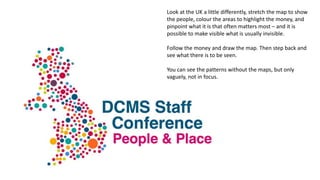
Look at the UK a little differently, stretch the map to show
the people, colour the areas to highlight the money, and
pinpoint what it is that often matters most – and it is
possible to make visible what is usually invisible.
Follow the money and draw the map. Then step back and
see what there is to be seen.
You can see the patterns without the maps, but only
vaguely, not in focus.
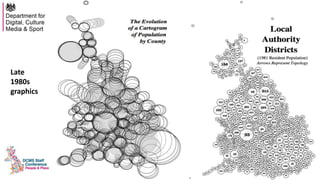
Late
1980s
graphics
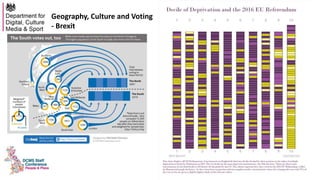
Geography, Culture and Voting
- Brexit
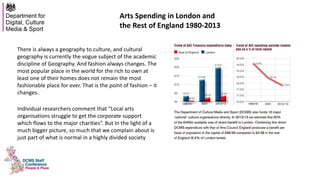
Arts Spending in London and
the Rest of England 1980-2013
There is always a geography to culture, and cultural
geography is currently the vogue subject of the academic
discipline of Geography. And fashion always changes. The
most popular place in the world for the rich to own at
least one of their homes does not remain the most
fashionable place for ever. That is the point of fashion – it
changes.
Individual researchers comment that “Local arts
organisations struggle to get the corporate support
which flows to the major charities”. But In the light of a
much bigger picture, so much that we complain about is
just part of what is normal in a highly divided society
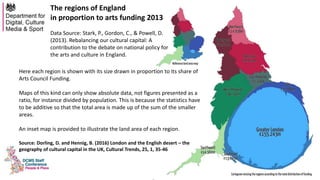
The regions of England
in proportion to arts funding 2013
Data Source: Stark, P., Gordon, C., & Powell, D.
(2013). Rebalancing our cultural capital: A
contribution to the debate on national policy for
the arts and culture in England.
Here each region is shown with its size drawn in proportion to its share of
Arts Council Funding.
Maps of this kind can only show absolute data, not figures presented as a
ratio, for instance divided by population. This is because the statistics have
to be additive so that the total area is made up of the sum of the smaller
areas.
An inset map is provided to illustrate the land area of each region.
Source: Dorling, D. and Hennig, B. (2016) London and the English desert – the
geography of cultural capital in the UK, Cultural Trends, 25, 1, 35-46
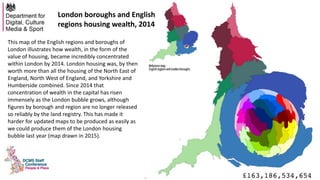
This map of the English regions and boroughs of
London illustrates how wealth, in the form of the
value of housing, became incredibly concentrated
within London by 2014. London housing was, by then
worth more than all the housing of the North East of
England, North West of England, and Yorkshire and
Humberside combined. Since 2014 that
concentration of wealth in the capital has risen
immensely as the London bubble grows, although
figures by borough and region are no longer released
so reliably by the land registry. This has made it
harder for updated maps to be produced as easily as
we could produce them of the London housing
bubble last year (map drawn in 2015).
London boroughs and English
regions housing wealth, 2014
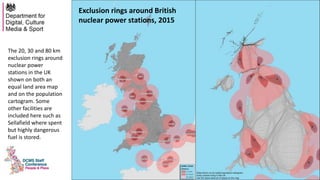
The 20, 30 and 80 km
exclusion rings around
nuclear power
stations in the UK
shown on both an
equal land area map
and on the population
cartogram. Some
other facilities are
included here such as
Sellafield where spent
but highly dangerous
fuel is stored.
Exclusion rings around British
nuclear power stations, 2015
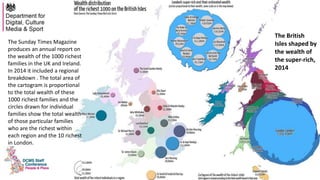
The Sunday Times Magazine
produces an annual report on
the wealth of the 1000 richest
families in the UK and Ireland.
In 2014 it included a regional
breakdown . The total area of
the cartogram is proportional
to the total wealth of these
1000 richest families and the
circles drawn for individual
families show the total wealth
of those particular families
who are the richest within
each region and the 10 richest
in London.
The British
Isles shaped by
the wealth of
the super-rich,
2014
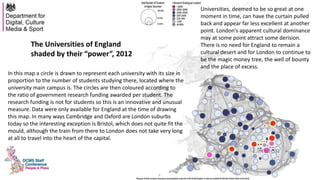
In this map a circle is drawn to represent each university with its size in
proportion to the number of students studying there, located where the
university main campus is. The circles are then coloured according to
the ratio of government research funding awarded per student. The
research funding is not for students so this is an innovative and unusual
measure. Data were only available for England at the time of drawing
this map. In many ways Cambridge and Oxford are London suburbs
today so the interesting exception is Bristol, which does not quite fit the
mould, although the train from there to London does not take very long
at all to travel into the heart of the capital.
The Universities of England
shaded by their “power”, 2012
Universities, deemed to be so great at one
moment in time, can have the curtain pulled
back and appear far less excellent at another
point. London’s apparent cultural dominance
may at some point attract some derision.
There is no need for England to remain a
cultural desert and for London to continue to
be the magic money tree, the well of bounty
and the place of excess.
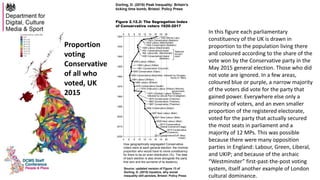
Proportion
voting
Conservative
of all who
voted, UK
2015
In this figure each parliamentary
constituency of the UK is drawn in
proportion to the population living there
and coloured according to the share of the
vote won by the Conservative party in the
May 2015 general election. Those who did
not vote are ignored. In a few areas,
coloured blue or purple, a narrow majority
of the voters did vote for the party that
gained power. Everywhere else only a
minority of voters, and an even smaller
proportion of the registered electorate,
voted for the party that actually secured
the most seats in parliament and a
majority of 12 MPs. This was possible
because there were many opposition
parties in England: Labour, Green, Liberal,
and UKIP; and because of the archaic
“Westminster” first-past-the-post voting
system, itself another example of London
cultural dominance.
4 6 8 10 12 14 16 18 20
4 6 8 10 12 14 16 18 20
1920
1930
1940
1950
1960
1970
1980
1990
2000
2010
2020
1922 (Bonar Law)
1923 Conservative (Baldwin)
1924 Labour (MacDonald)
1929 Labour (MacDonald)
1931 Conservative/Liberal/
Nat. Labour/etc. (MacDonald)
1935 Conservative/Liberal
(Baldwin)
1945 Labour (Attlee)
1950 Labour (Attlee)
1951 Conservative (Churchill)
1955 Conservative (Eden)
1959 Conservative (Macmillan, followed by Douglas-
Home in 1963)
1964 Labour (Wilson)
1966 Labour (Wilson)
1970 Conservative (Heath)
1974 (February) Labour (Wilson) Minority
government
1974 (October) Labour (Wilson),
followed by LibLab Pact (Callaghan)
1979 Conservative (Thatcher)
1983 Conservative (Thatcher)
1987 Conservative (Thatcher)
1992 Conservative (Major)
1997 New Labour (Blair)
2001 New Labour (Blair)
2005 New Labour (Blair)
2010 Conservative/
Liberal (Cameron/Clegg)
2015 Conservative
(Cameron)
2017 Conservative/DUP (May/
Foster)
1924 Conservative (Baldwin)
‘National
Govern-
ment’
Dorling, D. (2018) Peak Inequality: Britain's
ticking time bomb, Bristol: Policy Press
Figure 2.12.2: The Segregation Index
of Conservative voters 1920-2017
How geographically segregated Conservative
voters were at each general election: the minimal
proportion who would have to move constituency
for there to be an even distribution (%). The date
of each election is also show alongside the party
that won and the surname of its leader(s).
Source: updated version of Figure 13 of
Dorling, D. (2015) Injustice, why social
inequality still persists, Bristol: Policy Press
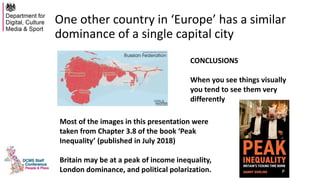
One other country in ‘Europe’ has a similar
dominance of a single capital city
CONCLUSIONS
When you see things visually
you tend to see them very
differently
Most of the images in this presentation were
taken from Chapter 3.8 of the book ‘Peak
Inequality’ (published in July 2018)
Britain may be at a peak of income inequality,
London dominance, and political polarization.

Cultural Geography

  • 1.
    Cultural GeographyDanny Dorling Wembley8th May 2018 Dorling, D. (2018) Cultural Geography, Opening keynote, Department for Digital, Culture, Media and Sport annual awayday, Wembley Stadium, London, May 8th
  • 2.
    Look at theUK a little differently, stretch the map to show the people, colour the areas to highlight the money, and pinpoint what it is that often matters most – and it is possible to make visible what is usually invisible. Follow the money and draw the map. Then step back and see what there is to be seen. You can see the patterns without the maps, but only vaguely, not in focus.
  • 3.
  • 4.
    Geography, Culture andVoting - Brexit
  • 5.
    Arts Spending inLondon and the Rest of England 1980-2013 There is always a geography to culture, and cultural geography is currently the vogue subject of the academic discipline of Geography. And fashion always changes. The most popular place in the world for the rich to own at least one of their homes does not remain the most fashionable place for ever. That is the point of fashion – it changes. Individual researchers comment that “Local arts organisations struggle to get the corporate support which flows to the major charities”. But In the light of a much bigger picture, so much that we complain about is just part of what is normal in a highly divided society
  • 6.
    The regions ofEngland in proportion to arts funding 2013 Data Source: Stark, P., Gordon, C., & Powell, D. (2013). Rebalancing our cultural capital: A contribution to the debate on national policy for the arts and culture in England. Here each region is shown with its size drawn in proportion to its share of Arts Council Funding. Maps of this kind can only show absolute data, not figures presented as a ratio, for instance divided by population. This is because the statistics have to be additive so that the total area is made up of the sum of the smaller areas. An inset map is provided to illustrate the land area of each region. Source: Dorling, D. and Hennig, B. (2016) London and the English desert – the geography of cultural capital in the UK, Cultural Trends, 25, 1, 35-46
  • 7.
    This map ofthe English regions and boroughs of London illustrates how wealth, in the form of the value of housing, became incredibly concentrated within London by 2014. London housing was, by then worth more than all the housing of the North East of England, North West of England, and Yorkshire and Humberside combined. Since 2014 that concentration of wealth in the capital has risen immensely as the London bubble grows, although figures by borough and region are no longer released so reliably by the land registry. This has made it harder for updated maps to be produced as easily as we could produce them of the London housing bubble last year (map drawn in 2015). London boroughs and English regions housing wealth, 2014
  • 8.
    The 20, 30and 80 km exclusion rings around nuclear power stations in the UK shown on both an equal land area map and on the population cartogram. Some other facilities are included here such as Sellafield where spent but highly dangerous fuel is stored. Exclusion rings around British nuclear power stations, 2015
  • 9.
    The Sunday TimesMagazine produces an annual report on the wealth of the 1000 richest families in the UK and Ireland. In 2014 it included a regional breakdown . The total area of the cartogram is proportional to the total wealth of these 1000 richest families and the circles drawn for individual families show the total wealth of those particular families who are the richest within each region and the 10 richest in London. The British Isles shaped by the wealth of the super-rich, 2014
  • 10.
    In this mapa circle is drawn to represent each university with its size in proportion to the number of students studying there, located where the university main campus is. The circles are then coloured according to the ratio of government research funding awarded per student. The research funding is not for students so this is an innovative and unusual measure. Data were only available for England at the time of drawing this map. In many ways Cambridge and Oxford are London suburbs today so the interesting exception is Bristol, which does not quite fit the mould, although the train from there to London does not take very long at all to travel into the heart of the capital. The Universities of England shaded by their “power”, 2012 Universities, deemed to be so great at one moment in time, can have the curtain pulled back and appear far less excellent at another point. London’s apparent cultural dominance may at some point attract some derision. There is no need for England to remain a cultural desert and for London to continue to be the magic money tree, the well of bounty and the place of excess.
  • 11.
    Proportion voting Conservative of all who voted,UK 2015 In this figure each parliamentary constituency of the UK is drawn in proportion to the population living there and coloured according to the share of the vote won by the Conservative party in the May 2015 general election. Those who did not vote are ignored. In a few areas, coloured blue or purple, a narrow majority of the voters did vote for the party that gained power. Everywhere else only a minority of voters, and an even smaller proportion of the registered electorate, voted for the party that actually secured the most seats in parliament and a majority of 12 MPs. This was possible because there were many opposition parties in England: Labour, Green, Liberal, and UKIP; and because of the archaic “Westminster” first-past-the-post voting system, itself another example of London cultural dominance. 4 6 8 10 12 14 16 18 20 4 6 8 10 12 14 16 18 20 1920 1930 1940 1950 1960 1970 1980 1990 2000 2010 2020 1922 (Bonar Law) 1923 Conservative (Baldwin) 1924 Labour (MacDonald) 1929 Labour (MacDonald) 1931 Conservative/Liberal/ Nat. Labour/etc. (MacDonald) 1935 Conservative/Liberal (Baldwin) 1945 Labour (Attlee) 1950 Labour (Attlee) 1951 Conservative (Churchill) 1955 Conservative (Eden) 1959 Conservative (Macmillan, followed by Douglas- Home in 1963) 1964 Labour (Wilson) 1966 Labour (Wilson) 1970 Conservative (Heath) 1974 (February) Labour (Wilson) Minority government 1974 (October) Labour (Wilson), followed by LibLab Pact (Callaghan) 1979 Conservative (Thatcher) 1983 Conservative (Thatcher) 1987 Conservative (Thatcher) 1992 Conservative (Major) 1997 New Labour (Blair) 2001 New Labour (Blair) 2005 New Labour (Blair) 2010 Conservative/ Liberal (Cameron/Clegg) 2015 Conservative (Cameron) 2017 Conservative/DUP (May/ Foster) 1924 Conservative (Baldwin) ‘National Govern- ment’ Dorling, D. (2018) Peak Inequality: Britain's ticking time bomb, Bristol: Policy Press Figure 2.12.2: The Segregation Index of Conservative voters 1920-2017 How geographically segregated Conservative voters were at each general election: the minimal proportion who would have to move constituency for there to be an even distribution (%). The date of each election is also show alongside the party that won and the surname of its leader(s). Source: updated version of Figure 13 of Dorling, D. (2015) Injustice, why social inequality still persists, Bristol: Policy Press
  • 12.
    One other countryin ‘Europe’ has a similar dominance of a single capital city CONCLUSIONS When you see things visually you tend to see them very differently Most of the images in this presentation were taken from Chapter 3.8 of the book ‘Peak Inequality’ (published in July 2018) Britain may be at a peak of income inequality, London dominance, and political polarization.