The Rowing Ergometer; It’s
Relevance to Training and Testing
                      Ivan Hooper
             M.Phty.St (Sports), B.Sc (HMS)
   AIS Sports Physiotherapist & RA SSSM Coordinator
Relevance to Training and Testing


                1. Discussion of some fundamentals
                   about the rowing ergometer

                2. Presentation of Drag Factor study
                   results

                3. Advice & recommendations


                  I AM NOT HERE TO TELL YOU TO
                  STOP USING THE ERGOMETER!
The Rowing Ergometer

  Does it accurately reflect what happens on water?
     –   Kleshnev (2001, 2003, 2005) lists six key differences

            1.   Stroke rate is always 10-15% lower *
            2.   The stroke length is 3-5% longer *
            3.   Handle force has a higher peak and develops later
            4.   Handle and footstretcher forces nearly equal as opposed to
                 footstretcher force on water being 30% higher
            5.   Difference in the timing of stretcher and handle forces *
            6.   Maximal legs velocity is lower on an ergometer *

          * a dynamic ergometer significantly alters or eliminates this difference

          “Rowers with fast legs produce more power on water, while athletes
          with slower legs and stronger upper bodies have relatively higher ergo
          scores”
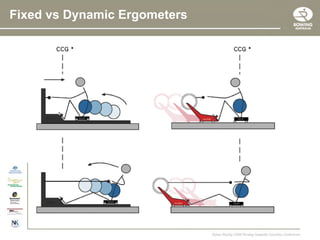
Fixed vs Dynamic Ergometers
Men’s Coxless Four
The rowing ergometer


                       • While static ergometers may
                         have been useful for training
                         physical fitness, they may also
                         adversely alter the coordination
                         of the muscles used in on water
                         rowing. (Elliot, 2002)
Fixed vs Dynamic Ergometers

    •   Bernstein et al, 2002
         – Athletes rowed average 53mm longer on a fixed
           ergometer
         – As pieces progressed, there was an increase in stroke
           length at the catch on a fixed ergometer
         – The mean forces developed during the power phase were
           significantly higher with the fixed ergometer
    •   Colloud et al, 2006
         – Rowing on a dynamic ergometer seems to require
           different muscular coordination to produce external force
           contact patterns
         – The lower catch and maximum values for external contact
           forces on a dynamic ergometer could decrease the risk
           factors for injuries
Ergometer Use and Low Back Pain

    •   Teitz et al, 2002
         – Ergometer training for longer than 30 mins was the most
            significant and consistent predictor of back pain for all age
            groups
    •   Holt et al 2003
         – 5% increase in lumbar flexion during a one hour ergometer
            at training intensities
         – Attributed to fatigue of the lumbar muscles
    •   Reid & McNair, 2000
         – The combination of lumbar flexion and muscular fatigue
            has long been identified as a cause of lumbar spine injury
            amongst rowers
Ergometer Use and Low Back Pain

    •   Bernstein et al, 2002
         – In elite rowers, land based training carries a 10-fold higher
           risk of injury per hour than water based training, the
           leading causes suggested being weights and ergometer
           training
    •   Wilson et al, 2008
         – Time spent ergometer training had the most significant
           impact on injury risk
         – This confirms biomechanical observations that the loading
           to the joints in ergometer sessions is different to the
           patterns seen on water
         – Nov, Dec & Jan highest months for injuries and this is
           related to high volumes of land training during winter
           months
If we can confidently say that the
  ergometer is not the same as on
water rowing, and that it is clearly
linked to injury, isn’t it time we did
        something about it?
The effect of manipulating drag factor and
     Concept II sliders on stroke rate

      Scott Coleman1, Margy Galloway1, Ivan Hooper2,
            Angela McCoombe1, Mark Osbourne3

      1. Biomechanics Dept, Australian Institute of Sport
   2. Physical Therapies Dept, Australian Institute of Sport
      3. Sports Science, Queensland Academy of Sport
Background


             •   Ergometer testing is often completed
                 at stroke rates well below on water
                 race pace

             •   Many athletes report the current drag
                 factor (DF) settings feel too heavy

             •   Many coaches now prescribe
                 ergometer training at lower DF’s

             •   There is increased interest in using
                 the Concept II sliders as training tools
What Do Crews Rate?


               2007 World Championships
       Class        SR         Class      SR

        M8+          40        W8+        39.1

        M4-         40.5       W4x        37.4

        M4x         39.3       W2x        35.9

        M2x         38.2       W2-        37.4

        M2-         38.8       W1x        34.1

        M1x         36.3       LW2x       36.1

       LM4-         40.6

       LM2x         38.8
The Current Situation


    • What are the current settings?
            Category    Drag Factor
              HM           130
              HW           120
              LM           120
              LW           110

    • Where did these come from?
Study Concept

    • Small study designed to add some knowledge to
      the following questions:

       – Are the current drag factor settings appropriate?
       – What effect do Concept II sliders have on stroke rate?
       – Can we manipulate DF +/- sliders to get stroke rate closer
         to on water race rates?
       – Are Concept II sliders a reliable form of testing?
On Water vs Ergometer?


               • Can we compare forces?

               • Assumption
                 – If we manipulate variables to get
                   rate similar to on water racing, then
                   forces must be close to similar
Study

    • 7 x 500m pieces at variable drag factors
        – 3 @ 80% 2000m PB wattage
        – 4 @ 100% 2000m PB wattage
    • Manipulation of DF outlined below
                    Study Settings
                    DF 1      DF 2    DF 3
            HM      130        115    100
            HW      120        105    90
            LM      120        105    90
            LW      110        100    90

    • Testing order was randomised for each subject
    • Done on fixed Concept II and on Sliders one week
      apart
Subjects


                                        Study Subjects
       Category               No                                   Crew
           HM                  4a                          Olympic Men's 4-
                               1                            Sen A Men's 2+
                               4                             U/23 Men's 4x
           HW                  4b                          U/23 Women's 4-
                               4                       WUG Women’s 2x, 4-
           LW                  3                       Sen A Women's LW4x
    a) 1 athlete completed both sessions on sliders, 1 athlete didn’t do sliders
    b) 1 athlete didn’t complete sliders
Results


    • Mean rates for current settings

           Study Results             WC Results

     Category    Group mean     Sculling        Sweep

          HM         29.8       36.3 (17.9%)   38.8 (23.2%)

          HW         28.4       34.1 (16.7%)   37.4 (24.1%)

          LW         31.3       36.1 (13.3%)
Results

                                           Sub Max Fixed Ergo
          Stroke Rate (spm)   30

                              28

                              26
                                                                         HMA
                              24
                                                                         HMB
                              22
                                                                         HWB
                              20
                                                                         HWUG
                              18                                         LWA
                              16

                              14
                                   D F1         D F2              D F3


                                          Sub Max Dynam ic Ergo
                              30
          Stroke Rate (spm)


                              28

                              26

                              24                                         HMA
                                                                         HMB
                              22
                                                                         HWB
                              20
                                                                         HWUG
                              18                                         LWA
                              16

                              14
                                   D F1         D F2              D F3
Results

                                           Fixed Race Pace
                               38
                               37
          Stroke Rate (spm)    36
                               35
                               34                                    HM
                               33                                    HW
                               32
                               31                                    LW
                               30
                               29
                               28
                                    DF1        DF2             DF3


                                          Dynam ic Race Pace
                               38
                               37
           Stroke Rate (spm)


                               36
                               35
                               34                                    HM
                               33                                    HW
                               32
                               31                                    LW
                               30
                               29
                               28
                                    DF1         DF2            DF3
Results

    • Most athletes subjectively reported that they found
      the lightest setting too light compared to the feel of
      “on water rowing”


                                        Com bined FE vs DE
                          40
      Stroke Rate (spm)


                          38
                          36                                   HM A
                          34                                   HM B
                          32                                   HWB
                          30                                   HWUG
                          28                                   LWA

                          26
                               FE DF1                 DE DF2
Results


                             Comparative Data


                                  Fixed Ergo     Fixed Ergo     Dynamic Ergo
                WC         WC
    Category                      Current Drag   Lighter Drag    Lighter Drag
               Sculling   Sweep
                                     (DF1)          (DF 2)          (DF 2)


      HM        36.3      38.8       29.8          30.23            36.4


      HW        34.1      37.4       28.4          29.82             35


      LW        36.1                 31.3          29.75            31.3
Results


    • Error measurements
                    Time      %

           Fixed   0.4 sec   0.4

          Dynamic 0.58 sec   0.58


    • Well within current accepted error
      measurements for stationary ergometer
Recommendations


                  • Change to the following DF’s

                      Category     Drag Factor

                         HM            115

                         HW            105

                          LM           105

                         LW            100

                  • Test on sliders
                  • Train on sliders
Thanks To:


     •   All the subjects
     •   Tim Conrad
     •   Ellen Randell
     •   Lincoln Handley
     •   Peter Howard
     •   Alan Bennett
     •   Phil Gardiner & Sykes Racing
What Would Change?

    •   Marsden, 2006
         – Comparison between physiological variables on fixed vs
           slider Concept II
         – No differences in curves, thresholds, peak metabolic data
           (n=4)
         – Mean 4.6 secs quicker on sliders (n=11)
         – Mean 5.3 points higher in rate on sliders (n=11)

    •   Mahony et al, 1999
         – No physiological differences during incremental rowing on
           a fixed and dynamic ergometer

    •   Kane et al, 2008
         – No significant differences in physiological variables with
           altering drag factors
What Would Change?


    • Perhaps a test that is more predictive of on
      water performance??

    • A training tool that may be closer to
      enhancing the correct skill pattern??

    • Likely decrease in low back injury rates!!
Reference List

    1. Bernstein, I. A., O. Webber, et al. (2002). "An ergonomic comparison of rowing machine designs: possible
        implications for safety." Br J Sports Med 36(2): 108-12.
    2. Colloud, F., P. Bahuaud, et al. (2006). "Fixed versus free-floating stretcher mechanism in rowing ergometers:
        Mechanical aspects." Journal of Sports Sciences 24(5): 479 - 493.
    3. Dudhia, A. (1999). "The physics of rowing: dynamic vs static ergometers." from
        http://www.atm.ox.ac.uk/rowing/physics/index.html.
    4. Elliott, B., A. Lyttle, et al. (2002). "The RowPerfect ergometer: a training aid for on-water single scull rowing." Sports
        Biomechanics 1(2): 123-134.
    5. Hollinger, N. R., I. Marchand, et al. (1995). A comparison of kinematic and kinetic performance among athletes
        during ergometer rowing. Aviron Canada Rowing. 1995: 9-13.
    6. Holt, P. J. E., A. M. J. Bull, et al. (2003). "Kinematics of Spinal Motion During Prolonged Rowing." International
        Journal of Sports Medicine(8): 597-602.
    7. Howell, D. W. (1984). "Musculoskeletal profile and incidence of musculoskeletal injuries in lightweight women
        rowers." Am J Sports Med 12(4): 278-82.
    8. Kane, D. A., R. L. Jensen, et al. (2008). "Effects of Drag Factor on Physiological Aspects of Rowing." International
        Journal of Sports Medicine(5): 390-394.
    9. Kelshnev, V. (2003). Discussion of ergometer rowing vs on water rowing. Rowing Biomechanics Newsletter. 3: 1.
    10. Kelshnev, V. (2005). Discussion of ergometer rowing vs on water rowing. Rowing Biomechanics Newsletter. 5: 1.
    11. Kleshnev, V. (2001). Discussion of ergometer rowing vs on water rowing. Rowing Biomechanics Newsletter. 1: 1.
    12. Lamb, D. H. (1989). "A kinematic comparison of ergometer and on-water rowing." Am J Sports Med 17(3): 367-73.
    13. Mahony, N., B. Donne, et al. (1999). "A comparison of physiological responses to rowing on friction-loaded and air-
        braked ergometers." J Sports Sci 17(2): 143-9.
    14. Marsden, J. (2006). 2 in 1 Results: Slider vs fixed Concept II. NSWIS Rowing Coaches Workshop. Sydney.
    15. Reid, D. A. and P. J. McNair (2000). "Factors contributing to low back pain in rowers." Br J Sports Med 34(5): 321-2.
    16. Rumball, J. S., C. M. Lebrun, et al. (2005). "Rowing injuries." Sports Med 35(6): 537-55.
    17. Teitz, C. C., J. O'Kane, et al. (2002). "Back pain in intercollegiate rowers." Am J Sports Med 30(5): 674-9.
    18. Wilson, F., C. Gissane, et al. (2008). "A 12 month prospective cohort study of injury in international rowers." Br J
        Sports Med.

Rowing ergometers as an aide to on-water training pros and cons

  • 1.
    The Rowing Ergometer;It’s Relevance to Training and Testing Ivan Hooper M.Phty.St (Sports), B.Sc (HMS) AIS Sports Physiotherapist & RA SSSM Coordinator
  • 2.
    Relevance to Trainingand Testing 1. Discussion of some fundamentals about the rowing ergometer 2. Presentation of Drag Factor study results 3. Advice & recommendations I AM NOT HERE TO TELL YOU TO STOP USING THE ERGOMETER!
  • 3.
    The Rowing Ergometer Does it accurately reflect what happens on water? – Kleshnev (2001, 2003, 2005) lists six key differences 1. Stroke rate is always 10-15% lower * 2. The stroke length is 3-5% longer * 3. Handle force has a higher peak and develops later 4. Handle and footstretcher forces nearly equal as opposed to footstretcher force on water being 30% higher 5. Difference in the timing of stretcher and handle forces * 6. Maximal legs velocity is lower on an ergometer * * a dynamic ergometer significantly alters or eliminates this difference “Rowers with fast legs produce more power on water, while athletes with slower legs and stronger upper bodies have relatively higher ergo scores”
  • 4.
    Fixed vs DynamicErgometers
  • 5.
  • 6.
    The rowing ergometer • While static ergometers may have been useful for training physical fitness, they may also adversely alter the coordination of the muscles used in on water rowing. (Elliot, 2002)
  • 7.
    Fixed vs DynamicErgometers • Bernstein et al, 2002 – Athletes rowed average 53mm longer on a fixed ergometer – As pieces progressed, there was an increase in stroke length at the catch on a fixed ergometer – The mean forces developed during the power phase were significantly higher with the fixed ergometer • Colloud et al, 2006 – Rowing on a dynamic ergometer seems to require different muscular coordination to produce external force contact patterns – The lower catch and maximum values for external contact forces on a dynamic ergometer could decrease the risk factors for injuries
  • 8.
    Ergometer Use andLow Back Pain • Teitz et al, 2002 – Ergometer training for longer than 30 mins was the most significant and consistent predictor of back pain for all age groups • Holt et al 2003 – 5% increase in lumbar flexion during a one hour ergometer at training intensities – Attributed to fatigue of the lumbar muscles • Reid & McNair, 2000 – The combination of lumbar flexion and muscular fatigue has long been identified as a cause of lumbar spine injury amongst rowers
  • 9.
    Ergometer Use andLow Back Pain • Bernstein et al, 2002 – In elite rowers, land based training carries a 10-fold higher risk of injury per hour than water based training, the leading causes suggested being weights and ergometer training • Wilson et al, 2008 – Time spent ergometer training had the most significant impact on injury risk – This confirms biomechanical observations that the loading to the joints in ergometer sessions is different to the patterns seen on water – Nov, Dec & Jan highest months for injuries and this is related to high volumes of land training during winter months
  • 10.
    If we canconfidently say that the ergometer is not the same as on water rowing, and that it is clearly linked to injury, isn’t it time we did something about it?
  • 11.
    The effect ofmanipulating drag factor and Concept II sliders on stroke rate Scott Coleman1, Margy Galloway1, Ivan Hooper2, Angela McCoombe1, Mark Osbourne3 1. Biomechanics Dept, Australian Institute of Sport 2. Physical Therapies Dept, Australian Institute of Sport 3. Sports Science, Queensland Academy of Sport
  • 12.
    Background • Ergometer testing is often completed at stroke rates well below on water race pace • Many athletes report the current drag factor (DF) settings feel too heavy • Many coaches now prescribe ergometer training at lower DF’s • There is increased interest in using the Concept II sliders as training tools
  • 13.
    What Do CrewsRate? 2007 World Championships Class SR Class SR M8+ 40 W8+ 39.1 M4- 40.5 W4x 37.4 M4x 39.3 W2x 35.9 M2x 38.2 W2- 37.4 M2- 38.8 W1x 34.1 M1x 36.3 LW2x 36.1 LM4- 40.6 LM2x 38.8
  • 14.
    The Current Situation • What are the current settings? Category Drag Factor HM 130 HW 120 LM 120 LW 110 • Where did these come from?
  • 15.
    Study Concept • Small study designed to add some knowledge to the following questions: – Are the current drag factor settings appropriate? – What effect do Concept II sliders have on stroke rate? – Can we manipulate DF +/- sliders to get stroke rate closer to on water race rates? – Are Concept II sliders a reliable form of testing?
  • 16.
    On Water vsErgometer? • Can we compare forces? • Assumption – If we manipulate variables to get rate similar to on water racing, then forces must be close to similar
  • 17.
    Study • 7 x 500m pieces at variable drag factors – 3 @ 80% 2000m PB wattage – 4 @ 100% 2000m PB wattage • Manipulation of DF outlined below Study Settings DF 1 DF 2 DF 3 HM 130 115 100 HW 120 105 90 LM 120 105 90 LW 110 100 90 • Testing order was randomised for each subject • Done on fixed Concept II and on Sliders one week apart
  • 18.
    Subjects Study Subjects Category No Crew HM 4a Olympic Men's 4- 1 Sen A Men's 2+ 4 U/23 Men's 4x HW 4b U/23 Women's 4- 4 WUG Women’s 2x, 4- LW 3 Sen A Women's LW4x a) 1 athlete completed both sessions on sliders, 1 athlete didn’t do sliders b) 1 athlete didn’t complete sliders
  • 19.
    Results • Mean rates for current settings Study Results WC Results Category Group mean Sculling Sweep HM 29.8 36.3 (17.9%) 38.8 (23.2%) HW 28.4 34.1 (16.7%) 37.4 (24.1%) LW 31.3 36.1 (13.3%)
  • 20.
    Results Sub Max Fixed Ergo Stroke Rate (spm) 30 28 26 HMA 24 HMB 22 HWB 20 HWUG 18 LWA 16 14 D F1 D F2 D F3 Sub Max Dynam ic Ergo 30 Stroke Rate (spm) 28 26 24 HMA HMB 22 HWB 20 HWUG 18 LWA 16 14 D F1 D F2 D F3
  • 21.
    Results Fixed Race Pace 38 37 Stroke Rate (spm) 36 35 34 HM 33 HW 32 31 LW 30 29 28 DF1 DF2 DF3 Dynam ic Race Pace 38 37 Stroke Rate (spm) 36 35 34 HM 33 HW 32 31 LW 30 29 28 DF1 DF2 DF3
  • 22.
    Results • Most athletes subjectively reported that they found the lightest setting too light compared to the feel of “on water rowing” Com bined FE vs DE 40 Stroke Rate (spm) 38 36 HM A 34 HM B 32 HWB 30 HWUG 28 LWA 26 FE DF1 DE DF2
  • 23.
    Results Comparative Data Fixed Ergo Fixed Ergo Dynamic Ergo WC WC Category Current Drag Lighter Drag Lighter Drag Sculling Sweep (DF1) (DF 2) (DF 2) HM 36.3 38.8 29.8 30.23 36.4 HW 34.1 37.4 28.4 29.82 35 LW 36.1 31.3 29.75 31.3
  • 24.
    Results • Error measurements Time % Fixed 0.4 sec 0.4 Dynamic 0.58 sec 0.58 • Well within current accepted error measurements for stationary ergometer
  • 25.
    Recommendations • Change to the following DF’s Category Drag Factor HM 115 HW 105 LM 105 LW 100 • Test on sliders • Train on sliders
  • 26.
    Thanks To: • All the subjects • Tim Conrad • Ellen Randell • Lincoln Handley • Peter Howard • Alan Bennett • Phil Gardiner & Sykes Racing
  • 27.
    What Would Change? • Marsden, 2006 – Comparison between physiological variables on fixed vs slider Concept II – No differences in curves, thresholds, peak metabolic data (n=4) – Mean 4.6 secs quicker on sliders (n=11) – Mean 5.3 points higher in rate on sliders (n=11) • Mahony et al, 1999 – No physiological differences during incremental rowing on a fixed and dynamic ergometer • Kane et al, 2008 – No significant differences in physiological variables with altering drag factors
  • 28.
    What Would Change? • Perhaps a test that is more predictive of on water performance?? • A training tool that may be closer to enhancing the correct skill pattern?? • Likely decrease in low back injury rates!!
  • 30.
    Reference List 1. Bernstein, I. A., O. Webber, et al. (2002). "An ergonomic comparison of rowing machine designs: possible implications for safety." Br J Sports Med 36(2): 108-12. 2. Colloud, F., P. Bahuaud, et al. (2006). "Fixed versus free-floating stretcher mechanism in rowing ergometers: Mechanical aspects." Journal of Sports Sciences 24(5): 479 - 493. 3. Dudhia, A. (1999). "The physics of rowing: dynamic vs static ergometers." from http://www.atm.ox.ac.uk/rowing/physics/index.html. 4. Elliott, B., A. Lyttle, et al. (2002). "The RowPerfect ergometer: a training aid for on-water single scull rowing." Sports Biomechanics 1(2): 123-134. 5. Hollinger, N. R., I. Marchand, et al. (1995). A comparison of kinematic and kinetic performance among athletes during ergometer rowing. Aviron Canada Rowing. 1995: 9-13. 6. Holt, P. J. E., A. M. J. Bull, et al. (2003). "Kinematics of Spinal Motion During Prolonged Rowing." International Journal of Sports Medicine(8): 597-602. 7. Howell, D. W. (1984). "Musculoskeletal profile and incidence of musculoskeletal injuries in lightweight women rowers." Am J Sports Med 12(4): 278-82. 8. Kane, D. A., R. L. Jensen, et al. (2008). "Effects of Drag Factor on Physiological Aspects of Rowing." International Journal of Sports Medicine(5): 390-394. 9. Kelshnev, V. (2003). Discussion of ergometer rowing vs on water rowing. Rowing Biomechanics Newsletter. 3: 1. 10. Kelshnev, V. (2005). Discussion of ergometer rowing vs on water rowing. Rowing Biomechanics Newsletter. 5: 1. 11. Kleshnev, V. (2001). Discussion of ergometer rowing vs on water rowing. Rowing Biomechanics Newsletter. 1: 1. 12. Lamb, D. H. (1989). "A kinematic comparison of ergometer and on-water rowing." Am J Sports Med 17(3): 367-73. 13. Mahony, N., B. Donne, et al. (1999). "A comparison of physiological responses to rowing on friction-loaded and air- braked ergometers." J Sports Sci 17(2): 143-9. 14. Marsden, J. (2006). 2 in 1 Results: Slider vs fixed Concept II. NSWIS Rowing Coaches Workshop. Sydney. 15. Reid, D. A. and P. J. McNair (2000). "Factors contributing to low back pain in rowers." Br J Sports Med 34(5): 321-2. 16. Rumball, J. S., C. M. Lebrun, et al. (2005). "Rowing injuries." Sports Med 35(6): 537-55. 17. Teitz, C. C., J. O'Kane, et al. (2002). "Back pain in intercollegiate rowers." Am J Sports Med 30(5): 674-9. 18. Wilson, F., C. Gissane, et al. (2008). "A 12 month prospective cohort study of injury in international rowers." Br J Sports Med.