Epilepsy in Australian Shepherd Dogs

        Valeria Rivera1,2, Katie M. Minor B.A3; Eva Furrow V.M.D., Edward (Ned)
                                 Patterson D.V.M., Ph.D.3

   1.University of Minnesota, Life Sciences Summer Undergraduate Research Program:
                                    Heart, Lung, & Blood
                          2.University of Puerto Rico at Cayey
     3. Department of Veterinary Clinical Sciences, University of Minnesota College of
                            Veterinary Medicine, St. Paul, MN.


   Abstract

          Idiopathic epilepsy implies having recurrent seizures in which no anomaly is
   known. It is a common disorder that affects about 4% of dogs and 1% of people.
   Previous Whole Genome Analysis showed statistical association of single nucleotide
   polymorphism (SNP) with Epilepsy in a study of 40 Australian shepherd dogs
   (Aussies) on loci of CFA1 and CFA19. This research further evaluated SNPs between
   epileptic and non-epileptic Aussies.
        The major objectives of this portion of the study were to confirm the statistical
   associations observed on CFA1 and CFA19 in additional case and control Aussies via
   PCR-RFLP tests and to sequence one candidate gene, DOK6. Two PCR-RFLP SNP
   tests were performed on 88 additional Aussies to compare their genotype
   frequencies by Chi-square statistical analysis. Sequencing of DOK6 was performed
   on one case and one control Aussie.
         By studying the SNPs in Aussies, we confirmed different genotype frequencies
   between normal and affected dogs on canine chromosomes 1 and 19 indicating
   possible causative genes in each location. Sequencing of DOK6 did not show any
   polymorphisms in the exons (coding regions).

   Key words: Epilepsy, canines, genetic basis, SNPs, and Australian Shepherds.

                                                          condition. Some studies suggest that ion
Introduction                                              channel genes cause epilepsy for many of
                                                          the human forms. The known human
       Epilepsy is a brain disorder of                    mutations have not shown to be the cause
abnormal electrical signals that cause                    in four dog breeds (Ekenstedt et al. 2011).
seizures. It varies in severity and is                    Breeds such as Bernese Mountain dogs,
common in children and adults.                            Vizslas,   Labrador    Retrievers,     and
Idiopathic    Epilepsy    (IE)   involves                 Australian Shepherds have a high
recurrent seizures in which no underlying                 incidence of epilepsy. For this study,
abnormality can be identified (Patterson                  Australian Shepherds were chosen
et al. 2003). Each year 200,000 new                       because of their high frequency of
human cases are diagnosed, being the                      epilepsy that appears to be inherited
second most common neurological                           based on pedigree analysis.             As


                                                                                                1
generations pass, there are some genes in       G is strongly associated with epilepsy.
close physical proximity on the same            Chromosome 1 has one of the associated
chromosome that do not recombine and            SNPs between C and T, with C being
are in what is called linkage                   strongly associated with epilepsy. The
disequilibrium (LD). In regions of LD           SNP BICF2G63036912 on CFA19 is
there is a haplotype that is shared             located at 13,956,701 bp of the
between closely related breeds and              chromosome         and       the       SNP
common ancestors. Long LD allows many           BICF2G630711334 on CFA1 is located at
fewer genetic markers and cases to be           12,632,317 bps. On the canine SNP array,
used for genome wide association studies        there is on average one SNP every
in dogs compared to people (Sutter et al.       14,000bp in the total of 2.4 billion bps of
2004). Breeds that have passed through          the canine genome.
population bottlenecks are prone to carry               DOK6 is a gene located in
more recessive traits since inbreeding is       chromosome 1 that is very near some of
frequently employed. As a result,               the associated SNP markers. It has 8
inbreeding may be responsible for               coding exons. Our objective was to
common diseases in these breeds.                perform Chi-square analysis for 88
Diseases include cancer, epilepsy,              additional Australian Shepherds for two
deafness, and heart diseases.                   of the associated SNPs to determine if the
        Whole genome association (WGA)          original association was real or only by
is a technique that examines the genome         chance. A second objective was to
of different individuals searching for          determine if there are any coding
differences among them. DNA samples             mutations in DOK6 for epilepsy in
are placed on a crystal chip that               Australian Shepherds. The overall
genotypes 170,000 canine SNPs. A SNP is         hypothesis of this work is that there is
a single nucleotide polymorphism, a             one or more epilepsy causing mutations
difference in base pairs when a single          in these specific regions of canine
nucleotide is altered at a specific location.   chromosomes 1 and/or 19.
The lab team performed previous work
(WGA) for 40 Australian Shepherds in            Figure 1: Aussies Chi-square test
which they established that there is a
possibility of one or two genes that cause
epilepsy in this breed.
        These genes are likely to be at
specific locations on canine chromosomes
1 (CFA1) and/or CFA19, based on Chi-
square analysis of the data and the
resulting p-values. To obtain this data,
they tested 19 affected dogs and 21
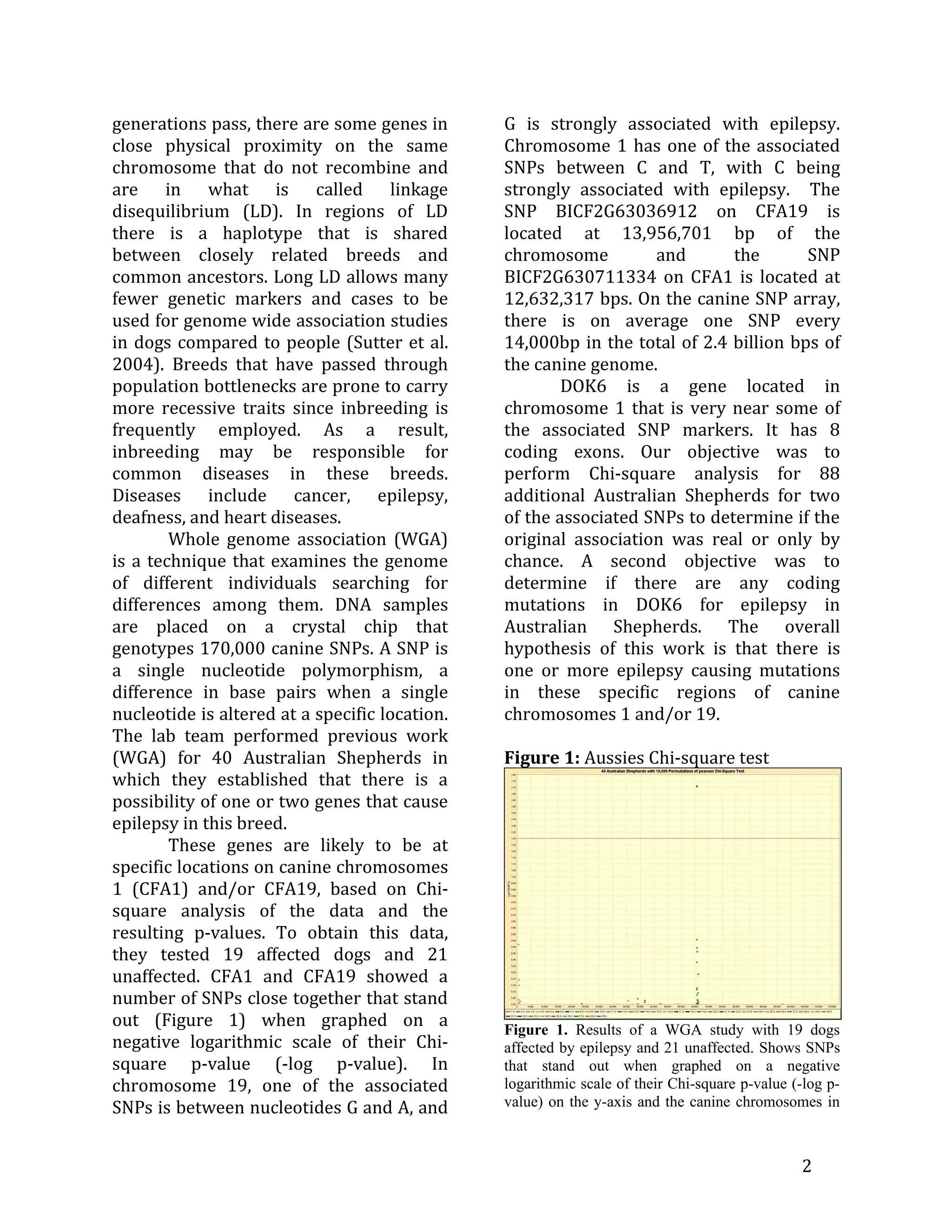
unaffected. CFA1 and CFA19 showed a
number of SNPs close together that stand
out (Figure 1) when graphed on a                Figure 1. Results of a WGA study with 19 dogs
negative logarithmic scale of their Chi-        affected by epilepsy and 21 unaffected. Shows SNPs
square p-value (-log p-value). In               that stand out when graphed on a negative
chromosome 19, one of the associated            logarithmic scale of their Chi-square p-value (-log p-
SNPs is between nucleotides G and A, and        value) on the y-axis and the canine chromosomes in


                                                                                               2
order on the x-axis. These are in CFA1 (pink) and in   when the sequence T G A T C is present.
CFA19 (green). CFA19 has one that is statistically     Where as BsmI (CFA19) recognizes
significant being over 1.3, equivalent to a p-value
less than 0.05.                                        nucleotide G and will cut there every time
                                                       the sequence G C A T C is present. For
Materials and Methods                                  CFA1 RFLP, 8 units (2µL) of sau3AI were
                                                       used along with NEB 1(2µL), BSA (0.2µL),
        Dog DNA samples were collected                 and water (10.8µL). The 8 unit master
along with their medical information.                  mix (15µL) was pipetted into PCR
Affected dogs must have had their first                product to digest overnight at 37°C hold.
seizure before 6 years, whereas normal                 For CFA19, 5 units of the enzyme BmsI
dogs were at least 8 years without a                   (0.5µL) were used leaving it digest for 3
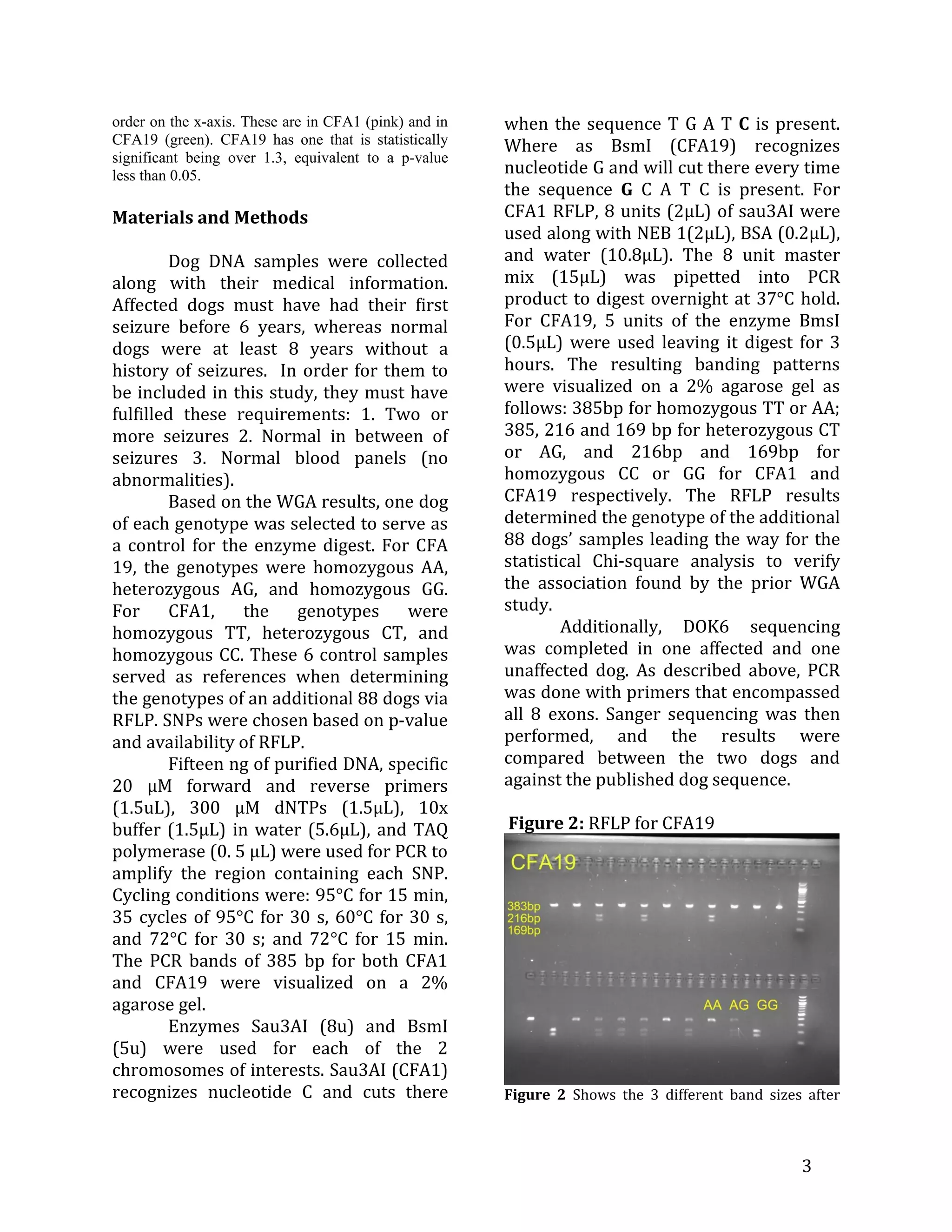
history of seizures. In order for them to              hours. The resulting banding patterns
be included in this study, they must have              were visualized on a 2% agarose gel as
fulfilled these requirements: 1. Two or                follows: 385bp for homozygous TT or AA;
more seizures 2. Normal in between of                  385, 216 and 169 bp for heterozygous CT
seizures 3. Normal blood panels (no                    or AG, and 216bp and 169bp for
abnormalities).                                        homozygous CC or GG for CFA1 and
        Based on the WGA results, one dog              CFA19 respectively. The RFLP results
of each genotype was selected to serve as              determined the genotype of the additional
a control for the enzyme digest. For CFA               88 dogs’ samples leading the way for the
19, the genotypes were homozygous AA,                  statistical Chi-square analysis to verify
heterozygous AG, and homozygous GG.                    the association found by the prior WGA
For     CFA1,    the    genotypes     were             study.
homozygous TT, heterozygous CT, and                            Additionally, DOK6 sequencing
homozygous CC. These 6 control samples                 was completed in one affected and one
served as references when determining                  unaffected dog. As described above, PCR
the genotypes of an additional 88 dogs via             was done with primers that encompassed
RFLP. SNPs were chosen based on p-value                all 8 exons. Sanger sequencing was then
and availability of RFLP.                              performed, and the results were
        Fifteen ng of purified DNA, specific           compared between the two dogs and
20 µM forward and reverse primers                      against the published dog sequence.
(1.5uL), 300 µM dNTPs (1.5µL), 10x
buffer (1.5µL) in water (5.6µL), and TAQ               Figure 2: RFLP for CFA19
polymerase (0. 5 µL) were used for PCR to
amplify the region containing each SNP.
Cycling conditions were: 95°C for 15 min,
35 cycles of 95°C for 30 s, 60°C for 30 s,
and 72°C for 30 s; and 72°C for 15 min.
The PCR bands of 385 bp for both CFA1
and CFA19 were visualized on a 2%
agarose gel.
        Enzymes Sau3AI (8u) and BsmI
(5u) were used for each of the 2
chromosomes of interests. Sau3AI (CFA1)
recognizes nucleotide C and cuts there                 Figure 2 Shows the 3 different band sizes after


                                                                                                3
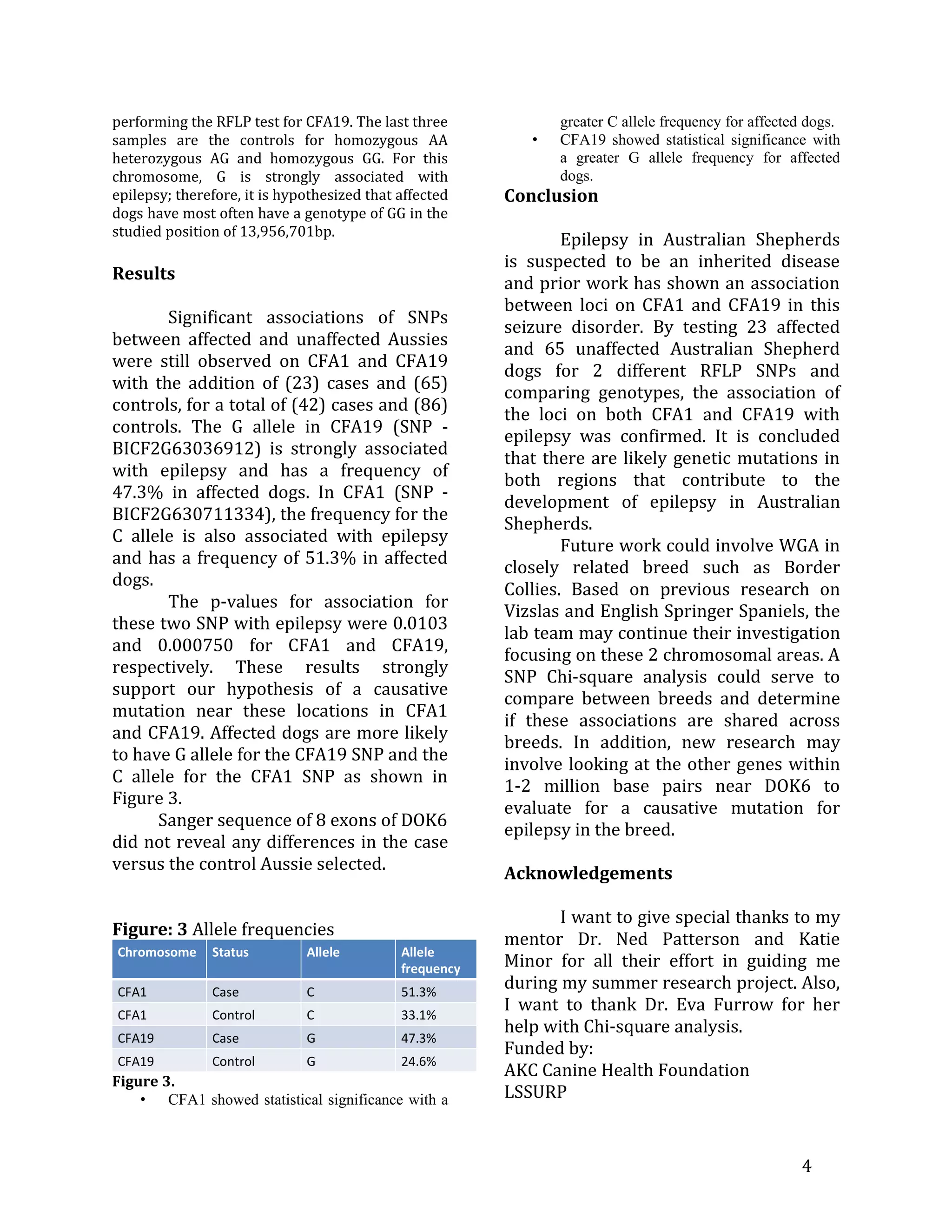
performing the RFLP test for CFA19. The last three             greater C allele frequency for affected dogs.
samples are the controls for homozygous AA                 •   CFA19 showed statistical significance with
heterozygous AG and homozygous GG. For this                    a greater G allele frequency for affected
chromosome, G is strongly associated with                      dogs.
epilepsy; therefore, it is hypothesized that affected   Conclusion
dogs have most often have a genotype of GG in the
studied position of 13,956,701bp.
                                                                Epilepsy in Australian Shepherds
                                                        is suspected to be an inherited disease
Results
                                                        and prior work has shown an association
                                                        between loci on CFA1 and CFA19 in this
       Significant associations of SNPs
                                                        seizure disorder. By testing 23 affected
between affected and unaffected Aussies
                                                        and 65 unaffected Australian Shepherd
were still observed on CFA1 and CFA19
                                                        dogs for 2 different RFLP SNPs and
with the addition of (23) cases and (65)
                                                        comparing genotypes, the association of
controls, for a total of (42) cases and (86)
                                                        the loci on both CFA1 and CFA19 with
controls. The G allele in CFA19 (SNP -
                                                        epilepsy was confirmed. It is concluded
BICF2G63036912) is strongly associated
                                                        that there are likely genetic mutations in
with epilepsy and has a frequency of
                                                        both regions that contribute to the
47.3% in affected dogs. In CFA1 (SNP -
                                                        development of epilepsy in Australian
BICF2G630711334), the frequency for the
                                                        Shepherds.
C allele is also associated with epilepsy
                                                                Future work could involve WGA in
and has a frequency of 51.3% in affected
                                                        closely related breed such as Border
dogs.
                                                        Collies. Based on previous research on
       The p-values for association for
                                                        Vizslas and English Springer Spaniels, the
these two SNP with epilepsy were 0.0103
                                                        lab team may continue their investigation
and 0.000750 for CFA1 and CFA19,
                                                        focusing on these 2 chromosomal areas. A
respectively. These results strongly
                                                        SNP Chi-square analysis could serve to
support our hypothesis of a causative
                                                        compare between breeds and determine
mutation near these locations in CFA1
                                                        if these associations are shared across
and CFA19. Affected dogs are more likely
                                                        breeds. In addition, new research may
to have G allele for the CFA19 SNP and the
                                                        involve looking at the other genes within
C allele for the CFA1 SNP as shown in
                                                        1-2 million base pairs near DOK6 to
Figure 3.
                                                        evaluate for a causative mutation for
      Sanger sequence of 8 exons of DOK6
                                                        epilepsy in the breed.
did not reveal any differences in the case
versus the control Aussie selected.
                                                        Acknowledgements

                                                               I want to give special thanks to my
Figure: 3 Allele frequencies
                                                        mentor Dr. Ned Patterson and Katie
                                                        Minor for all their effort in guiding me
                                                        during my summer research project. Also,
                                                        I want to thank Dr. Eva Furrow for her
                                                        help with Chi-square analysis.
                                                        Funded by:
                                                        AKC Canine Health Foundation
Figure 3.
    • CFA1 showed statistical significance with a       LSSURP


                                                                                                     4
RISE program R25GM059429-12
References

1. Ekenstedt k, Patterson E, Minor K et al.
2011. Candidate genes for idiopathic
epilepsy in four dog breeds BMC Genetics
[Internet].         Available         from:
http://www.biomedcentral.com/1471-21
56/12/38
2. Patterson E, Mickelson J, Da Y et al.
2003. Clinical Characteristics and
Inheritance of Idiopathic Epilepsy in
Vizlas. Journal of Internal Veterinary
Medicine Volume 17, Issue 3, pages
319-325, May 2003. [Internet]. Available
from:
http://onlinelibrary.wiley.com/doi/10.11
11/j.1939-1676.2003.tb02455.x/abstract
3. Sutter N, Eberle M, Parker H et al.2004.
Extensive         and        breed-specific
linkage disequilibrium in Canis familiaris.
[Internet].         Available         from:
http://www.ncbi.nlm.nih.gov/pmc/articl
es/PMC534662/


                                              5

The epilepsy paper 3

  • 1.
    Epilepsy in AustralianShepherd Dogs Valeria Rivera1,2, Katie M. Minor B.A3; Eva Furrow V.M.D., Edward (Ned) Patterson D.V.M., Ph.D.3 1.University of Minnesota, Life Sciences Summer Undergraduate Research Program: Heart, Lung, & Blood 2.University of Puerto Rico at Cayey 3. Department of Veterinary Clinical Sciences, University of Minnesota College of Veterinary Medicine, St. Paul, MN. Abstract Idiopathic epilepsy implies having recurrent seizures in which no anomaly is known. It is a common disorder that affects about 4% of dogs and 1% of people. Previous Whole Genome Analysis showed statistical association of single nucleotide polymorphism (SNP) with Epilepsy in a study of 40 Australian shepherd dogs (Aussies) on loci of CFA1 and CFA19. This research further evaluated SNPs between epileptic and non-epileptic Aussies. The major objectives of this portion of the study were to confirm the statistical associations observed on CFA1 and CFA19 in additional case and control Aussies via PCR-RFLP tests and to sequence one candidate gene, DOK6. Two PCR-RFLP SNP tests were performed on 88 additional Aussies to compare their genotype frequencies by Chi-square statistical analysis. Sequencing of DOK6 was performed on one case and one control Aussie. By studying the SNPs in Aussies, we confirmed different genotype frequencies between normal and affected dogs on canine chromosomes 1 and 19 indicating possible causative genes in each location. Sequencing of DOK6 did not show any polymorphisms in the exons (coding regions). Key words: Epilepsy, canines, genetic basis, SNPs, and Australian Shepherds. condition. Some studies suggest that ion Introduction channel genes cause epilepsy for many of the human forms. The known human Epilepsy is a brain disorder of mutations have not shown to be the cause abnormal electrical signals that cause in four dog breeds (Ekenstedt et al. 2011). seizures. It varies in severity and is Breeds such as Bernese Mountain dogs, common in children and adults. Vizslas, Labrador Retrievers, and Idiopathic Epilepsy (IE) involves Australian Shepherds have a high recurrent seizures in which no underlying incidence of epilepsy. For this study, abnormality can be identified (Patterson Australian Shepherds were chosen et al. 2003). Each year 200,000 new because of their high frequency of human cases are diagnosed, being the epilepsy that appears to be inherited second most common neurological based on pedigree analysis. As 1
  • 2.
    generations pass, thereare some genes in G is strongly associated with epilepsy. close physical proximity on the same Chromosome 1 has one of the associated chromosome that do not recombine and SNPs between C and T, with C being are in what is called linkage strongly associated with epilepsy. The disequilibrium (LD). In regions of LD SNP BICF2G63036912 on CFA19 is there is a haplotype that is shared located at 13,956,701 bp of the between closely related breeds and chromosome and the SNP common ancestors. Long LD allows many BICF2G630711334 on CFA1 is located at fewer genetic markers and cases to be 12,632,317 bps. On the canine SNP array, used for genome wide association studies there is on average one SNP every in dogs compared to people (Sutter et al. 14,000bp in the total of 2.4 billion bps of 2004). Breeds that have passed through the canine genome. population bottlenecks are prone to carry DOK6 is a gene located in more recessive traits since inbreeding is chromosome 1 that is very near some of frequently employed. As a result, the associated SNP markers. It has 8 inbreeding may be responsible for coding exons. Our objective was to common diseases in these breeds. perform Chi-square analysis for 88 Diseases include cancer, epilepsy, additional Australian Shepherds for two deafness, and heart diseases. of the associated SNPs to determine if the Whole genome association (WGA) original association was real or only by is a technique that examines the genome chance. A second objective was to of different individuals searching for determine if there are any coding differences among them. DNA samples mutations in DOK6 for epilepsy in are placed on a crystal chip that Australian Shepherds. The overall genotypes 170,000 canine SNPs. A SNP is hypothesis of this work is that there is a single nucleotide polymorphism, a one or more epilepsy causing mutations difference in base pairs when a single in these specific regions of canine nucleotide is altered at a specific location. chromosomes 1 and/or 19. The lab team performed previous work (WGA) for 40 Australian Shepherds in Figure 1: Aussies Chi-square test which they established that there is a possibility of one or two genes that cause epilepsy in this breed. These genes are likely to be at specific locations on canine chromosomes 1 (CFA1) and/or CFA19, based on Chi- square analysis of the data and the resulting p-values. To obtain this data, they tested 19 affected dogs and 21 unaffected. CFA1 and CFA19 showed a number of SNPs close together that stand out (Figure 1) when graphed on a Figure 1. Results of a WGA study with 19 dogs negative logarithmic scale of their Chi- affected by epilepsy and 21 unaffected. Shows SNPs square p-value (-log p-value). In that stand out when graphed on a negative chromosome 19, one of the associated logarithmic scale of their Chi-square p-value (-log p- SNPs is between nucleotides G and A, and value) on the y-axis and the canine chromosomes in 2
  • 3.
    order on thex-axis. These are in CFA1 (pink) and in when the sequence T G A T C is present. CFA19 (green). CFA19 has one that is statistically Where as BsmI (CFA19) recognizes significant being over 1.3, equivalent to a p-value less than 0.05. nucleotide G and will cut there every time the sequence G C A T C is present. For Materials and Methods CFA1 RFLP, 8 units (2µL) of sau3AI were used along with NEB 1(2µL), BSA (0.2µL), Dog DNA samples were collected and water (10.8µL). The 8 unit master along with their medical information. mix (15µL) was pipetted into PCR Affected dogs must have had their first product to digest overnight at 37°C hold. seizure before 6 years, whereas normal For CFA19, 5 units of the enzyme BmsI dogs were at least 8 years without a (0.5µL) were used leaving it digest for 3 history of seizures. In order for them to hours. The resulting banding patterns be included in this study, they must have were visualized on a 2% agarose gel as fulfilled these requirements: 1. Two or follows: 385bp for homozygous TT or AA; more seizures 2. Normal in between of 385, 216 and 169 bp for heterozygous CT seizures 3. Normal blood panels (no or AG, and 216bp and 169bp for abnormalities). homozygous CC or GG for CFA1 and Based on the WGA results, one dog CFA19 respectively. The RFLP results of each genotype was selected to serve as determined the genotype of the additional a control for the enzyme digest. For CFA 88 dogs’ samples leading the way for the 19, the genotypes were homozygous AA, statistical Chi-square analysis to verify heterozygous AG, and homozygous GG. the association found by the prior WGA For CFA1, the genotypes were study. homozygous TT, heterozygous CT, and Additionally, DOK6 sequencing homozygous CC. These 6 control samples was completed in one affected and one served as references when determining unaffected dog. As described above, PCR the genotypes of an additional 88 dogs via was done with primers that encompassed RFLP. SNPs were chosen based on p-value all 8 exons. Sanger sequencing was then and availability of RFLP. performed, and the results were Fifteen ng of purified DNA, specific compared between the two dogs and 20 µM forward and reverse primers against the published dog sequence. (1.5uL), 300 µM dNTPs (1.5µL), 10x buffer (1.5µL) in water (5.6µL), and TAQ Figure 2: RFLP for CFA19 polymerase (0. 5 µL) were used for PCR to amplify the region containing each SNP. Cycling conditions were: 95°C for 15 min, 35 cycles of 95°C for 30 s, 60°C for 30 s, and 72°C for 30 s; and 72°C for 15 min. The PCR bands of 385 bp for both CFA1 and CFA19 were visualized on a 2% agarose gel. Enzymes Sau3AI (8u) and BsmI (5u) were used for each of the 2 chromosomes of interests. Sau3AI (CFA1) recognizes nucleotide C and cuts there Figure 2 Shows the 3 different band sizes after 3
  • 4.
    performing the RFLPtest for CFA19. The last three greater C allele frequency for affected dogs. samples are the controls for homozygous AA • CFA19 showed statistical significance with heterozygous AG and homozygous GG. For this a greater G allele frequency for affected chromosome, G is strongly associated with dogs. epilepsy; therefore, it is hypothesized that affected Conclusion dogs have most often have a genotype of GG in the studied position of 13,956,701bp. Epilepsy in Australian Shepherds is suspected to be an inherited disease Results and prior work has shown an association between loci on CFA1 and CFA19 in this Significant associations of SNPs seizure disorder. By testing 23 affected between affected and unaffected Aussies and 65 unaffected Australian Shepherd were still observed on CFA1 and CFA19 dogs for 2 different RFLP SNPs and with the addition of (23) cases and (65) comparing genotypes, the association of controls, for a total of (42) cases and (86) the loci on both CFA1 and CFA19 with controls. The G allele in CFA19 (SNP - epilepsy was confirmed. It is concluded BICF2G63036912) is strongly associated that there are likely genetic mutations in with epilepsy and has a frequency of both regions that contribute to the 47.3% in affected dogs. In CFA1 (SNP - development of epilepsy in Australian BICF2G630711334), the frequency for the Shepherds. C allele is also associated with epilepsy Future work could involve WGA in and has a frequency of 51.3% in affected closely related breed such as Border dogs. Collies. Based on previous research on The p-values for association for Vizslas and English Springer Spaniels, the these two SNP with epilepsy were 0.0103 lab team may continue their investigation and 0.000750 for CFA1 and CFA19, focusing on these 2 chromosomal areas. A respectively. These results strongly SNP Chi-square analysis could serve to support our hypothesis of a causative compare between breeds and determine mutation near these locations in CFA1 if these associations are shared across and CFA19. Affected dogs are more likely breeds. In addition, new research may to have G allele for the CFA19 SNP and the involve looking at the other genes within C allele for the CFA1 SNP as shown in 1-2 million base pairs near DOK6 to Figure 3. evaluate for a causative mutation for Sanger sequence of 8 exons of DOK6 epilepsy in the breed. did not reveal any differences in the case versus the control Aussie selected. Acknowledgements I want to give special thanks to my Figure: 3 Allele frequencies mentor Dr. Ned Patterson and Katie Minor for all their effort in guiding me during my summer research project. Also, I want to thank Dr. Eva Furrow for her help with Chi-square analysis. Funded by: AKC Canine Health Foundation Figure 3. • CFA1 showed statistical significance with a LSSURP 4
  • 5.
    RISE program R25GM059429-12 References 1.Ekenstedt k, Patterson E, Minor K et al. 2011. Candidate genes for idiopathic epilepsy in four dog breeds BMC Genetics [Internet]. Available from: http://www.biomedcentral.com/1471-21 56/12/38 2. Patterson E, Mickelson J, Da Y et al. 2003. Clinical Characteristics and Inheritance of Idiopathic Epilepsy in Vizlas. Journal of Internal Veterinary Medicine Volume 17, Issue 3, pages 319-325, May 2003. [Internet]. Available from: http://onlinelibrary.wiley.com/doi/10.11 11/j.1939-1676.2003.tb02455.x/abstract 3. Sutter N, Eberle M, Parker H et al.2004. Extensive and breed-specific linkage disequilibrium in Canis familiaris. [Internet]. Available from: http://www.ncbi.nlm.nih.gov/pmc/articl es/PMC534662/ 5