


global web
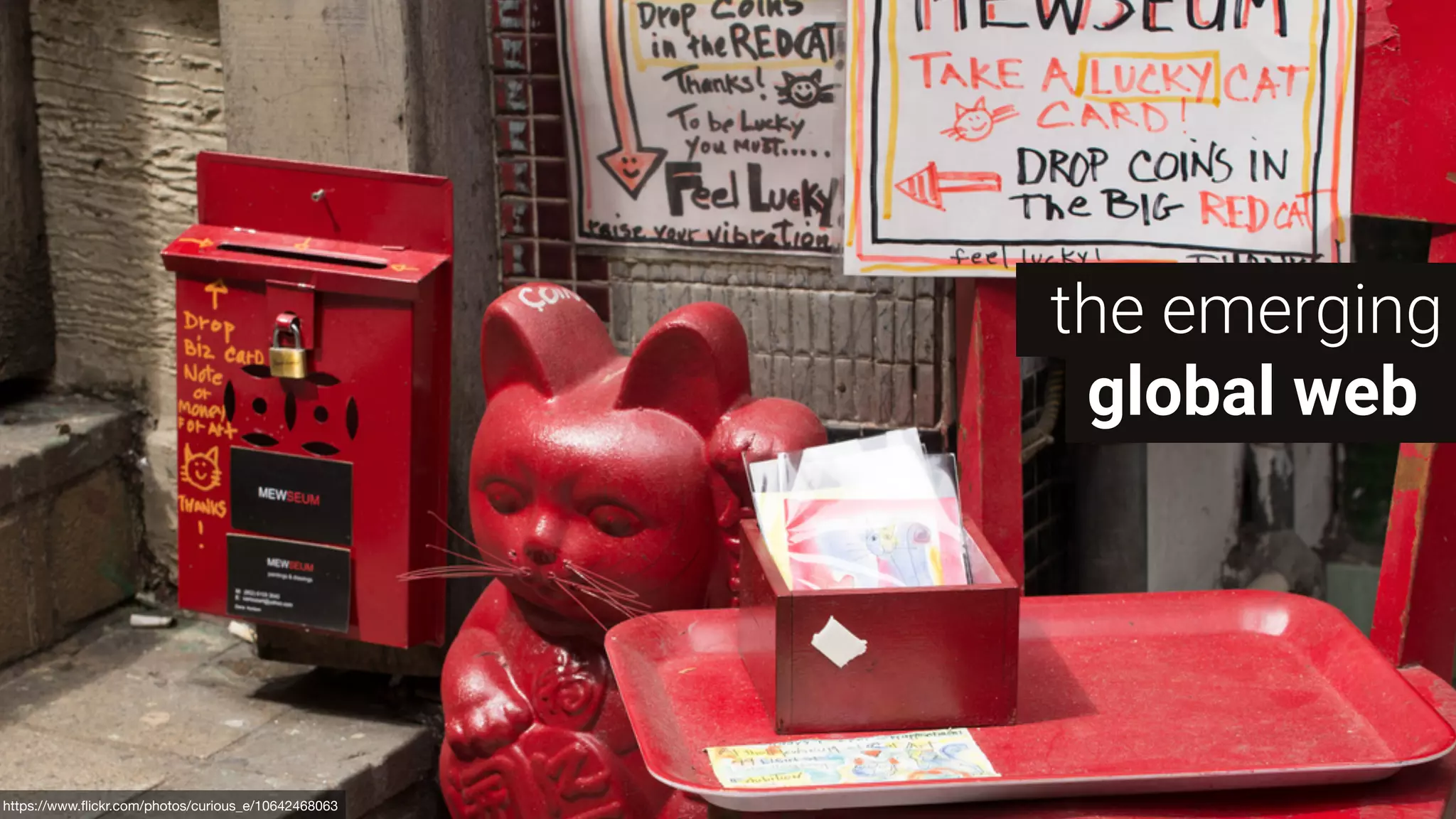
the emerging
https://www.flickr.com/photos/curious_e/10642468063
http://www.flickr.com/photos/ducdigital/2892313560
“To understand China’s Internet sector, start by thinking
of the services you know and love in the U.S. Then
change all their names, combine four of them into one,
drop any fees and reduce the number of ads.”

— Jessica E. Lessin, The Information
it’s easy to explain
these differences away
as purely cultural
https://www.flickr.com/photos/maureendidde/12691105824/
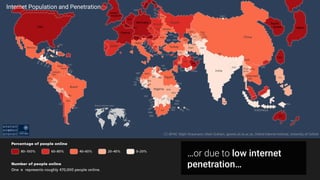
Internet Population and Penetration
…or due to low internet
penetration…
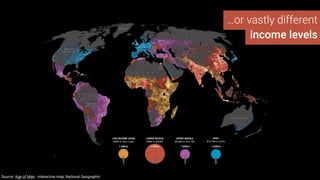
Source: Age of Man - interactive map, National Geographic
…or vastly different
income levels
But these factors (even combined) merely tell part of
the story—especially when it comes to commerce—

and that’s what we’re going to discuss today
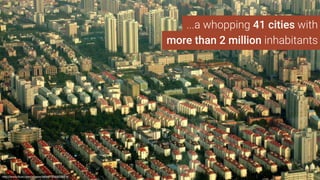
China has 14 cities with populations
over five million...
https://www.flickr.com/photos/decar66/6341327886
...a whopping 41 cities with
more than 2 million inhabitants
http://www.flickr.com/photos/tahini/10468208216
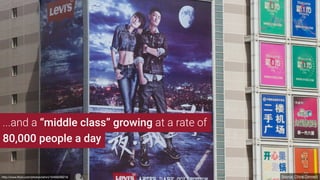
...and a “middle class” growing at a rate of
80,000 people a day
http://www.flickr.com/photos/tahini/10468208216 Source: China Connect
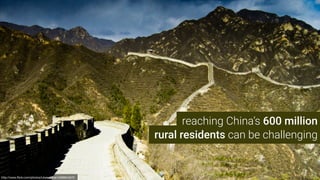
rural residents can be challenging
http://www.flickr.com/photos/lukewebber/4588854679
reaching China’s 600 million
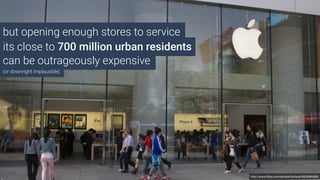
its close to 700 million urban residents
but opening enough stores to service
can be outrageously expensive
http://www.flickr.com/photos/tuchodi/5620884999
(or downright implausible)
http://www.flickr.com/photos/milo_riano/4336541309
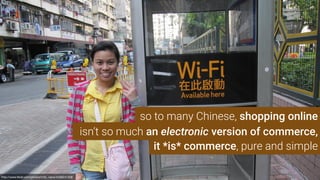
isn’t so much an electronic version of commerce,
it *is* commerce, pure and simple
so to many Chinese, shopping online
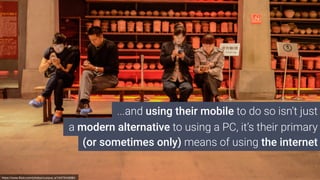
https://www.flickr.com/photos/curious_e/10473440064
...and using their mobile to do so isn’t just
a modern alternative to using a PC, it’s their primary
(or sometimes only) means of using the internet
Chinese e-commerce is also different in one more
very important way...
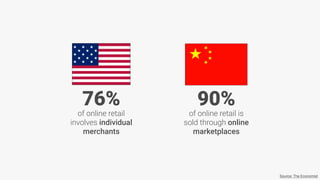
76%
of online retail
involves individual
merchants
of online retail is
sold through online
marketplaces
90%
Source: The Economist
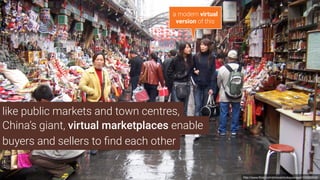
China’s giant, virtual marketplaces enable
buyers and sellers to find each other
a modern virtual
version of this
http://www.flickr.com/photos/mckaysavage/135932500/
like public markets and town centres,
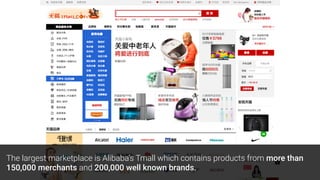
The largest marketplace is Alibaba’s Tmall which contains products from more than
150,000 merchants and 200,000 well known brands.
Tmall charges an entry fee, and a commission for each sale, but in return provides a
high visibility, high traffic, customizable, social-media and mobile optimized e-
commerce platform.
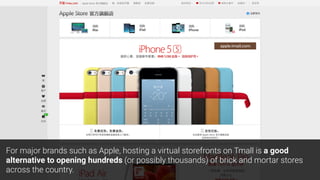
apple.tmall.com
For major brands such as Apple, hosting a virtual storefronts on Tmall is a good
alternative to opening hundreds (or possibly thousands) of brick and mortar stores
across the country.
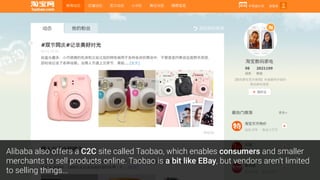
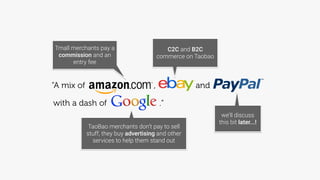
Alibaba also offers a C2C site called Taobao, which enables consumers and smaller
merchants to sell products online. Taobao is a bit like EBay, but vendors aren’t limited
to selling things...
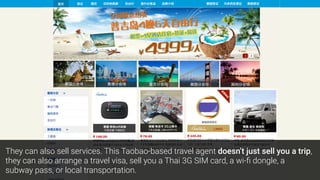
They can also sell services. This Taobao-based travel agent doesn’t just sell you a trip,
they can also arrange a travel visa, sell you a Thai 3G SIM card, a wi-fi dongle, a
subway pass, or local transportation.
C2C and B2C
commerce on Taobao
Tmall merchants pay a
commission and an
entry fee
we’ll discuss
this bit later...!
TaoBao merchants don’t pay to sell
stuff, they buy advertising and other
services to help them stand out
and“A mix of ,
with a dash of .”
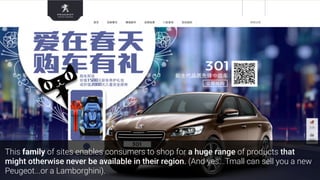
This family of sites enables consumers to shop for a huge range of products that
might otherwise never be available in their region. (And yes...Tmall can sell you a new
Peugeot...or a Lamborghini).
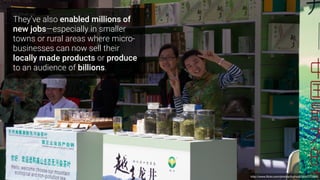
They’ve also enabled millions of
new jobs—especially in smaller
towns or rural areas where micro-
businesses can now sell their
locally made products or produce
to an audience of billions.
http://www.flickr.com/photos/tuchodi/5642172895
The Chinese marketplace model has already slipped
beyond its borders...
“...most of the people have phones but [in Lagos]
there are only 3 malls per 21 million inhabitants...
It’s a unique time...the right time to leapfrog over ‘offline’.”
- jumia.com co-founder
THE BIGGEST ONLINE SHOPPING MALL IN AFRICA
Egypt | Kenya | Uganda| Ivory Coast| Nigeria | Morocco
*that’s 60K people per retail outlet compared to 7K in APAC and 389 in the U.S.
https://www.flickr.com/photos/davidrosenphotography/15137403228/
we literally have some customers who have ordered
multiple times and never spoken to us…
- How WhatsApp helped Jumia disrupt Africa
“…our [agents] chat all day long
never placed an order online”
on messaging and social media with our customers…
https://www.flickr.com/photos/decar66/5150814952
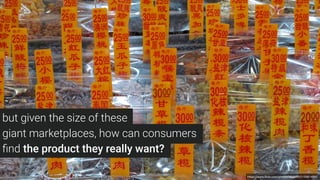
but given the size of these
giant marketplaces, how can consumers
find the product they really want?
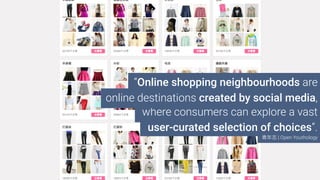
where consumers can explore a vast
user-curated selection of choices”.
| Open Youthology
“Online shopping neighbourhoods are
online destinations created by social media,
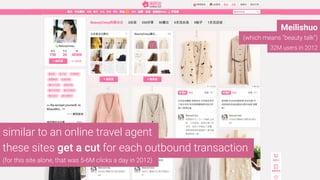
Meilishuo
(which means “beauty talk”)
32M users in 2012
similar to an online travel agent
these sites get a cut for each outbound transaction
(for this site alone, that was 5-6M clicks a day in 2012)
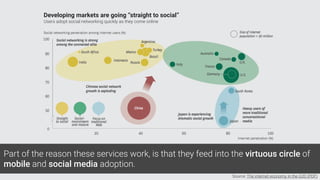
Part of the reason these services work, is that they feed into the virtuous circle of
mobile and social media adoption.
Source: The internet economy in the G20 (PDF)
Developing markets are going “straight to social”
Users adopt social networking quickly as they come online
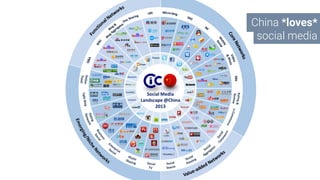
China *loves*
social media
...but the most popular social media services in China
aren’t just “sites”—they’re platforms.
one of the most popular
(lately) is WeChat
or Wēixìn - - in China
five years old
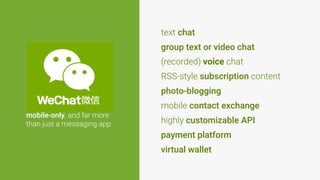
mobile-only
700+ million MAU
mobile-only, and far more
than just a messaging app
(recorded) voice chat
RSS-style subscription content
mobile contact exchange
highly customizable API
payment platform
text chat
group text or video chat
photo-blogging
virtual wallet
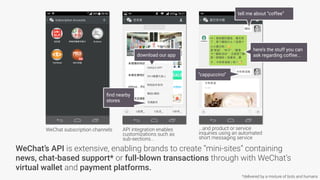
WeChat’s API is extensive, enabling brands to create “mini-sites” containing
news, chat-based support* or full-blown transactions through with WeChat’s
virtual wallet and payment platforms.
WeChat subscription channels API integration enables
customizations such as
sub-sections...
download our app
find nearby
stores
...and product or service
inquiries using an automated
short messaging service
here’s the stuff you can
ask regarding coffee...
“cappuccino”
tell me about “coffee”
*delivered by a mixture of bots and humans
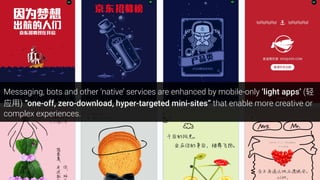
Messaging, bots and other ‘native’ services are enhanced by mobile-only ‘light apps’ (
) “one-off, zero-download, hyper-targeted mini-sites” that enable more creative or
complex experiences.
“Philosophically, while Facebook and WhatsApp measure growth by
the number of daily and monthly active users…WeChat cares more
about how relevant it is in addressing the daily, even hourly needs of
its users…[its] goal is to address every aspect of its users’ lives,
including non-social ones.”
— Connie Chang, a16z
http://www.flickr.com/photos/ducdigital/2892313560
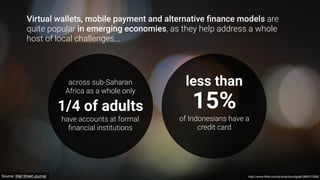
Virtual wallets, mobile payment and alternative finance models are
quite popular in emerging economies, as they help address a whole
host of local challenges...
1/4 of adults
across sub-Saharan
Africa as a whole only
have accounts at formal
financial institutions
less than
of Indonesians have a
credit card
15%
Source: Wall Street Journal
http://www.flickr.com/photos/kiwanja/3169409467/
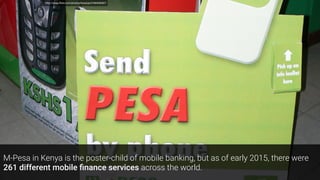
M-Pesa in Kenya is the poster-child of mobile banking, but as of early 2015, there were
261 different mobile finance services across the world.
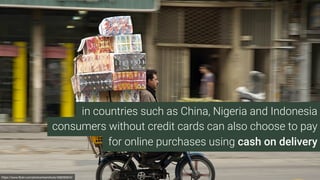
consumers without credit cards can also choose to pay
https://www.flickr.com/photos/kamshots/468265643/
in countries such as China, Nigeria and Indonesia
for online purchases using cash on delivery
https://www.flickr.com/photos/wippetywu/14295584182/
or M-Pesa on delivery, or [mobile] airtime
on delivery, or whatever it is…"
- interview with Parinaz Firozi, Jumia MD, Kenya
if it will be delivered…we allow cash on delivery,
“…if you’re not sure if this is a scam,
In most cases, mobile is the glue that ties these
platforms, services and communities together...
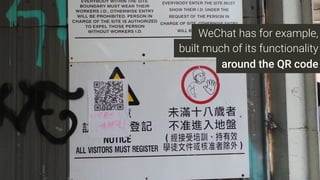
WeChat has for example,
built much of its functionality
around the QR code
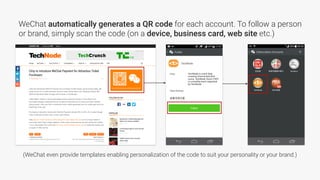
WeChat automatically generates a QR code for each account. To follow a person
or brand, simply scan the code (on a device, business card, web site etc.)
(WeChat even provide templates enabling personalization of the code to suit your personality or your brand.)
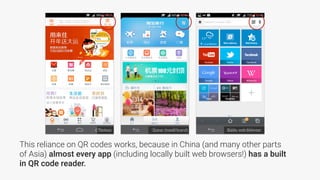
This reliance on QR codes works, because in China (and many other parts
of Asia) almost every app (including locally built web browsers!) has a built
in QR code reader.
Qunar (travel brand) Baidu web browserTaobao
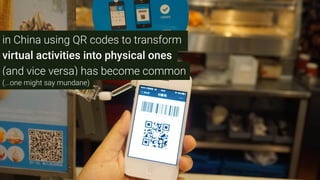
in China using QR codes to transform
virtual activities into physical ones
(and vice versa) has become common
(...one might say mundane)
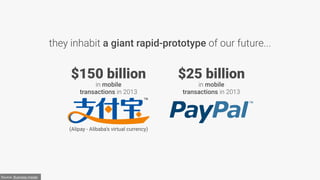
These brands and consumers aren’t merely
“leapfrogging” desktop, or finance, or physical retail...
in mobile
transactions in 2013
$25 billion
in mobile
transactions in 2013
$150 billion
(Alipay - Alibaba’s virtual currency)
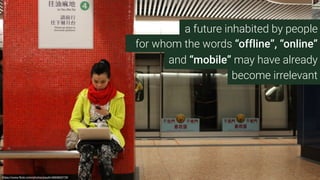
they inhabit a giant rapid-prototype of our future...
Source: Business Insider
a future inhabited by people
https://www.flickr.com/photos/paulk/4693602730
for whom the words “offline”, “online”
and “mobile” may have already
become irrelevant
It also enables brands operating in these markets to
try things that might otherwise sound a little crazy...
In Russia, e-commerce
brand Lamoda turned poor
postal infrastructure and
payment on delivery into an
excuse to try something that
seems completely un-
scaleable...
“...Lamoda sends sales assistants directly to
homes...uniformed delivery men bring the clothes,
wait for [customers] to try them on, offers fashion advice,
take returns and process payments on the spot”
- Russia: Where the Deliveryman Gives Fashion Advice
https://www.flickr.com/photos/41738141@N06/6814977720/
https://www.flickr.com/photos/rodriguez5000/12149403593
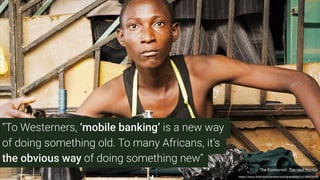
The Economist: The next frontier
“To Westerners, ‘mobile banking’ is a new way
of doing something old. To many Africans, it’s
the obvious way of doing something new”
http://www.flickr.com/photos/tinou/453593446
thank you
many thanks to the
amazing photographers on
http://creativecommons.org/licenses/by/2.0
@yiibu
hello@yiibu.com
contact us
at
Presentation deck available @

http://www.slideshare.net/yiibu

The emerging global web

  • 1.
  • 2.
    http://www.flickr.com/photos/ducdigital/2892313560 “To understand China’sInternet sector, start by thinking of the services you know and love in the U.S. Then change all their names, combine four of them into one, drop any fees and reduce the number of ads.”
 — Jessica E. Lessin, The Information
  • 3.
    it’s easy toexplain these differences away as purely cultural https://www.flickr.com/photos/maureendidde/12691105824/
  • 4.
    Internet Population andPenetration …or due to low internet penetration…
  • 5.
    Source: Age ofMan - interactive map, National Geographic …or vastly different income levels
  • 6.
    But these factors(even combined) merely tell part of the story—especially when it comes to commerce—
 and that’s what we’re going to discuss today
  • 7.
    China has 14cities with populations over five million... https://www.flickr.com/photos/decar66/6341327886
  • 8.
    ...a whopping 41cities with more than 2 million inhabitants http://www.flickr.com/photos/tahini/10468208216
  • 9.
    ...and a “middleclass” growing at a rate of 80,000 people a day http://www.flickr.com/photos/tahini/10468208216 Source: China Connect
  • 10.
    rural residents canbe challenging http://www.flickr.com/photos/lukewebber/4588854679 reaching China’s 600 million
  • 11.
    its close to700 million urban residents but opening enough stores to service can be outrageously expensive http://www.flickr.com/photos/tuchodi/5620884999 (or downright implausible)
  • 12.
    http://www.flickr.com/photos/milo_riano/4336541309 isn’t so muchan electronic version of commerce, it *is* commerce, pure and simple so to many Chinese, shopping online
  • 13.
    https://www.flickr.com/photos/curious_e/10473440064 ...and using theirmobile to do so isn’t just a modern alternative to using a PC, it’s their primary (or sometimes only) means of using the internet
  • 14.
    Chinese e-commerce isalso different in one more very important way...
  • 15.
    76% of online retail involvesindividual merchants of online retail is sold through online marketplaces 90% Source: The Economist
  • 16.
    China’s giant, virtualmarketplaces enable buyers and sellers to find each other a modern virtual version of this http://www.flickr.com/photos/mckaysavage/135932500/ like public markets and town centres,
  • 17.
    The largest marketplaceis Alibaba’s Tmall which contains products from more than 150,000 merchants and 200,000 well known brands.
  • 18.
    Tmall charges anentry fee, and a commission for each sale, but in return provides a high visibility, high traffic, customizable, social-media and mobile optimized e- commerce platform.
  • 19.
    apple.tmall.com For major brandssuch as Apple, hosting a virtual storefronts on Tmall is a good alternative to opening hundreds (or possibly thousands) of brick and mortar stores across the country.
  • 20.
    Alibaba also offersa C2C site called Taobao, which enables consumers and smaller merchants to sell products online. Taobao is a bit like EBay, but vendors aren’t limited to selling things...
  • 21.
    They can alsosell services. This Taobao-based travel agent doesn’t just sell you a trip, they can also arrange a travel visa, sell you a Thai 3G SIM card, a wi-fi dongle, a subway pass, or local transportation.
  • 22.
    C2C and B2C commerceon Taobao Tmall merchants pay a commission and an entry fee we’ll discuss this bit later...! TaoBao merchants don’t pay to sell stuff, they buy advertising and other services to help them stand out and“A mix of , with a dash of .”
  • 23.
    This family ofsites enables consumers to shop for a huge range of products that might otherwise never be available in their region. (And yes...Tmall can sell you a new Peugeot...or a Lamborghini).
  • 24.
    They’ve also enabledmillions of new jobs—especially in smaller towns or rural areas where micro- businesses can now sell their locally made products or produce to an audience of billions. http://www.flickr.com/photos/tuchodi/5642172895
  • 25.
    The Chinese marketplacemodel has already slipped beyond its borders...
  • 26.
    “...most of thepeople have phones but [in Lagos] there are only 3 malls per 21 million inhabitants... It’s a unique time...the right time to leapfrog over ‘offline’.” - jumia.com co-founder THE BIGGEST ONLINE SHOPPING MALL IN AFRICA Egypt | Kenya | Uganda| Ivory Coast| Nigeria | Morocco *that’s 60K people per retail outlet compared to 7K in APAC and 389 in the U.S.
  • 27.
    https://www.flickr.com/photos/davidrosenphotography/15137403228/ we literally havesome customers who have ordered multiple times and never spoken to us… - How WhatsApp helped Jumia disrupt Africa “…our [agents] chat all day long never placed an order online” on messaging and social media with our customers…
  • 28.
    https://www.flickr.com/photos/decar66/5150814952 but given thesize of these giant marketplaces, how can consumers find the product they really want?
  • 29.
    where consumers canexplore a vast user-curated selection of choices”. | Open Youthology “Online shopping neighbourhoods are online destinations created by social media,
  • 30.
    Meilishuo (which means “beautytalk”) 32M users in 2012 similar to an online travel agent these sites get a cut for each outbound transaction (for this site alone, that was 5-6M clicks a day in 2012)
  • 31.
    Part of thereason these services work, is that they feed into the virtuous circle of mobile and social media adoption. Source: The internet economy in the G20 (PDF) Developing markets are going “straight to social” Users adopt social networking quickly as they come online
  • 32.
  • 33.
    ...but the mostpopular social media services in China aren’t just “sites”—they’re platforms.
  • 34.
    one of themost popular (lately) is WeChat or Wēixìn - - in China five years old mobile-only 700+ million MAU
  • 35.
    mobile-only, and farmore than just a messaging app (recorded) voice chat RSS-style subscription content mobile contact exchange highly customizable API payment platform text chat group text or video chat photo-blogging virtual wallet
  • 36.
    WeChat’s API isextensive, enabling brands to create “mini-sites” containing news, chat-based support* or full-blown transactions through with WeChat’s virtual wallet and payment platforms. WeChat subscription channels API integration enables customizations such as sub-sections... download our app find nearby stores ...and product or service inquiries using an automated short messaging service here’s the stuff you can ask regarding coffee... “cappuccino” tell me about “coffee” *delivered by a mixture of bots and humans
  • 37.
    Messaging, bots andother ‘native’ services are enhanced by mobile-only ‘light apps’ ( ) “one-off, zero-download, hyper-targeted mini-sites” that enable more creative or complex experiences.
  • 38.
    “Philosophically, while Facebookand WhatsApp measure growth by the number of daily and monthly active users…WeChat cares more about how relevant it is in addressing the daily, even hourly needs of its users…[its] goal is to address every aspect of its users’ lives, including non-social ones.” — Connie Chang, a16z
  • 39.
    http://www.flickr.com/photos/ducdigital/2892313560 Virtual wallets, mobilepayment and alternative finance models are quite popular in emerging economies, as they help address a whole host of local challenges... 1/4 of adults across sub-Saharan Africa as a whole only have accounts at formal financial institutions less than of Indonesians have a credit card 15% Source: Wall Street Journal
  • 40.
    http://www.flickr.com/photos/kiwanja/3169409467/ M-Pesa in Kenyais the poster-child of mobile banking, but as of early 2015, there were 261 different mobile finance services across the world.
  • 41.
    consumers without creditcards can also choose to pay https://www.flickr.com/photos/kamshots/468265643/ in countries such as China, Nigeria and Indonesia for online purchases using cash on delivery
  • 42.
    https://www.flickr.com/photos/wippetywu/14295584182/ or M-Pesa ondelivery, or [mobile] airtime on delivery, or whatever it is…" - interview with Parinaz Firozi, Jumia MD, Kenya if it will be delivered…we allow cash on delivery, “…if you’re not sure if this is a scam,
  • 43.
    In most cases,mobile is the glue that ties these platforms, services and communities together...
  • 44.
    WeChat has forexample, built much of its functionality around the QR code
  • 45.
    WeChat automatically generatesa QR code for each account. To follow a person or brand, simply scan the code (on a device, business card, web site etc.) (WeChat even provide templates enabling personalization of the code to suit your personality or your brand.)
  • 46.
    This reliance onQR codes works, because in China (and many other parts of Asia) almost every app (including locally built web browsers!) has a built in QR code reader. Qunar (travel brand) Baidu web browserTaobao
  • 47.
    in China usingQR codes to transform virtual activities into physical ones (and vice versa) has become common (...one might say mundane)
  • 48.
    These brands andconsumers aren’t merely “leapfrogging” desktop, or finance, or physical retail...
  • 49.
    in mobile transactions in2013 $25 billion in mobile transactions in 2013 $150 billion (Alipay - Alibaba’s virtual currency) they inhabit a giant rapid-prototype of our future... Source: Business Insider
  • 50.
    a future inhabitedby people https://www.flickr.com/photos/paulk/4693602730 for whom the words “offline”, “online” and “mobile” may have already become irrelevant
  • 51.
    It also enablesbrands operating in these markets to try things that might otherwise sound a little crazy...
  • 52.
    In Russia, e-commerce brandLamoda turned poor postal infrastructure and payment on delivery into an excuse to try something that seems completely un- scaleable...
  • 53.
    “...Lamoda sends salesassistants directly to homes...uniformed delivery men bring the clothes, wait for [customers] to try them on, offers fashion advice, take returns and process payments on the spot” - Russia: Where the Deliveryman Gives Fashion Advice https://www.flickr.com/photos/41738141@N06/6814977720/
  • 54.
    https://www.flickr.com/photos/rodriguez5000/12149403593 The Economist: Thenext frontier “To Westerners, ‘mobile banking’ is a new way of doing something old. To many Africans, it’s the obvious way of doing something new”
  • 55.
    http://www.flickr.com/photos/tinou/453593446 thank you many thanksto the amazing photographers on http://creativecommons.org/licenses/by/2.0 @yiibu hello@yiibu.com contact us at Presentation deck available @
 http://www.slideshare.net/yiibu